


 |
市場調查報告書
商品編碼
2124733
美國垃圾袋:市場佔有率分析、行業趨勢和統計數據、成長預測(2026-2031)United States Trash Bags - Market Share Analysis, Industry Trends & Statistics, Growth Forecasts (2026 - 2031) |
||||||

※ 本網頁內容可能與最新版本有所差異。詳細情況請與我們聯繫。
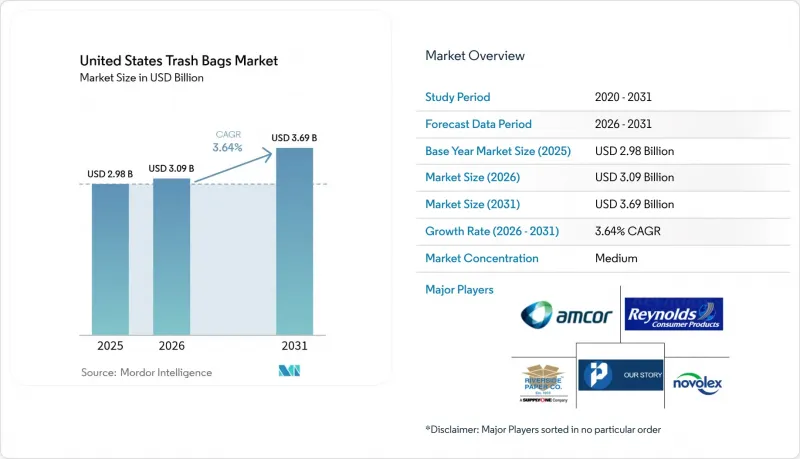
據 Mordor Intelligence 稱,美國垃圾袋市場預計到 2026 年價值 30.9 億美元,高於 2025 年的 29.8 億美元,預計到 2031 年將達到 36.9 億美元。
預計 2026 年至 2031 年的複合年成長率為 3.64%。
本報告按材料類型(HDPE、LDPE 等)、容量/包裝尺寸(3 加侖以下、3-13 加侖及其他)、最終用戶(住宅、公共機構等)和分銷管道(實體店、線上零售等)進行細分。市場預測以美元計價。
美國垃圾袋市場的趨勢與洞察
對可堆肥和Oxo分解袋的需求日益成長
地方政府強制推行有機垃圾分類收集,為符合ASTM D6400認證標準的垃圾袋創造了穩定的基本客群。例如,佛蒙特州的《通用回收法案》要求每週產生超過26加侖食物廢棄物的企業必須使用經認證的可堆肥垃圾袋。此外,預計2024年一項3,200萬美元的聯邦基礎設施津貼將使工業堆肥設施的數量在2027年從185個增加到275個。儘管政策支持力度很大,但聚乳酸(PLA)內襯袋仍然需要在140°F以上的工業堆肥溫度下進行處理,並且在運輸過程中容易受潮。實驗室研究表明,PLA內襯袋的分解時間差異很大,從最佳化條件下的90天到控制不佳環境下的180天不等。
加強衛生標準和廢棄物分類要求
美國疾病管制與預防中心(CDC)的感染控制指南指示醫護人員將一般廢棄物、受管制醫療廢棄物和藥品廢棄物分開處理,並鼓勵購買符合美國食品藥品監督管理局(FDA)21 CFR 178.3297 標準的彩色編碼抗菌垃圾袋。一家擁有500張床位的醫院,每張運作每天產生25至30磅的廢棄物,其中85%仍被歸類為「一般」城市固態廢棄物(MSW),但由於存在交叉感染的風險,不能與生活垃圾混合處理。聯合委員會已要求美國所有6,090家認證醫院記錄其廢棄物程序,這進一步增加了受監管醫療機構處理的廢棄物量。
一次性塑膠製品的相關規定
加州SB 54法案對生產商徵收分級費用並限制市場准入,導致合規成本相當於產品銷售額的8%至12%。此外,2024年35個州提出的127項塑膠監管法案表明,政策風險正在擴大。未能達到再生材料含量或減量目標的生產商可能面臨店面銷售禁令。
細分市場分析
低密度聚乙烯 (LDPE) 憑藉其低成本和完善的加工基礎設施,預計到 2025 年將佔據美國垃圾袋市場 39.85% 的佔有率。然而,在地方政府強制推行堆肥政策的推動下,生物基/生物分解性塑膠預計將以 4.52% 的複合年成長率成長,在所有材料中增速最高。在該領域,符合 ASTM D6400 標準的 PBAT-PLA 共混物可在 90 天內進行工業堆肥,並可在現有的充氣成型生產線上生產,從而減輕加工商的資本投資負擔。一項衍生專利,即美國專利號 11,456,789,詳細介紹了可達到與 LDPE 相當的撕裂強度的鏈延伸添加劑。 PCR 聚乙烯也是一個快速發展的新興細分市場,因為《生產者延伸責任法》(EPR) 規定,家庭垃圾收集袋中必須使用最低比例的 PCR(回收)聚乙烯。
監管指導配方選擇。 FDA 21 CFR 174.5 法規對與食品間接接觸的產品中的再生材料進行監管,而 ASTM D6400 認證是參與分類有機物收集競標的必要條件。能夠同時滿足再生塑膠含量和可堆肥性要求的製造商具有優勢,尤其是在加州、奧勒岡州和佛蒙特州,因為這些州的採購政策會根據合規性對每項指標給予加分。
容量超過30加侖的垃圾袋是成長最快的品類,複合年成長率達4.91%,主要得益於醫院、機場和教育機構校園內中央廢棄物站的設計。較大的垃圾袋可以延長垃圾收集間隔,並減少25%至40%的清潔工作。美國疾病管制與預防中心(CDC)的研究也證實了這種效果,即降低感染風險。生產這些大容量垃圾袋需要多層模頭和更嚴格的厚度控制系統,以防止側壁強度下降。目前,只有頂級加工商具備這些能力,這進一步提高了競爭障礙。
到2025年,13-30加侖的垃圾袋將占美國垃圾袋市場38.20%的佔有率,這主要得益於其在住宅廚房和商業衛生間的廣泛應用。 3加侖以下和3-13加侖的垃圾袋雖然屬於小眾市場,但對於食品加工區和生物醫學樣本的運輸至關重要。同時,2.0-3.0密耳厚的垃圾壓縮機內襯袋價格較高,但銷售量較小,略微拖累了標準厚度產品的整體銷售成長。
其他好處:
- Excel格式的市場預測(ME)表
- 3個月的分析師支持
目錄
第1章:引言
- 研究假設和市場定義
- 調查範圍
第2章:調查方法
第3章執行摘要
第4章 市場狀況
- 市場概覽
- 市場促進因素
- 對可堆肥和Oxo分解袋的需求日益成長
- 加強衛生和廢棄物分類的法規
- 網上生鮮購物的蓬勃發展導致家庭購物袋的使用量增加。
- 採用含有抗菌添加劑的包裝袋
- 各州的生產者責任延伸計畫鼓勵使用更厚、更容易回收的購物袋。
- 填充用袋設計的智慧分配器提供的訂閱服務
- 市場限制因素
- 一次性塑膠製品的相關規定
- 原生樹脂價格波動
- 堆肥基礎設施正在減少傳統塑膠袋的使用。
- 透過垃圾壓縮機減少垃圾袋的使用
- 產業價值鏈分析
- 監理情勢
- 技術展望
- 波特五力分析
- 宏觀經濟因素對市場的影響
第5章 市場規模與成長預測
- 材料類型
- 高密度聚苯乙烯(HDPE)
- 低密度聚乙烯(LDPE)
- 線型低密度聚乙烯(LLDPE)
- 生物基/生物分解性塑膠(PLA、PBAT、PHA)
- 其他材料類型
- 按容量/袋子尺寸
- 3加侖或更少
- 3-13加侖
- 13-30加侖
- 30加侖或更多
- 最終用戶
- 住宅
- 適用於機構(旅館餐飲業、醫療保健業、教育業)
- 商業和工業用途
- 透過分銷管道
- 實體零售店(超級市場、倉儲式會員店、便利商店)
- 線上零售
- B2B/機構銷售
第6章 競爭情勢
- 市場集中度
- 策略趨勢
- 市佔率分析
- 公司簡介
- Amcor plc
- Reynolds Consumer Products Inc.
- Novolex Holdings, LLC
- Inteplast Group Corporation
- Riverside Paper Co., Inc.
- Fast Bags Corp.
- International Plastics, Inc.
- Neway Packaging Corporation
- AR-BEE Transparent Products, Inc.
- Universal Plastic Bag Co.
- The Clorox Company(Glad)
- Poly-America, LP
- Advance Polybag, Inc.
- Crown Poly, Inc.
- Aluf Plastics, Inc.
- BioBag Americas, Inc.
- Heritage Bag Company
- Command Packaging LLC
- Green Genius LLC
- PAC Worldwide Corporation
第7章 市場機會與未來展望
According to Mordor Intelligence, United States trash bags market size in 2026 is estimated at USD 3.09 billion, growing from 2025 value of USD 2.98 billion with 2031 projections showing USD 3.69 billion, growing at 3.64% CAGR over 2026-2031.
This report is Segmented by Material Type (HDPE, LDPE, and More), Capacity/Bag Size (Up To 3 Gallons, 3-13 Gallons, and More), End-User (Residential, Institutional, and More), Distribution Channel (Offline Retail, Online Retail, and More). The Market Forecasts are Provided in Terms of Value (USD).
United States Trash Bags Market Trends and Insights
Growing demand for compostable and Oxo-biodegradable bags
Municipal organics diversion mandates create a verified customer base for ASTM D6400-certified liners. Vermont's Universal Recycling Law, for example, compels businesses that generate more than 26 gallons of food waste weekly to adopt certified compostable containment, while USD 32 million in federal infrastructure grants awarded in 2024 is expanding industrial composting capacity from 185 to a projected 275 facilities by 2027. Despite strong policy pull, polylactic acid (PLA) liners still require >= 140 °F industrial composting temperatures and experience moisture sensitivity during transport; laboratory studies show degradation windows ranging from 90 days in optimized facilities to 180 days in less-controlled environments.
Rising hygiene and waste-segregation mandates
CDC infection-control guidance instructs healthcare providers to differentiate general, regulated medical, and pharmaceutical waste streams, prompting purchases of color-coded or antimicrobial bags certified under FDA 21 CFR 178.3297. A 500-bed hospital generates 25-30 pounds of waste per occupied bed each day, 85% of which still falls under "general" MSW, yet cannot commingle with retail refuse due to cross-contamination risk. The Joint Commission requires all 6,090 U.S.-accredited hospitals to document waste-handling protocols, enlarging the addressable institutional volume.
Restrictions on single-use plastics
California's SB 54 imposes graduated producer fees and market-access limitations that add compliance costs equivalent to 8-12% of product revenue, while 127 plastic regulation bills introduced across 35 states in 2024 indicate broadening policy risk. Producers that fail to meet recycled-content or reduction targets may face shelf-space bans.
Other drivers and restraints analyzed in the detailed report include:
- E-grocery boom increasing household bag consumption
- Adoption of antimicrobial additive-infused bags
- Volatility in virgin resin prices
For complete list of drivers and restraints, kindly check the Table Of Contents.
Segment Analysis
Low-Density Polyethylene commanded 39.85% of the United States trash bags market share in 2025, supported by low cost and broad processing infrastructure. Yet bio-based/biodegradable plastics are on track for a 4.52% CAGR, the highest among all materials, propelled by municipal composting mandates. Within this segment, PBAT-PLA blends that meet ASTM D6400 standards can achieve industrial compostability within ninety days and run on existing blown-film lines, mitigating capital outlay for converters. A derivative patent, US 11,456,789, details chain-extending additives that enhance tear resistance to match LDPE. Post-consumer recycled (PCR) polyethylene is another fast-emerging subset because EPR statutes specify minimum PCR thresholds for bags used in curbside programs.
Regulatory oversight guides formulation choices. FDA 21 CFR 174.5 regulates recycled materials in indirect food-contact articles, while ASTM D6400 certification is vital for access to organics diversion tenders. Producers that can combine PCR inclusion and compostability credentials enjoy premium positioning, particularly in California, Oregon, and Vermont, where procurement policies award compliance points for each attribute.
The above-30-gallon category is the fastest-growing band at a 4.91% CAGR, riding on central waste-station designs in hospitals, airports, and educational campuses. Larger liners extend collection intervals and cut janitorial labor by 25-40%, outcomes backed by CDC studies on infection-risk mitigation. Manufacturing these large formats requires multi-layer die heads and tighter gauge-control systems to avoid weak sidewalls; only the top tier of converters now owns such capabilities, reinforcing competitive barriers.
The 13-30-gallon bracket held 38.20% of the United States trash bags market size in 2025, favored for versatility in residential kitchens and commercial restrooms. Up to 3-gallon and 3-13-gallon bags remain niche but indispensable for food-prep zones and biomedical sample transport. Meanwhile, trash-compactor liners in the 2.0-3.0-mil gauge class command higher price points but fewer units sold, slightly diluting overall volume growth for standard gauges.
Complete Report Scope:
- By Material Type
- High-Density Polyethylene (HDPE)
- Low-Density Polyethylene (LDPE)
- Linear Low-Density Polyethylene (LLDPE)
- Bio-based/Biodegradable Plastics (PLA, PBAT, PHA)
- Other Material Types
- By Capacity / Bag Size
- Up to 3 Gallons
- 3-13 Gallons
- 13-30 Gallons
- Above 30 Gallons
- By End-user
- Residential
- Institutional (HoReCa, Healthcare, Education)
- Commercial and Industrial
- By Distribution Channel
- Offline Retail (Supermarkets, Warehouse Clubs, Convenience Stores)
- Online Retail
- B2B / Institutional Sales
List of Companies Covered in this Report:
- Amcor plc
- Reynolds Consumer Products Inc.
- Novolex Holdings, LLC
- Inteplast Group Corporation
- Riverside Paper Co., Inc.
- Fast Bags Corp.
- International Plastics, Inc.
- Neway Packaging Corporation
- AR-BEE Transparent Products, Inc.
- Universal Plastic Bag Co.
- The Clorox Company (Glad)
- Poly-America, L.P.
- Advance Polybag, Inc.
- Crown Poly, Inc.
- Aluf Plastics, Inc.
- BioBag Americas, Inc.
- Heritage Bag Company
- Command Packaging LLC
- Green Genius LLC
- PAC Worldwide Corporation
Additional Benefits:
- The market estimate (ME) sheet in Excel format
- 3 months of analyst support
TABLE OF CONTENTS
1 INTRODUCTION
- 1.1 Study Assumptions and Market Definition
- 1.2 Scope of the Study
2 RESEARCH METHODOLOGY
3 EXECUTIVE SUMMARY
4 MARKET LANDSCAPE
- 4.1 Market Overview
- 4.2 Market Drivers
- 4.2.1 Growing demand for compostable and oxo-biodegradable bags
- 4.2.2 Rising hygiene and waste-segregation mandates
- 4.2.3 E-grocery boom increasing household bag consumption
- 4.2.4 Adoption of antimicrobial additive-infused bags
- 4.2.5 State-level EPR nudging thicker recyclable bags
- 4.2.6 Smart dispenser subscriptions for refill bags
- 4.3 Market Restraints
- 4.3.1 Restrictions on single-use plastics
- 4.3.2 Volatility in virgin resin prices
- 4.3.3 Composting infrastructure curbing conventional bags
- 4.3.4 Trash compactors reducing bag consumption
- 4.4 Industry Value Chain Analysis
- 4.5 Regulatory Landscape
- 4.6 Technological Outlook
- 4.7 Porter's Five Forces Analysis
- 4.7.1 Bargaining Power of Suppliers
- 4.7.2 Bargaining Power of Consumers
- 4.7.3 Threat of New Entrants
- 4.7.4 Threat of Substitute Products
- 4.7.5 Intensity of Competitive Rivalry
- 4.8 The Impact of Macroeconomic Factors on the Market
5 MARKET SIZE AND GROWTH FORECASTS (VALUE)
- 5.1 By Material Type
- 5.1.1 High-Density Polyethylene (HDPE)
- 5.1.2 Low-Density Polyethylene (LDPE)
- 5.1.3 Linear Low-Density Polyethylene (LLDPE)
- 5.1.4 Bio-based/Biodegradable Plastics (PLA, PBAT, PHA)
- 5.1.5 Other Material Types
- 5.2 By Capacity / Bag Size
- 5.2.1 Up to 3 Gallons
- 5.2.2 3-13 Gallons
- 5.2.3 13-30 Gallons
- 5.2.4 Above 30 Gallons
- 5.3 By End-user
- 5.3.1 Residential
- 5.3.2 Institutional (HoReCa, Healthcare, Education)
- 5.3.3 Commercial and Industrial
- 5.4 By Distribution Channel
- 5.4.1 Offline Retail (Supermarkets, Warehouse Clubs, Convenience Stores)
- 5.4.2 Online Retail
- 5.4.3 B2B / Institutional Sales
6 COMPETITIVE LANDSCAPE
- 6.1 Market Concentration
- 6.2 Strategic Moves
- 6.3 Market Share Analysis
- 6.4 Company Profiles (includes Global level Overview, Market level overview, Core Segments, Financials as available, Strategic Information, Market Rank/Share for key companies, Products and Services, and Recent Developments)
- 6.4.1 Amcor plc
- 6.4.2 Reynolds Consumer Products Inc.
- 6.4.3 Novolex Holdings, LLC
- 6.4.4 Inteplast Group Corporation
- 6.4.5 Riverside Paper Co., Inc.
- 6.4.6 Fast Bags Corp.
- 6.4.7 International Plastics, Inc.
- 6.4.8 Neway Packaging Corporation
- 6.4.9 AR-BEE Transparent Products, Inc.
- 6.4.10 Universal Plastic Bag Co.
- 6.4.11 The Clorox Company (Glad)
- 6.4.12 Poly-America, L.P.
- 6.4.13 Advance Polybag, Inc.
- 6.4.14 Crown Poly, Inc.
- 6.4.15 Aluf Plastics, Inc.
- 6.4.16 BioBag Americas, Inc.
- 6.4.17 Heritage Bag Company
- 6.4.18 Command Packaging LLC
- 6.4.19 Green Genius LLC
- 6.4.20 PAC Worldwide Corporation
7 MARKET OPPORTUNITIES AND FUTURE OUTLOOK
- 7.1 White-space and Unmet-Need Assessment

 北美垃圾袋市場:市場佔有率分析、產業趨勢與統計及成長預測(2026-2031 年)
 Bagster袋市場分析及至2035年預測:類型、產品、服務、應用、材料類型、部署、最終用戶、功能
 一次性垃圾袋市場:2026-2032年全球市場預測(依材質、厚度、尺寸、封口方式、最終用途及通路分類)
 一次性垃圾袋市場規模、佔有率和成長分析:按產品類型、容量、應用、分銷管道、最終用戶和地區分類-2026-2033年產業預測
 Bagster 袋市場:按材料類型、終端用戶行業、分銷管道、產品類型和地區分類危險廢棄物袋市場:依材料、容量、密封方法、應用、最終用戶、法規遵循和地區分類。垃圾袋市場:產品類型、材質、厚度、顏色、通路、應用、最終用途-2026-2032年全球市場預測
 垃圾袋市場報告:按類型、材質、尺寸、分銷管道、最終用戶和地區分類(2026-2034 年)垃圾袋:市佔率分析、產業趨勢與統計、成長預測(2026-2031)
 全球垃圾袋市場規模、佔有率、趨勢和成長分析報告(2026-2034年)