


 |
市場調查報告書
商品編碼
2124731
智慧電視和機上盒:市場佔有率分析、行業趨勢和統計數據以及成長預測(2026-2031 年)Smart Television And Set-Top Box - Market Share Analysis, Industry Trends & Statistics, Growth Forecasts (2026 - 2031) |
||||||

※ 本網頁內容可能與最新版本有所差異。詳細情況請與我們聯繫。
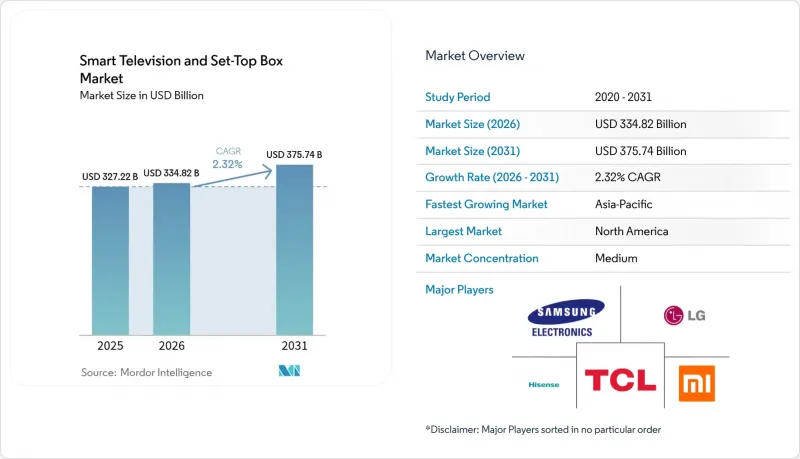
根據 Mordor Intelligence 預測,智慧電視和機上盒市場規模將從 2025 年的 3,272.2 億美元成長到 2026 年的 3,348.2 億美元,到 2031 年將達到 3,757.4 億美元,2026 年至 2031 年的複合年成長率為 2.32%。
本報告按技術(衛星廣播/DTH、IPTV 等)、解析度(標準清晰度等)、螢幕大小(32 吋以下等)、顯示技術(液晶/LED 等)、作業系統/平台(安卓/Google電視等)、銷售管道(離線零售、線上/電商)、最終用戶(住宅用戶等)和地區進行細分。市場預測以美元計價。
全球智慧電視和機上盒市場趨勢及洞察
串流媒體平台用戶的激增正在推動設備更換。
到2024年6月,串流媒體將佔據總觀看時間的大部分,這將加速家庭用戶從傳統平板電視向支援頻寬應用的連網4K電視的升級。歐洲和亞洲的電信業者正在銷售與光纖套餐捆綁的智慧電視,以防止客戶流失,而這一趨勢正在北美以外的地區蔓延。製造商正透過更快的處理器和更大的記憶體來應對這一趨勢,但傳統的機上盒供應商卻面臨困境,因為他們老舊的晶片組無法解碼最新的轉碼器,例如AV1。這波更換正沿著都市區寬頻線路蔓延,這些線路普遍提供100Mbps的服務,將更換週期縮短至不到五年。儘管硬體利潤率下降,但擁有廣泛的應用生態系統和語音助理的品牌仍在確保更高的單件價值。
向高解析度、4K 和 8K 廣播標準過渡
日本NHK計畫於2024年擴大其8K衛星廣播能力,用於體育賽事轉播;韓國廣播公司也承諾在2026年前透過ATSC 3.0標準部署4K地面電波廣播。這些舉措與歐盟在2030年前逐步淘汰標清訊號的指令一致,從而對整合於下一代面板中的調諧器產生了迫切需求。由於4K面板生產線已佔據全球液晶顯示器產能的相當大一部分,單位成本正在下降,使得中階品牌能夠以與傳統全高清電視相同的價格銷售原生4K電視。因此,消費者開始將4K視為新的標準,而早期用戶則將目光投向了8K,用於打造大螢幕家庭劇院和商業指示牌。
激烈的市場競爭給供應商的利潤率帶來了壓力。
2024年,TCL和海信繼續利用中國一體化的供應鏈降低物流和零件成本,擴大市場佔有率,並將其Mini-LED電視的價格定得比三星和LG的同類產品低30%。 IPTV機上盒的價格如今已低於15美元,這給營運商補貼帶來了壓力,並降低了供應商的盈利。監管審查也加劇了這種壓力。 2024年,美國聯邦貿易委員會(FTC)因Vizio違反資料收集規定對其處以罰款,限制了其基於受眾分析的收入來源。因此,在規模經濟和軟體收入多元化將獲得回報的環境下,老牌企業正努力應對利潤率的壓力。
細分市場分析
到2025年,混合型和OTT設備將佔據智慧電視和機上盒市場佔有率的38.00%,成為最大佔有率。預計到2031年,它們的複合年成長率也將達到3.96%,成為成長最快的市場。北美和歐洲的營運商正在部署整合線性頻道和串流媒體庫的Android TV營運商級硬體,以幫助遏制用戶流失。儘管由衛星電視機上盒驅動的智慧電視和機上盒市場規模持續萎縮,因為DirecTV和其他競爭對手將資金重新分配到純串流媒體服務領域,但IPTV機上盒在亞太和中東的光纖部署中仍發揮著重要作用。有線電視機上盒正受到停掉有線電視服務有線電視)和推動開放標準的監管要求的影響。在預測期內,差異化的重點將從專有硬體轉向支援語音導航、雲端DVR和定向廣告的軟體更新。
此外,混合解決方案為付費電視業者提供了一種平衡頻寬、本地快取和服務個人化的方法,而無需更換整個視訊前端。透過利用通用的SoC系列,它們縮短了開發週期並實現了無線功能更新。對於越南和墨西哥的契約製造製造商而言,與傳統遙控器相比,這種轉變提高了物料清單(BOM)的價值,並增強了利潤率,使其免受平均售價下降的影響。然而,設計方案能否成功應用,如今取決於是否符合隱私框架的要求,這些框架要求為資料收集提供明確的退出機制,這增加了韌體和身份驗證的複雜性。
2025年,4K超高清產品出貨量佔比達到45.02%,預計到2031年將維持在40%以上,這主要得益於面板良率的提升和內容庫的擴充。 8K電視目前市佔率處於個位數,但其複合年成長率(CAGR)為3.05%,主要得益於NHK的8K廣播和三星對microRGB顯示器的重視。 8K智慧電視和機上盒的市場規模主要依賴願意為高像素密度支付溢價的家庭劇院愛好者數位電子看板用戶。在非洲和東南亞,標清產品仍然在政府補充的過渡項目中存在,但隨著各國政府逐步淘汰類比廣播,其受歡迎程度正在下降。
消費者普遍認為4K是55吋以上客廳顯示器的新標準,2024年65吋4K電視的平均售價較去年同期下降了8%。供應鏈效率的提升使得各大品牌能夠在不大幅提價的情況下,將120Hz面板和HDMI 2.1介面標準化,從而提升了產品對遊戲玩家的吸引力。相較之下,8K電視製造商則試圖透過人工智慧影像增強技術和Micro-LED技術的進步來證明其價格差異的合理性,直到2028年及以後全解析度內容成為主流。
到2025年,55-65吋電視的銷量將佔總銷量的41.05%,這既滿足了客廳的易用性需求,又兼顧了面板成本的下降。同時,66吋以上螢幕大小將以3.55%的複合年成長率(CAGR)實現最高成長,這反映了高階家庭劇院的建設以及酒店和零售行業對數位電子看板的採用。面向66吋以上顯示器的智慧電視和機上盒市場主要集中在美國、海灣合作理事會國家和日本,這些地區較高的可支配收入支撐了對大尺寸顯示器的需求。另一方面,32吋和33-43吋的電視在亞洲和拉丁美洲空間有限的都市區公寓中仍然很受歡迎,保持著穩定的更換週期。
由於家具擺放位置和觀看距離的限制,飯店等企業客戶通常更傾向於選擇 43-55 吋的電視尺寸,但他們也願意為像 LG Pro Centric 這樣無需外接媒體播放機即可與設施管理系統整合的軟體付費。中國製造工廠轉向使用更大尺寸的玻璃基板,使得 75 吋面板的價格區間與之前的 55 吋電視相當,從而推動了住宅市場對更大螢幕大小的更換需求。
區域分析
亞太地區佔據最大的區域市場佔有率,這主要得益於中國、韓國和日本製造地的集中,以及印度和東南亞地區可支配收入的成長。預計到2024年,中國智慧電視的銷量將超過4,000萬台,TCL、海信和小米等品牌將憑藉價格和功能上的可比性展開競爭。印度的生產連結獎勵計畫計畫(PLI)吸引了Dixon Technologies和Amber Enterprises等公司的投資,建立了國內面板組裝系統。這降低了對進口的依賴,並提高了抵禦關稅波動的能力。日本和韓國主導著高階細分市場,索尼和三星利用其新興的8K廣播生態系統和強大的品牌影響力推高了平均售價(ASP)。印尼、越南和泰國正受惠於寬頻的快速普及和政府機上盒補貼,計劃在三年內實現類比廣播家庭的數位轉型。
北美和歐洲是成熟的市場,其特點是更換需求旺盛、高階市場成長潛力巨大,以及消費者正持續從捆綁式付費電視訂閱轉向隨選點播串流服務。沃爾瑪於2024年12月以23億美元收購Vizio,這清楚地表明了零售商專注於獲取廣告收入的決心。美國因其早期採用65英寸及以上的大螢幕電視而脫穎而出,並且其用戶介面高度依賴語音助理。加拿大在「停掉有線電視服務」(放棄有線電視)方面也取得了進展,與美國類似,但墨西哥仍在繼續為機上盒(STB)提供補貼,因為其地面電波電視轉型預計要到2026年才能完成。歐洲的《一般資料保護規則》(GDPR)限制了自動內容識別,縮小了原始設備製造商(OEM)的資料貨幣化機會,但與ATSC類似的DVB-T2升級正在推動4K的普及。德國、法國和英國佔歐洲銷售額的 60% 以上,在這些國家,三星、LG 和索尼的品質和售後服務比新興品牌更受重視。
在南美、中東和非洲,快速的數位轉型和不斷擴大的中產階級消費共同推動了巴西智慧電視銷量在2024年實現兩位數成長,這主要得益於Mercado Livre等電商平台提供的分期付款服務。同時,阿根廷的智慧電視銷售因宏觀經濟逆風而停滯不前,但延遲的更換需求將在2026年持續累積。在海灣合作理事會(GCC)國家,對75吋以上面板的需求不斷成長,為三星和LG提供了強勁的需求推動要素。土耳其作為製造地,向其北非鄰國供應產品。在南非,類比廣播已於2024年3月全面停止,導致對低成本地面電波數位接收器(DTT機上盒)的需求短暫激增。另一方面,肯亞和奈及利亞已推出有利於中國ODM供應商的補貼計劃,並正朝著2027年的最後期限穩步推進。
其他好處:
- Excel格式的市場預測(ME)表
- 3個月的分析師支持
目錄
第1章:引言
- 研究假設和市場定義
- 調查範圍
第2章:調查方法
第3章執行摘要
第4章 市場狀況
- 市場概覽
- 市場促進因素
- 串流媒體平台用戶的激增正在推動設備更換。
- 向高解析度、4K 和 8K 廣播標準過渡
- 新興經濟體政府強制推行數位轉型
- 人工智慧驅動的超高清技術正在提升傳統內容的價值。
- 零售商擁有的智慧電視廣告平台正在擴大OEM廠商的收入來源。
- 國內製造業獎勵措施降低了機上盒的生產成本
- 市場限制因素
- 激烈的市場競爭給供應商的利潤率帶來了壓力。
- 低成本串流媒體棒的普及正在蠶食機上盒市場。
- 面板價格的重新計算正在擾亂顯示器供應鏈。
- 限制智慧電視資料貨幣化的資料隱私法規
- 產業價值鏈分析
- 監理情勢
- 技術展望
- 宏觀經濟因素對市場的影響
- 波特五力分析
第5章 市場規模與成長預測
- 透過技術
- 衛星廣播/直播衛星電視
- IPTV
- 電纜
- 混合/OTT
- 通過決議
- SD
- HD/FHD
- 4K UHD
- 8K 或更高
- 螢幕大小
- 32英吋或更小
- 33-43英寸
- 44-55英寸
- 56-65英寸
- 66吋或更大
- 顯示技術
- LCD/LED
- OLED
- QLED/Mini-LED
- Micro-LED
- 作業系統/平台
- Android/Google TV
- Tizen
- webOS
- Roku TV OS
- Fire TV OS
- 按銷售管道
- 線下零售
- 線上/電子商務
- 最終用戶
- 住宅
- 商業/飯店
- 機構
- 按地區
- 北美洲
- 美國
- 加拿大
- 墨西哥
- 南美洲
- 巴西
- 阿根廷
- 歐洲
- 德國
- 英國
- 法國
- 義大利
- 西班牙
- 俄羅斯
- 亞太地區
- 中國
- 日本
- 印度
- 韓國
- 東南亞
- 中東
- 波灣合作理事會
- 土耳其
- 非洲
- 南非
- 北美洲
第6章 競爭情勢
- 市場集中度
- 策略趨勢
- 市佔率分析
- 公司簡介
- Samsung Electronics Co., Ltd.
- LG Electronics Inc.
- TCL Technology Group Corp.
- Hisense Group Co., Ltd.
- Sony Group Corporation
- Panasonic Holdings Corporation
- Vizio Holding Corp.
- Skyworth Group Ltd.
- Sharp Corporation
- Xiaomi Corporation
- Roku, Inc.
- Amazon.com, Inc.(Fire TV Devices)
- Apple Inc.
- CommScope Holding Company, Inc.
- VANTIVA SA(formerly Technicolor SA)
- Sagemcom SAS
- HUMAX Holdings Co., Ltd.
- Kaonmedia Co., Ltd.
- ZTE Corporation
- Shenzhen Skyworth Digital Technology Co., Ltd.
- Evolution Digital, LLC
- Shenzhen SDMC Technology Co., Ltd.
- Echostar Corporation
- Advance Digital Broadcast SA
第7章 市場機會與未來展望
According to Mordor Intelligence, the smart television and set-top box market size is expected to grow from USD 327.22 billion in 2025 to USD 334.82 billion in 2026 and is forecast to reach USD 375.74 billion by 2031 at 2.32% CAGR over 2026-2031.
This report is Segmented by Technology (Satellite/DTH, IPTV, and More), Resolution (SD, and More), Display Size (32 and Below, and More), Display Technology (LCD/LED, and More), Operating System (Android/Google TV, and More), Distribution Channel (Offline Retail, and Online/E-Commerce), End User (Residential, and More), and Geography. The Market Forecasts are Provided in Terms of Value (USD).
Global Smart Television And Set-Top Box Market Trends and Insights
Surging Streaming Platform Subscriptions Driving Device Refresh
Streaming took a majority share of total viewing in June 2024, and the milestone has accelerated household upgrades from legacy flat panels to connected 4K units that support bandwidth-intensive apps. Operators in Europe and Asia bundle smart televisions with fiber packages to curb churn, extending the trend beyond North America. Manufacturers answer with faster processors and extra memory, but legacy STB vendors struggle because older chipsets cannot decode modern codecs such as AV1. The refresh wave propagates along urban broadband corridors where 100 Mbps service is common, shortening replacement cycles to five years or less. Brands positioned with wide app ecosystems and voice assistants capture the uplift in unit value even as hardware margins thin.
Transition to High-Definition, 4K and 8K Broadcasting Standards
Japan's NHK scaled its 8K satellite feeds for the 2024 sporting calendar, and South Korean broadcasters committed to 4K over-air rollouts via ATSC 3.0 by 2026. These moves align with European directives that phase out SD signals by 2030, creating mandatory demand for tuners embedded in next-generation panels. As 4K panel lines already account for most global LCD capacity, per-unit costs fall, letting mid-tier brands ship native-4K sets at historical full-HD prices. Consumers consequently perceive 4K as the new baseline, while early adopters gravitate to 8K for large-screen home theaters and commercial signage.
Intense Price Competition Compressing Vendor Margins
TCL and Hisense continued to grow share in 2024 by pricing Mini-LED televisions 30% below Samsung and LG equivalents, leveraging integrated Chinese supply chains that shave logistics and component costs. Set-top box contract prices now dip under USD 15 for IPTV models, squeezing operator subsidies and eroding vendor profitability. Regulatory scrutiny adds pressure: the U.S. Federal Trade Commission fined Vizio for data-collection infractions in 2024, restricting an offsetting revenue stream based on viewer analytics. Established brands therefore navigate a margin squeeze that rewards economies of scale and software-based revenue diversification.
Other drivers and restraints analyzed in the detailed report include:
- Government Digital Switchover Mandates in Emerging Nations
- AI-Based Upscaling Enhancing Value of Legacy Content
- Proliferation of Low-Cost Streaming Sticks Cannibalizing STBs
For complete list of drivers and restraints, kindly check the Table Of Contents.
Segment Analysis
Hybrid and OTT devices accounted for the largest slice of the smart television and set-top box market share at 38.00% in 2025 and are projected to notch the fastest 3.96% CAGR to 2031. Operators in North America and Europe deploy Android TV Operator Tier hardware that merges linear channels with streaming libraries, helping them stem subscriber losses. The smart television and set-top box market size attributable to satellite STBs continues to shrink as DirecTV and peers reallocate capital toward pure streaming services, whereas IPTV boxes remain critical in fiber rollouts across Asia Pacific and the Middle East. Cable STBs suffer from cord-cutting and regulatory mandates favouring open standards. Over the forecast period, differentiation tilts from proprietary hardware to software updates that enable voice navigation, cloud DVR, and targeted advertising.
Hybrid solutions also give pay-TV providers tools to balance bandwidth, local caching, and service personalization without replacing entire video head-ends. They leverage common SoC families, cutting development cycles and enabling feature updates over-the-air. For contract manufacturers in Vietnam and Mexico, the pivot unlocks higher bill-of-materials value compared to legacy zappers, cushioning margins against falling average selling prices. That said, design wins now hinge on compliance with privacy frameworks that compel clear opt-out pathways for data collection, adding firmware and certification complexities.
The 4K UHD cohort held 45.02% of 2025 shipments, a level expected to stay north of 40% through 2031 as panel yields rise and content libraries broaden. 8K sets, while only a mid-single digit share today, show a 3.05% CAGR driven by NHK's 8K broadcasts and Samsung's push into Micro RGB displays. The smart television and set-top box market size tied to 8K leans heavily on home-theater enthusiasts and digital signage buyers willing to pay premiums for high pixel density. Standard-definition units linger in subsidy-driven switch-over programs across Africa and Southeast Asia but trend downward as governments phase out analog feeds.
Consumers perceive 4K as the new normal for living-room screens 55 inches and larger, and average selling prices for 65-inch 4K sets fell another 8% year on year in 2024. Supply-chain efficiencies permit brands to bundle 120 Hz panels and HDMI 2.1 ports without hefty price premiums, boosting appeal to gamers. In contrast, 8K makers bank on AI-based upscaling and Micro-LED advances to justify valuation gaps until full-resolution content becomes mainstream, likely post-2028.
Sets measuring 55-65 inches controlled 41.05% of 2025 units, balancing living-room ergonomics with falling panel costs. Screens 66 inches and above, however, record the highest 3.55% CAGR, reflecting premium home-cinema builds and digital signage rollouts in hospitality and retail. The smart television and set-top box market size for 66-inch plus displays skews toward the United States, the Gulf Cooperation Council, and Japan, where disposable incomes support bigger footprints. Conversely, 32-inch and 33-43-inch models still cater to space-limited urban apartments in Asia and Latin America, sustaining steady replacement cycles.
Commercial buyers such as hotel chains prefer 43-55-inch sizes owing to furniture constraints and viewing distances yet are willing to pay for software like LG Pro:Centric that integrates property-management systems without external media players. The migration to larger glass substrates at Chinese fabs now positions 75-inch panels at price points previously occupied by 55-inch sets, nudging residential up-graders toward bigger diagonals.
Complete Report Scope:
- By Technology (Set-Top Box)
- Satellite / DTH
- IPTV
- Cable
- Hybrid / OTT
- By Resolution
- SD
- HD / FHD
- 4K UHD
- 8K and Higher
- By Display Size (in Inches)
- 32 and Below
- 33-43
- 44-55
- 56-65
- 66 and Above
- By Display Technology
- LCD / LED
- OLED
- QLED / Mini-LED
- Micro-LED
- By Operating System / Platform
- Android / Google TV
- Tizen
- webOS
- Roku TV OS
- Fire TV OS
- By Distribution Channel
- Offline Retail
- Online / E-Commerce
- By End User
- Residential
- Commercial / Hospitality
- Institutional
- By Geography
- North America
- United States
- Canada
- Mexico
- South America
- Brazil
- Argentina
- Europe
- Germany
- United Kingdom
- France
- Italy
- Spain
- Russia
- Asia Pacific
- China
- Japan
- India
- South Korea
- Southeast Asia
- Middle East
- Gulf Cooperation Council
- Turkey
- Africa
- South Africa
- North America
Geography Analysis
Asia Pacific holds the largest regional share owing to concentrated manufacturing in China, South Korea, and Japan, and to rising disposable incomes in India and Southeast Asia. China sold more than 40 million smart TVs in 2024, with TCL, Hisense, and Xiaomi fighting on price and feature parity. India's Production-Linked Incentive program lured investments from Dixon Technologies and Amber Enterprises to build domestic panel assembly, cutting import dependence and adding resilience against tariff shifts. Japan and South Korea dominate premium niches; Sony and Samsung leverage early 8K broadcast ecosystems and strong brand pull to push ASPs higher. Indonesia, Vietnam, and Thailand benefit from rapid broadband rollouts and government set-top subsidies that convert analog households to digital within three years.
North America and Europe represent mature territories shaped by replacement demand, premium segment upside, and an ongoing pivot from pay-TV bundles to a la carte streaming. Walmart's USD 2.3 billion acquisition of Vizio in December 2024 underscores retailers' bid to harness advertising revenue. The United States stands out for early adoption of 65-inch-plus screens and voice-assistant-heavy interfaces. Canada mirrors U.S. cord-cutting, while Mexico still enjoys STB subsidy support as its digital-terrestrial transition finalizes in 2026. Europe's GDPR regime restricts automatic content recognition, curtailing data-monetization opportunities for OEMs, while ATSC-like DVB-T2 upgrades push 4K adoption. Germany, France, and the United Kingdom make up over 60% of European sales, favouring quality and after-sales support from Samsung, LG, and Sony over emerging brands.
South America, the Middle East, and Africa combine rapid digital-switch initiatives with growing middle-class consumption. Brazil booked double-digit smart TV growth in 2024, supported by e-commerce instalment plans from Mercado Livre, while Argentina's macro headwinds stalled volume though deferred replacement demand builds into 2026. Gulf Cooperation Council countries gravitate toward 75-inch plus panels, delivering strong value pull for Samsung and LG. Turkey functions as a manufacturing hub feeding neighbouring states in North Africa. South Africa's analog switch-off completed in March 2024, creating a one-time surge for low-cost DTT boxes, while Kenya and Nigeria progress toward 2027 deadlines with subsidy programs that favour Chinese ODM supply.
- Samsung Electronics Co., Ltd.
- LG Electronics Inc.
- TCL Technology Group Corp.
- Hisense Group Co., Ltd.
- Sony Group Corporation
- Panasonic Holdings Corporation
- Vizio Holding Corp.
- Skyworth Group Ltd.
- Sharp Corporation
- Xiaomi Corporation
- Roku, Inc.
- Amazon.com, Inc. (Fire TV Devices)
- Apple Inc.
- CommScope Holding Company, Inc.
- VANTIVA SA (formerly Technicolor SA)
- Sagemcom SAS
- HUMAX Holdings Co., Ltd.
- Kaonmedia Co., Ltd.
- ZTE Corporation
- Shenzhen Skyworth Digital Technology Co., Ltd.
- Evolution Digital, LLC
- Shenzhen SDMC Technology Co., Ltd.
- Echostar Corporation
- Advance Digital Broadcast SA
Additional Benefits:
- The market estimate (ME) sheet in Excel format
- 3 months of analyst support
TABLE OF CONTENTS
1 INTRODUCTION
- 1.1 Study Assumptions and Market Definition
- 1.2 Scope of the Study
2 RESEARCH METHODOLOGY
3 EXECUTIVE SUMMARY
4 MARKET LANDSCAPE
- 4.1 Market Overview
- 4.2 Market Drivers
- 4.2.1 Surging Streaming Platform Subscriptions Driving Device Refresh
- 4.2.2 Transition to High-Definition, 4K and 8K Broadcasting Standards
- 4.2.3 Government Digital Switchover Mandates in Emerging Nations
- 4.2.4 AI-Based Upscaling Enhancing Value of Legacy Content
- 4.2.5 Retailer-Owned Smart-TV Ad Platforms Expanding OEM Revenue Streams
- 4.2.6 Domestic Manufacturing Incentives Reducing STB Production Costs
- 4.3 Market Restraints
- 4.3.1 Intense Price Competition Compressing Vendor Margins
- 4.3.2 Proliferation of Low-Cost Streaming Sticks Cannibalizing STBs
- 4.3.3 Panel Tariff Realignments Disrupting Display Supply Chains
- 4.3.4 Data-Privacy Regulations Curbing Smart-TV Data Monetisation
- 4.4 Industry Value-Chain Analysis
- 4.5 Regulatory Landscape
- 4.6 Technological Outlook
- 4.7 Impact of Macroeconomic Factors on the Market
- 4.8 Porter's Five Forces Analysis
- 4.8.1 Threat of New Entrants
- 4.8.2 Bargaining Power of Buyers
- 4.8.3 Bargaining Power of Suppliers
- 4.8.4 Threat of Substitutes
- 4.8.5 Intensity of Competitive Rivalry
5 MARKET SIZE AND GROWTH FORECASTS (VALUE)
- 5.1 By Technology (Set-Top Box)
- 5.1.1 Satellite / DTH
- 5.1.2 IPTV
- 5.1.3 Cable
- 5.1.4 Hybrid / OTT
- 5.2 By Resolution
- 5.2.1 SD
- 5.2.2 HD / FHD
- 5.2.3 4K UHD
- 5.2.4 8K and Higher
- 5.3 By Display Size (in Inches)
- 5.3.1 32 and Below
- 5.3.2 33-43
- 5.3.3 44-55
- 5.3.4 56-65
- 5.3.5 66 and Above
- 5.4 By Display Technology
- 5.4.1 LCD / LED
- 5.4.2 OLED
- 5.4.3 QLED / Mini-LED
- 5.4.4 Micro-LED
- 5.5 By Operating System / Platform
- 5.5.1 Android / Google TV
- 5.5.2 Tizen
- 5.5.3 webOS
- 5.5.4 Roku TV OS
- 5.5.5 Fire TV OS
- 5.6 By Distribution Channel
- 5.6.1 Offline Retail
- 5.6.2 Online / E-Commerce
- 5.7 By End User
- 5.7.1 Residential
- 5.7.2 Commercial / Hospitality
- 5.7.3 Institutional
- 5.8 By Geography
- 5.8.1 North America
- 5.8.1.1 United States
- 5.8.1.2 Canada
- 5.8.1.3 Mexico
- 5.8.2 South America
- 5.8.2.1 Brazil
- 5.8.2.2 Argentina
- 5.8.3 Europe
- 5.8.3.1 Germany
- 5.8.3.2 United Kingdom
- 5.8.3.3 France
- 5.8.3.4 Italy
- 5.8.3.5 Spain
- 5.8.3.6 Russia
- 5.8.4 Asia Pacific
- 5.8.4.1 China
- 5.8.4.2 Japan
- 5.8.4.3 India
- 5.8.4.4 South Korea
- 5.8.4.5 Southeast Asia
- 5.8.5 Middle East
- 5.8.5.1 Gulf Cooperation Council
- 5.8.5.2 Turkey
- 5.8.6 Africa
- 5.8.6.1 South Africa
- 5.8.1 North America
6 COMPETITIVE LANDSCAPE
- 6.1 Market Concentration
- 6.2 Strategic Moves
- 6.3 Market Share Analysis
- 6.4 Company Profiles (includes Global Level Overview, Market Level Overview, Core Segments, Financials as available, Strategic Information, Market Rank/Share for key companies, Products and Services, and Recent Developments)
- 6.4.1 Samsung Electronics Co., Ltd.
- 6.4.2 LG Electronics Inc.
- 6.4.3 TCL Technology Group Corp.
- 6.4.4 Hisense Group Co., Ltd.
- 6.4.5 Sony Group Corporation
- 6.4.6 Panasonic Holdings Corporation
- 6.4.7 Vizio Holding Corp.
- 6.4.8 Skyworth Group Ltd.
- 6.4.9 Sharp Corporation
- 6.4.10 Xiaomi Corporation
- 6.4.11 Roku, Inc.
- 6.4.12 Amazon.com, Inc. (Fire TV Devices)
- 6.4.13 Apple Inc.
- 6.4.14 CommScope Holding Company, Inc.
- 6.4.15 VANTIVA SA (formerly Technicolor SA)
- 6.4.16 Sagemcom SAS
- 6.4.17 HUMAX Holdings Co., Ltd.
- 6.4.18 Kaonmedia Co., Ltd.
- 6.4.19 ZTE Corporation
- 6.4.20 Shenzhen Skyworth Digital Technology Co., Ltd.
- 6.4.21 Evolution Digital, LLC
- 6.4.22 Shenzhen SDMC Technology Co., Ltd.
- 6.4.23 Echostar Corporation
- 6.4.24 Advance Digital Broadcast SA
7 MARKET OPPORTUNITIES AND FUTURE OUTLOOK
- 7.1 White-Space and Unmet-Need Assessment

 電視機和機上盒:市場佔有率分析、行業趨勢和統計數據、成長預測(2026-2031 年)
 機上盒市場:全球市場預測,2026-2032年4K機上盒市場:按類型、連接方式、作業系統、錄製功能、最終用戶和分銷管道分類——2026-2032年全球市場預測
 機上盒市場規模、佔有率、趨勢和預測:按類型、解析度、最終用戶、服務類型、分銷管道和地區分類(2026-2034 年)
 機上盒市場:按類型、影像品質和地區分類
 2026年全球智慧型機上盒(STB)和加密狗市場報告4K機上盒市場報告:按產品、應用和地區分類(2026-2034年)
 機上盒市場分析及預測(至2035年):依類型、產品類型、服務、技術、組件、應用、功能、安裝類型、設備分類機上盒(STB):市場佔有率分析、行業趨勢和統計數據、成長預測(2026-2031)
 全球機上盒(STB)市場規模、佔有率、趨勢和成長分析報告(2026-2034)