


 |
市場調查報告書
商品編碼
1939739
機上盒(STB):市場佔有率分析、行業趨勢和統計數據、成長預測(2026-2031)Set-Top Box - Market Share Analysis, Industry Trends & Statistics, Growth Forecasts (2026 - 2031) |
||||||

※ 本網頁內容可能與最新版本有所差異。詳細情況請與我們聯繫。
預計到 2026 年,機上盒 (STB) 市值將達到 2,022.7 億美元,高於 2025 年的 2,047.2 億美元。
預計到 2031 年,該產業規模將達到 1,904.4 億美元,2026 年至 2031 年的複合年成長率為 -1.20%。
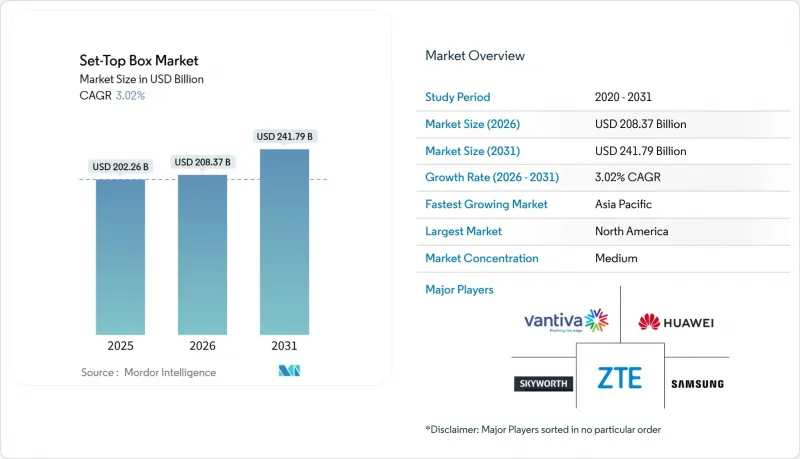
儘管預計成長為負,營運商仍在將傳統接收設備轉型為支援 IP 的樞紐,整合廣播和串流媒體服務,降低軟體授權費用,並減少能源消耗。光纖網路的部署、RDK 和 Android TV 等開放原始碼平台以及混合 IP 閘道持續刺激著裝置更新換代的需求。全球賽事前的超高清體育頻道、新興市場的 DTH OTT 整合服務以及 ESG主導的更新周期都在推動硬體創新。隨著科技巨頭紛紛推出集娛樂、智慧家居、電子商務和廣告功能於一體的消費級設備,繞過營運商的發行網路,競爭日益激烈。
全球機上盒(STB)市場趨勢與洞察
透過光纖基礎設施向IP/混合機上盒遷移
歐洲有線電視業者在向光纖過渡的同時,也需要能夠同時支援DOCSIS和全IP傳輸的機上盒,以在中期內繼續使用HFC網路。 CommScope的DOCSIS 4.0試驗表明,整合晶片組能夠充分利用更高的上行頻寬,這促使營運商採購混合型硬體。瑞典BoxerTV退出地面電波廣播業務,凸顯了向純串流媒體傳輸模式的更廣泛轉變,加速了升級需求。
開放原始碼RDK和Android TV降低了營運成本
Vantiva 已出貨超過 1.25 億台 RDK 設備和 2,200 萬台 Android TV 設備,顯示標準化技術堆疊能夠降低授權成本並簡化認證流程。印尼 Telkomsel 部署 200 萬台 Android TV 設備,凸顯了開放原始碼在價格敏感市場中的強勁發展勢頭。營運商目前正在將 RDK 安全功能與 Android 應用目錄整合到混合型機上盒中,以縮短產品上市時間,同時保持對使用者介面的控制。
北美和西歐有線電視取消用戶數上升
光是2024年第四季,DISH和Sling就流失了25.3萬付費電視用戶,導致其提供的機上盒需求下降。英國廣播公司(BBC)計劃在2030年代轉向純網路廣播,這表明即使是公共廣播公司也認為傳統分發方式的前景有限。
細分市場分析
到2025年,衛星廣播將保持37.42%的市場佔有率,即使用戶持續停掉有線電視服務有線電視,它仍將為機上盒(STB)市場奠定基礎。在光纖網路發展的推動下,隨著營運商將寬頻、音訊和影像捆綁銷售,IPTV預計將以0.83%的複合年成長率成長。有線電視正在經歷從QAM到全IP的轉換,而像巴西電視3.0這樣的混合地面電波-OTT模式則將廣播網路覆蓋與互動串流媒體結合。雖然衛星機上盒(STB)市場依然龐大,但長期趨勢正轉向IP閘道。
營運商希望機上盒能夠解碼目前的DVB-S2訊號,並在未來支援HLS和DASH協議,這迫使供應商採用多重通訊協定晶片組。 Astundo在美國從QAM遷移到IPTV就是一個清晰的例子,它展示瞭如何將現有的有線電視基礎設施改造用於管理型IP服務。預計到2025年,巴西的免費衛星電視用戶數將達到900萬,印證了付費和免費平台的市場需求。
由於生產線日趨成熟且頻寬需求降低,高清(HD)將在2025年佔據出貨量的一半。超高清(UHD)/4K將以1.03%的複合年成長率推動成長,人工智慧輔助的圖像升頻技術使營運商無需擁有完整的原生內容庫即可提供優質體驗。中興通訊的4K AI-SR機上盒功耗降低50%,速度提升29%,在提高解析度的同時實現了更高的效率。目前,支援超高清的機上盒市場佔有率雖然不大,但隨著體育賽事擁有者強制要求4K分發,其市場佔有率正在穩步成長。
SEI Robotics 的 AI超高解析度裝置彌合了原生 4K 串流播放能力有限與消費者對高清影像需求之間的差距,在降低營運商頻寬的同時保持了畫質。儘管原生 4K 體育賽事直播仍受制於製作成本,但混合式超解析度解決方案將保持成長動能。
區域分析
北美地區預計到2025年將貢獻29.65%的收入,這主要得益於較高的每位用戶平均收入(ARPU)和廣泛的寬頻普及。自2012年以來,能源效率法規已使設備的平均功耗降低了68%,迫使供應商採用更先進的晶片製程。持續的「停掉有線電視服務有線電視服務)趨勢正迫使營運商轉向全屋覆蓋解決方案,將純IP閘道器與Wi-Fi Mesh網路結合。
亞太地區正經歷最快成長,複合年成長率達0.58%,這主要得益於印度、中國和印尼的光纖網路部署。中興通訊和Telkomsel部署的200萬台安卓電視表明,在價格敏感的市場中,通訊業者正在將寬頻與OTT聚合服務捆綁銷售。日本和韓國正在大力推廣4K/HDR,為高階機上盒打造了一個高階市場。
歐洲正經歷分化趨勢。由於串流媒體的興起,西方市場正在萎縮,而東歐市場則繼續推動地面電波和有線電視網路的數位化。歐盟的電子廢棄物指令提高了回收成本,但也催生了對模組化、可維修硬體的需求。中東正結合國家發展規劃,投資建置超高清衛星平台。預計到2029年,非洲將新增1,200萬付費電視家庭,政府資金籌措包括低成本DVB-T2和衛星接收設備在內的費用。南美洲正著力推進巴西的TV 3.0計劃,隨著ATSC 3.0的推出,混合型機上盒在廠商的產品藍圖中繼續佔據重要位置。
其他福利:
- Excel格式的市場預測(ME)表
- 3個月的分析師支持
目錄
第1章 引言
- 研究假設和市場定義
- 調查範圍
第2章調查方法
第3章執行摘要
第4章 市場情勢
- 市場概覽
- 市場促進因素
- 透過光纖基礎設施向IP/混合機上盒遷移
- 利用開放原始碼RDK和Android TV降低營運成本
- 大型賽事前夕,4K/HDR體育頻道將播出。
- 新興市場DTH捆綁式OTT聚合服務
- 促進非洲和東南亞的數位化
- 以ESG主導的低功耗CPE更新週期
- 市場限制
- 北美和西歐的停掉有線電視服務
- 灰色市場IPTV盜版設備
- 半導體成本上漲
- 嚴格的電子廢棄物收集要求
- 產業價值鏈分析
- 監管環境
- 技術展望
- 波特五力分析
- 供應商的議價能力
- 買方的議價能力
- 新進入者的威脅
- 替代品的威脅
- 競爭對手之間的競爭
- 產業相關人員分析
- 宏觀經濟趨勢評估
- 投資和資金籌措環境
第5章 市場規模與成長預測
- 透過技術
- 衛星廣播/直播衛星(DTH)
- 電纜
- IPTV
- 數位地面廣播/混合廣播
- 通過決議
- SD
- HD
- 超高清/4K 以上解析度
- 最終用戶
- 住宅
- 商業/飯店
- 政府及教育機構
- 運輸(航空、海運)
- 按作業系統
- Android-TV
- RDK
- Proprietary Linux
- 其他開放原始碼
- 按地區
- 北美洲
- 美國
- 加拿大
- 墨西哥
- 歐洲
- 英國
- 德國
- 法國
- 義大利
- 其他歐洲地區
- 亞太地區
- 中國
- 日本
- 印度
- 韓國
- 其他亞洲地區
- 中東
- 以色列
- 沙烏地阿拉伯
- 阿拉伯聯合大公國
- 土耳其
- 其他中東地區
- 非洲
- 南非
- 埃及
- 其他非洲地區
- 南美洲
- 巴西
- 阿根廷
- 南美洲其他地區
- 北美洲
第6章 競爭情勢
- 市場集中度
- 策略趨勢
- 市佔率分析
- 公司簡介
- Vantiva SA
- Samsung Electronics Co., Ltd.
- Huawei Technologies Co., Ltd.
- Skyworth Digital Technology Co., Ltd.
- Humax Holdings Co., Ltd.
- ZTE Corporation
- Sagemcom SAS
- Kaonmedia Co., Ltd.
- CommScope Holding Company, Inc.
- Shenzhen SDMC Technology Co., Ltd.
- Shenzhen Coship Electronics Co., Ltd.
- Evolution Digital LLC
- Technicolor Connected Home USA LLC
- Dish TV India Ltd.
- Tata Play Ltd.
- ARRIS International plc(re-branded)
- Apple Inc.(Apple TV 4K)
- Roku Inc.
- Amazon .com, Inc.(Fire TV Cube)
- DISH Network LLC(Hopper)
第7章 市場機會與未來展望
The set-top box market size in 2026 is estimated at USD 202.27 billion, growing from 2025 value of USD 204.72 billion with 2031 projections showing USD 190.44 billion, growing at -1.20% CAGR over 2026-2031.
Even with negative growth, operators are transforming traditional reception devices into IP-enabled hubs that unify broadcast and streaming services, cut software licensing fees, and lower energy use. Fiber network rollouts, open-source platforms such as RDK and Android TV, and hybrid IP gateways continue to stimulate replacement demand. UHD sports channels ahead of global tournaments, bundled OTT aggregation in emerging-market DTH, and ESG-driven refresh cycles sustain hardware innovation. Competitive intensity is rising as technology giants bypass operator distribution with direct-to-consumer devices that blend entertainment, smart-home, e-commerce, and advertising functions.
Global Set-Top Box Market Trends and Insights
Fiber-backed migration to IP/hybrid STBs
European cable groups shifting to fibre while retaining HFC for the medium-term need boxes that handle both DOCSIS and full-IP delivery. CommScope's DOCSIS 4.0 trials show unified chipsets that exploit higher upstream bandwidth, spurring operator purchase of hybrid hardware. Sweden's BoxerTV exit from terrestrial broadcast underscores a broader move toward streaming-only distribution that accelerates replacement demand.
Open-source RDK and Android-TV lowering opex
Vantiva has shipped more than 125 million RDK units and 22 million Android TV units, proving that standardized stacks trim licensing costs and simplify certification. Indonesia's Telkomsel deployed 2 million Android TV units, highlighting open-source momentum in price-sensitive markets. Operators now merge RDK security with Android's app catalogue inside hybrid boxes, accelerating time-to-market while keeping UI control.
Cord-cutting in North America and Western Europe
DISH and Sling lost 253,000 pay-TV subscribers in Q4 2024 alone, eroding demand for operator-supplied boxes. The BBC plans an internet-only switchover in the 2030s, signalling that even public broadcasters see a limited future for legacy distribution.
Other drivers and restraints analyzed in the detailed report include:
- 4K/HDR sports channels before mega-events
- Digitisation stimulus in Africa and SE-Asia
- Grey-market IPTV piracy devices
For complete list of drivers and restraints, kindly check the Table Of Contents.
Segment Analysis
Satellite held a 37.42% share in 2025, anchoring the set-top box market despite cord-cutting. IPTV, supported by fiber rollouts, will grow at a 0.83% CAGR as operators bundle broadband, voice, and video. Cable's move to all-IP QAM replacement is underway, while hybrid DTT-OTT models such as Brazil's TV 3.0 combine broadcast reach with interactive streaming. The set-top box market size for satellite remains large, yet the long-term trajectory tilts toward IP gateways.
Operators want boxes that decode DVB-S2 today and HLS or DASH tomorrow, pressuring vendors to add multi-protocol chipsets. Astound's conversion from QAM to IPTV in the United States shows how legacy cable infrastructure is being repurposed for managed IP. Free-to-air satellite households in Brazil are projected to reach 9 million by 2025, underscoring dual demand for both pay and free platforms.
HD represents half of 2025 shipments due to mature production chains and lower bandwidth needs. UHD/4K will lead growth at 1.03% CAGR as AI-assisted upscaling enables operators to market premium experiences without full native content libraries. ZTE's 4K AI-SR box lowers power use by 50% and boosts speed by 29%, proving efficiency gains alongside resolution upgrades. The set-top box market share for UHD remains modest today but rises steadily as sports rights holders mandate 4K distribution.
AI super-resolution devices from SEI Robotics bridge the gap between scarce native 4K feeds and consumer appetite for sharper imagery, reducing operator bandwidth while sustaining quality. Native 4K live sports streaming is still limited by production costs, but hybrid upscaling solutions keep momentum intact.
The Set-Top Box Market Report is Segmented by Technology (Satellite/DTH, Cable, IPTV, DTT/Hybrid), Resolution (SD, HD, UHD/4K and Higher), End-User (Residential, Commercial/Hospitality, Government and Education, Transportation), Operating System (Android-TV, RDK, Proprietary Linux, Other Open-Source), and Geography. The Market Forecasts are Provided in Terms of Value (USD).
Geography Analysis
North America contributed 29.65% revenue in 2025, anchored by high ARPU and widespread broadband. Energy-efficiency rules have cut average box power by 68% since 2012, prompting vendors to adopt advanced silicon nodes. Continuous cord-cutting forces operators to shift toward IP-only gateways paired with Wi-Fi mesh for whole-home coverage.
Asia-Pacific is the fastest-growing region at 0.58% CAGR, propelled by fiber buildouts in India, China, and Indonesia. ZTE and Telkomsel's 2 million-unit Android TV deployment showcases how telcos bundle broadband with OTT aggregators in price-sensitive markets. Japan and South Korea champion 4K/HDR, creating premium niches for high-spec boxes.
Europe shows a bifurcated trend: Western markets decline with streaming adoption, while Eastern markets still digitize terrestrial and cable networks. EU e-waste directives raise recycling costs yet also open demand for modular, repairable hardware. The Middle East invests in UHD satellite platforms linked to national Vision programs. Africa expects 12 million additional pay-TV homes by 2029, often financed through state vouchers that include low-cost DVB-T2 or satellite kits. South America's focus on Brazil's TV 3.0 keeps hybrid boxes on vendor roadmaps as ATSC 3.0 launches.
- Vantiva SA
- Samsung Electronics Co., Ltd.
- Huawei Technologies Co., Ltd.
- Skyworth Digital Technology Co., Ltd.
- Humax Holdings Co., Ltd.
- ZTE Corporation
- Sagemcom SAS
- Kaonmedia Co., Ltd.
- CommScope Holding Company, Inc.
- Shenzhen SDMC Technology Co., Ltd.
- Shenzhen Coship Electronics Co., Ltd.
- Evolution Digital LLC
- Technicolor Connected Home USA LLC
- Dish TV India Ltd.
- Tata Play Ltd.
- ARRIS International plc (re-branded)
- Apple Inc. (Apple TV 4K)
- Roku Inc.
- Amazon .com, Inc. (Fire TV Cube)
- DISH Network L.L.C. (Hopper)
Additional Benefits:
- The market estimate (ME) sheet in Excel format
- 3 months of analyst support
TABLE OF CONTENTS
1 INTRODUCTION
- 1.1 Study Assumptions and Market Definition
- 1.2 Scope of the Study
2 RESEARCH METHODOLOGY
3 EXECUTIVE SUMMARY
4 MARKET LANDSCAPE
- 4.1 Market Overview
- 4.2 Market Drivers
- 4.2.1 Fibre-backed migration to IP/hybrid STBs
- 4.2.2 Open-source RDK and Android-TV lowering opex
- 4.2.3 4K / HDR sports channels before mega-events
- 4.2.4 Bundled OTT aggregation in emerging-market DTH
- 4.2.5 Digitisation stimulus in Africa and SE-Asia
- 4.2.6 ESG-driven low-power CPE refresh cycles
- 4.3 Market Restraints
- 4.3.1 Cord-cutting in N. America and W. Europe
- 4.3.2 Grey-market IPTV piracy devices
- 4.3.3 Semiconductor cost inflation
- 4.3.4 Strict e-waste take-back mandates
- 4.4 Industry Value-Chain Analysis
- 4.5 Regulatory Landscape
- 4.6 Technological Outlook
- 4.7 Porter's Five Forces Analysis
- 4.7.1 Bargaining Power of Suppliers
- 4.7.2 Bargaining Power of Buyers
- 4.7.3 Threat of New Entrants
- 4.7.4 Threat of Substitutes
- 4.7.5 Intensity of Competitive Rivalry
- 4.8 Industry Stakeholder Analysis
- 4.9 Assessment of Macroeconomic Trends
- 4.10 Investment and Funding Landscape
5 MARKET SIZE AND GROWTH FORECASTS (VALUE)
- 5.1 By Technology
- 5.1.1 Satellite / DTH
- 5.1.2 Cable
- 5.1.3 IPTV
- 5.1.4 DTT / Hybrid
- 5.2 By Resolution
- 5.2.1 SD
- 5.2.2 HD
- 5.2.3 UHD / 4K and Higher
- 5.3 By End-User
- 5.3.1 Residential
- 5.3.2 Commercial / Hospitality
- 5.3.3 Government and Education
- 5.3.4 Transportation (Airline, Maritime)
- 5.4 By Operating System
- 5.4.1 Android-TV
- 5.4.2 RDK
- 5.4.3 Proprietary Linux
- 5.4.4 Other Open-Source
- 5.5 By Geography
- 5.5.1 North America
- 5.5.1.1 United States
- 5.5.1.2 Canada
- 5.5.1.3 Mexico
- 5.5.2 Europe
- 5.5.2.1 United Kingdom
- 5.5.2.2 Germany
- 5.5.2.3 France
- 5.5.2.4 Italy
- 5.5.2.5 Rest of Europe
- 5.5.3 Asia-Pacific
- 5.5.3.1 China
- 5.5.3.2 Japan
- 5.5.3.3 India
- 5.5.3.4 South Korea
- 5.5.3.5 Rest of Asia
- 5.5.4 Middle East
- 5.5.4.1 Israel
- 5.5.4.2 Saudi Arabia
- 5.5.4.3 United Arab Emirates
- 5.5.4.4 Turkey
- 5.5.4.5 Rest of Middle East
- 5.5.5 Africa
- 5.5.5.1 South Africa
- 5.5.5.2 Egypt
- 5.5.5.3 Rest of Africa
- 5.5.6 South America
- 5.5.6.1 Brazil
- 5.5.6.2 Argentina
- 5.5.6.3 Rest of South America
- 5.5.1 North America
6 COMPETITIVE LANDSCAPE
- 6.1 Market Concentration
- 6.2 Strategic Moves
- 6.3 Market Share Analysis
- 6.4 Company Profiles {(includes Global level Overview, Market level overview, Core Segments, Financials as available, Strategic Information, Market Rank/Share for key companies, Products and Services, and Recent Developments)}
- 6.4.1 Vantiva SA
- 6.4.2 Samsung Electronics Co., Ltd.
- 6.4.3 Huawei Technologies Co., Ltd.
- 6.4.4 Skyworth Digital Technology Co., Ltd.
- 6.4.5 Humax Holdings Co., Ltd.
- 6.4.6 ZTE Corporation
- 6.4.7 Sagemcom SAS
- 6.4.8 Kaonmedia Co., Ltd.
- 6.4.9 CommScope Holding Company, Inc.
- 6.4.10 Shenzhen SDMC Technology Co., Ltd.
- 6.4.11 Shenzhen Coship Electronics Co., Ltd.
- 6.4.12 Evolution Digital LLC
- 6.4.13 Technicolor Connected Home USA LLC
- 6.4.14 Dish TV India Ltd.
- 6.4.15 Tata Play Ltd.
- 6.4.16 ARRIS International plc (re-branded)
- 6.4.17 Apple Inc. (Apple TV 4K)
- 6.4.18 Roku Inc.
- 6.4.19 Amazon .com, Inc. (Fire TV Cube)
- 6.4.20 DISH Network L.L.C. (Hopper)
7 MARKET OPPORTUNITIES AND FUTURE OUTLOOK
- 7.1 White-space and Unmet-need Assessment

 智慧電視和機上盒:市場佔有率分析、行業趨勢和統計數據以及成長預測(2026-2031 年)電視機和機上盒:市場佔有率分析、行業趨勢和統計數據、成長預測(2026-2031 年)
 機上盒市場:全球市場預測,2026-2032年4K機上盒市場:按類型、連接方式、作業系統、錄製功能、最終用戶和分銷管道分類——2026-2032年全球市場預測
 機上盒市場規模、佔有率、趨勢和預測:按類型、解析度、最終用戶、服務類型、分銷管道和地區分類(2026-2034 年)
 機上盒市場:按類型、影像品質和地區分類
 2026年全球智慧型機上盒(STB)和加密狗市場報告4K機上盒市場報告:按產品、應用和地區分類(2026-2034年)
 機上盒市場分析及預測(至2035年):依類型、產品類型、服務、技術、組件、應用、功能、安裝類型、設備分類
 全球機上盒(STB)市場規模、佔有率、趨勢和成長分析報告(2026-2034)