


 |
市場調查報告書
商品編碼
2124636
電視機和機上盒:市場佔有率分析、行業趨勢和統計數據、成長預測(2026-2031 年)Television And Set Top Box - Market Share Analysis, Industry Trends & Statistics, Growth Forecasts (2026 - 2031) |
||||||

※ 本網頁內容可能與最新版本有所差異。詳細情況請與我們聯繫。
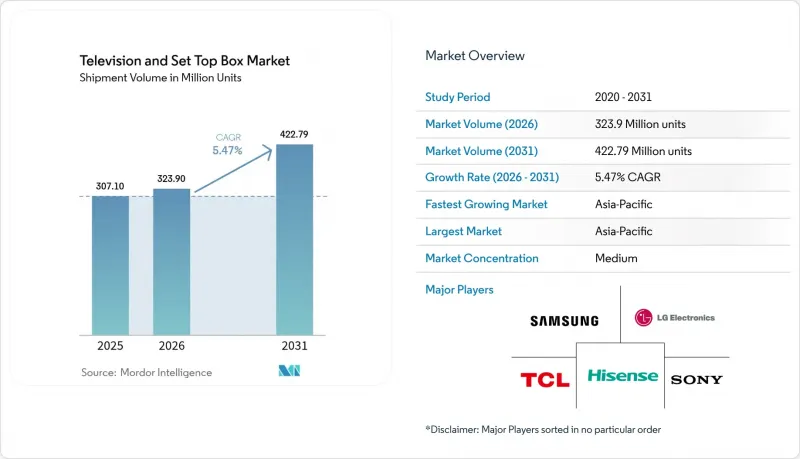
根據 Mordor Intelligence 預測,電視機和機上盒的市場規模預計將從 2025 年的 3.071 億台成長到 2026 年的 3.239 億台,然後從 2026 年到 2031 年以 5.47% 的複合年成長,到 2031 年達到 4.79 億台。
本報告按產品類型(電視、機上盒、串流媒體棒/電視盒)、解析度(標清、高清/全高清、4K、8K以上)、螢幕大小(32吋以下及其他)、技術(LCD/LED、QLED/Mini-LED及其他)、最終用戶(住宅、商用、公共)和地區(北美、南美、歐洲及其他)進行細分。市場預測以美元計價。
全球電視和機上盒市場趨勢及洞察
消費者迅速轉向4K和8K超高清內容
高解析度螢幕需求的激增正在縮短更換週期,並推高平均售價。雖然市面上已有兼容 8K 的硬體,但由於原生內容有限,普及速度緩慢,4K 仍然是升級換代的主流選擇。明基預測,8K 的廣泛普及至少還需要六年時間,這意味著 4K 面板在中期內仍將保持其商業性優勢。三星龐大的 8K 專利組合也可能影響成本結構和競爭性授權。因此,在電視和機上盒市場,4K 被定位為主要的價值促進因素,而 8K 則被視為長期的高階策略。
智慧電視作業系統生態系統正在加速電視的更換週期。
軟體生態系統如今已成為產品差異化的核心。三星2025年的機型將整合「Vision AI」技術,最佳化推薦內容和語音指令,使其更符合用戶需求。 LG則透過與微軟Copilot軟體結合,提升產品生產力,縮短產品生命週期,並鼓勵用戶每四到五年更換。 Android TV、Roku、webOS等平台的碎片化,正在建立一個「黏性」生態系統,將使用者牢牢綁定到各個品牌的介面上。因此,服務收入和定向廣告收入與硬體銷售同步成長,推動了電視和機上盒市場的發展。
面板和半導體採購成本不斷上漲
從2024年中期開始,顯示器玻璃、驅動晶片和記憶體的成本將呈上升趨勢。面板製造集中在東亞,使品牌商面臨地緣政治和物流風險。小規模供應商沒有對沖空間,被迫要麼自行承擔成本,要麼提高零售價格,這給利潤率帶來了壓力。大型企業正在尋求垂直整合和長期晶圓供應契約,但這些對沖措施只能部分抵消電視和機上盒市場複合年成長率(CAGR)1.1個百分點的下行壓力。
細分市場分析
在電視和機上盒市場,預計到2025年,電視機將佔總銷量的65.40%,而串流電視棒和加密狗在該細分市場中以7.74%的複合年成長率位居榜首。加密狗因其便攜性、快速設定和低成本而日益普及,逐漸削弱了傳統有線和衛星機上盒能夠滿足用戶對直播和OTT觀看的需求。同時,在已開發國家,智慧電視的日益普及預計將在未來降低對獨立加密狗的需求,但在新興市場,低成本的附加元件仍然被廣泛接受,作為邁向互聯內容的第一步。各大品牌正擴大將廣告支援的免費串流電視(FAST)頻道整合到其介面中,這正在推動用戶參與度和數據收集。
棒狀設備(如 Roku、亞馬遜 Fire TV 和小米)的價格競爭正在擠壓利潤空間,同時也擴大了用戶群體,進而導致廣告庫存增加。電視製造商則透過將類似的作業系統功能整合到面板中來應對,從而維持主導。這種拉鋸戰確保了產品的多樣性,同時也模糊了產品類別的界限,這意味著許多家庭除了智慧電視外,還同時運作多個串流媒體設備。因此,電視和機上盒市場的設備總數正在增加。
預計到2025年,4K電視和機上盒市佔率將達到43.85%,在成熟的生產良率和OTT平台豐富的原生內容推動下,持續推動中期更換需求。考慮更換的用戶在主流尺寸的面板上體驗到4K電視相比高清電視畫質的顯著提升,這也是4K電視保持其吸引力的原因之一。同時,8K電視的複合年成長率(CAGR)為6.95%,但2024年的出貨量僅14.3萬台,反映內容匱乏和高價位定位。儘管如此,硬體製造商仍在大力推廣8K電視,以維護其平均售價(ASP)和品牌領導地位。
製造商正利用人工智慧技術進行畫面增強,以彌補原生8K內容的不足,旨在為8K正式發布前的大規模8K廣播奠定基礎。明基預測,8K要到2031年或更晚才能普及,這意味著4K將在預測期內保持主導地位。高清和全高清將繼續在注重成本的新興市場以及頻寬和內容限制導致4K過剩的商業場所中使用。
區域分析
預計到2025年,亞太地區將佔全球銷售額的42.20%,年複合成長率達6.53%,主要得益於中國的大規模生產以及印度智慧電視家庭滲透率的兩位數成長。國內領導企業TCL和海信正利用低廉的人事費用和政府支持,加速高級產品的出貨,縮小與韓國老牌企業的差距。印尼、越南和菲律賓的銷售額也因政府的數位化措施而成長,而日本和韓國則透過8K試點計畫和身臨其境型視聽標準,維持著技術領先地位。
北美市場成熟且盈利豐厚,4K和8K大尺寸面板在客廳中佔據主導地位。韓國品牌在美國成年人市場擁有52%的銷售佔有率,反映了其強大的品牌價值。該地區銷售額正以7.92%的複合年成長率穩定成長,其成長動力主要來自高級產品的提升銷售而非銷售擴張,消費者積極接受語音助理、主機遊戲和先進的HDR標準。美墨加協定(USMCA)下的貿易支援從墨西哥組裝工廠進行即時物流,降低了零售商的庫存風險。
歐洲的成長雖然更為穩定,但受到能源效率法規和模擬廣播提前結束的限制。生態設計法規要求使用節能韌體和可回收包裝,由此增加的合規成本對於新興的亞洲製造商來說可能難以承受。儘管如此,65吋以上的4K電視在德國、英國和法國仍然是市場優先考慮的產品,OLED電視在西歐主要城市的普及率仍然最高。在中東歐新興市場以及一些非洲國家,向數位廣播的轉型帶來了利好,如果經濟指標趨於穩定,預計各品牌電視的長期更換需求將會擴大。
其他好處:
- Excel格式的市場預測(ME)表
- 3個月的分析師支持
目錄
第1章:引言
- 研究假設和市場定義
- 調查範圍
第2章:調查方法
第3章執行摘要
第4章 市場狀況
- 市場概覽
- 市場促進因素
- 消費者迅速轉向4K和8K超高清內容
- 智慧電視作業系統生態系統正在加速電視的更換週期。
- 政府主導的數位廣播轉型計劃
- 透過人工智慧驅動的個人化使用者介面提升每位使用者平均收入
- 基於邊緣運算的互動廣告津貼模式
- DTH-IP 服務結合了低地球軌道衛星和衛星廣播,其部署正在加速向農村地區的普及。
- 市場限制因素
- 面板和半導體原料成本上漲
- 已開發市場的飽和
- 由於人們逐漸轉向使用行動裝置和個人電腦,電視觀看時間正在減少。
- 即將推出的有關大型顯示器的碳排放和電子廢棄物法規。
- 產業價值鏈分析
- 監理情勢
- 技術展望
- 波特五力分析
- 價格分析
- 宏觀經濟因素對市場的影響
- 投資分析
第5章 市場規模與成長預測
- 依產品類型
- 電視機
- 機上盒
- 串流加密狗/棒
- 通過決議
- SD
- HD/FHD
- 4K
- 8K 或更高
- 螢幕大小
- 32英吋或更小
- 33-43英寸
- 44-55英寸
- 56-64英寸
- 65-74英寸
- 75吋或更大
- 透過技術
- LCD/LED
- QLED/Mini-LED
- OLED
- 雷射/投影電視
- 最終用戶
- 住宅
- 商業和公共機構
- 按地區
- 北美洲
- 美國
- 加拿大
- 墨西哥
- 南美洲
- 巴西
- 阿根廷
- 其他南美國家
- 歐洲
- 德國
- 英國
- 法國
- 義大利
- 其他歐洲國家
- 亞太地區
- 中國
- 日本
- 韓國
- 印度
- 其他亞太國家
- 中東
- 沙烏地阿拉伯
- 阿拉伯聯合大公國
- 其他中東國家
- 非洲
- 南非
- 其他非洲國家
- 北美洲
第6章 競爭情勢
- 市場集中度
- 策略趨勢
- 市佔率分析
- 公司簡介
- Samsung Electronics Co., Ltd.
- LG Electronics Inc.
- TCL Technology Group Corp.
- Hisense Co., Ltd.
- Sony Group Corporation
- Panasonic Holdings Corporation
- Sharp Corporation
- Vizio Holding Corp.
- Skyworth Group Co., Ltd.
- Xiaomi Corporation
- Haier Smart Home Co., Ltd.
- Koninklijke Philips NV
- TP Vision
- Toshiba Corporation
- Arris International Ltd.(CommScope)
- Technicolor SA
- Humax Co., Ltd.
- Sagemcom SAS
- ZTE Corporation
- Kaon Media Co., Ltd.
- Evolution Digital LLC
- Coship Electronics Co., Ltd.
- Intek Digital Inc.
- Gospell Digital Technology Co., Ltd.
- Roku, Inc.
- Amazon.com, Inc.(Fire TV)
第7章 市場機會與未來展望
According to Mordor Intelligence, the television and Set Top Box market size is expected to grow from 307.10 million units in 2025 to 323.9 million units in 2026 and is forecast to reach 422.79 million units by 2031 at 5.47% CAGR over 2026-2031.
This report is Segmented by Product Type (Television, Set-Top Box, Streaming Dongles/Sticks), Resolution (SD, HD/FHD, 4K, 8K and Above), Screen Size (32" and Below, and More), Technology (LCD/LED, QLED/Mini-LED, and More), End-User (Residential, Commercial and Institutional), and Geography (North America, South America, Europe, and More). The Market Forecasts are Provided in Terms of Value (USD).
Global Television And Set Top Box Market Trends and Insights
Rapid Consumer Migration to 4K and 8K UHD Content
Surging demand for higher-resolution screens is compressing replacement cycles and lifting average selling prices. Although 8K hardware exists, limited native content keeps adoption muted, so 4K continues to dominate upgrade decisions. BenQ forecasts that widescale 8K take-up remains at least six years away, reinforcing the mid-term commercial primacy of 4K panels. Samsung's extensive 8K patent portfolio is also likely to influence cost structures and competitive licensing. The Television and Set Top Box market, therefore, leans on 4K as the principal value driver while treating 8K as a longer-run premium pathway.
Smart-TV OS Ecosystems Accelerating Replacement Cycles
Software ecosystems are now the heart of product differentiation. Samsung's 2025 sets integrate Vision AI to tailor recommendations and voice commands. LG is pairing Microsoft Copilot to add productivity features, shortening perceived product life and encouraging 4- to 5-year upgrade intervals. Platform fragmentation, Android TV, Roku, webOS and others, creates sticky ecosystems that lock users into branded interfaces. As a result, service revenue and targeted advertising are growing alongside hardware revenue, boosting the Television And Set Top Box market.
Escalating Panel and Semiconductor Input Costs
Display glass, driver ICs, and memory have seen cost rebound since mid-2024. Concentrated panel fabrication in East Asia exposes brands to geopolitical and logistics risks. Smaller suppliers lack hedge leverage and must either absorb costs or raise retail prices, pressuring margins. Larger firms pursue vertical integration and long-term wafer agreements, but these hedges only partially offset the negative 1.1-percentage-point drag on the Television and Set Top Box market CAGR.
Other drivers and restraints analyzed in the detailed report include:
- Government-Mandated Digital-Switchover Programs
- AI-Enabled Personalized User Interfaces Enhancing ARPU
- Saturation in Developed Markets
For complete list of drivers and restraints, kindly check the Table Of Contents.
Segment Analysis
The Television and Set Top Box market size for televisions retained a 65.40% slice of 2025 revenue, yet streaming dongles and sticks posted the segment's top 7.74% CAGR. Dongles thrive on portability, quick setup, and low entry prices, eroding traditional cable and satellite box relevance. In regions where legacy pay-TV retains sway, hybrid satellite-IP-IP boxes address both linear and OTT viewing. Meanwhile, smart-TV integration lowers future standalone dongle demand in developed economies, but emerging markets still adopt low-cost add-ons as the first step into connected content. Brands increasingly bundle free ad-supported streaming television (FAST) channels in the interface, increasing engagement and data collection.
Price wars in sticks, Roku versus Amazon Fire TV and Xiaomi, compress margins yet expand installed base, which in turn fuels ad inventory. Television manufacturers counter by embedding comparable OS functionality in-panel, retaining value chain control. This tug-of-war ensures product diversity but also blurs category lines, meaning that many households now run multiple streaming devices alongside smart panels, inflating total addressable units within the Television And Set Top Box market.
The Television And Set Top Box market share for 4K rose to 43.85% in 2025 and continues to command mid-cycle upgrades, propelled by mature production yields and abundant native content via OTT platforms. Upgraders see tangible visual benefits over HD at mainstream panel sizes, helping 4K sets maintain compelling value. Conversely, the 8K class, while logging a 6.95% CAGR, shipped only 143,000 units in 2024, reflective of its content deficit and premium price positioning. Hardware makers nevertheless push 8K to defend ASPs and brand leadership.
Manufacturers apply AI upscaling to mitigate native content scarcity, hoping to seed an install base ahead of true 8K broadcast. BenQ anticipates mass adoption no sooner than 2031, suggesting continued dominance of 4K through the forecast period. HD and Full HD persist in cost-focused emerging nations and commercial installations where bandwidth and content constraints make 4K overkill.
Complete Report Scope:
- By Product Type
- Television
- Set-Top Box
- Streaming Dongles/Sticks
- By Resolution
- SD
- HD/FHD
- 4K
- 8K and Above
- By Screen Size
- 32" and Below
- 33-43"
- 44-55"
- 56-64"
- 65-74"
- 75" and Above
- By Technology
- LCD/LED
- QLED / Mini-LED
- OLED
- Laser / Projection TV
- By End-User
- Residential
- Commercial and Institutional
- By Geography
- North America
- United States
- Canada
- Mexico
- South America
- Brazil
- Argentina
- Rest of South America
- Europe
- Germany
- United Kingdom
- France
- Italy
- Rest of Europe
- Asia-Pacific
- China
- Japan
- South Korea
- India
- Rest of Asia-Pacific
- Middle East
- Saudi Arabia
- United Arab Emirates
- Rest of Middle East
- Africa
- South Africa
- Rest of Africa
- North America
Geography Analysis
Asia-Pacific generated 42.20% of global 2025 revenue and will advance at a 6.53% CAGR, fueled by China's scale production and India's double-digit smart-TV household expansion. Domestic champions TCL and Hisense leverage lower labor costs and state incentives to accelerate premium shipments, narrowing the gap with Korean incumbents. Government digital initiatives in Indonesia, Vietnam, and the Philippines enlarge unit volumes, while Japan and South Korea maintain technology leadership through 8K trials and immersive audio-visual standards.
North America presents a mature yet lucrative arena where large-format 4K and 8K panels dominate living-room real estate. Korean brands captured 52% unit share among U.S. adults, reflecting durable brand equity. The region shows solid 7.92% revenue CAGR driven by premium upselling rather than unit expansion, with consumers embracing voice assistants, console gaming, and advanced HDR variants. Trade under the USMCA agreement supports just-in-time logistics from Mexican assembly hubs, moderating inventory risk for retailers.
Europe's growth is steadier, constrained by energy-efficiency mandates and early analog switch-off completion. Eco-design rules force power-saving firmware and recyclable packaging, adding compliance costs that smaller Asian entrants may struggle to meet. Nevertheless, Germany, the UK, and France prioritize 65-inch-plus 4K sets, and OLED adoption remains strongest in Western capitals. Emerging Central and Eastern Europe sees digital switchover tailwinds similar to select African states, affording brands a long-term replacement runway once economic indicators stabilize.
- Samsung Electronics Co., Ltd.
- LG Electronics Inc.
- TCL Technology Group Corp.
- Hisense Co., Ltd.
- Sony Group Corporation
- Panasonic Holdings Corporation
- Sharp Corporation
- Vizio Holding Corp.
- Skyworth Group Co., Ltd.
- Xiaomi Corporation
- Haier Smart Home Co., Ltd.
- Koninklijke Philips N.V.
- TP Vision
- Toshiba Corporation
- Arris International Ltd. (CommScope)
- Technicolor S.A.
- Humax Co., Ltd.
- Sagemcom SAS
- ZTE Corporation
- Kaon Media Co., Ltd.
- Evolution Digital LLC
- Coship Electronics Co., Ltd.
- Intek Digital Inc.
- Gospell Digital Technology Co., Ltd.
- Roku, Inc.
- Amazon.com, Inc. (Fire TV)
Additional Benefits:
- The market estimate (ME) sheet in Excel format
- 3 months of analyst support
TABLE OF CONTENTS
1 INTRODUCTION
- 1.1 Study Assumptions and Market Definition
- 1.2 Scope of the Study
2 RESEARCH METHODOLOGY
3 EXECUTIVE SUMMARY
4 MARKET LANDSCAPE
- 4.1 Market Overview
- 4.2 Market Drivers
- 4.2.1 Rapid consumer migration to 4K and 8K UHD content
- 4.2.2 Smart-TV OS ecosystems accelerating replacement cycles
- 4.2.3 Government-mandated digital-switchover programs
- 4.2.4 AI-enabled personalised user interfaces enhancing ARPU
- 4.2.5 Edge-based interactive-advertising subsidisation models
- 4.2.6 LEO-satellite hybrid DTH-IP roll-outs expanding rural reach
- 4.3 Market Restraints
- 4.3.1 Escalating panel and semiconductor input costs
- 4.3.2 Saturation in developed markets
- 4.3.3 Cord-shifting to mobile/PC reduces TV viewing hours
- 4.3.4 Imminent carbon and e-waste regulation on large displays
- 4.4 Industry Value Chain Analysis
- 4.5 Regulatory Landscape
- 4.6 Technological Outlook
- 4.7 Porter's Five Forces Analysis
- 4.7.1 Bargaining Power of Suppliers
- 4.7.2 Bargaining Power of Consumers
- 4.7.3 Threat of New Entrants
- 4.7.4 Intensity of Competitive Rivalry
- 4.7.5 Threat of Substitutes
- 4.8 Pricing Analysis
- 4.9 Impact of Macroeconomic Factors on the Market
- 4.10 Investment Analysis
5 MARKET SIZE AND GROWTH FORECASTS (VALUE)
- 5.1 By Product Type
- 5.1.1 Television
- 5.1.2 Set-Top Box
- 5.1.3 Streaming Dongles/Sticks
- 5.2 By Resolution
- 5.2.1 SD
- 5.2.2 HD/FHD
- 5.2.3 4K
- 5.2.4 8K and Above
- 5.3 By Screen Size
- 5.3.1 32" and Below
- 5.3.2 33-43"
- 5.3.3 44-55"
- 5.3.4 56-64"
- 5.3.5 65-74"
- 5.3.6 75" and Above
- 5.4 By Technology
- 5.4.1 LCD/LED
- 5.4.2 QLED / Mini-LED
- 5.4.3 OLED
- 5.4.4 Laser / Projection TV
- 5.5 By End-User
- 5.5.1 Residential
- 5.5.2 Commercial and Institutional
- 5.6 By Geography
- 5.6.1 North America
- 5.6.1.1 United States
- 5.6.1.2 Canada
- 5.6.1.3 Mexico
- 5.6.2 South America
- 5.6.2.1 Brazil
- 5.6.2.2 Argentina
- 5.6.2.3 Rest of South America
- 5.6.3 Europe
- 5.6.3.1 Germany
- 5.6.3.2 United Kingdom
- 5.6.3.3 France
- 5.6.3.4 Italy
- 5.6.3.5 Rest of Europe
- 5.6.4 Asia-Pacific
- 5.6.4.1 China
- 5.6.4.2 Japan
- 5.6.4.3 South Korea
- 5.6.4.4 India
- 5.6.4.5 Rest of Asia-Pacific
- 5.6.5 Middle East
- 5.6.5.1 Saudi Arabia
- 5.6.5.2 United Arab Emirates
- 5.6.5.3 Rest of Middle East
- 5.6.6 Africa
- 5.6.6.1 South Africa
- 5.6.6.2 Rest of Africa
- 5.6.1 North America
6 COMPETITIVE LANDSCAPE
- 6.1 Market Concentration
- 6.2 Strategic Moves
- 6.3 Market Share Analysis
- 6.4 Company Profiles (includes Global level Overview, Market level overview, Core Segments, Financials as available, Strategic Information, Market Rank/Share for key companies, Products and Services, and Recent Developments)
- 6.4.1 Samsung Electronics Co., Ltd.
- 6.4.2 LG Electronics Inc.
- 6.4.3 TCL Technology Group Corp.
- 6.4.4 Hisense Co., Ltd.
- 6.4.5 Sony Group Corporation
- 6.4.6 Panasonic Holdings Corporation
- 6.4.7 Sharp Corporation
- 6.4.8 Vizio Holding Corp.
- 6.4.9 Skyworth Group Co., Ltd.
- 6.4.10 Xiaomi Corporation
- 6.4.11 Haier Smart Home Co., Ltd.
- 6.4.12 Koninklijke Philips N.V.
- 6.4.13 TP Vision
- 6.4.14 Toshiba Corporation
- 6.4.15 Arris International Ltd. (CommScope)
- 6.4.16 Technicolor S.A.
- 6.4.17 Humax Co., Ltd.
- 6.4.18 Sagemcom SAS
- 6.4.19 ZTE Corporation
- 6.4.20 Kaon Media Co., Ltd.
- 6.4.21 Evolution Digital LLC
- 6.4.22 Coship Electronics Co., Ltd.
- 6.4.23 Intek Digital Inc.
- 6.4.24 Gospell Digital Technology Co., Ltd.
- 6.4.25 Roku, Inc.
- 6.4.26 Amazon.com, Inc. (Fire TV)
7 MARKET OPPORTUNITIES AND FUTURE OUTLOOK
- 7.1 White-space and Unmet-need Assessment

 智慧電視和機上盒:市場佔有率分析、行業趨勢和統計數據以及成長預測(2026-2031 年)
 機上盒市場:全球市場預測,2026-2032年4K機上盒市場:按類型、連接方式、作業系統、錄製功能、最終用戶和分銷管道分類——2026-2032年全球市場預測
 機上盒市場規模、佔有率、趨勢和預測:按類型、解析度、最終用戶、服務類型、分銷管道和地區分類(2026-2034 年)
 機上盒市場:按類型、影像品質和地區分類
 2026年全球智慧型機上盒(STB)和加密狗市場報告4K機上盒市場報告:按產品、應用和地區分類(2026-2034年)
 機上盒市場分析及預測(至2035年):依類型、產品類型、服務、技術、組件、應用、功能、安裝類型、設備分類機上盒(STB):市場佔有率分析、行業趨勢和統計數據、成長預測(2026-2031)
 全球機上盒(STB)市場規模、佔有率、趨勢和成長分析報告(2026-2034)