


 |
市場調查報告書
商品編碼
2124704
東南亞鋰離子電池:市場佔有率分析、行業趨勢和統計數據以及成長預測(2026-2031 年)Southeast Asia Lithium-ion Battery - Market Share Analysis, Industry Trends & Statistics, Growth Forecasts (2026 - 2031) |
||||||

※ 本網頁內容可能與最新版本有所差異。詳細情況請與我們聯繫。
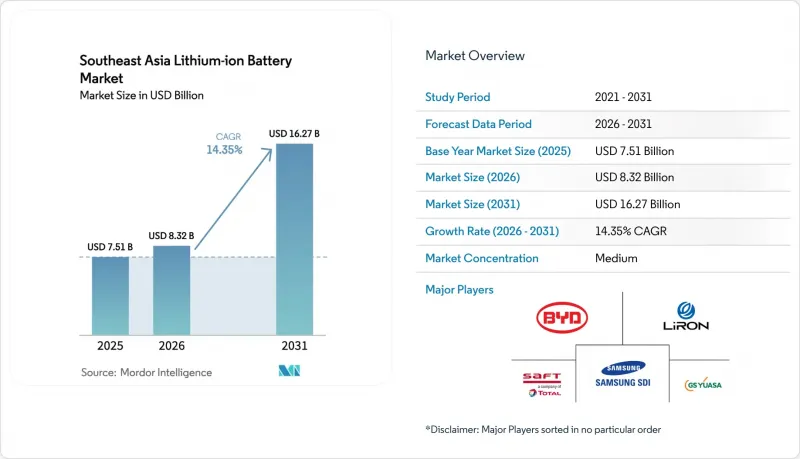
根據 Mordor Intelligence 預測,東南亞鋰離子電池市場預計將從 2025 年的 75.1 億美元成長到 2026 年的 83.2 億美元,到 2031 年達到 162.7 億美元,2026 年至 2031 年的複合年預計成長率為 14.35%。
本報告依產品類型(LCO、LFP、NMC、NCA、LMO、LTO)、形狀(圓柱形、矩形、軟包)、容量(小於 3,000 mAh、3,000–10,000 mAh、10,000–60,000 mAh、大於 60,000 mAh)、最終用途產業(汽車、消費電子、工業和電動工具、其他)和地區(印尼、馬來西亞、菲律賓、越南、其他)進行分類。
東南亞鋰離子電池市場趨勢與洞察
鼓勵電動車快速普及的獎勵
印尼降低增值稅、越南退還車輛登記費以及泰國為電動車提供3.5%的現金補貼,使得電動車與內燃機汽車的總擁有成本(TCO)差距在2025年前縮小了25個百分點,活性化了摩托車和小型汽車新車型的推出。汽車製造商目前正加快在地採購電池,以充分利用這些獎勵,這不僅加速了超級工廠的運轉率,也鞏固了成本競爭力強的磷酸鋰鐵鋰電池在補貼上限車型中的地位。雅加達和曼谷可更換電池汽車在最後一公里配送領域的應用日益廣泛,推動了對標準化3000-10000mAh電池組的需求激增。每兩年提高在地採購率門檻的合規條款促進了垂直整合,同時也使外國整車製造商面臨政策變化的風險。因此,預計到 2028 年,東南亞鋰離子電池市場的成長軌跡將持續上升。
擴大家用電器生產
隨著三星和蘋果的供應商將生產線從中國遷至越南,預計到2025年,越南在全球智慧型手機和筆記型電腦組裝市場的佔有率將上升至31%,其中圓柱形和棱柱形電池的需求主要集中在北寧省和北江省。鄰近的電池工廠已將物流前置作業時間縮短至不到一周,從而降低了營運資金,同時確保了3000-5000mAh LCO和NMC電池的重複訂單。在泰國的資料中心硬體生產線上,用於UPS模組的高循環壽命LTO電池的需求正在興起。同時,符合IEC 62133測試標準導致新產品上市時間延遲長達六週。雖然勞動力市場緊張推高了技術人員的薪資,但電極塗覆製程自動化的引入正在抵消這一影響。
對進口原料的依賴
在該地區,超過95%的鋰化學品和87%的合成石墨依賴進口,這使得電池製造商極易受到大宗商品價格波動的影響。預計到2025年,碳酸鋰價格將達到每噸12,500美元至18,700美元,這將擠壓利潤空間。中國將石墨出口許可證核准週期從兩週延長至八週,延緩了馬來西亞正極材料產能的擴張。嘉能可旗下穆坦達礦宣布不可抗力後,鈷價飆升,迫使越南生產商維持90天的庫存,導致流動性緊張。儘管氫氧化鈷和隔膜的試點計畫正在進行中,但大規模替代仍需數年時間,這使得東南亞鋰離子電池市場極易受到上游產業衝擊的影響。
細分市場分析
即使到了2025年,鋰鎳錳鈷(NMC)電池仍佔總銷售量的61.3%,但隨著汽車製造商轉向符合補貼上限的無鈷電池組,東南亞磷酸鋰鐵(LFP)市場預計將以38.5%的複合年成長率成長三倍。比亞迪將Blade技術授權給VinFast和Banpu NEXT,減少了模組數量,降低了電池組重量10%,並將每輛車的電池成本降至每千瓦時90美元以下。寧德時代(CATL)的M3P電池將於2026年起在印尼投產,與標準LFP電池相比,其能量密度提高了15%,並避免了與鈷相關的風險。
預計到2031年,無鈷化學成分電池的市場佔有率將從2025年的28.7%上升至46.3%,這主要得益於印尼對硫酸鎳出口徵收課稅,刺激了國內正極材料的生產,以及泰國對富錳配方電池的偏好。鎳鈷複合電池(NCA)的市場佔有率將保持在8.2%,主要局限於特斯拉進口電池中使用的松下圓柱形電池。而鈦酸鋰電池(LTO)的市佔率正在擴大,尤其是在船舶和不斷電系統(UPS)領域,這些領域對電池的循環壽命要求高達10,000次。競爭的焦點在於正極前驅體的採購以及電池到電池組的整合效率。
到2025年,棱柱形電池將佔據市場主導地位,銷量佔比達46.5%,因為中國電動車傾向於採用可堆疊的圓柱形電池,以打造滑板式底盤。然而,軟包電池的年成長率高達21.1%,這主要得益於現代和LG在卡拉旺的生產線,這些生產線可將電池組重量減輕12%,並延長續航里程。在東南亞豪華轎車鋰離子電池市場,到2031年,軟包電池的市場佔有率預計將超過35%,因為陶瓷塗層層壓板能夠有效抑制熱帶高溫引起的膨脹。
圓柱形電池維持著32.8%的市場佔有率,並在電動工具和高性能消費性電子產品領域佔據主導地位。在這些領域,自動繞線技術實現了低成本和長循環壽命。方形電池則繼續在公用事業規模的儲能領域保持主導地位。寧德時代(CATL)的280Ah罐式電池已在馬來西亞一個400MWh的先導計畫中投入使用,可承受6000次充放電循環,效率高達90%。均衡的人事費用使得泰國和越南的工廠能夠大規模生產軟包電池和方形電池,其價格與圓柱形電池的價格相差不到5%。
其他好處:
- Excel格式的市場預測(ME)表
- 3個月的分析師支持
目錄
第1章:引言
- 研究假設和市場定義
- 調查範圍
第2章:調查方法
第3章執行摘要
第4章 市場狀況
- 市場概覽
- 市場促進因素
- 促進電動車快速普及的獎勵
- 家用電器製造業的擴張
- 政府支持對超級工廠的投資
- 降低電池組成本
- 印尼鎳紅土礦高壓酸浸出液產量激增
- 島嶼海洋電氣化
- 市場限制因素
- 對進口原料的依賴
- 安全召回及熱失控隱患
- 系統不穩定性阻礙了儲能系統(ESS)的廣泛應用。
- 在地採購規則限制
- 供應鏈分析
- 監理情勢
- 技術展望
- 波特五力模型
第5章 市場規模與成長預測
- 依產品類型
- 鈷酸鋰(LCO)
- 磷酸鋰鐵(LFP)
- 鋰鎳錳鈷(NMC)
- 鋰鎳鈷鋁(NCA)
- 錳酸鋰(LMO)
- 鈦酸鋰(LTO)
- 按形狀
- 圓柱形
- 矩形的
- 袋式
- 按產能
- 小於3000毫安培時
- 3,000~10,000 mAh
- 10,000~60,000 mAh
- 超過 60,000mAh
- 按最終用途行業分類
- 汽車(電動車、油電混合車、插電式油電混合車)
- 消費性電子產品
- 工業和電動工具
- 固定式儲能
- 航太/國防
- 海軍
- 按地區
- 印尼
- 馬來西亞
- 菲律賓
- 新加坡
- 泰國
- 越南
- 其他東南亞國家
第6章 競爭情勢
- 市場集中度
- 策略趨勢(併購、聯盟、購電協議)
- 市場佔有率分析(主要公司的市場排名和佔有率)
- 公司簡介
- Contemporary Amperex Technology Co. Ltd.(CATL)
- LG Energy Solution Ltd.
- BYD Co. Ltd.
- Samsung SDI Co., Ltd.
- Panasonic Holdings Corp.
- SK On Co., Ltd.
- EVE Energy Co., Ltd.
- Saft Groupe SA
- GS Yuasa Corp.
- Murata Manufacturing Co., Ltd.
- Tesla, Inc.
- Envision AESC Group Ltd.
- Varta AG
- A123 Systems LLC
- Narada Power Source Co., Ltd.
- Sunwoda Electronic Co., Ltd.
- Dynapack Asia Pte Ltd
- LiRON LIB Power Pte Ltd
- CSB Energy Technology Co., Ltd.
- Northvolt AB
第7章 市場機會與未來展望
According to Mordor Intelligence, the Southeast Asia lithium-ion battery market size is expected to increase from USD 7.51 billion in 2025 to USD 8.32 billion in 2026 and reach USD 16.27 billion by 2031, growing at a CAGR of 14.35% over 2026-2031.
This report is Segmented by Product Type (LCO, LFP, NMC, NCA, LMO, and LTO), Form Factor (Cylindrical, Prismatic, and Pouch), Power Capacity (Up To 3, 000 MAh, 3, 000 To 10, 000 MAh, 10, 000 To 60, 000 MAh, and Above 60, 000 MAh), End-Use Industry (Automotive, Consumer Electronics, Industrial, Stationary Storage, and More), and Geography (Indonesia, Malaysia, Philippines, Vietnam, and More).
Southeast Asia Lithium-ion Battery Market Trends and Insights
Rapid EV-Adoption Incentives
VAT cuts in Indonesia, registration-fee rebates in Vietnam, and Thailand's EV 3.5 cash subsidies narrowed the total-cost-of-ownership gap against internal-combustion vehicles by up to 25 percentage points in 2025, lifting model launches across two-wheelers and compact cars. Automakers now localize cell sourcing to unlock incentives, accelerating gigafactory utilization and cementing cost-competitive LFP chemistry in subsidy-capped vehicle classes. Swappable-battery fleets for last-mile delivery in Jakarta and Bangkok multiply demand for standardized 3,000-to-10,000 mAh packs. Compliance clauses that ratchet local-content thresholds every two years encourage vertical integration but expose foreign OEMs to policy shifts. The net effect is a sustained uplift in the Southeast Asia lithium-ion battery market trajectory through 2028.
Expanding Consumer-Electronics Manufacturing
Vietnam's share of global smartphone and notebook assembly climbed to 31% in 2025 as Samsung and Apple suppliers relocated lines from China, clustering cylindrical- and prismatic-cell demand around Bac Ninh and Bac Giang. Adjacent cell plants shorten logistics lead times to under one week, lowering working capital and locking in repeat orders for 3,000-to-5,000 mAh LCO and NMC cells. Thailand's data-center hardware lines add niche demand for high-cycle-life LTO cells in UPS modules, while compliance with IEC 62133 testing slows new SKUs by up to six weeks. Tightening labor markets raise technician wages but are offset by automation upgrades in electrode coating.
Imported Raw-Material Dependence
The region sources more than 95% of lithium chemicals and 87% of synthetic graphite from abroad, exposing cell makers to volatile commodity swings that eroded margins in 2025 when lithium carbonate ranged between USD 12,500 and USD 18,700/t. China's export-licensing on graphite stretched approval cycles from two to eight weeks, delaying Malaysian cathode ramps. Cobalt price spikes following Glencore's Mutanda force-majeure forced Vietnamese producers to hold 90-day inventories, freezing liquidity. While pilot hydroxide and separator ventures are underway, meaningful substitution is still several years out, keeping the Southeast Asia lithium-ion battery market exposed to upstream shocks.
Other drivers and restraints analyzed in the detailed report include:
- Government-Backed Gigafactory Investments
- Declining Battery-Pack Costs
- Safety Recalls & Thermal-Runaway Concerns
For complete list of drivers and restraints, kindly check the Table Of Contents.
Segment Analysis
Lithium Nickel Manganese Cobalt retained 61.3% revenue in 2025, yet the Southeast Asia lithium-ion battery market size for Lithium Iron Phosphate is projected to triple at a 38.5% CAGR as automakers shift to cobalt-free packs that meet subsidy caps. BYD's Blade licensing to VinFast and Banpu NEXT cut module count and trimmed pack weight by 10%, shrinking per-vehicle battery cost below USD 90 per kWh. CATL's M3P variant, produced in Indonesia from 2026, adds 15% energy density versus baseline LFP without introducing cobalt risk.
Cobalt-free chemistries collectively rise from 28.7% share in 2025 to 46.3% by 2031, propelled by Indonesia's export levies on nickel sulfate that encourage in-country cathode production and Thailand's preference for manganese-rich formulations. NCA remains niche at 8.2% share, reserved for Panasonic cylindrical cells used in Tesla imports, while LTO captures marine and UPS segments requiring 10,000-cycle durability. Competitive pressure revolves around cathode precursor sourcing and cell-to-pack integration efficiencies.
Prismatic units led with 46.5% revenue in 2025 as Chinese EVs favored stackable cans for skateboard chassis, but pouch cells are growing 21.1% annually, spurred by Hyundai-LG's Karawang line that delivers 12% lighter packs and extra driving range. The Southeast Asia lithium-ion battery market share for pouch architecture in premium sedans could top 35% by 2031 as ceramic-coated laminate reduces swelling in tropical heat.
Cylindrical formats maintain a 32.8% share, dominating power-tool and high-performance consumer devices, where automated winding yields low cost and high cycle life. Prismatic designs continue leading in utility-scale storage; CATL's 280 Ah cans deployed in Malaysia's 400 MWh pilot deliver 6,000 cycles at 90% efficiency. Labor-cost parity enables Thai and Vietnamese plants to mass-produce pouch and prismatic cells within 5% of cylindrical price points.
Complete Report Scope:
- By Product Type
- Lithium Cobalt Oxide (LCO)
- Lithium Iron Phosphate (LFP)
- Lithium Nickel Manganese Cobalt (NMC)
- Lithium Nickel Cobalt Aluminium (NCA)
- Lithium Manganese Oxide (LMO)
- Lithium Titanate (LTO)
- By Form Factor
- Cylindrical
- Prismatic
- Pouch
- By Power Capacity
- Up to 3,000 mAh
- 3,000 to 10,000 mAh
- 10,000 to 60,000 mAh
- Above 60,000 mAh
- By End-use Industry
- Automotive (EV, HEV, PHEV)
- Consumer Electronics
- Industrial and Power Tools
- Stationary Energy Storage
- Aerospace and Defense
- Marine
- By Geography
- Indonesia
- Malaysia
- Philippines
- Singapore
- Thailand
- Vietnam
- Rest of Southeast Asia
List of Companies Covered in this Report:
- Contemporary Amperex Technology Co. Ltd. (CATL)
- LG Energy Solution Ltd.
- BYD Co. Ltd.
- Samsung SDI Co., Ltd.
- Panasonic Holdings Corp.
- SK On Co., Ltd.
- EVE Energy Co., Ltd.
- Saft Groupe SA
- GS Yuasa Corp.
- Murata Manufacturing Co., Ltd.
- Tesla, Inc.
- Envision AESC Group Ltd.
- Varta AG
- A123 Systems LLC
- Narada Power Source Co., Ltd.
- Sunwoda Electronic Co., Ltd.
- Dynapack Asia Pte Ltd
- LiRON LIB Power Pte Ltd
- CSB Energy Technology Co., Ltd.
- Northvolt AB
Additional Benefits:
- The market estimate (ME) sheet in Excel format
- 3 months of analyst support
TABLE OF CONTENTS
1 Introduction
- 1.1 Study Assumptions & Market Definition
- 1.2 Scope of the Study
2 Research Methodology
3 Executive Summary
4 Market Landscape
- 4.1 Market Overview
- 4.2 Market Drivers
- 4.2.1 Rapid EV-adoption incentives
- 4.2.2 Expanding consumer-electronics manufacturing
- 4.2.3 Government-backed gigafactory investments
- 4.2.4 Declining battery-pack costs
- 4.2.5 Indonesia nickel-laterite HPAL upsurge
- 4.2.6 Maritime electrification of archipelagos
- 4.3 Market Restraints
- 4.3.1 Imported raw-material dependence
- 4.3.2 Safety recalls & thermal-runaway concerns
- 4.3.3 Grid-instability limiting ESS uptake
- 4.3.4 Restrictive local-content rules
- 4.4 Supply-Chain Analysis
- 4.5 Regulatory Landscape
- 4.6 Technological Outlook
- 4.7 Porter's Five Forces
- 4.7.1 Bargaining Power of Suppliers
- 4.7.2 Bargaining Power of Buyers
- 4.7.3 Threat of New Entrants
- 4.7.4 Threat of Substitutes
- 4.7.5 Competitive Rivalry
5 Market Size & Growth Forecasts
- 5.1 By Product Type
- 5.1.1 Lithium Cobalt Oxide (LCO)
- 5.1.2 Lithium Iron Phosphate (LFP)
- 5.1.3 Lithium Nickel Manganese Cobalt (NMC)
- 5.1.4 Lithium Nickel Cobalt Aluminium (NCA)
- 5.1.5 Lithium Manganese Oxide (LMO)
- 5.1.6 Lithium Titanate (LTO)
- 5.2 By Form Factor
- 5.2.1 Cylindrical
- 5.2.2 Prismatic
- 5.2.3 Pouch
- 5.3 By Power Capacity
- 5.3.1 Up to 3,000 mAh
- 5.3.2 3,000 to 10,000 mAh
- 5.3.3 10,000 to 60,000 mAh
- 5.3.4 Above 60,000 mAh
- 5.4 By End-use Industry
- 5.4.1 Automotive (EV, HEV, PHEV)
- 5.4.2 Consumer Electronics
- 5.4.3 Industrial and Power Tools
- 5.4.4 Stationary Energy Storage
- 5.4.5 Aerospace and Defense
- 5.4.6 Marine
- 5.5 By Geography
- 5.5.1 Indonesia
- 5.5.2 Malaysia
- 5.5.3 Philippines
- 5.5.4 Singapore
- 5.5.5 Thailand
- 5.5.6 Vietnam
- 5.5.7 Rest of Southeast Asia
6 Competitive Landscape
- 6.1 Market Concentration
- 6.2 Strategic Moves (M&A, Partnerships, PPAs)
- 6.3 Market Share Analysis (Market Rank/Share for key companies)
- 6.4 Company Profiles (includes Global level Overview, Market level overview, Core Segments, Financials as available, Strategic Information, Products & Services, and Recent Developments)
- 6.4.1 Contemporary Amperex Technology Co. Ltd. (CATL)
- 6.4.2 LG Energy Solution Ltd.
- 6.4.3 BYD Co. Ltd.
- 6.4.4 Samsung SDI Co., Ltd.
- 6.4.5 Panasonic Holdings Corp.
- 6.4.6 SK On Co., Ltd.
- 6.4.7 EVE Energy Co., Ltd.
- 6.4.8 Saft Groupe SA
- 6.4.9 GS Yuasa Corp.
- 6.4.10 Murata Manufacturing Co., Ltd.
- 6.4.11 Tesla, Inc.
- 6.4.12 Envision AESC Group Ltd.
- 6.4.13 Varta AG
- 6.4.14 A123 Systems LLC
- 6.4.15 Narada Power Source Co., Ltd.
- 6.4.16 Sunwoda Electronic Co., Ltd.
- 6.4.17 Dynapack Asia Pte Ltd
- 6.4.18 LiRON LIB Power Pte Ltd
- 6.4.19 CSB Energy Technology Co., Ltd.
- 6.4.20 Northvolt AB
7 Market Opportunities & Future Outlook
- 7.1 White-space & Unmet-need Assessment

 2026-2034年全球液態鋰離子電池市場規模、佔有率、趨勢和成長分析報告2026-2034年全球鋰箔市場規模、佔有率、趨勢和成長分析報告
 鋰離子電池市場分析及預測至 2035 年:按類型、產品、技術、組件、應用、形式、材料類型、最終用戶、功能和安裝類型分類。
 鋰離子電池市場預測至 2034 年——按電池化學成分、組件、容量、電壓、外形尺寸、應用、最終用戶、銷售管道和地區進行全球分析。
 鋰離子電池:市場佔有率分析、行業趨勢和統計數據、成長預測(2026-2031 年)印度鋰離子電池:市場佔有率分析、行業趨勢和統計數據以及成長預測(2026-2031 年)全球無鈷正極材料市場規模、佔有率、趨勢和成長分析報告(2026-2034)
 鋰離子電池市場:2026-2032 年全球市場預測,依電池化學成分、電壓範圍、外形尺寸和應用細分。
 無鈷陰極材料市場機會、成長要素、產業趨勢分析及2026-2035年預測。
 住宅鋰離子電池市場-全球產業規模、佔有率、趨勢、機會、預測:按類型和最終用途產業、地區和競爭格局分類,2021-2031年