


 |
市場調查報告書
商品編碼
2122329
鋰離子電池:市場佔有率分析、行業趨勢和統計數據、成長預測(2026-2031 年)Lithium-ion Battery - Market Share Analysis, Industry Trends & Statistics, Growth Forecasts (2026 - 2031) |
||||||

※ 本網頁內容可能與最新版本有所差異。詳細情況請與我們聯繫。
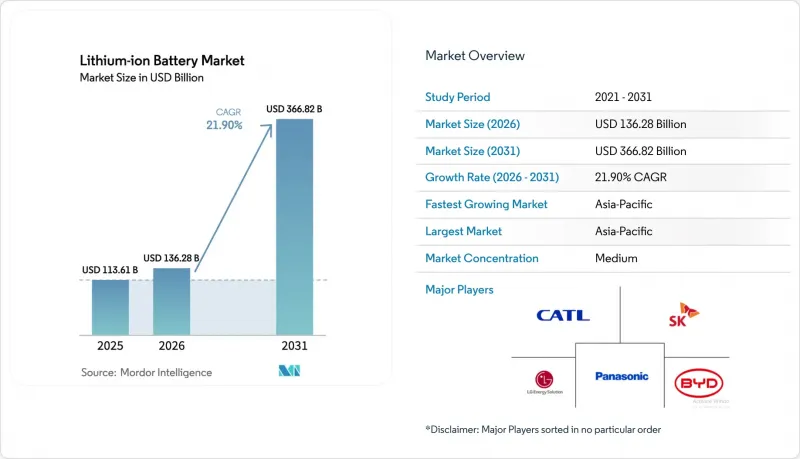
根據 Mordor Intelligence 預測,鋰離子電池市場預計將從 2025 年的 1,136.1 億美元成長到 2026 年的 1,362.8 億美元,到 2031 年達到 3,668.2 億美元,2026 年至 2031 年的複合年成長率為 21.90%。
本報告依產品類型(LCO、LFP、NMC、NCA、LMO、LTO)、形狀(圓柱形、矩形、軟包)、容量(3000 mAh 以下、3000–10000 mAh、10000–60000 mAh、60000 mAh以上)、終端用戶產業(汽車、家用電子電器、工業、固定式儲能、航太、船舶)和地區(北美、歐洲、亞太、南美、中東和非洲)進行分類。
全球鋰離子電池市場趨勢及洞察
長續航里程電動車平台對高能量密度電池的需求激增
高階汽車製造商目前普遍採用75kWh至120kWh的電池組,以確保續航里程超過400英里(約644公里)。梅賽德斯-賓士EQXX等原型車以及Lucid Air等量產車型均已驗證了這項標準。當鎳含量超過90%時,能量密度可超過250Wh/kg,但熱失控的風險也隨之增加,因此需要同時投資研發固體電解質和陶瓷隔膜。供應穩定性正面臨日益嚴峻的挑戰。汽車製造商正在繞過傳統的一級供應商,直接與電池製造商簽訂多年啟動協議,以確保電池化學成分藍圖與2028-2030車型週期保持一致。因此,鋰離子電池市場正變得更加垂直整合,供應商的議價能力向上游轉移。此舉雖然提高了資本密集度,但也縮短了研發週期,縮小了小規模新參與企業追趕的緩衝期。
中國的產業政策「中國製造2025」正加速國內鋰離子超級工廠的興建。
在「中國製造2025」計劃下,中國政府設定了2030年實現1,200吉瓦時(GWh)國內電池產能的目標。各省提供的優惠政策,包括免費土地和低價電力等,支撐了中國電池的成本結構,這是國外競爭對手難以匹敵的。光是寧德時代(CATL)一家,就將在2025年至2026年間在洛源和洛陽兩地運作70吉瓦時的電池產能;比亞迪也在深圳將其磷酸鋰鐵電池(LFP)產能擴大了25吉瓦時。該政策中包含的強制性技術轉移條款,使得當地企業能夠從韓國和日本的合作夥伴那裡獲得鎳鈷鋁(NCA)負極和矽負極方面的技術,從而提升自身的競爭力。同時,中國在印尼和泰國的投資也正在拓展其海外生態系統,旨在確保鎳紅土礦原料的供應,並積極應對未來的貿易壁壘。
中國的環境法規導致石墨負極材料短缺。
中國佔全球天然石墨開採量的65%和球墨鑄鐵加工量的95%,但2024年內蒙古和黑龍江兩省因環境檢查關閉了30%的產能,導致全球供應緊張。修訂後的污水和顆粒物排放標準使加工成本每噸增加了高達1,200美元,而2023年12月生效的許可證制度則更有利於國內電池製造商。中國以外的項目,例如Syrah公司的Vidalia項目和Nouveau Monde公司的魁北克生產線,到2030年只能滿足不到5%的需求。矽混合負極材料將降低對石墨的需求,但目前仍處於早期階段。
細分市場分析
預計到2025年,磷酸鋰鐵(LFP)電池的出貨量將佔電池總量的50%,超過富鎳電池。這主要得益於其每千瓦時47美元的成本優勢,使製造商免受碳酸鋰價格波動的影響。由於其熱穩定性在中國、印度和東南亞的入門級電動車市場備受青睞,預計到2031年,採用LFP電池的鋰離子電池市場將以每年23.5%的速度成長。汽車製造商正在拓展其化學成分的選擇範圍。特斯拉已在其面向美國市場的標準續航車型中重新引入LFP電池,通用汽車也已在其基於Ultium平台的商用車型中添加了LFP模組。同時,寧德時代(CATL)的「麒麟3.0」電芯到電池包一體化技術已將LFP電池的能量密度提升至255瓦時/公斤,縮小了與鎳基碳化鋰(NMC)電池的差距,並吸引了此前需要富鎳電池的中檔車型的關注。
儘管NMC電池對於目標能量密度超過250Wh/kg的豪華車和長途駕駛平台仍然至關重要,但其市場佔有率預計到2025年將下降至44.5%。 NCA電池和全固體電池的原型產品正在進一步提高能量密度,但成本和鈷供應的限制阻礙了其廣泛應用。在智慧型手機領域,隨著設備容量超過5000mAh,鈷酸鋰的市佔率持續萎縮。同時,錳酸鋰和鈦酸鋰的應用仍侷限於電動工具和高循環次數公車。鋰離子電池市場保持著產品系列的多樣性,但其價值正日益趨向於那些在成本、安全性和供應穩定性方面取得良好平衡的化學成分。
2025年,圓柱形電池仍維持49.3%的市佔率。這主要得益於特斯拉的「4680」電池以及電子產業的「18650」和「21700」等傳統電池的普及。然而,隨著汽車製造商採用將鋁箔層壓電池直接整合到車輛底盤中的「電池到電池包一體化」結構,預計到2031年,軟包電池的複合年成長率將達到22.7%。軟包電池的柔軟性使其體積效率提升高達60%,並透過省去中間模組,使電池包重量減少15%。因此,軟包電池的鋰離子電池市場規模成長速度超過了其他任何外形尺寸的電池。
棱柱形電池組設計在中國整車製造商中佔據主導地位,並正發展成為載重式「電池-車身一體化」概念,可將車輛重量減輕5%至8%。不同電池組的溫度控管策略有所不同;圓柱形電池組需要浸沒式冷卻或專用冷卻液通道,而軟包型和棱柱型電池組共用冷卻板,從而降低熱阻。 LG能源解決方案公司的P5系統採用此方法,可將電池組組件數量減少40%。雖然目前圓柱形電池組的良率較高,但預計在預測期內,模組化趨勢將推動軟包型和大型棱柱型電池組的資本投資增加。
區域分析
到2025年,亞太地區將佔據全球電池市場55.7%的佔有率,預計到2031年將以每年30.8%的速度成長。這主要得益於中國、印度和東南亞地區加速推動正極材料、負極材料和電池組裝的在地化進程。光是中國一國就將在2026年初之前運作150吉瓦時(GWh)的產能,其規模經濟效益將透過在印尼和泰國的合資企業惠及整個東協地區。印度已撥款1810億盧比用於先進化學電池工廠的建設,一條50吉瓦時(GWh)的磷酸鋰鐵(LFP)生產線預計將於2028年推出,這將促進信實工業(Reliance)、Panasonic)和寧德時代(CATL)之間的合作。日本和韓國在鎳基NMC和矽負極材料的研發方面繼續保持主導地位,Panasonic和特斯拉在堪薩斯州合作開發的4680電池進一步鞏固了其在該領域的領先地位。
北美市場佔有率正在上升。這主要歸功於《通貨膨脹控制法案》,該法案規定到2024年電池組件的在地採購必須達到50%,到2029年將提高到100%。通用汽車、福特和Stellantis已宣布總投資730億美元,計畫在2030年在全部區域建成500吉瓦時的產能。BASF和Northvolt等公司的正極材料和前驅體工廠正被吸引到加拿大各省的水力發電廠,而墨西哥則利用美墨加協定(USMCA)的規定和低廉的人事費用,在新萊昂州和哈利斯科州建立電池組組裝線。因此,鋰離子電池市場正在向亞洲、北美和歐洲的三方格局轉變。
在歐洲,供應鏈正透過「電池法規」進行重組,這些法規將強制要求從2025年2月起揭露碳足跡,並設定到2031年最低再生材料含量標準。 Northvolt的Skellefftair工廠使用可再生能源,包括水力發電和風力發電,其碳排放強度低於10公斤二氧化碳/千瓦時,但資本風險也凸顯出來,例如一家公司由於建設成本超支,於2025年在美國申請破產保護。德國的ACC財團已將計畫延後到2026年下半年,但法國、義大利和西班牙正在競相滿足即將到來的需求。南美洲、中東和非洲仍處於發展階段,但這些地區從一開始就展現出極大的熱情,例如沙烏地阿拉伯的NEOM計劃與Envision AESC合作建造一座10吉瓦時的工廠,目標是在2028年投入運作。
其他好處:
- Excel格式的市場預測(ME)表
- 3個月的分析師支持
目錄
第1章:引言
- 研究假設和市場定義
- 調查範圍
第2章:調查方法
第3章執行摘要
第4章 市場狀況
- 市場概覽
- 市場促進因素
- 長續航里程電動車平台對高能量密度電池的需求激增
- 中國的產業政策(「中國製造2025」)正加速興建國內鋰離子電池超級工廠。
- 美國公用事業規模電池採購項目快速擴張
- 北歐國家固定資料中心備用電池從 VRLA 電池過渡到鋰離子電池。
- 國際海事組織 (IMO) 在航運業中設定的溫室氣體 (GHG) 減排目標正在推動歐洲船舶採用鋰離子電池。
- 印度汽車製造商轉向使用磷酸鐵鋰電池(LFP)化學品來生產注重成本的入門級電動車。
- 市場限制因素
- 中國的環保法規導致石墨負極材料短缺。
- 自烏克蘭衝突以來,高壓電解液添加劑的價格飆升。
- 美國和歐盟在關鍵礦產方面的貿易壁壘正在破壞跨大西洋供應鏈。
- 大洋洲缺乏回收基礎設施,導致循環材料的流動速度減慢。
- 供應鏈分析
- 近期趨勢與發展
- 監理展望
- 科技趨勢
- 價格趨勢分析
- 波特五力模型
第5章 市場規模與成長預測
- 依產品類型
- 鈷酸鋰(LCO)
- 磷酸鋰鐵(LFP)
- 鋰鎳錳鈷(NMC)
- 鋰鎳鈷鋁(NCA)
- 鋰錳氧化物(LMO)
- 鈦酸鋰(LTO)
- 按外形規格
- 圓柱形
- 棱鏡
- 小袋
- 按功率容量
- 0~3,000 mAh
- 3,000~10,000 mAh
- 10,000~60,000 mAh
- 超過 60,000mAh
- 按最終用途行業分類
- 汽車(電動車、油電混合車、插電式油電混合車)
- 家用電子產品
- 工業和電動工具
- 固定式儲能
- 航太/國防
- 海上
- 按地區
- 北美洲
- 美國
- 加拿大
- 墨西哥
- 歐洲
- 英國
- 德國
- 法國
- 西班牙
- 北歐國家
- 俄羅斯
- 其他歐洲國家
- 亞太地區
- 中國
- 印度
- 日本
- 韓國
- 馬來西亞
- 泰國
- 印尼
- 越南
- 澳洲
- 其他亞太國家
- 南美洲
- 巴西
- 阿根廷
- 哥倫比亞
- 其他南美國家
- 中東和非洲
- 阿拉伯聯合大公國
- 沙烏地阿拉伯
- 南非
- 埃及
- 其他中東和非洲國家
- 北美洲
第6章 競爭情勢
- 市場集中度
- 策略趨勢(併購、聯盟、購電協議)
- 市場佔有率分析(主要公司的市場排名和佔有率)
- 公司簡介
- Contemporary Amperex Technology Co., Ltd.(CATL)
- BYD Company Limited
- LG Energy Solution Ltd.
- Panasonic Holdings Corp.
- Samsung SDI Co., Ltd.
- SK On Co., Ltd.
- AESC(Envision AESC Group)
- CALB Co., Ltd.
- Gotion High-Tech Co., Ltd.
- EVE Energy Co., Ltd.
- Farasis Energy Inc.
- Sunwoda Electronic Co., Ltd.
- Murata Manufacturing Co., Ltd.
- VARTA AG
- Toshiba Corporation
- Saft Groupe SAS
- Northvolt AB
- Microvast Holdings, Inc.
- A123 Systems LLC
- Hitachi Energy Ltd.
- Lithium Werks BV
- Tesla Inc.(Battery Division)
第7章 市場機會與未來展望
According to Mordor Intelligence, the lithium-ion battery market size is expected to increase from USD 113.61 billion in 2025 to USD 136.28 billion in 2026 and reach USD 366.82 billion by 2031, growing at a CAGR of 21.90% over 2026-2031.
This report is Segmented by Product Type (LCO, LFP, NMC, NCA, LMO, LTO), Form Factor (Cylindrical, Prismatic, Pouch), Power Capacity (Up To 3, 000 MAh, 3, 000 To 10, 000 MAh, 10, 000 To 60, 000 MAh, Above 60, 000 MAh), End-Use Industry (Automotive, Consumer Electronics, Industrial, Stationary Storage, Aerospace, Marine), and Geography (North America, Europe, Asia-Pacific, South America, Middle East and Africa).
Global Lithium-ion Battery Market Trends and Insights
Surging Demand for High-Energy-Density Batteries in Long-Range EV Platforms
Automakers competing in the premium segment now specify packs between 75 kWh and 120 kWh to guarantee 400-mile driving ranges or better, a threshold proven by prototypes such as Mercedes-Benz EQXX and commercial models like the Lucid Air. Nickel content above 90% pushes energy density past 250 Wh/kg but also heightens thermal-runaway risk, steering parallel investment toward solid-state electrolytes and ceramic separators. Supply security is tightening: original equipment manufacturers are locking multi-year offtake agreements directly with cell producers, bypassing traditional Tier-1 suppliers to align chemistry roadmaps with 2028-2030 model cycles. As a result, the lithium-ion battery market sees heightened vertical integration that redistributes bargaining power upstream. This move amplifies capital intensity but shortens development cycles, compressing the window for smaller entrants to catch up.
China's Industrial Policy "Made in China 2025" Accelerating Domestic Li-ion Gigafactory Build-Out
Beijing targets 1,200 GWh of domestic capacity by 2030 under "Made in China 2025" and provincial incentives ranging from land grants to cut-rate electricity underpin cost structures foreign rivals struggle to match. CATL alone commissioned 70 GWh across Luoyuan and Luoyang between 2025 and 2026, while BYD added 25 GWh of LFP output in Shenzhen. The policy's mandatory technology-transfer clauses let local firms absorb NCA and silicon-anode know-how from Korean and Japanese partners, broadening competitive depth. Concurrent investments in Indonesia and Thailand extend China's ecosystem offshore to secure nickel laterite feedstock and to pre-empt potential trade barriers.
Graphite Anode Supply Tightness Owing to Chinese Environmental Curtailments
China controls 65% of mined natural graphite and 95% of spherical processing, and environmental inspections that shuttered 30% of Inner Mongolia and Heilongjiang capacity during 2024 tightened global supply. Revised wastewater and particulate standards raised processing costs by up to USD 1,200 per tonne, while December 2023 export licensing favors domestic cell makers. Non-Chinese projects such as Syrah's Vidalia and Nouveau Monde's Quebec lines will cover less than 5% of 2030 demand. Silicon-blend anodes lower the graphite needs but remain early-stage.
Other drivers and restraints analyzed in the detailed report include:
- Rapid Roll-Out of Utility-Scale Battery Energy Storage Procurements in the United States
- Stationary Data-Center Back-Up Migration from VRLA to Lithium-Ion in Nordic Countries
- High-Voltage Electrolyte Additive Cost Inflation Post-Ukraine Conflict
For complete list of drivers and restraints, kindly check the Table Of Contents.
Segment Analysis
Lithium iron phosphate commanded 50% of 2025 cell shipments, overtaking nickel-rich chemistries on the strength of a USD 47 per kWh advantage that shields manufacturers from lithium carbonate swings. The lithium-ion battery market size for LFP cells is projected to expand at 23.5% through 2031 as entry-level EVs in China, India, and Southeast Asia favor its thermal stability. Automakers are widening chemistry menus: Tesla reintroduced LFP in standard-range U.S. models, while General Motors added LFP modules to commercial variants of its Ultium platform. Concurrently, CATL's cell-to-pack Qilin 3.0 lifts LFP energy density to 255 Wh/kg, narrowing the gap with NMC and attracting mid-range vehicles that previously insisted on nickel-rich chemistries.
NMC remains indispensable in luxury and long-range platforms that target 250-plus Wh/kg, but its share slid to 44.5% in 2025. NCA and solid-state prototypes push density even higher, yet cost and cobalt constraints restrain wide adoption. Lithium cobalt oxide continues to retreat in smartphones as handset capacities crest 5,000 mAh; meanwhile, lithium manganese oxide and lithium titanate remain confined to power tools and high-cycle buses. The lithium-ion battery market maintains portfolio diversity, but value is gravitating toward chemistries that balance cost, safety, and supply security.
Cylindrical cells retained a 49.3% share in 2025, anchored by Tesla's 4680 and a legacy base of 18650s and 21700s in electronics. Yet pouch formats are slated for a 22.7% CAGR through 2031 as automakers adopt cell-to-pack architectures that integrate aluminum-laminate cells directly into vehicle chassis. Pouch flexibility improves volumetric efficiency by up to 60% and eliminates intermediate modules, trimming 15% pack mass. The lithium-ion battery market size for pouch cells, therefore, grows faster than any rival form factor.
Prismatic designs dominate Chinese OEM preferences and evolve toward load-bearing cell-to-body concepts that cut vehicle weight by 5% to 8%. Thermal strategies differ: cylindrical arrays require immersion or dedicated coolant channels, whereas pouch and prismatic stacks share cooling plates, reducing resistance. LG Energy Solution's P5 system removes 40% of pack components via this approach. Manufacturing yields currently favor cylindrical lines, but module-free trends tilt capital toward pouch and large prismatic tooling over the forecast horizon.
Complete Report Scope:
- By Product Type
- Lithium Cobalt Oxide (LCO)
- Lithium Iron Phosphate (LFP)
- Lithium Nickel Manganese Cobalt (NMC)
- Lithium Nickel Cobalt Aluminium (NCA)
- Lithium Manganese Oxide (LMO)
- Lithium Titanate (LTO)
- By Form Factor
- Cylindrical
- Prismatic
- Pouch
- By Power Capacity
- 0 to 3,000 mAh
- 3,000 to 10,000 mAh
- 10,000 to 60,000 mAh
- Above 60,000 mAh
- By End-use Industry
- Automotive (EV, HEV, PHEV)
- Consumer Electronics
- Industrial and Power Tools
- Stationary Energy Storage
- Aerospace and Defense
- Marine
- By Geography
- North America
- United States
- Canada
- Mexico
- Europe
- United Kingdom
- Germany
- France
- Spain
- Nordic Countries
- Russia
- Rest of Europe
- Asia-Pacific
- China
- India
- Japan
- South Korea
- Malaysia
- Thailand
- Indonesia
- Vietnam
- Australia
- Rest of Asia-Pacific
- South America
- Brazil
- Argentina
- Colombia
- Rest of South America
- Middle East and Africa
- United Arab Emirates
- Saudi Arabia
- South Africa
- Egypt
- Rest of Middle East and Africa
- North America
Geography Analysis
Asia-Pacific commanded 55.7% of the 2025 value and is forecast to expand at 30.8% through 2031 as China, India, and Southeast Asia hurry to localize cathode, anode, and cell assembly. China alone commissioned 150 GWh of new capacity by early 2026, sustaining scale economies that ripple across ASEAN through joint ventures in Indonesia and Thailand. India's incentive scheme earmarks INR 181 billion for advanced-chemistry cell plants, anchoring 50 GWh of prospective LFP lines by 2028 and drawing collaborations among Reliance, Panasonic, and CATL. Japan and South Korea continue to lead high-nickel NMC and silicon-anode research; Panasonic's 4680 tie-up with Tesla in Kansas underscores that edge.
North America's share is rising as the Inflation Reduction Act requires 50% local battery components in 2024, escalating to 100% by 2029. Announced investments from General Motors, Ford, and Stellantis total USD 73 billion toward a 500 GWh regional footprint by 2030. Canada's hydro-powered provinces attract cathode and precursor plants from BASF and Northvolt, while Mexico leverages USMCA rules and lower labor costs for pack assembly lines in Nuevo Leon and Jalisco. The lithium-ion battery market thus becomes tri-polar across Asia, North America, and Europe.
Europe is reshaping supply through the Battery Regulation that enforces carbon-footprint declarations from February 2025 and minimum recycled-content thresholds by 2031. Northvolt's Skelleftea plant runs on renewable hydro and wind, cutting carbon intensity below 10 kg CO2/kWh, yet construction overruns led to a 2025 Chapter 11 filing in the United States, highlighting capital risk. Germany's ACC consortium is delayed to late 2026, while France, Italy, and Spain race to capture the impending demand. South America and the Middle East-Africa are nascent but signal early ambition, with Saudi Arabia's NEOM planning a 10 GWh plant with Envision AESC for a 2028 start-up.
- Contemporary Amperex Technology Co., Ltd. (CATL)
- BYD Company Limited
- LG Energy Solution Ltd.
- Panasonic Holdings Corp.
- Samsung SDI Co., Ltd.
- SK On Co., Ltd.
- AESC (Envision AESC Group)
- CALB Co., Ltd.
- Gotion High-Tech Co., Ltd.
- EVE Energy Co., Ltd.
- Farasis Energy Inc.
- Sunwoda Electronic Co., Ltd.
- Murata Manufacturing Co., Ltd.
- VARTA AG
- Toshiba Corporation
- Saft Groupe SAS
- Northvolt AB
- Microvast Holdings, Inc.
- A123 Systems LLC
- Hitachi Energy Ltd.
- Lithium Werks BV
- Tesla Inc. (Battery Division)
Additional Benefits:
- The market estimate (ME) sheet in Excel format
- 3 months of analyst support
TABLE OF CONTENTS
1 Introduction
- 1.1 Study Assumptions & Market Definition
- 1.2 Scope of the Study
2 Research Methodology
3 Executive Summary
4 Market Landscape
- 4.1 Market Overview
- 4.2 Market Drivers
- 4.2.1 Surging Demand for High-Energy-Density Batteries in Long-Range EV Platforms
- 4.2.2 China's Industrial Policy ("Made in China 2025") Accelerating Domestic Li-ion Gigafactory Build-out
- 4.2.3 Rapid Roll-out of Utility-Scale Battery Energy Storage Procurements in the United States
- 4.2.4 Stationary Data-centre Back-up Migration from VRLA to Lithium-ion in Nordic Countries
- 4.2.5 Maritime IMO GHG targets Driving Marine-Grade Li-ion Adoption in Europe
- 4.2.6 OEM Shift to LFP Chemistry for Cost-Sensitive Entry-Level EVs in India
- 4.3 Market Restraints
- 4.3.1 Graphite Anode Supply Tightness Owing to Chinese Environmental Curtailments
- 4.3.2 High-Voltage Electrolyte Additive Cost Inflation Post-Ukraine Conflict
- 4.3.3 US-EU Trade Barriers on Critical Minerals Undermining Trans-Atlantic Supply Chains
- 4.3.4 Recycling Infrastructure Lag Delaying Circular Material Flows in Oceania
- 4.4 Supply-Chain Analysis
- 4.5 Recent Trends & Developments
- 4.6 Regulatory Outlook
- 4.7 Technology Outlook
- 4.8 Price Trend Analysis
- 4.9 Porter's Five Forces
- 4.9.1 Bargaining Power of Suppliers
- 4.9.2 Bargaining Power of Buyers
- 4.9.3 Threat of New Entrants
- 4.9.4 Threat of Substitutes
- 4.9.5 Intensity of Competitive Rivalry
5 Market Size & Growth Forecasts
- 5.1 By Product Type
- 5.1.1 Lithium Cobalt Oxide (LCO)
- 5.1.2 Lithium Iron Phosphate (LFP)
- 5.1.3 Lithium Nickel Manganese Cobalt (NMC)
- 5.1.4 Lithium Nickel Cobalt Aluminium (NCA)
- 5.1.5 Lithium Manganese Oxide (LMO)
- 5.1.6 Lithium Titanate (LTO)
- 5.2 By Form Factor
- 5.2.1 Cylindrical
- 5.2.2 Prismatic
- 5.2.3 Pouch
- 5.3 By Power Capacity
- 5.3.1 0 to 3,000 mAh
- 5.3.2 3,000 to 10,000 mAh
- 5.3.3 10,000 to 60,000 mAh
- 5.3.4 Above 60,000 mAh
- 5.4 By End-use Industry
- 5.4.1 Automotive (EV, HEV, PHEV)
- 5.4.2 Consumer Electronics
- 5.4.3 Industrial and Power Tools
- 5.4.4 Stationary Energy Storage
- 5.4.5 Aerospace and Defense
- 5.4.6 Marine
- 5.5 By Geography
- 5.5.1 North America
- 5.5.1.1 United States
- 5.5.1.2 Canada
- 5.5.1.3 Mexico
- 5.5.2 Europe
- 5.5.2.1 United Kingdom
- 5.5.2.2 Germany
- 5.5.2.3 France
- 5.5.2.4 Spain
- 5.5.2.5 Nordic Countries
- 5.5.2.6 Russia
- 5.5.2.7 Rest of Europe
- 5.5.3 Asia-Pacific
- 5.5.3.1 China
- 5.5.3.2 India
- 5.5.3.3 Japan
- 5.5.3.4 South Korea
- 5.5.3.5 Malaysia
- 5.5.3.6 Thailand
- 5.5.3.7 Indonesia
- 5.5.3.8 Vietnam
- 5.5.3.9 Australia
- 5.5.3.10 Rest of Asia-Pacific
- 5.5.4 South America
- 5.5.4.1 Brazil
- 5.5.4.2 Argentina
- 5.5.4.3 Colombia
- 5.5.4.4 Rest of South America
- 5.5.5 Middle East and Africa
- 5.5.5.1 United Arab Emirates
- 5.5.5.2 Saudi Arabia
- 5.5.5.3 South Africa
- 5.5.5.4 Egypt
- 5.5.5.5 Rest of Middle East and Africa
- 5.5.1 North America
6 Competitive Landscape
- 6.1 Market Concentration
- 6.2 Strategic Moves (M&A, Partnerships, PPAs)
- 6.3 Market Share Analysis (Market Rank/Share for key companies)
- 6.4 Company Profiles (includes Global level Overview, Market level overview, Core Segments, Financials as available, Strategic Information, Products & Services, and Recent Developments)
- 6.4.1 Contemporary Amperex Technology Co., Ltd. (CATL)
- 6.4.2 BYD Company Limited
- 6.4.3 LG Energy Solution Ltd.
- 6.4.4 Panasonic Holdings Corp.
- 6.4.5 Samsung SDI Co., Ltd.
- 6.4.6 SK On Co., Ltd.
- 6.4.7 AESC (Envision AESC Group)
- 6.4.8 CALB Co., Ltd.
- 6.4.9 Gotion High-Tech Co., Ltd.
- 6.4.10 EVE Energy Co., Ltd.
- 6.4.11 Farasis Energy Inc.
- 6.4.12 Sunwoda Electronic Co., Ltd.
- 6.4.13 Murata Manufacturing Co., Ltd.
- 6.4.14 VARTA AG
- 6.4.15 Toshiba Corporation
- 6.4.16 Saft Groupe SAS
- 6.4.17 Northvolt AB
- 6.4.18 Microvast Holdings, Inc.
- 6.4.19 A123 Systems LLC
- 6.4.20 Hitachi Energy Ltd.
- 6.4.21 Lithium Werks BV
- 6.4.22 Tesla Inc. (Battery Division)
7 Market Opportunities & Future Outlook
- 7.1 White-space & Unmet-Need Assessment

 2026-2034年全球液態鋰離子電池市場規模、佔有率、趨勢和成長分析報告2026-2034年全球鋰箔市場規模、佔有率、趨勢和成長分析報告
 東南亞鋰離子電池:市場佔有率分析、行業趨勢和統計數據以及成長預測(2026-2031 年)
 鋰離子電池市場分析及預測至 2035 年:按類型、產品、技術、組件、應用、形式、材料類型、最終用戶、功能和安裝類型分類。
 鋰離子電池市場預測至 2034 年——按電池化學成分、組件、容量、電壓、外形尺寸、應用、最終用戶、銷售管道和地區進行全球分析。印度鋰離子電池:市場佔有率分析、行業趨勢和統計數據以及成長預測(2026-2031 年)全球無鈷正極材料市場規模、佔有率、趨勢和成長分析報告(2026-2034)
 鋰離子電池市場:2026-2032 年全球市場預測,依電池化學成分、電壓範圍、外形尺寸和應用細分。
 無鈷陰極材料市場機會、成長要素、產業趨勢分析及2026-2035年預測。
 住宅鋰離子電池市場-全球產業規模、佔有率、趨勢、機會、預測:按類型和最終用途產業、地區和競爭格局分類,2021-2031年