


 |
市場調查報告書
商品編碼
2124660
美國智慧鎖:市場佔有率分析、產業趨勢與統計及成長預測(2026-2031)United States Smart Lock - Market Share Analysis, Industry Trends & Statistics, Growth Forecasts (2026 - 2031) |
||||||

※ 本網頁內容可能與最新版本有所差異。詳細情況請與我們聯繫。
據 Mordor Intelligence 稱,2025 年美國智慧鎖市場價值為 33.6 億美元,預計到 2031 年將達到 60.3 億美元,而 2026 年為 38.8 億美元,預測期(2026-2031 年)的複合年成長率為 9.22%。
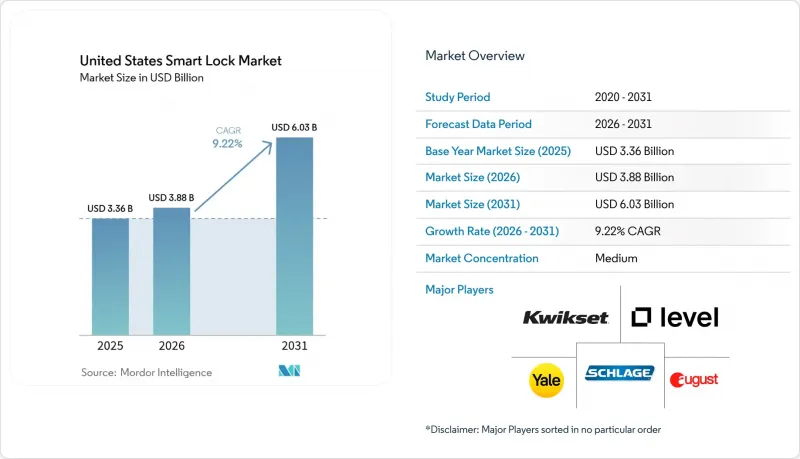
本報告按產品類型(例如:門栓、掛鎖等)、最終用戶(例如:住宅(例如:獨棟多用戶住宅)、商業(例如:飯店、零售、公司辦公室等))、安裝類型(例如:改造等)和分銷管道(例如:線上(例如:電商平台等)、線下(例如:專業安裝商))進行細分。市場預測以美元計價。
美國智慧鎖市場趨勢與洞察
與智慧家庭中心和語音助理整合
隨著 Matter 1.3 於 2024 年底獲得批准,智慧鎖無需專用橋接器即可與 Apple Home、Google Home、Amazon Alexa 和 Samsung SmartThings 等智慧家庭平台互通,從而消除了普及的一大障礙。 Thread 網狀網路取代藍牙低功耗 (Bluetooth Low Energy) 成為電池供電智慧鎖的預設無線通訊標準,降低了延遲並擴大了多層住宅的覆蓋範圍。 Schlage 的 Encode Plus 於 2025 年初開始支援 Apple Home Key,Kwikset 的 Halo Select Plus 也於 2025 年 8 月實現了類似的功能,進一步增強了其在身份驗證方面的競爭優勢。語音助理現在可以透過一條語音指令執行複雜的操作,例如鎖門、啟動警報系統和調節恆溫器,從而降低了首次購買者的技術門檻。因此,智慧鎖的易用性得到了提升,美國智慧鎖市場也從早期用戶擴展到一般家庭用戶。持續的韌體更新使舊設備獲得 Matter 認證,進一步保護了消費者的投資,並促進了它們融入智慧鎖生態系統。
宅配的不斷增加推動了家庭安防的需求。
根據物流公司彙總數據和零售商調查,預計到2025年,美國每天將有約25萬個小包裹被盜,每年對美國家庭造成約150億美元的損失。整合式門鈴攝影機的智慧鎖允許屋主創建一次性或限時密碼,方便快遞員將小包裹放在前院或車庫中。亞馬遜的「車庫鑰匙投遞」計畫將於2025年前擴展到另外15個大都會區,鎖具供應商正競相獲得「鑰匙投遞」認證以進入該通路。雖然郊區獨棟住宅的小包裹數量不斷增加,但與城市地區相比,郊區攝影機的密度較低,這推動了對門禁控制收貨點的需求。因此,影像驗證、臨時認證和雲端日誌記錄等功能的整合,使入口大門成為最後一公里物流鏈中的關鍵樞紐,從而促進了美國智慧鎖市場的銷售。
持續存在的網路安全漏洞和公開披露的駭客攻擊事件
2024 年 DEF CON 32 大會上的一項演示表明,用於酒店門鎖的 RFID 卡可在 60 秒內被複製。此外,2024 年至 2025 年的 CVE 揭露揭示了多個消費品牌產品中存在的硬程式編碼金鑰和重播攻擊漏洞。與歐洲的 ETSI TS 103 815 標準不同,美國缺乏強制性的聯邦認證體系,導致美國消費者只能依靠媒體報告和品牌聲譽來評估設備的安全性。每一次安全漏洞都會暫時抑制零售需求,尤其是在那些擔心門鎖被盜用的精通科技的住宅群體中。雖然製造商正在透過安全引導程式和基於硬體的加密來解決這個問題,但 SoC 更新卻延長了產品週期並增加了組件成本。因此,儘管功能創新不斷加速,但一系列負面新聞正在減緩美國智慧鎖市場的發展勢頭。
細分市場分析
到2025年,插銷式智慧鎖將占美國智慧鎖市場佔有率的60.73%,反映出其在獨棟住宅外門上的廣泛應用。同時,由於飯店、辦公室和醫療機構優先考慮符合建築規範的1級機械強度和緊急逃脫功能,預計到2031年,榫眼式和槓桿式智慧鎖的複合年成長率將達到10.37%。在美國智慧鎖市場,榫眼式平台的市場規模預計將從2026年的7億美元成長到2031年的11.5億美元。由於商業買家願意接受更高的平均售價(考慮到其耐用性和全面的保固服務),預計其成長速度將超過銷售成長。製造商目前正在推出模組化底盤,配備可互換的裝飾、表面處理、認證模組以及Wi-Fi、Thread或Zigbee相容性,從而減少了SKU數量,並簡化了安裝人員的物流操作。
槓桿式智慧鎖符合《美國殘障人士法案》(ADA)規定的淨空角度和單手逃生要求,在養老院和公立學校等建築檢查員要求使用無障礙五金件的場所,其應用越來越廣泛。掛鎖式智慧鎖雖然仍屬於小眾但市場需求強勁,尤其受到物流場的需求,因為這類智慧鎖無需在貨櫃門上永久鑽孔即可取得稽核日誌。另一方面,外裝式智慧鎖在多用戶住宅居民中很受歡迎,但其表面安裝式設計限制了其在高所得屋主中的普及。所有類型的智慧鎖都在快速改進,以最佳化電池續航時間和升級到「物質取代線材」技術,模糊了傳統商用和消費級智慧鎖功能之間的界限,並保持了美國智慧鎖市場產品多樣化的發展勢頭。
儘管住宅買家在2025年佔銷售額的88.39%,但預計到2031年,酒店、零售、企業園區、教育和醫療保健等行業的商業應用將達到11.12%的複合年成長率,是住宅市場成長率的兩倍。從RFID卡遷移到行動認證的連鎖飯店正在獲得顯著的投資回報。簡化前台流程不僅提高了賓客滿意度,也降低了塑膠卡的成本。 Dormakaba的「Ambiance Cloud」系統將在2025年前部署到500多家飯店,而Vingcard的「VConnect」系統則為現有設備添加了Apple和Google Wallet的金鑰功能,這凸顯了該技術在整個生態系統中的廣泛應用。
企業辦公室正在向無固定辦公桌系統轉型,並在辦公室套間、電話亭和儲物櫃中安裝具備身份驗證功能的智慧鎖,將存取日誌與佔用分析相結合,以輔助房地產整合決策。大型零售商店正在倉庫和POS機收銀抽屜中安裝智慧掛鎖,取代人工鑰匙借用。在醫療保健領域,智慧鎖確保了藥品儲存室的安全,並提高了符合HIPAA標準的藥品審計的準確性。同時,大學正在將學生ID系統整合到宿舍門鎖中,在學生畢業或受到紀律處分時自動失效身分驗證資訊。這些多樣化的商業應用案例推動了SaaS模式的單門經常性收入高於住宅管道,提高了美國智慧鎖定產業的平均售價,並促進了收入多元化。
其他好處:
- Excel格式的市場預測(ME)表
- 3個月的分析師支持
目錄
第1章:引言
- 研究假設和市場定義
- 調查範圍
第2章:調查方法
第3章執行摘要
第4章 市場狀況
- 市場概覽
- 市場促進因素
- 與智慧家庭中心和語音助理整合
- 包裹竊盜案的增加推高了對入戶門安全防護的需求。
- 安裝智慧安防設備可享保險費折扣
- 智慧鎖在「建造出租」型獨立住宅的開發中已被廣泛應用。
- 互聯接入解決方案的ESG和LEED獎勵
- 智慧型手機內建的UWB免鑰匙進入功能
- 市場限制因素
- 持續存在的網路安全漏洞和公開披露的駭客攻擊事件
- 《建築標準法》中關於多戶住宅維修設備的規定
- 安全SoC晶片組供應受限
- 消費者對資料共用的隱私擔憂
- 產業價值鏈分析
- 監理情勢
- 技術展望
- 波特五力分析
- 價格分析
- 宏觀經濟因素對市場的影響
第5章 市場規模與成長預測
- 依產品類型
- 門栓
- 掛鎖
- 其他產品類型(嵌入式、槓桿式、輪圈式等)
- 最終用戶
- 住宅
- 獨立式住宅
- 多用戶住宅
- 商業
- 飯店業
- 零售
- 公司總部
- 衛生保健
- 教育及其他
- 住宅
- 按安裝類型
- 改裝
- 新一體化型
- 透過分銷管道
- 線上
- 廠商直銷
- 市場
- 離線
- 零售
- 專業安裝公司
- 線上
第6章 競爭情勢
- 市場集中度
- 策略趨勢
- 市佔率分析
- 公司簡介
- August Home Inc.
- ASSA ABLOY Residential Group, Inc.(doing business as Yale Home)
- Kwikset Corporation(an ASSA ABLOY company)
- Schlage Lock Company LLC(wholly owned by Allegion plc)
- Level Home Inc.
- U-Tec Group Inc.
- Wyze Labs, Inc.
- Pin Genie Inc.(doing business as Lockly)
- Anker Innovations Limited(Eufy Security brand)
- SimpliSafe, Inc.
- Aqara(Lumi United Technology Co., Ltd.)
- Gate Labs Inc.
- LockState, Inc.(doing business as RemoteLock)
- Shenzhen Wonder Technology Co., Ltd.(doing business as SwitchBot)
- Onity, Inc.(a Carrier Global Corporation company)
- Digilock, Inc.
- Igloohome Pte. Ltd.
- Nuki Home Solutions GmbH
- PDQ Manufacturing, Inc.
- Baldwin Hardware Corporation(an ASSA ABLOY company)
第7章 市場機會與未來展望
According to Mordor Intelligence, the United States smart lock market size was valued at USD 3.36 billion in 2025 and estimated to grow from USD 3.88 billion in 2026 to reach USD 6.03 billion by 2031, at a CAGR of 9.22% during the forecast period (2026-2031).
This report is Segmented by Product Type (Deadbolt, Padlock, and More), End-User (Residential (Single-Family, and Multi-Family), Commercial (Hospitality, Retail, Corporate Offices, and More)), Installation Type (Retrofit, and More), and Distribution Channel (Online (Marketplaces, and More), Offline (Retailers, and Professional Installers)). The Market Forecasts are Provided in Terms of Value (USD).
United States Smart Lock Market Trends and Insights
Integration With Smart-Home Hubs and Voice Assistants
Matter 1.3 certification, ratified in late 2024, lets locks interoperate across Apple Home, Google Home, Amazon Alexa, and Samsung SmartThings without proprietary bridges, eliminating a major adoption barrier. Thread mesh networking replaces Bluetooth Low Energy as the default radio for battery-powered locks, cutting latency and improving range inside multistory residences. Schlage's Encode Plus debuted Apple Home Key support in early 2025, and Kwikset's Halo Select Plus matched the feature set by August 2025, reinforcing competitive parity on credential options. Voice assistants now trigger compound routines, such as locking the door, arming the alarm, and adjusting the thermostat, through a single spoken command, which lowers the technical threshold for first-time buyers. The resulting rise in ease of use is broadening the United States smart lock market beyond early adopters into mass-market households. Continued firmware updates that bring Matter certification to older devices further protect consumer investment and encourage ecosystem stickiness.
Rising Package-Theft Incidents Boosting Entryway Security Demand
An estimated 250 000 parcels were stolen every day in 2025, driving USD 15 billion in annual losses across U.S. households according to aggregated carrier claims and retailer surveys. Smart locks paired with doorbell cameras allow owners to create one-time or time-bounded codes so delivery drivers can leave packages inside vestibules or garages. Amazon's Key In-Garage Delivery program expanded to 15 additional metros in 2025, prompting lock vendors to pursue "Key-compatible" certification to tap that channel. Higher parcel volume in suburban single-family neighborhoods, combined with lower camera density than urban cores, intensifies demand for access-controlled drop-off points. The functional convergence of video verification, temporary credentials, and cloud logging has therefore repositioned entry doors as critical nodes in the last-mile logistics chain, lifting unit sales within the United States smart lock market.
Persistent Cyber-Security Vulnerabilities and Public Hacks
Demonstrations at DEF CON 32 in 2024 showed cloning of hotel-lock RFID cards in under 60 seconds, while CVE disclosures during 2024-2025 exposed hard-coded keys and replay flaws in several consumer brands. Absent a mandatory federal certification regime, unlike the European ETSI TS 103 815 baseline, U.S. buyers rely on media reports and brand reputation to gauge device security. Each breach temporarily suppresses retail demand, especially among tech-savvy homeowners who fear door-unlock exploits. Manufacturers have responded with secure boot loaders and hardware-backed encryption, but SoC updates lengthen product cycles and raise bill-of-materials costs. Continued negative headlines therefore subtract momentum from the United States smart lock market even as feature innovation accelerates.
Other drivers and restraints analyzed in the detailed report include:
- Build-to-Rent Single-Family Developments Adopting Smart Locks at Scale
- UWB Passive-Entry Capabilities Embedded in Smartphones
- Multi-Family Building Code Restrictions on Retrofit Devices
For complete list of drivers and restraints, kindly check the Table Of Contents.
Segment Analysis
Deadbolts commanded 60.73% of United States smart lock market share in 2025, reflecting their ubiquity on single-family exterior doors. Mortise and lever formats, however, are forecast to grow at a 10.37% CAGR through 2031 as hotels, offices, and healthcare facilities prioritize Grade 1 mechanical robustness and code-compliant panic egress. The United States smart lock market size attributed to mortise platforms is projected to expand from USD 0.70 billion in 2026 to USD 1.15 billion by 2031, outpacing unit growth because commercial buyers accept higher average selling prices for durability and warranty coverage. Manufacturers now ship modular chassis that accept interchangeable trims, finishes, and credential modules, Wi-Fi, Thread, or Zigbee, reducing SKU count and smoothing installer logistics.
Lever-handle locks satisfy Americans with Disabilities Act clearance angles and one-hand egress rules, increasing adoption in elder-care facilities and public schools where building inspectors demand accessible hardware. Padlock-style smart locks remain a niche but resilient sub-segment, especially among logistics yards that need audit logs without drilling permanent holes into container doors. Meanwhile, rim locks attract multifamily renters who cannot alter door hardware, yet their surface-mount profile limits penetration into higher-income owner-occupied homes. Across every format, rapid iteration on battery-life optimization and Matter-over-Thread upgrades is blurring historical boundaries between commercial and consumer feature sets, sustaining momentum for product diversification inside the United States smart lock market.
Residential buyers generated 88.39% of 2025 revenue, but commercial deployments, in hospitality, retail, corporate campuses, education, and healthcare, are projected to post an 11.12% CAGR to 2031, twice the residential rate. Hotel chains migrating from RFID cards to mobile credentials show clear ROI: front-desk bypass improves guest satisfaction scores while reducing plastic card costs. Dormakaba's Ambiance Cloud on-boarded over 500 hotels in 2025, and Vingcard's VConnect added Apple and Google Wallet keys to legacy installations, confirming broad ecosystem uptake.
Corporate offices pivoting toward hot-desking rely on credentialed locks for office suites, phone booths, and lockers, linking access logs to occupancy analytics that inform real-estate consolidation decisions. Retail big-box stores deploy smart padlocks on warehouses and point-of-sale cash drawers, replacing manual key sign-outs. In healthcare, smart locks secure medication rooms to improve narcotics auditing under HIPAA, while universities integrate student ID systems to dormitory locks, automatically revoking credentials upon graduation or disciplinary action. This mosaic of commercial use cases captures higher recurring SaaS revenue per door than residential channels, lifting the blended average selling price and reinforcing revenue diversification across the United States smart lock industry.
Complete Report Scope:
- By Product Type
- Deadbolt
- Padlock
- Other Product Types (Mortise, Lever, Rim, etc.)
- By End-User
- Residential
- Single-Family
- Multi-Family
- Commercial
- Hospitality
- Retail
- Corporate Offices
- Healthcare
- Education and More
- Residential
- By Installation Type
- Retrofit
- New-Construction Integrated
- By Distribution Channel
- Online
- Direct from Manufacturer
- Marketplaces
- Offline
- Retailers
- Professional Installers
- Online
List of Companies Covered in this Report:
- August Home Inc.
- ASSA ABLOY Residential Group, Inc. (doing business as Yale Home)
- Kwikset Corporation (an ASSA ABLOY company)
- Schlage Lock Company LLC (wholly owned by Allegion plc)
- Level Home Inc.
- U-Tec Group Inc.
- Wyze Labs, Inc.
- Pin Genie Inc. (doing business as Lockly)
- Anker Innovations Limited (Eufy Security brand)
- SimpliSafe, Inc.
- Aqara (Lumi United Technology Co., Ltd.)
- Gate Labs Inc.
- LockState, Inc. (doing business as RemoteLock)
- Shenzhen Wonder Technology Co., Ltd. (doing business as SwitchBot)
- Onity, Inc. (a Carrier Global Corporation company)
- Digilock, Inc.
- Igloohome Pte. Ltd.
- Nuki Home Solutions GmbH
- PDQ Manufacturing, Inc.
- Baldwin Hardware Corporation (an ASSA ABLOY company)
Additional Benefits:
- The market estimate (ME) sheet in Excel format
- 3 months of analyst support
TABLE OF CONTENTS
1 INTRODUCTION
- 1.1 Study Assumptions and Market Definition
- 1.2 Scope of the Study
2 RESEARCH METHODOLOGY
3 EXECUTIVE SUMMARY
4 MARKET LANDSCAPE
- 4.1 Market Overview
- 4.2 Market Drivers
- 4.2.1 Integration With Smart-Home Hubs and Voice Assistants
- 4.2.2 Rising Package-Theft Incidents Boosting Entryway Security Demand
- 4.2.3 Insurance Premium Discounts for Smart-Security Installations
- 4.2.4 Build-to-Rent Single-Family Developments Adopting Smart Locks at Scale
- 4.2.5 ESG and LEED Incentives for Connected Access Solutions
- 4.2.6 UWB Passive-Entry Capabilities Embedded in Smartphones
- 4.3 Market Restraints
- 4.3.1 Persistent Cyber-Security Vulnerabilities and Public Hacks
- 4.3.2 Multi-Family Building Code Restrictions on Retrofit Devices
- 4.3.3 Chip-Set Supply Constraints for Secure SoCs
- 4.3.4 Consumer Privacy Concerns Over Data Sharing
- 4.4 Industry Value Chain Analysis
- 4.5 Regulatory Landscape
- 4.6 Technological Outlook
- 4.7 Porter's Five Forces Analysis
- 4.7.1 Bargaining Power of Suppliers
- 4.7.2 Bargaining Power of Buyers
- 4.7.3 Threat of New Entrants
- 4.7.4 Intensity of Competitive Rivalry
- 4.7.5 Threat of Substitute Products
- 4.8 Pricing Analysis
- 4.9 Impact of Macroeconomic Factors on the Market
5 MARKET SIZE AND GROWTH FORECASTS (VALUE)
- 5.1 By Product Type
- 5.1.1 Deadbolt
- 5.1.2 Padlock
- 5.1.3 Other Product Types (Mortise, Lever, Rim, etc.)
- 5.2 By End-User
- 5.2.1 Residential
- 5.2.1.1 Single-Family
- 5.2.1.2 Multi-Family
- 5.2.2 Commercial
- 5.2.2.1 Hospitality
- 5.2.2.2 Retail
- 5.2.2.3 Corporate Offices
- 5.2.2.4 Healthcare
- 5.2.2.5 Education and More
- 5.2.1 Residential
- 5.3 By Installation Type
- 5.3.1 Retrofit
- 5.3.2 New-Construction Integrated
- 5.4 By Distribution Channel
- 5.4.1 Online
- 5.4.1.1 Direct from Manufacturer
- 5.4.1.2 Marketplaces
- 5.4.2 Offline
- 5.4.2.1 Retailers
- 5.4.2.2 Professional Installers
- 5.4.1 Online
6 COMPETITIVE LANDSCAPE
- 6.1 Market Concentration
- 6.2 Strategic Moves
- 6.3 Market Share Analysis
- 6.4 Company Profiles (includes Global Level Overview, Market Level Overview, Core Segments, Financials as available, Strategic Information, Market Rank/Share, Products and Services, Recent Developments)
- 6.4.1 August Home Inc.
- 6.4.2 ASSA ABLOY Residential Group, Inc. (doing business as Yale Home)
- 6.4.3 Kwikset Corporation (an ASSA ABLOY company)
- 6.4.4 Schlage Lock Company LLC (wholly owned by Allegion plc)
- 6.4.5 Level Home Inc.
- 6.4.6 U-Tec Group Inc.
- 6.4.7 Wyze Labs, Inc.
- 6.4.8 Pin Genie Inc. (doing business as Lockly)
- 6.4.9 Anker Innovations Limited (Eufy Security brand)
- 6.4.10 SimpliSafe, Inc.
- 6.4.11 Aqara (Lumi United Technology Co., Ltd.)
- 6.4.12 Gate Labs Inc.
- 6.4.13 LockState, Inc. (doing business as RemoteLock)
- 6.4.14 Shenzhen Wonder Technology Co., Ltd. (doing business as SwitchBot)
- 6.4.15 Onity, Inc. (a Carrier Global Corporation company)
- 6.4.16 Digilock, Inc.
- 6.4.17 Igloohome Pte. Ltd.
- 6.4.18 Nuki Home Solutions GmbH
- 6.4.19 PDQ Manufacturing, Inc.
- 6.4.20 Baldwin Hardware Corporation (an ASSA ABLOY company)
7 MARKET OPPORTUNITIES AND FUTURE OUTLOOK
- 7.1 White-Space and Unmet-Need Assessment

 智慧鎖:市場佔有率分析、產業趨勢與統計及成長預測(2026-2031)
 智慧鎖市場:2026-2032年全球市場預測(依鎖類型、通訊協定、認證方式、應用及銷售管道)
 2026 年至 2035 年住宅智慧鎖的市場機會、成長要素、產業趨勢與預測。
 全球智慧鎖市場規模、佔有率、趨勢和成長分析報告(2026-2034)
 智慧門鎖和門鈴市場預測至2034年-按產品類型、鎖具類型、通路、最終用戶和地區分類的全球分析
 2026年全球人工智慧(AI)智慧鎖市場報告2026年全球智慧鎖控制器市場報告
 智慧鎖市場規模、佔有率、趨勢和預測:按鎖類型、通訊協定、最終用戶和地區分類,2026-2034年
 智慧鎖市場:按產品類型、解鎖方式、應用程式和地區分類2026年全球智慧鎖市場報告