

 |
市場調查報告書
商品編碼
2101933
2026 年至 2035 年住宅智慧鎖的市場機會、成長要素、產業趨勢與預測。Residential Smart Lock Market Opportunity, Growth Drivers, Industry Trend Analysis, and Forecast 2026 - 2035 |
||||||

全球住宅智慧鎖市場預計到 2025 年將達到 34 億美元,並以 10.9% 的複合年成長率成長,到 2035 年將達到 95 億美元。
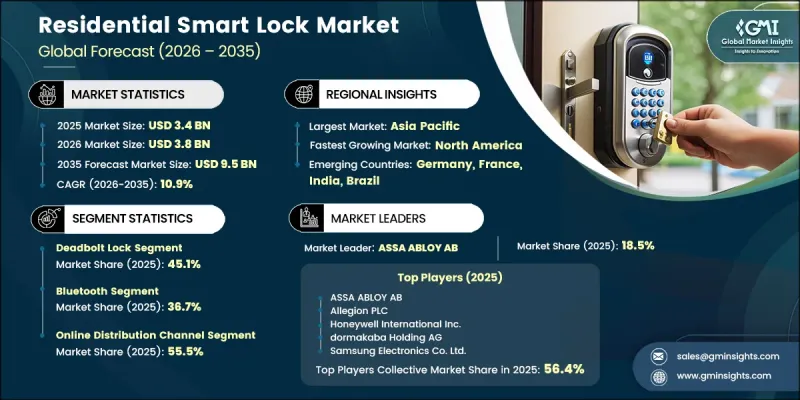
人們對住宅安全的日益關注以及對入侵和盜竊行為的日益警惕是推動這一市場發展的主要因素。隨著越來越多的消費者尋求保護家園的方法,對智慧門鎖等先進安全解決方案的需求也隨之激增。與傳統的機械門鎖相比,智慧門鎖提供無鑰匙解鎖和遠端控制等功能,從而提供更強大的安全防護。它們還能與其他智慧家庭設備(例如監視攝影機和警報系統)整合,對於追求便利性和更強住宅安全控制能力的住宅來說,無疑是一個極具吸引力的選擇。
| 市場範圍 | |
|---|---|
| 開始年份 | 2025 |
| 預測期 | 2026-2035 |
| 初始市場規模 | 34億美元 |
| 預測金額 | 95億美元 |
| 複合年成長率 | 10.9% |
到2025年,插芯鎖市場佔有率將達到45.1%。插芯鎖因其強大的安全功能和與智慧技術的兼容性而備受青睞。它們比彈簧鎖堅固得多,能提供高水準的安全性,即使使用扳手等工具也無法打開。隨著技術的進步,插芯鎖現在整合了藍牙、Wi-Fi和生物識別功能,為住宅提供無鑰匙進入和遠端存取功能,同時增強了安全性。
到2025年,藍牙市場將佔據36.7%的市場。由於藍牙技術的節能性和成本效益,預計該市場將進一步成長。支援藍牙功能的智慧門鎖使住宅能夠透過智慧型手機解鎖房門,無需實體鑰匙。這種免鑰出入控管系統正受到注重便利性併計劃遠端管理家居的科技達人的青睞。
到2025年,北美住宅智慧鎖市場佔有率將達到33%。該地區如此顯著的市場佔有率主要得益於智慧家庭技術和自動化系統的普及。隨著消費者對更高安全解決方案的需求不斷成長,生物識別、Wi-Fi和藍牙智慧鎖的需求也日益旺盛。遠端存取、無鑰匙進入以及與其他智慧型設備的整合等功能的流行,也進一步推動了該地區市場的發展。
目錄
第1章:調查方法
第2章執行摘要
第3章 行業洞察
- 產業生態系分析
- 影響價值鏈的因素
- 利潤率分析
- 中斷
- 前景
- 製造商
- 中斷
- 供應商情況
- 主要新聞和舉措
- 技術與創新展望
- 監理情勢
- 對產業的影響
- 促進因素
- 產業潛在風險與挑戰
- 機會
- 波特的分析
- PESTLE分析
- 價格分析
- 2019-2024年歷史價格趨勢分析
- 定價策略:按業務類型分類
- 貿易數據分析
- 進出口量及進口額趨勢
- 主要貿易路線及關稅的影響
- 人工智慧和生成式人工智慧對市場的影響
- 利用人工智慧改造現有經營模式
- 按細分市場分類的生成式人工智慧用例和部署藍圖
- 風險、限制和監管考量
- 目前分銷基礎設施和通路滲透情況
- 按地區與業態(現代零售與傳統零售)分類的通路覆蓋率
- 缺乏最後一公里基礎設施和不斷發展的管道
第4章 競爭情勢
- 介紹
- 企業市佔率分析
- 競爭定位矩陣
- 戰略展望矩陣
- 主要市場公司的競爭分析
- 主要進展
- 併購
- 夥伴關係和聯盟
- 新產品發布
- 業務拓展計劃
第5章 市場估算與預測:依產品類型分類,2022-2035年
- 門栓鎖
- 槓桿手柄
- 掛鎖
- 其他
第6章 市場估算與預測:依解封機制分類,2022-2035年
- 鍵盤
- 觸控螢幕
- 基於應用程式
- 混合
- 生物識別
- 其他
第7章 市場估計與預測:依連結類型分類,2022-2035年
- Wi-Fi
- Bluetooth
- Z-Wave
- 其他
第8章 市場估算與預測:依價格區間分類,2022-2035年
- 價格區間低(100美元)
- 中價位(100-300美元)
- 高價位(超過300美元)
第9章 市場估計與預測:依最終用途分類,2022-2035年
- 公寓
- 獨立式住宅
- 公寓
- 其他(例如,度假屋)
第10章 市場估價與預測:依通路分類,2022-2035年
- 線上
- 我們的網站
- 電子商務網站
- 離線
- 公寓
- 獨立式住宅
- 公寓
- 其他(例如度假屋)
第11章:預測:依地區分類,2022-2035年
- 北美洲
- 美國
- 加拿大
- 歐洲
- 德國
- 英國
- 法國
- 義大利
- 西班牙
- 亞太地區
- 中國
- 印度
- 日本
- 韓國
- 澳洲
- 拉丁美洲
- 巴西
- 墨西哥
- 阿根廷
- 中東和非洲
- UAE
- 沙烏地阿拉伯
- 南非
第12章:公司簡介
- 世界公司
- Condominium
- Individual houses
- Apartments
- Others(vacation homes, etc.)
- 當地公司
- Shenzhen Kaadas Intelligent Technology Co., Ltd.
- DESSMANN(China)M&E Co., Ltd.
- MIWA Lock Co., Ltd.
- Godrej Enterprises Group
- Nuki Home Solutions GmbH
- ZKTeco Co., Ltd.
- Lockin Smart Home Technology Co., Ltd.
- 新興企業
- Anker Innovations Ltd.
- Lumi United Technology Co., Ltd.
- U-tec Group Inc.
- Level Home Inc.
- igloohome Pte. Ltd.
- Tedee sp. z oo
- Wondertech Co., Ltd.
The Global Residential Smart Lock Market was valued at USD 3.4 billion in 2025 and is estimated to grow at a CAGR of 10.9% to reach USD 9.5 billion by 2035.
The rising concern over home security and increased awareness of break-ins and theft are major drivers of this market. As more consumers seek ways to protect their homes, the demand for advanced security solutions like smart locks has surged. These locks offer enhanced protection compared to traditional mechanical locks by providing keyless entry and remote control capabilities. Integration with other smart home devices like security cameras and alarms makes them an attractive choice for homeowners looking for convenience and greater control over their home security systems.
| Market Scope | |
|---|---|
| Start Year | 2025 |
| Forecast Year | 2026-2035 |
| Start Value | $3.4 Billion |
| Forecast Value | $9.5 Billion |
| CAGR | 10.9% |
The deadbolt lock segment held 45.1% share in 2025. Deadbolts are preferred due to their robust security features and compatibility with smart technologies. They are significantly stronger than spring bolt locks, offering a higher level of security that cannot be bypassed with tools like wrenches. With technological advancements deadbolt locks now come with Bluetooth, Wi-Fi, and biometric capabilities, providing homeowners with keyless entry and remote access while enhancing security.
Bluetooth segment held a 36.7% share in 2025. This segment is poised for growth due to the energy efficiency and cost-effectiveness of Bluetooth technology. Bluetooth-enabled smart locks allow homeowners to unlock their doors with a smartphone, eliminating the need for physical keys. This keyless entry system appeals to tech-savvy consumers who prioritize convenience and plan to manage their homes remotely.
North America Residential Smart Lock Market held 33% share in 2025. The region's significant market share is driven by the widespread adoption of smart home technologies and automation systems. As consumers increasingly seek better security solutions, demand for biometric, Wi-Fi, and Bluetooth-enabled locks has grown. The popularity of features like remote access, keyless entry, and integration with other smart devices is boosting the region's market.
Major players operating in the Global Residential Smart Lock Industry include Xiaomi Corporation, Gantner Electronic GmbH, Honeywell International Inc., Allegion Plc, Amadas Inc., Salto Systems S.L., Assa Abloy AB, Avent Security, Onity Inc., Nord-Lock International AB, Spectrum Brands, Inc., Samsung Electronics Co. Ltd., ZKTeco USA, Megadoorlock Technology Co., Ltd., August Home Inc. The key strategies in the residential smart lock market include focusing on product innovation, strategic partnerships, and expanding their distribution networks. Companies are investing in research and development to improve the functionality and security features of their locks. They collaborate with home automation companies to ensure compatibility with a wide range of smart home systems.
Table of Contents
Chapter 1 Research Methodology
- 1.1 Research approach
- 1.2 Quality Commitments
- 1.2.1 GMI AI policy & data integrity commitment
- 1.2.1.1 Source consistency protocol
- 1.2.1 GMI AI policy & data integrity commitment
- 1.3 Research Trail & Confidence Scoring
- 1.3.1 Research Trail Components
- 1.3.2 Scoring Components
- 1.4 Data Collection
- 1.4.1 Partial list of primary sources
- 1.5 Data mining sources
- 1.5.1 Paid sources
- 1.5.1.1 Sources, by region
- 1.5.1 Paid sources
- 1.6 Base estimates and calculations
- 1.6.1 Base year calculation for any one approach
- 1.7 Forecast model
- 1.7.1 Quantified market impact analysis
- 1.7.1.1 Mathematical impact of growth parameters on forecast
- 1.7.1 Quantified market impact analysis
- 1.8 Research transparency addendum
- 1.8.1 Source attribution framework
- 1.8.2 Quality assurance metrics
- 1.8.3 Our commitment to trust
Chapter 2 Executive Summary
- 2.1 Industry 360° synopsis, 2022 - 2035
- 2.2 Key market trends
- 2.2.1 Regional
- 2.2.2 Product Type
- 2.2.3 Unlocking Mechanism
- 2.2.4 Connectivity Type
- 2.2.5 Price Range
- 2.2.6 End Use
- 2.2.7 Distribution Channel
Chapter 3 Industry Insights
- 3.1 Industry ecosystem analysis
- 3.1.1 Factor affecting the value chain
- 3.1.2 Profit margin analysis
- 3.1.3 Disruptions
- 3.1.4 Future outlook
- 3.1.5 Manufacturers
- 3.1.6 Distributors
- 3.2 Supplier landscape
- 3.3 Key news & initiatives
- 3.4 Technology & Innovation Landscape
- 3.5 Regulatory landscape
- 3.6 Impact on forces
- 3.6.1 Growth drivers
- 3.6.2 Industry pitfalls & challenges
- 3.6.3 Opportunities
- 3.7 Porter's analysis
- 3.8 PESTEL analysis
- 3.9 Pricing analysis (driven by primary research)
- 3.9.1 Historical Price Trend Analysis, 2019-2024 (Driven by Primary Research)
- 3.9.2 Pricing Strategy by Player Type (Driven by Primary Research)
- 3.10 Trade data analysis (driven by paid database)
- 3.10.1 Import/Export Volume & Value Trends (Driven by Primary Research)
- 3.10.2 Key Trade Corridors & Tariff Impact (Driven by Primary Research)
- 3.11 Impact of AI & Generative AI on the Market
- 3.11.1 AI-Driven Disruption of Existing Business Models
- 3.11.2 GenAI Use Cases & Adoption Roadmap by Segment
- 3.11.3 Risks, Limitations & Regulatory Considerations
- 3.12 Distribution Infrastructure & Channel Penetration Landscape (Driven by Primary Research)
- 3.12.1 Channel Coverage by Region & Format (Modern vs. Traditional Trade) (Driven by Primary Research)
- 3.12.2 Last-Mile Infrastructure Gaps & Emerging Channel Shifts (Driven by Primary Research)
Chapter 4 Competitive Landscape, 2025
- 4.1 Introduction
- 4.2 Company market share analysis
- 4.3 Competitive positioning matrix
- 4.4 Strategic outlook matrix
- 4.5 Competitive analysis of major market players
- 4.6 Key developments
- 4.6.1 Mergers & acquisitions
- 4.6.2 Partnerships & collaborations
- 4.6.3 New product launches
- 4.6.4 Expansion plans
Chapter 5 Market Estimates and Forecast, By Product type, 2022 - 2035 (USD Billion, Thousand Units)
- 5.1 Key trends
- 5.2 Deadbolt lock
- 5.3 Lever handle
- 5.4 Padlock
- 5.5 Others
Chapter 6 Market Estimates and Forecast, By Unlocking Mechanism, 2022 - 2035 (USD Billion, Thousand Units)
- 6.1 Key trends
- 6.2 Keyboard
- 6.3 Touchscreen
- 6.4 App based
- 6.5 Hybrid
- 6.6 Biometric
- 6.7 Others
Chapter 7 Market Estimates and Forecast, By Connectivity Type, 2022 - 2035 (USD Billion, Thousand Units)
- 7.1 Key trends
- 7.2 Wi-Fi
- 7.3 Bluetooth
- 7.4 Z-wave
- 7.5 Others
Chapter 8 Market Estimates and Forecast, By Price Range, 2022 - 2035 (USD Billion, Thousand Units)
- 8.1 Key trends
- 8.2 Low (100$)
- 8.3 Mid (100$-300$)
- 8.4 High (>300$)
Chapter 9 Market Estimates and Forecast, By End Use, 2022 - 2035 (USD Billion, Thousand Units)
- 9.1 Key trends
- 9.2 Condominium
- 9.3 Individual houses
- 9.4 Apartments
- 9.5 Others (vacation homes, etc.)
Chapter 10 Market Estimates and Forecast, By Distribution Channel, 2022 - 2035 (USD Billion, Thousand Units)
- 10.1 Key trends
- 10.2 Online
- 10.2.1 Company's website
- 10.2.2 E-Commerce website
- 10.3 Offline
- 10.3.1 Condominium
- 10.3.2 Individual houses
- 10.3.3 Apartments
- 10.3.4 Others (vacation homes, etc.)
Chapter 11 Forecast, By Region, 2022 - 2035, (USD Billion, Thousand Units)
- 11.1 Key trends
- 11.2 North America
- 11.2.1 U.S.
- 11.2.2 Canada
- 11.3 Europe
- 11.3.1 Germany
- 11.3.2 U.K.
- 11.3.3 France
- 11.3.4 Italy
- 11.3.5 Spain
- 11.4 Asia Pacific
- 11.4.1 China
- 11.4.2 India
- 11.4.3 Japan
- 11.4.4 South Korea
- 11.4.5 Australia
- 11.5 Latin America
- 11.5.1 Brazil
- 11.5.2 Mexico
- 11.5.3 Argentina
- 11.6 MEA
- 11.6.1 UAE
- 11.6.2 Saudi Arabia
- 11.6.3 South Africa
Chapter 12 Company Profiles
- 12.1 Global players
- 12.1.1 Condominium
- 12.1.2 Individual houses
- 12.1.3 Apartments
- 12.1.4 Others (vacation homes, etc.)
- 12.2 Regional players
- 12.2.1 Shenzhen Kaadas Intelligent Technology Co., Ltd.
- 12.2.2 DESSMANN (China) M&E Co., Ltd.
- 12.2.3 MIWA Lock Co., Ltd.
- 12.2.4 Godrej Enterprises Group
- 12.2.5 Nuki Home Solutions GmbH
- 12.2.6 ZKTeco Co., Ltd.
- 12.2.7 Lockin Smart Home Technology Co., Ltd.
- 12.3 Emerging players
- 12.3.1 Anker Innovations Ltd.
- 12.3.2 Lumi United Technology Co., Ltd.
- 12.3.3 U-tec Group Inc.
- 12.3.4 Level Home Inc.
- 12.3.5 igloohome Pte. Ltd.
- 12.3.6 Tedee sp. z o.o.
- 12.3.7 Wondertech Co., Ltd.

 美國智慧鎖:市場佔有率分析、產業趨勢與統計及成長預測(2026-2031)智慧鎖:市場佔有率分析、產業趨勢與統計及成長預測(2026-2031)
 智慧鎖市場:2026-2032年全球市場預測(依鎖類型、通訊協定、認證方式、應用及銷售管道)
 全球智慧鎖市場規模、佔有率、趨勢和成長分析報告(2026-2034)
 智慧門鎖和門鈴市場預測至2034年-按產品類型、鎖具類型、通路、最終用戶和地區分類的全球分析
 2026年全球人工智慧(AI)智慧鎖市場報告2026年全球智慧鎖控制器市場報告
 智慧鎖市場規模、佔有率、趨勢和預測:按鎖類型、通訊協定、最終用戶和地區分類,2026-2034年
 智慧鎖市場:按產品類型、解鎖方式、應用程式和地區分類2026年全球智慧鎖市場報告