


 |
市場調查報告書
商品編碼
2124549
管理決策:市場佔有率分析、產業趨勢與統計、成長預測(2026-2031)Management Decision - Market Share Analysis, Industry Trends & Statistics, Growth Forecasts (2026 - 2031) |
||||||

※ 本網頁內容可能與最新版本有所差異。詳細情況請與我們聯繫。
根據 Mordor Intelligence 稱,管理決策市場規模預計在 2026 年達到 80.5 億美元,高於 2025 年的 67 億美元,預計到 2031 年將達到 201.9 億美元。
預計從 2026 年到 2031 年,其複合年成長率將達到 20.18%。
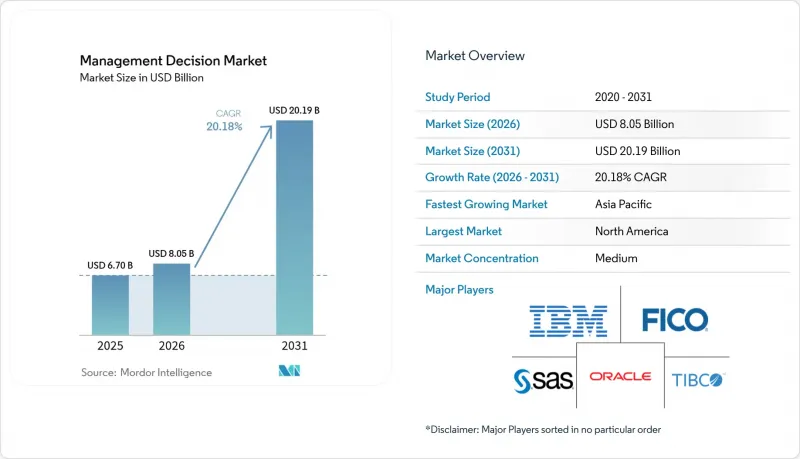
本報告按元件(軟體和服務)、部署模式(本地部署和雲端部署)、組織規模(大型企業和中小企業)、功能(風險和合規管理等)、最終用戶行業(銀行、金融服務和保險等)以及地區進行細分。市場預測以美元計價。
全球管理決策市場的趨勢與洞察
對業務敏捷性和即時洞察力的需求日益成長。
市場波動使得即時決策成為企業生存的必要條件。現代平台融合了預測分析和規則引擎,使企業能夠在績效受損之前根據訊號採取行動。企業正透過多智慧體系統實現高容量營運決策(例如定價和路線規劃)的自動化,這些系統能夠自動調整工作流程,無需人工干預。決策流程具有跨職能性,能夠在維持政策執行一致性的同時,根據不斷變化的市場狀況調整執行方案。
決策分析在銀行業、金融服務業和保險業(BFSI)的應用正在迅速成長。
銀行和保險公司正在將決策引擎整合到信貸評估、理賠處理和客戶互動流程中。自動化信貸決策流程可在幾秒鐘內處理貸款申請,並實施統一的合規性檢查。透過結合內部記錄和數位行為數據,企業正在建立個人化的金融產品,並將服務擴展到以前服務不足的借款人。端到端編配工具可根據客戶風險因素和市場數據的變化即時調整產品條款,從而提高投資組合品質和使用者體驗。
高昂的實施和整合成本
實施一套全面的決策支援系統需要投入大量成本,包括平台許可、流程重組和變更管理。如果舊有系統缺乏標準應用程式介面 (API),整合過程可能會非常複雜,可能需要開發中間件並進行耗時的測試。對於中小企業而言,高昂的成本負擔會延緩其採用速度。分階段實施,重點關注幾個高價值的應用案例,可以儘早取得成效,為後續擴展籌集資金,並累積內部專業知識。
細分市場分析
到2025年,軟體將在管理決策市場佔據67.20%的主導地位。這主要得益於整合了規則管理、分析和自然語言介面的引擎。供應商正擴大採用生成式人工智慧技術,以提供規則最佳化提案並識別合規性缺陷。儘管服務業的規模可能較小,但隨著企業對諮詢、實施和持續最佳化方面的專業知識需求不斷成長,其複合年成長率預計將達到21.95%。服務提供者正在開發行業加速器,透過打包成熟的決策模板來縮短部署時間。
實施夥伴正在重新設計流程、制定管治手冊並運行管理最佳化項目,以確保決策績效與不斷變化的法規和業務目標保持一致。缺乏內部資料科學專業知識的公司正在利用這些服務來維持決策品質。隨著人工智慧規模化應用成為經營團隊的首要任務,對持續模型監控和調整服務的需求不斷成長,從而支撐了服務提供者的持續發展。
到2025年,雲端運算將佔據企業決策市場79.30%的佔有率,預計到2031年將以21.56%的複合年成長率成長,這主要得益於企業對彈性容量和付費使用制的偏好。雲端平台能夠實現即時擴展,以應對波動較大的決策工作負載,這在季節性交易高峰期至關重要。即使是監管嚴格的產業也在採用虛擬私有雲端來滿足主權要求。然而,一些公司正在將敏感工作負載遷移回私有環境,建構混合環境,將雲端運算的柔軟性與本地控制結合。
如今,決策架構師不再只是選擇單一的託管模式,而是根據延遲、資料局部和授權協議等標準來評估每個工作負載。為了避免被單一供應商鎖定並充分利用不同供應商提供的專業功能,多重雲端部署正在加速發展。供應商也積極回應,提供基於容器技術的高度可移植服務,使客戶能夠在不重寫決策邏輯的情況下遷移配置。
區域分析
到2025年,北美將引領管理決策市場,佔36.50%的銷售額。人工智慧的早期應用、強大的雲端基礎設施以及主要供應商的集中佈局,都支撐著該地區的主導地位。金融機構正在利用決策引擎改善信用評分和詐欺防範,而醫院則將其用於臨床路徑和計費。隨著監管機構對管治公平性的關注度不斷提高,對透明且管理完善的決策平台的需求也不斷成長。越來越多的商業人士開始採用低程式碼工具,將使用者群體擴展到IT部門之外,進一步加速了該地區的成長。
亞太地區是成長最快的地區,預計2026年至2031年將以23.95%的複合年成長率成長。中國、日本和印度政府正大力投資人工智慧基礎設施和人才培養,創造有利於大規模的管理體制正在促進可配置管治模組的採用,這些模組能夠適應當地的合規要求,同時又不破壞企業標準。
歐洲憑藉嚴格的法規結構(該框架優先考慮可解釋性),保持顯著的市場佔有率。歐盟人工智慧立法對高風險系統施加了嚴格的義務,迫使金融和醫療機構採用能夠提供詳細審計追蹤和自然語言推理的平台。跨國公司要求跨國決策的一致性,從而推動了對集中式規則庫和語言無關管治的需求。擁有領域知識和合規專長的強大實施合作夥伴生態系統支撐著全部區域的穩定成長。
其他好處:
- Excel格式的市場預測(ME)表
- 3個月的分析師支持
目錄
第1章:引言
- 研究假設和市場定義
- 調查範圍
第2章:調查方法
第3章執行摘要
第4章 市場狀況
- 市場概覽
- 市場促進因素
- 對業務敏捷性和即時洞察力的需求日益成長。
- 銀行業、金融服務業和保險業(BFSI)對決策分析的採用正在迅速增加。
- 合規性驅動下對「可解釋人工智慧(AI)」的需求
- 低程式碼/無程式碼平台的用戶群正在不斷擴大。
- 邊緣與物聯網 (IoT) 設備中的嵌入式決策
- 市場限制因素
- 高昂的實施和整合成本
- 缺乏用於模型訓練的特定領域數據
- 對雲端原生架構中供應商鎖定問題的擔憂
- 自動化決策監管方面的不確定性
- 產業供應鏈分析
- 監理情勢
- 技術展望
- 波特五力分析
- 評估宏觀經濟趨勢對市場的影響
第5章 市場規模與成長預測
- 按組件
- 軟體
- 服務
- 依部署類型
- 現場
- 雲
- 按組織規模
- 大公司
- 中小企業
- 按功能
- 風險與合規管理
- 客戶經驗與個人化
- 詐欺檢測與預防
- 定價和收益最佳化
- 其他功能
- 按最終用戶行業分類
- 銀行、金融服務和保險(BFSI)
- 資訊科技(IT)和通訊
- 衛生保健
- 零售與電子商務
- 製造業
- 政府/公共部門
- 其他終端用戶產業
- 按地區
- 北美洲
- 美國
- 加拿大
- 南美洲
- 巴西
- 阿根廷
- 其他南美國家
- 歐洲
- 德國
- 英國
- 法國
- 西班牙
- 俄羅斯
- 其他歐洲國家
- 亞太地區
- 中國
- 日本
- 印度
- 韓國
- 澳洲和紐西蘭
- 其他亞太國家
- 中東和非洲
- 中東
- 沙烏地阿拉伯
- 阿拉伯聯合大公國
- 其他中東國家
- 非洲
- 南非
- 埃及
- 其他非洲國家
- 中東
- 北美洲
第6章 競爭情勢
- 市場集中度
- 策略趨勢
- 市佔率分析
- 公司簡介
- IBM Corporation
- Oracle Corporation
- SAS Institute Inc.
- SAP SE
- FICO(Fair Isaac Corporation)
- Pegasystems Inc.
- TIBCO Software Inc.
- Actico GmbH
- Sapiens International Corp.
- Equifax Inc.
- Experian plc
- Scorto Inc.
- Sparkling Logic Inc.
- InRule Technology Inc.
- RapidMiner Inc.
- Teradata Corp.
- Alteryx Inc.
- DataRobot Inc.
- Decision Management Solutions
第7章 市場機會與未來展望
According to Mordor Intelligence, the management decision market size in 2026 is estimated at USD 8.05 billion, growing from 2025 value of USD 6.70 billion with 2031 projections showing USD 20.19 billion, growing at 20.18% CAGR over 2026-2031.
This report is Segmented by Component (Software and Services), by Deployment Type (On-Premises and Cloud), by Organization Size (Large Enterprises and Small and Medium-Size Enterprises (SMEs)), by Function (Risk and Compliance Management, and More), by End-User Industry (Banking, Financial Services, and Insurance (BFSI), and More), and Geography. The Market Forecasts are Provided in Terms of Value (USD).
Global Management Decision Market Trends and Insights
Increasing Need for Business Agility and Real-Time Insights
Market turbulence has turned real-time decisioning into a survival requirement. Modern platforms now fuse predictive analytics with rule engines, enabling organizations to act on signals before they disrupt performance. Enterprises are automating high-volume operational decisions such as pricing and routing through multi-agent systems that coordinate workflows without human delay. Decision flows span departments to keep execution aligned with evolving market conditions while preserving consistent policy enforcement.
Surge in Decision Analytics Adoption in Banking, Financial Services, and Insurance (BFSI)
Banks and insurers are embedding decision engines in credit approval, claims processing and customer interaction journeys. Automated credit decisioning processes loan applications within seconds and enforces uniform compliance checks. Firms are combining internal records with digital behavior to craft individualized financial offerings, extending services to previously underserved borrowers. End-to-end orchestration tools adjust product terms in real time when customer risk factors or market data shift, improving both portfolio quality and user experience.
High Implementation and Integration Cost
Comprehensive decision programs demand sizable outlays for platform licenses, process redesign and change management. Integration can be complex where legacy systems lack standard Application Programming Interfaces (APIs), forcing middleware development and prolonged testing. Smaller firms bear a higher cost burden relative to their budgets, which slows adoption. A phased approach that first targets a few high-value use cases helps generate quick wins and funds expansion while building internal expertise.
Other drivers and restraints analyzed in the detailed report include:
- Compliance-Driven Demand for Explainable Artificial Intelligence (AI)
- Low-Code/No-Code Platforms Widening User Base
- Shortage of Domain-Specific Data for Model Training
For complete list of drivers and restraints, kindly check the Table Of Contents.
Segment Analysis
Software accounted for a commanding 67.20% management decision market share in 2025, underpinned by engines that merge rule management with analytics and natural-language interfaces. Vendors increasingly embed generative AI that suggests rule optimizations and flags compliance gaps. Services, though smaller, are on a 21.95% CAGR path as organizations seek advisory, deployment, and continuous optimization expertise. Providers are evolving industry accelerators that compress rollout timelines by packaging proven decision templates.
Implementation partners redesign processes, create governance playbooks, and run managed optimization programs that keep decision performance aligned with changing regulations and business goals. Firms lacking in-house data science tap these offerings to maintain decision quality. As AI scaling tops executive agendas, demand for continuous model monitoring and recalibration services is rising, supporting sustained expansion for service specialists.
Cloud captured 79.30% of the management decision market in 2025 and is growing at 21.56% CAGR through 2031 as organizations favor elastic capacity and consumption-based pricing. Cloud platforms allow instant scaling to meet volatile decision workloads, important for seasonal transaction spikes. Even regulated sectors adopt virtual private clouds to meet sovereignty requirements. Some enterprises, however, repatriate sensitive workloads to private environments, creating hybrid estates that blend cloud flexibility with on-premise control.
Decision architects now evaluate each workload along criteria such as latency, data locality, and licensing commitments rather than choosing a single hosting model. Multi-cloud adoption is rising to avoid lock-in and to exploit specialized capabilities from different providers. Vendors respond with portable services built on container technology so clients can shift deployments without rewriting decision logic.
Complete Report Scope:
- By Component
- Software
- Services
- By Deployment Type
- On-premises
- Cloud
- By Organization Size
- Large Enterprises
- Small and Medium-size Enterprises (SMEs)
- By Function
- Risk and Compliance Management
- Customer Experience and Personalization
- Fraud Detection and Prevention
- Pricing and Revenue Optimization
- Other Function
- By End-User Industry
- Banking, Financial Services, and Insurance (BFSI)
- Information Technology (IT) and Telecom
- Healthcare
- Retail and E-commerce
- Manufacturing
- Government and Public Sector
- Other End-User Industry
- By Geography
- North America
- United States
- Canada
- South America
- Brazil
- Argentina
- Rest of South America
- Europe
- Germany
- United Kingdom
- France
- Spain
- Russia
- Rest of Europe
- Asia-Pacific
- China
- Japan
- India
- South Korea
- Australia and New Zealand
- Rest of Asia-Pacific
- Middle East and Africa
- Middle East
- Saudi Arabia
- United Arab Emirates
- Rest of Middle East
- Africa
- South Africa
- Egypt
- Rest of Africa
- Middle East
- North America
Geography Analysis
North America dominated the management decision market with 36.50% revenue in 2025. Early adoption of AI, deep cloud infrastructure, and a concentration of leading vendors underpin leadership. Financial institutions use decision engines to refine credit scoring and fraud controls, while hospitals apply them to clinical pathways and billing. Regulatory focus on algorithmic fairness reinforces demand for transparent, governable decision platforms. Business specialists increasingly adopt low-code tools, broadening the user community beyond IT and amplifying regional growth momentum.
Asia-Pacific is the fastest-growing region, set to advance at a 23.95% CAGR from 2026 to 2031. Governments across China, Japan, and India invest heavily in AI infrastructure and skills, fostering an environment conducive to large-scale decision deployments. Banks deploy real-time credit and fraud engines to expand financial inclusion, manufacturers embed decision logic in digital production lines, and public agencies roll out citizen-facing services powered by automated decisions. Diverse regulatory regimes spur the adoption of configurable governance modules that adapt to local compliance mandates without fragmenting enterprise standards.
Europe retains a significant share on the back of stringent regulatory frameworks that prioritize explainability. The EU AI Act imposes rigorous obligations for high-risk systems, prompting financial and healthcare organizations to adopt platforms capable of detailed audit trails and natural-language rationale. Multinational firms require cross-border decision consistency, driving demand for centralized rule repositories and language-agnostic governance. Strong implementation partner ecosystems with domain and compliance expertise support steady growth across the region.
- IBM Corporation
- Oracle Corporation
- SAS Institute Inc.
- SAP SE
- FICO (Fair Isaac Corporation)
- Pegasystems Inc.
- TIBCO Software Inc.
- Actico GmbH
- Sapiens International Corp.
- Equifax Inc.
- Experian plc
- Scorto Inc.
- Sparkling Logic Inc.
- InRule Technology Inc.
- RapidMiner Inc.
- Teradata Corp.
- Alteryx Inc.
- DataRobot Inc.
- Decision Management Solutions
Additional Benefits:
- The market estimate (ME) sheet in Excel format
- 3 months of analyst support
TABLE OF CONTENTS
1 INTRODUCTION
- 1.1 Study Assumptions and Market Definition
- 1.2 Scope of the Study
2 RESEARCH METHODOLOGY
3 EXECUTIVE SUMMARY
4 MARKET LANDSCAPE
- 4.1 Market Overview
- 4.2 Market Drivers
- 4.2.1 Increasing Need for Business Agility and Real-Time Insights
- 4.2.2 Surge In Decision Analytics Adoption in Banking, Financial Services, And Insurance (BFSI)
- 4.2.3 Compliance-Driven Demand for Explainable Artificial Intelligence (AI)
- 4.2.4 Low-Code/No-Code Platforms Widening User Base
- 4.2.5 Embedded Decisioning in Edge and Internet of Things (IoT) Devices
- 4.3 Market Restraints
- 4.3.1 High Implementation and Integration Cost
- 4.3.2 Shortage Of Domain-Specific Data for Model Training
- 4.3.3 Vendor Lock-In Concerns with Cloud-Native Stacks
- 4.3.4 Regulatory Uncertainty Around Automated Decisions
- 4.4 Industry Supply Chain Analysis
- 4.5 Regulatory Landscape
- 4.6 Technological Outlook
- 4.7 Porter's Five Forces Analysis
- 4.7.1 Threat of New Entrants
- 4.7.2 Bargaining Power of Suppliers
- 4.7.3 Bargaining Power of Buyers
- 4.7.4 Threat of Substitutes
- 4.7.5 Competitive Rivalry
- 4.8 Assessment of the Impact of Macroeconomic Trends on the Market
5 MARKET SIZE AND GROWTH FORECASTS (VALUE)
- 5.1 By Component
- 5.1.1 Software
- 5.1.2 Services
- 5.2 By Deployment Type
- 5.2.1 On-premises
- 5.2.2 Cloud
- 5.3 By Organization Size
- 5.3.1 Large Enterprises
- 5.3.2 Small and Medium-size Enterprises (SMEs)
- 5.4 By Function
- 5.4.1 Risk and Compliance Management
- 5.4.2 Customer Experience and Personalization
- 5.4.3 Fraud Detection and Prevention
- 5.4.4 Pricing and Revenue Optimization
- 5.4.5 Other Function
- 5.5 By End-User Industry
- 5.5.1 Banking, Financial Services, and Insurance (BFSI)
- 5.5.2 Information Technology (IT) and Telecom
- 5.5.3 Healthcare
- 5.5.4 Retail and E-commerce
- 5.5.5 Manufacturing
- 5.5.6 Government and Public Sector
- 5.5.7 Other End-User Industry
- 5.6 By Geography
- 5.6.1 North America
- 5.6.1.1 United States
- 5.6.1.2 Canada
- 5.6.2 South America
- 5.6.2.1 Brazil
- 5.6.2.2 Argentina
- 5.6.2.3 Rest of South America
- 5.6.3 Europe
- 5.6.3.1 Germany
- 5.6.3.2 United Kingdom
- 5.6.3.3 France
- 5.6.3.4 Spain
- 5.6.3.5 Russia
- 5.6.3.6 Rest of Europe
- 5.6.4 Asia-Pacific
- 5.6.4.1 China
- 5.6.4.2 Japan
- 5.6.4.3 India
- 5.6.4.4 South Korea
- 5.6.4.5 Australia and New Zealand
- 5.6.4.6 Rest of Asia-Pacific
- 5.6.5 Middle East and Africa
- 5.6.5.1 Middle East
- 5.6.5.1.1 Saudi Arabia
- 5.6.5.1.2 United Arab Emirates
- 5.6.5.1.3 Rest of Middle East
- 5.6.5.2 Africa
- 5.6.5.2.1 South Africa
- 5.6.5.2.2 Egypt
- 5.6.5.2.3 Rest of Africa
- 5.6.5.1 Middle East
- 5.6.1 North America
6 COMPETITIVE LANDSCAPE
- 6.1 Market Concentration
- 6.2 Strategic Moves
- 6.3 Market Share Analysis
- 6.4 Company Profiles (includes Global level Overview, Market level overview, Core Segments, Financials as available, Strategic Information, Market Rank/Share for key companies, Products and Services, and Recent Developments)
- 6.4.1 IBM Corporation
- 6.4.2 Oracle Corporation
- 6.4.3 SAS Institute Inc.
- 6.4.4 SAP SE
- 6.4.5 FICO (Fair Isaac Corporation)
- 6.4.6 Pegasystems Inc.
- 6.4.7 TIBCO Software Inc.
- 6.4.8 Actico GmbH
- 6.4.9 Sapiens International Corp.
- 6.4.10 Equifax Inc.
- 6.4.11 Experian plc
- 6.4.12 Scorto Inc.
- 6.4.13 Sparkling Logic Inc.
- 6.4.14 InRule Technology Inc.
- 6.4.15 RapidMiner Inc.
- 6.4.16 Teradata Corp.
- 6.4.17 Alteryx Inc.
- 6.4.18 DataRobot Inc.
- 6.4.19 Decision Management Solutions
7 MARKET OPPORTUNITIES AND FUTURE OUTLOOK
- 7.1 White-Space and Unmet-Need Assessment

 代理管理服務:市場佔有率分析、產業趨勢與統計、成長預測(2026-2031)自動化決策管理軟體:市場佔有率分析、產業趨勢與統計、成長預測(2026-2031)
 管理決策市場報告:按組件、部署模式、功能、組織規模、產業和地區分類(2026-2034 年)
 智慧平台管理介面市場:依產品、組件、連接方式、最終用戶、部署類型和組織規模分類-2026-2032年全球預測
 商業決策市場分析及預測(至2035年):依類型、產品、服務、技術、組件、應用、部署類型、最終用戶及功能分類
 全球商業決策市場規模、佔有率、趨勢和成長分析報告(2026-2034)
 全球數位化變電站智慧市場:預測(至2034年)-按解決方案類型、組件、技術、應用、最終用戶和地區進行分析
 智慧平台管理介面市場 - 全球產業規模、佔有率、趨勢、機會及預測(按組件、最終用戶、地區和競爭格局分類,2021-2031年)數位平台指揮軟體市場,依部署模式、組件類型、組織規模和產業垂直領域分類,全球預測,2026-2032年智慧標籤管理系統市場按產品類型、應用、最終用戶和分銷管道分類,全球預測(2026-2032年)