


 |
市場調查報告書
商品編碼
2118867
自動化決策管理軟體:市場佔有率分析、產業趨勢與統計、成長預測(2026-2031)Automated Decision Management Software - Market Share Analysis, Industry Trends & Statistics, Growth Forecasts (2026 - 2031) |
||||||

※ 本網頁內容可能與最新版本有所差異。詳細情況請與我們聯繫。
據 Mordor Intelligence 稱,2025 年自動化決策管理軟體市場價值為 87.2 億美元,預計到 2031 年將達到 218.7 億美元,而 2026 年為 99.6 億美元,預測期(2026-2031 年)的複合年成長率為 17.04%。
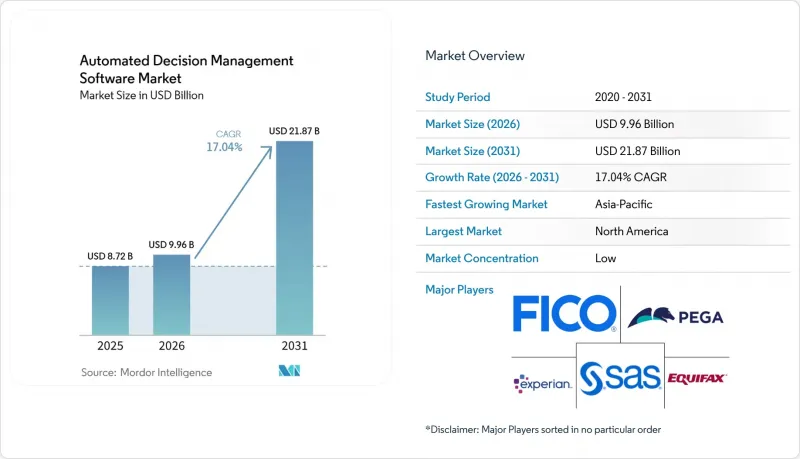
本報告按交付方式(軟體和服務)、部署模式(雲端、混合、本地部署)、功能(風險和合規管理等)、企業規模(大型企業、中小企業)、最終用戶(IT和電信、銀行、金融服務和保險、能源和公共產業等)以及地區進行細分。市場預測以價值(美元)表示。
全球自動化決策管理軟體市場趨勢及洞察
對即時、大批量業務決策的需求
處理大量支付、保險索賠和線上交易的機構不能依賴人工審核來做出所有日常決策,尤其是在響應延遲可能導致損失增加和客戶互動中斷的情況下。這種需求在欺詐管理方面尤其明顯。 AWS 和 Stripe 在 2025 年的案例研究中指出,自動化引擎能夠即時偵測 95% 的信用卡測試攻擊,並將與客戶之間不必要的摩擦減少了 20%。這凸顯了對自動化決策管理軟體的需求,因為買家希望在日益增多的管道中獲得更快的結果和一致的策略應用。隨著即時決策變得越來越普遍,買家更加重視能夠解釋決策背後的原因、記錄相關數據並保留證據以供未來檢驗的系統。此外,隨著詐欺模式的變化以及新產品的出現導致需要評估的交易類型發生變化,銀行也需要適應性強的管理結構。美國貨幣監理署 (OCC) 在其 2026 年春季風險展望中倡導採用動態和適應性強的風險管理方法,這將推動對自動化風險流程的持續投資。
擴展可解釋人工智慧和模型管治要求
歐盟的人工智慧法案正在提升高風險自動化決策中管治的重要性,這些決策會影響個人、服務取得或安全等相關流程。歐盟委員會解釋說,該法案為某些人工智慧系統設定了透明度義務,並為相關資訊的提供者和實施者設定了揭露義務。這使得可解釋性、可審計性和人工監督成為許多公司用例的營運要求,而非部署後添加的選用功能。隨著企業選擇提供決策記錄和控制功能的平台,而不是部署具有獨立管治流程的孤立模型,自動化決策管理軟體市場將從中受益。這些功能減少了在未來可能需要考慮政策結果的領域(例如信貸、保險、就業和臨床分診)記錄決策所需的工作量。此外,它還使合規團隊更容易在政策變更影響客戶或患者之前進行審查,並確定何時需要在決策過程中進行手動干預。
高昂的實施和整合成本
實施決策管理軟體通常需要與資料管道、模型註冊表、規則制定工具、監控系統以及業務決策的核心應用程式整合。這些整合可能會延長專案工期,並增加初始授權費用以外的成本,尤其是當客戶需要協調不同系統間不一致的資料定義時。即使組織已為人工智慧相關活動累計,管治、安全和整合要求仍可能構成障礙。對於中型企業而言,成本包括實施後的監控、模型更新、使用者培訓和合規性審計支援。銀行和保險業的舊有系統可能帶來額外的負擔,因為現有的政策規則可能已經過時,分散在未記錄的代碼中,而且難以規範化。雖然這些限制因素支撐了對該服務的需求,但對於部署能力有限的買家而言,它們可能會延遲其進入自動化決策管理軟體市場。
細分市場分析
到2025年,軟體將佔據自動化決策管理軟體市場71.26%的佔有率。企業傾向於採用整合訂閱模式,將規則引擎、模型部署、可解釋性功能、監控儀錶板以及用於策略管理的通用工作空間整合在一起。利用單一平台可以減少合規性審計期間需要評估的供應商數量,並明確更新的責任歸屬。對於大規模企業而言,它還能實現跨業務部門、產品和區域營運的策略變更管理的一致性。當決策規則和分析模型需要在同一管治工作流程中協同工作時,這種軟體模式尤其有效。這些趨勢確保了軟體將繼續保持其在自動化決策管理軟體市場中領先的商業地位。
預計2026年至2031年,服務業的複合年成長率將達到18.14%。採購公司需要支持,才能將決策系統與舊有應用程式整合,並配置符合其營運流程的文件、稽核追蹤、測試案例和控制措施。隨著供應商承擔起監控模型、偵測偏差、強制執行策略更新以及回應不斷變化的需求等責任,管理決策營運也變得越來越重要。 2025年12月,IBM發布了ODM 9.5.0.1,該版本整合了決策助手,有助於將業務策略轉化為決策邏輯。雖然內建工具可以減輕一些技術工作,但複雜的部署仍然需要實施和管治的專業知識,尤其是在替換未記錄的規則時。因此,服務供應商可以在運作之外繼續參與,而不是在初始軟體設定完成後就結束其角色。
在2025年的自動化決策管理軟體市場中,雲端部署佔了66.83%的佔有率。科技公司和零售商傾向於選擇雲端交付,因為它能夠實現快速更新、靈活的容量配置,並減少本地基礎設施的管理工作。雲端系統也適用於需求波動較大的組織,例如客戶互動和交易量存在季節性高峰的組織,這得益於其靈活的資料規則。與自行部署相比,供應商管理的升級使用戶能夠更快地採用新的管治和分析功能。這種模式還能縮短產品發佈到業務用戶可用所需的時間。由於這些優勢,雲端仍然是最大的部署模式。
預計到2031年,混合部署將以17.92%的複合年成長率成長。銀行和醫療機構正在採用混合設計,將高度敏感的工作負載保留在私人基礎設施上,同時在需求變化或敏感度較低的流程可以外部處理時利用雲端容量。這種方法無需所有元件都使用相同的環境,即可滿足資料居住要求、回應時間要求、業務永續營運計劃以及對雲端服務的存取。在國防、政府和中央銀行等需要隔離操作和對系統進行直接控制的領域,本地部署仍然發揮著重要作用。混合模式還為買家在協調供應商關係或在不同環境之間遷移工作負載時提供了更大的柔軟性。因此,自動化決策管理軟體市場可能會保持多種可行的部署路徑,而不是完全轉向單一架構。
區域分析
到2025年,北美將佔據該區域市場佔有率的39.82%。該地區擁有眾多銀行、金融和保險(BFSI)機構,這些機構已在信貸、詐欺預防、合規和客戶准入流程中應用自動化決策。此外,該地區的科技公司擁有先進的人工智慧工程能力、成熟的企業軟體採購流程,以及許多具備監管部署經驗的供應商。該地區的大部分需求來自美國,加拿大則透過金融服務和公共部門的數位轉型做出貢獻。在墨西哥,銀行業和製造業合規性領域正在開發應用案例。成熟的用戶和技術供應商的組合鞏固了北美在自動化決策管理軟體市場的主導地位。
預計亞太地區2026年至2031年的複合年成長率將達到18.08%。這一成長主要集中在印度、中國、日本和東南亞,這些地區的企業人工智慧應用正在加速推進,同時對自動化決策管理的需求也日益成長。在印度,企業人工智慧的基礎正在不斷完善,公共專案也已到位,旨在支援企業取得運算基礎設施。該地區的數位銀行正在推動對能夠處理大量交易的自動化信貸和詐欺檢測決策系統的需求。因此,亞太地區為供應商提供了大規模的客戶群體,他們需要在地化產品、本地實施支援以及能夠滿足各種數據和監管要求的系統。該地區數位金融服務的快速發展表明,決策平台有望順利度過最初的試點階段。
在歐洲,隨著企業為應對人工智慧監管法規做好準備並探索如何清楚地記錄自動化結果,對管治工具的需求日益成長。在德國,企業正在積極採用人工智慧,推動軟體的更廣泛部署,以管理決策和相關記錄。在南美洲,尤其是巴西,隨著企業將人工智慧策略性地列為優先事項並探索其在金融服務和業務運營中的應用,人工智慧的發展勢頭正在增強。在中東和非洲,銀行業和政府服務正從早期考慮階段過渡到更有系統的試點階段。沙烏地阿拉伯、阿拉伯聯合大公國、南非和奈及利亞等市場已出現相關的早期活動。資料本地化法規和各國特定的部署需求預計將影響這些地區的供應商選擇。
其他好處:
- Excel格式的市場預測(ME)表
- 3個月的分析師支持
目錄
第1章:引言
- 研究假設和市場定義
- 調查範圍
第2章:調查方法
第3章執行摘要
第4章 市場狀況
- 市場概覽
- 市場促進因素
- 對即時、大批量業務決策的需求
- 可解釋人工智慧的普及和模型管治要求的擴展。
- 低程式碼決策建模正在受到企業用戶的青睞。
- 跨數位管道和核心應用程式的嵌入式決策。
- 投資於受監管產業的決策智慧
- 需要受控行為和策略實施的基於代理的人工智慧
- 市場限制因素
- 高昂的實施和整合成本
- 缺乏特定領域的數據和決策的專業知識
- 專有雲決策堆疊中的供應商鎖定
- 自動化決策的法律責任和監管待遇存在不確定性
- 宏觀經濟因素對市場的影響
- 產業價值鏈分析
- 科技趨勢
- 監理情勢
- 波特五力分析
第5章 市場規模與成長預測
- 報價
- 軟體
- 服務
- 按部署模式
- 雲
- 混合
- 現場
- 按功能
- 風險與合規管理
- 客戶經驗與個人化
- 欺詐管理
- 定價和收益最佳化
- 信用檢查
- 其他功能
- 按公司規模
- 大公司
- 小型企業
- 最終用戶
- 資訊科技/通訊
- BFSI
- 汽車和運輸業
- 醫療保健和生命科學
- 能源公用事業
- 工業製造
- 旅遊與飯店
- 其他最終用戶
- 按地區
- 北美洲
- 美國
- 加拿大
- 墨西哥
- 南美洲
- 巴西
- 阿根廷
- 其他南美國家
- 歐洲
- 德國
- 英國
- 法國
- 俄羅斯
- 西班牙
- 其他歐洲國家
- 亞太地區
- 中國
- 日本
- 印度
- 韓國
- 東南亞
- 其他亞太國家
- 中東和非洲
- 中東
- 沙烏地阿拉伯
- 阿拉伯聯合大公國
- 其他中東國家
- 非洲
- 南非
- 奈及利亞
- 其他非洲國家
- 中東
- 北美洲
第6章 競爭情勢
- 市場集中度
- 策略趨勢
- 市佔率分析
- 公司簡介
- Fair Isaac Corporation
- Pegasystems Inc.
- SAS Institute Inc.
- ACTICO GmbH
- Sparkling Logic, Inc.
- InRule Technology, Inc.
- FlexRule Inc.
- DecisionRules sro
- Sapiens International Corporation NV
- Progress Software Corporation
- Software AG
- Camunda Services GmbH
- Appian Corporation
- Decisions.com, Inc.
- Nected Technologies Private Limited
- Rulebricks, Inc.
- OpenL Tablets
- Drools
- Experian plc
- Equifax Inc.
- Moody's Analytics, Inc.
- Verisk Analytics, Inc.
- MeridianLink, Inc.
- Cognizant Technology Solutions Corporation
第7章 市場機會與未來展望
According to Mordor Intelligence, the automated decision management software market size was valued at USD 8.72 billion in 2025 and is estimated to grow from USD 9.96 billion in 2026 to reach USD 21.87 billion by 2031, at a CAGR of 17.04% during the forecast period (2026-2031).
This report is Segmented by Offering (Software, and Services), Deployment Model (Cloud, Hybrid, and On-Premises), Function (Risk and Compliance Management, and More), Enterprise Size (Large Enterprises, and Small and Mid-Sized Enterprises), End Users (IT and Telecommunication, BFSI, Energy and Utilities, and More), and Geography. The Market Forecasts are Provided in Terms of Value (USD).
Global Automated Decision Management Software Market Trends and Insights
Demand for Real-Time, High-Volume Operational Decisions
Organizations that process large volumes of payments, insurance claims, and online transactions cannot rely on human review for every routine decision, particularly when delayed action can increase losses or interrupt a customer interaction. The need is especially clear in fraud management, where a 2025 AWS and Stripe case study reported that automated engines identified 95% of card-testing attacks in real time and reduced unnecessary customer friction by 20%. This supports demand for the Automated Decision Management Software Market because buyers need both faster outcomes and consistent application of policy across a growing number of channels. As real-time decisioning becomes more common, buyers place greater value on systems that explain why a decision was made, record the relevant data, and retain evidence for later review. Banks also need adaptable controls as fraud patterns change and as new products alter the profile of transactions that must be assessed. The OCC called for a dynamic and adaptive approach to risk management in its Spring 2026 risk perspective, which supports continued investment in automated risk processes.
Expansion of Explainable AI and Model Governance Requirements
The European Union AI Act increases the importance of governance for high-risk automated decisions that affect individuals, access to services, or safety-related processes. The European Commission explains that the Act establishes transparency obligations for certain AI systems and related information duties for providers and deployers. This makes explainability, auditability, and human oversight part of the operating requirements for many enterprise use cases, rather than optional features added after deployment. The Automated Decision Management Software Market benefits when organizations choose platforms that provide decision records and controls instead of deploying isolated models with separate governance processes. These capabilities can reduce the work needed to document decisions in areas such as credit, insurance, employment, and clinical triage, where a policy outcome may later need to be examined. They also make it easier for compliance teams to review policy changes before they affect customers or patients, and to identify when a decision requires human intervention.
High Implementation and Integration Costs
Deploying decision management software often requires connections to data pipelines, model registries, rule-authoring tools, monitoring systems, and the core applications where business decisions are carried out. These connections can extend project schedules and add costs beyond the initial license, especially when the client has to reconcile inconsistent data definitions across systems. Governance, security, and integration requirements can remain barriers even when an organization has budgeted for AI-related work. For mid-sized companies, the cost includes monitoring, model updates, user training, and support for compliance reviews after the first implementation. Legacy systems in banking and insurance can create an additional burden because existing policy rules may be dispersed across old, undocumented code, making them difficult to formalize. This constraint supports demand for services, but it can delay entry into the Automated Decision Management Software Market for buyers with limited implementation capacity.
Other drivers and restraints analyzed in the detailed report include:
- Low-Code Decision Modeling Expanding Business-User Adoption
- Embedded Decisioning Across Digital Channels and Core Applications
- Shortage of Domain-Specific Data and Decision Expertise
For complete list of drivers and restraints, kindly check the Table Of Contents.
Segment Analysis
Software held 71.26% of the Automated Decision Management Software Market share in 2025. Enterprises favored integrated subscriptions that combine rules engines, model deployment, explainability functions, monitoring dashboards, and a common workspace for policy management. A single platform can reduce the number of vendors to be assessed during a compliance review and simplify responsibility for updates. It can also give large organizations a more consistent way to manage policy changes across business units, products, and geographic operations. The software model is particularly relevant where decision rules and analytical models need to work together within the same governed workflow. This preference keeps software as the leading commercial component of the Automated Decision Management Software Market.
Services is projected to grow at a CAGR of 18.14% from 2026 to 2031. Buyers need support to connect decision systems with legacy applications and to configure documentation, audit trails, test cases, and controls that align with their operating procedures. Managed decision operations are also becoming more important as vendors assume responsibility for monitoring models, detecting drift, applying policy updates, and helping teams respond to changing requirements. IBM released ODM 9.5.0.1 in December 2025 with Decision Assistant integration to help translate business policy into decision logic. Embedded tools may reduce some technical work, but complex deployments still require implementation and governance expertise, particularly when a company is replacing undocumented rules. Service providers can therefore remain involved after go-live rather than ending their role when the initial software configuration is complete.
Cloud accounted for 66.83% of the Automated Decision Management Software Market in 2025. Technology and retail companies often favor cloud delivery because it enables rapid updates, flexible capacity, and reduced internal infrastructure management. Cloud systems also suit organizations with flexible data rules and variable demand, including seasonal peaks in customer interactions or transactions. Vendor-managed upgrades can help users adopt new governance or analytics features more quickly than they could through a self-managed installation. The model can also shorten the time between a product release and its availability to business users. These advantages keep the cloud as the largest deployment model.
Hybrid deployment is projected to grow at a 17.92% CAGR through 2031. Banking and healthcare organizations use hybrid designs to retain sensitive workloads on private infrastructure while using cloud capacity when demand changes or when less sensitive processes can be handled externally. This approach can support data residency needs, response-time requirements, continuity planning, and access to cloud services without requiring every component to use the same environment. On-premises installations retain a role in defense, government, and central-bank settings that require isolated operations and direct control over systems. A hybrid model can also give buyers more flexibility when they need to adjust a vendor relationship or move a workload between environments. The Automated Decision Management Software Market is therefore likely to retain more than one viable deployment route rather than move entirely to a single architecture.
Complete Report Scope:
- By Offering
- Software
- Services
- By Deployment Model
- Cloud
- Hybrid
- On-Premises
- By Function
- Risk and Compliance Management
- Customer Experience and Personalization
- Fraud Management
- Pricing and Revenue Optimization
- Credit Decisioning
- Other Functions
- By Enterprise Size
- Large Enterprises
- Small and Mid-sized Enterprises
- By End Users
- IT and Telecommunication
- BFSI
- Automotive and Transportation
- Healthcare and Life Sciences
- Energy and Utilities
- Industrial Manufacturing
- Travel and Hospitality
- Other End Users
- By Geography
- North America
- United States
- Canada
- Mexico
- South America
- Brazil
- Argentina
- Rest of South America
- Europe
- Germany
- United Kingdom
- France
- Russia
- Spain
- Rest of Europe
- Asia-Pacific
- China
- Japan
- India
- South Korea
- Southeast Asia
- Rest of Asia-Pacific
- Middle East and Africa
- Middle East
- Saudi Arabia
- United Arab Emirates
- Rest of Middle East
- Africa
- South Africa
- Nigeria
- Rest of Africa
- Middle East
- North America
Geography Analysis
North America held 39.82% of the geographic segment in 2025. The region has a large base of BFSI institutions that already use automated decisions in credit, fraud, compliance, and customer onboarding workflows. Its technology companies also have deep AI engineering capabilities, established enterprise software buying processes, and a large base of suppliers with experience in regulated deployments. The United States drives most regional demand, while Canada contributes through financial services and public-sector digitization. Mexico is developing use cases in banking and manufacturing compliance, while this mix of mature users and technology providers supports North America's leading position in the Automated Decision Management Software Market.
Asia-Pacific is projected to grow at a CAGR of 18.08% from 2026 to 2031. Growth is concentrated in India, China, Japan, and Southeast Asia, where enterprise AI activity is being matched by a growing need to control automated decisions. India has an expanding base of enterprise AI and public programs that support access to computing infrastructure. The region's digital banks are driving demand for automated credit and fraud decision-making systems capable of handling high transaction volumes. Asia-Pacific, therefore, offers vendors a large group of buyers who need localized products, local implementation support, and systems that meet diverse data and regulatory requirements. The region's pace of digital financial services adoption offers a practical path for decision platforms to move beyond early pilots.
Europe is seeing stronger demand for governance tools as companies prepare for AI regulation and seek clearer ways to document automated outcomes. Germany's enterprise adoption of AI has increased, supporting broader deployment of software that manages decisions and related records. South America is gaining momentum, particularly in Brazil, where companies are giving AI a higher strategic priority and are examining its use in financial services and enterprise operations. The Middle East and Africa are moving from early exploration into more structured pilots in banking and government services. Saudi Arabia, the United Arab Emirates, South Africa, and Nigeria are among the markets with relevant early activity. Data localization rules and sovereign deployment needs will influence vendor selection across these regions.
- Fair Isaac Corporation
- Pegasystems Inc.
- SAS Institute Inc.
- ACTICO GmbH
- Sparkling Logic, Inc.
- InRule Technology, Inc.
- FlexRule Inc.
- DecisionRules s.r.o.
- Sapiens International Corporation N.V.
- Progress Software Corporation
- Software AG
- Camunda Services GmbH
- Appian Corporation
- Decisions.com, Inc.
- Nected Technologies Private Limited
- Rulebricks, Inc.
- OpenL Tablets
- Drools
- Experian plc
- Equifax Inc.
- Moody's Analytics, Inc.
- Verisk Analytics, Inc.
- MeridianLink, Inc.
- Cognizant Technology Solutions Corporation
Additional Benefits:
- The market estimate (ME) sheet in Excel format
- 3 months of analyst support
TABLE OF CONTENTS
1 INTRODUCTION
- 1.1 Study Assumptions and Market Definition
- 1.2 Scope of the Study
2 RESEARCH METHODOLOGY
3 EXECUTIVE SUMMARY
4 MARKET LANDSCAPE
- 4.1 Market Overview
- 4.2 Market Drivers
- 4.2.1 Demand for Real-Time, High-Volume Operational Decisions
- 4.2.2 Expansion of Explainable AI and Model Governance Requirements
- 4.2.3 Low-Code Decision Modeling Expanding Business-User Adoption
- 4.2.4 Embedded Decisioning Across Digital Channels and Core Applications
- 4.2.5 Decision Intelligence Investment in Regulated Industries
- 4.2.6 Agentic AI Requiring Governed Action and Policy Execution
- 4.3 Market Restraints
- 4.3.1 High Implementation and Integration Costs
- 4.3.2 Shortage of Domain-Specific Data and Decision Expertise
- 4.3.3 Vendor Lock-In Across Proprietary Cloud Decision Stacks
- 4.3.4 Uncertain Liability and Regulatory Treatment of Automated Decisions
- 4.4 Impact of Macroeconomic Factors on the Market
- 4.5 Industry Value-Chain Analysis
- 4.6 Technology Outlook
- 4.7 Regulatory Landscape
- 4.8 Porter's Five Forces Analysis
- 4.8.1 Threat of New Entrants
- 4.8.2 Bargaining Power of Suppliers
- 4.8.3 Bargaining Power of Buyers
- 4.8.4 Threat of Substitutes
- 4.8.5 Intensity of Competitive Rivalry
5 MARKET SIZE AND GROWTH FORECASTS (VALUE)
- 5.1 By Offering
- 5.1.1 Software
- 5.1.2 Services
- 5.2 By Deployment Model
- 5.2.1 Cloud
- 5.2.2 Hybrid
- 5.2.3 On-Premises
- 5.3 By Function
- 5.3.1 Risk and Compliance Management
- 5.3.2 Customer Experience and Personalization
- 5.3.3 Fraud Management
- 5.3.4 Pricing and Revenue Optimization
- 5.3.5 Credit Decisioning
- 5.3.6 Other Functions
- 5.4 By Enterprise Size
- 5.4.1 Large Enterprises
- 5.4.2 Small and Mid-sized Enterprises
- 5.5 By End Users
- 5.5.1 IT and Telecommunication
- 5.5.2 BFSI
- 5.5.3 Automotive and Transportation
- 5.5.4 Healthcare and Life Sciences
- 5.5.5 Energy and Utilities
- 5.5.6 Industrial Manufacturing
- 5.5.7 Travel and Hospitality
- 5.5.8 Other End Users
- 5.6 By Geography
- 5.6.1 North America
- 5.6.1.1 United States
- 5.6.1.2 Canada
- 5.6.1.3 Mexico
- 5.6.2 South America
- 5.6.2.1 Brazil
- 5.6.2.2 Argentina
- 5.6.2.3 Rest of South America
- 5.6.3 Europe
- 5.6.3.1 Germany
- 5.6.3.2 United Kingdom
- 5.6.3.3 France
- 5.6.3.4 Russia
- 5.6.3.5 Spain
- 5.6.3.6 Rest of Europe
- 5.6.4 Asia-Pacific
- 5.6.4.1 China
- 5.6.4.2 Japan
- 5.6.4.3 India
- 5.6.4.4 South Korea
- 5.6.4.5 Southeast Asia
- 5.6.4.6 Rest of Asia-Pacific
- 5.6.5 Middle East and Africa
- 5.6.5.1 Middle East
- 5.6.5.1.1 Saudi Arabia
- 5.6.5.1.2 United Arab Emirates
- 5.6.5.1.3 Rest of Middle East
- 5.6.5.2 Africa
- 5.6.5.2.1 South Africa
- 5.6.5.2.2 Nigeria
- 5.6.5.2.3 Rest of Africa
- 5.6.5.1 Middle East
- 5.6.1 North America
6 COMPETITIVE LANDSCAPE
- 6.1 Market Concentration
- 6.2 Strategic Moves
- 6.3 Market Share Analysis
- 6.4 Company Profiles (includes Global Level Overview, Market Level Overview, Core Segments, Financials as available, Strategic Information, Market Rank/Share, Products and Services, Recent Developments)
- 6.4.1 Fair Isaac Corporation
- 6.4.2 Pegasystems Inc.
- 6.4.3 SAS Institute Inc.
- 6.4.4 ACTICO GmbH
- 6.4.5 Sparkling Logic, Inc.
- 6.4.6 InRule Technology, Inc.
- 6.4.7 FlexRule Inc.
- 6.4.8 DecisionRules s.r.o.
- 6.4.9 Sapiens International Corporation N.V.
- 6.4.10 Progress Software Corporation
- 6.4.11 Software AG
- 6.4.12 Camunda Services GmbH
- 6.4.13 Appian Corporation
- 6.4.14 Decisions.com, Inc.
- 6.4.15 Nected Technologies Private Limited
- 6.4.16 Rulebricks, Inc.
- 6.4.17 OpenL Tablets
- 6.4.18 Drools
- 6.4.19 Experian plc
- 6.4.20 Equifax Inc.
- 6.4.21 Moody's Analytics, Inc.
- 6.4.22 Verisk Analytics, Inc.
- 6.4.23 MeridianLink, Inc.
- 6.4.24 Cognizant Technology Solutions Corporation
7 MARKET OPPORTUNITIES AND FUTURE OUTLOOK
- 7.1 White-Space and Unmet-Need Assessment

 管理決策:市場佔有率分析、產業趨勢與統計、成長預測(2026-2031)代理管理服務:市場佔有率分析、產業趨勢與統計、成長預測(2026-2031)
 管理決策市場報告:按組件、部署模式、功能、組織規模、產業和地區分類(2026-2034 年)
 智慧平台管理介面市場:依產品、組件、連接方式、最終用戶、部署類型和組織規模分類-2026-2032年全球預測
 商業決策市場分析及預測(至2035年):依類型、產品、服務、技術、組件、應用、部署類型、最終用戶及功能分類
 全球商業決策市場規模、佔有率、趨勢和成長分析報告(2026-2034)
 全球數位化變電站智慧市場:預測(至2034年)-按解決方案類型、組件、技術、應用、最終用戶和地區進行分析
 智慧平台管理介面市場 - 全球產業規模、佔有率、趨勢、機會及預測(按組件、最終用戶、地區和競爭格局分類,2021-2031年)數位平台指揮軟體市場,依部署模式、組件類型、組織規模和產業垂直領域分類,全球預測,2026-2032年智慧標籤管理系統市場按產品類型、應用、最終用戶和分銷管道分類,全球預測(2026-2032年)