


 |
市場調查報告書
商品編碼
2119094
代理管理服務:市場佔有率分析、產業趨勢與統計、成長預測(2026-2031)Agency Management Services - Market Share Analysis, Industry Trends & Statistics, Growth Forecasts (2026 - 2031) |
||||||

※ 本網頁內容可能與最新版本有所差異。詳細情況請與我們聯繫。
據 Mordor Intelligence 稱,2025 年代理管理服務市場價值為 26.1 億美元,預計到 2031 年將達到 40.1 億美元,而 2026 年為 28.2 億美元,預測期(2026-2031 年)的複合年成長率為 7.31%。
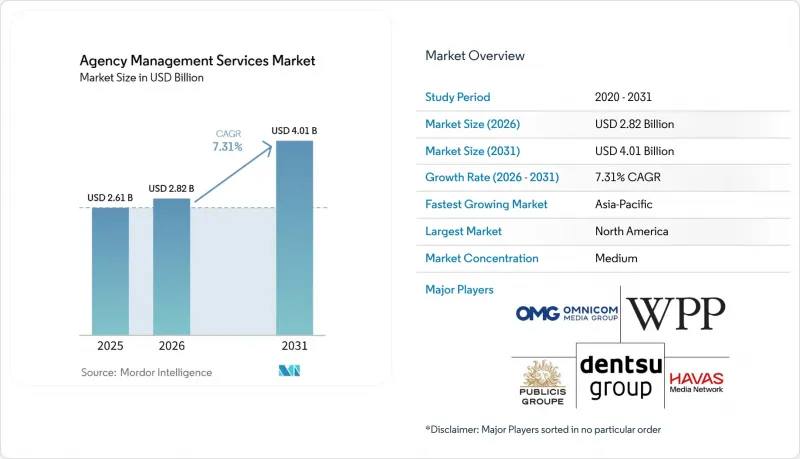
本報告按服務類型(數位行銷服務、傳統行銷服務、公共關係與傳播等)、服務類型(策略與諮詢、創新服務等)、終端用戶產業(零售與電子商務、媒體與娛樂、醫療保健與生命科學等)以及地區進行細分。市場預測以美元計價。
全球代理管理服務市場趨勢與洞察
全通路宣傳活動編配的需求日益成長
從各自獨立的通路活動轉向協調一致的客戶旅程,是推動代理商管理服務市場發展的主要動力。如今,品牌需要同時管理付費搜尋、零售媒體、連網電視、電子郵件、社群媒體活動、網站和店內接點,並且通常針對每個平台採用不同的規則和報告格式。這就要求代理商協調跨管道的時間表、受眾規則、創新素材、投放頻率、支出決策和報告,並將各項活動作為一個整體進行管理。 Adobe 於 2025 年 1 月發布了 Journey Optimizer B2B Edition,將宣傳活動編配擴展到以客戶為基礎的行銷旅程,涵蓋電子郵件、網站、LinkedIn 和付費管道。代理商需要採用類似的技術或將這些工具整合到自身的交付模式中。當客戶的資料結構和工作流程規則深深融入代理商的流程時,更換服務商可能不只是協商降價的價格那麼簡單。
零售媒體與商業媒體支出擴張
零售媒體正在為代理管理服務市場帶來獨特的管理服務需求。品牌需要協助規劃其在零售商廣告平台和更廣泛的電商媒體管道中的活動。這些管道在不同網路上的廣告資源、消費者訊號和宣傳活動指標可能各不相同。這項工作需要網路規劃、受眾選擇、宣傳活動管理、效果衡量、創新調整以及與零售合作夥伴的商業性協調等不同能力。大規模平台需要深厚的營運知識,而小規模網路則會增加協調工作量,並難以獲得一致的結果。在這種情況下,品牌團隊很難在內部管理所有活動,尤其是在同一產品線部署於多個電商環境時。能夠提供整合零售媒體規劃、消費者分析和創新分發的代理商可以幫助客戶更好地開展其更廣泛的電商專案。
大型企業內部團隊的擴張
在代理管理服務市場,一些大型客戶正透過擴充內部團隊來限制外包工作的範圍。這種轉變是選擇性的,並非完全取代與代理商的關係,因為內部團隊未必具備專業技能、全球企業發展能力或處理複雜監管合規事務的能力。客戶組織正擴大將日常製作、基礎宣傳活動執行和大量處理任務轉移到內部。輝瑞公司在2025年建立了內部SEO和AI搜尋能力。同時,Brandtech Group報告稱,八家全球客戶在九個月內就將AI驅動的搜尋視覺化能力納入了內部。雀巢也透過共享服務精簡了行銷運營,將其支援的品牌數量從2024年初的400多個減少到2026年的150個。這些變化更加清晰地表明,代理商需要提供客戶團隊難以輕易複製的專業技能、監管行銷、全球協調以及其他任務。
細分市場分析
至2025年,數位行銷服務將佔代理管理服務市場佔有率的35.36%。這個細分市場受益於客戶對跨搜尋、社交平臺、連網電視和電商管道的以結果為導向的規劃的需求。數位分發仍然至關重要,因為它將媒體活動與更即時的衡量、最佳化、受眾管理、創新調整和報告聯繫起來。雖然傳統行銷服務和創新內容創作在品牌一致性至關重要的消費品和金融服務產業仍然很重要,但生成式人工智慧正在減少創建標準化素材所需的時間和成本。這給標準創新工作的「按時間計費」模式帶來了壓力。
預計到2031年,電子郵件和生命週期行銷服務將以7.52%的複合年成長率成長,成為成長最快的服務。該服務中代理商管理服務的市場規模反映出,隨著第三方Cookie效用的下降,企業內部客戶關係的重要性日益凸顯。 Klaviyo報告稱,截至2026年第二季度,其付費帳戶超過16.5萬個,每月處理超過600億資料點。這一規模表明,即使對於中型品牌而言,人工智慧驅動的細分也變得更加容易,平台正在簡化基本的執行流程。同時,代理商在受眾設計、專案遷移、訊息排序、客戶架構和跨通路整合方面仍然發揮著至關重要的作用。
區域分析
2025年,北美地區佔代理管理服務收入的34.36%。該地區受益於成熟的程序化購買系統、較高的代理商預付費用以及眾多大型廣告控股公司的存在。宏盟集團於2025年11月26日完成了對埃培智集團的收購,合併後的公司預計收入將超過250億美元。 WPP集團公佈的2025年收入為135.5億英鎊(約173.44億美元),但以相同基準計算,收入下降了3.6%。該公司的「Elevate28」計畫旨在2028年實現每年節省5億英鎊(約6.4億美元)的成本。
歐洲在代理管理服務市場佔有重要地位,其中英國、德國和法國主導。該地區的代理機構需遵守歐盟《人工智慧法案》第50條的特定合規要求,該條款於2026年8月2日生效,規定了透明度義務。這些義務涵蓋人工智慧生成或篡改內容的揭露,因此需要記錄內容來源,並對面向歐盟受眾的作品實施揭露流程。能夠支援內容審核、來源元元資料和揭露工作流程的代理機構可以幫助客戶應對這些要求。南美洲市場規模仍然較小,但巴西正在推動對託管行銷服務的需求,而哥倫比亞的數位服務產業也在蓬勃發展。
預計到2031年,亞太地區將以9.21%的複合年成長率成長,成為成長最快的區域市場。代理商管理服務市場的成長主要得益於龐大的中小型廣告主群體、多元化的本地媒體體係以及不斷擴展的數位行銷活動。中國的超級應用和零售媒體結構與北美截然不同,其商業環境也存在差異。由於合約金額較低,中國的業務擴張往往更依賴增加客戶數量,而非現有客戶的成長。以阿拉伯聯合大公國和沙烏地阿拉伯主導的中東地區,正透過國家發展計畫和體育贊助吸引控股公司和獨立代理商的投資。非洲市場仍處於起步階段,但隨著行動優先廣告體系的日趨成熟,奈及利亞和南非的需求不斷成長。
其他好處:
- Excel格式的市場預測(ME)表
- 3個月的分析師支持
目錄
第1章:引言
- 研究假設和市場定義
- 調查範圍
第2章:調查方法
第3章執行摘要
第4章 市場狀況
- 市場概覽
- 市場促進因素
- 全通路宣傳活動編配的需求日益成長
- 零售媒體與商業媒體支出成長
- 對可衡量的投資報酬率和績效薪酬的需求日益成長。
- 為中小企業提供全通路行銷實施外包服務
- 人工智慧管治和合成內容的可追溯性
- 在保護隱私的同時使用第一方數據
- 市場限制因素
- 大型企業內部團隊的擴張
- 費用降低和採購主導的商品化
- 隱私限制下的「圍牆花園」之間歸屬關係的碎片化
- 專業人才保留面臨的挑戰
- 宏觀經濟因素對市場的影響
- 產業價值鏈分析
- 科技趨勢
- 監理情勢
- 波特五力分析
第5章 市場規模與成長預測
- 報價
- 數位行銷服務
- 傳統行銷服務
- 公共關係與傳播
- 創新和內容創作
- 品牌策略與諮詢
- 電子郵件和生命週期行銷服務
- 按服務
- 策略與諮詢
- 創新服務
- 宣傳活動管理
- 媒體管理
- 分析與最佳化
- 其他服務
- 按最終用戶行業分類
- 零售與電子商務
- 媒體與娛樂
- 醫療保健和生命科學
- 旅遊與飯店
- 消費品
- 其他終端用戶產業(銀行、金融服務與保險、教育、汽車、IT/電信等)
- 按地區
- 北美洲
- 美國
- 加拿大
- 墨西哥
- 南美洲
- 巴西
- 阿根廷
- 智利
- 其他南美國家
- 歐洲
- 德國
- 英國
- 法國
- 義大利
- 西班牙
- 其他歐洲國家
- 亞太地區
- 中國
- 日本
- 印度
- 韓國
- 澳洲
- 其他亞太國家
- 中東
- 阿拉伯聯合大公國
- 沙烏地阿拉伯
- 卡達
- 其他中東國家
- 非洲
- 南非
- 埃及
- 奈及利亞
- 其他非洲國家
- 北美洲
第6章 競爭情勢
- 市場集中度
- 策略趨勢
- 市佔率分析
- 公司簡介
- WPP plc
- Omnicom Group Inc.
- Publicis Groupe SA
- The Interpublic Group of Companies, Inc.
- Dentsu Group Inc.
- Havas NV
- Stagwell Inc.
- Accenture plc
- Deloitte Touche Tohmatsu Limited
- IBM Corporation
- Cognizant Technology Solutions Corporation
- S4 Capital plc
- M&C Saatchi plc
- Serviceplan Group SE & Co. KG
- VCCP Limited
- WebFX, Inc.
- Disruptive Advertising, LLC
- Ignite Visibility, LLC
- NP Digital, LLC
- 9thWonder LLC
第7章 市場機會與未來展望
According to Mordor Intelligence, the agency management services market size was valued at USD 2.61 billion in 2025 and estimated to grow from USD 2.82 billion in 2026 to reach USD 4.01 billion by 2031, at a CAGR of 7.31% during the forecast period (2026-2031).
This report is Segmented by Offering (Digital Marketing Services, Traditional Marketing Services, Public Relations and Communications, and More), Services (Strategy and Consulting, Creative Services, and More), End User Industry (Retail and E-Commerce, Media and Entertainment, Healthcare and Life Sciences, and More), and Geography. The Market Forecasts are Provided in Terms of Value (USD).
Global Agency Management Services Market Trends and Insights
Rising Demand for Omnichannel Campaign Orchestration
The move from channel-specific activity to coordinated customer journeys is a major driver for the Agency Management Services Market. Brands now manage paid search, retail media, connected television, email, social activity, websites, and in-store touchpoints simultaneously, often with separate platform rules and reporting formats. This work requires agencies to coordinate timing, audience rules, creative assets, frequency, spending decisions, and reporting across channels to manage activity as a connected program. Adobe introduced Journey Optimizer B2B Edition in January 2025, extending campaign orchestration to account-based marketing journeys across email, web, LinkedIn, and paid channels. Agencies must either use comparable technology or integrate these tools into their delivery model. Once a client's data structures and workflow rules are embedded in an agency process, changing providers can involve much more than negotiating a lower fee.
Growth in Retail Media and Commerce Media Spend
Retail media is creating a distinct source of managed-service demand within the Agency Management Services Market. Brands need support to plan activity across retailer-owned advertising environments and broader commerce media channels, where available inventory, shopper signals, and campaign metrics can vary by network. This work calls for separate capabilities in network planning, audience selection, campaign management, measurement, creative adaptation, and commercial coordination with retailer partners. Large platforms require deep operating knowledge, while smaller networks add further coordination work and make it harder to establish a consistent view of results. The resulting mix can make it difficult for brand teams to manage all activity internally, especially when the same product line runs across several commerce environments. Agencies that bring retail media planning together with shopper analysis and creative delivery can support clients across a wider range of commerce programs.
In-House Team Expansion at Large Enterprises
In-house team expansion limits the scope of external work at some large accounts in the Agency Management Services Market. The shift is selective, rather than a complete replacement of agency relationships, because internal teams do not always have the same specialist technology, global operating reach, or capacity for complex regulated assignments. Routine production, basic campaign execution, and high-volume work are more likely to move inside the client organization. Pfizer built internal SEO and AI search capabilities in 2025, while Brandtech Group reported that 8 global clients had brought AI discoverability functions in-house over 9 months. Nestle also streamlined its marketing operations through shared services, reducing the number of brands it supported from more than 400 in early 2024 to 150 by 2026. These changes leave agencies with a clearer need to provide specialist technology, regulated marketing, global coordination, and work that client teams cannot easily replicate.
Other drivers and restraints analyzed in the detailed report include:
- Rising Need for Measurable ROI and Outcome-Based Fees
- SME Outsourcing of Full-Funnel Marketing Execution
- Fee Compression and Procurement-Led Commoditization
For complete list of drivers and restraints, kindly check the Table Of Contents.
Segment Analysis
Digital marketing services held 35.36% of the Agency Management Services Market share in 2025. The segment benefits from client demand for performance-oriented planning across search, social platforms, connected television, and commerce channels. Digital delivery remains central because it links media activity with more immediate measurement, optimization, audience management, creative adaptation, and reporting. Traditional marketing services and creative and content production remain relevant in consumer goods and financial services, where brand consistency is important, although generative AI is reducing the time and cost required to produce routine assets. This places pressure on the billable-hours model for standard creative work.
Email and lifecycle marketing services are projected to grow at a 7.52% CAGR through 2031, making them the fastest-growing offering. The Agency Management Services Market size for this offering reflects the growing importance of owned customer relationships as third-party cookies become less useful. Klaviyo reported more than 165,000 paying accounts and processed more than 60 billion data points each month in the second quarter of 2026. This scale shows how AI-supported segmentation has become more available to mid-sized brands, while platforms can simplify basic execution. Agencies retain a role in audience design, program migration, message sequencing, customer architecture, and cross-channel integration.
Complete Report Scope:
- By Offering
- Digital Marketing Services
- Traditional Marketing Services
- Public Relations and Communications
- Creative and Content Production
- Brand Strategy and Consulting
- Email and Lifecycle Marketing Services
- By Services
- Strategy and consulting
- Creative services
- Campaign management
- Media management
- Analytics and optimization
- Other Services
- By End User Industry
- Retail and E-commerce
- Media and Entertainment
- Healthcare and Life Sciences
- Travel and Hospitality
- Consumer Goods
- Other End User Industries (BFSI, Education, Automotive, and IT and Telecom amongst Others)
- By Geography
- North America
- United States
- Canada
- Mexico
- South America
- Brazil
- Argentina
- Chile
- Rest of South America
- Europe
- Germany
- United Kingdom
- France
- Italy
- Spain
- Rest of Europe
- Asia-Pacific
- China
- Japan
- India
- South Korea
- Australia
- Rest of Asia-Pacific
- Middle East
- United Arab Emirates
- Saudi Arabia
- Qatar
- Rest of Middle East
- Africa
- South Africa
- Egypt
- Nigeria
- Rest of Africa
- North America
Geography Analysis
North America held 34.36% of agency management services revenue in 2025. The region benefits from mature programmatic systems, high agency retainer values, and the presence of major advertising holding companies. Omnicom completed its acquisition of Interpublic on November 26, 2025, creating a combined company with pro forma revenue above USD 25 billion. WPP reported 2025 revenue of GBP 13,550 million, equivalent to USD 17,344 million, while its like-for-like revenue declined by 3.6%. Its Elevate28 plan targets GBP 500 million (USD 640 million) in gross annual cost savings by 2028.
Europe has a substantial presence in the Agency Management Services Market, led by the United Kingdom, Germany, and France. Agencies in the region face a specific compliance need under Article 50 of the EU AI Act, whose transparency obligations took effect on August 2, 2026. These obligations address the disclosure of AI-generated or manipulated content, creating a need for Agency Management Services Market providers to document content origins and apply disclosure processes for work reaching EU audiences. Agencies that support content review, provenance metadata, and disclosure workflows can help clients manage these requirements. South America remains smaller in value, but Brazil anchors demand for managed marketing services alongside developing digital-service activity in Colombia.
Asia-Pacific is projected to grow at a 9.21% CAGR through 2031, making it the fastest-growing regional segment. The Agency Management Services Market's growth is driven by a large base of small- and medium-sized advertisers, varied local media systems, and expanding digital marketing activity. China's super-app and retail media structures create a different operating environment from North America, and lower retainer values mean expansion is more dependent on client volume than on growth within existing accounts. The Middle East, led by the United Arab Emirates and Saudi Arabia, is attracting investment from holding companies and independent agencies in national development programs and sports sponsorships. Africa remains at an earlier stage, although Nigeria and South Africa show increasing demand as mobile-first advertising systems mature.
- WPP plc
- Omnicom Group Inc.
- Publicis Groupe S.A.
- The Interpublic Group of Companies, Inc.
- Dentsu Group Inc.
- Havas N.V.
- Stagwell Inc.
- Accenture plc
- Deloitte Touche Tohmatsu Limited
- IBM Corporation
- Cognizant Technology Solutions Corporation
- S4 Capital plc
- M&C Saatchi plc
- Serviceplan Group SE & Co. KG
- VCCP Limited
- WebFX, Inc.
- Disruptive Advertising, LLC
- Ignite Visibility, LLC
- NP Digital, LLC
- 9thWonder LLC
Additional Benefits:
- The market estimate (ME) sheet in Excel format
- 3 months of analyst support
TABLE OF CONTENTS
1 INTRODUCTION
- 1.1 Study Assumptions and Market Definition
- 1.2 Scope of the Study
2 RESEARCH METHODOLOGY
3 EXECUTIVE SUMMARY
4 MARKET LANDSCAPE
- 4.1 Market Overview
- 4.2 Market Drivers
- 4.2.1 Rising Demand for Omnichannel Campaign Orchestration
- 4.2.2 Growth in Retail Media and Commerce Media Spend
- 4.2.3 Rising Need for Measurable ROI and Outcome-Based Fees
- 4.2.4 SME Outsourcing of Full-Funnel Marketing Execution
- 4.2.5 AI Governance and Synthetic Content Traceability
- 4.2.6 Privacy-Safe First-Party Data Activation
- 4.3 Market Restraints
- 4.3.1 In-House Team Expansion at Large Enterprises
- 4.3.2 Fee Compression and Procurement-Led Commoditization
- 4.3.3 Fragmented Attribution Across Privacy-Restricted Walled Gardens
- 4.3.4 Talent Retention Challenges in Specialized Roles
- 4.4 Impact of Macroeconomic Factors on the Market
- 4.5 Industry Value-Chain Analysis
- 4.6 Technology Outlook
- 4.7 Regulatory Landscape
- 4.8 Porter's Five Forces Analysis
- 4.8.1 Threat of New Entrants
- 4.8.2 Bargaining Power of Suppliers
- 4.8.3 Bargaining Power of Buyers
- 4.8.4 Threat of Substitutes
- 4.8.5 Intensity of Competitive Rivalry
5 MARKET SIZE AND GROWTH FORECASTS (VALUE)
- 5.1 By Offering
- 5.1.1 Digital Marketing Services
- 5.1.2 Traditional Marketing Services
- 5.1.3 Public Relations and Communications
- 5.1.4 Creative and Content Production
- 5.1.5 Brand Strategy and Consulting
- 5.1.6 Email and Lifecycle Marketing Services
- 5.2 By Services
- 5.2.1 Strategy and consulting
- 5.2.2 Creative services
- 5.2.3 Campaign management
- 5.2.4 Media management
- 5.2.5 Analytics and optimization
- 5.2.6 Other Services
- 5.3 By End User Industry
- 5.3.1 Retail and E-commerce
- 5.3.2 Media and Entertainment
- 5.3.3 Healthcare and Life Sciences
- 5.3.4 Travel and Hospitality
- 5.3.5 Consumer Goods
- 5.3.6 Other End User Industries (BFSI, Education, Automotive, and IT and Telecom amongst Others)
- 5.4 By Geography
- 5.4.1 North America
- 5.4.1.1 United States
- 5.4.1.2 Canada
- 5.4.1.3 Mexico
- 5.4.2 South America
- 5.4.2.1 Brazil
- 5.4.2.2 Argentina
- 5.4.2.3 Chile
- 5.4.2.4 Rest of South America
- 5.4.3 Europe
- 5.4.3.1 Germany
- 5.4.3.2 United Kingdom
- 5.4.3.3 France
- 5.4.3.4 Italy
- 5.4.3.5 Spain
- 5.4.3.6 Rest of Europe
- 5.4.4 Asia-Pacific
- 5.4.4.1 China
- 5.4.4.2 Japan
- 5.4.4.3 India
- 5.4.4.4 South Korea
- 5.4.4.5 Australia
- 5.4.4.6 Rest of Asia-Pacific
- 5.4.5 Middle East
- 5.4.5.1 United Arab Emirates
- 5.4.5.2 Saudi Arabia
- 5.4.5.3 Qatar
- 5.4.5.4 Rest of Middle East
- 5.4.6 Africa
- 5.4.6.1 South Africa
- 5.4.6.2 Egypt
- 5.4.6.3 Nigeria
- 5.4.6.4 Rest of Africa
- 5.4.1 North America
6 COMPETITIVE LANDSCAPE
- 6.1 Market Concentration
- 6.2 Strategic Moves
- 6.3 Market Share Analysis
- 6.4 Company Profiles (includes Global Level Overview, Market Level Overview, Core Segments, Financials as available, Strategic Information, Market Rank/Share, Products and Services, Recent Developments)
- 6.4.1 WPP plc
- 6.4.2 Omnicom Group Inc.
- 6.4.3 Publicis Groupe S.A.
- 6.4.4 The Interpublic Group of Companies, Inc.
- 6.4.5 Dentsu Group Inc.
- 6.4.6 Havas N.V.
- 6.4.7 Stagwell Inc.
- 6.4.8 Accenture plc
- 6.4.9 Deloitte Touche Tohmatsu Limited
- 6.4.10 IBM Corporation
- 6.4.11 Cognizant Technology Solutions Corporation
- 6.4.12 S4 Capital plc
- 6.4.13 M&C Saatchi plc
- 6.4.14 Serviceplan Group SE & Co. KG
- 6.4.15 VCCP Limited
- 6.4.16 WebFX, Inc.
- 6.4.17 Disruptive Advertising, LLC
- 6.4.18 Ignite Visibility, LLC
- 6.4.19 NP Digital, LLC
- 6.4.20 9thWonder LLC
7 MARKET OPPORTUNITIES AND FUTURE OUTLOOK
- 7.1 White-Space and Unmet-Need Assessment

 管理決策:市場佔有率分析、產業趨勢與統計、成長預測(2026-2031)自動化決策管理軟體:市場佔有率分析、產業趨勢與統計、成長預測(2026-2031)
 管理決策市場報告:按組件、部署模式、功能、組織規模、產業和地區分類(2026-2034 年)
 智慧平台管理介面市場:依產品、組件、連接方式、最終用戶、部署類型和組織規模分類-2026-2032年全球預測
 商業決策市場分析及預測(至2035年):依類型、產品、服務、技術、組件、應用、部署類型、最終用戶及功能分類
 全球商業決策市場規模、佔有率、趨勢和成長分析報告(2026-2034)
 全球數位化變電站智慧市場:預測(至2034年)-按解決方案類型、組件、技術、應用、最終用戶和地區進行分析
 智慧平台管理介面市場 - 全球產業規模、佔有率、趨勢、機會及預測(按組件、最終用戶、地區和競爭格局分類,2021-2031年)數位平台指揮軟體市場,依部署模式、組件類型、組織規模和產業垂直領域分類,全球預測,2026-2032年智慧標籤管理系統市場按產品類型、應用、最終用戶和分銷管道分類,全球預測(2026-2032年)