


 |
市場調查報告書
商品編碼
2124522
中國煤炭產業:市場佔有率分析、產業趨勢與統計及成長預測(2026-2031年)China Coal - Market Share Analysis, Industry Trends & Statistics, Growth Forecasts (2026 - 2031) |
||||||

※ 本網頁內容可能與最新版本有所差異。詳細情況請與我們聯繫。
根據 Mordor Intelligence 預測,中國煤炭市場規模(以產量計)預計將從 2026 年的 49.4 億噸成長到 2031 年的 50.9 億噸,預測期(2026-2031 年)複合年成長率為 0.63%。
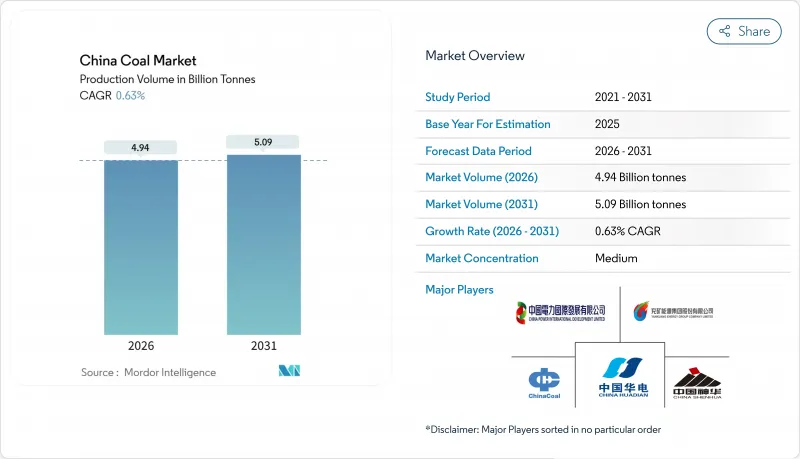
本報告按煤炭等級(褐煤/低品位煤、次煙煤、煙煤和焦結煤)和應用領域(發電、鋼鐵冶金、水泥及其他應用)進行細分。市場規模和預測以噸為單位。
中國煤炭市場趨勢與洞察
資料中心叢集導致電力需求激增
人工智慧(AI)工作負載和雲端運算服務正在重塑中國的煤炭市場,它們帶來的基本負載需求柔軟性降低,而僅靠可再生能源尚無法滿足這一需求。預計2024年至2030年間,資料中心將額外消耗90太瓦時(TWh)的燃煤電力,促使省級監管機構在2024年迅速批准新增15吉瓦(GW)的燃煤發電裝置容量,以支援這些叢集。營運商正與礦區配套的電廠簽訂為期10年的購電協議,透過固定的價格遞增條款確保煙煤的供應。這種機制抑制了超大規模資料中心現貨市場價格的波動,並保障了煤礦的市場。儘管中國可再生能源發展迅速,但這一趨勢仍將暫時延長煤炭在中國電力結構中的地位。同時,這也促使垂直一體化的國有企業投資鐵路和港口物流,以確保沿海資料叢集的穩定運輸。
煤化工聯合裝置現場發電需求激增
到2025年,煤化工計畫將佔煤炭消費量的約8%,隨著山西、陝西和寧夏回族自治區等地的持續擴張,到2030年這一比例可能超過10%。這些綜合設施運作現場汽電共生設備,熱效率接近50%,高於獨立電廠。陝西一座於2024年底運作的煤製烯烴工廠,年耗煤600萬噸,每年消耗褐煤1200萬噸,降低了中國對石腦油進口的依賴。高用水量仍然是一個挑戰,需要投資建造水循環利用系統,而進入許可權地下蓄水層的營運商則更佔優勢。該行業為低品位煤炭提供了一個市場,這些煤炭受長期價格波動的影響較小,從而保護了煤礦企業免受電力需求下降的影響。此外,該行業還創造了對聚丙烯和聚乙烯的需求,這些材料供應給國內包裝和汽車行業。
到 2030 年實現碳排放達峰,到 2060 年實現碳中和的承諾,導致了更嚴格的核准標準。
繼中國「兩大目標」氣候承諾之後,監管機構預計2025年將駁回40%的煤炭計畫申請,高於2022年的20%。江蘇、浙江、廣東等沿海省份的審查標準最為嚴格,資金正轉向離岸風力發電和電網級儲能。投資者在評估新建燃煤發電工程時,已將「擱淺資產」風險納入考量,轉而將資金投入清潔煤維修。除特定工業市場等細分領域外,這種轉變限制了中國煤炭市場的上漲潛力。儘管二氧化碳捕集與利用(CCU)技術(最終可能實現廢氣貨幣化)的研究正在加速推進,但短期資金籌措仍集中在能夠承受政策波動的國有開發商手中。
細分市場分析
截至2025年,煙煤和焦結煤將佔中國煤炭市場佔有率的67.3%,預計到2031年將以1.1%的複合年成長率成長。這反映了高爐煉焦煤生產的穩定,2024年焦結煤消耗量為6.5億噸。次煙煤約佔總量的20%,主要供應給優先考慮低硫含量以符合排放法規的電廠和水泥窯。褐煤和其他低品位煤炭佔剩餘的13%,主要集中在蒙古和華南地區。在這些地區,與煤礦相連的電廠和煤化工聯合企業採用煤氣化製程。國內鋼鐵企業傾向於與山西和貴州兩省簽訂長期契約,以對沖澳洲進口價格波動帶來的風險。 2024年,澳洲供應了國內鋼鐵企業45%的煉焦煤進口。對這座900吉瓦燃煤電廠進行超低排放氣體維修後,無需改用價格較高的進口煤,即可使用次菸煤作為原料,滿足更嚴格的粒狀物、二氧化硫和氮氧化物排放標準。
冶金煤和火力發電需求的兩極化正在影響投資流向。國營企業正投入資金擴大優質煉焦煤的生產,而小規模的參與企業則難以資金籌措優質煤礦。與此同時,火力發電用煤的利潤率正受到來自價格更低的可再生能源的壓力,電力公司正在就浮動負荷價格和靈活的提煤條款進行談判。選擇性催化還原(SCR)和排煙脫硫(FGD)等技術的升級延長了電廠的使用壽命,限制了中國次菸煤市場的規模逐步萎縮。從長遠來看,即使火力發電用煤的需求趨於穩定,冶金煤的需求仍將繼續支撐優質煤炭的需求。
其他好處:
- Excel格式的市場預測(ME)表
- 3個月的分析師支持
目錄
第1章:引言
- 研究假設和市場定義
- 調查範圍
第2章:調查方法
第3章執行摘要
第4章 市場狀況
- 市場概覽
- 市場促進因素
- 資料中心叢集導致電力需求激增
- 煤化工聯合裝置現場發電需求激增。
- 政府支援的設備更新計劃
- 國內具有成本競爭力的蘊藏量與海運進口的比較
- 引入自主智慧礦山將降低營運設備成本 (OPEX)。
- 超低排放氣體維修可延長工廠壽命。
- 市場限制因素
- 到 2030 年實現碳排放達峰,到 2060 年實現碳中和的承諾,導致了更嚴格的核准標準。
- 可再生能源和儲能設施的加速發展正在導致燃煤發電量的減少。
- 基於ESG原則的煤炭專案信貸限制
- 煤炭資源豐富的省份面臨水資源短缺問題,限制了新煤礦的開發。
- 供應鏈分析
- 監理情勢
- 技術展望
- 波特五力模型
- PESTLE分析
第5章 市場規模與成長預測
- 煤炭等級
- 褐煤/低階煤
- 次煙煤
- 煙煤和焦結煤
- 透過使用
- 發電
- 鋼鐵冶金
- 水泥及其他用途
第6章 競爭情勢
- 市場集中度
- 策略趨勢(併購、聯盟、購電協議)
- 市場佔有率分析(主要公司的市場排名和佔有率)
- 公司簡介
- China Energy Investment Corp.(China Shenhua)
- China Coal Energy Group
- Shaanxi Coal & Chemical Industry Group
- Shandong Energy Group
- Yankuang Energy Group
- Huadian Power Intl.
- Huaneng Power Intl.
- Datang Intl. Power Generation
- China Resources Power
- China Power Intl. Development
- Jinneng Holding Group
- Inner Mongolia Yitai Coal
- Kailuan Group
- Zhejiang Energy Group
- Guanghui Energy
- China Datang Group Coal Industry
- Huabei Coal & Electricity
- Beijing Jingmei Group
- Shanxi Lu'an Mining
- Guodian Power Development
第7章 市場機會與未來展望
According to Mordor Intelligence, the China coal market size in terms of production volume is expected to grow from 4.94 Billion tonnes in 2026 to 5.09 Billion tonnes by 2031, at a CAGR of 0.63% during the forecast period (2026-2031).
This report is Segmented by Coal Grade (Lignite/Low-Rank, Sub-Bituminous, and Bituminous and Coking) and Application (Power Generation, Iron/Steel/Metallurgy, and Cement and Other Applications). The Market Sizes and Forecasts are Provided in Terms of Volume (Tonnes).
China Coal Market Trends and Insights
Rapid Growth in Electricity Demand from Data-Center Clusters
Artificial-intelligence workloads and cloud services are reshaping the Chinese coal market by adding inflexible baseload demand that renewables alone cannot yet satisfy. Data centers are poised to consume an extra 90 TWh of coal-fired electricity between 2024 and 2030, and provincial regulators fast-tracked 15 GW of coal capacity in 2024 to backstop these clusters. Operators secure ten-year power-purchase agreements with mine-mouth generators, locking in bituminous supply at fixed escalators. This arrangement reduces spot-market volatility for hyperscale facilities and guarantees offtake for miners. The trend temporarily extends coal's role in China's power mix despite the country's renewable boom. It also encourages vertically integrated SOEs to invest in rail-port logistics that deliver stable throughput to coastal data clusters.
Surging Captive-Power Demand from Coal-Chemical Complexes
Coal-to-chemicals projects accounted for about 8% of coal consumption in 2025, and expansions underway in Shanxi, Shaanxi, and Ningxia could push the share above 10% by 2030. These complexes run captive cogeneration units that reach thermal efficiencies near 50%, higher than stand-alone generators. Shaanxi Coal's 6 Mt/yr coal-to-olefins plant, commissioned in late 2024, consumes 12 Mt of lignite annually and lowers China's reliance on imported naphtha. Water intensity remains a hurdle, requiring investments in recycling systems that favor players with aquifer access. The segment provides a long-term, price-insulated outlet for low-rank coal, shielding miners from shrinking utility demand. It also creates downstream polypropylene and polyethylene volumes that feed domestic packaging and auto industries.
2030 Carbon-Peaking / 2060 Neutrality Pledges Tighten Approvals
China's dual-target climate pledge prompted regulators to reject 40% of coal-project applications in 2025, up from 20% in 2022. Coastal provinces such as Jiangsu, Zhejiang, and Guangdong apply the strictest filters and pivot funding toward offshore wind and grid-scale storage. Investors now price in stranded-asset risk when assessing greenfield thermal projects, steering capital toward clean-coal retrofits instead. The shift limits upside for the Chinese coal market beyond captive industrial niches. It also accelerates research into carbon-capture utilization that could eventually monetize flue-gas streams, but near-term financing remains skewed toward state-backed developers capable of absorbing policy swings.
Other drivers and restraints analyzed in the detailed report include:
- Government-Backed Capacity Replacement Program
- Autonomous and Smart-Mine Deployment Cuts OPEX
- Accelerating Renewable and Storage Build-Out Curbs Coal Burn
For complete list of drivers and restraints, kindly check the Table Of Contents.
Segment Analysis
Bituminous and coking grades held 67.3% of China's coal market share in 2025 and are forecast to expand at a 1.1% CAGR through 2031, reflecting stable blast-furnace output that consumed 650 Mt of coking coal in 2024. Sub-bituminous coal, roughly 20% of volume, serves power plants and cement kilns that value its lower sulfur content for easier emissions compliance. Lignite and other low-rank grades make up the remaining 13%, concentrated in Inner Mongolia and Yunnan, where mine-mouth generators and coal-chemical complexes exploit gasification pathways. Domestic steelmakers favor long-term contracts from Shanxi and Guizhou to hedge against import volatility from Australia, which supplied 45% of coking-coal imports in 2024. Ultra-low-emission retrofits at 900 GW of coal-fired capacity let sub-bituminous feedstock satisfy stricter particulate, SO2, and NOx limits without switching to pricier imports.
The bifurcation between metallurgical and thermal demand shapes investment flows. SOEs are allocating capex to expand premium coking-coal output, while smaller entrants struggle to finance high-quality shafts. Meanwhile, thermal grades face margin pressure from cheaper renewables, prompting utilities to negotiate variable-load pricing and flexible offtake terms. Technology upgrades such as selective catalytic reduction and flue-gas desulfurization extend plant life, allowing the China coal market size for sub-bituminous grades to decline only slowly. Over time, metallurgical demand will remain the anchor for premium coal even as thermal volumes plateau.
Complete Report Scope:
- By Coal Grade
- Lignite/Low-Rank
- Sub-bituminous
- Bituminous and Coking
- By Application
- Power Generation
- Iron, Steel, and Metallurgy
- Cement and Other Applications
List of Companies Covered in this Report:
- China Energy Investment Corp. (China Shenhua)
- China Coal Energy Group
- Shaanxi Coal & Chemical Industry Group
- Shandong Energy Group
- Yankuang Energy Group
- Huadian Power Intl.
- Huaneng Power Intl.
- Datang Intl. Power Generation
- China Resources Power
- China Power Intl. Development
- Jinneng Holding Group
- Inner Mongolia Yitai Coal
- Kailuan Group
- Zhejiang Energy Group
- Guanghui Energy
- China Datang Group Coal Industry
- Huabei Coal & Electricity
- Beijing Jingmei Group
- Shanxi Lu'an Mining
- Guodian Power Development
Additional Benefits:
- The market estimate (ME) sheet in Excel format
- 3 months of analyst support
TABLE OF CONTENTS
1 Introduction
- 1.1 Study Assumptions & Market Definition
- 1.2 Scope of the Study
2 Research Methodology
3 Executive Summary
4 Market Landscape
- 4.1 Market Overview
- 4.2 Market Drivers
- 4.2.1 Rapid growth in electricity demand from data-center clusters
- 4.2.2 Surging captive-power demand from coal-chemical complexes
- 4.2.3 Government-backed capacity replacement program
- 4.2.4 Cost-competitive domestic reserves vs. seaborne imports
- 4.2.5 Autonomous & smart-mine deployment cuts OPEX
- 4.2.6 Ultra-low-emission retrofits extend plant lifetimes
- 4.3 Market Restraints
- 4.3.1 2030 carbon-peaking/2060 neutrality pledges tighten approvals
- 4.3.2 Accelerating renewable & storage build-out curbs coal burn
- 4.3.3 ESG-driven credit restrictions on coal projects
- 4.3.4 Water-stress in coal-rich provinces limits new mines
- 4.4 Supply-Chain Analysis
- 4.5 Regulatory Landscape
- 4.6 Technological Outlook
- 4.7 Porter's Five Forces
- 4.7.1 Threat of New Entrants
- 4.7.2 Bargaining Power of Suppliers
- 4.7.3 Bargaining Power of Buyers
- 4.7.4 Threat of Substitutes
- 4.7.5 Competitive Rivalry
- 4.8 PESTLE Analysis
5 Market Size & Growth Forecasts
- 5.1 By Coal Grade
- 5.1.1 Lignite/Low-Rank
- 5.1.2 Sub-bituminous
- 5.1.3 Bituminous and Coking
- 5.2 By Application
- 5.2.1 Power Generation
- 5.2.2 Iron, Steel, and Metallurgy
- 5.2.3 Cement and Other Applications
6 Competitive Landscape
- 6.1 Market Concentration
- 6.2 Strategic Moves (M&A, Partnerships, PPAs)
- 6.3 Market Share Analysis (Market Rank/Share for key companies)
- 6.4 Company Profiles (includes Global level Overview, Market level overview, Core Segments, Financials as available, Strategic Information, Products & Services, and Recent Developments)
- 6.4.1 China Energy Investment Corp. (China Shenhua)
- 6.4.2 China Coal Energy Group
- 6.4.3 Shaanxi Coal & Chemical Industry Group
- 6.4.4 Shandong Energy Group
- 6.4.5 Yankuang Energy Group
- 6.4.6 Huadian Power Intl.
- 6.4.7 Huaneng Power Intl.
- 6.4.8 Datang Intl. Power Generation
- 6.4.9 China Resources Power
- 6.4.10 China Power Intl. Development
- 6.4.11 Jinneng Holding Group
- 6.4.12 Inner Mongolia Yitai Coal
- 6.4.13 Kailuan Group
- 6.4.14 Zhejiang Energy Group
- 6.4.15 Guanghui Energy
- 6.4.16 China Datang Group Coal Industry
- 6.4.17 Huabei Coal & Electricity
- 6.4.18 Beijing Jingmei Group
- 6.4.19 Shanxi Lu'an Mining
- 6.4.20 Guodian Power Development
7 Market Opportunities & Future Outlook
- 7.1 White-space & Unmet-Need Assessment

 半碳化顆粒市場規模、佔有率和成長分析:按原料、應用、最終用戶、分銷管道、顆粒尺寸和地區分類 - 產業預測,2026-2033年
 煤炭貿易:市場佔有率分析、產業趨勢與統計、成長預測(2026-2031)冶金煤:市場佔有率分析、產業趨勢與統計、成長預測(2026-2031)
 煤炭市場規模、佔有率和成長分析:按類型、應用、開採方法、最終用戶、分銷管道和地區分類-2026-2033年產業預測
 焦煤市場規模、佔有率和成長分析:按類型、等級、開採流程、最終用戶、分銷管道和地區分類-2026-2033年產業預測
 煤炭交易市場規模、佔有率和成長分析:按煤炭類型、交易方式、終端用戶產業、供應來源、交易類型、分銷管道和地區分類-2026-2033年產業預測
 2026-2030年全球煉焦煤市場
 煤炭市場:2026-2032年全球市場預測(依煤炭類型、產品類型、品質、採礦技術及最終用途產業分類)煤炭自燃抑制劑市場:依化學類型、形態、應用方法、應用階段和最終用戶分類-全球預測,2026-2032年
 動力煤市場規模、佔有率和成長分析:按熱值、揮發分餾、工業應用、區域和產業預測,2026-2033年