


 |
市場調查報告書
商品編碼
2117490
冶金煤:市場佔有率分析、產業趨勢與統計、成長預測(2026-2031)Metallurgical Coal - Market Share Analysis, Industry Trends & Statistics, Growth Forecasts (2026 - 2031) |
||||||

※ 本網頁內容可能與最新版本有所差異。詳細情況請與我們聯繫。
冶金煤市場預計將從 2025 年的 1,283.7 億美元和 2026 年的 1,324.6 億美元成長到 2031 年的 1,543.7 億美元,2026 年至 2031 年的年複合成長率(CAGR)為 3.11%。
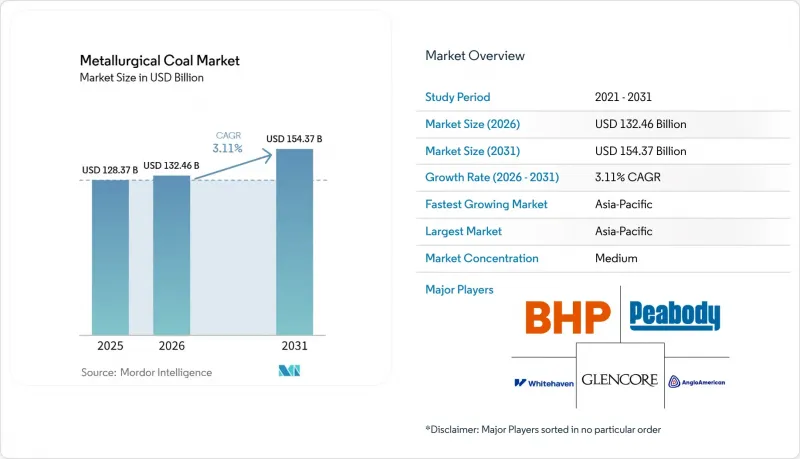
本報告按產品類型(硬焦結煤、半軟半硬焦結煤等)、開採方法(地下開採和露天開採)、應用領域(鋼鐵生產、鐵礦石等)以及地區(亞太地區、北美地區、歐洲地區、南美地區、中東和非洲地區)進行細分。市場預測以美元計價。
全球冶金煤市場趨勢及洞察
鋼鐵業對冶金煤的結構性依賴
高爐資產壽命長,一旦運作,通常可連續運作數十年。因此,冶金煤市場不僅與短期市場情緒密切相關,也與現有的煉鋼產能息息相關。在高爐-轉爐(BF-BOF)製程中,生產一噸鋼仍需要約0.86噸冶金煤。這是因為焦炭在高爐原料中發揮化學和結構上的作用。根據經合組織的數據,2025年至2027年間全球整體計畫新增的1.65億噸煉鋼產能中,超過40%仍將採用高爐-轉爐工藝,其中大部分計畫集中在印度和東南亞國協。這種產能結構確保了冶金煤市場與實際營運需求緊密相關,即使在成熟地區鋼鐵業的盈利不均衡的情況下也是如此。供應狀況是另一個影響因素。正如世界鋼鐵協會所指出的,高價值焦炭的生產面臨資源和供應鏈的限制。因此,即使運轉率下降,冶金煤市場仍可能保持強勁,因為現有的高爐仍需要高等級的煉焦煤來維持生產品質。
煉鐵業中使用的冶金煤的商業性替代品有限。
冶金煤市場仍反映出一個現實:目前尚無一種能夠大規模商業化生產高爐煉鋼所需的燃料和還原性能兼具煤炭特性的替代能源。根據經合組織(OECD)關於氫氣在煉鋼中應用的研究,綠色鋼鐵生產路線面臨資金、盈利和產能過剩等障礙,導致煤炭密集型生產路線的替代速度無法達到預期。預計到2025年,鋼鐵脫碳進程仍將緩慢推進,因為新增高爐煉鋼產能持續超過新增直接還原鐵(DRI)產能,排放強度基本上保持不變。國際能源總署(IEA)也預測,由於成本壓力和廢鋼供應的限制,中期內氫基煉鋼的推廣仍將受到限制。因此,冶金煤市場在短期內受替代能源的影響較小,並將依賴鋼廠現代化、資金籌措和原料加工等較緩慢的經濟趨勢。此外,由於鋼鐵製造商無法迅速重新設計現有的煉鋼高爐以適應替代原料,這使得頂級生產商能夠在長期合約中保持談判優勢。
針對高碳鋼鐵生產的脫碳政策
由於已開發國家為減少煤炭依賴型煉鋼製程而推行的脫碳法規,冶金煤市場面臨長期限制。自2026年起,修訂後的歐盟排放交易體系(ETS)基準定義將涵蓋燒結礦、鐵水和氫氣,從而加強對氫基直接還原鐵電弧爐(H2-DRI-EAF)製程相對於傳統高爐煉鋼製程的政策支持。歐盟的碳邊境調節機制(CBAM)透過對進口鋼鐵徵收碳相關費用,進一步加大了壓力,鼓勵歐盟以外的生產商加快清潔生產計畫。英國計畫於2025年發布的鋼鐵戰略也將電弧爐(EAF)定位為長期國家發展方向,而直接還原鐵(DRI)則在初級煉鋼中發揮過渡作用。然而,根據經濟合作暨發展組織)的數據,冶金煤市場仍然存在嚴重的產能過剩和盈利低下的問題,這阻礙了綠色轉型投資,因此預計短期內需求不會大幅下降。因此,預計市場需求將隨著時間的推移而逐漸放緩,而不是短期內停止使用高爐煤。
細分市場分析
預計到2025年,硬焦煤將佔冶金煤市場的58.24%,反映出其作為高爐焦炭生產主要原料的持續重要地位。其地位的支撐得益於其低硫含量、優異的成形性和反應後焦炭強度高等特性,這些特性在高品質高爐煉鋼作業中難以替代。因此,優質煤在煉鋼煤市場仍然至關重要,煉鋼企業不太可能為了更便宜的煤種而犧牲高爐的穩定性。預計到2031年,粉煤(PCI)市場將以3.87%的複合年成長率成長,這主要得益於鋼鐵企業在不降低鐵水產量的情況下減少焦炭用量的需求。半軟煤和半硬煤在配煤最佳化中繼續發揮重要作用,尤其是在印度和東南亞地區,因為鋼鐵廠需要在技術性能和進口成本之間取得平衡。
預計噴吹煤(PCI煤)將成為該細分市場中成長最快的產品,到2031年,冶金煤市場預計將成長3.87%,這反映了噴吹煤在現有熔爐-轉爐(BF-BOF)系統中作為成本控制手段的作用。現代高爐允許以噴吹煤取代原料配比中相當一部分焦炭,使鋼廠能夠在不放棄煤基煉鋼製程的情況下提高原料成本效益。因此,噴吹煤的成長是對冶金煤市場的補充,而冶金煤市場仍依賴高爐運作。硬焦煤的價格基礎受供應風險的影響。澳洲的鮑恩盆地和阿巴拉契亞盆地仍然是海運優質煤炭的主要供應地,但這兩個地區都經常面臨供應中斷的問題。因此,就產品組成而言,最大的細分市場仍與品質保證密切相關,而成長最快的細分市場則隨著鋼廠在相同的煉鋼製程中減少焦炭用量而加速成長。
區域分析
預計到2025年,亞太地區將佔全球冶金煤市場佔有率的57.28%,並有望成為成長最快的區域市場,到2031年複合年成長率將達到4.21%。中國是最大的需求基地,因為該國90%以上的鋼鐵生產仍採用高爐-轉爐(BF-BOF)製程。因此,冶金煤市場與中國的煉鋼高爐運轉率密切相關。印度是重要的成長市場,根據印度鋼鐵部統計,2024-2025會計年度印度煉焦煤進口量將達到5,710萬噸,預計2026年將持續擴大其煉鋼產能。日本和韓國支持區域採購活動,因為它們的採購模式持續影響煤炭出口品質標準和配煤偏好。因此,亞太地區仍然是冶金煤市場的核心,該地區成熟和不斷擴張的煉鋼系統都繼續依賴燃煤煉鋼。
北美憑藉其出口能力和國內政策對煤炭在煉鋼中作用的支持,仍然是冶金煤市場的重要參與者。美國能源部 (DOE) 預計於 2025 年 5 月將煤炭列為「關鍵材料」將進一步鞏固北美的地位,聯邦政府的授權支持預計將在 2026 年初覆蓋阿拉巴馬州新增蘊藏量的開發。加拿大也保持活躍,不列顛哥倫比亞省和亞伯達擁有優質煉鋼煤蘊藏量,儘管面臨更嚴格的環境審查,但開發興趣仍然不減。相較之下,由於排放交易體系 (ETS) 改革和碳邊境調節措施 (CBAM) 對煤炭密集型煉鋼製程施加了更大的壓力,歐洲的需求正經歷結構性放緩。然而,剩餘的高爐產能仍能滿足短期消費需求。
儘管南美、中東和非洲的需求量相對較小,但由於巴西和南非的綜合煉鋼廠仍需要煤炭作為原料,因此它們在冶金煤市場佔有重要地位。在巴西,進口需求主要由擁有高爐的綜合煉鋼廠支撐;而在南非,國內消費則主要由高爐煉鋼系統維持。在中東部分地區,與亞太地區相比,對直接還原鐵(DRI)煉鋼投資的增加抑制了直接煤炭需求的成長。在每個地區,冶金煤市場的成長都受到新建高爐-轉爐(BF-BOF)裝置的推動,但在電弧爐(EAF)和直接還原鐵(DRI)製程取代老舊高爐裝置的地區,市場壓力正在增加。
其他好處:
- Excel格式的市場預測(ME)表
- 3個月的分析師支持
目錄
第1章:引言
- 研究假設和市場定義
- 調查範圍
第2章:調查方法
第3章執行摘要
第4章 市場狀況
- 市場概覽
- 市場促進因素
- 高爐-轉爐煉鋼的結構依賴性
- 大規模商業替代方案有限。
- 鋼鐵製造商需要穩定的焦炭質量
- 透過數位採礦實現採礦自動化和最佳化
- 市場限制因素
- 脫碳政策與對ESG的壓力
- 價格波動和合約風險
- 新礦授權延誤及資本密集度
- 價值鏈分析
- 波特五力分析
第5章 市場規模與成長預測
- 依產品類型
- 用於硬焦生產的煤炭
- 用於半軟焦和半硬焦的煤
- 用於粉煤(PCI)的煤
- 透過採礦方法
- 地下採礦
- 露天採礦
- 透過使用
- 鋼鐵生產
- 鐵礦石
- 其他
- 按地區
- 亞太地區
- 中國
- 印度
- 日本
- 韓國
- 其他亞太國家
- 北美洲
- 美國
- 加拿大
- 墨西哥
- 歐洲
- 德國
- 英國
- 法國
- 義大利
- 俄羅斯
- 其他歐洲國家
- 南美洲
- 巴西
- 阿根廷
- 其他南美國家
- 中東和非洲
- 沙烏地阿拉伯
- 南非
- 其他中東和非洲國家
- 亞太地區
第6章 競爭情勢
- 市場集中度
- 策略趨勢
- 市佔率和排名分析
- 公司簡介
- Alpha Metallurgical Resources, Inc.
- Anglo American plc
- BHP
- China Shenhua Energy Company Limited
- Coal India Limited
- Core Natural Resources
- Coronado Global Resources Inc.
- Glencore
- Peabody Energy, Inc.
- Raspadskaya Public Joint Stock Company
- Shanxi Coking Coal Group Co., Ltd.
- Teck Resources Limited
- Warrior Met Coal, Inc.
- Whitehaven Coal Limited
- Yancoal Australia Ltd.
第7章 市場機會與未來展望
According to Mordor Intelligence, the metallurgical coal market size is projected to expand from USD 128.37 billion in 2025 and USD 132.46 billion in 2026 to USD 154.37 billion by 2031, registering a CAGR of 3.11% between 2026 to 2031.
This report is Segmented by Product Type (Hard Coking Coal, Semi-Soft and Semi-Hard Coking Coal, and More), Mining Method (Underground Mining and Surface Mining), Application (Steel Production, Iron Ore, and Others), and Geography (Asia-Pacific, North America, Europe, South America, and Middle-East and Africa). The Market Forecasts are Provided in Terms of Value (USD).
Global Metallurgical Coal Market Trends and Insights
Structural Dependency of the Steel Industry on Metallurgical Coal
Blast furnaces have long asset lives and, once commissioned, typically remain in service for decades. This keeps the metallurgical coal market linked to installed steelmaking capacity, rather than only to short-term sentiment. Producing 1 ton of steel through the Blast Furnace-Basic Oxygen Furnace (BF-BOF) route still requires nearly 0.86 tons of metallurgical coal, as coke plays both a chemical and structural role in the furnace burden. The OECD stated that more than 40% of the 165 million metric tons of global steelmaking capacity planned for 2025-2027 remains BF-BOF-based, with India and ASEAN accounting for much of that pipeline. This capacity mix keeps the metallurgical coal market tied to physical operating requirements, even when steel profitability remains uneven across mature regions. Supply conditions add another factor, as World Steel has highlighted resource and supply chain constraints around the grades most valued in coke making. As a result, the metallurgical coal market can remain firm even when capacity utilization softens, since existing blast furnaces still require high-grade input coal to maintain output quality.
Limited Commercial Substitutes for Metallurgical Coal in Steelmaking
The metallurgical coal market continues to reflect the lack of a broadly commercial substitute that can match coal's combined fuel and reduction functions at the scale required for blast furnace steelmaking. OECD research on hydrogen in steelmaking shows that green steel pathways face capital, profitability, and overcapacity barriers, which delay their ability to replace coal-intensive routes at the required pace. The steel decarbonization outlook for 2025 is expected to remain gradual, as newly announced blast furnace capacity continues to exceed newly announced Direct Reduced Iron (DRI) capacity, while emissions intensity remains largely flat. The International Energy Agency (IEA) also expects hydrogen-based steelmaking adoption to remain limited over the medium term due to cost pressures and constraints on scrap availability. This leaves the metallurgical coal market less exposed to immediate substitution and more dependent on the slower economics of steel plant turnover, financing, and feedstock readiness. It also means quality producers continue to hold negotiating leverage in long-term contracts, as steelmakers cannot rapidly redesign existing blast furnaces to accommodate alternative inputs.
Decarbonization Policies Targeting Carbon-Intensive Steelmaking
The metallurgical coal market faces a long-term restraint from decarbonization regulations that aim to reduce the role of coal-intensive steelmaking routes in developed economies. From 2026, the revised EU Emissions Trading System (ETS) benchmark definitions will cover sintered ore, hot metal, and hydrogen, strengthening policy support for H2-Direct Reduced Iron-Electric Arc Furnace (H2-DRI-EAF) pathways over traditional blast furnace production. The EU Carbon Border Adjustment Mechanism adds another layer of pressure by imposing carbon-related costs on imported steel, encouraging non-EU producers to accelerate cleaner production plans. The UK Steel Strategy, expected to be published in 2025, also points to EAF as the long-term domestic direction, with DRI positioned as a bridge for primary steelmaking. However, the metallurgical coal market does not face an immediate demand decline, as Organization for Economic Co-operation and Development (OECD) data still indicates large excess capacity and weak profitability, which delays capital spending on green transitions. As a result, the market is likely to experience a gradual demand headwind over time rather than a near-term break in blast furnace coal use.
Other drivers and restraints analyzed in the detailed report include:
- Steelmakers' Need for High-Quality, Consistent Coking Coal Supply
- Mining Automation and Productivity Enhancement
- Price Volatility and Cost Inflation Pressures on Producers
For complete list of drivers and restraints, kindly check the Table Of Contents.
Segment Analysis
Hard coking coal is projected to hold 58.24% of the metallurgical coal market in 2025, reflecting its continued role as a key feedstock for blast furnace coke making. Its position is supported by low sulfur content, strong caking properties, and higher coke strength after reaction, which remain difficult to replace in premium furnace operations. As a result, the metallurgical coal market continues to prioritize grade quality, as operators are unlikely to compromise blast furnace stability for cheaper coal blends. Pulverized Coal Injection (PCI) coal is forecast to expand at a 3.87% CAGR through 2031, supported by steelmakers seeking to reduce coke rates without lowering hot metal output. Semi-soft and semi-hard grades remain relevant in blend optimization, especially in India and Southeast Asia, where mills balance technical performance against import costs.
PCI coal is expected to record the fastest growth in this segment, and its projected 3.87% expansion in the metallurgical coal market through 2031 reflects its role as a cost-control lever within the existing Blast Furnace-Basic Oxygen Furnace (BF-BOF) system. Modern blast furnaces can use PCI coal to replace a meaningful portion of coke in the burden mix, helping mills improve raw material economics without moving away from coal-based ironmaking. This makes PCI growth complementary to the metallurgical coal market, as the segment still depends on active blast furnace operations. Supply risk supports hard coking coal's pricing position, as Australia's Bowen Basin and the Appalachian Basin remain central to seaborne quality supply, and both regions face periodic disruptions. The result is a product mix in which the largest segment remains tied to quality assurance, while the fastest-growing segment gains traction as mills seek lower coke intensity within the same process route.
Complete Report Scope:
- By Product Type
- Hard Coking Coal
- Semi-Soft and Semi-Hard Coking Coal
- Pulverized Coal Injection (PCI) Coal
- By Mining Method
- Underground Mining
- Surface Mining
- By Application
- Steel Production
- Iron Ore
- Others
- By Geography
- Asia-Pacific
- China
- India
- Japan
- South Korea
- Rest of Asia-Pacific
- North America
- United States
- Canada
- Mexico
- Europe
- Germany
- United Kingdom
- France
- Italy
- Russia
- Rest of Europe
- South America
- Brazil
- Argentina
- Rest of South America
- Middle-East and Africa
- Saudi Arabia
- South Africa
- Rest of Middle-East and Africa
- Asia-Pacific
Geography Analysis
Asia-Pacific is projected to account for 57.28% of the metallurgical coal market in 2025 and is expected to be the fastest-growing regional block, registering a CAGR of 4.21% through 2031. China provides the largest demand base, as more than 90% of its steel production still uses the Blast Furnace-Basic Oxygen Furnace (BF-BOF) route. This keeps the metallurgical coal market closely tied to blast furnace utilization in the country. India is a key growth market, with the Ministry of Steel reporting 57.1 million tons of coking coal imports in FY2024-25 and continued steel capacity expansion into 2026. Japan and South Korea support regional procurement activity, as their buying patterns continue to influence seaborne quality benchmarks and blend preferences. As a result, Asia-Pacific remains central to the metallurgical coal market, as both mature and expanding steel systems in the region continue to rely on coal-based ironmaking.
North America remains relevant in the metallurgical coal market, as it combines export capacity with domestic policy support for coal's role in steelmaking. The Department of Energy's (DOE's) May 2025 critical material designation is expected to support that position, while federal permitting support is set to cover additional reserve development in Alabama by early 2026. Canada also remains active through its premium steelmaking coal reserves in British Columbia and Alberta, which continue to attract development interest despite tighter environmental reviews. Europe, by contrast, is moving toward slower structural demand, as Emissions Trading System (ETS) reform and CBAM increase pressure on coal-intensive steelmaking routes, although residual blast furnace capacity continues to support near-term consumption.
South America and the Middle East and Africa represent smaller demand pools, but both remain relevant to the metallurgical coal market because integrated steel assets in Brazil and South Africa continue to require coal-based inputs. Brazil supports import demand through its integrated blast furnace producers, while South Africa maintains domestic usage linked to its BF-based steel system. Parts of the Middle East are investing more in Direct Reduced Iron (DRI)-based steelmaking, which limits direct coal demand growth compared with Asia-Pacific. Across regions, metallurgical coal market growth follows new BF-BOF additions, while pressure increases where EAF and DRI routes displace older blast furnace capacity.
- Alpha Metallurgical Resources, Inc.
- Anglo American plc
- BHP
- China Shenhua Energy Company Limited
- Coal India Limited
- Core Natural Resources
- Coronado Global Resources Inc.
- Glencore
- Peabody Energy, Inc.
- Raspadskaya Public Joint Stock Company
- Shanxi Coking Coal Group Co., Ltd.
- Teck Resources Limited
- Warrior Met Coal, Inc.
- Whitehaven Coal Limited
- Yancoal Australia Ltd.
Additional Benefits:
- The market estimate (ME) sheet in Excel format
- 3 months of analyst support
TABLE OF CONTENTS
1 Introduction
- 1.1 Study Assumptions and Market Definition
- 1.2 Scope of the Study
2 Research Methodology
3 Executive Summary
4 Market Landscape
- 4.1 Market Overview
- 4.2 Market Drivers
- 4.2.1 Structural Dependence of BF-BOF Steelmaking
- 4.2.2 Limited Commercial Substitutes at Scale
- 4.2.3 Steelmakers' Need for Consistent Coke Quality
- 4.2.4 Mining Automation and Digital Mine Optimization
- 4.3 Market Restraints
- 4.3.1 Decarbonization Policies and ESG Pressure
- 4.3.2 Price Volatility and Contracting Risk
- 4.3.3 Permitting Delays and Capital Intensity of New Mines
- 4.4 Value Chain Analysis
- 4.5 Porter's Five Forces Analysis
- 4.5.1 Threat of New Entrants
- 4.5.2 Bargaining Power of Suppliers
- 4.5.3 Bargaining Power of Buyers
- 4.5.4 Threat of Substitutes
- 4.5.5 Competitive Rivalry
5 Market Size and Growth Forecasts (Value)
- 5.1 By Product Type
- 5.1.1 Hard Coking Coal
- 5.1.2 Semi-Soft and Semi-Hard Coking Coal
- 5.1.3 Pulverized Coal Injection (PCI) Coal
- 5.2 By Mining Method
- 5.2.1 Underground Mining
- 5.2.2 Surface Mining
- 5.3 By Application
- 5.3.1 Steel Production
- 5.3.2 Iron Ore
- 5.3.3 Others
- 5.4 By Geography
- 5.4.1 Asia-Pacific
- 5.4.1.1 China
- 5.4.1.2 India
- 5.4.1.3 Japan
- 5.4.1.4 South Korea
- 5.4.1.5 Rest of Asia-Pacific
- 5.4.2 North America
- 5.4.2.1 United States
- 5.4.2.2 Canada
- 5.4.2.3 Mexico
- 5.4.3 Europe
- 5.4.3.1 Germany
- 5.4.3.2 United Kingdom
- 5.4.3.3 France
- 5.4.3.4 Italy
- 5.4.3.5 Russia
- 5.4.3.6 Rest of Europe
- 5.4.4 South America
- 5.4.4.1 Brazil
- 5.4.4.2 Argentina
- 5.4.4.3 Rest of South America
- 5.4.5 Middle-East and Africa
- 5.4.5.1 Saudi Arabia
- 5.4.5.2 South Africa
- 5.4.5.3 Rest of Middle-East and Africa
- 5.4.1 Asia-Pacific
6 Competitive Landscape
- 6.1 Market Concentration
- 6.2 Strategic Moves
- 6.3 Market Share (%)/Ranking Analysis
- 6.4 Company Profiles (includes Global Overview, Market Overview, Core Segments, Financials as available, Strategic Information, Products and Services, and Recent Developments)
- 6.4.1 Alpha Metallurgical Resources, Inc.
- 6.4.2 Anglo American plc
- 6.4.3 BHP
- 6.4.4 China Shenhua Energy Company Limited
- 6.4.5 Coal India Limited
- 6.4.6 Core Natural Resources
- 6.4.7 Coronado Global Resources Inc.
- 6.4.8 Glencore
- 6.4.9 Peabody Energy, Inc.
- 6.4.10 Raspadskaya Public Joint Stock Company
- 6.4.11 Shanxi Coking Coal Group Co., Ltd.
- 6.4.12 Teck Resources Limited
- 6.4.13 Warrior Met Coal, Inc.
- 6.4.14 Whitehaven Coal Limited
- 6.4.15 Yancoal Australia Ltd.
7 Market Opportunities and Future Outlook
- 7.1 White-Space and Unmet-Need Assessment

 半碳化顆粒市場規模、佔有率和成長分析:按原料、應用、最終用戶、分銷管道、顆粒尺寸和地區分類 - 產業預測,2026-2033年
 中國煤炭產業:市場佔有率分析、產業趨勢與統計及成長預測(2026-2031年)煤炭貿易:市場佔有率分析、產業趨勢與統計、成長預測(2026-2031)
 煤炭市場規模、佔有率和成長分析:按類型、應用、開採方法、最終用戶、分銷管道和地區分類-2026-2033年產業預測
 焦煤市場規模、佔有率和成長分析:按類型、等級、開採流程、最終用戶、分銷管道和地區分類-2026-2033年產業預測
 煤炭交易市場規模、佔有率和成長分析:按煤炭類型、交易方式、終端用戶產業、供應來源、交易類型、分銷管道和地區分類-2026-2033年產業預測
 2026-2030年全球煉焦煤市場
 煤炭市場:2026-2032年全球市場預測(依煤炭類型、產品類型、品質、採礦技術及最終用途產業分類)煤炭自燃抑制劑市場:依化學類型、形態、應用方法、應用階段和最終用戶分類-全球預測,2026-2032年
 動力煤市場規模、佔有率和成長分析:按熱值、揮發分餾、工業應用、區域和產業預測,2026-2033年