


 |
市場調查報告書
商品編碼
2124491
事件流處理:市場佔有率分析、產業趨勢與統計、成長預測(2026-2031)Event Stream Processing - Market Share Analysis, Industry Trends & Statistics, Growth Forecasts (2026 - 2031) |
||||||

※ 本網頁內容可能與最新版本有所差異。詳細情況請與我們聯繫。
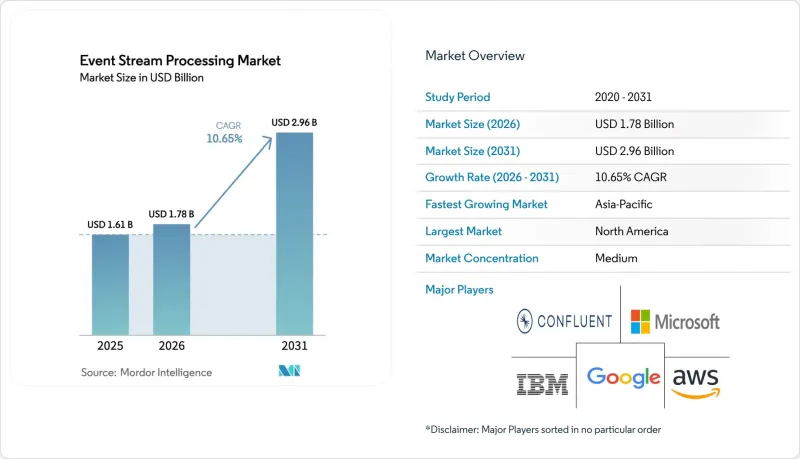
根據 Mordor Intelligence 預測,事件流處理市場規模預計將在 2025 年達到 16.1 億美元,2026 年達到 17.8 億美元,到 2031 年達到 29.6 億美元,2026 年至 2031 年的複合年成長率為 10.65%。
本報告按部署類型(雲端和本地部署)、組件(解決方案和服務)、應用(詐欺偵測、交易、監控、智慧定位、個人化、客戶體驗等)、最終用戶產業(IT和電信、銀行、金融服務和保險、製造業、零售業、能源業、醫療保健業等)以及地區進行細分。市場預測以美元計價。
全球事件流處理市場趨勢與洞察
Kubernetes原生資料管道加速ESP的採用。
2024年,雲端原生運算基金會 (CNCF) 將事件驅動自動擴縮容標準化為 Kubernetes 的一項功能,使團隊能夠根據主題延遲擴展 Apache Flink 和 Pulsar Pod,與靜態虛擬機器相比,可將空閒運算成本降低 30% 至 40%。 Redpanda 的 C++ 架構消除了 Java 虛擬機器的開銷,將 p99 延遲保持在 10 毫秒以下——這是金融機構對即時詐欺評分所需的效能等級。 Airbyte 的數據顯示,2024 年發布的新連接器中有 62% 面向 Kubernetes叢集,這表明容器已成為串流工作負載的預設基礎架構。隨著 Helm Charts 和 Operator 的日趨成熟,中型零售商將能夠部署企業級管道,而無需專門的站點可靠性團隊,從而釋放資金用於投資資料科學人才。
MiFID III 即時交易報告
根據《金融工具市場指令III》(MiFID III),投資公司必須在一個工作天內以微秒時間戳精度報告訂單、修改和取消。麥肯錫的一項調查顯示,73%的歐洲銀行已將低延遲分析的支出累計在2025年前至少增加20%,其中大部分用於部署在交易所資料中心的Apache Flink叢集。系統整合商必須證明其最佳執行能力,這推動了對毫秒訂單簿聚合的需求。德意志銀行和法國巴黎銀行等銀行已宣布遷移到事件流處理平台,以便在每日收盤前檢測違規。
各種開放原始碼引擎的激增使標準化變得複雜。
根據 Linux 基金會的一項調查,47% 的企業同時運作兩個或多個串流處理引擎,通常是 Kafka Streams 和 Flink 的組合。每個框架都有不同的狀態管理語義、監控堆疊和序列化格式,這推高了總體擁有成本 (TCO)。由於缺乏通用的串流 SQL 標準,企業被迫使用特定供應商的語法,導致供應商鎖定。雖然 Ververica 和 StreamNative 提供了託管抽像功能,但它們的採用僅限於願意承擔平台風險的早期採用者。
細分市場分析
到2025年,雲端採用將佔事件流處理市場57.12%的佔有率,預計到2031年將以11.32%的複合年成長率成長。這一快速成長與Kubernetes自動擴縮容功能的成熟相吻合,該功能允許維運人員根據工作負載波動自動調整計算資源,而無需手動操作。金融機構過去曾因延遲和主權問題而對公共雲端避而遠之,如今卻開始採用混合拓撲結構,透過將訂單簿保留在本地,同時在雲端規範化市場數據,從而縮短開發週期。
當工作負載吞吐量超過每日 100 TB 時,雲端的經濟優勢就會減弱,而且超過這個閾值後,專用硬體的折舊速度會更快。然而,超大規模雲端服務商會將機器學習、資料湖和商業智慧 (BI) 服務捆綁在一起,這增加了轉換成本,並維持了雲端的發展動能。中國和德國的資料居住法規迫使一些叢集在企業內部運行,但大多數全球企業仍將託管服務視為預設選項。因此,事件流處理市場持續向付費使用制轉變,而多重雲端正成為降低風險的最佳實踐。
儘管解決方案在2025年佔總收入的64.31%,但預計到2031年,服務業務將以10.78%的複合年成長率成長,因為企業面臨著精通有狀態流處理的工程師短缺問題。Accenture、Capgemini SA和印孚瑟斯等公司的專業服務目前專注於事件驅動架構,填補了金融服務和通訊業客戶的能力缺口。 Confluent公司報告稱,受自託管Kafka遷移的推動,其2024年第三季託管業務收益較去年同期成長35%。
串流分析為核心引擎增添了價值,它提供 SQL 介面和自動化機器學習鉤子,使業務用戶無需使用 Java 或 Scala 即可分析資料。 Databricks 的 Delta Live Tables 簡化了串流 ETL 流程,並在發布後的六個月內實現了 1000 次生產部署。隨著監管機構對即時風險模型的審查日益嚴格,對血緣關係和品質檢查等管治功能的需求不斷成長,從而推動了整個事件流處理行業的服務成長。
區域分析
預計到2025年,北美將引領事件流處理市場,佔據38.64%的營收佔有率,主要得益於超大規模雲端供應商和高頻交易公司的早期採用。芝加哥和新澤西的資料中心生態系統距離交易所引擎僅數公尺之遙,持續吸引託管投資,從而推動了超低延遲技術的創新。此外,美國零售商在自助結帳系統詐欺分析方面處於領先地位,進一步提升了對即時平台的需求。
亞太地區預計將以13.60%的複合年成長率成為全球成長最快的地區,這主要得益於中國、日本和韓國5G SA遙測負載的成長。印度的OTT(Over-The-Top)影片服務擁有9億用戶,依靠逐秒緩衝和延遲遙測來最佳化其CDN。中國和印尼的資料本地化法規迫使營運商在國內部署叢集,這將增加成本,但能確保國內消費的穩定。
歐洲的發展取決於MiFID III的實施,該指令要求金融公司將其管道升級到微秒精度,並為每次訂單變更添加時間戳。德國在採用「工業4.0」方面處於主導,該技術利用振動和聲學數據進行預測性維護。在中東,沙烏地阿拉伯正透過「2030願景」大力投資智慧城市儀表板,整合交通號誌、水錶和空氣品質感測器。南美和非洲也在持續成長,儘管規模較小,巴西的電子商務企業和南非的銀行在人才儲備有限的情況下仍處於領先地位。
其他好處:
- Excel格式的市場預測(ME)表
- 3個月的分析師支持
目錄
第1章:引言
- 研究假設和市場定義
- 調查範圍
第2章:調查方法
第3章執行摘要
第4章 市場狀況
- 市場概覽
- 市場促進因素
- 北美地區的 Kubernetes 原生資料管道正在加速 ESP 的普及。
- MiFID III 的即時報告正在推動歐洲的低延遲交易分析。
- 來自 5G SA 網路的遙測數據正在推動亞太地區電信業者對 ESP 的需求激增。
- 工業 4.0 預測性維護感測器正在德國和日本的工廠中擴大 ESP 的應用。
- 美國零售業採用自助結帳系統詐騙分析
- 印度和東南亞OTT影片客戶體驗(CX)監測的成長
- 市場限制因素
- 各種開放原始碼引擎的激增使得公司內部的標準化工作變得複雜。
- 中國和歐盟的資料居住要求正在推動本地部署資本投資的增加。
- 新興市場Apache Flink和Kafka Streams人才短缺
- 用於資本市場工作負載的低於 50 毫秒的基礎設施成本高昂
- 產業價值鏈分析
- 監理情勢
- 技術展望
- 波特五力分析
第5章 市場規模與成長預測
- 依部署類型
- 雲
- 現場
- 按組件
- 解決方案
- 串流處理引擎
- 串流分析軟體
- 事件視覺化和儀表板
- 服務
- 專業服務
- 託管服務
- 解決方案
- 透過使用
- 詐欺偵測和風險分析
- 演算法交易和高頻交易
- 流程和運行監控
- 位置智慧與地理空間分析
- 銷售和行銷個人化
- 客戶經驗與情感分析
- 其他用途
- 按最終用戶行業分類
- IT/通訊
- BFSI
- 製造業
- 零售與電子商務
- 能源公用事業
- 醫療保健和生命科學
- 運輸/物流
- 其他
- 按地區
- 北美洲
- 美國
- 加拿大
- 墨西哥
- 南美洲
- 巴西
- 阿根廷
- 其他南美國家
- 歐洲
- 德國
- 英國
- 法國
- 義大利
- 西班牙
- 其他歐洲國家
- 亞太地區
- 中國
- 日本
- 韓國
- 印度
- 澳洲
- 紐西蘭
- 其他亞太國家
- 中東和非洲
- 中東
- 阿拉伯聯合大公國
- 沙烏地阿拉伯
- 土耳其
- 其他中東國家
- 非洲
- 南非
- 奈及利亞
- 肯亞
- 其他非洲國家
- 中東
- 北美洲
第6章 競爭情勢
- 市場集中度
- 策略趨勢
- 市佔率分析
- 公司簡介
- Confluent Inc.
- IBM Corporation
- Amazon Web Services Inc.
- Microsoft Corporation
- Google LLC
- Oracle Corporation
- SAP SE
- TIBCO Software Inc.
- Hazelcast Inc.
- Cloudera Inc.
- SAS Institute Inc.
- Hitachi Vantara LLC
- Informatica Inc.
- Redpanda Data Inc.
- Ververica GmbH
- Databricks Inc.
- Software AG
- Lightbend Inc.
- StreamNative Inc.
- Imply Data Inc.
第7章 市場機會與未來展望
According to Mordor Intelligence, the event stream processing market size is projected to be USD 1.61 billion in 2025, USD 1.78 billion in 2026, and reach USD 2.96 billion by 2031, growing at a CAGR of 10.65% from 2026 to 2031.
This report is Segmented by Deployment Type (Cloud, and On-Premise), Component (Solutions, and Services), Application (Fraud Detection, Trading, Monitoring, Location Intelligence, Personalization, Customer Experience, and More), End-User Vertical (IT and Telecom, BFSI, Manufacturing, Retail, Energy, Healthcare, and More), and Geography. The Market Forecasts are Provided in Terms of Value (USD).
Global Event Stream Processing Market Trends and Insights
Kubernetes-Native Data Pipelines Accelerate ESP Adoption
Cloud Native Computing Foundation standardization of Kubernetes Event-Driven Autoscaling in 2024 lets teams scale Apache Flink or Pulsar pods based on topic lag, trimming idle compute costs by 30-40% compared with static virtual machines. Redpanda's C++ architecture removes Java Virtual Machine overhead and delivers sub-10 ms p99 latency, a performance tier that financial institutions require for real-time fraud scoring. Airbyte disclosed that 62% of new connectors launched in 2024 target Kubernetes clusters, signaling that containers have become the default substrate for streaming workloads. As Helm charts and Operators mature, mid-sized retailers can deploy enterprise-grade pipelines without a dedicated site-reliability team, reallocating capital toward data-science talent.
MiFID III Real-Time Transaction Reporting
The Markets in Financial Instruments Directive III compels investment firms to report orders, amendments, and cancellations within one business day and with 1-microsecond timestamp accuracy. McKinsey found that 73% of European banks budgeted at least 20% spending increases for low-latency analytics in 2025, predominantly for Apache Flink clusters co-located at exchange data centers. Systematic internalizers must now prove best execution, driving demand for millisecond-level order-book aggregation. Banks such as Deutsche Bank and BNP Paribas publicly confirmed moves to event stream processing platforms that flag compliance breaches before end-of-day reconciliation.
Proliferation of Divergent Open-Source Engines Complicates Standardization
Linux Foundation research shows 47% of organizations run two or more streaming engines simultaneously, usually pairing Kafka Streams with Flink. Each framework has distinct state-management semantics, monitoring stacks, and serialization formats, driving up total cost of ownership. The lack of a universal streaming SQL standard forces firms into vendor-specific dialects that create lock-in. While Ververica and StreamNative offer managed abstractions, uptake remains limited to early adopters ready to absorb platform risk.
Other drivers and restraints analyzed in the detailed report include:
- 5G Stand-Alone Telemetry Growth
- Industry 4.0 Predictive-Maintenance Sensors
- China and EU Data-Residency Mandates Elevate On-Premise CapEx
For complete list of drivers and restraints, kindly check the Table Of Contents.
Segment Analysis
Cloud installations held 57.12% of the Event stream processing market share in 2025 and are forecast to compound at an 11.32% CAGR through 2031. This surge aligns with maturing autoscaling on Kubernetes, letting operators modulate compute to workload volatility without manual tuning. Financial firms that once shunned public clouds for latency or sovereignty concerns now run hybrid topologies, keeping order books on-premise but normalizing market data in the cloud to shorten development cycles.
The economic advantage of cloud narrows once workloads exceed 100 TB of daily throughput, after which dedicated hardware amortizes quickly. However, hyperscale vendors bundle machine-learning, data-lake, and BI services, creating switching costs that preserve cloud momentum. Data-residency rules in China or Germany force some clusters on-premise, but most global firms still view managed services as the default. As a result, the Event stream processing market continues its pivot toward consumption-based pricing, and multicloud is emerging as best practice for risk mitigation.
Solutions generated 64.31% of revenue in 2025, yet services are projected to grow at a 10.78% CAGR to 2031 as enterprises confront a shortage of engineers fluent in stateful stream processing. Professional-services practices inside Accenture, Capgemini, and Infosys now specialize in event-driven architectures, filling capability gaps for financial services and telecom clients. Confluent reported 35% year-over-year managed-service revenue growth in Q3 2024 on the back of migrations from self-hosted Kafka.
Streaming analytics add value on top of core engines, offering SQL interfaces and auto-ML hooks that let business users interrogate data without Java or Scala. Databricks' Delta Live Tables simplified streaming ETL and saw 1,000 production deployments in its first six months. Demand for governance features such as lineage and quality checks is rising as regulators scrutinize real-time risk models, reinforcing services growth in the broader Event stream processing industry.
Complete Report Scope:
- By Deployment Type
- Cloud
- On-Premise
- By Component
- Solutions
- Stream Processing Engines
- Streaming Analytics Software
- Event Visualization and Dashboarding
- Services
- Professional Services
- Managed Services
- Solutions
- By Application
- Fraud Detection and Risk Analytics
- Algorithmic and High-Frequency Trading
- Process and Operations Monitoring
- Location Intelligence and Geospatial Analytics
- Sales and Marketing Personalization
- Customer Experience and Sentiment Analysis
- Other Application
- By End-User Vertical
- IT and Telecommunications
- BFSI
- Manufacturing
- Retail and eCommerce
- Energy and Utilities
- Healthcare and Life Sciences
- Transportation and Logistics
- Others
- By Geography
- North America
- United States
- Canada
- Mexico
- South America
- Brazil
- Argentina
- Rest of South America
- Europe
- Germany
- United Kingdom
- France
- Italy
- Spain
- Rest of Europe
- Asia Pacific
- China
- Japan
- South Korea
- India
- Australia
- New Zealand
- Rest of Asia-Pacific
- Middle East and Africa
- Middle East
- United Arab Emirates
- Saudi Arabia
- Turkey
- Rest of Middle East
- Africa
- South Africa
- Nigeria
- Kenya
- Rest of Africa
- Middle East
- North America
Geography Analysis
North America led the Event stream processing market with 38.64% revenue share in 2025 thanks to early adoption by hyperscale cloud vendors and high-frequency trading firms. Chicago and New Jersey data-center ecosystems, located meters from exchange engines, continue to attract co-location spend that fuels ultra-low-latency innovation. U.S. retailers also pioneer self-checkout fraud analytics, adding incremental demand for real-time platforms.
Asia-Pacific is forecast to post a 13.60% CAGR, the fastest worldwide, buoyed by 5G SA telemetry loads in China, Japan, and South Korea. India's over-the-top video services deliver content to 900 million viewers and rely on second-by-second buffering and latency telemetry to optimize CDNs. Data-localization rules in China and Indonesia force operators to deploy clusters inside national borders, raising costs yet guaranteeing steady local spend.
Europe's trajectory hinges on MiFID III enforcement, which obliges financial firms to upgrade to microsecond-accurate pipelines and timestamp every order change. Germany leads Industry 4.0 deployments that stream vibration and acoustic data for predictive maintenance. The Middle East funds smart-city dashboards through Saudi Vision 2030, integrating traffic-light, water-meter, and air-quality sensors. South America and Africa remain smaller but growing, with Brazil's e-commerce firms and South Africa's banks acting as regional pioneers despite limited talent pools.
- Confluent Inc.
- IBM Corporation
- Amazon Web Services Inc.
- Microsoft Corporation
- Google LLC
- Oracle Corporation
- SAP SE
- TIBCO Software Inc.
- Hazelcast Inc.
- Cloudera Inc.
- SAS Institute Inc.
- Hitachi Vantara LLC
- Informatica Inc.
- Redpanda Data Inc.
- Ververica GmbH
- Databricks Inc.
- Software AG
- Lightbend Inc.
- StreamNative Inc.
- Imply Data Inc.
Additional Benefits:
- The market estimate (ME) sheet in Excel format
- 3 months of analyst support
TABLE OF CONTENTS
1 INTRODUCTION
- 1.1 Study Assumptions and Market Definition
- 1.2 Scope of the Study
2 RESEARCH METHODOLOGY
3 EXECUTIVE SUMMARY
4 MARKET LANDSCAPE
- 4.1 Market Overview
- 4.2 Market Drivers
- 4.2.1 North-American Kubernetes-Native Data Pipelines Accelerate ESP Adoption
- 4.2.2 MiFID III Real-Time Reporting Drives Low-Latency Trading Analytics in Europe
- 4.2.3 5G SA Network Telemetry Surges ESP Demand Across Asia-Pacific Telcos
- 4.2.4 Industry-4.0 Predictive-Maintenance Sensors Expand ESP Use in German and Japanese Plants
- 4.2.5 US Retail Self-Checkout Fraud Analytics Adoption
- 4.2.6 OTT Video CX Monitoring Growth in India and Southeast Asia
- 4.3 Market Restraints
- 4.3.1 Proliferation of Divergent Open-Source Engines Complicates Enterprise Standardization
- 4.3.2 China and EU Data-Residency Mandates Elevate On-Prem CapEx
- 4.3.3 Scarcity of Apache Flink or Kafka-Streams Talent in Emerging Markets
- 4.3.4 High Cost of Sub-50 ms Infrastructure for Capital-Market Workloads
- 4.4 Industry Value-Chain Analysis
- 4.5 Regulatory Landscape
- 4.6 Technological Outlook
- 4.7 Porter's Five Forces Analysis
- 4.7.1 Bargaining Power of Buyers
- 4.7.2 Bargaining Power of Suppliers
- 4.7.3 Threat of New Entrants
- 4.7.4 Threat of Substitutes
- 4.7.5 Competitive Rivalry
5 MARKET SIZE AND GROWTH FORECASTS (VALUE)
- 5.1 By Deployment Type
- 5.1.1 Cloud
- 5.1.2 On-Premise
- 5.2 By Component
- 5.2.1 Solutions
- 5.2.1.1 Stream Processing Engines
- 5.2.1.2 Streaming Analytics Software
- 5.2.1.3 Event Visualization and Dashboarding
- 5.2.2 Services
- 5.2.2.1 Professional Services
- 5.2.2.2 Managed Services
- 5.2.1 Solutions
- 5.3 By Application
- 5.3.1 Fraud Detection and Risk Analytics
- 5.3.2 Algorithmic and High-Frequency Trading
- 5.3.3 Process and Operations Monitoring
- 5.3.4 Location Intelligence and Geospatial Analytics
- 5.3.5 Sales and Marketing Personalization
- 5.3.6 Customer Experience and Sentiment Analysis
- 5.3.7 Other Application
- 5.4 By End-User Vertical
- 5.4.1 IT and Telecommunications
- 5.4.2 BFSI
- 5.4.3 Manufacturing
- 5.4.4 Retail and eCommerce
- 5.4.5 Energy and Utilities
- 5.4.6 Healthcare and Life Sciences
- 5.4.7 Transportation and Logistics
- 5.4.8 Others
- 5.5 By Geography
- 5.5.1 North America
- 5.5.1.1 United States
- 5.5.1.2 Canada
- 5.5.1.3 Mexico
- 5.5.2 South America
- 5.5.2.1 Brazil
- 5.5.2.2 Argentina
- 5.5.2.3 Rest of South America
- 5.5.3 Europe
- 5.5.3.1 Germany
- 5.5.3.2 United Kingdom
- 5.5.3.3 France
- 5.5.3.4 Italy
- 5.5.3.5 Spain
- 5.5.3.6 Rest of Europe
- 5.5.4 Asia Pacific
- 5.5.4.1 China
- 5.5.4.2 Japan
- 5.5.4.3 South Korea
- 5.5.4.4 India
- 5.5.4.5 Australia
- 5.5.4.6 New Zealand
- 5.5.4.7 Rest of Asia-Pacific
- 5.5.5 Middle East and Africa
- 5.5.5.1 Middle East
- 5.5.5.1.1 United Arab Emirates
- 5.5.5.1.2 Saudi Arabia
- 5.5.5.1.3 Turkey
- 5.5.5.1.4 Rest of Middle East
- 5.5.5.2 Africa
- 5.5.5.2.1 South Africa
- 5.5.5.2.2 Nigeria
- 5.5.5.2.3 Kenya
- 5.5.5.2.4 Rest of Africa
- 5.5.5.1 Middle East
- 5.5.1 North America
6 COMPETITIVE LANDSCAPE
- 6.1 Market Concentration
- 6.2 Strategic Moves
- 6.3 Market Share Analysis
- 6.4 Company Profiles (includes Global Level Overview, Market Level Overview, Core Segments, Financials as available, Strategic Information, Market Rank/Share, Products and Services, Recent Developments)
- 6.4.1 Confluent Inc.
- 6.4.2 IBM Corporation
- 6.4.3 Amazon Web Services Inc.
- 6.4.4 Microsoft Corporation
- 6.4.5 Google LLC
- 6.4.6 Oracle Corporation
- 6.4.7 SAP SE
- 6.4.8 TIBCO Software Inc.
- 6.4.9 Hazelcast Inc.
- 6.4.10 Cloudera Inc.
- 6.4.11 SAS Institute Inc.
- 6.4.12 Hitachi Vantara LLC
- 6.4.13 Informatica Inc.
- 6.4.14 Redpanda Data Inc.
- 6.4.15 Ververica GmbH
- 6.4.16 Databricks Inc.
- 6.4.17 Software AG
- 6.4.18 Lightbend Inc.
- 6.4.19 StreamNative Inc.
- 6.4.20 Imply Data Inc.
7 MARKET OPPORTUNITIES AND FUTURE OUTLOOK
- 7.1 White-Space and Unmet-Need Assessment

 事件流處理(ESP)全球市場規模、佔有率、趨勢和成長分析報告(2026-2034)
 事件流處理市場預測至2034年-按組件、部署模式、處理類型、應用、最終用戶和地區分類的全球分析
 串流平台技術:市場佔有率分析、產業趨勢與統計、成長預測(2026-2031)複雜事件處理:市場佔有率分析、產業趨勢與統計、成長預測(2026-2031)即時資料流市場:預測至 2034 年 - 按組件、部署模式、資料處理模型、資料來源、應用程式、最終用戶和地區分類的全球分析即時資料流平台市場預測至2034年-按組件、部署模式、類型、組織規模、應用、最終用戶和地區分類的全球分析
 2026年全球即時網格事件儲存市場報告
 複雜事件處理市場:按組件、部署類型、產業、應用和組織規模分類 - 全球預測 2026-2032 年
 事件流處理市場分析及預測(至2035年):按類型、產品類型、服務、技術、組件、應用、部署類型、最終用戶和功能分類2026年全球事件流處理市場報告