


 |
市場調查報告書
商品編碼
2121842
複雜事件處理:市場佔有率分析、產業趨勢與統計、成長預測(2026-2031)Complex Event Processing - Market Share Analysis, Industry Trends & Statistics, Growth Forecasts (2026 - 2031) |
||||||

※ 本網頁內容可能與最新版本有所差異。詳細情況請與我們聯繫。
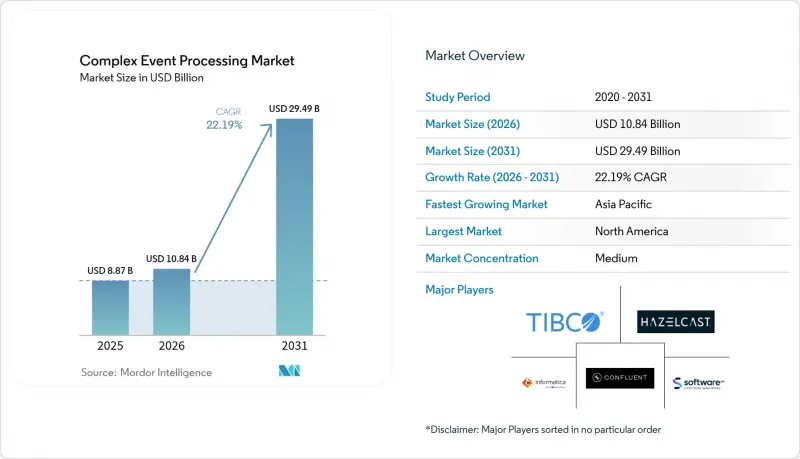
根據 Mordor Intelligence 預測,組合事件處理 (CEP) 市場將從 2025 年的 88.7 億美元成長到 2026 年的 108.4 億美元,然後在 2031 年達到 294.9 億美元,2026 年至 2031 年的複合成長率為 2.19%。
本報告按元件(平台、軟體工具、服務)、部署模式(雲端、本地部署、混合部署)、應用(詐欺偵測、網路監控、演算法交易、預測性維護及其他)、產業領域(銀行、金融服務和保險、電訊及其他)以及地區進行細分。市場預測以美元計價。
全球複雜事件處理市場趨勢與洞察
事件驅動型微服務架構的採用率不斷提高
將單體系統拆分為容器化工作負載的公司發現,同步 REST 呼叫會導致延遲和級聯故障。透過將事件暴露給持久性日誌,下游服務可以在恢復後重播遺失的數據,從而縮短平均恢復時間 (MTTR) 並提高彈性。高盛透露,其事件驅動付款管道與傳統訊息佇列系統相比,將股票交易結算時間縮短了 40%。雖然像 Strimzi 這樣的 Kubernetes 原生供應商可以自動部署叢集,但調整分區、複製因子和消費者偏移量仍然需要分散式系統方面的專業知識,而這方面的人才十分稀缺。隨著越來越多的行業採用微服務,對彈性、精確的一次性處理管道的持續需求正在推動複雜事件處理市場的成長。
工業環境中物聯網產生的資料量激增
現代汽車工廠每天產生約 2 Terabyte的即時遙測數據,遠遠超出夜間 ETL 窗口的處理能力。輕量級邊緣處理器能夠檢測機器人焊接機溫度何時超出規格 3°C,從而在缺陷擴大之前採取糾正措施。西門子報告稱,透過將振動數據流整合到預測演算法中,他們已將意外停機時間減少了 25%,並節省了 1,800 萬歐元(1,940 萬美元)的成本。邊緣閘道器能夠過濾雜訊並僅傳輸異常數據,從而節省頻寬,同時將響應時間保持在 100 毫秒以下。感測器安裝量的快速成長正在推動複雜事件處理市場的長期發展。
熟練的流處理工程師短缺
由於大學在事件時間語意、浮水印策略和分區重平衡理論方面的教學內容有限,企業不得不依賴顧問顧問或實施長期的內部培訓計畫。 Confluent 2024 年的一項調查發現,68% 的資料管理人員認為人才短缺是採用這些技術的最大障礙。在許多大都會圈,職缺已超過六個月,導致專案預算超支和上運作計畫延期。託管服務雖然可以掩蓋部分複雜性,但董事會仍不願將關鍵任務事件流外包,這種限制依然存在。
細分市場分析
到 2025 年,服務收入將佔總收入的 36.28%,凸顯了架構設計、Kubernetes 調優和模式管治方面專家支援的重要性。隨著企業利用系統整合商整合 SCADA 資料流、物聯網遙測資料和事務資料庫,預計到 2031 年,服務領域複雜事件處理市場的規模將以 23.08% 的複合年成長率成長。典型的合約期限為 6 至 12 個月,合約金額超過 50 萬美元,計費金額遠高於許可費。雖然商業平台 Kafka、Flink 和廠商特定引擎等平台仍佔據較大佔有率,但隨著超大規模雲端超大規模資料中心業者將託管串流服務整合到更廣泛的雲端服務包中,商品化趨勢正在加劇。隨著開放原始碼儀表板和命令列介面 (CLI) 複製核心功能,輔助開發工具面臨更大的價格壓力。
儘管利潤率受到壓縮,平台的重要性仍然不變。採用 Apache Kafka 和 Pulsar 等標準化架構的公司將其事件骨幹網路定位為基礎架構,並撥出多年預算用於全球複製、災害復原和「精確一次」保證。軟體工具雖然專注於提高開發人員效率、模式註冊表、IDE 插件和血緣追蹤器,但其支出很少超過年度支出的 10%。因此,服務防禦得到了加強。合規性審計、零信任安全審查以及在負載擴展下的效能調優都需要人工監控,因此,服務仍然是複雜事件處理市場中最可靠的貢獻者。
預計到 2025 年,雲端運算將佔總營收的 55.62%,這主要得益於 AWS Managed Streaming for Apache Kafka、Azure Event Hubs 和 Google Pub/Sub 等服務,它們簡化了叢集配置的繁瑣工作。付費使用制對於產品發布和限時促銷期間激增的工作負載非常有利,而自動擴展功能則有助於控制閒置成本。然而,電信業者和資本市場等需要持續高吞吐量的行業,其每月雲端使用費用已超過 5 萬美元,導致它們重新選擇本地部署的 Kubernetes。受監管行業既需要自我管理,也需要彈性分析,預計這些行業在混合架構的事件處理市場佔有率中將實現最快成長,達到 23.10%。
混合設計引入了複雜性。企業需要在製造叢集和雲端資料湖之間同步存取控制清單 (ACL)、安全符記和模式。歐洲 NIS2 網路安全法規要求關鍵基礎設施營運商將原始事件資料保留在其境內。為此,供應商正在提供支援叢集的連接器,以確保只有經過清理的聚合資料才能跨越司法管轄區邊界傳輸。在預測期內,混合事件處理市場預計將看到雲端供應商更加關注能夠促進混合環境中編配的託管連接器,而硬體 OEM 廠商則將輕量級 Kafka 節點整合到工業閘道器中,以確保邊緣延遲低於 10 毫秒。
區域分析
預計到2025年,北美將佔全球營收的37.62%,這主要得益於華爾街交易公司和矽谷科技巨頭在演算法交易、詐欺偵測和點選流個人化領域的開創性貢獻。創業投資已向Confluent、Imply和Materialize等公司投入數十億美元,從而培養了一批高技能的工程人才。加州消費者隱私法案(CCPA)正在推動即時匿名化管道的普及,擴大了目標市場的需求。然而,分散式系統工程師的短缺依然十分嚴重,導致薪資水準居高不下,專案啟動日期也隨之延後。採用這些解決方案的中型企業通常會選擇託管服務來規避人才短缺的問題,這推動了複雜事件處理市場服務供應商的成長。
預計亞太地區將實現最快成長,到2031年複合年成長率將達到23.48%。在中國的智慧城市計畫中,交通號誌、公用事業收費計量表和監視器Petabyte的事件數據被傳送到指揮中心。印度的統一支付介面(UPI)預計在2024年10月處理114億筆交易,這意味著支付處理和詐欺檢測必須在不到一秒鐘的時間內完成。日本的工廠正在實現預測性維護的自動化,以應對勞動力老化問題;韓國的電信營運商正在採用依賴即時資源分配的5G網路切片技術。中國的《個人資訊保護法》(PIPL)等主權資料法強制要求在國內進行叢集部署,這增加了冗餘基礎設施的成本,同時也提高了本地供應商的收入,並進一步擴大了複雜事件處理市場。
在歐洲,德國、法國和瑞典對車用通訊系統和工業IoT的廣泛應用正在推動市場發展。 GDPR、NIS2 以及即將訂定的人工智慧法案都對資料處理歷程和使用者許可提出了嚴格的要求,這使得能夠精準追蹤任何事件演變過程的平台更具優勢。在中東,杜拜和沙烏地阿拉伯的智慧城市大型企劃正在利用串流分析來引導交通流量並最佳化電網。在非洲,該市場仍處於起步階段,但其潛力巨大,這得益於能夠近乎即時發送小額支付的行動支付生態系統。在南美洲,巴西的活動最為活躍,當地銀行正在部署複雜事件處理(CEP)引擎以打擊 Pix 支付的詐欺行為。整體而言,不同地區在監管、通訊基礎設施和產業成熟度方面的差異,造就了多元化的需求結構,從而刺激了複雜事件處理市場的發展。
其他好處
- Excel格式的市場預測(ME)表
- 3個月的分析師支持
目錄
第1章:引言
- 研究假設和市場定義
- 調查範圍
第2章:調查方法
第3章執行摘要
第4章 市場狀況
- 市場概覽
- 市場促進因素
- 事件驅動型微服務架構的採用率不斷提高
- 工業環境中物聯網產生的資料量激增
- 人工智慧與機器學習的融合用於即時預測分析
- 整個銀行、金融服務和保險 (BFSI) 行業對即時詐欺偵測的需求激增。
- 擴展邊緣運算以實現超低延遲處理
- 創業投資正湧入專門從事流處理的新創公司。
- 市場限制因素
- 熟練的流處理工程師短缺
- 大型企業中舊有系統整合的複雜性
- 資料主權和隱私合規的障礙
- 高吞吐量工作負載的雲端使用成本過高
- 產業價值鏈分析
- 監理情勢
- 技術展望
- 波特五力分析
- 宏觀經濟因素的影響
第5章 市場規模與成長預測
- 按組件
- 平台
- 軟體工具
- 服務
- 部署模式
- 雲
- 現場
- 混合
- 透過使用
- 詐欺偵測
- 網路監控
- 演算法交易
- 預測性保護
- 銷售與行銷
- 其他
- 按行業細分
- 銀行業、金融服務業及保險業
- 電訊
- 零售與電子商務
- 製造業
- 衛生保健
- 政府/國防
- 能源與公共產業
- 其他行業領域
- 按地區
- 北美洲
- 美國
- 加拿大
- 墨西哥
- 歐洲
- 德國
- 英國
- 法國
- 義大利
- 其他歐洲國家
- 亞太地區
- 中國
- 日本
- 印度
- 韓國
- 澳洲
- 其他亞太國家
- 中東和非洲
- 中東
- 沙烏地阿拉伯
- 阿拉伯聯合大公國
- 其他中東國家
- 非洲
- 南非
- 埃及
- 其他非洲地區
- 中東
- 南美洲
- 巴西
- 阿根廷
- 南美洲其他地區
- 北美洲
第6章 競爭情勢
- 市場集中度
- 策略趨勢
- 市佔率分析
- 公司簡介
- Confluent, Inc.
- TIBCO Software Inc.
- Software AG
- Informatica Inc.
- Hazelcast, Inc.
- SAS Institute Inc.
- EsperTech, Inc.
- Striim, Inc.
- StreamSets, Inc.
- Impetus Technologies, Inc.
- Nastel Technologies, Inc.
- WSO2 LLC
- Red Hat, Inc.
- Cloudera, Inc.
- Amazon Web Services, Inc.
- IBM Corporation
- Oracle Corporation
- Google LLC
- Hitachi Vantara LLC
- Imply Data, Inc.
- Kafkaesque Technologies Ltd.
- Bentley Systems, Incorporated
第7章 市場機會與未來展望
According to Mordor Intelligence, the complex event processing market size is expected to grow from USD 8.87 billion in 2025 to USD 10.84 billion in 2026 and is forecast to reach USD 29.49 billion by 2031 at 22.19% CAGR over 2026-2031.
This report is Segmented by Component (Platforms, Software Tools, and Services), Deployment Mode (Cloud, On-Premises, and Hybrid), Application (Fraud Detection, Network Monitoring, Algorithmic Trading, Predictive Maintenance, and More), Industry Vertical (Banking Financial Services and Insurance, Telecommunications, and More), and Geography. The Market Forecasts are Provided in Terms of Value (USD).
Global Complex Event Processing Market Trends and Insights
Rising Adoption of Event-Driven Microservices Architectures
Firms decomposing monoliths into containerized workloads notice that synchronous REST calls propagate latency and cascading failure. Publishing events to durable logs lets downstream services replay missed data after recovery, trimming mean time to recovery and boosting resilience. Goldman Sachs disclosed that its event-driven settlement platform shortened equity trade clearance time by 40% compared with message-queue predecessors. Kubernetes-native operators such as Strimzi automate cluster rollout, yet tuning partitions, replication factors and consumer offsets still demands scarce distributed-systems expertise. As additional industries embrace microservices, steady demand for elastic, exactly-once pipelines sustains growth in the complex event processing market.
Escalating IoT-Generated Data Volumes in Industrial Settings
A modern automotive plant emits nearly 2 terabytes of real-time telemetry per day, overwhelming nightly ETL windows. Lightweight edge processors detect robotic welder temperatures that drift 3 °C above spec, enabling corrections before defects propagate. Siemens reported a 25% cut in unplanned downtime and EUR 18 million (USD 19.4 million) cost avoidance once vibration streams flowed into predictive algorithms. Edge gateways filter noise and forward only anomalies, conserving bandwidth and keeping response below 100 milliseconds. The surging sensor footprint anchors long-run momentum for the complex event processing market.
Shortage of Skilled Stream-Processing Engineers
Universities rarely teach event-time semantics, watermark strategies or partition-rebalance theory, forcing firms to rely on consultants or lengthy internal boot camps. A 2024 Confluent survey found 68% of data leaders citing talent scarcity as the top adoption barrier. Roles stay unfilled for six months or longer in many metros, inflating project budgets and delaying production timelines. Managed services partly mask complexity, yet boards remain cautious about outsourcing mission-critical event flows, prolonging the constraint.
Other drivers and restraints analyzed in the detailed report include:
- Integration of AI and ML for Real-Time Predictive Analytics
- Surge in Instant Fraud Detection Requirements Across BFSI
- Legacy System Integration Complexity in Large Enterprises
For complete list of drivers and restraints, kindly check the Table Of Contents.
Segment Analysis
Services generated 36.28% revenue in 2025, underscoring that architecture design, Kubernetes tuning and schema governance require expert support. Complex event processing market size for services is set to climb at a 23.08% CAGR through 2031 as enterprises engage system integrators to unify SCADA feeds, IoT telemetry and transactional databases. Typical engagements last 6-12 months and exceed USD 500,000, a billable base that dwarfs license fees. Platforms, including commercial Kafka, Flink, and vendor-specific engines, retain a healthy share; however, commoditization rises as hyperscalers integrate managed streaming into broader cloud bundles. Ancillary developer tools face even stronger price pressure because open-source dashboards and CLIs replicate core functionality.
Despite margin compression, platforms still matter. Enterprises standardizing on Apache Kafka or Pulsar treat the event backbone as foundational, allocating multiyear budgets for global replication, disaster recovery and exactly-once guarantees. Software tooling focuses on developer productivity, schema registries, IDE plugins, lineage trackers, but seldom represents more than 10% of annual spend. The defensibility of services therefore strengthens. Compliance audits, zero-trust security reviews and performance retuning under scaling load all demand human oversight, keeping services as the most reliable contributor to the complex event processing market.
Cloud accounted for 55.62% revenue in 2025 as AWS Managed Streaming for Apache Kafka, Azure Event Hubs and Google Pub/Sub removed the toil of provisioning clusters. Usage-based pricing benefits spiky workloads that spike during product launches or flash sales, and auto-scaling curbs idle spend. Yet telecom operators and capital-market venues with steady high throughput report monthly cloud bills topping USD 50,000, nudging repatriation to on-premises Kubernetes. Complex event processing market share for hybrid architectures will expand fastest at 23.10% because regulated industries need both sovereign control and elastic analytics.
Hybrid design creates complexity. Enterprises must synchronize ACLs, security tokens and schemas between plant-floor clusters and cloud data lakes. European NIS2 cybersecurity rules push critical-infrastructure operators to keep raw events inside national borders. Vendors respond by shipping cluster-aware connectors that propagate only sanitized aggregates across jurisdictional boundaries. Over the forecast horizon, the complex event processing market will witness cloud providers doubling down on managed connectors that ease hybrid orchestration, while hardware OEMs integrate lightweight Kafka nodes into industrial gateways to guarantee sub-10-millisecond latency at the edge.
Complete Report Scope:
- By Component
- Platforms
- Software Tools
- Services
- By Deployment Mode
- Cloud
- On-Premises
- Hybrid
- By Application
- Fraud Detection
- Network Monitoring
- Algorithmic Trading
- Predictive Maintenance
- Sales and Marketing
- Other Application
- By Industry Vertical
- Banking, Financial Services and Insurance
- Telecommunications
- Retail and E-Commerce
- Manufacturing
- Healthcare
- Government and Defense
- Energy and Utilities
- Other Industry Vertical
- By Geography
- North America
- United States
- Canada
- Mexico
- Europe
- Germany
- United Kingdom
- France
- Italy
- Rest of Europe
- Asia-Pacific
- China
- Japan
- India
- South Korea
- Australia
- Rest of Asia-Pacific
- Middle East and Africa
- Middle East
- Saudi Arabia
- United Arab Emirates
- Rest of Middle East
- Africa
- South Africa
- Egypt
- Rest of Africa
- Middle East
- South America
- Brazil
- Argentina
- Rest of South America
- North America
Geography Analysis
North America controlled 37.62% revenue in 2025 thanks to Wall Street trading firms and Silicon Valley technology giants that pioneered algorithmic trading, fraud detection and clickstream personalization. Venture investors funneled billions into Confluent, Imply and Materialize, building a deep engineering talent pool. The California Consumer Privacy Act pushes real-time anonymization pipelines, expanding addressable demand. Yet a shortage of distributed-systems engineers remains acute, inflating salaries and delaying project start dates. Mid-market adopters often choose managed services to sidestep the talent gap, fueling service-provider growth inside the complex event processing market.
Asia Pacific registers the fastest growth at 23.48% CAGR through 2031. Chinese smart-city programs instrument traffic lights, utility meters and surveillance cameras, streaming petabytes of events to command centers. India's Unified Payments Interface processed 11.4 billion transactions in October 2024, requiring sub-second clearing and fraud detection. Japanese factories automate predictive maintenance to offset workforce aging, and South Korean carriers use 5G network slicing that depends on real-time resource allocation. Sovereign data laws such as China's PIPL force in-country clusters, raising duplicate infrastructure costs but simultaneously boosting local vendor revenues, further enlarging the complex event processing market.
Europe benefits from automotive telematics and industrial IoT rollouts in Germany, France and Sweden. GDPR, NIS2 and the pending AI Act impose strict lineage and consent obligations that favor platforms capably tracking every event transformation. Middle East smart-city megaprojects in Dubai and Saudi Arabia rely on streaming analytics to route traffic and optimize energy grids. Africa remains nascent yet shows promise through mobile-money ecosystems that transfer micro-payments in near real time. South America concentrates activity in Brazil, where banks deploy CEP engines to combat Pix payment fraud. Overall, regional variances in regulation, connectivity and industrial maturity ensure a diverse demand landscape that enriches the complex event processing market.
- Confluent, Inc.
- TIBCO Software Inc.
- Software AG
- Informatica Inc.
- Hazelcast, Inc.
- SAS Institute Inc.
- EsperTech, Inc.
- Striim, Inc.
- StreamSets, Inc.
- Impetus Technologies, Inc.
- Nastel Technologies, Inc.
- WSO2 LLC
- Red Hat, Inc.
- Cloudera, Inc.
- Amazon Web Services, Inc.
- IBM Corporation
- Oracle Corporation
- Google LLC
- Hitachi Vantara LLC
- Imply Data, Inc.
- Kafkaesque Technologies Ltd.
- Bentley Systems, Incorporated
Additional Benefits:
- The market estimate (ME) sheet in Excel format
- 3 months of analyst support
TABLE OF CONTENTS
1 INTRODUCTION
- 1.1 Study Assumptions and Market Definition
- 1.2 Scope of the Study
2 RESEARCH METHODOLOGY
3 EXECUTIVE SUMMARY
4 MARKET LANDSCAPE
- 4.1 Market Overview
- 4.2 Market Drivers
- 4.2.1 Rising Adoption of Event-Driven Microservices Architectures
- 4.2.2 Escalating IoT-Generated Data Volumes in Industrial Settings
- 4.2.3 Integration of AI and ML for Real-Time Predictive Analytics
- 4.2.4 Surge in Instant Fraud Detection Requirements Across BFSI
- 4.2.5 Expansion of Edge Computing for Ultra-Low Latency Processing
- 4.2.6 Venture Capital Inflows into Pure-Play Stream Processing Start-Ups
- 4.3 Market Restraints
- 4.3.1 Shortage of Skilled Stream-Processing Engineers
- 4.3.2 Legacy System Integration Complexity in Large Enterprises
- 4.3.3 Data Sovereignty and Privacy Compliance Hurdles
- 4.3.4 High Cloud Consumption Costs for High-Throughput Workloads
- 4.4 Industry Value Chain Analysis
- 4.5 Regulatory Landscape
- 4.6 Technological Outlook
- 4.7 Porter's Five Forces Analysis
- 4.7.1 Threat of New Entrants
- 4.7.2 Bargaining Power of Suppliers
- 4.7.3 Bargaining Power of Buyers
- 4.7.4 Threat of Substitutes
- 4.7.5 Competitive Rivalry
- 4.8 Impact of Macroeconomic Factors
5 MARKET SIZE AND GROWTH FORECASTS (VALUE)
- 5.1 By Component
- 5.1.1 Platforms
- 5.1.2 Software Tools
- 5.1.3 Services
- 5.2 By Deployment Mode
- 5.2.1 Cloud
- 5.2.2 On-Premises
- 5.2.3 Hybrid
- 5.3 By Application
- 5.3.1 Fraud Detection
- 5.3.2 Network Monitoring
- 5.3.3 Algorithmic Trading
- 5.3.4 Predictive Maintenance
- 5.3.5 Sales and Marketing
- 5.3.6 Other Application
- 5.4 By Industry Vertical
- 5.4.1 Banking, Financial Services and Insurance
- 5.4.2 Telecommunications
- 5.4.3 Retail and E-Commerce
- 5.4.4 Manufacturing
- 5.4.5 Healthcare
- 5.4.6 Government and Defense
- 5.4.7 Energy and Utilities
- 5.4.8 Other Industry Vertical
- 5.5 By Geography
- 5.5.1 North America
- 5.5.1.1 United States
- 5.5.1.2 Canada
- 5.5.1.3 Mexico
- 5.5.2 Europe
- 5.5.2.1 Germany
- 5.5.2.2 United Kingdom
- 5.5.2.3 France
- 5.5.2.4 Italy
- 5.5.2.5 Rest of Europe
- 5.5.3 Asia-Pacific
- 5.5.3.1 China
- 5.5.3.2 Japan
- 5.5.3.3 India
- 5.5.3.4 South Korea
- 5.5.3.5 Australia
- 5.5.3.6 Rest of Asia-Pacific
- 5.5.4 Middle East and Africa
- 5.5.4.1 Middle East
- 5.5.4.1.1 Saudi Arabia
- 5.5.4.1.2 United Arab Emirates
- 5.5.4.1.3 Rest of Middle East
- 5.5.4.2 Africa
- 5.5.4.2.1 South Africa
- 5.5.4.2.2 Egypt
- 5.5.4.2.3 Rest of Africa
- 5.5.4.1 Middle East
- 5.5.5 South America
- 5.5.5.1 Brazil
- 5.5.5.2 Argentina
- 5.5.5.3 Rest of South America
- 5.5.1 North America
6 COMPETITIVE LANDSCAPE
- 6.1 Market Concentration
- 6.2 Strategic Moves
- 6.3 Market Share Analysis
- 6.4 Company Profiles (includes Global Level Overview, Market Level Overview, Core Segments, Financials as Available, Strategic Information, Market Rank/Share for Key Companies, Products and Services, and Recent Developments)
- 6.4.1 Confluent, Inc.
- 6.4.2 TIBCO Software Inc.
- 6.4.3 Software AG
- 6.4.4 Informatica Inc.
- 6.4.5 Hazelcast, Inc.
- 6.4.6 SAS Institute Inc.
- 6.4.7 EsperTech, Inc.
- 6.4.8 Striim, Inc.
- 6.4.9 StreamSets, Inc.
- 6.4.10 Impetus Technologies, Inc.
- 6.4.11 Nastel Technologies, Inc.
- 6.4.12 WSO2 LLC
- 6.4.13 Red Hat, Inc.
- 6.4.14 Cloudera, Inc.
- 6.4.15 Amazon Web Services, Inc.
- 6.4.16 IBM Corporation
- 6.4.17 Oracle Corporation
- 6.4.18 Google LLC
- 6.4.19 Hitachi Vantara LLC
- 6.4.20 Imply Data, Inc.
- 6.4.21 Kafkaesque Technologies Ltd.
- 6.4.22 Bentley Systems, Incorporated
7 MARKET OPPORTUNITIES AND FUTURE OUTLOOK
- 7.1 White-Space and Unmet-Need Assessment

 事件流處理(ESP)全球市場規模、佔有率、趨勢和成長分析報告(2026-2034)
 事件流處理:市場佔有率分析、產業趨勢與統計、成長預測(2026-2031)
 事件流處理市場預測至2034年-按組件、部署模式、處理類型、應用、最終用戶和地區分類的全球分析串流平台技術:市場佔有率分析、產業趨勢與統計、成長預測(2026-2031)即時資料流市場:預測至 2034 年 - 按組件、部署模式、資料處理模型、資料來源、應用程式、最終用戶和地區分類的全球分析即時資料流平台市場預測至2034年-按組件、部署模式、類型、組織規模、應用、最終用戶和地區分類的全球分析
 2026年全球即時網格事件儲存市場報告
 複雜事件處理市場:按組件、部署類型、產業、應用和組織規模分類 - 全球預測 2026-2032 年
 事件流處理市場分析及預測(至2035年):按類型、產品類型、服務、技術、組件、應用、部署類型、最終用戶和功能分類2026年全球事件流處理市場報告