


 |
市場調查報告書
商品編碼
2118898
串流平台技術:市場佔有率分析、產業趨勢與統計、成長預測(2026-2031)Streaming Platform Technology - Market Share Analysis, Industry Trends & Statistics, Growth Forecasts (2026 - 2031) |
||||||

※ 本網頁內容可能與最新版本有所差異。詳細情況請與我們聯繫。
據 Mordor Intelligence 稱,2025 年串流平台技術市值為 55.6 億美元,預計到 2031 年將達到 100.3 億美元,而 2026 年為 62.5 億美元,預測期(2026-2031 年)的複合年成長率為 9.92%。
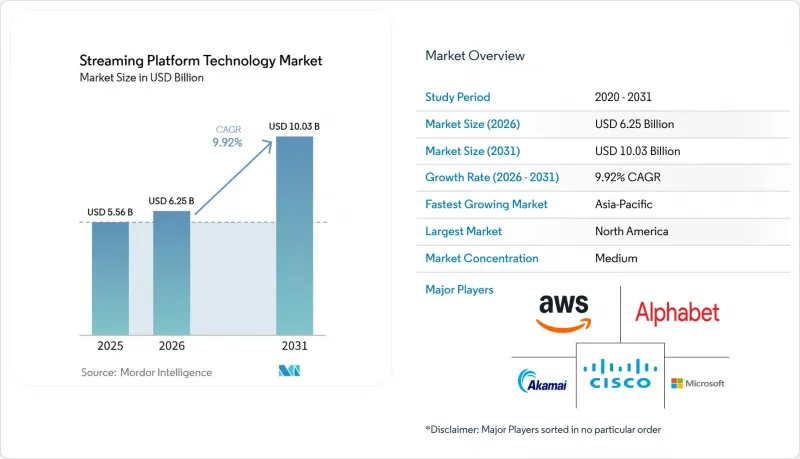
本報告按組件(解決方案和服務)、串流媒體類型(直播和視訊點播)、行業領域(媒體、娛樂和廣播、體育和實況活動、電信和付費電視、企業和公司通訊、教育和數位學習等)以及地區進行細分。市場預測以價值(美元)表示。
全球串流平台技術市場趨勢與洞察
對低延遲即時體驗的需求日益成長
隨著亞秒級影片傳輸成為即時直播形式的商業性需求(觀眾需要即時互動、競標和下注),串流平台技術市場正從中受益。傳統的HLS設計可能存在10-30秒的延遲,限制了效用。 LL-HLS、CMAF-CTE和基於QUIC的媒體傳輸技術降低了可接受的延遲,從而推動了對專用配送網路、播放器軟體和即時分析的需求。 2025年,Cloudflare部署了一個覆蓋全球330多個城市的基於QUIC的媒體傳輸中繼網路,該網路由Meta、谷歌、思科和IETF社區共同開發。 2026年7月,日本網路計劃組織(Internet Initiative Japan)、富士通和野村綜合研究所(Nomura Research Institute)在KYOJO CUP系列賽上進行了一項概念驗證實驗,利用低延遲的AI選擇攝影機角度進行賽事規模的直播,展示了本地5G和實體AI串流技術的應用。
人工智慧驅動的影片自動化和定位
串流平台技術市場正在變革影片運營,其應用範圍已從簡單的內容擷取和元資料標記擴展到本地化、無障礙存取和廣告工作流程。這些功能減少了為不同語言、設備和地區的受眾準備相同內容所需的人工工作量。 2026年2月,Brightcove宣布擴展其人工智慧套件,其中包括90多種語言的字幕、人工智慧輔助音訊說明以及基於內容分析的上下文廣告。 Kaltura在收購eSelf.ai和PathFactory後,擴展了其平台並推出了“智慧化身”,該技術能夠以30多種語言即時生成個人化媒體。 2025年,Akamai部署了由NETINT影片處理單元驅動的雲端實例,因此為媒體工作負載實現了低成本的影片處理。
頻寬和轉碼成本不斷上漲
在串流平台技術市場,由於並發觀看人數的成長和影片品質要求的提高,頻寬和轉碼成本飆升。這種成本結構有利於那些能夠獲得批量定價或營運大規模基礎設施的營運商。小規模的供應商通常缺乏管理多CDN路由、內部編碼流程和品管所需的資源。 Akamai的雲端實例配備了視訊處理單元,為降低媒體工作負載的運算成本提供了一種途徑,並表明成本效益正成為一項重要的競爭優勢。歐洲資料中心法規規定的能源效率要求也是選擇供應商時需要考慮的另一個因素,促使一些營運商將工作負載整合到那些擁有良好業績記錄的供應商那裡。
細分市場分析
在2025年的串流平台技術市場中,解決方案佔了76.82%的佔有率。這是因為解決方案涵蓋了經營完整串流媒體服務所需的軟體功能。影片處理、編碼和打包構成了計算處理的核心,而分發、播放、工作流程、盈利和安全工具則為服務的其他部分提供支援。這些層面緊密相關,因為工作流程中任何環節出現問題都可能影響播放品質、廣告精準度或內容保護。在廣告支援型服務中,精準的廣告投放至關重要;同時,由於營運商必須滿足資料居住要求,影片獲利和安全功能也日益受到關注。此外,由於客戶需要證明服務目標能夠實現,分析、可觀測性和體驗品質 (QoE) 監控在供應商選擇中也變得越來越重要。 2025年,Akamai將MediaMelon的影片智慧平台SmartSight納入其合格運算合作夥伴計劃,從而將串流分析與基礎設施部署連結起來。在串流平台技術市場中,這些需求使得解決方案繼續成為投資的核心要素。此外,當營運商需要在多個市場協調內容準備、分發、廣告和安全時,他們往往更喜歡整合系統。
預計到2031年,服務市場將以10.63%的複合年成長率成長,成為成長最快的組件類別。對於那些需要在不組建大規模內部工程團隊的情況下實施多CDN、適合傳輸速率、安全性和雲端工作流程的企業而言,託管服務和專業服務極具吸引力。這種模式還支援基於服務品質和交付成果的契約,而不僅僅是基於軟體授權銷售。對於南美洲、非洲和亞太地區一些可能沒有專門影片平台技術產業正在向技術支援轉型,以幫助客戶在部署後運維複雜的環境。這種轉變可能會縮短部署時間,但同時,服務品質和人力資源能力對供應商也變得更加重要。這使得供應商即使在平台投入生產後也能深化與客戶的關係。
區域分析
北美地區雲端基礎設施、媒體公司和企業客戶的集中分佈,預計2025年將佔據串流平台技術市場37.41%的佔有率。該地區擁有成熟的聯網電視生態系統,對廣告插入、受眾測量、播放和安全工具的需求十分旺盛。在加拿大,雙語在地化需求日益成長;而在墨西哥,隨著寬頻存取和串流媒體使用量的增加,早期需求正在湧現。這些因素都促使人們繼續投資串流平台技術市場,開發能夠在跨區域運作且不影響服務品質的系統。
預計到2031年,亞太地區將以10.38%的複合年成長率成長,成為成長最快的區域市場。其龐大的市場規模、內容支出、行動裝置使用率以及連網電視日益普及,使其成為串流平台技術市場優先發展的區域。此外,多語言環境和多樣化的網路環境也推動了對高度適應性工作流程、播放工具和傳輸方式的需求。
2025年,歐洲憑藉英國、德國、法國和荷蘭等國廣播公司大規模營運的雲端直播和隨選服務,持續維持其重要地位。 ITV與Akamai合作推出了“Freely”,提供免費的串流電視服務,該服務利用了內容傳送、網路應用保護和機器人管理等技術。歐盟資料法、NIS2指令和DORA要求正在推動系統升級,以滿足安全和主權要求。在南美洲,由於寬頻發展和對本土內容的投資,市場正在擴張,而在地化的分發能力對於滿足當地語言和監管需求至關重要。在中東,對本土內容和主權雲端基礎設施的投資正在催生公共部門主導的需求,而在非洲,則需要行動優先、頻寬高效的服務來解決頻寬受限的網路問題。這些市場的結合為串流平台技術市場提供了更廣泛的區域基礎,儘管基礎設施品質、當地合規規則和購買力在不同地區存在顯著差異。
其他好處:
- Excel格式的市場預測(ME)表
- 3個月的分析師支持
目錄
第1章:引言
- 研究假設和市場定義
- 調查範圍
第2章:調查方法
第3章執行摘要
第4章 市場狀況
- 市場概覽
- 市場促進因素
- 對低延遲即時體驗的需求日益成長
- 雲端原生影片工作流程正在加快產品上市速度。
- 人工智慧驅動的影片自動化和定位
- 聯網電視和多設備分發的擴展
- 廣告收入成長及混合收入模式
- 支援互動式串流媒體的 5G 和邊緣基礎設施
- 市場限制因素
- 頻寬和轉碼成本不斷上漲
- 設備、轉碼器和播放器碎片化
- 隱私權、權利和資料居住限制
- 新興網路中的尖峰時段效能不穩定
- 產業價值鏈分析
- 宏觀經濟因素對市場的影響
- 監理情勢
- 技術展望
- 波特五力分析
第5章 市場規模與成長預測
- 按組件
- 解決方案
- 影像處理、編碼、打包
- 影片內容管理和工作流程
- 影片串流、播放和觀看體驗
- 影片變現解決方案
- 影像安全和存取管理
- 其他解決方案
- 服務
- 解決方案
- 按串流媒體類型
- 直播
- 視訊點播 (VOD) 串流媒體
- 按行業分類
- 媒體、娛樂、廣播
- 體育賽事和實況活動
- 通訊和付費電視
- 企業和組織溝通
- 教育和數位學習
- 衛生保健
- 銀行業、金融服務業及保險業
- 政府/公共部門
- 零售與電子商務
- 其他工業部門
- 按地區
- 北美洲
- 美國
- 加拿大
- 墨西哥
- 南美洲
- 巴西
- 阿根廷
- 其他南美國家
- 歐洲
- 英國
- 德國
- 法國
- 義大利
- 西班牙
- 俄羅斯
- 其他歐洲國家
- 亞太地區
- 中國
- 印度
- 日本
- 韓國
- 澳洲
- 其他亞太國家
- 中東
- 沙烏地阿拉伯
- 阿拉伯聯合大公國
- 土耳其
- 其他中東國家
- 非洲
- 南非
- 奈及利亞
- 埃及
- 其他非洲國家
- 北美洲
第6章 競爭情勢
- 市場集中度
- 策略趨勢
- Market Positioning Analysis
- 公司簡介
- Amazon.com, Inc.
- Alphabet Inc.
- Microsoft Corporation
- Akamai Technologies, Inc.
- Cisco Systems, Inc.
- Brightcove Inc.
- Kaltura, Inc.
- Vimeo, Inc.
- Wowza Media Systems, LLC
- Muvi LLC
- Bitmovin Inc.
- Haivision Systems Inc.
- Telestream, LLC
- Cloudinary Ltd.
- Mux, Inc.
- Panopto, Inc.
- JW Player, Inc.
- Dacast, Inc.
- Verimatrix, Inc.
- Synamedia Limited
- Amagi Media Labs Private Limited
- Dalet SA
- Conviva, Inc.
第7章 市場機會與未來展望
According to Mordor Intelligence, the streaming platform technology market size was valued at USD 5.56 billion in 2025 and estimated to grow from USD 6.25 billion in 2026 to reach USD 10.03 billion by 2031, at a CAGR of 9.92% during the forecast period (2026-2031).
This report is Segmented by Component (Solutions, and Services), Streaming Type (Live Streaming and Video-On-Demand Streaming), Industry Vertical (Media, Entertainment and Broadcasting, Sports and Live Events, Telecommunications and Pay-TV, Enterprise and Corporate Communications, Education and E-Learning, and More), and Geography. The Market Forecasts are Provided in Terms of Value (USD).
Global Streaming Platform Technology Market Trends and Insights
Rising Demand for Low-Latency Live Experiences
The streaming platform technology market benefits as sub-second video delivery becomes a commercial requirement for live formats where viewers react, bid, or place bets in real time. Traditional HLS designs can introduce delays of 10-30 seconds, which limits their usefulness for synchronized sports, interactive commerce, polling, and second-screen programs. LL-HLS, CMAF-CTE, and Media over QUIC are reducing acceptable delay windows and increasing demand for specialized delivery networks, player software, and real-time analytics. Cloudflare introduced a globally distributed Media over QUIC relay network across more than 330 cities in 2025, with development involving Meta, Google, Cisco, and the IETF community. Internet Initiative Japan, Fujitsu, and Nomura Research Institute demonstrated Local 5G and physical AI streaming at the KYOJO CUP racing series in July 2026, using AI-selected camera angles with low delay at an event scale.
AI-Powered Video Automation and Localization
The streaming platform technology market is changing video operations, moving beyond ingest and metadata tagging to include localization, accessibility, and advertising workflows. These capabilities reduce the manual work required to prepare the same content for several languages, devices, and regional audiences. Brightcove announced an expanded AI Suite in February 2026 that included captions in more than 90 languages, AI-supported audio descriptions, and contextual advertising based on content analysis. Kaltura expanded its platform after acquiring eSelf.ai and PathFactory, and it introduced Agentic Avatars that generate personalized media in more than 30 languages in real time. Akamai introduced cloud instances powered by NETINT video processing units in 2025, enabling lower-cost video processing for media workloads.
Escalating Bandwidth and Transcoding Costs
The streaming platform technology market faces high bandwidth and transcoding costs, as spending rises with concurrent audience size and higher video quality requirements. This cost structure favors operators that can secure committed-volume pricing or operate infrastructure at a large scale. Smaller providers often have fewer resources to manage multi-CDN routing, internal encoding ladders, and quality controls. Akamai's video processing unit cloud instances provide one route to lower compute costs for media workloads and demonstrate how cost efficiency has become a competitive requirement. Energy-efficiency obligations under European data center rules add another factor to provider selection and encourage some operators to consolidate workloads with providers that can document their operating performance.
Other drivers and restraints analyzed in the detailed report include:
- Cloud-Native Video Workflows Lowering Time to Market
- Expansion of Connected TV and Multi-Device Delivery
- Privacy, Rights, and Data Residency Constraints
For complete list of drivers and restraints, kindly check the Table Of Contents.
Segment Analysis
Solutions accounted for 76.82% of the streaming platform technology market in 2025, as they cover the software functions required to operate a complete streaming service. Video processing, encoding, and packaging form the computational core, while delivery, playback, workflow, monetization, and security tools support the rest of the service. These layers are closely connected because problems in one part of the workflow can affect playback quality, advertising accuracy, or content protection. Video monetization and security functions are receiving greater attention as ad-supported services need accurate insertion and operators address data residency requirements. Analytics, observability, and quality-of-experience monitoring are also becoming increasingly important in vendor selection, as customers need evidence that service targets can be met. Akamai added MediaMelon's SmartSight video intelligence platform to its Qualified Compute Partner Program in 2025, linking streaming analytics with infrastructure deployment. Within the streaming platform technology market, these requirements keep solutions central to spending. Operators also prefer integrated systems when they need to coordinate content preparation, delivery, advertising, and security across multiple markets.
Services are projected to expand at a CAGR of 10.63% through 2031, making it the fastest-growing component category. Managed and professional services appeal to operators that need to deploy multi-CDN, adaptive bitrate, security, and cloud workflows without building large internal engineering teams. The model also supports contracts based on service quality and delivery outcomes, rather than solely on the sale of software licenses. Demand is particularly relevant for smaller operators in South America, Africa, and parts of the Asia-Pacific that may not have specialized video operations teams. Standards compliance is becoming part of larger public-sector and enterprise procurement processes, which supports providers with established cloud-native implementations. The component mix shows that the streaming platform technology industry is shifting toward technical support that helps customers operate complex environments after implementation. This change can shorten deployment time, but it also makes service quality and workforce capacity more important for suppliers. It allows vendors to deepen customer relationships once the platforms are deployed to production.
Complete Report Scope:
- By Component
- Solutions
- Video Processing, Encoding and Packaging
- Video Content Management and Workflow
- Video Delivery, Playback and Experience
- Video Monetization Solutions
- Video Security and Access Management
- Other Solutions
- Services
- Solutions
- By Streaming Type
- Live Streaming
- Video-on-Demand Streaming
- By Industry Vertical
- Media, Entertainment and Broadcasting
- Sports and Live Events
- Telecommunications and Pay-TV
- Enterprise and Corporate Communications
- Education and E-Learning
- Healthcare
- Banking, Financial Services and Insurance
- Government and Public Sector
- Retail and E-Commerce
- Other Industry Verticals
- By Geography
- North America
- United States
- Canada
- Mexico
- South America
- Brazil
- Argentina
- Rest of South America
- Europe
- United Kingdom
- Germany
- France
- Italy
- Spain
- Russia
- Rest of Europe
- Asia-Pacific
- China
- India
- Japan
- South Korea
- Australia
- Rest of Asia-Pacific
- Middle East
- Saudi Arabia
- United Arab Emirates
- Turkey
- Rest of Middle East
- Africa
- South Africa
- Nigeria
- Egypt
- Rest of Africa
- North America
Geography Analysis
North America held 37.41% of the streaming platform technology market share in 2025, supported by the region's concentration of cloud infrastructure, media companies, and enterprise customers. The region has a mature connected television ecosystem and a strong need for ad insertion, audience measurement, playback, and security tools. Canada creates bilingual localization needs, while Mexico adds early-stage demand as broadband access and streaming activity expand. These conditions support continued spending in the streaming platform technology market on systems that can operate across regions without compromising service quality.
Asia-Pacific is projected to grow at a CAGR of 10.38% through 2031, making it the fastest-growing regional segment. The region's scale, content spending, mobile use, and connected television expansion make it a priority growth area for the streaming platform technology market. Its large number of languages and wide range of network conditions increase the need for adaptable workflows, playback tools, and delivery methods.
Europe maintained a significant position in 2025 because broadcasters in the United Kingdom, Germany, France, and the Netherlands operate cloud-based live and VoD services at scale. ITV partnered with Akamai to launch Freely, leveraging content delivery, web application protection, and bot management for free streaming television. The EU Data Act, NIS2 Directive, and DORA requirements are encouraging upgrades that support security and sovereignty requirements. South America is growing through broadband development and domestic content investment, with local language and regulatory needs favoring regional delivery capabilities. Middle Eastern investment in domestic content and sovereign cloud infrastructure is creating public-sector-led demand, while Africa requires mobile-first, bandwidth-efficient services for constrained networks. Together, these markets give the streaming platform technology market a broader regional base, although infrastructure quality, local compliance rules, and purchasing capacity differ widely.
- Amazon.com, Inc.
- Alphabet Inc.
- Microsoft Corporation
- Akamai Technologies, Inc.
- Cisco Systems, Inc.
- Brightcove Inc.
- Kaltura, Inc.
- Vimeo, Inc.
- Wowza Media Systems, LLC
- Muvi LLC
- Bitmovin Inc.
- Haivision Systems Inc.
- Telestream, LLC
- Cloudinary Ltd.
- Mux, Inc.
- Panopto, Inc.
- JW Player, Inc.
- Dacast, Inc.
- Verimatrix, Inc.
- Synamedia Limited
- Amagi Media Labs Private Limited
- Dalet S.A.
- Conviva, Inc.
Additional Benefits:
- The market estimate (ME) sheet in Excel format
- 3 months of analyst support
TABLE OF CONTENTS
1 INTRODUCTION
- 1.1 Study Assumptions and Market Definition
- 1.2 Scope of the Study
2 RESEARCH METHODOLOGY
3 EXECUTIVE SUMMARY
4 MARKET LANDSCAPE
- 4.1 Market Overview
- 4.2 Market Drivers
- 4.2.1 Rising Demand for Low-Latency Live Experiences
- 4.2.2 Cloud-Native Video Workflows Lowering Time to Market
- 4.2.3 AI-Powered Video Automation and Localization
- 4.2.4 Expansion of Connected TV and Multi-Device Delivery
- 4.2.5 Growth of Ad-Supported and Hybrid Monetization
- 4.2.6 5G and Edge Infrastructure Enabling Interactive Streaming
- 4.3 Market Restraints
- 4.3.1 Escalating Bandwidth and Transcoding Costs
- 4.3.2 Device, Codec, and Player Fragmentation
- 4.3.3 Privacy, Rights, and Data Residency Constraints
- 4.3.4 Peak-Time Quality Instability in Emerging Networks
- 4.4 Industry Value Chain Analysis
- 4.5 Impact of Macroeconomic Factors on the Market
- 4.6 Regulatory Landscape
- 4.7 Technological Outlook
- 4.8 Porter's Five Forces Analysis
- 4.8.1 Bargaining Power of Suppliers
- 4.8.2 Bargaining Power of Buyers
- 4.8.3 Threat of New Entrants
- 4.8.4 Threat of Substitutes
- 4.8.5 Intensity of Competitive Rivalry
5 MARKET SIZE AND GROWTH FORECASTS (VALUE)
- 5.1 By Component
- 5.1.1 Solutions
- 5.1.1.1 Video Processing, Encoding and Packaging
- 5.1.1.2 Video Content Management and Workflow
- 5.1.1.3 Video Delivery, Playback and Experience
- 5.1.1.4 Video Monetization Solutions
- 5.1.1.5 Video Security and Access Management
- 5.1.1.6 Other Solutions
- 5.1.2 Services
- 5.1.1 Solutions
- 5.2 By Streaming Type
- 5.2.1 Live Streaming
- 5.2.2 Video-on-Demand Streaming
- 5.3 By Industry Vertical
- 5.3.1 Media, Entertainment and Broadcasting
- 5.3.2 Sports and Live Events
- 5.3.3 Telecommunications and Pay-TV
- 5.3.4 Enterprise and Corporate Communications
- 5.3.5 Education and E-Learning
- 5.3.6 Healthcare
- 5.3.7 Banking, Financial Services and Insurance
- 5.3.8 Government and Public Sector
- 5.3.9 Retail and E-Commerce
- 5.3.10 Other Industry Verticals
- 5.4 By Geography
- 5.4.1 North America
- 5.4.1.1 United States
- 5.4.1.2 Canada
- 5.4.1.3 Mexico
- 5.4.2 South America
- 5.4.2.1 Brazil
- 5.4.2.2 Argentina
- 5.4.2.3 Rest of South America
- 5.4.3 Europe
- 5.4.3.1 United Kingdom
- 5.4.3.2 Germany
- 5.4.3.3 France
- 5.4.3.4 Italy
- 5.4.3.5 Spain
- 5.4.3.6 Russia
- 5.4.3.7 Rest of Europe
- 5.4.4 Asia-Pacific
- 5.4.4.1 China
- 5.4.4.2 India
- 5.4.4.3 Japan
- 5.4.4.4 South Korea
- 5.4.4.5 Australia
- 5.4.4.6 Rest of Asia-Pacific
- 5.4.5 Middle East
- 5.4.5.1 Saudi Arabia
- 5.4.5.2 United Arab Emirates
- 5.4.5.3 Turkey
- 5.4.5.4 Rest of Middle East
- 5.4.6 Africa
- 5.4.6.1 South Africa
- 5.4.6.2 Nigeria
- 5.4.6.3 Egypt
- 5.4.6.4 Rest of Africa
- 5.4.1 North America
6 COMPETITIVE LANDSCAPE
- 6.1 Market Concentration
- 6.2 Strategic Moves
- 6.3 Market Positioning Analysis
- 6.4 Company Profiles (includes Global Level Overview, Market Level Overview, Core Segments, Financials as available, Strategic Information, Market Rank/Share, Products and Services, Recent Developments)
- 6.4.1 Amazon.com, Inc.
- 6.4.2 Alphabet Inc.
- 6.4.3 Microsoft Corporation
- 6.4.4 Akamai Technologies, Inc.
- 6.4.5 Cisco Systems, Inc.
- 6.4.6 Brightcove Inc.
- 6.4.7 Kaltura, Inc.
- 6.4.8 Vimeo, Inc.
- 6.4.9 Wowza Media Systems, LLC
- 6.4.10 Muvi LLC
- 6.4.11 Bitmovin Inc.
- 6.4.12 Haivision Systems Inc.
- 6.4.13 Telestream, LLC
- 6.4.14 Cloudinary Ltd.
- 6.4.15 Mux, Inc.
- 6.4.16 Panopto, Inc.
- 6.4.17 JW Player, Inc.
- 6.4.18 Dacast, Inc.
- 6.4.19 Verimatrix, Inc.
- 6.4.20 Synamedia Limited
- 6.4.21 Amagi Media Labs Private Limited
- 6.4.22 Dalet S.A.
- 6.4.23 Conviva, Inc.
7 MARKET OPPORTUNITIES AND FUTURE OUTLOOK
- 7.1 White-Space and Unmet-Need Assessment

 事件流處理(ESP)全球市場規模、佔有率、趨勢和成長分析報告(2026-2034)
 事件流處理:市場佔有率分析、產業趨勢與統計、成長預測(2026-2031)
 事件流處理市場預測至2034年-按組件、部署模式、處理類型、應用、最終用戶和地區分類的全球分析複雜事件處理:市場佔有率分析、產業趨勢與統計、成長預測(2026-2031)即時資料流市場:預測至 2034 年 - 按組件、部署模式、資料處理模型、資料來源、應用程式、最終用戶和地區分類的全球分析即時資料流平台市場預測至2034年-按組件、部署模式、類型、組織規模、應用、最終用戶和地區分類的全球分析
 2026年全球即時網格事件儲存市場報告
 複雜事件處理市場:按組件、部署類型、產業、應用和組織規模分類 - 全球預測 2026-2032 年
 事件流處理市場分析及預測(至2035年):按類型、產品類型、服務、技術、組件、應用、部署類型、最終用戶和功能分類2026年全球事件流處理市場報告