


 |
市場調查報告書
商品編碼
2124476
糖包裝:市場佔有率分析、產業趨勢與統計、成長預測(2026-2031)Sugar Packaging - Market Share Analysis, Industry Trends & Statistics, Growth Forecasts (2026 - 2031) |
||||||

※ 本網頁內容可能與最新版本有所差異。詳細情況請與我們聯繫。
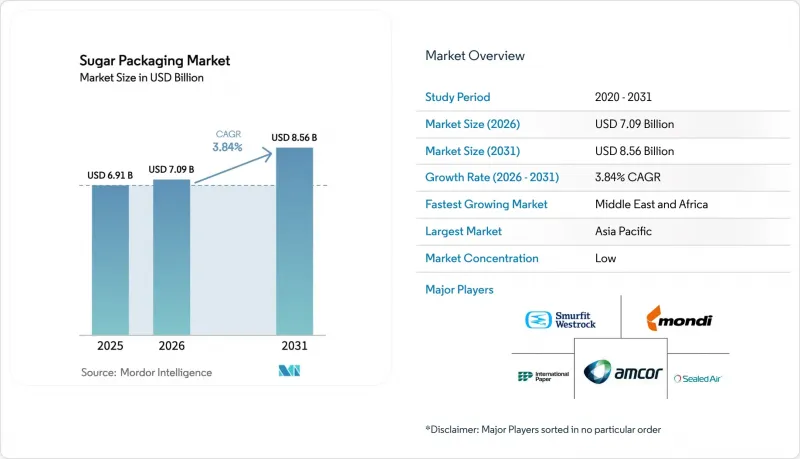
據 Mordor Intelligence 稱,2025 年糖包裝市場價值為 69.1 億美元,預計到 2031 年將達到 85.6 億美元,而 2026 年為 70.9 億美元,預測期內(2026-2031 年)的複合年預計成長率為 3.84%。
本報告按包裝類型(軟包裝和硬包裝)、材料類型(塑膠、紙張、生物基材料和可堆肥材料)、包裝規格(1公斤以下、2-5公斤、5公斤以上)、最終用戶(大型、中型和小規模製造商)以及地區(北美、南美、歐洲、亞太地區及其他地區)進行細分。市場預測以美元計價。
全球糖包裝市場趨勢及洞察
新興經濟體糖消費量持續成長
預計到2025年,印度人均糖消費量將達到20.1公斤,印尼和越南也將出現類似成長,這將推動散裝袋和零售包裝袋的基本需求。在這些市場,2-5公斤規格的糖銷量成長最為顯著,因為家庭購物時價格敏感度和儲存空間限制因素在此範圍內較為平衡。在中國,有機糖和特殊糖的消費量預計到2025年將佔總消費量的8%,這將催生對防篡改、可重複密封包裝的需求,從而支撐更高的價格。東南亞地區的淨進口量較去年同期成長4.2%,而能夠承受熱帶潮濕環境的軟性包裝形式的銷售量也進一步成長。總體而言,該地區消費量的成長是糖包裝市場成長的直接驅動力。
對客製化、永續包裝形式的需求日益成長
歐盟的《包裝和包裝廢棄物法規》將於2025年全面實施,該法規要求到2030年包裝材料的可回收性或可堆肥性達到65%,這促使加工商轉向使用單一材料的聚乙烯和聚乳酸(PLA)基材。根據Mondi公司預測,到2025年,生物基樹脂將佔食品軟包裝材料的42%,較兩年前的28%顯著成長。各大品牌還在單份包裝袋中加入易撕口、可重複密封拉鍊和雷射劃線等功能,以方便控制份量,從而提升其在商店的吸引力。安姆科公司於2025年中期推出的「AmLite」系列產品採用奈米黏土塗層,在維持阻隔性能的同時,將薄膜厚度減少15%,並降低了碳強度和運輸重量。這些設計上的改變正在推動醣類包裝市場走向優質化,即便原物料價格波動不定。
轉換器運作和合規成本
到2025年,法國、德國和荷蘭的塑膠包裝生產者延伸責任制(EPR)費用平均為每公斤0.12歐元(0.13美元),這將擠壓加工商的利潤空間,並推高商店價格3%至5%。無法承擔這些成本的小規模加工商退出了商品契約,促使部分供應鏈整合。新的可回收性測試法規導致每個SKU額外增加8000至15000歐元(8500至16000美元)的成本,而這筆前期投入延長了新型薄膜結構的投資回收期。加拿大和亞洲市場標準的差異使庫存管理更加複雜,並導致重複測試。因此,糖包裝市場的擴張計畫受到阻礙,尤其是中型企業。
細分市場分析
到2025年,柔軟性包裝解決方案將佔醣類包裝市場88.32%的佔有率,預計到2031年將以4.62%的複合年成長率成長。袋裝和軟包裝是推動銷售量,其中小包裝袋在快餐店和飯店餐飲通路的市場佔有率穩步提升。硬質容器仍然是小眾產品,主要用於高階有機糖和食品服務用分配器,其透明度和可重複使用性可以抵消較高的運輸成本。希悅爾公司(Sealed Air)的內置排氣閥的可回收聚乙烯軟包裝袋,透過防止在潮濕氣候下膨脹並減少零售商的退貨,進一步鞏固了其高階定位。相比之下,袋裝包裝的市場佔有率正被中型散貨箱。自動化處理中對硬質包裝的偏好凸顯了物料搬運技術的創新如何影響醣類包裝市場的趨勢。
硬質包裝3.1%的低複合年成長率主要歸因於其主要面向成熟市場以及消費者對價格的敏感度。儘管玻璃瓶在歐洲有機食品通路出現有限的復甦,因為透明度與純淨度密切相關,但軟包裝仍有望保持其主導地位,因為其重量輕、可重複密封且經久耐用等特性仍然深受零售商和消費者的青睞。因此,預計糖包裝市場將繼續加大對薄膜技術和瓶蓋創新的投資。
到2025年,塑膠仍將佔據醣類包裝市場68.97%的佔有率,其中散裝包裝採用編織聚丙烯,零售包裝採用多層複合材料。然而,受零售商評估標準和消費者永續性理念的推動,生物基和可堆肥基材的成長速度最快,複合年成長率達5.22%。紙質包裝的佔有率也在逐步提升,帶有可生物分解內襯的牛皮紙袋滿足了消費者對外觀和環保的雙重需求,尤其是在歐洲的高階市場。 Billerud的耐油複合材料符合歐盟法規10/2011的要求,顯示無需使用塑膠,紙張也能滿足安全標準,但由於價格溢價,其應用仍然有限。
Smurfit Westrock 與 Granbio 的合資企業旨在大規模商業化甘蔗渣衍生聚乙烯,目標是在 2029 年實現與化石燃料衍生樹脂的成本持平。在此之前,聚乙烯和聚丙烯薄膜可能仍將佔據主導地位,因為它們輕巧、具有可靠的防潮性能,並能最大限度地降低物流成本。然而,鑑於零售商的需求,生物基薄膜的市場佔有率預計將逐步成長,並持續推動糖包裝行業的創新需求。
區域分析
預計到2025年,亞太地區將佔據40.21%的市場佔有率,並在2031年之前以4.1%的複合年成長率成長。印度強制推行的鐵強化糖計畫正在推動對高阻隔薄膜的需求;在中國,區塊鏈技術在高階市場的應用正在從安全角度實現產品差異化。在東南亞,加速的都市化進程正促使銷售模式從散裝銷售迅速轉向零售包裝。日本人口老化迫使品牌開發易於開啟的密封條和更小尺寸的包裝,凸顯了不同地區需求的多樣性,也正是這些需求正在推動糖包裝市場的擴張。
預計中東和非洲地區的複合年成長率將達到最高,為5.32%。在沙烏地阿拉伯,進口商品必須使用防篡改包裝,這導致對全像標籤和易碎封條的需求增加。然而,當地加工商往往無法供應這些產品,從而為歐洲和亞洲供應商創造了出口機會。預計到2025年,奈及利亞的糖消費量將達到180萬噸,但國內包裝產能無法滿足需求,刺激了外國投資。外匯波動,例如埃及在2025年的貨幣貶值,正在影響材料的選擇,工業通路傾向於使用成本較低的紙袋,並重塑全部區域的糖包裝市場格局。
在歐洲,由於糖消費量下降,糖包裝行業的成長正在放緩,但永續性法規為其提供了支撐。德國提高了不可回收包裝的生產者責任延伸制度(EPR)費用,並加快了向單一材料聚乙烯的轉換。法國禁止使用一次性塑膠袋的政策帶來了不確定性,而各品牌正試圖透過採用紙本替代品來降低風險。西班牙和義大利的閉合迴路回收試點計畫展現了循環經濟的潛力,但這些計畫依賴相關人員的合作。因此,監管的複雜性是歐洲糖包裝產業前景的一個顯著特徵。
在北美,美國正透過電子商務推動對小型包裝的需求,而加拿大的生產者則延伸責任制(EPR)草案與美國法規存在差異,使得跨境合規變得更加複雜。墨西哥出口商正在使用阻隔性複合材料來滿足美國零售商對保存期限的要求。總體而言,專注於可重複密封功能和圖形設計的創新正在為糖包裝市場這一成熟細分領域增添價值。
南美洲有望成為成長區域之一,這得益於巴西甘蔗衍生聚乙烯的供應以及阿根廷穩定的投入成本。南方共同市場對包裝材料的關稅下調降低了生產成本,並促進了跨境一體化。雖然聖保羅和布宜諾斯艾利斯的都市區消費者越來越傾向於使用可重複密封的包裝袋,但低成本包裝袋在農村零售市場仍然佔據主導地位。隨著生物聚合物產能的擴大,南美洲可望成為全球糖包裝市場永續原料的出口中心。
其他好處:
- Excel格式的市場預測(ME)表
- 3個月的分析師支持
目錄
第1章:引言
- 研究假設和市場定義
- 調查範圍
第2章:調查方法
第3章執行摘要
第4章 市場狀況
- 市場概覽
- 市場促進因素
- 新興國家糖消費量持續成長
- 對客製化永續包裝形式的需求日益成長
- 電子商務的發展帶動了對獨立包裝糖的需求。
- 基於區塊鏈的高階糖供應鏈可追溯性
- 一項強制添加糖、要求特殊包裝的計劃。
- 在高濕度地區採用可生物分解的高阻隔薄膜
- 市場限制因素
- 轉換器運作和監管合規成本
- 全球糖價波動正在影響包裝需求。
- 轉向使用替代甜味劑導致人均糖消費量下降。
- 由於擴大生產者責任制(EPR)計劃,包裝成本增加。
- 產業價值鏈分析
- 監理情勢
- 技術展望
- 波特五力分析
- 宏觀經濟因素對市場的影響
- 投資分析
第5章 市場規模與成長預測
- 按包裝類型
- 軟包裝
- 袋子和小袋
- 小袋
- 包包
- 硬包裝
- 瓶子和容器
- 軟包裝
- 材料類型
- 塑膠
- 聚丙烯織物
- 塑膠薄膜
- 紙
- 生物基和可堆肥材料
- 塑膠
- : 英語
- 1公斤或以下
- 2~5 kg
- 5~25 kg
- 25公斤或以上
- 最終用戶
- 大型製造商
- 中型製造商
- 小規模製造商
- 按地區
- 北美洲
- 美國
- 加拿大
- 墨西哥
- 南美洲
- 巴西
- 阿根廷
- 其他南美國家
- 歐洲
- 德國
- 英國
- 法國
- 義大利
- 西班牙
- 其他歐洲國家
- 亞太地區
- 中國
- 印度
- 日本
- 韓國
- 澳洲
- 其他亞太國家
- 中東和非洲
- 中東
- 沙烏地阿拉伯
- 阿拉伯聯合大公國
- 土耳其
- 其他中東國家
- 非洲
- 南非
- 埃及
- 奈及利亞
- 其他非洲國家
- 中東
- 北美洲
第6章 競爭情勢
- 市場集中度
- 策略趨勢
- 市佔率分析
- 公司簡介
- Mondi plc
- Klabin SA
- Coveris Holdings SA
- United Bags Inc.
- Smurfit WestRock
- Amcor plc
- Sealed Air Corporation
- International Paper Company
- TedPack Company Limited
- Packman Industries
- Swiss Pack Private Limited
- Grupo Bio Pappel SAB de CV
- Stora Enso Oyj
- Crown Holdings Inc.
- Huhtamaki Oyj
- Billerud AB
- Glenroy Inc.
第7章 市場機會與未來展望
According to Mordor Intelligence, the sugar packaging market size was valued at USD 6.91 billion in 2025 and is estimated to grow from USD 7.09 billion in 2026 to reach USD 8.56 billion by 2031, at a CAGR of 3.84% during the forecast period (2026-2031).
This report is Segmented by Packaging Type (Flexible Packaging, and Rigid Packaging), Material Type (Plastic, Paper, and Bio-Based and Compostable Materials), Packaging Size (<=1 Kg, 2-5 Kg, and More), End User (Large Scale, Medium Scale, and Small Scale Manufacturers), and Geography (North America, South America, Europe, Asia-Pacific, and More). The Market Forecasts are Provided in Terms of Value (USD).
Global Sugar Packaging Market Trends and Insights
Steady Increase in Sugar Consumption in Emerging Economies
Per-capita intake in India climbed to 20.1 kilograms in 2025, and similar gains appeared in Indonesia and Vietnam, lifting baseline demand for both bulk sacks and retail pouches. The 2-5 kilogram bracket benefits most because household shopping trips in these markets balance price sensitivity with storage constraints. In China, organic and specialty sugars represented 8% of consumption in 2025, requiring tamper-evident, resealable packs that justify price premiums. Southeast Asia's net imports rose 4.2% year-on-year, further expanding volumes through flexible formats that withstand tropical humidity. Altogether, heightened regional consumption is a direct growth engine for the sugar packaging market.
Rising Demand for Customized and Sustainable Packaging Formats
The European Union's Packaging and Packaging Waste Regulation, fully enforced in 2025, compels 65% recyclability or compostability by 2030, steering converters toward mono-material polyethylene and polylactic acid substrates. Mondi reported that bio-attributed resins reached 42% of its food-flexible mix in 2025, up sharply from 28% two years earlier. Brands are also embracing single-serve sachets with tear notches, resealable zippers, and laser scoring for portion control, all of which heighten shelf appeal. Amcor's AmLite family, introduced mid-2025, cut film gauge by 15% yet preserved barrier performance via nano-clay coatings, lowering carbon intensity and shipping weight. These design shifts keep the sugar packaging market on a path of premiumization, even as raw material prices fluctuate.
Operational and Regulatory Compliance Costs for Converters
Extended Producer Responsibility fees averaged EUR 0.12 per kilogram (USD 0.13) of plastic packaging in France, Germany, and the Netherlands during 2025, squeezing converter margins and raising shelf prices by 3-5%. Smaller converters unable to absorb these charges exited commodity contracts, prompting some supply chain consolidation. New recyclability testing rules add EUR 8,000-EUR 15,000 (USD 8,500-USD 16,000) per SKU, an upfront burden that lengthens payback periods for new film constructions. Varying standards in Canada and Asian markets complicate inventory management and duplicate testing. The result is a drag on expansion plans, especially for mid-size firms, within the sugar packaging market.
Other drivers and restraints analyzed in the detailed report include:
- Growth of E-commerce Fueling Unit-Sized Sugar Packs
- Blockchain-Enabled Supply Chain Traceability for Premium Sugars
- Shift Toward Alternative Sweeteners Reducing Per-Capita Sugar Use
For complete list of drivers and restraints, kindly check the Table Of Contents.
Segment Analysis
Flexible solutions accounted for 88.32% of the sugar packaging market in 2025 and are expanding at a 4.62% CAGR through 2031. Bags and pouches drive volume, yet sachets are steadily gaining share in quick-service restaurants and hospitality channels. Rigid containers remain niche, catering to premium organic sugars and foodservice dispensers where clarity and reuse offset higher shipment costs. Sealed Air's recyclable polyethylene pouch with an integrated degassing valve prevents ballooning in humid climates, reducing retailer returns and validating the format's premium positioning. In contrast, sacks are ceding space to intermediate bulk containers where automated handling favors rigid formats, underscoring how material handling innovation influences the trajectory of the sugar packaging market.
Rigid packaging's lower 3.1% CAGR stems from concentration in mature markets and consumer price sensitivity, yet glass jars are enjoying a limited revival in European organic channels associating transparency with purity. Flexible formats, however, are likely to retain leadership because lightweighting, resealable features, and omnichannel durability remain highly valued by retailers and consumers alike. Consequently, the sugar packaging market is expected to see continued investment in film science and closure innovation.
Plastic retained 68.97% sugar packaging market share in 2025, split between woven polypropylene for bulk and multilayer laminates for retail. Yet bio-based and compostable substrates are growing fastest at 5.22% CAGR, driven by retailer scorecards and consumer sustainability preferences. Paper packaging also edges higher as kraft pouches with biodegradable liners satisfy both visual and environmental expectations, especially in European premium segments. Billerud's grease-resistant laminate passed EU Regulation 10/2011, demonstrating that paper can meet safety standards without plastics, though price premiums keep adoption selective.
Smurfit WestRock's joint venture with GranBio aims to commercialize bagasse-derived polyethylene at scale, targeting cost parity with fossil-based resin by 2029. Until then, polyethylene and polypropylene films will dominate because they deliver proven moisture barriers at lower weights, minimizing logistics costs. Nonetheless, retailer mandates suggest that bio-based films will capture incremental share, sustaining innovation demand within the sugar packaging industry.
Complete Report Scope:
- By Packaging Type
- Flexible Packaging
- Bags and Pouches
- Sachets
- Sacks
- Rigid Packaging
- Jars and Containers
- Flexible Packaging
- By Material Type
- Plastic
- Woven Polypropylene
- Plastic Films
- Paper
- Bio-based and Compostable Materials
- Plastic
- By Packaging Size
- Less than equal to 1 kg
- 2 - 5 kg
- 5 - 25 kg
- More than 25 kg
- By End User
- Large Scale Manufacturers
- Medium Scale Manufacturers
- Small Scale Manufacturers
- By Geography
- North America
- United States
- Canada
- Mexico
- South America
- Brazil
- Argentina
- Rest of South America
- Europe
- Germany
- United Kingdom
- France
- Italy
- Spain
- Rest of Europe
- Asia -Pacific
- China
- India
- Japan
- South Korea
- Australia
- Rest of Asia-Pacific
- Middle East and Africa
- Middle East
- Saudi Arabia
- United Arab Emirates
- Turkey
- Rest of Middle East
- Africa
- South Africa
- Egypt
- Nigeria
- Rest of Africa
- Middle East
- North America
Geography Analysis
Asia-Pacific held 40.21% of the market share in 2025 and is expected to grow at an estimated 4.1% CAGR through 2031. India's mandated iron-fortified sugar program drives demand for high-barrier films, while China's blockchain adoption in premium segments differentiates products on safety credentials. Southeast Asia is transitioning rapidly from loose bulk to retail packs as urbanization accelerates. Japan's aging demographics are pushing brands to engineer easy-open closures and smaller formats, underscoring diverse regional needs that are expanding the sugar packaging market.
The Middle East and Africa region posts the highest forecast at 5.32% CAGR. Saudi Arabia enforces tamper-evident packaging on imports, spurring holographic labels and breakable seals that local converters often cannot supply, thereby opening export opportunities for European and Asian suppliers. Nigeria's sugar consumption reached 1.8 million metric tons in 2025, but domestic packaging capacity trails demand, promoting foreign investment. Currency volatility, such as Egypt's 2025 devaluation, alters substrate choices, favoring lower-cost paper sacks in industrial channels and reshaping the sugar packaging market across the region.
In Europe, growth is muted by declining sugar use but buoyed by sustainability mandates. Germany raised EPR fees on non-recyclable packs, accelerating the switch to mono-material polyethylene. France's ban on single-use plastic sachets creates uncertainty, prompting brands to hedge with paper alternatives. Closed-loop recycling pilots in Spain and Italy demonstrate the potential of the circular economy but depend on multi-stakeholder coordination. Regulatory complexity, therefore, defines the European outlook for the sugar packaging industry.
In North America, the United States relies on e-commerce to stimulate unit-pack demand, whereas Canada's draft EPR proposal diverges from U.S. rules, complicating cross-border compliance. Mexico's exporters use higher-barrier laminates to meet U.S. retailer shelf-life requirements. Overall, innovation skewed to resealability and graphics delivers incremental value in this mature part of the sugar packaging market.
South America is expected to be one of the growing regions, powered by Brazil's sugarcane-derived polyethylene supply and Argentina's stabilization of input costs. Mercosur tariff cuts on packaging materials cut production costs and encourage cross-border integration. Urban consumers in Sao Paulo and Buenos Aires increasingly prefer resealable pouches, while rural retail still leans on low-cost sacks. As bio-polymer capacity climbs, South America could become an exporting hub for sustainable inputs used worldwide in the sugar packaging market.
- Mondi plc
- Klabin S.A.
- Coveris Holdings S.A.
- United Bags Inc.
- Smurfit WestRock
- Amcor plc
- Sealed Air Corporation
- International Paper Company
- TedPack Company Limited
- Packman Industries
- Swiss Pack Private Limited
- Grupo Bio Pappel S.A.B. de C.V.
- Stora Enso Oyj
- Crown Holdings Inc.
- Huhtamaki Oyj
- Billerud AB
- Glenroy Inc.
Additional Benefits:
- The market estimate (ME) sheet in Excel format
- 3 months of analyst support
TABLE OF CONTENTS
1 INTRODUCTION
- 1.1 Study Assumptions and Market Definition
- 1.2 Scope of the Study
2 RESEARCH METHODOLOGY
3 EXECUTIVE SUMMARY
4 MARKET LANDSCAPE
- 4.1 Market Overview
- 4.2 Market Drivers
- 4.2.1 Steady Increase in Sugar Consumption in Emerging Economies
- 4.2.2 Rising Demand for Customized and Sustainable Packaging Formats
- 4.2.3 Growth of E-commerce Fueling Unit-Sized Sugar Packs
- 4.2.4 Blockchain-Enabled Supply Chain Traceability for Premium Sugars
- 4.2.5 Mandatory Sugar-Fortification Programs Requiring Specialized Packs
- 4.2.6 Adoption of Biodegradable High-Barrier Films in Humid Regions
- 4.3 Market Restraints
- 4.3.1 Operational and Regulatory Compliance Costs for Converters
- 4.3.2 Volatility in Global Sugar Prices Impacting Packaging Demand
- 4.3.3 Shift Toward Alternative Sweeteners Reducing Per-Capita Sugar Use
- 4.3.4 Extended Producer Responsibility (EPR) Increasing Packaging Costs
- 4.4 Industry Value Chain Analysis
- 4.5 Regulatory Landscape
- 4.6 Technological Outlook
- 4.7 Porter's Five Forces Analysis
- 4.7.1 Bargaining Power of Suppliers
- 4.7.2 Bargaining Power of Buyers
- 4.7.3 Threat of New Entrants
- 4.7.4 Threat of Substitute Products
- 4.7.5 Intensity of Competitive Rivalry
- 4.8 Impact of Macroeconomic Factors on the Market
- 4.9 Investment Analysis
5 MARKET SIZE AND GROWTH FORECASTS (VALUE)
- 5.1 By Packaging Type
- 5.1.1 Flexible Packaging
- 5.1.1.1 Bags and Pouches
- 5.1.1.2 Sachets
- 5.1.1.3 Sacks
- 5.1.2 Rigid Packaging
- 5.1.2.1 Jars and Containers
- 5.1.1 Flexible Packaging
- 5.2 By Material Type
- 5.2.1 Plastic
- 5.2.1.1 Woven Polypropylene
- 5.2.1.2 Plastic Films
- 5.2.2 Paper
- 5.2.3 Bio-based and Compostable Materials
- 5.2.1 Plastic
- 5.3 By Packaging Size
- 5.3.1 Less than equal to 1 kg
- 5.3.2 2 - 5 kg
- 5.3.3 5 - 25 kg
- 5.3.4 More than 25 kg
- 5.4 By End User
- 5.4.1 Large Scale Manufacturers
- 5.4.2 Medium Scale Manufacturers
- 5.4.3 Small Scale Manufacturers
- 5.5 By Geography
- 5.5.1 North America
- 5.5.1.1 United States
- 5.5.1.2 Canada
- 5.5.1.3 Mexico
- 5.5.2 South America
- 5.5.2.1 Brazil
- 5.5.2.2 Argentina
- 5.5.2.3 Rest of South America
- 5.5.3 Europe
- 5.5.3.1 Germany
- 5.5.3.2 United Kingdom
- 5.5.3.3 France
- 5.5.3.4 Italy
- 5.5.3.5 Spain
- 5.5.3.6 Rest of Europe
- 5.5.4 Asia -Pacific
- 5.5.4.1 China
- 5.5.4.2 India
- 5.5.4.3 Japan
- 5.5.4.4 South Korea
- 5.5.4.5 Australia
- 5.5.4.6 Rest of Asia-Pacific
- 5.5.5 Middle East and Africa
- 5.5.5.1 Middle East
- 5.5.5.1.1 Saudi Arabia
- 5.5.5.1.2 United Arab Emirates
- 5.5.5.1.3 Turkey
- 5.5.5.1.4 Rest of Middle East
- 5.5.5.2 Africa
- 5.5.5.2.1 South Africa
- 5.5.5.2.2 Egypt
- 5.5.5.2.3 Nigeria
- 5.5.5.2.4 Rest of Africa
- 5.5.5.1 Middle East
- 5.5.1 North America
6 COMPETITIVE LANDSCAPE
- 6.1 Market Concentration
- 6.2 Strategic Moves
- 6.3 Market Share Analysis
- 6.4 Company Profiles (Includes Global Level Overview, Market Level Overview, Core Segments, Financials as Available, Strategic Information, Market Rank/Share, Products and Services, and Recent Developments)
- 6.4.1 Mondi plc
- 6.4.2 Klabin S.A.
- 6.4.3 Coveris Holdings S.A.
- 6.4.4 United Bags Inc.
- 6.4.5 Smurfit WestRock
- 6.4.6 Amcor plc
- 6.4.7 Sealed Air Corporation
- 6.4.8 International Paper Company
- 6.4.9 TedPack Company Limited
- 6.4.10 Packman Industries
- 6.4.11 Swiss Pack Private Limited
- 6.4.12 Grupo Bio Pappel S.A.B. de C.V.
- 6.4.13 Stora Enso Oyj
- 6.4.14 Crown Holdings Inc.
- 6.4.15 Huhtamaki Oyj
- 6.4.16 Billerud AB
- 6.4.17 Glenroy Inc.
7 MARKET OPPORTUNITIES AND FUTURE OUTLOOK
- 7.1 White-Space and Unmet-Need Assessment

 糖粉包裝機市場:全球市場預測,2026-2032年
 棒狀包裝:市場佔有率分析、產業趨勢與統計、成長預測(2026-2031)棒狀包裝市場:依產品類型、材料類型、產品形式、包裝尺寸、封口方式及最終用途分類-全球預測,2026-2032年
 條狀包裝市場報告:按材料、填充類型、容量、應用和地區分類(2026-2034 年)
 全球條狀包裝市場規模、佔有率、趨勢和成長分析報告(2026-2034年)
 條狀包裝市場規模、佔有率及成長分析(按材料、終端用途產業及地區分類)-2026-2033年產業預測
 棒狀包裝市場規模、佔有率和趨勢分析報告:按材料、應用、地區和細分市場預測(2025-2033 年)
 棒包裝市場機會、成長動力、產業趨勢分析及 2024 年至 2032 年預測