


 |
市場調查報告書
商品編碼
2124458
數位徽章:市場佔有率分析、產業趨勢與統計、成長預測(2026-2031)Digital Badges - Market Share Analysis, Industry Trends & Statistics, Growth Forecasts (2026 - 2031) |
||||||

※ 本網頁內容可能與最新版本有所差異。詳細情況請與我們聯繫。
根據 Mordor Intelligence 預測,數位徽章市場規模將從 2025 年的 2.3729 億美元成長到 2026 年的 2.7807 億美元,到 2031 年將達到 6.1343 億美元,2026 年至 2031 年的複合年成長率為 17.18%。
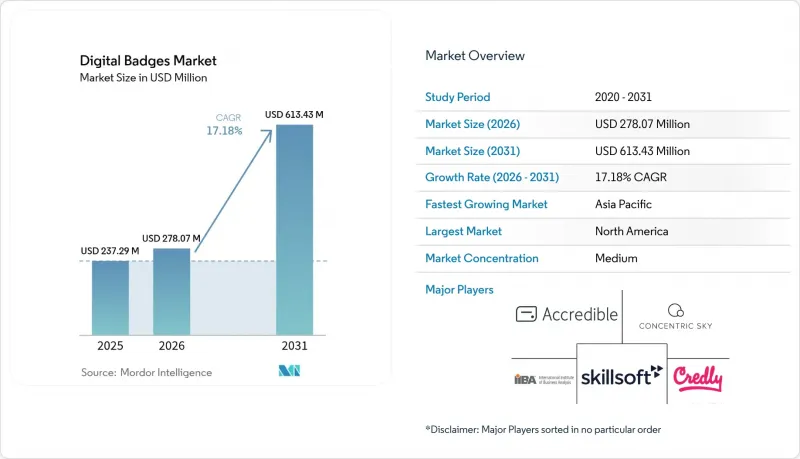
本報告按交付方式(平台和服務)、資格類型(參與徽章、技能徽章、成就徽章、貢獻徽章)、部署方式(雲端和本地部署)、最終用戶(教育機構、企業、政府和非營利組織)以及地區(北美、南美、歐洲、亞太地區及其他地區)進行細分。市場預測以美元計價。
全球數位徽章市場趨勢與洞察
美國高等教育機構中可疊加微證書的迅速普及
美國十分之八的教育機構計劃在2029年前實施微證書制度,理由是微證書能夠提高就業率並增強品牌知名度。一項調查顯示,97%的教育機構領導者認為微證書與畢業生積極的職涯發展前景有關。這種可疊加的學習路徑讓學習者可以逐步提升個人技能,從而獲得更高的資質,同時也能清楚地向雇主展示他們的成就。亞利桑那大學目前正在其工程、商業和公共衛生課程中頒發數位徽章,使畢業生能夠直接在LinkedIn上展示他們的能力。學習者的需求進一步推動了這一趨勢,90%的學生認為微證書是履歷中極具價值的組成部分。
歐洲政府資助的用於提昇勞動力技能的津貼日益增多
歐盟的「數位教育行動計畫」正利用公共資金解決歐洲的技能缺口問題,目前仍有37%的勞動力缺乏基本的數位技能。法國的「我的培訓帳戶」(Mon Compte Formation)和德國的「技能戰略」向個人學習者發放微證書券,從而刺激了對檢驗徽章的需求。伊拉斯謨+計畫已動員歐盟13個成員國的28個合作夥伴,將永續發展技能融入數位徽章課程。將徽章與即將推出的「歐洲數位技能認證」掛鉤的教育機構正在獲得跨境認可,並縮短畢業生在綠色科技和人工智慧相關領域的就業時間。
將分散的IT系統整合到傳統LMS中
大約 60% 的高等教育機構 IT 部門表示,將使用超過 10 年的 LMS 平台與徽章 API 整合時,會遇到中度至重度的困難。對於擁有多個校區的系統而言,學生資訊系統、校友資料庫和第三方招募網站的加入,進一步加劇了整合專案的複雜性。這些障礙導致部署週期延長、預算增加以及使用者接受度降低。雖然專業的整合商可以透過中間件和現成的連接器來解決這些挑戰,但許多機構仍然選擇等到老舊的 LMS 合約到期後再進行全面實施。
細分市場分析
到2025年,該平台將保持67.85%的數位徽章市場佔有率,體現了其在徽章頒發和管理方面的先發優勢。同時,隨著客戶對與其現有的人力資源和學術工作流程相契合的客製化實施方案的需求不斷成長,服務領域正以21.26%的複合年成長率快速擴張。諮詢專家為專案設計、元資料標準和成果評估提供建議,而支援和維護團隊則確保系統的長期可靠性。這種由服務主導的加速成長表明,教育機構越來越傾向於將徽章視為一項轉型管理舉措,而不僅僅是獨立的軟體購買專案。因此,數位徽章市場持續多元化發展,其範圍已超越核心平台,涵蓋了生態系統中各種能夠將專業知識貨幣化的角色。
這種成長差距凸顯了與學習管理系統 (LMS)、客戶關係管理系統 (CRM) 和企業識別工具無縫整合對於成功實施徽章的重要性。高等教育機構正在與整合商簽訂契約,將徽章與學分課程和認證要求關聯起來。同時,企業正在尋求徽章平台與人才管理解決方案之間的單一登入整合,以便在職業發展路徑儀表板中獲取學習分析數據。這些複雜的需求推高了整合專家的薪酬,並鞏固了更廣泛的數位徽章市場服務的收入基礎。
2025年,參與徽章的收入佔比為42.15%,而技能徽章預計將以22.6%的複合年成長率飆升,因為雇主越來越重視可驗證的技能而非出勤記錄。成就徽章介於兩者之間,旨在表彰長期學習過程中取得的里程碑式成就。另一方面,貢獻徽章在開放原始碼和志工社群中越來越受歡迎。對於徽章頒發者而言,技能徽章已成為基於技能的招聘策略的“通用貨幣”,因為它們提供與職位框架直接對應的詳細元資料。因此,預計到2031年,以技能為中心的數位徽章市場將超越符號類別,以實現更多元化的發展。
紅帽公司的認證項目清楚地展現了這一趨勢。他們的「專業認證」徽章代表著全球負責人認可的技術水準。目前,83%的雇主在評估候選人時會優先考慮徽章檢驗的技能。這種雇主需求推動了對嚴格徽章評估的投入,包括監考考試、情境模擬和同儕審查。隨著這項標準的普及,對高級創建工具和分析模組的需求也在不斷成長,從而提升了數位徽章行業供應商的收入。
區域分析
預計到2025年,北美仍將是數位徽章市場的中心,佔全球收入的39.75%,這主要得益於大學的早期採用和企業人才招募的壓力。美國五分之一的大學已經開始頒發徽章,預計到2025年,60%的雇主將認可這些徽章作為有效資格證書。加拿大各省政府正在為失業人士提供微證書計畫的津貼,從而提振了社區大學的需求。墨西哥仍處於起步階段,但跨國公司和頂尖大學正在推動一些獨立但影響深遠的試點項目,這些項目強調跨境資格互認。
亞太地區是成長最快的地區,預計2026年至2031年複合年成長率將達到20.9%。作為五年計畫的一部分,中國正投入國家津貼以提升數位技能,並鼓勵企業採用基於徽章的人才評估指標。日本和韓國正在將區塊鏈技術融入其國家資格認證體系,以擴大徽章在各行業的應用範圍。印度一家IT服務公司已實施徽章認證,用於認證500萬名技術人員在雲端運算、安全性和人工智慧領域的技能。儘管取得了這些進展,但農村地區寬頻接入不足的問題依然存在,亞太部分經濟體中只有不到40%的居民擁有穩定的網路連接,這限制了徽章在都市區以外地區的發放。
以德國、英國和法國為中心的歐洲則佔第二大市場。歐盟的微證書成熟度模型為大學制定統一的徽章標準提供了藍圖。遵守GDPR(一般資料保護規則)是關鍵的競爭因素,能夠對學習者資料進行精細控制的供應商具有競爭優勢。在中東地區,波灣合作理事會(GCC)成員國正在迅速採用這項技術,這些國家的國家願景強調終身學習。在撒哈拉以南非洲,儘管網路連線落後(只有25%的農村人口能夠連接先進的網路)帶來了挑戰,但捐助者資助的先導計畫表明,對檢驗的技能認證有潛在需求。
其他好處:
- Excel格式的市場預測(ME)表
- 3個月的分析師支持
目錄
第1章:引言
- 研究假設和市場定義
- 調查範圍
第2章:調查方法
第3章執行摘要
第4章 市場狀況
- 市場概覽
- 市場促進因素
- 美國高等教育機構中可疊加微證書的迅速普及
- 歐洲政府資助的用於提昇勞動力技能的津貼日益增多
- 受監管職業(例如護理、會計)必須提供完成繼續教育的證明。
- 亞洲企業學習與發展(L&D):轉向技能型招聘
- 互通性標準(Open Badges 3.0、W3C-VC)重振了供應商生態系統。
- 利用遊戲化驅動的參與度來提高北美 K-12 教育環境中的應用率。
- 市場限制因素
- 將分散的IT系統整合到傳統LMS中
- 徽章濫用和身分驗證成本超支
- 非洲和南亞農村地區寬頻存取的局限性
- 遵守資料隱私法規(GDPR、FERPA)帶來的負擔
- 技術展望
- 宏觀經濟因素對產業的影響
- 波特五力分析
- 投資分析
第5章 市場規模與成長預測
- 報價
- 平台
- 服務
- 諮詢
- 整合和部署
- 支援與維護
- 按資格類型
- 參與徽章
- 技能徽章
- 成就徽章
- 貢獻徽章
- 部署模式
- 雲
- 現場
- 最終用戶
- 學術機構
- K-12
- 高等教育
- 公司
- 大公司
- 中小企業
- 政府和非營利組織
- 學術機構
- 按地區
- 北美洲
- 美國
- 加拿大
- 墨西哥
- 南美洲
- 巴西
- 阿根廷
- 智利
- 秘魯
- 其他南美國家
- 歐洲
- 德國
- 英國
- 法國
- 義大利
- 西班牙
- 其他歐洲國家
- 亞太地區
- 中國
- 日本
- 韓國
- 印度
- 澳洲
- 紐西蘭
- 其他亞太國家
- 中東
- 阿拉伯聯合大公國
- 沙烏地阿拉伯
- 土耳其
- 其他中東國家
- 非洲
- 南非
- 其他非洲國家
- 北美洲
第6章 競爭情勢
- Strategic Developments
- Vendor Positioning Analysis
- 公司簡介
- Accredible
- Credly, Inc.
- Concentric Sky, Inc.
- Badgr
- Skillsoft Corporation
- Digitalbadges.io
- Forall Systems Inc.
- Sertifier
- Badgecraft
- Portfolium Inc.(Instructure)
- Badgecraft
- IBM Corporation
- Microsoft Corporation
- Salesforce.com Inc.
- SAP SE
- Oracle Corporation
- Coursera Inc.
- Udacity Inc.
- Adobe Inc.
- Pearson PLC
第7章 市場機會與未來展望
According to Mordor Intelligence, the digital badges market size is expected to grow from USD 237.29 million in 2025 to USD 278.07 million in 2026 and is forecast to reach USD 613.43 million by 2031 at 17.18% CAGR over 2026-2031.
This report is Segmented by Offering (Platforms, and Services), Credential Type (Participation Badges, Skill Badges, Achievement Badges, and Contribution Badges), Deployment Mode (Cloud, and On-Premise), End-User (Academic, Corporate, and Government and Non-Profits), and Geography (North America, South America, Europe, Asia-Pacific, and More). The Market Forecasts are Provided in Terms of Value (USD).
Global Digital Badges Market Trends and Insights
Rapid Adoption of Stackable Micro-Credentials in U.S. Higher-Ed
Eight in ten U.S. institutions plan to embed micro-credentials by 2029, citing stronger job placement outcomes and improved institutional branding. Surveys show 97% of academic leaders link micro-credentials to positive career results for graduates. Stackable paths let learners accumulate discrete skills that count toward larger qualifications while remaining visible to employers. The University of Arizona now issues digital badges across engineering, business, and public health programs, enabling graduates to showcase competencies directly on LinkedIn. Learner demand is amplifying the signal: 90% of students rate micro-credentials as highly valuable additions to their resumes.
Rise of Government-Funded Workforce Upskilling Grants in Europe
The EU Digital Education Action Plan commits public funds to closing the continent's skills gap, where 37% of workers still lack basic digital abilities. France's Mon Compte Formation and Germany's Skills Strategy distribute micro-credential vouchers to individual learners, stimulating demand for verified badges. Erasmus+ has mobilized 28 partners in 13 EU states to integrate sustainability skills into digital badge coursework. Providers that map badges to the upcoming European Digital Skills Certificate gain recognition across borders, shortening graduate time-to-hire in green-tech and AI job clusters.
Fragmented IT System Integration for Legacy LMSs
Roughly 60% of higher-education IT departments report moderate to severe difficulty connecting badge APIs with decade-old LMS platformsk. In multi-campus systems, integration projects grow further complicated by student-information systems, alumni databases, and third-party job boards. These hurdles extend roll-outs, raising budgets and delaying user uptake. Specialist integrators address the pain point through middleware and pre-built connectors, yet many institutions defer full adoption until aging LMS contracts lapse.
Other drivers and restraints analyzed in the detailed report include:
- Mandatory Continuing-Education Proof in Regulated Professions
- Corporate L&D Shift Toward Skills-Based Hiring in Asia
- Badge Fraud & Verification Cost Overruns
For complete list of drivers and restraints, kindly check the Table Of Contents.
Segment Analysis
Platforms retained 67.85% of the digital badges market share in 2025, reflecting their early-mover advantage in badge issuance and management. Services, however, are scaling at a 21.26% CAGR as clients seek bespoke roll-outs that align with existing HR and academic workflows. Consulting specialists advise on program design, metadata standards, and outcome measurement, while Support & Maintenance teams ensure long-term reliability. This service-led acceleration demonstrates how institutions increasingly view badges as change-management initiatives rather than stand-alone software purchases. As a result, the digital badges market continues to diversify into ecosystem roles that monetize expertise beyond core platforms.
The growth gap underscores the fact that successful badge adoption hinges on seamless integration with LMSs, CRM systems, and enterprise identity tools. Higher-education clients contract integrators to tie badges to credit-bearing courses and accreditation requirements. Corporates, meanwhile, demand single sign-on links between badge platforms and talent suites to capture learning analytics inside career-pathway dashboards. These complex needs fuel premium pricing for integration specialists, strengthening the revenue pool that services generate inside the broader digital badges market.
Participation badges held a 42.15% revenue foothold in 2025, yet skill badges are forecast to surge at a 22.6% CAGR as employers privilege demonstrable competencies over attendance records. Achievement badges fall between the two, rewarding milestone completions in longer learning journeys, while contribution badges gain popularity in open-source and volunteer communities. For issuers, skill badges offer fine-grained metadata that maps directly to job frameworks, making them the currency of skills-based recruitment strategies. Consequently, the digital badges market size for skill-focused credentials is expected to outpace symbolic categories through 2031.
Red Hat's certification program illustrates the trend: its Professional Certification badges validate technical mastery that hiring managers recognize globally. Eighty-three percent of employers now prefer badge-verified skills when short-listing candidates. This employer pull fuels investment in assessment-rigorous badges with proctored exams, scenario labs, or peer reviews. As this standard spreads, demand for advanced authoring tools and analytics modules climbs, boosting vendor revenues inside the digital badges industry.
Complete Report Scope:
- By Offering
- Platforms
- Services
- Consulting
- Integration and Implementation
- Support and Maintenance
- By Credential Type
- Participation Badges
- Skill Badges
- Achievement Badges
- Contribution Badges
- By Deployment Mode
- Cloud
- On-Premise
- By End-User
- Academic
- K-12
- Higher Education
- Corporate
- Large Enterprises
- Small and Mid-Sized Enterprises (SMEs)
- Government and Non-Profits
- Academic
- By Geography
- North America
- United States
- Canada
- Mexico
- South America
- Brazil
- Argentina
- Chile
- Peru
- Rest of South America
- Europe
- Germany
- United Kingdom
- France
- Italy
- Spain
- Rest of Europe
- Asia-Pacific
- China
- Japan
- South Korea
- India
- Australia
- New Zealand
- Rest of Asia-Pacific
- Middle East
- United Arab Emirates
- Saudi Arabia
- Turkey
- Rest of Middle East
- Africa
- South Africa
- Rest of Africa
- North America
Geography Analysis
North America remained the epicenter of the digital badges market in 2025, securing 39.75% of global revenue thanks to early college adoption and corporate talent-pipeline pressures. One in five U.S. colleges already issue badges, and 60% of employers are projected to treat them as valid qualifications by 2025. Canada's provincial governments subsidize micro-credential programs for displaced workers, spurring demand among community colleges. Mexico is in a nascent phase, with multinational firms and elite universities driving isolated but influential pilots that emphasize cross-border credential portability.
Asia-Pacific stands out as the fastest-growing region, tracking a 20.9% CAGR from 2026-2031. China funnels state grants into digital upskilling as part of its Five-Year Plan, encouraging enterprises to adopt badge-driven workforce metrics. Japan and South Korea embed blockchain in national credential networks, extending badge validity across industries. India's IT services firms deploy badges to certify cloud, security, and GenAI proficiencies for 5 million technologists. Despite these advances, rural broadband deficits linger: less than 40% of citizens in some Asia-Pacific economies have reliable connections, limiting badge issuance outside urban hubs.
Europe secures the number-two slot in market share, anchored by Germany, the U.K., and France. The EU's micro-credential maturity model supplies universities with a roadmap for uniform badge standards. GDPR compliance shapes competitive positioning, favoring vendors that provide granular learner-data controls. Elsewhere, the Middle East witnesses strong uptake in Gulf Cooperation Council states where national visions spotlight lifelong learning. Sub-Saharan Africa wrestles with low connectivity-only 25% of rural populations enjoy upgraded networks-yet donor-funded pilot projects indicate pent-up demand for verifiable skills evidence.
- Accredible
- Credly, Inc.
- Concentric Sky, Inc.
- Badgr
- Skillsoft Corporation
- Digitalbadges.io
- Forall Systems Inc.
- Sertifier
- Badgecraft
- Portfolium Inc. (Instructure)
- Badgecraft
- IBM Corporation
- Microsoft Corporation
- Salesforce.com Inc.
- SAP SE
- Oracle Corporation
- Coursera Inc.
- Udacity Inc.
- Adobe Inc.
- Pearson PLC
Additional Benefits:
- The market estimate (ME) sheet in Excel format
- 3 months of analyst support
TABLE OF CONTENTS
1 Introduction
- 1.1 Study Assumptions and Market Definition
- 1.2 Scope of the Study
2 Research Methodology
3 Executive Summary
4 Market Landscape
- 4.1 Market Overview
- 4.2 Market Drivers
- 4.2.1 Rapid Adoption of Stackable Micro-Credentials in U.S. Higher-Ed
- 4.2.2 Rise of Government-Funded Workforce Upskilling Grants in Europe
- 4.2.3 Mandatory Continuing-Ed Proof in Regulated Professions (e.g., Nursing, Accounting)
- 4.2.4 Corporate L&D Shift Toward Skills-Based Hiring in Asia
- 4.2.5 Interoperability Standards (Open Badges 3.0, W3C-VC) Catalyzing Vendor Ecosystem
- 4.2.6 Gamified Engagement Driving K-12 Adoption in North America
- 4.3 Market Restraints
- 4.3.1 Fragmented IT System Integration for Legacy LMSs
- 4.3.2 Badge Fraud and Verification Cost Overruns
- 4.3.3 Limited Broadband Access in Rural Africa and South Asia
- 4.3.4 Data-Privacy Compliance Burden (GDPR, FERPA)
- 4.4 Technological Outlook
- 4.5 Impact of Macroeconomic factors on the Industry
- 4.6 Porter's Five Forces Analysis
- 4.6.1 Bargaining Power of Suppliers
- 4.6.2 Bargaining Power of Buyers/Consumers
- 4.6.3 Threat of New Entrants
- 4.6.4 Threat of Substitute Products
- 4.6.5 Intensity of Competitive Rivalry
- 4.7 Investment Analysis
5 Market Size and Growth Forecasts (Value)
- 5.1 By Offering
- 5.1.1 Platforms
- 5.1.2 Services
- 5.1.2.1 Consulting
- 5.1.2.2 Integration and Implementation
- 5.1.2.3 Support and Maintenance
- 5.2 By Credential Type
- 5.2.1 Participation Badges
- 5.2.2 Skill Badges
- 5.2.3 Achievement Badges
- 5.2.4 Contribution Badges
- 5.3 By Deployment Mode
- 5.3.1 Cloud
- 5.3.2 On-Premise
- 5.4 By End-User
- 5.4.1 Academic
- 5.4.1.1 K-12
- 5.4.1.2 Higher Education
- 5.4.2 Corporate
- 5.4.2.1 Large Enterprises
- 5.4.2.2 Small and Mid-Sized Enterprises (SMEs)
- 5.4.3 Government and Non-Profits
- 5.4.1 Academic
- 5.5 By Geography
- 5.5.1 North America
- 5.5.1.1 United States
- 5.5.1.2 Canada
- 5.5.1.3 Mexico
- 5.5.2 South America
- 5.5.2.1 Brazil
- 5.5.2.2 Argentina
- 5.5.2.3 Chile
- 5.5.2.4 Peru
- 5.5.2.5 Rest of South America
- 5.5.3 Europe
- 5.5.3.1 Germany
- 5.5.3.2 United Kingdom
- 5.5.3.3 France
- 5.5.3.4 Italy
- 5.5.3.5 Spain
- 5.5.3.6 Rest of Europe
- 5.5.4 Asia-Pacific
- 5.5.4.1 China
- 5.5.4.2 Japan
- 5.5.4.3 South Korea
- 5.5.4.4 India
- 5.5.4.5 Australia
- 5.5.4.6 New Zealand
- 5.5.4.7 Rest of Asia-Pacific
- 5.5.5 Middle East
- 5.5.5.1 United Arab Emirates
- 5.5.5.2 Saudi Arabia
- 5.5.5.3 Turkey
- 5.5.5.4 Rest of Middle East
- 5.5.6 Africa
- 5.5.6.1 South Africa
- 5.5.6.2 Rest of Africa
- 5.5.1 North America
6 Competitive Landscape
- 6.1 Strategic Developments
- 6.2 Vendor Positioning Analysis
- 6.3 Company Profiles (includes Global level Overview, Market level overview, Core Segments, Financials as available, Strategic Information, Products and Services, and Recent Developments)
- 6.3.1 Accredible
- 6.3.2 Credly, Inc.
- 6.3.3 Concentric Sky, Inc.
- 6.3.4 Badgr
- 6.3.5 Skillsoft Corporation
- 6.3.6 Digitalbadges.io
- 6.3.7 Forall Systems Inc.
- 6.3.8 Sertifier
- 6.3.9 Badgecraft
- 6.3.10 Portfolium Inc. (Instructure)
- 6.3.11 Badgecraft
- 6.3.12 IBM Corporation
- 6.3.13 Microsoft Corporation
- 6.3.14 Salesforce.com Inc.
- 6.3.15 SAP SE
- 6.3.16 Oracle Corporation
- 6.3.17 Coursera Inc.
- 6.3.18 Udacity Inc.
- 6.3.19 Adobe Inc.
- 6.3.20 Pearson PLC
7 Market Opportunities and Future Outlook
- 7.1 White-space and Unmet-need Assessment

 數位證書和徽章市場:預測(至 2034 年)—按組件、徽章類型、部署方式、技術、最終用戶和地區分類的全球分析
 數位徽章市場:2026-2032年全球市場預測(按產品、發行方類型、徽章類型、部署等級、應用程式和最終用戶分類)
 2026年全球數位徽章市場報告
 數位徽章市場規模、佔有率、成長及全球產業分析:按類型和應用分類,區域洞察及2026-2034年預測
 數位徽章市場規模、佔有率和成長分析(按類型、最終用戶、應用、部署模式和地區分類)-2026-2033年產業預測技能認證和數位徽章市場預測至2032年:按證書類型、檢驗方法、交付格式、技術、最終用戶和地區分類的全球分析數位徽章市場預測至2032年:按類型、憑證類型、產品供應、部署、最終用戶和地區分類的全球分析2032 年微證書和數位徽章市場預測:按類型、提供者、最終用戶、垂直行業和地區進行的全球分析
 數位徽章市場報告:2031 年趨勢、預測與競爭分析