


 |
市場調查報告書
商品編碼
2124451
鹼性電池:市場佔有率分析、產業趨勢與統計、成長預測(2026-2031)Alkaline Battery - Market Share Analysis, Industry Trends & Statistics, Growth Forecasts (2026 - 2031) |
||||||

※ 本網頁內容可能與最新版本有所差異。詳細情況請與我們聯繫。
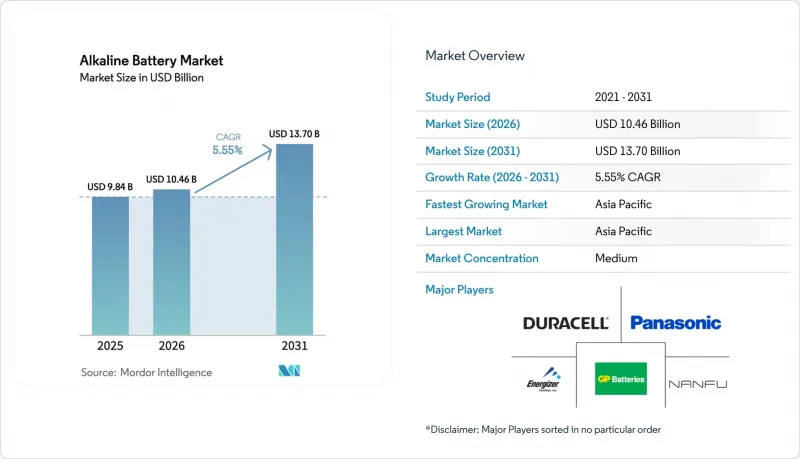
據 Mordor Intelligence 稱,2025 年鹼性電池市值為 98.4 億美元,預計到 2031 年將達到 137 億美元,而 2026 年為 104.6 億美元,預測期(2026-2031 年)的複合年成長率為 5.55%。
本報告按電池類型(一次電池)、尺寸(AA、AAA、9伏、C、D、紐扣電池和特殊尺寸電池)、應用領域(消費電子產品、工業和商業設備、醫療設備、照明和手電筒等)以及地區(北美、歐洲、亞太地區、南美以及中東和非洲)進行細分。市場規模和預測均以美元計價。
全球鹼性電池市場趨勢與洞察
消費性電子產品對一次性電源的需求日益成長
2025年,消費性電子產品仍保持45.6%的市場佔有率,但其使用呈現兩極分化:一方面是採用鋰離子電池的高階電子產品,另一方面是大規模的低功耗周邊設備、遙控器、時鐘和智慧家居感測器用戶群,他們仍然因為成本和可靠性而偏愛鹼性電池。印度零售業的現代化使得品牌電池的展示更加整齊,隨著消費者從鋅碳電池升級,銷售量也隨之成長。Panasonic和金霸王目前正在銷售長壽命AA和AAA系列電池,並提供10年防漏保證,目標客戶是智慧家庭中心。 USB充電設備在富裕人群中很受歡迎,但亞洲和拉丁美洲入門級電子產品銷售的成長也維持了穩定的電池更換週期。因此,儘管鋰離子電池在其他領域不斷擴張,但鹼性電池市場仍形成了一個穩定的需求基礎。
低功耗物聯網感測器設備的普及
新加坡、深圳和首爾的市政府已部署了數千個空氣品質和停車感測器,這些感測器僅消耗微安培級電流。鹼性電池的成本績效優於鋅碳電池,而且不像鋰一次電池需要被標記為危險廢棄物。符合IEC 60086標準可以實現相容採購,這在零件短缺時尤其有利。供應商使用標準化的AA電池盒,現場工作人員無需專用工具即可更換電池,從而降低了現場服務成本。 2024年的一項研究證實,在低負載條件下,鹼性電池的能量密度高於鋅碳電池,儘管脈衝電流限制仍然是無線遙測技術的一個限制因素。能源採集模組可能會在本十年後半期降低電池更換頻率,但鹼性電池仍然是市政競標的預設選擇,這提高了長期銷售量的可預測性。
與鋰離子充電電池相比的性能差異
在高功率設備中,鋰離子電池的能量密度是傳統鹼性電池的3到5倍,因此傳統鹼性電池已被旗艦相機和遊戲手把淘汰。可充電鹼性電池的循環壽命僅25到50次,即使採用更安全的水性電解,也限制了其廣泛應用。儘管錳鋅可充電電池的研發在2024年已在實驗室層級取得進展,但枝晶的形成仍是其大規模生產的一大障礙。各大品牌紛紛推出「終極」鹼性電池系列,旨在略微提升運作時間,但鋰離子電池在脈衝電流特性上具有實體優勢。隨著高階電子產品向USB-C標準過渡,鹼性電池需要將重心轉移到低功率細分市場,才能維持其市場地位。
細分市場分析
2025年,一次性鹼性電池的銷售額仍維持在74.5%,凸顯了其在鹼性電池市場的主導地位。由於無需維護,它們非常適合用於緊急包、煙霧偵測器和物聯網感測器。軍方採購商要求電池的保存期限達到10年,這是可充電電池無法滿足的要求。預計到2031年,一次性鹼性電池市場規模將達到101億美元,為現有企業帶來強勁的現金流。
可充電鹼性電池目前市佔率較小,但預計到2031年將以8.9%的複合年成長率成長,因為環保意識強的家庭正在尋求介於一次性電池和鋰離子電池之間的過渡方案。製造商正專注於安全、水基電解和熟悉的外形設計,以消除消費者的疑慮。早期用戶包括經常使用雷射筆等中等耗電量設備的學校和辦公室。然而,在循環壽命接近100次充電循環之前,可充電電池將與一次電池形成互補,而非蠶食其市場佔有率,從而支持整個鹼性電池市場的均衡成長。
區域分析
預計到2025年,亞太地區將以38.3%的市佔率引領市場,並在2031年之前維持6.4%的年均成長率,這主要得益於中國製造業的規模優勢和印度零售業的現代化。中國供應全球約70%的鹼性電池,並擁有完善的鋅錳供應鏈。隨著印度消費者擴大在大賣場購買品牌產品的多包裝,潛在需求不斷擴大。東南亞國協智慧城市的建設也穩步提升了對低功耗AA電池的需求,各國政府正鼓勵採用標準化的外形規格以方便維護。
北美和歐洲市場雖然成熟,但盈利豐厚。品牌透過宣傳防偽包裝和長使用壽命來獲得溢價。歐盟法規要求到2025年回收率達到65%,這迫使製造商投資於回收利用,同時也為此前因危險品標籤限制而無法進入的雜貨店管道打開了大門。此外,儘管消費者轉向可充電產品,但由於美國軍方採購了寬溫域的D型和C型電池,工業需求仍保持穩定。
南美洲、中東和非洲地區的鹼性電池市場正從小規模的基數快速擴張。雖然巴西和墨西哥的現代零售商店展示空間不斷增加,但在以「現金取貨」模式為主的農村地區,鹼性電池的市場滲透率仍然有限。在阿拉伯聯合大公國和沙烏地阿拉伯,鹼性電池已被納入民防裝備;而在非洲,一些非政府組織正在太陽能充電器尚未普及的地區分發一次電池電池手電筒。供應鏈摩擦、港口擁塞和外匯波動推高了成本,但都市化進程的加速將長期推動鹼性電池市場的發展。
其他好處:
- Excel格式的市場預測(ME)表
- 3個月的分析師支持
目錄
第1章:引言
- 研究假設和市場定義
- 調查範圍
第2章:調查方法
第3章執行摘要
第4章 市場狀況
- 市場概覽
- 市場促進因素
- 家用電器對一次性電源的需求日益成長。
- 低功耗物聯網感測設備的普及
- 新興市場有組織零售的擴張
- 增加對離網災害防備措施的支出
- 軍方需要具有寬溫度範圍的一次電池
- 在汞法規推出後,如何開發新的零售通路
- 市場限制因素
- 與鋰離子充電電池相比的性能差異
- 電子商務中假電池數量增加
- 地方政府關於一次性手機掩埋的規定
- 鋅錳礦供應波動
- 供應鏈分析
- 監理情勢
- 技術展望
- 波特五力模型
第5章 市場規模與成長預測
- 依電池類型
- 一次電池
- 可充電電池(鹼性電池)
- 尺寸
- AA(LR6)
- AAA(LR03)
- 9伏
- C
- D
- 金幣/特殊金幣
- 透過使用
- 消費性電子產品
- 工業和商業設備
- 醫療器材
- 玩具和娛樂
- 照明設備和手電筒
- 按地區
- 北美洲
- 美國
- 加拿大
- 墨西哥
- 歐洲
- 德國
- 英國
- 法國
- 義大利
- 北歐國家
- 俄羅斯
- 其他歐洲國家
- 亞太地區
- 中國
- 印度
- 日本
- 韓國
- 東南亞國協
- 澳洲和紐西蘭
- 其他亞太國家
- 南美洲
- 巴西
- 阿根廷
- 哥倫比亞
- 其他南美國家
- 中東和非洲
- 沙烏地阿拉伯
- 阿拉伯聯合大公國
- 南非
- 埃及
- 其他中東和非洲國家
- 北美洲
第6章 競爭情勢
- 市場集中度
- 策略趨勢(併購、聯盟、購電協議)
- 市場佔有率分析(主要公司的市場排名和佔有率)
- 公司簡介
- Duracell Inc
- Energizer Holdings Inc
- Panasonic Corporation
- GP Batteries International Ltd
- Nanfu Battery Co Ltd
- VARTA AG
- Koninklijke Philips NV
- Fujitsu Ltd
- Maxell Holdings Ltd
- Sony Group(Murata Manufacturing battery business)
- Spectrum Brands(Rayovac)
- Toshiba Corporation
- Camelion Battery Co
- Shenzhen PKCELL Battery Co Ltd
- Eveready Industries India Ltd
- Zhejiang Must Power Co Ltd
- Sunbeam Products Inc
- Amperex Technology Ltd(ATL)-Primary division
- Union Battery Corporation
- Euroforce Battery Co
第7章 市場機會與未來展望
According to Mordor Intelligence, the alkaline battery market size was valued at USD 9.84 billion in 2025 and is estimated to grow from USD 10.46 billion in 2026 to reach USD 13.70 billion by 2031, at a CAGR of 5.55% during the forecast period (2026-2031).
This report is Segmented by Battery Type (Primary and Secondary), Size (AA, AAA, 9-Volt, C, D, and Coin and Specialty), Application (Consumer Electronics, Industrial and Commercial Devices, Medical Devices, Lighting and Flashlights, and More), and Geography (North America, Europe, Asia-Pacific, South America, and Middle East and Africa). The Market Sizes and Forecasts are Provided in Terms of Value (USD).
Global Alkaline Battery Market Trends and Insights
Rising Demand for Disposable Power in Consumer Electronics
Consumer electronics retained a 45.6% share in 2025, yet usage is splitting between premium gadgets adopting lithium-ion and a large installed base of low-drain peripherals, remote controls, clocks, and smart-home sensors that still prefer alkaline for cost and reliability. India's retail modernization placed branded batteries on organized shelves, lifting unit volumes as shoppers traded up from zinc-carbon packs. Panasonic and Duracell now market extended-life AA and AAA lines with 10-year leak-proof guarantees aimed at smart-home hubs. Although USB-rechargeable devices proliferate in affluent segments, volume growth in entry-level gadgets across Asia and Latin America preserves a robust replacement cycle. The net result is a stable demand core that underpins the alkaline battery market even while lithium-ion expands elsewhere.
Penetration of Low-Drain IoT Sensing Devices
City governments in Singapore, Shenzhen, and Seoul deploy thousands of air-quality or parking sensors that draw micro-amp currents, a sweet spot where alkaline delivers better cost-per-watt than zinc-carbon without the hazardous-waste labeling lithium-primary chemistries require. Compliance with IEC 60086 enables interchangeable sourcing, an advantage during component shortages. Vendors adopt standardized AA cartridges so field crews can swap cells without proprietary tools, reducing truck-roll costs. Research in 2024 confirmed alkaline's higher energy density under low loads versus zinc-carbon, though pulse-current limitations remain a boundary in wireless telemetry. Energy-harvesting modules could trim replacement rates later in the decade, yet municipal tenders still default to primary alkaline today, bolstering long-term volume visibility.
Performance Gap Versus Lithium-Ion Rechargeables
Lithium-ion delivers 3-5X the energy density of primary alkaline in high-drain devices, pushing alkaline out of flagship cameras and game controllers. Rechargeable alkaline offers only 25-50 cycles, limiting adoption despite a safer aqueous electrolyte. R&D into zinc-manganese dioxide rechargeables made lab progress in 2024, yet dendrite formation still curtails mass-market readiness. Brands respond with "ultimate" alkaline lines that squeeze incremental runtime gains, but physics favors lithium-ion for pulse-current profiles. As premium gadgets march toward USB-C standardization, alkaline cells must pivot to low-drain niches to remain relevant.
Other drivers and restraints analyzed in the detailed report include:
- Expansion of Organized Retail in Emerging Economies
- Growing Off-Grid Emergency-Preparedness Spend
- Rising E-Commerce Counterfeit Battery Incidents
For complete list of drivers and restraints, kindly check the Table Of Contents.
Segment Analysis
Primary alkaline cells retained 74.5% revenue share in 2025, underlining their dominance in the alkaline battery market. Their zero-maintenance nature aligns with emergency kits, smoke detectors, and IoT sensors. Military buyers specify a 10-year shelf-life that rechargeable formats cannot match. The alkaline battery market size for primary cells is poised to reach USD 10.1 billion by 2031, maintaining healthy cash generation for incumbents.
Secondary alkaline variants, while only a sliver today, are set to grow at an 8.9% CAGR to 2031 as environmentally minded households seek midway solutions between disposables and lithium-ion. Manufacturers emphasize safe aqueous electrolytes and familiar form factors to overcome consumer skepticism. Early adopters are schools and offices that cycle through moderate-drain devices like laser pointers. However, until cycle life approaches 100 charges, secondary formats will complement rather than cannibalize primary sales, supporting balanced growth inside the alkaline battery market.
Complete Report Scope:
- By Battery Type
- Primary
- Secondary (Rechargeable Alkaline)
- By Size
- AA (LR6)
- AAA (LR03)
- 9-Volt
- C
- D
- Coin and Specialty
- By Application
- Consumer Electronics
- Industrial and Commercial Devices
- Medical Devices
- Toys and Entertainment
- Lighting and Flashlights
- By Geography
- North America
- United States
- Canada
- Mexico
- Europe
- Germany
- United Kingdom
- France
- Italy
- NORDIC Countries
- Russia
- Rest of Europe
- Asia-Pacific
- China
- India
- Japan
- South Korea
- ASEAN Countries
- Australia and New Zealand
- Rest of Asia-Pacific
- South America
- Brazil
- Argentina
- Colombia
- Rest of South America
- Middle East and Africa
- Saudi Arabia
- United Arab Emirates
- South Africa
- Egypt
- Rest of Middle East and Africa
- North America
Geography Analysis
Asia-Pacific dominated with 38.3% share in 2025 and should post 6.4% annual growth to 2031, fueled by China's manufacturing heft and India's retail modernization. China supplies roughly 70% of global alkaline output, underpinned by integrated zinc and manganese supply chains. Indian consumers increasingly buy branded multipacks in hypermarkets, widening addressable demand. ASEAN smart-city deployments add steady volumes for low-drain AA sensors, and governments encourage standard form factors to facilitate maintenance.
North America and Europe are mature but profitable arenas. Brands command premium prices via anti-counterfeit packaging and long-life claims. EU regulations enforce a 65% collection rate by 2025, compelling producers to invest in recycling yet opening grocery channels once barred by hazardous labeling. U.S. military procurement for wide-temperature D and C cells stabilizes industrial demand despite consumer shifts to rechargeable alternatives.
South America and the Middle East-Africa corridor expand from smaller bases. Brazil and Mexico gain shelf space in modern retail, yet rural cash-and-carry dominance limits penetration. The UAE and Saudi Arabia incorporate alkaline batteries into civil-defense kits, while African NGOs distribute torches powered by primary cells where solar-charger reach is sporadic. Supply-chain friction, port congestion, and currency swings add cost, but rising urbanization provides a long-run tailwind for the alkaline battery market.
- Duracell Inc
- Energizer Holdings Inc
- Panasonic Corporation
- GP Batteries International Ltd
- Nanfu Battery Co Ltd
- VARTA AG
- Koninklijke Philips NV
- Fujitsu Ltd
- Maxell Holdings Ltd
- Sony Group (Murata Manufacturing battery business)
- Spectrum Brands (Rayovac)
- Toshiba Corporation
- Camelion Battery Co
- Shenzhen PKCELL Battery Co Ltd
- Eveready Industries India Ltd
- Zhejiang Must Power Co Ltd
- Sunbeam Products Inc
- Amperex Technology Ltd (ATL) - Primary division
- Union Battery Corporation
- Euroforce Battery Co
Additional Benefits:
- The market estimate (ME) sheet in Excel format
- 3 months of analyst support
TABLE OF CONTENTS
1 Introduction
- 1.1 Study Assumptions & Market Definition
- 1.2 Scope of the Study
2 Research Methodology
3 Executive Summary
4 Market Landscape
- 4.1 Market Overview
- 4.2 Market Drivers
- 4.2.1 Rising demand for disposable power in consumer electronics
- 4.2.2 Penetration of low-drain IoT sensing devices
- 4.2.3 Expansion of organized retail in emerging economies
- 4.2.4 Growing off-grid emergency-preparedness spend
- 4.2.5 Military need for wide-temperature-range primary cells
- 4.2.6 Post-mercury regulations opening new retail channels
- 4.3 Market Restraints
- 4.3.1 Performance gap versus Li-ion rechargeables
- 4.3.2 Rising e-commerce counterfeit battery incidents
- 4.3.3 Municipal landfill restrictions on single-use cells
- 4.3.4 Supply volatility of zinc and manganese ores
- 4.4 Supply-Chain Analysis
- 4.5 Regulatory Landscape
- 4.6 Technological Outlook
- 4.7 Porter's Five Forces
- 4.7.1 Bargaining Power of Suppliers
- 4.7.2 Bargaining Power of Consumers
- 4.7.3 Threat of New Entrants
- 4.7.4 Threat of Substitute Products & Services
- 4.7.5 Intensity of Competitive Rivalry
5 Market Size & Growth Forecasts
- 5.1 By Battery Type
- 5.1.1 Primary
- 5.1.2 Secondary (Rechargeable Alkaline)
- 5.2 By Size
- 5.2.1 AA (LR6)
- 5.2.2 AAA (LR03)
- 5.2.3 9-Volt
- 5.2.4 C
- 5.2.5 D
- 5.2.6 Coin and Specialty
- 5.3 By Application
- 5.3.1 Consumer Electronics
- 5.3.2 Industrial and Commercial Devices
- 5.3.3 Medical Devices
- 5.3.4 Toys and Entertainment
- 5.3.5 Lighting and Flashlights
- 5.4 By Geography
- 5.4.1 North America
- 5.4.1.1 United States
- 5.4.1.2 Canada
- 5.4.1.3 Mexico
- 5.4.2 Europe
- 5.4.2.1 Germany
- 5.4.2.2 United Kingdom
- 5.4.2.3 France
- 5.4.2.4 Italy
- 5.4.2.5 NORDIC Countries
- 5.4.2.6 Russia
- 5.4.2.7 Rest of Europe
- 5.4.3 Asia-Pacific
- 5.4.3.1 China
- 5.4.3.2 India
- 5.4.3.3 Japan
- 5.4.3.4 South Korea
- 5.4.3.5 ASEAN Countries
- 5.4.3.6 Australia and New Zealand
- 5.4.3.7 Rest of Asia-Pacific
- 5.4.4 South America
- 5.4.4.1 Brazil
- 5.4.4.2 Argentina
- 5.4.4.3 Colombia
- 5.4.4.4 Rest of South America
- 5.4.5 Middle East and Africa
- 5.4.5.1 Saudi Arabia
- 5.4.5.2 United Arab Emirates
- 5.4.5.3 South Africa
- 5.4.5.4 Egypt
- 5.4.5.5 Rest of Middle East and Africa
- 5.4.1 North America
6 Competitive Landscape
- 6.1 Market Concentration
- 6.2 Strategic Moves (M&A, Partnerships, PPAs)
- 6.3 Market Share Analysis (Market Rank/Share for key companies)
- 6.4 Company Profiles (includes Global level Overview, Market level overview, Core Segments, Financials as available, Strategic Information, Products & Services, and Recent Developments)
- 6.4.1 Duracell Inc
- 6.4.2 Energizer Holdings Inc
- 6.4.3 Panasonic Corporation
- 6.4.4 GP Batteries International Ltd
- 6.4.5 Nanfu Battery Co Ltd
- 6.4.6 VARTA AG
- 6.4.7 Koninklijke Philips NV
- 6.4.8 Fujitsu Ltd
- 6.4.9 Maxell Holdings Ltd
- 6.4.10 Sony Group (Murata Manufacturing battery business)
- 6.4.11 Spectrum Brands (Rayovac)
- 6.4.12 Toshiba Corporation
- 6.4.13 Camelion Battery Co
- 6.4.14 Shenzhen PKCELL Battery Co Ltd
- 6.4.15 Eveready Industries India Ltd
- 6.4.16 Zhejiang Must Power Co Ltd
- 6.4.17 Sunbeam Products Inc
- 6.4.18 Amperex Technology Ltd (ATL) - Primary division
- 6.4.19 Union Battery Corporation
- 6.4.20 Euroforce Battery Co
7 Market Opportunities & Future Outlook
- 7.1 White-Space & Unmet-Need Assessment

 2026-2030年全球鹼性電池市場
 印度鹼性電池:市場佔有率分析、產業趨勢與統計及成長預測(2026-2031)
 鹼性電池市場:全球市場預測,2026-2032年
 全球鹼性電池市場規模、佔有率、趨勢和成長分析報告(2026-2034年)
 鹼性電池市場機會、成長要素、產業趨勢分析及2026年至2035年預測鋰碳氟化物紐扣電池市場(按電池尺寸、應用、最終用戶和分銷管道分類)—2026-2032年全球預測全球鹼性電池市場:市場規模、佔有率、成長率、產業分析、依類型、應用和地區劃分的分析以及未來預測(2026-2034)
 鹼性電池市場規模、佔有率和成長分析(按產品、規格、應用和地區分類):產業預測(2026-2033 年)鹼性電池市場-2025年至2030年預測
 鹼性電池市場-全球產業規模、佔有率、趨勢、機會和預測,按電池類型(一次鹼性電池、二次鹼性電池)、按規模、按最終用途行業、按地區和競爭情況細分,2020 年至 2030 年