


 |
市場調查報告書
商品編碼
2116303
印度鹼性電池:市場佔有率分析、產業趨勢與統計及成長預測(2026-2031)India Alkaline Battery - Market Share Analysis, Industry Trends & Statistics, Growth Forecasts (2026 - 2031) |
||||||

※ 本網頁內容可能與最新版本有所差異。詳細情況請與我們聯繫。
據 Mordor Intelligence 稱,2025 年印度鹼性電池市值為 9.2 億美元,預計到 2031 年將從 2026 年的 9.8 億美元成長至 13.1 億美元,預測期(2026-2031 年)的複合年成長率為 6.12%。
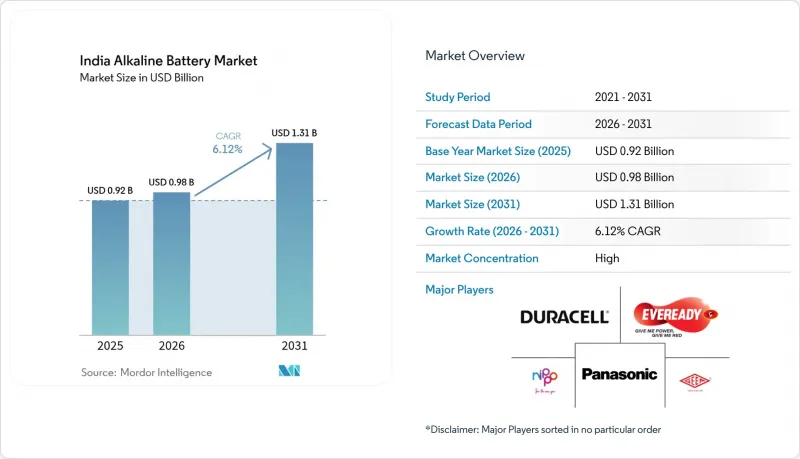
本報告按電池類型(一次電池)、尺寸(AA、AAA、9伏、C、D、紐扣電池和特殊類型電池)和應用領域(消費電子產品、工業和商業設備、醫療設備、玩具和娛樂設備、照明和手電筒)進行細分。市場規模和預測以美元計價。
印度鹼性電池市場趨勢與洞察
家用電子電器的普及率和可支配所得的快速成長
印度消費者可支配收入的成長和電池供電設備的日益普及,推動了鹼性電池在印度市場客戶群的不斷擴大。遙控器、玩具、掛鐘、無線周邊設備和數位體溫計等產品佔據了大部分的電池更換週期。雖然鹼性電池的價格是鋅碳電池的三倍,但其運作時間卻是鋅碳電池的三到十倍。 Everedy公司2025年第三季的鹼性電池銷量較去年同期成長90.8%,實現了四年內佔據53%市場佔有率的目標。中型製造商Nippo-So自產品上市以來,僅花了11個月就獲得了3-4%的市場佔有率。然而,鋰離子電池組在耳機、智慧型手錶和藍牙音箱市場佔據主導地位,限制了鹼性電池在成長最快的電子產品領域的成長潛力。因此,製造商們正致力於開拓中等電力消耗的應用領域,因為在這些領域,可充電電池的優勢並不明顯。
農村地區的停電正在推動對攜帶式電源的需求。
印度廣袤農村地區電力供應不穩定,為印度鹼性電池市場帶來了龐大的商機。儘管印度可再生累積發電量已達220吉瓦,但北方邦、比哈爾邦、賈坎德邦和東北部地區仍頻繁出現計畫性停電,導致家庭囤積手電筒、收音機和應急燈等設備的電池。鹼性電池在長期儲存和寒冷氣候下的表現表現優異,因此對於注重囤積的消費模式而言尤其重要。 Everedy公司位於查謨的新廠毗鄰印度北部的國防區和農村市場,降低了物流成本,並加強了其低溫運輸供應系統。屋頂太陽能板的普及反而帶來了鹼性電池需求的矛盾成長,因為用戶為了應對季風季節和夜間停電,紛紛安裝鹼性電池供電的備用照明設備。然而,持續的電網升級和可充電手電筒價格的下降可能會導致農村地區對鹼性電池的需求在中長期趨於穩定。
鋰離子電池的廣泛應用正在蠶食一次性鹼性電池的銷售。
在印度,可充電鋰離子電池市場正以22.7%的複合年成長率快速成長,逐漸取代耳機、電動工具和可攜式音箱等領域的一次性電池。在都市區,一顆AA型可充電鋰離子電池在其使用壽命內可取代50多節鹼性電池,顯著提升了成本績效。像Everready和India National這樣的公司正透過投資鋰離子電池製造商並拓展手電筒產品線來規避這一風險,從而在鹼性電池退出市場後也能維持客戶關係。雖然現有市場的萎縮在USB-C充電普及的大都會圈普遍存在充電器短缺和初始成本高的問題,這種影響在農村市場出現的時間相對較晚。
細分市場分析
預計到2025年,一次電池將佔據印度鹼性電池市場83.90%的佔有率,鞏固其在遙控器、手電筒等中等功耗設備中的主導地位。儘管印度鹼性電池市場預計會逐步向可充電產品過渡,但由於充電器獲取困難和初始購買價格較高,可充電電池的廣泛普及仍然受到阻礙。 Everready公司2025年第四季鹼性電池銷量成長46.3%,證實了鋅碳電池向一次性鹼性電池的過渡正在所有銷售管道持續進行。
儘管可充電鹼性電池的普及率較低,但預計到2031年,其年複合成長率將達到11.05%。它們在工業測量儀器和商用照明領域越來越受歡迎,因為可重複使用性可以抵消部分成本;此外,在鋰離子電池面臨極端溫度認證和安全挑戰的領域,可充電鹼性電池也越來越受歡迎。雖然BIS IS 16046標準有助於認證,但就能量密度而言,鎳氫電池和鋰離子電池仍然優於可充電鹼性電池。
其他好處:
- Excel格式的市場預測(ME)表
- 3個月的分析師支持
目錄
第1章:引言
- 研究假設和市場定義
- 調查範圍
第2章:調查方法
第3章執行摘要
第4章 市場狀況
- 市場概覽
- 市場促進因素
- 家用電器普及率的提高和可支配收入的快速成長
- 農村地區的停電導致可攜式電源需求上升。
- 從成本和能量密度的角度來看,從鋅碳電池過渡到鹼性電池。
- 電子商務和有組織零售通路的快速成長
- 國防部採購用於邊境監視的耐用鹼性電池
- 玩具製造群的合規要求(無鉛)
- 市場限制因素
- 鋰離子電池的廣泛應用正在蠶食一次性鹼性電池的銷售。
- 加強對生產者責任延伸制度和一次性電池廢棄物的監管。
- KOH 不穩定的供應鏈推高了投入成本。
- 低劣的假電池正在損害品牌聲譽。
- 供應鏈分析
- 監理情勢
- 技術展望
- 波特五力模型
- PESTLE分析
第5章 市場規模與成長預測
- 依電池類型
- 一次電池
- 可充電電池(鹼性電池)
- 尺寸
- AA(LR6)
- AAA(LR03)
- 9伏
- C
- D
- 硬幣和特殊應用
- 透過使用
- 家用電子產品
- 工業和商業設備
- 醫療器材
- 玩具和娛樂
- 照明設備和手電筒
第6章 競爭情勢
- 市場集中度
- 策略趨勢(併購、聯盟、購電協議)
- 市場佔有率分析(主要公司的市場排名和佔有率)
- 公司簡介
- Duracell Inc.
- Eveready Industries India Ltd.
- Indo National Ltd.(Nippo)
- Panasonic Energy India Co. Ltd.
- Geep Industries Pvt. Ltd.
- GPB International Ltd.
- FUTURISTIC IDC Pvt. Ltd.
- Sony Group Corporation(Murata)
- Energizer Holdings Inc.
- Gold Peak Industries(GP Batteries)
- Toshiba Corporation
- Maxell Holdings Ltd.
- Camelion Batterien GmbH
- VARTA AG
- Zhejiang Mustang Battery Co.
- Base Corporation Ltd.
- EVE Energy Co. Ltd.
- Rayovac(Spectrum Brands)
- AmazonBasics(Amazon India)
- Fujitsu Ltd.
第7章 市場機會與未來展望
According to Mordor Intelligence, the India alkaline battery market size was valued at USD 0.92 billion in 2025 and estimated to grow from USD 0.98 billion in 2026 to reach USD 1.31 billion by 2031, at a CAGR of 6.12% during the forecast period (2026-2031).
This report is Segmented by Battery Type (Primary and Secondary), Size (AA, AAA, 9-Volt, C, D, and Coin and Specialty), Application (Consumer Electronics, Industrial and Commercial Devices, Medical Devices, Toys and Entertainment, and Lighting and Flashlights). The Market Sizes and Forecasts are Provided in Terms of Value (USD).
India Alkaline Battery Market Trends and Insights
Surge In Consumer Electronics Penetration & Disposable Income
Disposable-income gains and an expanding installed base of battery-powered devices continue to widen the customer pool for the India Alkaline Battery market. Remote controls, toys, wall clocks, wireless peripherals, and digital thermometers dominate the replacement cycle, and a three-fold price premium over zinc-carbon translates to three-to-ten-times longer runtime for alkaline cells. Eveready's alkaline revenue rose 90.8% year-on-year in Q3 FY25 as it pursued a 53% market-share target within four years. Mid-market entrant Nippo Thor followed with a 3-4% share after only 11 months on the shelf. Yet lithium-ion powerpacks have captured earbuds, smartwatches, and Bluetooth speakers, constraining alkaline's headroom in the fastest-growing electronics segments. Manufacturers respond by deepening penetration in moderate-drain uses where rechargeability confers minimal benefit.
Rural Electrification Outages Driving Portable Power Demand
Intermittent grid supply in large swaths of rural India sustains a sizable opportunity for the India Alkaline Battery market. Despite a cumulative renewable-energy capacity of 220 GW, frequent load-shedding in Uttar Pradesh, Bihar, Jharkhand, and the Northeast prompts households to stockpile batteries for torches, radios, and emergency lanterns. Alkaline chemistry offers superior shelf life and cold-weather performance, especially valuable in storage-heavy consumption patterns. Eveready's new Jammu plant positions the firm near defense zones and rural markets in North India, trimming logistics costs and bolstering cold-chain supply. Rooftop solar adoption adds a paradoxical boost, as users attach alkaline-powered backup lights for the monsoon season or nighttime outages. Nevertheless, ongoing grid upgrades and declining prices for rechargeable lanterns may cap rural alkaline demand beyond the medium term.
Li-Ion Adoption Cannibalizing Primary Alkaline Sales
Rechargeable lithium-ion packs expand at a 22.7% CAGR in India, displacing single-use cells in earbuds, power tools, and portable speakers. In urban cores, a rechargeable AA-equivalent lithium-ion cell can replace fifty or more alkaline units over its life, tipping the value equation sharply. Eveready and Indo National hedge the risk by acquiring stakes in lithium-ion producers and broadening flash-light portfolios that maintain customer ties post-alkaline. Cannibalization remains most acute in metros where USB-C charging is pervasive; rural markets lag because of charger scarcity and higher perceived up-front costs.
Other drivers and restraints analyzed in the detailed report include:
- Rapid Growth In E-Commerce & Organized Retail Channels
- Shift From Zinc-Carbon To Alkaline On Cost & Energy Density
- EPR & Single-Use Battery Waste Regulations Tightening
For complete list of drivers and restraints, kindly check the Table Of Contents.
Segment Analysis
Primary cells represented 83.90% of India's Alkaline Battery market share in 2025, reinforcing their dominance in moderate-drain devices such as remote controls and flashlights. The India Alkaline Battery market anticipates incremental substitution toward rechargeable formats, yet mass adoption remains restrained by charger availability gaps and higher first-purchase pricing. Eveready's 46.3% alkaline sales jump in Q4 FY25 underscores ongoing migration from zinc-carbon to single-use alkaline across all channels.
Rechargeable alkaline batteries are projected to expand at an 11.05% CAGR through 2031, albeit from a low installed base. They win favor in industrial instrumentation and professional lighting, where reusability offsets cost and where lithium-ion faces certification or safety hurdles at extreme temperatures. BIS IS 16046 standards support certification, but nickel-metal hydride and lithium-ion still outpace secondary alkaline in energy density.
Complete Report Scope:
- By Battery Type
- Primary
- Secondary (Rechargeable Alkaline)
- By Size
- AA (LR6)
- AAA (LR03)
- 9-Volt
- C
- D
- Coin and Specialty
- By Application
- Consumer Electronics
- Industrial and Commercial Devices
- Medical Devices
- Toys and Entertainment
- Lighting and Flashlights
List of Companies Covered in this Report:
- Duracell Inc.
- Eveready Industries India Ltd.
- Indo National Ltd. (Nippo)
- Panasonic Energy India Co. Ltd.
- Geep Industries Pvt. Ltd.
- GPB International Ltd.
- FUTURISTIC IDC Pvt. Ltd.
- Sony Group Corporation (Murata)
- Energizer Holdings Inc.
- Gold Peak Industries (GP Batteries)
- Toshiba Corporation
- Maxell Holdings Ltd.
- Camelion Batterien GmbH
- VARTA AG
- Zhejiang Mustang Battery Co.
- Base Corporation Ltd.
- EVE Energy Co. Ltd.
- Rayovac (Spectrum Brands)
- AmazonBasics (Amazon India)
- Fujitsu Ltd.
Additional Benefits:
- The market estimate (ME) sheet in Excel format
- 3 months of analyst support
TABLE OF CONTENTS
1 Introduction
- 1.1 Study Assumptions & Market Definition
- 1.2 Scope of the Study
2 Research Methodology
3 Executive Summary
4 Market Landscape
- 4.1 Market Overview
- 4.2 Market Drivers
- 4.2.1 Surge in consumer-electronics penetration & disposable income
- 4.2.2 Rural electrification outages driving portable-power demand
- 4.2.3 Shift from zinc-carbon to alkaline on cost & energy density
- 4.2.4 Rapid growth in e-commerce & organised retail channels
- 4.2.5 Defence procurement of rugged alkaline cells for border surveillance
- 4.2.6 Toy-manufacturing clusters' compliance needs (lead-free)
- 4.3 Market Restraints
- 4.3.1 Li-ion adoption cannibalising primary alkaline sales
- 4.3.2 EPR & single-use battery-waste regulations tightening
- 4.3.3 Volatile KOH supply chain inflating input costs
- 4.3.4 Counterfeit low-grade cells eroding brand trust
- 4.4 Supply-Chain Analysis
- 4.5 Regulatory Landscape
- 4.6 Technological Outlook
- 4.7 Porter's Five Forces
- 4.7.1 Threat of New Entrants
- 4.7.2 Bargaining Power of Suppliers
- 4.7.3 Bargaining Power of Buyers
- 4.7.4 Threat of Substitutes
- 4.7.5 Competitive Rivalry
- 4.8 PESTEL Analysis
5 Market Size & Growth Forecasts
- 5.1 By Battery Type
- 5.1.1 Primary
- 5.1.2 Secondary (Rechargeable Alkaline)
- 5.2 By Size
- 5.2.1 AA (LR6)
- 5.2.2 AAA (LR03)
- 5.2.3 9-Volt
- 5.2.4 C
- 5.2.5 D
- 5.2.6 Coin and Specialty
- 5.3 By Application
- 5.3.1 Consumer Electronics
- 5.3.2 Industrial and Commercial Devices
- 5.3.3 Medical Devices
- 5.3.4 Toys and Entertainment
- 5.3.5 Lighting and Flashlights
6 Competitive Landscape
- 6.1 Market Concentration
- 6.2 Strategic Moves (M&A, Partnerships, PPAs)
- 6.3 Market Share Analysis (Market Rank/Share for key companies)
- 6.4 Company Profiles (includes Global level Overview, Market level overview, Core Segments, Financials as available, Strategic Information, Products & Services, and Recent Developments)
- 6.4.1 Duracell Inc.
- 6.4.2 Eveready Industries India Ltd.
- 6.4.3 Indo National Ltd. (Nippo)
- 6.4.4 Panasonic Energy India Co. Ltd.
- 6.4.5 Geep Industries Pvt. Ltd.
- 6.4.6 GPB International Ltd.
- 6.4.7 FUTURISTIC IDC Pvt. Ltd.
- 6.4.8 Sony Group Corporation (Murata)
- 6.4.9 Energizer Holdings Inc.
- 6.4.10 Gold Peak Industries (GP Batteries)
- 6.4.11 Toshiba Corporation
- 6.4.12 Maxell Holdings Ltd.
- 6.4.13 Camelion Batterien GmbH
- 6.4.14 VARTA AG
- 6.4.15 Zhejiang Mustang Battery Co.
- 6.4.16 Base Corporation Ltd.
- 6.4.17 EVE Energy Co. Ltd.
- 6.4.18 Rayovac (Spectrum Brands)
- 6.4.19 AmazonBasics (Amazon India)
- 6.4.20 Fujitsu Ltd.
7 Market Opportunities & Future Outlook
- 7.1 White-space & Unmet-Need Assessment

 2026-2030年全球鹼性電池市場
 鹼性電池:市場佔有率分析、產業趨勢與統計、成長預測(2026-2031)
 鹼性電池市場:全球市場預測,2026-2032年
 全球鹼性電池市場規模、佔有率、趨勢和成長分析報告(2026-2034年)
 鹼性電池市場機會、成長要素、產業趨勢分析及2026年至2035年預測鋰碳氟化物紐扣電池市場(按電池尺寸、應用、最終用戶和分銷管道分類)—2026-2032年全球預測全球鹼性電池市場:市場規模、佔有率、成長率、產業分析、依類型、應用和地區劃分的分析以及未來預測(2026-2034)
 鹼性電池市場規模、佔有率和成長分析(按產品、規格、應用和地區分類):產業預測(2026-2033 年)鹼性電池市場-2025年至2030年預測
 鹼性電池市場-全球產業規模、佔有率、趨勢、機會和預測,按電池類型(一次鹼性電池、二次鹼性電池)、按規模、按最終用途行業、按地區和競爭情況細分,2020 年至 2030 年