


 |
市場調查報告書
商品編碼
2124318
微學習:市場佔有率分析、產業趨勢與統計、成長預測(2026-2031)Microlearning - Market Share Analysis, Industry Trends & Statistics, Growth Forecasts (2026 - 2031) |
||||||

※ 本網頁內容可能與最新版本有所差異。詳細情況請與我們聯繫。
根據 Mordor Intelligence 預測,微學習市場預計將在 2026 年達到 33.2 億美元,到 2031 年將以 11.83% 的複合年成長率成長,達到 58.1 億美元。
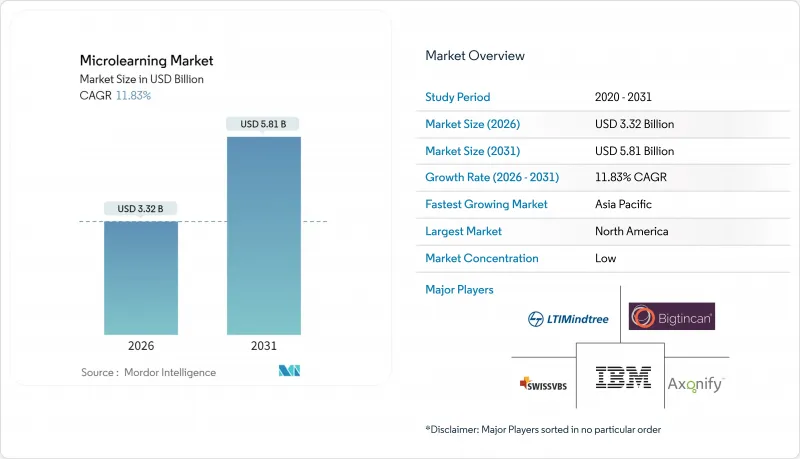
本報告按組件(解決方案和服務)、組織規模(大型企業和中小企業)、部署類型(本地部署和雲端部署)、最終用戶(零售、製造、電信和IT等)、交付形式(影片學習、互動式模擬、播客和有聲書等)以及地區進行細分。市場預測以美元計價。
全球微學習市場趨勢與洞察
行動優先型員工學習平台的普及
目前,約有27億一線員工和無固定辦公人員依賴智慧型手機進行日常工作,而原生運行於iOS和Android平台的微學習解決方案的普及正在消除桌面端的瓶頸。飲料連鎖店Chatime透過在班前簡報中提供長達5分鐘的學習模組,實現了91%的員工參與度。寵物超市也採用了類似的方法,取得了79%的完成率,並將離職率降低了15%。 AWS預測,到2025年,亞太地區將需要57億次數位化培訓,而只有非同步行動傳輸才能實現如此規模。 5G網路覆蓋範圍的擴大使得智慧型手機上的影片和模擬體驗流暢無延遲,讓身臨其境型形式對第一線技術人員和臨床醫生來說更加實用化。
對技能型、即時培訓的需求日益成長。
從年度課程安排轉向以角色為基礎的培訓轉變,正在推動微學習市場的需求。對於需要學習新設備、法規或產品功能的員工來說,五分鐘的複習比半天的研討會更有效。研究表明,用基於技能的學習路徑取代通用課程,可以將內部知識遷移和保留率提高三倍。透過在每個模組中添加能力元資料,該平台可以在ERP和CRM系統偵測到工作流程變更時立即顯示相關內容,從而加快新員工達到工作效率所需的時間。
將傳統內容轉換為微模組的成本龐大
根據 Articulate 的基準研究,將傳統課程轉換為微型單元的成本在 1 萬至 5 萬美元之間,每完成一小時的微單元課程,開發時間最多可達 184 小時。擁有 100 門課程的公司必須開展一項耗時數年的項目,同時運行傳統平台和微學習市場平台。熟練人才的短缺進一步拖慢了進度,導致買家更傾向於選擇提供內容即服務 (CaaS) 套餐的供應商,因為這類服務可以顯著縮短前置作業時間,儘管它們可能缺乏行業特定的細節。
細分市場分析
儘管2025年解決方案授權收入佔總收入的68.19%,但預計到2031年,服務業務的複合年成長率將達到13.43%,超過微學習市場的整體表現。隨著企業平台遷移的推進,外包內容審核、整合和變更管理的趨勢日益明顯,使得提供諮詢服務和技術一體化解決方案的供應商更具吸引力。諮詢合約涵蓋能力映射、學習路徑重新設計和API配置,而支援合約則提供持續升級和技術支持,所有這些都有助於實現可預測的年度經常性收入。
許多大型公司擁有超過100門傳統課程的龐大目錄,內部團隊很難快速重建這些課程。像Skillsoft和Cornerstone這樣的供應商正在推出“內容即服務(CaaS)”,旨在透過將實施週期從18個月縮短至6個月,來解決微學習會犧牲學習深度的擔憂。因此,他們的專業服務管道得以擴展,從而帶來更穩定的現金流和更牢固的客戶關係。
預計到2025年,大型企業將憑藉其更雄厚的學習與發展預算和IT支持,佔據微學習市場54.72%的佔有率。然而,隨著雲端訂閱降低了初始基礎設施成本,中小企業市場預計將在2031年之前以14.59%的年平均成長率成長。 EdApp和TalentCards的免費增值計劃允許企業最多10名用戶進行試點部署,而人工智慧創作功能可以將PDF和標準作業程序(SOP)轉換為行動友善模組,從而消除培訓設計中的瓶頸。
根據經合組織的一項調查,歐洲中小企業僅將收入的1.2%用於培訓,凸顯了低成本、高效率培訓方法的必要性。然而,中小企業創建的大部分培訓內容並非由學習專家製作,而是由相關領域的專家撰寫,這可能導致教育差距。為了解決這個問題,供應商正在努力將微學習的市場經驗與成人學習原則結合,同時又不增加預算,他們提供基於模板的故事板和自動評估生成功能。
區域分析
預計到2025年,北美將佔總收入的37.61%。學習管理系統(LMS)的高普及率、供應商的高度集中以及銀行業和醫療保健行業的嚴格監管,預計將推動支出保持穩定成長。聯邦金融機構審查委員會(FFIEC)2024年更新的《銀行保密法》指南強調了自適應和基於角色的培訓,凸顯了微學習解決方案在合規工作流程中的有效性。隨著Cornerstone以52億美元完成私有化,私募股權投資興趣達到頂峰,這表明市場對未來產業整合充滿信心。然而,市場飽和可能成為成長的阻力,未來的成長將取決於人工智慧驅動的個人化和技能智慧模組的提升銷售。
亞太地區預計將以14.81%的複合年成長率實現最高成長,這主要得益於智慧型手機的普及和政府對技能發展的強制性要求。新加坡的「數位企業藍圖」旨在到2025年使中小企業的技術採用率達到95%,並已資助一項人工智慧課程,培訓了2000名員工。印尼的「勞工卡」(Kartu Prakerja)擁有1,430萬註冊公民,並已提供32兆印尼幣(約21億美元)的津貼,用於短期數位技能課程。亞馬遜雲端服務(AWS)估計,到2025年,該地區將有8.19億勞工需要掌握新的數位技能,這表明微學習市場潛力巨大。雖然區域資料居住要求會增加基礎設施成本,但擁有本土資料中心的供應商具有先發優勢。
歐洲的趨勢正受到《一般資料保護規範》(GDPR) 的影響。 GDPR 將學習記錄歸類為個人數據,要求供應商將其伺服器設在歐洲經濟區 (EEA) 內。像 Valamis 這樣的當地企業正利用區域託管服務來獲取公共部門客戶,而全球性公司則在法蘭克福和都柏林等地投資,以符合相關法規。德國的雙元培訓模式鼓勵學徒在輪調實習期間利用微學習進行理論學習,而法國的醫學教育要求也推動了醫療保健產業的需求。拉丁美洲、中東和非洲的市場仍處於起步階段,但隨著跨國公司在其子公司部署標準化計畫並利用微學習市場來避免因課堂學習而產生的差旅費用和停工時間,這些地區的市場展現出巨大的潛力。
其他好處:
- Excel格式的市場預測(ME)表
- 3個月的分析師支持
目錄
第1章:引言
- 研究假設和市場定義
- 調查範圍
第2章:調查方法
第3章執行摘要
第4章 市場狀況
- 市場概覽
- 市場促進因素
- 行動優先型員工學習平台的普及
- 對技能導向型、即時訓練的需求日益成長。
- 透過遊戲化提高學習者的參與度和留存率。
- 人工智慧驅動的微內容個人化
- 微學習和基於工作流程的生產力工具的整合
- 在高度監管的行業中推廣持續合規培訓
- 市場限制因素
- 將傳統內容轉換為微模組的高成本
- 與傳統的學習與發展方法相比,衡量投資報酬率有困難
- 對基於雲端的學習平台的資料隱私和安全問題的擔憂
- 學習資源過度碎片化所導致的“內容疲勞”
- 產業價值鏈分析
- 監理情勢
- 技術展望
- 宏觀經濟因素對市場的影響
- 波特五力分析
第5章 市場規模與成長預測
- 按組件
- 解決方案
- 服務
- 諮詢和實施
- 支援與維護
- 按組織規模
- 大公司
- 小型企業
- 部署模式
- 現場
- 雲
- 最終用戶
- 零售
- 製造業
- 銀行業、金融服務業及保險業
- 通訊/IT
- 醫療保健和生命科學
- 物流
- 教育
- 媒體與娛樂
- 按規定形式
- 基於影片的學習
- 互動式模擬
- 播客和有聲讀物
- 測驗和評估
- 資訊圖
- 微博和文字片段
- 按地區
- 北美洲
- 美國
- 加拿大
- 墨西哥
- 南美洲
- 巴西
- 阿根廷
- 其他南美國家
- 歐洲
- 德國
- 英國
- 法國
- 義大利
- 西班牙
- 俄羅斯
- 其他歐洲國家
- 亞太地區
- 中國
- 日本
- 印度
- 韓國
- 澳洲和紐西蘭
- 東南亞
- 其他亞太國家
- 中東
- GCC
- 土耳其
- 以色列
- 其他中東國家
- 非洲
- 南非
- 北非
- 其他非洲國家
- 北美洲
第6章 競爭情勢
- 市場集中度
- 策略趨勢
- 市佔率分析
- 公司簡介
- Axonify Inc.
- Cornerstone OnDemand Inc.
- IBM Corporation
- Bigtincan Holdings Ltd.
- Saba Software Inc.
- iSpring Solutions Inc.
- Epignosis LLC
- Qstream Inc.
- Mindtree Ltd.
- SwissVBS
- Skillsoft Corp.
- Docebo Inc.
- Articulate Global LLC
- EdApp(SafetyCulture)
- Gnowbe Pte. Ltd.
- TalentCards(Epignosis)
- Udemy Business
- Pluralsight LLC
- Valamis Group Oy
- Absorb LMS Software Inc.
- LearnUpon Ltd.
第7章 市場機會與未來展望
According to Mordor Intelligence, the microlearning market size reached USD 3.32 billion in 2026 and is forecast to advance at an 11.83% CAGR to USD 5.81 billion by 2031.
This report is Segmented by Component (Solution, and Services), Organization Size (Large Enterprises, and Small and Medium-Sized Enterprises), Deployment Mode (On-Premise, and Cloud), End User (Retail, Manufacturing, Telecom and IT, and More), Delivery Format (Video-Based Learning, Interactive Simulation, Podcast and Audiobook, and More), and Geography. The Market Forecasts are Provided in Terms of Value (USD).
Global Microlearning Market Trends and Insights
Proliferation of Mobile-First Workforce Learning Platforms
Roughly 2.7 billion frontline and deskless employees now rely on smartphones for daily tasks, and adoption of microlearning market solutions that launch natively on iOS and Android removes the desktop bottleneck. Beverage chain Chatime reached 91% learner uptake with sub-5-minute modules accessed during pre-shift briefings, while Pet Supermarket logged 79% completion rates and cut turnover by 15% using similar tactics. AWS projects Asia Pacific will require 5.7 billion digital training interventions by 2025, a scale only feasible with asynchronous mobile delivery. Broader 5G coverage is enabling latency-free video and simulation on phones, making immersive formats viable for field technicians and clinicians.
Growing Need for Skills-Based, Just-In-Time Training
Enterprises moving away from annual course calendars toward role-triggered interventions are fuelling microlearning market demand. Workers asked to master new equipment, regulations, or product features benefit more from a 5-minute refresher than a half-day workshop. Internal mobility and retention gains of up to 3 times have been documented when skills-based pathways replace generic curricula. Tagging every module with competency metadata lets platforms surface content the instant an ERP or CRM system detects a workflow change, shortening time-to-productivity for new hires.
High Cost of Transforming Legacy Content into Micro-Modules
Articulate benchmarking shows converting a single traditional course into micro-units' costs USD 10,000 to USD 50,000 and demands up to 184 development hours per finished hour. Enterprises with 100-course libraries confront multiyear efforts that force them to run legacy and microlearning market platforms in parallel. Scarce subject-matter experts further slow progress, prompting buyers to favour vendors offering content-as-a-service bundles that slash lead times but may lack industry-specific nuance.
Other drivers and restraints analyzed in the detailed report include:
- Gamification Enhancing Learner Engagement and Retention
- AI-Driven Personalization of Micro-Content
- Difficulty in Measuring ROI Versus Traditional L and D Approaches
For complete list of drivers and restraints, kindly check the Table Of Contents.
Segment Analysis
Solution licenses generated 68.19% of 2025 revenue, yet services are projected to outstrip the broader microlearning market at a 13.43% CAGR to 2031. As organizations re-platform, they increasingly outsource content audits, integration, and change management, favouring vendors that bundle advisory with technology. Consulting engagements map competencies, redesign learning pathways, and configure APIs, while support contracts provide ongoing upgrades and helpdesk access that convert into predictable annual recurring revenue.
Many large enterprises maintain catalogues exceeding 100 legacy courses, a workload internal teams cannot re-author quickly. Vendors such as Skillsoft and Cornerstone now position content-as-a-service to shrink deployment from 18 months to 6 months, addressing worries that microlearning sacrifices depth. The result is expanding professional-services pipelines that stabilize cash flows and deepen customer lock-in.
Large enterprises held 54.72% of microlearning market share in 2025, leveraging bigger L&D budgets and IT support. However, SMEs are expected to grow at 14.59% through 2031 as cloud subscriptions remove upfront infrastructure costs. Freemium tiers from EdApp or TalentCards let firms pilot with ten users, while AI authoring converts PDFs and SOPs into mobile-ready modules, eliminating instructional-design bottlenecks.
The OECD found European SMEs allocate just 1.2% of revenue to training, so low-cost, high-impact interventions resonate. Yet subject-matter experts, not learning professionals, create most small-business content, risking pedagogical gaps. Vendors counter with template-driven storyboards and automated assessment generation that align microlearning market experiences with adult-learning principles without inflating budgets.
Complete Report Scope:
- By Component
- Solution
- Services
- Consulting and Implementation
- Support and Maintenance
- By Organization Size
- Large Enterprises
- Small and Medium-Sized Enterprises
- By Deployment Mode
- On-Premise
- Cloud
- By End User
- Retail
- Manufacturing
- Banking, Financial Services and Insurance
- Telecom and IT
- Healthcare and Life Sciences
- Logistics
- Education
- Media and Entertainment
- By Delivery Format
- Video-Based Learning
- Interactive Simulations
- Podcasts and Audiobooks
- Quizzes and Assessments
- Infographics
- Micro-Blogs and Text Nuggets
- By Geography
- North America
- United States
- Canada
- Mexico
- South America
- Brazil
- Argentina
- Rest of South America
- Europe
- Germany
- United Kingdom
- France
- Italy
- Spain
- Russia
- Rest of Europe
- Asia Pacific
- China
- Japan
- India
- South Korea
- Australia and New Zealand
- Southeast Asia
- Rest of Asia Pacific
- Middle East
- GCC
- Turkey
- Israel
- Rest of Middle East
- Africa
- South Africa
- North Africa
- Rest of Africa
- North America
Geography Analysis
North America generated 37.61% of 2025 revenue. High LMS penetration, dense vendor clusters, and stringent banking and healthcare regulations ensure steady recurring spend. The FFIEC's 2024 update to Bank Secrecy Act guidance emphasized adaptive, role-based training, validating microlearning solutions for compliance workflows. Private-equity interest peaked with Cornerstone's USD 5.2 billion take-private, signalling confidence in continued consolidation. Saturation is a looming headwind, so growth now hinges on upselling AI personalization and skills-intelligence modules.
Asia Pacific is forecast to record the fastest 14.81% CAGR as smartphone ubiquity meets government upskilling mandates. Singapore's Digital Enterprise Blueprint targets 95% SME tech adoption by 2025, funding AI courses that already trained 2,000 workers. Indonesia's Kartu Prakerja enrolled 14.3 million citizens, supplying IDR 32 trillion (USD 2.1 billion) in grants for bite-sized digital skills courses. AWS estimates 819 million regional workers need new digital abilities by 2025, heralding massive microlearning market potential. Regional data-residency rules raise infrastructure costs, but vendors with in-country data centers gain first-mover advantage.
Europe's trajectory is shaped by GDPR, which classifies learning records as personal data, compelling vendors to keep servers inside the European Economic Area. Homegrown providers such as Valamis leverage regional hosting to win public-sector accounts, while global players invest in Frankfurt and Dublin regions to comply. Germany's dual-training model encourages apprentices to use microlearning for theory between shop-floor rotations, and France's medical-education requirements are boosting demand in healthcare. Latin America, the Middle East, and Africa remain early-stage but show promise as multinationals deploy standardized programs across subsidiaries, using the microlearning market to avoid travel costs and classroom downtime.
- Axonify Inc.
- Cornerstone OnDemand Inc.
- IBM Corporation
- Bigtincan Holdings Ltd.
- Saba Software Inc.
- iSpring Solutions Inc.
- Epignosis LLC
- Qstream Inc.
- Mindtree Ltd.
- SwissVBS
- Skillsoft Corp.
- Docebo Inc.
- Articulate Global LLC
- EdApp (SafetyCulture)
- Gnowbe Pte. Ltd.
- TalentCards (Epignosis)
- Udemy Business
- Pluralsight LLC
- Valamis Group Oy
- Absorb LMS Software Inc.
- LearnUpon Ltd.
Additional Benefits:
- The market estimate (ME) sheet in Excel format
- 3 months of analyst support
TABLE OF CONTENTS
1 INTRODUCTION
- 1.1 Study Assumptions and Market Definition
- 1.2 Scope of the Study
2 RESEARCH METHODOLOGY
3 EXECUTIVE SUMMARY
4 MARKET LANDSCAPE
- 4.1 Market Overview
- 4.2 Market Drivers
- 4.2.1 Proliferation of Mobile-First Workforce Learning Platforms
- 4.2.2 Growing Need for Skills-Based, Just-in-Time Training
- 4.2.3 Gamification Enhancing Learner Engagement and Retention
- 4.2.4 AI-Driven Personalization of Micro-Content
- 4.2.5 Integration of Microlearning into Flow-of-Work Productivity Tools
- 4.2.6 Regulatory Push for Continuous Compliance Training in Highly Regulated Industries
- 4.3 Market Restraints
- 4.3.1 High Cost of Transforming Legacy Content into Micro-Modules
- 4.3.2 Difficulty in Measuring ROI Versus Traditional L&D Approaches
- 4.3.3 Data-Privacy and Security Concerns in Cloud-Based Learning Platforms
- 4.3.4 Content Fatigue from Over-Fragmentation of Learning Assets
- 4.4 Industry Value-Chain Analysis
- 4.5 Regulatory Landscape
- 4.6 Technological Outlook
- 4.7 Impact of Macroeconomic Factors on the Market
- 4.8 Porter's Five Forces Analysis
- 4.8.1 Bargaining Power of Suppliers
- 4.8.2 Bargaining Power of Consumers
- 4.8.3 Threat of New Entrants
- 4.8.4 Threat of Substitutes
- 4.8.5 Intensity of Competitive Rivalry
5 MARKET SIZE AND GROWTH FORECASTS (VALUE)
- 5.1 By Component
- 5.1.1 Solution
- 5.1.2 Services
- 5.1.2.1 Consulting and Implementation
- 5.1.2.2 Support and Maintenance
- 5.2 By Organization Size
- 5.2.1 Large Enterprises
- 5.2.2 Small and Medium-Sized Enterprises
- 5.3 By Deployment Mode
- 5.3.1 On-Premise
- 5.3.2 Cloud
- 5.4 By End User
- 5.4.1 Retail
- 5.4.2 Manufacturing
- 5.4.3 Banking, Financial Services and Insurance
- 5.4.4 Telecom and IT
- 5.4.5 Healthcare and Life Sciences
- 5.4.6 Logistics
- 5.4.7 Education
- 5.4.8 Media and Entertainment
- 5.5 By Delivery Format
- 5.5.1 Video-Based Learning
- 5.5.2 Interactive Simulations
- 5.5.3 Podcasts and Audiobooks
- 5.5.4 Quizzes and Assessments
- 5.5.5 Infographics
- 5.5.6 Micro-Blogs and Text Nuggets
- 5.6 By Geography
- 5.6.1 North America
- 5.6.1.1 United States
- 5.6.1.2 Canada
- 5.6.1.3 Mexico
- 5.6.2 South America
- 5.6.2.1 Brazil
- 5.6.2.2 Argentina
- 5.6.2.3 Rest of South America
- 5.6.3 Europe
- 5.6.3.1 Germany
- 5.6.3.2 United Kingdom
- 5.6.3.3 France
- 5.6.3.4 Italy
- 5.6.3.5 Spain
- 5.6.3.6 Russia
- 5.6.3.7 Rest of Europe
- 5.6.4 Asia Pacific
- 5.6.4.1 China
- 5.6.4.2 Japan
- 5.6.4.3 India
- 5.6.4.4 South Korea
- 5.6.4.5 Australia and New Zealand
- 5.6.4.6 Southeast Asia
- 5.6.4.7 Rest of Asia Pacific
- 5.6.5 Middle East
- 5.6.5.1 GCC
- 5.6.5.2 Turkey
- 5.6.5.3 Israel
- 5.6.5.4 Rest of Middle East
- 5.6.6 Africa
- 5.6.6.1 South Africa
- 5.6.6.2 North Africa
- 5.6.6.3 Rest of Africa
- 5.6.1 North America
6 COMPETITIVE LANDSCAPE
- 6.1 Market Concentration
- 6.2 Strategic Moves
- 6.3 Market Share Analysis
- 6.4 Company Profiles (includes Global Level Overview, Market Level Overview, Core Segments, Financials as available, Strategic Information, Market Rank/Share for key companies, Products and Services, and Recent Developments)
- 6.4.1 Axonify Inc.
- 6.4.2 Cornerstone OnDemand Inc.
- 6.4.3 IBM Corporation
- 6.4.4 Bigtincan Holdings Ltd.
- 6.4.5 Saba Software Inc.
- 6.4.6 iSpring Solutions Inc.
- 6.4.7 Epignosis LLC
- 6.4.8 Qstream Inc.
- 6.4.9 Mindtree Ltd.
- 6.4.10 SwissVBS
- 6.4.11 Skillsoft Corp.
- 6.4.12 Docebo Inc.
- 6.4.13 Articulate Global LLC
- 6.4.14 EdApp (SafetyCulture)
- 6.4.15 Gnowbe Pte. Ltd.
- 6.4.16 TalentCards (Epignosis)
- 6.4.17 Udemy Business
- 6.4.18 Pluralsight LLC
- 6.4.19 Valamis Group Oy
- 6.4.20 Absorb LMS Software Inc.
- 6.4.21 LearnUpon Ltd.
7 MARKET OPPORTUNITIES AND FUTURE OUTLOOK
- 7.1 White-Space and Unmet-Need Assessment

 微學習市場預測至2034年—按內容格式、交付方式、部署方式、組件、應用、最終用戶和地區分類的全球分析
 微學習市場:2026-2032年全球市場預測(依內容類型、設備類型、技能等級、部署模式、應用、最終用戶和產業分類)
 全球微學習市場
 微學習平台:市場佔有率分析、產業趨勢與統計、成長預測(2026-2031)微學習平台市場預測至2034年:按組件、內容類型、應用、部署模式、最終用戶和地區分類的全球分析
 微學習市場分析及預測(至2035年):依類型、產品類型、服務、技術、組件、應用、形式、部署類型、最終使用者及模式分類
 微學習市場-全球產業規模、佔有率、趨勢、機會、預測:按組件、組織規模、部署模式、最終用戶、地區和競爭對手分類,2021-2031年
 微學習市場規模、佔有率和成長分析(按組件、組織類型、部署類型、最終用戶產業和地區分類)-2026-2033年產業預測行動優先學習平台市場預測至2032年:按產品、組件、部署模式、應用、最終用戶和地區分類的全球分析
 全球微學習市場規模按組件、部署類型、組織規模、最終用戶產業、區域範圍和預測分類: