


 |
市場調查報告書
商品編碼
2124302
北美發電機組:市場佔有率分析、行業趨勢和統計數據、成長預測(2026-2031 年)North America Generator Sets - Market Share Analysis, Industry Trends & Statistics, Growth Forecasts (2026 - 2031) |
||||||

※ 本網頁內容可能與最新版本有所差異。詳細情況請與我們聯繫。
根據 Mordor Intelligence 估計,北美發電機組市場在 2026 年的價值為 94.3 億美元,預計到 2031 年將達到 115.6 億美元,在預測期(2026-2031 年)內以 4.16% 的複合年成長率成長。
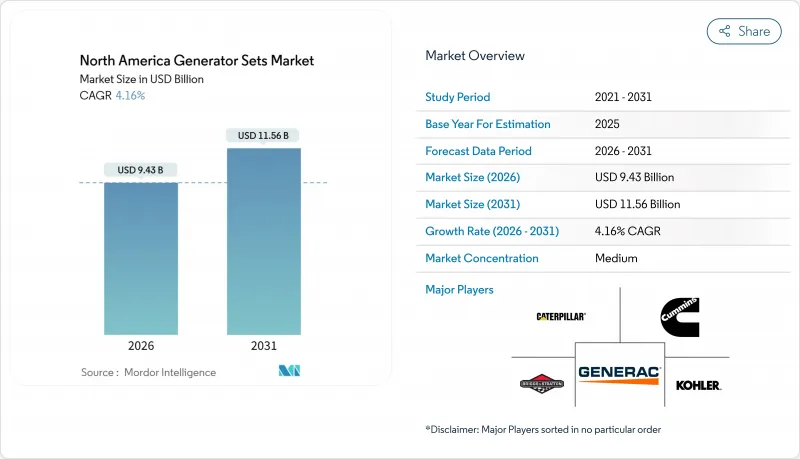
本報告按輸出功率(小於 75 kVA、75–375 kVA、375–750 kVA 及以上)、燃料類型(柴油、天然氣、雙燃料和混合動力等)、應用(備用電源、主電源/連續電源、微電網和混合支援等)、最終用戶(商業建築、工業和製造業、資料中心等)以及地區(美國分類中心等)。
北美發電機組市場趨勢及洞察
北美資料中心容量擴張
超大規模資料中心和託管業者增加備用發電容量的速度遠超傳統企業設施。勞倫斯柏克萊國家實驗室預測,區域資料中心的電力需求將從2024年的97太瓦時(TWh)躍升至2030年的130太瓦時(TWh),增幅達34%,因此部署冗餘的現場發電機對於滿足這一需求至關重要。資本市場估計,到2030年,全球整體資料中心擴建計畫預計將達到1兆美元,其中約40%將集中在北美,數十億美元將投資於電力和冷卻基礎設施。自主人工智慧工作負載進一步提高了對2000千伏安(kVA)及以上發電機的規格要求,雙燃料發電機組正逐漸成為主流,以對沖柴油價格波動風險並推進脫碳目標。康明斯在2025年第三季公佈財報中指出,資料中心訂單年增28%,並表示自動傳輸交換器和雲端監控已成為超大規模超大規模資料中心業者的標準配置。這些因素解釋了儘管375-750 kVA市場已趨於成熟,但該細分市場仍能快速成長的原因。
天氣原因導致的停電事故激增,推動了備用電源的普及。
根據氣候中心(Climate Central)的記錄,預計2024年將發生180起大規模與天氣相關的停電事件,比前一年增加23%。美國能源局的數據顯示,2024年每位用戶的平均停電時間將達到8.2小時,為2013年有紀錄以來的最高值。先前按季節租賃發電機的醫院,現在正安裝永久性發電機以滿足更嚴格的生命安全標準。同時,商業房地產所有者在租賃協議中加入緊急電源條款,以避免因業務中斷而遭受損失。保險公司正在承保“停電保險”,該保險要求使用經過測試的發電機並備有經過核實的燃料儲備,這實際上加速了資本投資。 Generac公司預測,2025年第二季住宅和小規模商用發電機的出貨量將增加19%,這次激增主要歸因於德克薩斯州和佛羅裡達州的住宅受到持續數日停電的影響。建設產業也出現了類似的趨勢,易受野火侵襲地區的承包商正在指示現場安裝發電機,以應對停電情況。
加大對分散式可再生能源和儲能系統的投資
根據拉札德(Lazard)發布的2025年平準化電力成本(LCOE)研究報告,一個能夠持續放電四小時的鋰離子電池儲能系統預計成本為每兆瓦時140美元。這比2023年下降了25%,如果將燃料和維護成本考慮在內,其成本將與柴油發電機大致相當。美國能源資訊署(EIA)預測,到2027年,公用事業規模的電池容量將達到50吉瓦,另有15吉瓦將安裝在家庭(用戶端)。在加州的「家庭發電激勵計畫」中,92%的補貼已經分配給了電池儲能系統而非發電機,這表明零排放備用電源政策的推進勢頭強勁。將電池與小型發電機結合的混合設計,在降低燃料消耗和排放的同時,也減少了對柴油的需求。隨著電池儲能系統價格的下降,傳統備用發電機的收入基礎正在縮小,尤其是在短時停電的情況下。
細分市場分析
2025年,75-375 kVA級發電機組佔北美發電機組市場收入的46.51%。這反映出商業建築和輕工業設施對中等備用電源的需求強勁,這些電源用於暖通空調、照明和安全系統。儘管該細分市場規模龐大,但成長較為溫和,因為大部分訂單是現有設備的升級改造,而非新建設。 375-750 kVA頻寬預計到2031年將以6.68%的複合年成長率訂單,這主要得益於資料中心邊緣節點和醫院擴建中採用N+1冗餘模組化陣列。這種加速成長凸顯了數位經濟基礎設施正在如何再形成北美發電機組市場的容量配置。
高階750-2000 kVA級機組主要供應給中型工業廠房和水處理廠,隨著製造業投資的增加,市場需求也不斷成長。儘管由於客製化設計和較長的銷售週期,2000 kVA以上等級的銷售量仍然較低,但其對收入的影響卻十分顯著,尤其是在超大規模資料中心園區和電力公司高峰負載設施領域。康明斯計劃於2025年推出的3000 kVA燃氣發電機組可在10秒內與電網同步,使其成為“可調備用電源”,其作用不再局限於應急備用電源。此細分市場的複雜前景表明,北美發電機組市場的佔有率正在隨著終端用戶電能品質要求的不斷變化而轉移。
到2025年,柴油發電機組將佔總裝置容量的64.83%,凸顯其高能量密度以及在偏遠和臨時場所的物流便利性。然而,遵守Tier 4 Final排放標準和獲得區域授權的繁瑣流程正促使買家轉向天然氣發電機組,預計到2031年,天然氣發電機年複合成長率(CAGR)將達到10.11%。德克薩斯州、亞伯達和美國東北部地區的管道擴建提升了天然氣發電機組的經濟效益,而企業減排目標也是推動其發展的因素。科勒公司2025年推出的雙燃料控制器,可根據成本和排放標準在柴油和天然氣之間自動切換,正是以柔軟性為核心的產品創新典範。
電池與小型發電機相結合的混合動力配置也正在擴大市場佔有率,尤其是在參與需量反應市場的微型電網專案中。加州透過低碳燃料標準(LCFS)為可再生柴油提供政策支持,到2025年,每加侖再生柴油最高可獲得1.50美元的補貼,但原料短缺和成本溢價限制了其普及。丙烷和雙燃料發電機在沒有天然氣管道的農村地區仍然存在一些小眾市場,但隨著基礎設施的完善,它們在北美發電機組中的佔有率持續萎縮。
其他好處:
- Excel格式的市場預測(ME)表
- 3個月的分析師支持
目錄
第1章:引言
- 市場定義與研究假設
- 調查範圍
第2章:調查方法
第3章執行摘要
第4章 市場狀況
- 市場概覽
- 市場促進因素
- 醫療和建築業的需求增加
- 天氣原因導致的停電次數急劇增加,推動了備用電源系統的應用。
- 北美資料中心容量擴張
- 在ESG框架內,透過資本支出(CAPEX)獎勵來提高韌性。
- 微電網的併網規則對5兆瓦以下的發電機是有利的。
- 市場限制因素
- 增加對分散式可再生能源和儲能設施的投資
- 更嚴格的美國環保署第四階段最終版柴油排放氣體法規
- 柴油和天然氣價格波動加劇。
- 都市區電氣化法規限制了新柴油罐的安裝。
- 供應鏈分析
- 監理情勢
- 技術展望
- 波特五力分析
第5章 市場規模與成長預測
- 按產能
- 小於75千伏安
- 75~375 kVA
- 375~750 kVA
- 750~2,000 kVA
- 2000千伏安或以上
- 按燃料類型
- 柴油引擎
- 天然氣
- 雙燃料和混合動力
- 可再生能源/生質燃料
- 其他
- 透過使用
- 待機電源
- 主電源/持續電源
- 尖峰用電調節
- 租賃/臨時電源
- 支援微電網和混合系統
- 最終用戶
- 住宅
- 商業建築
- 工業和製造業
- 資料中心
- 醫療機構
- 石油和天然氣
- 公共產業與電力
- 採礦和建築
- 按地區
- 美國
- 加拿大
- 墨西哥
第6章 競爭情勢
- 市場集中度
- 策略趨勢(併購、聯盟、購電協議)
- 市場佔有率分析(主要公司的市場排名和佔有率)
- 公司簡介
- Caterpillar Inc.
- Cummins Inc.
- Generac Holdings Inc.
- Kohler Co.
- Briggs & Stratton Corp.
- Rolls-Royce plc(MTU Onsite Energy)
- Atlas Copco AB
- Doosan Corporation(Bobcat)
- HIMOINSA(Yanmar)
- AKSA Power Generation
- Honda Power Equipment
- Grupel SA
- Kohler-SDMO
- Wartsila Corp.
- Mitsubishi Heavy Industries-Power Systems
- GE Vernova
- Aggreko Ltd.
- Kirloskar Oil Engines Ltd.
- Energy Solutions(United Rentals)
- Westinghouse Electric Corp.
第7章 市場機會與未來展望
According to Mordor Intelligence, the North America generator sets market size is estimated at USD 9.43 billion in 2026, and is expected to reach USD 11.56 billion by 2031, at a CAGR of 4.16% during the forecast period (2026-2031).
This report is Segmented by Capacity (Below 75 KVA, 75 To 375 KVA, 375 To 750 KVA, and More), Fuel Type (Diesel, Natural Gas, Dual-Fuel and Hybrid, and More), Application (Standby Power, Prime/Continuous Power, Micro-Grid and Hybrid Support, and More), End-User (Commercial Buildings, Industrial and Manufacturing, Data Centers, and More), and Geography (United States, Canada, and Mexico).
North America Generator Sets Market Trends and Insights
Data-Center Capacity Expansion Across North America
Hyperscale and colocation operators are adding backup generation at a pace that surpasses legacy enterprise facilities. Lawrence Berkeley National Laboratory projects regional data-center power demand to jump from 97 TWh in 2024 to 130 TWh by 2030, a 34% rise that must be met with redundant on-site gensets. Capital markets estimates indicate roughly 40% of the USD 1 trillion global data-center buildout through 2030 will land in North America, channeling billions into power and cooling infrastructure. Sovereign-AI workloads are further driving specifications for 2,000 kVA-plus machines, often with dual-fuel capability to hedge diesel-price volatility and advance decarbonization objectives. Cummins reported a 28% year-over-year increase in data-center orders during its Q3 2025 earnings call, noting that automatic transfer switches and cloud monitoring are now standard in hyperscaler requests. These factors explain why the 375 to 750 kVA segment is accelerating despite the market's matured installed base.
Spike in Weather-Related Outages Prompting Standby Adoption
Climate Central recorded 180 major weather-related outages in 2024, 23% more than the prior year. U.S. Department of Energy data show average customer outage hours reached 8.2 in 2024, the highest since records began in 2013. Hospitals that once rented seasonal gensets are now acquiring permanent units to satisfy stricter life-safety codes, while commercial landlords include backup-power clauses in leases to avert business-interruption claims. Insurance providers are underwriting "outage" policies that mandate tested gensets and verified fuel reserves, effectively accelerating capital spending. Generac shipped 19% more residential and light-commercial units in Q2 2025, attributing the surge to Texas and Florida homeowners affected by multi-day blackouts. The construction sector mirrors the trend, as contractors in wildfire-prone zones specify on-site gensets to offset utility shutoffs.
Rising Investments in Distributed Renewables & Storage
Lazard's 2025 levelized-cost study priced lithium-ion storage for 4-hour discharge at USD 140 per megawatt-hour, down 25% from 2023 and close to diesel genset parity after fuel and maintenance are added. The U.S. Energy Information Administration expects utility-scale battery capacity to hit 50 GW by 2027, with another 15 GW behind the meter. California's Self-Generation Incentive Program already channels 92% of its rebates to storage rather than gensets, signaling policy momentum toward zero-emission backup. Hybrid designs that blend batteries with downsized gensets moderate fuel consumption and emissions, yet still erode diesel-only demand. As storage prices fall, the revenue pool for traditional standby units narrows, especially for short-duration outage profiles.
Other drivers and restraints analyzed in the detailed report include:
- Increasing Demand from Healthcare & Construction Sectors
- CAPEX Incentives for Resiliency in ESG Frameworks
- Stricter EPA Tier 4 Final Diesel Emission Norms
For complete list of drivers and restraints, kindly check the Table Of Contents.
Segment Analysis
The 75 to 375 kVA class captured 46.51% of the North America generator sets market revenue in 2025, reflecting entrenched demand from commercial buildings and light-industrial facilities that depend on moderate backup power for HVAC, lighting, and safety systems. Notwithstanding its scale, growth in this tranche is tempered because replacements, not new builds, drive most orders. The 375 to 750 kVA band is forecast to deliver a 6.68% CAGR through 2031, as data-center edge nodes and hospital expansions adopt modular arrays with N+1 redundancy. This acceleration underscores how digital-economy infrastructure reshapes capacity profiles within the North America generator sets market.
Higher up the spectrum, units rated 750 to 2,000 kVA serve mid-sized industrial plants and water-treatment facilities, advancing in line with manufacturing investment. Above 2,000 kVA, bespoke engineering and long sales cycles keep volumes low but revenue impact high, especially for hyperscale data-center campuses and utility peaker installations. Cummins' launch of a 3,000 kVA gas machine in 2025 that can synchronize with the grid in 10 seconds positions gensets as dispatchable reserves, broadening their role beyond emergency standby. The segment's mixed outlook shows how the North America generator sets market share shifts alongside end-user power-quality requirements.
Diesel held 64.83% of 2025 installations, underlining its energy density and logistical simplicity for remote or temporary sites. Yet the compliance burden of Tier 4 Final and local permitting is nudging buyers toward natural-gas units, which exhibit a robust 10.11% CAGR outlook through 2031. Pipeline expansions in Texas, Alberta, and the U.S. Northeast bolster the economic case for gas, while corporate emissions targets add qualitative impetus. Kohler's 2025 dual-fuel controller that toggles between diesel and gas on cost or emissions criteria exemplifies product innovation aimed at flexibility.
Hybrid configurations that blend batteries with smaller gensets are also gaining share, especially in micro-grid projects that bid into demand-response markets. Renewable diesel receives policy boosts in California via Low Carbon Fuel Standard credits valued at up to USD 1.50 per gallon in 2025, but limited feedstock and cost premiums confine uptake. Propane and bi-fuel niches persist in rural regions without gas pipelines, though their slice of the North America generator sets market size continues to erode as infrastructure improves.
Complete Report Scope:
- By Capacity
- Below 75 kVA
- 75 to 375 kVA
- 375 to 750 kVA
- 750 to 2,000 kVA
- Above 2,000 kVA
- By Fuel Type
- Diesel
- Natural Gas
- Dual-Fuel and Hybrid
- Renewable/Bio-fuel
- Others
- By Application
- Standby Power
- Prime/Continuous Power
- Peak-Shaving
- Rental/Temporary Power
- Micro-grid and Hybrid Support
- By End-User
- Residential
- Commercial Buildings
- Industrial and Manufacturing
- Data Centers
- Healthcare Facilities
- Oil and Gas
- Utilities and Power
- Mining and Construction
- By Geography
- United States
- Canada
- Mexico
List of Companies Covered in this Report:
- Caterpillar Inc.
- Cummins Inc.
- Generac Holdings Inc.
- Kohler Co.
- Briggs & Stratton Corp.
- Rolls-Royce plc (MTU Onsite Energy)
- Atlas Copco AB
- Doosan Corporation (Bobcat)
- HIMOINSA (Yanmar)
- AKSA Power Generation
- Honda Power Equipment
- Grupel SA
- Kohler-SDMO
- Wartsila Corp.
- Mitsubishi Heavy Industries - Power Systems
- GE Vernova
- Aggreko Ltd.
- Kirloskar Oil Engines Ltd.
- Energy Solutions (United Rentals)
- Westinghouse Electric Corp.
Additional Benefits:
- The market estimate (ME) sheet in Excel format
- 3 months of analyst support
TABLE OF CONTENTS
1 Introduction
- 1.1 Market Definition & Study Assumptions
- 1.2 Scope of the Study
2 Research Methodology
3 Executive Summary
4 Market Landscape
- 4.1 Market Overview
- 4.2 Market Drivers
- 4.2.1 Increasing demand from healthcare & construction sectors
- 4.2.2 Spike in weather-related outages prompting standby adoption
- 4.2.3 Data-center capacity expansion across NA
- 4.2.4 CAPEX incentives for resiliency in ESG frameworks
- 4.2.5 Micro-grid interconnection rules favor sub-5 MW gensets
- 4.3 Market Restraints
- 4.3.1 Rising investments in distributed renewables & storage
- 4.3.2 Stricter EPA Tier 4 Final diesel emission norms
- 4.3.3 Escalating diesel & natural-gas price volatility
- 4.3.4 Urban electrification codes limiting new diesel tanks
- 4.4 Supply-Chain Analysis
- 4.5 Regulatory Landscape
- 4.6 Technological Outlook
- 4.7 Porter's Five Forces Analysis
- 4.7.1 Bargaining Power of Suppliers
- 4.7.2 Bargaining Power of Consumers
- 4.7.3 Threat of New Entrants
- 4.7.4 Threat of Substitute Products & Services
- 4.7.5 Intensity of Competitive Rivalry
5 Market Size & Growth Forecasts
- 5.1 By Capacity
- 5.1.1 Below 75 kVA
- 5.1.2 75 to 375 kVA
- 5.1.3 375 to 750 kVA
- 5.1.4 750 to 2,000 kVA
- 5.1.5 Above 2,000 kVA
- 5.2 By Fuel Type
- 5.2.1 Diesel
- 5.2.2 Natural Gas
- 5.2.3 Dual-Fuel and Hybrid
- 5.2.4 Renewable/Bio-fuel
- 5.2.5 Others
- 5.3 By Application
- 5.3.1 Standby Power
- 5.3.2 Prime/Continuous Power
- 5.3.3 Peak-Shaving
- 5.3.4 Rental/Temporary Power
- 5.3.5 Micro-grid and Hybrid Support
- 5.4 By End-User
- 5.4.1 Residential
- 5.4.2 Commercial Buildings
- 5.4.3 Industrial and Manufacturing
- 5.4.4 Data Centers
- 5.4.5 Healthcare Facilities
- 5.4.6 Oil and Gas
- 5.4.7 Utilities and Power
- 5.4.8 Mining and Construction
- 5.5 By Geography
- 5.5.1 United States
- 5.5.2 Canada
- 5.5.3 Mexico
6 Competitive Landscape
- 6.1 Market Concentration
- 6.2 Strategic Moves (M&A, Partnerships, PPAs)
- 6.3 Market Share Analysis (Market Rank/Share for key companies)
- 6.4 Company Profiles (includes Global level Overview, Market level overview, Core Segments, Financials as available, Strategic Information, Products & Services, and Recent Developments)
- 6.4.1 Caterpillar Inc.
- 6.4.2 Cummins Inc.
- 6.4.3 Generac Holdings Inc.
- 6.4.4 Kohler Co.
- 6.4.5 Briggs & Stratton Corp.
- 6.4.6 Rolls-Royce plc (MTU Onsite Energy)
- 6.4.7 Atlas Copco AB
- 6.4.8 Doosan Corporation (Bobcat)
- 6.4.9 HIMOINSA (Yanmar)
- 6.4.10 AKSA Power Generation
- 6.4.11 Honda Power Equipment
- 6.4.12 Grupel SA
- 6.4.13 Kohler-SDMO
- 6.4.14 Wartsila Corp.
- 6.4.15 Mitsubishi Heavy Industries - Power Systems
- 6.4.16 GE Vernova
- 6.4.17 Aggreko Ltd.
- 6.4.18 Kirloskar Oil Engines Ltd.
- 6.4.19 Energy Solutions (United Rentals)
- 6.4.20 Westinghouse Electric Corp.
7 Market Opportunities & Future Outlook
- 7.1 White-space & Unmet-Need Assessment

 發電機組市場:按燃料類型、輸出功率、應用領域、國家和地區分類-產業分析、市場規模、市場佔有率和預測(2026-2033 年)
 發電機組:市場佔有率分析、產業趨勢與統計、成長預測(2026-2031)
 尖峰用電調節市場預測至2034年-按控制策略、技術、應用、最終用戶和地區分類的全球分析
 發電機組市場規模、佔有率和成長分析:額定功率、燃料類型、應用、最終用戶和地區分類-2026-2033年產業預測商用發電機:市場佔有率分析、產業趨勢與統計、成長預測(2026-2031 年)
 商用發電機市場 - 全球產業規模、佔有率、趨勢、機會、預測:按燃料、便攜性、功率輸出、應用、地區和競爭格局分類,2021-2031年
 全球發電機組市場
 發電機組市場:依燃料類型、型號、相數、額定輸出功率及最終用戶分類-2026-2032年全球市場預測防水發電機組市場:依燃料類型、額定功率、應用、便攜性、相數、冷卻方式和機殼類型分類,全球預測,2026-2032年
 尖峰用電調節發電機組市場:商業機會、成長要素、產業趨勢分析及2026-2035年預測