


 |
市場調查報告書
商品編碼
2124288
亞太地區小型基地台:市場佔有率分析、產業趨勢與統計及成長預測(2026-2031)Asia Pacific Small Cell Tower - Market Share Analysis, Industry Trends & Statistics, Growth Forecasts (2026 - 2031) |
||||||

※ 本網頁內容可能與最新版本有所差異。詳細情況請與我們聯繫。
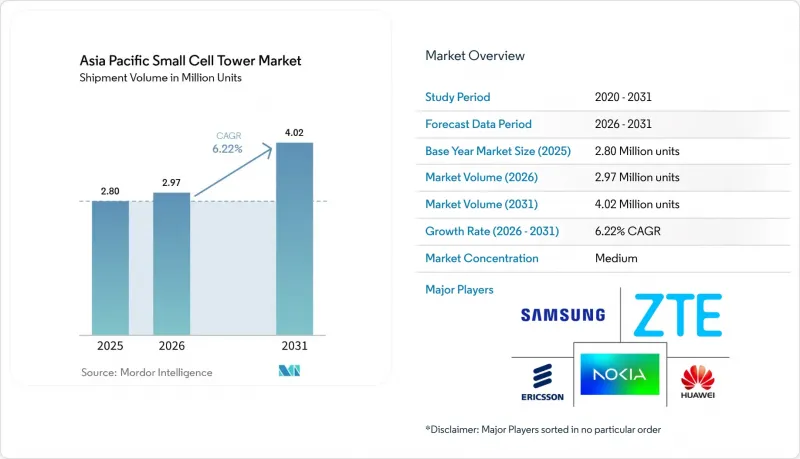
根據 Mordor Intelligence 預測,亞太地區小型基地台市場規模將從 2025 年的 280 萬台成長到 2026 年的 297 萬台,然後在 2031 年達到 402 萬台,2026 年至 2031 年的複合年成長率為 6.22%。
本報告按應用領域(室外/室內)、網路技術(3G、4G/LTE、5G)、所有權模式(營運商安裝、中立主機、企業私人)、部署地點(都市區、郊區、農村)和國家(中國、韓國、日本、印度、東南亞及其他亞太地區)進行細分。市場預測以銷售量(單位)為單位。
亞太地區小型基地台市場趨勢與洞察
行動數據流量的激增和日益成長的密度需求
行動影片串流媒體、雲端遊戲和職場協作工具的普及,導致主要都會大都會圈的網路流量年增40%至60%,造成廣域基地台容量不足,超出其設計極限。電信業者目前正將小型基地台作為在土地資源受限地區實現頻譜復用的最具成本效益的方式,部署高密度網路。透過將這些無線設備安裝在路燈桿、公車站和建築物外牆上,可以最大限度地減少與土地所有者的談判,並縮短安裝時間。這種對高密度網路的需求也延伸至機場、購物中心和娛樂場所,這些場所的單一用戶吞吐量需求在高峰時段仍然最高。能夠提供整合4G主載波和5G NR的緊湊型多頻段無線設備的供應商正在成為首選供應商。因此,亞太地區的小型基地台市場正從試點部署走向大規模網路規劃,並持續走向成熟。
加速亞太地區5G部署進度
各公司競相發布的公告已將各國的5G藍圖提前了多達18個月,迫使業者縮短土地徵用、土木工程和整合工作。中國和韓國政府將基礎設施建設與更廣泛的經濟成長目標掛鉤,並提供資金和公共土地以加速部署。小型基地台覆蓋範圍有限,無需等待新的宏基地台即可快速疊加5G覆蓋。能夠在NSA和SA模式之間切換的多技術無線電設備有助於營運商滿足短期覆蓋承諾,同時為過渡到獨立組網(SA)核心網奠定基礎。整合天線、數位去程傳輸和零接觸配置工具正在縮短商業化時間,並支撐亞太地區小型基地台市場的強勁需求。
複雜的土地徵用和授權障礙
各市政當局不同的分區法規導致審核流程延長,租金上升。這一趨勢在印度的一線城市尤其明顯,這些城市的業主往往要求高額租金。在某些地區,還需要消防、航空和文化遺產部門出具單獨的“無異議證明”,這進一步延長了專案工期。由於缺乏標準化的收費系統,不同地點的成本波動使得投資報酬率 (ROI) 的計算變得困難,也使網路規劃更加複雜。電信業者通常需要逐案協商屋頂進入許可權,這減緩了網路密度的提升,並限制了亞太地區小型基地台市場的短期出貨量。
細分市場分析
至2025年,室內安裝將佔亞太地區小型基地台市場出貨量的30.88%,約86萬台。此外,預計到2031年,室內安裝將以7.32%的複合年成長率成長。企業意識到,強大的室內5G環境對於客戶參與工具、自助結帳系統和身臨其境型零售展示至關重要。因此,購物中心、機場和體育場館正將全部資本投資預算用於小型基地台建設,而不是僅僅升級Wi-Fi網路。中立主機營運商透過將這些系統整合到長期服務合約中,在確保接入多家營運商網路的同時,也簡化了預算核准流程。
戶外部署仍是亞太地區小型基地台市場的基礎,預計到2025年將佔出貨量的69.12%。電信業者正在小巷和交通走廊安裝桿式和壁掛式無線設備,以緩解尖峰時段的宏觀區域擁塞。整合式街道設備設計將無線設備、電源模組和回程傳輸線路整合到美觀的機殼中,從而符合市政法規。雖然戶外網路仍然是主要的收入來源,但室內網路的成長勢頭表明,市場正沿著兩條路徑發展。
到2025年,4G/LTE無線電模組將佔亞太小型基地台市場出貨量的50.32%,相當於141萬台,這反映出營運商優先考慮最大化利用現有頻段資源。然而,隨著營運商部署中頻段和毫米波頻段以支援多Gigabit的峰值吞吐量,5G無線電設備的年複合成長率(CAGR)正以7.98%的速度成長。能夠提供雙重標準覆蓋的組合無線電模組可以加速用戶遷移,同時降低站點租金。
此外,採用多技術平台可以解決終端配置的實際挑戰。到2025年底,東南亞許多市場的5G智慧型手機普及率將低於45%,這將迫使營運商保留4G連結以支援語音服務和物聯網終端。分階段淘汰3G的計畫將釋放更多頻段,使營運商能夠將這些頻寬重新分配給5G NR,從而進一步增加對可透過軟體升級的無線設備的需求。
其他好處
- Excel格式的市場預測(ME)表
- 3個月的分析師支持
目錄
第1章:引言
- 研究假設和市場定義
- 調查範圍
第2章:調查方法
第3章執行摘要
第4章 市場狀況
- 市場概覽
- 市場促進因素
- 行動數據流量的快速成長以及對更高密度儲存的需求
- 亞太地區的5G部署計畫正在加速推進。
- 政府措施和頻率政策旨在支持小型基地台的引入。
- 製造業集群中專用5G網路的興起
- AI驅動的自最佳化網路降低了高密度帶來的營運成本(OPEX)。
- 市場限制因素
- 複雜的土地徵用和授權取得過程中的障礙
- 高密度部署需要大量的初始投資。
- 共用頻段和非授權頻段的干擾管理
- 半導體供應鏈中斷導致產品推出延遲。
- 宏觀經濟因素的影響
- 產業價值鏈分析
- 監理情勢
- 技術展望
- 波特五力分析
- 亞太地區5G藍圖圖分析
第5章 市場規模與成長預測
- 透過使用
- 戶外的
- 室內的
- 網路科技
- 3G
- 4G/LTE
- 5G
- 自有車型
- 電信業者安裝
- 中立主機
- 私人公司
- 按安裝位置
- 都市區
- 郊區
- 地區
- 國家
- 中國
- 韓國
- 日本
- 印度
- 東南亞
- 亞太其他地區
第6章 競爭情勢
- 市場集中度
- 策略趨勢
- 市佔率分析
- 公司簡介
- Huawei Technologies Co., Ltd.
- Telefonaktiebolaget LM Ericsson
- Nokia Corporation
- ZTE Corporation
- Samsung Electronics Co., Ltd.
- Parallel Wireless Inc.
- Airspan Networks Inc.
- Baicells Technologies Co., Ltd.
- NEC Corporation
- Comba Telecom Systems Holdings Limited
- Fujitsu Limited
- JMA Wireless
- CommScope Holding Company, Inc.
- Mavenir Systems, Inc.
- Rakuten Symphony, Inc.
- Qucell Networks Co., Ltd.
- ip.access Ltd.
- Corning Incorporated
- Sercomm Corporation
- Dali Wireless, Inc.
第7章 市場機會與未來展望
According to Mordor Intelligence, the Asia Pacific small cell tower market size is expected to grow from 2.80 million units in 2025 to 2.97 million units in 2026 and is forecast to reach 4.02 million units by 2031 at 6.22% CAGR over 2026-2031.
This report is Segmented by Application (Outdoor, and Indoor), Network Technology (3G, 4G/LTE, and 5G), Ownership Model (Operator-Deployed, Neutral-Host, and Private Enterprises), Deployment Location (Urban, Suburban, and Rural), and Country (China, South Korea, Japan, India, South-East Asia, and Rest of Asia Pacific). The Market Forecasts are Provided in Terms of Volume (Units).
Asia Pacific Small Cell Tower Market Trends and Insights
Rapid Surge in Mobile Data Traffic and Densification Requirements
Mobile video streaming, cloud gaming, and workplace collaboration tools have triggered year-over-year traffic spikes of 40-60% in key metropolitan areas, exceeding the capacity of macro sites beyond their engineered limits. Operators now view dense grids of small cells as the most cost-efficient lever to add spectral reuse in real estate-constrained neighborhoods. Street-level poles, bus shelters, and building facades host these radios, minimizing landlord negotiations while shortening installation cycles. The densification imperative extends to airports, malls, and entertainment venues, where per-user throughput demands remain highest during peak hours. Vendors able to supply compact, multi-band radios that integrate 4G anchor carriers with 5G NR are securing preferred-supplier status. As a result, the Asia Pacific small cell tower market continues to mature from pilot deployments toward mass-scale grid planning.
Accelerated 5G Rollout Timelines Across Asia Pacific
Competitive announcements have condensed national 5G roadmaps by as much as 18 months, forcing operators to compress site-acquisition, civil works, and integration activities. Governments in China and South Korea have linked infrastructure development to broader economic growth targets, releasing funds and public properties for accelerated deployment. Because small cells cover limited radii, they enable rapid 5G coverage overlays without waiting for new macro towers. Multi-technology radios that switch between NSA and SA modes help operators satisfy near-term coverage promises while laying groundwork for standalone cores. Integrated antennas, digital front-haul, and zero-touch provisioning tools are shortening time-to-revenue, underpinning robust demand for the Asia Pacific small cell tower market.
Complex Site Acquisition and Permitting Hurdles
Municipal zoning disparities prolong approval cycles and inflate leasing charges, especially across tier-1 Indian cities where building owners demand premium rents. Some jurisdictions require separate no-objection certificates from fire, aviation, and heritage departments, which can extend project timelines. The absence of standardized fee structures complicates network planning, as per-site cost variability challenges return-on-investment calculations. Operators often negotiate rooftop access on an ad-hoc basis, delaying grid densification and capping near-term shipment volumes for the Asia Pacific small cell tower market.
Other drivers and restraints analyzed in the detailed report include:
- Government Initiatives and Spectrum Policies Supporting Small Cell Deployments
- Emergence of Private 5G Networks in Manufacturing Corridors
- High Upfront Capital Expenditure for Dense Deployments
For complete list of drivers and restraints, kindly check the Table Of Contents.
Segment Analysis
Indoor sites captured 30.88% of shipments in 2025, equivalent to approximately 0.86 million units of the Asia Pacific small cell tower market size, and are projected to track a 7.32% CAGR to 2031. Enterprises view robust indoor 5G as non-negotiable for customer engagement tools, cashier-less checkouts, and immersive retail displays. Consequently, shopping malls, airports, and stadiums allocate capital expenditure budgets exclusively for small cell layers rather than Wi-Fi upgrades. Neutral-host operators bundle these systems into long-term service agreements, easing budget approval while ensuring multi-carrier access.
Outdoor deployments continue to anchor the Asia Pacific small cell tower market, accounting for 69.12% of the 2025 volumes. Operators use pole-mount and wall-mount radios in alleyways and transit corridors to alleviate macro-sector congestion during peak commuting hours. Integrated street-furniture designs blend radios, power modules, and backhaul links into aesthetically pleasing housings, thereby satisfying municipal ordinances. Although outdoor grids remain the dominant revenue stream, the rising momentum in indoor grids underscores the market's dual-track growth narrative.
4G/LTE radios comprised 50.32% of 2025 shipments, equivalent to 1.41 million units in the Asia Pacific small cell tower market size, reflecting operators' preference for maximizing existing spectrum allocations. Yet 5G radios are expanding at an 7.98% CAGR as carriers introduce mid-band and mmWave layers that support multi-gigabit peak throughput. Combo radios that deliver dual-standard coverage preserve site rent outlays and accelerate user migration.
Multi-technology platform adoption also addresses the realities of device mix. In late 2025, 5G smartphone penetration sits below 45% in many Southeast Asian markets, compelling operators to retain 4G anchor links for voice services and IoT endpoints. Gradual sunset plans for 3G free additional spectrum, enabling carriers to refarm bandwidth for 5G NR, thus reinforcing demand for software-upgradable radios.
Complete Report Scope:
- By Application
- Outdoor
- Indoor
- By Network Technology
- 3G
- 4G/LTE
- 5G
- By Ownership Model
- Operator-deployed
- Neutral-host
- Private enterprises
- By Deployment Location
- Urban
- Suburban
- Rural
- By Country
- China
- South Korea
- Japan
- India
- South-East Asia
- Rest of Asia Pacific
List of Companies Covered in this Report:
- Huawei Technologies Co., Ltd.
- Telefonaktiebolaget LM Ericsson
- Nokia Corporation
- ZTE Corporation
- Samsung Electronics Co., Ltd.
- Parallel Wireless Inc.
- Airspan Networks Inc.
- Baicells Technologies Co., Ltd.
- NEC Corporation
- Comba Telecom Systems Holdings Limited
- Fujitsu Limited
- JMA Wireless
- CommScope Holding Company, Inc.
- Mavenir Systems, Inc.
- Rakuten Symphony, Inc.
- Qucell Networks Co., Ltd.
- ip.access Ltd.
- Corning Incorporated
- Sercomm Corporation
- Dali Wireless, Inc.
Additional Benefits:
- The market estimate (ME) sheet in Excel format
- 3 months of analyst support
TABLE OF CONTENTS
1 INTRODUCTION
- 1.1 Study Assumptions and Market Definition
- 1.2 Scope of the Study
2 RESEARCH METHODOLOGY
3 EXECUTIVE SUMMARY
4 MARKET LANDSCAPE
- 4.1 Market Overview
- 4.2 Market Drivers
- 4.2.1 Rapid surge in mobile data traffic and densification requirements
- 4.2.2 Accelerated 5G rollout timelines across Asia Pacific
- 4.2.3 Government initiatives and spectrum policies supporting small cell deployments
- 4.2.4 Emergence of private 5G networks in manufacturing corridors
- 4.2.5 AI-powered self-optimizing networks lowering OPEX for densification
- 4.3 Market Restraints
- 4.3.1 Complex site acquisition and permitting hurdles
- 4.3.2 High upfront capital expenditure for dense deployments
- 4.3.3 Interference management in shared and unlicensed spectrum bands
- 4.3.4 Semiconductor supply-chain disruptions delaying roll-outs
- 4.4 Impact of Macroeconomic Factors
- 4.5 Industry Value Chain Analysis
- 4.6 Regulatory Landscape
- 4.7 Technological Outlook
- 4.8 Porter's Five Forces Analysis
- 4.8.1 Bargaining Power of Suppliers
- 4.8.2 Bargaining Power of Consumers
- 4.8.3 Threat of New Entrants
- 4.8.4 Intensity of Competitive Rivalry
- 4.8.5 Threat of Substitutes
- 4.9 Analysis of 5G Roadmap in Asia Pacific
5 MARKET SIZE AND GROWTH FORECASTS (VALUE)
- 5.1 By Application
- 5.1.1 Outdoor
- 5.1.2 Indoor
- 5.2 By Network Technology
- 5.2.1 3G
- 5.2.2 4G/LTE
- 5.2.3 5G
- 5.3 By Ownership Model
- 5.3.1 Operator-deployed
- 5.3.2 Neutral-host
- 5.3.3 Private enterprises
- 5.4 By Deployment Location
- 5.4.1 Urban
- 5.4.2 Suburban
- 5.4.3 Rural
- 5.5 By Country
- 5.5.1 China
- 5.5.2 South Korea
- 5.5.3 Japan
- 5.5.4 India
- 5.5.5 South-East Asia
- 5.5.6 Rest of Asia Pacific
6 COMPETITIVE LANDSCAPE
- 6.1 Market Concentration
- 6.2 Strategic Moves
- 6.3 Market Share Analysis
- 6.4 Company Profiles (includes Global level Overview, Market level overview, Core Segments, Financials as available, Strategic Information, Market Rank/Share for key companies, Products and Services, and Recent Developments)
- 6.4.1 Huawei Technologies Co., Ltd.
- 6.4.2 Telefonaktiebolaget LM Ericsson
- 6.4.3 Nokia Corporation
- 6.4.4 ZTE Corporation
- 6.4.5 Samsung Electronics Co., Ltd.
- 6.4.6 Parallel Wireless Inc.
- 6.4.7 Airspan Networks Inc.
- 6.4.8 Baicells Technologies Co., Ltd.
- 6.4.9 NEC Corporation
- 6.4.10 Comba Telecom Systems Holdings Limited
- 6.4.11 Fujitsu Limited
- 6.4.12 JMA Wireless
- 6.4.13 CommScope Holding Company, Inc.
- 6.4.14 Mavenir Systems, Inc.
- 6.4.15 Rakuten Symphony, Inc.
- 6.4.16 Qucell Networks Co., Ltd.
- 6.4.17 ip.access Ltd.
- 6.4.18 Corning Incorporated
- 6.4.19 Sercomm Corporation
- 6.4.20 Dali Wireless, Inc.
7 MARKET OPPORTUNITIES AND FUTURE OUTLOOK
- 7.1 White-space and Unmet-need assessment

 2026-2034年全球5G小型基地台網路市場規模、佔有率、趨勢和成長分析報告
 小型基地台5G網路:市場佔有率分析、產業趨勢與統計及成長預測(2026-2031年)小型基地台網路:市場佔有率分析、行業趨勢和統計數據、成長預測(2026-2031 年)
 小型基地台5G網路市場:依組件、網路模型、網路架構、部署模式、頻段、最終用戶、國家及地區分類-全球產業分析、市場規模、市場佔有率及2026年至2033年預測
 小型基地台網路市場-2026-2032年全球市場預測小型基地台5G網路市場-2026-2032年全球市場預測
 小型基地台回程傳輸市場規模、佔有率和成長分析:按技術、頻率、應用、最終用戶和地區分類-2026-2033年產業預測
 小型基地台市場規模、佔有率和成長分析:按類型、技術、部署模式、最終用戶和地區分類-2026-2033年產業預測
 小型基地台市場預測至2034年—按基地台類型、無線技術、部署模式、應用、最終用戶和地區分類的全球分析
 小型基地台網路市場機會、成長要素、產業趨勢分析及2026-2035年預測