


 |
市場調查報告書
商品編碼
2123280
小型基地台5G網路:市場佔有率分析、產業趨勢與統計及成長預測(2026-2031年)Small Cell 5G Network - Market Share Analysis, Industry Trends & Statistics, Growth Forecasts (2026 - 2031) |
||||||

※ 本網頁內容可能與最新版本有所差異。詳細情況請與我們聯繫。
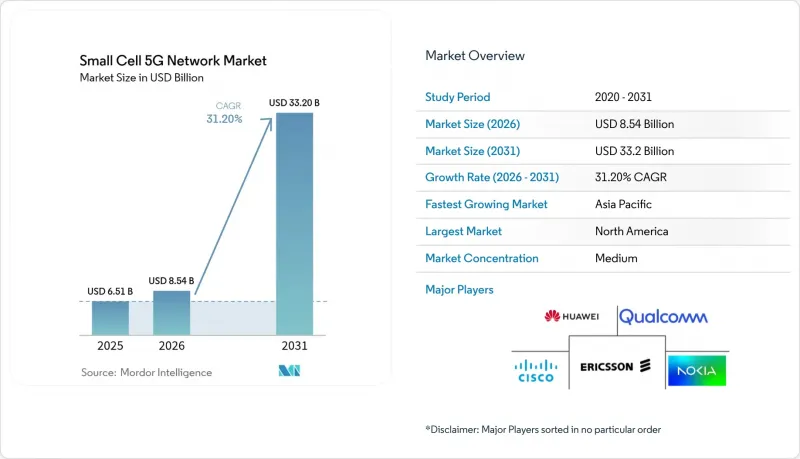
預計小型基地台5G 網路市場規模將從 2025 年的 65.1 億美元成長到 2026 年的 85.4 億美元,然後從 2026 年到 2031 年以 31.2% 的複合年成長率成長,到 2031 年達到 332 億美元。
本報告按小區類型(毫微微基地台、微微微微型基地台、微型蜂窩、區域基地台)、運行環境(室內和室外)、頻段(6 GHz 以下、毫米波 [24 GHz 以上]、1 GHz 以下)、最終用戶(電信運營商、企業、住宅)和地區進行分類。
全球5G小型基地台網路市場趨勢與洞察
由於5G在都市區的部署,對快速成長的密度需求日益增加。
電信業者已確認,僅靠大型基地台無法滿足人口密集都市區5G服務等級協定(SLA)的要求。 EE已在英國運作了1000多個小型基地台,其中倫敦的25個站點每週處理7.5TB的數據,有效緩解了傳統網路的擁塞。 Virgin Media O2部署了英國首個5G獨立組網小型基地台,實現了宏基地台無法實現的網路切片和低延遲。小型基地台內部的頻率復用提高了頻譜利用率,這對於AR和工業IoT等上行鏈路密集型應用的普及至關重要。地方政府正在推動網路放鬆管制,目前全球已有超過100個中立主機部署運作。這些因素共同表明,網路密度在中期內至關重要。
企業(製造業、物流業)對專用網路的需求
政府政策和工業4.0藍圖正在推動工廠和物流中心對確定性無線連接的需求。中國目前已部署約4000個5G工廠網路,目標是到2027年達到10,000個。截至2024年第四季,諾基亞擁有850個5G專用網路客戶,較上一季成長55個。營運成果顯著。泰國一家消費性電子工廠在實施基於5G的自動化後,生產效率提高了15%至20%。目前,已有七個歐洲國家頒發了26GHz頻段的國內許可證,六個國家分配了3.4-3.8GHz頻段的100MHz頻譜,這使得企業更容易獲得頻段資源。由於小型基地台能夠確保嚴格的覆蓋範圍、整合邊緣運算並支援並發網路切片,因此仍然是首選的無線層方案。
郊區和農村地區光纖/回程傳輸獲利能力面臨的挑戰。
在郊區架設架空光纖的成本為每英里6萬至17萬美元,這給人口稀少地區的盈利帶來了壓力。 Crown Castle公司在認定回程傳輸不具備獲利能力可行性後,凍結了全美7,000個小型基地台的建設,從而節省了未來8億美元的資本投資。雖然微波和衛星回程傳輸可以降低資本投資,但它們目前無法滿足5G的容量和延遲目標。根據美國聯邦公路管理局的數據,即使採用微型溝槽施工,在郊區環境中也需要6到8年才能達到損益平衡點。因此,在下一代無線回程傳輸被證明具有商業性可行性之前,電信業者不願在盈利的大都會圈以外增加基地台密度。
細分市場分析
預計到2025年,微微型基地台將佔總收入的40.45%,這表明它們非常適合在擁擠的城市走廊中覆蓋100-200公尺的區域。隨著中頻寬頻譜和多用戶MIMO技術的進步,單一站點的容量不斷提升,面向微微型基地台的小型基地台5G網路市場規模預計將迅速擴大。毫米波(mmWave)微微型基地台的複合年成長率最高,達到35.2%,主要得益於專用網路和固定無線存取利用28 GHz和39 GHz頻段實現多Gigabit吞吐量。諸如EdgeQ的「晶片基地台」等矽技術創新正在整合人工智慧,並降低功耗、成本和面積。
毫微微基地台)在住宅和小規模辦公室等特定區域仍佔有一席之地,但正面臨來自 Wi-Fi 7 的競爭壓力。另一方面,微蜂窩基地台(Microcell)則涵蓋大片郊區區域,在這些區域部署高密度的微微蜂窩基地台(微微型基地台)成本過高,難以實際應用。康巴電信(Comba Telecom)符合 ORAN 標準的微型無線電單元體現了向標準化、多廠商生態系統發展的趨勢。隨著人工智慧驅動的最佳化技術縮小不同外形規格之間的效能差距,營運商將能夠靈活地適應每個站點的容量需求,而不會犧牲營運效率。
到2025年,室內站點將佔部署總量的62.10%。這主要是由於現代建築材料會衰減中頻段5G訊號。中立主機系統和智慧建築管理系統使得室內投資對那些希望在辦公室、體育場館和工廠等場所獲得優質服務(QoS)的企業來說極具吸引力。室外站點正以32.4%的複合年成長率快速成長,這主要得益於市政核准流程的簡化、Release-17 NR-U標準的發布以及基礎設施共用等因素降低了安裝門檻。例如,Virgin Media O2在曼徹斯特市中心的戶外基地台就清楚展現了這一轉變。
混合解決方案也正在湧現,例如Freshwave將英國四大營運商的網路整合到一個室內/室外小型基地台機房中,與傳統系統相比,成本降低了65%,能耗降低了60%。為了與理論速度高達46 Gbps的Wi-Fi 7競爭,室內通訊供應商現在需要強調自身的優勢——例如延遲保障、安全性和網路切片管理——而這些是Wi-Fi無法實現的。
區域分析
預計到2025年,亞太地區將佔全球營收的37.60%,並將持續以31.95%的複合年成長率成長至2031年。這主要得益於中國已建成的440萬個5G基地台,以及30億元人民幣用於在300個城市建設5G-Advanced網路。中國聯通北京和華為已為未來高密度網路建設樹立了標桿,在1000萬人口範圍內實現了11.2Gbps的下行峰值速度。日本和韓國正在大力推進企業級毫米波(mmWave)技術,而在印度,透過官民合作關係,競標後的網路建設正在為更高密度的網路建設創造空間。
在北美,商業化效率卓越。愛立信在該地區的營收年增55%,這得益於與AT&T簽訂的價值140億美元的契約,凸顯了強勁的投資回報。在美國,已有超過50個中立主機專案在CBRS頻段運作,而加拿大電信公司TELUS部署了第一個商用虛擬化開放式無線存取網(Open RAN),使該地區在雲端原生無線接入網路(RAN)實驗方面處於領先地位。然而,Crown Castle部署計畫的終止表明,郊區經濟狀況仍然是一個障礙。歐洲擁有明確的頻率政策,但在獨立組網(SA)5G覆蓋率方面卻落後於其他國家,預計到2024年底,其滲透率僅能達到2%。儘管Virgin Media O2和EE正在擴大其小型基地台的部署,但許多營運商仍在等待更高的設備滲透率,以實現其商業模式的轉折點。在中東,阿拉伯聯合大公國創下了30.5 Gbps的5G速度紀錄,du公司已投資20億迪拉姆建造超大規模資料中心。這顯示沿岸地區的電信業者正直接邁向5G-Advanced時代。在拉丁美洲,巴西的Brisanet和烏拉圭的Antel正在擴展公共5G網路,但宏觀經濟限制和頻寬不足正在減緩小型基地台的部署。
其他好處:
- Excel格式的市場預測(ME)表
- 3個月的分析師支持
目錄
第1章:引言
- 研究假設和市場定義
- 調查範圍
第2章:調查方法
第3章執行摘要
第4章 市場狀況
- 市場概覽
- 市場促進因素
- 由於5G在都市區的部署,對快速成長的密度需求日益增加。
- 企業對專用網路的需求(製造業、物流業)
- Release-17:實現 5G NR-U 的免許可小型基地台頻段。
- 中立主機經營模式正獲得監理機關的支持。
- 透過人工智慧驅動的自最佳化網路降低營運成本(媒體報告不足)
- 市場限制因素
- 郊區和農村地區光纖/回程傳輸獲利能力面臨的挑戰。
- 地方政府在徵地過程中所產生的延誤和費用。
- 圍繞開放式無線存取網小型基地台的持續安全隱患(媒體覆蓋不足)
- 供應鏈分析
- 監理情勢
- 技術展望
- 波特五力分析
第5章 市場規模與成長預測
- 細胞類型
- 毫微微基地台
- 微微型基地台
- 微細胞
- Metrocell
- 透過商業環境
- 室內的
- 戶外的
- 按頻段
- 6GHz以下頻段
- 毫米波(24 GHz 以上)
- 小於 1 GHz
- 最終用戶
- 電信營運商
- 公司
- 住宅
- 按地區
- 北美洲
- 美國
- 加拿大
- 墨西哥
- 南美洲
- 巴西
- 阿根廷
- 其他南美國家
- 歐洲
- 德國
- 英國
- 法國
- 俄羅斯
- 其他歐洲國家
- 亞太地區
- 中國
- 印度
- 日本
- 韓國
- 其他亞太國家
- 中東
- 沙烏地阿拉伯
- UAE
- 土耳其
- 其他中東國家
- 非洲
- 南非
- 其他非洲國家
- 北美洲
第6章 競爭情勢
- 市場集中度
- 策略趨勢
- 市佔率分析
- 公司簡介
- Telefonaktiebolaget LM Ericsson
- Nokia Corporation
- Huawei Technologies Co. Ltd
- ZTE Corporation
- Samsung Electronics Co. Ltd
- Qualcomm Technologies Inc.
- Airspan Networks Inc.
- CommScope Inc.
- Cisco Systems Inc.
- NEC Corporation
- Baicells Technologies Co. Ltd
- Qucell Inc.
- JMA Wireless
- Parallel Wireless
- Mavenir Systems
- Casa Systems
- Corning Inc.
- Sercomm Corporation
- Comba Telecom Systems Holdings Ltd
- American Tower Corporation
- Boingo Wireless Inc.
第7章 市場機會與未來展望
According to Mordor Intelligence, the small cell 5G network market size is expected to grow from USD 6.51 billion in 2025 to USD 8.54 billion in 2026 and is forecast to reach USD 33.2 billion by 2031 at 31.2% CAGR over 2026-2031.
This report is Segmented by Cell Type (Femtocell, Picocell, Microcell, and Metrocell), Operating Environment (Indoor and Outdoor), Frequency Band (Sub-6 GHz, Mmwave [More Than 24 GHz], and Sub-1 GHz), End-User (Telecom Operators, Enterprises, and Residential), and Geography.
Global Small Cell 5G Network Market Trends and Insights
Rapid densification needs in urban 5G rollouts
Operators have confirmed that macro cells alone cannot satisfy 5G service-level agreements in dense cities. EE has activated more than 1,000 small cells across the United Kingdom, with 25 London sites moving 7.5 TB of data each week, easing congestion in traditional sectors. Virgin Media O2 introduced the first UK 5G standalone small cells, unlocking network slicing and lower latency that macro sites cannot match. Fractional frequency reuse within small cells improves spectrum utilization, which is critical as uplink-heavy applications such as AR and industrial IoT become mainstream. Municipalities are cutting red tape, and more than 100 neutral-host installations are now live worldwide. Combined, these factors reinforce the densification imperative over the medium term.
Enterprise private-network demand (manufacturing, logistics)
Government policy and Industry 4.0 roadmaps are pushing factories and logistics sites toward deterministic wireless connectivity. China already hosts roughly 4,000 5G factory networks and targets 10,000 by 2027. Nokia counted 850 private 5G customers by Q4 2024, adding 55 in a single quarter. Operational outcomes are compelling: a Thai appliance plant reported 15-20% productivity gains after 5G-enabled automation. Seven European states now license the 26 GHz band locally, and six allocate 100 MHz in the 3.4-3.8 GHz range, making spectrum procurement easier for enterprises. Small cells remain the preferred radio layer because they enforce tight coverage boundaries, integrate edge compute, and support concurrent network slices.
Challenging fiber/backhaul economics in suburban and rural zones
Aerial fiber construction costs between USD 60,000 and USD 170,000 per mile in suburbs, depressing returns where population density is low. Crown Castle shelved 7,000 U.S. small-cell sites, preserving USD 800 million in future capital spending, after recognizing unfavorable backhaul math. Microwave and satellite backhaul trim capex but cannot yet meet 5G capacity or latency targets. Federal Highway Administration data show that using micro-trenching still leaves a six-to-eight-year breakeven in suburban settings. Consequently, operators hesitate to densify beyond profitable metros until next-generation wireless backhaul proves commercially viable.
Other drivers and restraints analyzed in the detailed report include:
- Release-17 5G NR-U enabling unlicensed small-cell spectrum
- AI-driven self-optimizing networks cutting OpEx
- Persistent security concerns around Open RAN small cells
For complete list of drivers and restraints, kindly check the Table Of Contents.
Segment Analysis
Picocells contributed 40.45% of 2025 revenue, confirming their suitability for 100-200 m coverage zones in crowded downtown corridors. The Small Cell 5G Network market size for picocells is on course to expand sharply as mid-band spectrum and multi-user MIMO raise per-site capacity. mmWave picocells show the sharpest 35.2% CAGR, propelled by private networks and fixed wireless access that exploit 28 GHz and 39 GHz to deliver multi-gigabit throughput. Silicon innovation, such as EdgeQ's base-station-on-a-chip, brings integrated AI that shrinks power, cost, and footprint.
Femtocells hold niche residential and small-office positions but face pressure from Wi-Fi 7, while microcells support wider suburban blocks where picocell density is cost-prohibitive. ORAN-compliant micro-radio units from Comba Telecom reflect a drift toward standardized multi-vendor ecosystems. As AI-enabled optimization narrows performance gaps between form factors, operators gain flexibility to match each site's capacity requirements without sacrificing operating efficiency.
Indoor sites represented 62.10% of 2025 deployments, since mid-band 5G signals fade through modern building materials. Neutral-host systems and smart-building management keep indoor investments compelling for enterprises seeking quality-of-service across offices, stadiums, and factories. The outdoor category is accelerating at a 32.4% CAGR as faster municipal permitting, Release-17 NR-U, and shared infrastructure lower siting friction. Initiatives such as Virgin Media O2's outdoor cells in central Manchester underline this pivot.
Hybrid solutions are emerging, with Freshwave integrating all four UK carriers into a single outdoor-indoor small cell enclosure, cutting costs by 65% and energy by 60% relative to earlier systems. Indoor providers must now defend against Wi-Fi 7, which advertises 46 Gbps theoretical speeds, by highlighting deterministic latency, security, and slice management that Wi-Fi cannot match.
Complete Report Scope:
- By Cell Type
- Femtocell
- Picocell
- Microcell
- Metrocell
- By Operating Environment
- Indoor
- Outdoor
- By Frequency Band
- Sub-6 GHz
- mmWave (More than 24 GHz)
- Sub-1 GHz
- By End-User
- Telecom Operators
- Enterprises
- Residential
- By Geography
- North America
- United States
- Canada
- Mexico
- South America
- Brazil
- Argentina
- Rest of South America
- Europe
- Germany
- United Kingdom
- France
- Russia
- Rest of Europe
- Asia-Pacific
- China
- India
- Japan
- South Korea
- Rest of Asia-Pacific
- Middle East
- Saudi Arabia
- UAE
- Turkey
- Rest of Middle East
- Africa
- South Africa
- Rest of Africa
- North America
Geography Analysis
Asia Pacific owns 37.60% of 2025 revenue and tracks a 31.95% CAGR to 2031, propelled by China's 4.4 million 5G base stations and CNY 3 billion earmarked for 5G-Advanced overlays in 300 cities. China Unicom Beijing and Huawei achieved downlink peaks of 11.2 Gbps across a population of 10 million, setting a reference point for future dense overlays. Japan and South Korea push enterprise mmWave, and India's post-auction build-out supplies scope for densification through public-private partnerships.
North America showcases revenue realization efficiency. Ericsson's regional revenue climbed 55% year over year on the back of AT&T's USD 14 billion contract, underlining robust investment returns. More than 50 U.S. neutral-host projects operate in CBRS, and Canada's TELUS is rolling out the first commercial virtualized Open RAN, positioning the region at the forefront of cloud-native RAN experimentation. Still, Crown Castle's canceled deployments highlight suburban economics as a persistent hurdle. Europe enjoys a clear spectrum policy yet lags in standalone 5G coverage, reaching only 2% penetration by late 2024. Virgin Media O2 and EE are ramping small-cell footprints, but many operators wait for a business-case inflection once device penetration rises. In the Middle East, the UAE logged record 30.5 Gbps 5G speeds, and du committed AED 2 billion to hyperscale data centers, signaling that Gulf operators will leapfrog directly to 5G-Advanced. Latin America sees Brazil's Brisanet and Uruguay's Antel expanding public 5G, though macroeconomic constraints and spectrum scarcity temper small-cell rollouts.
- Telefonaktiebolaget LM Ericsson
- Nokia Corporation
- Huawei Technologies Co. Ltd
- ZTE Corporation
- Samsung Electronics Co. Ltd
- Qualcomm Technologies Inc.
- Airspan Networks Inc.
- CommScope Inc.
- Cisco Systems Inc.
- NEC Corporation
- Baicells Technologies Co. Ltd
- Qucell Inc.
- JMA Wireless
- Parallel Wireless
- Mavenir Systems
- Casa Systems
- Corning Inc.
- Sercomm Corporation
- Comba Telecom Systems Holdings Ltd
- American Tower Corporation
- Boingo Wireless Inc.
Additional Benefits:
- The market estimate (ME) sheet in Excel format
- 3 months of analyst support
TABLE OF CONTENTS
1 INTRODUCTION
- 1.1 Study Assumptions and Market Definition
- 1.2 Scope of the Study
2 RESEARCH METHODOLOGY
3 EXECUTIVE SUMMARY
4 MARKET LANDSCAPE
- 4.1 Market Overview
- 4.2 Market Drivers
- 4.2.1 Rapid densification needs in urban 5G roll-outs
- 4.2.2 Enterprise private-network demand (manufacturing, logistics)
- 4.2.3 Release-17 5G NR-U enabling unlicensed small-cell spectrum
- 4.2.4 Neutral-host business models gaining regulatory support
- 4.2.5 AI-driven self-optimizing networks cutting OpEx (under-reported)
- 4.3 Market Restraints
- 4.3.1 Challenging fiber/backhaul economics in suburban and rural zones
- 4.3.2 Municipal site-acquisition delays and fees
- 4.3.3 Persistent security concerns around Open RAN small-cells (under-reported)
- 4.4 Supply-Chain Analysis
- 4.5 Regulatory Landscape
- 4.6 Technological Outlook
- 4.7 Porter's Five Forces Analysis
- 4.7.1 Bargaining Power of Suppliers
- 4.7.2 Bargaining Power of Buyers
- 4.7.3 Threat of New Entrants
- 4.7.4 Threat of Substitutes
- 4.7.5 Intensity of Rivalry
5 MARKET SIZE AND GROWTH FORECASTS (VALUE)
- 5.1 By Cell Type
- 5.1.1 Femtocell
- 5.1.2 Picocell
- 5.1.3 Microcell
- 5.1.4 Metrocell
- 5.2 By Operating Environment
- 5.2.1 Indoor
- 5.2.2 Outdoor
- 5.3 By Frequency Band
- 5.3.1 Sub-6 GHz
- 5.3.2 mmWave (More than 24 GHz)
- 5.3.3 Sub-1 GHz
- 5.4 By End-User
- 5.4.1 Telecom Operators
- 5.4.2 Enterprises
- 5.4.3 Residential
- 5.5 By Geography
- 5.5.1 North America
- 5.5.1.1 United States
- 5.5.1.2 Canada
- 5.5.1.3 Mexico
- 5.5.2 South America
- 5.5.2.1 Brazil
- 5.5.2.2 Argentina
- 5.5.2.3 Rest of South America
- 5.5.3 Europe
- 5.5.3.1 Germany
- 5.5.3.2 United Kingdom
- 5.5.3.3 France
- 5.5.3.4 Russia
- 5.5.3.5 Rest of Europe
- 5.5.4 Asia-Pacific
- 5.5.4.1 China
- 5.5.4.2 India
- 5.5.4.3 Japan
- 5.5.4.4 South Korea
- 5.5.4.5 Rest of Asia-Pacific
- 5.5.5 Middle East
- 5.5.5.1 Saudi Arabia
- 5.5.5.2 UAE
- 5.5.5.3 Turkey
- 5.5.5.4 Rest of Middle East
- 5.5.6 Africa
- 5.5.6.1 South Africa
- 5.5.6.2 Rest of Africa
- 5.5.1 North America
6 COMPETITIVE LANDSCAPE
- 6.1 Market Concentration
- 6.2 Strategic Moves
- 6.3 Market Share Analysis
- 6.4 Company Profiles (includes Global level Overview, Market level overview, Core Segments, Financials as available, Strategic Information, Market Rank/Share for key companies, Products and Services, and Recent Developments)
- 6.4.1 Telefonaktiebolaget LM Ericsson
- 6.4.2 Nokia Corporation
- 6.4.3 Huawei Technologies Co. Ltd
- 6.4.4 ZTE Corporation
- 6.4.5 Samsung Electronics Co. Ltd
- 6.4.6 Qualcomm Technologies Inc.
- 6.4.7 Airspan Networks Inc.
- 6.4.8 CommScope Inc.
- 6.4.9 Cisco Systems Inc.
- 6.4.10 NEC Corporation
- 6.4.11 Baicells Technologies Co. Ltd
- 6.4.12 Qucell Inc.
- 6.4.13 JMA Wireless
- 6.4.14 Parallel Wireless
- 6.4.15 Mavenir Systems
- 6.4.16 Casa Systems
- 6.4.17 Corning Inc.
- 6.4.18 Sercomm Corporation
- 6.4.19 Comba Telecom Systems Holdings Ltd
- 6.4.20 American Tower Corporation
- 6.4.21 Boingo Wireless Inc.
7 MARKET OPPORTUNITIES AND FUTURE OUTLOOK
- 7.1 White-space and Unmet-need Assessment

 2026-2034年全球5G小型基地台網路市場規模、佔有率、趨勢和成長分析報告
 亞太地區小型基地台:市場佔有率分析、產業趨勢與統計及成長預測(2026-2031)小型基地台網路:市場佔有率分析、行業趨勢和統計數據、成長預測(2026-2031 年)
 小型基地台5G網路市場:依組件、網路模型、網路架構、部署模式、頻段、最終用戶、國家及地區分類-全球產業分析、市場規模、市場佔有率及2026年至2033年預測
 小型基地台網路市場-2026-2032年全球市場預測小型基地台5G網路市場-2026-2032年全球市場預測
 小型基地台回程傳輸市場規模、佔有率和成長分析:按技術、頻率、應用、最終用戶和地區分類-2026-2033年產業預測
 小型基地台市場規模、佔有率和成長分析:按類型、技術、部署模式、最終用戶和地區分類-2026-2033年產業預測
 小型基地台市場預測至2034年—按基地台類型、無線技術、部署模式、應用、最終用戶和地區分類的全球分析
 小型基地台網路市場機會、成長要素、產業趨勢分析及2026-2035年預測