


 |
市場調查報告書
商品編碼
2124197
基於MEMS的慣性測量單元:市場佔有率分析、產業趨勢與統計數據、成長預測(2026-2031年)MEMS-Based IMU - Market Share Analysis, Industry Trends & Statistics, Growth Forecasts (2026 - 2031) |
||||||

※ 本網頁內容可能與最新版本有所差異。詳細情況請與我們聯繫。
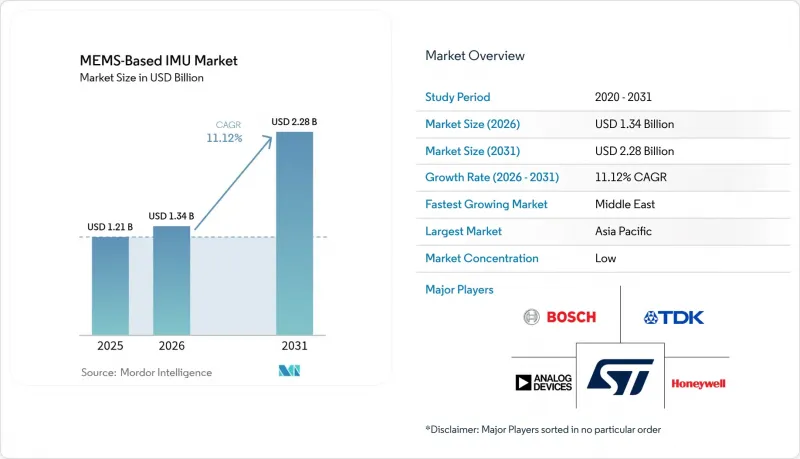
根據 Mordor Intelligence 預測,基於 MEMS 的 IMU 市場將從 2025 年的 12.1 億美元成長到 2026 年的 13.4 億美元,然後在 2031 年達到 22.8 億美元,2026 年至 2031 年的複合年成長率為 11.12%。
本報告按最終用戶產業(消費性電子、汽車、醫療等)、組件(加速計、陀螺儀、磁力計、整合六軸模組等)、自由度(3自由度、6自由度、9自由度)、平台等級(消費級、工業級等)和地區進行細分。市場預測以美元(USD)計價。
全球基於MEMS的慣性測量單元市場趨勢及洞察
自動駕駛汽車的普及
擁有L2級或更高級別自動駕駛平台的汽車製造商,正在為每輛車配備6至12個MEMS慣性測量單元(IMU),以確保在隧道或人口密集都市區衛星導航精度下降時仍能保持冗餘。特斯拉的「硬體4」系統於2024年將博世的SMI230六軸單元引入Model 3和Model Y生產線。這清楚地表明,IMU的地位已從單純的成本削減措施轉變為安全關鍵組件。 Waymo的第六代駕駛系統採用解析度低於每小時5度的戰術級陀螺儀,以確保即使GPS訊號中斷10分鐘也能維持車道。美國汽車工程師協會(SAE)J3016 L4級自動駕駛定義已將慣性感測確立為強制性的備用措施。同時,在中國,2024 年 L2+ 級自動駕駛汽車的出貨量為 480 萬輛,每輛車至少配備兩個 IMU,需求的下限也遠高於 900 萬輛。
具有 9 自由度 (9-DOF) 感測功能的消費級穿戴式裝置激增。
智慧型手錶正從六軸追蹤發展到九軸慣性感測,使用戶無需連接智慧型手機即可進行逐嚮導航。三星 Galaxy Watch7 採用九自由度 (9-DOF) 感應器陣列來辨識手腕手勢,作為運動時觸控螢幕的替代方案。 OPPO Watch X 搭載 TDK InvenSense 的 ICM-20948 晶片,將連續指南針導航帶入主流運動穿戴裝置。雖然這種架構會使組件成本增加 0.80 美元至 1.20 美元,但它也使得高階零售價格成為可能,例如售價 799 美元的 Apple Watch Ultra,它結合了雙頻 GPS 和九軸慣性感測。獲得 FDA已通過核准的設備,例如 Withings 的 ScanWatch 2,將運動感測器與容積描記法結合,以過濾心率訊號中的雜訊。
包裝造成的漂移和校準成本
矽晶片和陶瓷封裝之間熱膨脹係數的不匹配會導致應力,在-40 度C至+85 度C的溫度範圍內,加速計的偏壓會發生10至50毫重力的偏移。這需要進行多點校準,從而使每個單元的成本增加2至8美元。 IEEE感測器期刊定量計算了由熱膨脹係數差異引起的15兆帕應力,顯示這會導致運作導航漂移數公里。 Analog Devices透過在ADIS16577中整合八個片上溫度感測器來解決這個問題,但這使得晶片面積增加了18%。汽車產業ISO 26262 ASIL-D認證現在要求進行1000次熱循環測試,將測試週期延長至14個月,提高了進入門檻。校準台的成本為每個單位40萬美元,並且需要每90天由美國國家標準與技術研究院(NIST)重新校準,這使得它只有資金雄厚的供應商才能負擔得起。
細分市場分析
預計醫療設備將以12.43%的年複合成長率(CAGR)成長,到2031年將超過所有其他產業。這一快速成長主要得益於對極高精度產品需求的不斷成長,尤其是在手術機器人和步態分析監測器領域。同時,消費性電子產品在智慧型手機和智慧型手錶的推動下,銷售強勁,預計到2025年將佔銷售額的31.85%。然而,由於行動電話利潤率的下降,預計該領域的成長速度將會放緩。
2024年,機器人手術領域的先驅史賽克(Stryker)旗下的Mako SmartRobotics公司憑藉其在美國人工膝關節關節重建市場38%的市場佔有率,佔據了主導地位。這得歸功於其將六軸慣性測量單元(IMU)整合到手持式切割器中,實現了0.5度的精度。同時,Medtronic)的Hugo系統配備了戰術級陀螺儀感測器,能夠補償呼吸運動,顯著降低了腹腔鏡手術中22%的組織損傷。在汽車產業,每輛L2級自動駕駛汽車都整合了2到4個IMU,以增強電子穩定控制系統。然而,供應商整合限制了其成長,年複合成長率僅10.55%。在航太和國防領域,微機電系統(MEMS)正逐漸取代環形雷射陀螺儀,尤其是在無人機和小型飛彈領域。在工業機械領域,利用IMU進行預測性維護正在縮短投資回收期。
整合式六軸模組佔據了大部分銷售額,預計到2025年將佔據高達40.55%的市場。同時,整合式九軸設備正快速崛起,年複合成長率高達12.74%。這一快速成長主要得益於擴增實境(AR)頭戴設備和無人機需求的增加,這些設備需要在無需外部磁力計的情況下獲取方向資訊。
博世的BMI323尺寸僅2.5mm x 3.0mm,體積小巧,連續使用時僅消耗1.8mA電流,滿足耳機空間音訊的需求。同時,意法半導體的LSM6DSV16X憑藉其整合的9軸感測器和晶片機器學習核心脫穎而出,能夠運行16棵決定架構。這項創新顯著降低了系統功耗40%。獨立的加速計對於安全氣囊碰撞檢測至關重要,因為100G的測量範圍是關鍵;而分立式陀螺儀對於光學影像防手震不可或缺。磁力計正朝著組合模組的方向發展,但它們在工業指南針領域仍有特定的應用,例如方位角精度小於1度的應用。
區域分析
預計到2025年,亞太地區將成為市場主導力量,佔全球銷售額的44.10%。這主要得益於中國1,430億美元的積體電路基金以及日本在MEMS代工產能的主導地位。儘管中國對中芯國際和華虹半導體的補貼正在降低其對海外晶圓廠的依賴,但日本主要企業TDK和村田製作所憑藉垂直整合的供應鏈,將前置作業時間縮短至八週,佔據了消費類產品出貨量的35%。韓國622兆韓元(約4,500億美元)的半導體發展藍圖預計將使三星的系統級LSI MEMS產能到2027年成長40%。台灣台積電為博世、義法半導體和亞德諾半導體提供8吋晶圓代工產能,但地緣政治風險正促使客戶尋求供應鏈多元化。
到2025年,北美和歐洲的銷售額合計將佔全球近37.60%,主要得益於航太、國防和高階汽車產業的需求成長。美國《晶片與科學法案》撥款390億美元用於製造業獎勵,使GlobalFoundries公司得以將其位於紐約州馬耳他工廠的汽車慣性測量單元(IMU)產能擴大25%。德國已向半導體設施投入100億歐元,使博世公司得以將其位於德勒斯登的微機電系統(MEMS)生產線擴建30%。法國Crolles先進封裝合資企業正在為穿戴式裝置和醫療客戶縮小模組尺寸40%。英國化合物半導體應用彈射器(Compound Semiconductor Applications Catapult)正在投資1.5億英鎊(約1.9億美元)用於開發渦輪引擎的氮化鎵(GaN)MEMS陀螺儀。
在中東地區,在地採購率對於國防能力現代化和智慧城市計畫的重要性日益凸顯。預計到2031年,該地區將實現最高的成長率,複合年成長率(CAGR)將達到11.75%。沙烏地阿拉伯的SAMI公司正與泰雷茲公司建立合資企業,目標是到2028年實現60%的戰術級產品在國內生產。阿拉伯聯合大公國的EDGE集團收購了Sensonor公司40%的股份,以確保其國產無人機陀螺儀的智慧財產權。以色列的拉斐爾公司已將LITEF慣性測量單元(IMU)整合到其「長釘」(Spike)飛彈中,以減輕重量。同時,土耳其的ASELSAN公司為其「KAAN」戰鬥機開發了一款導航級微機電系統(MEMS)單元,但目前正面臨長達九個月的出口許可核准延遲。由於產能有限和模組前置作業時間,非洲和南美洲的市佔率均不足5%。
其他好處
- Excel格式的市場預測(ME)表
- 3個月的分析師支持
目錄
第1章:引言
- 研究假設和市場定義
- 調查範圍
第2章:調查方法
第3章執行摘要
第4章 市場狀況
- 市場概覽
- 市場促進因素
- 自動駕駛汽車的普及
- 具有 9 自由度 (9-DOF) 感測功能的消費級穿戴式裝置激增。
- 國防領域對導航級MEMS慣性測量單元的需求不斷成長。
- 利用物聯網實現工業自動化發展
- 航太領域立方衛星小型化趨勢
- 政府對國內半導體供應鏈的財政支持
- 市場限制因素
- 包裝造成的漂移和校準成本
- 高性能慣性測量單元的出口限制
- 特殊MEMS晶圓供不應求
- 多感測器融合演算法的複雜性
- 價值鏈分析
- 監理情勢
- 技術展望
- 波特五力分析
- 宏觀經濟因素對市場的影響
第5章 市場規模與成長預測
- 按最終用戶行業分類
- 家用電器
- 車
- 醫療保健
- 航太/國防
- 工業機械
- 其他
- 按組件
- 加速計
- 陀螺儀
- 磁力計
- 整合式六軸模組
- 整合式9軸模組
- 按自由度
- 3個自由度
- 6個自由度
- 9個自由度
- 按平台等級
- 消費級
- 工業級
- 戰術級
- 導航等級
- 按地區
- 北美洲
- 美國
- 加拿大
- 墨西哥
- 南美洲
- 巴西
- 阿根廷
- 其他南美國家
- 歐洲
- 德國
- 英國
- 法國
- 義大利
- 西班牙
- 其他歐洲國家
- 亞太地區
- 中國
- 印度
- 日本
- 韓國
- ASEAN
- 其他亞太國家
- 中東和非洲
- 中東
- 沙烏地阿拉伯
- 阿拉伯聯合大公國
- 其他中東國家
- 非洲
- 南非
- 奈及利亞
- 其他非洲地區
- 中東
- 北美洲
第6章 競爭情勢
- 市場集中度
- 策略趨勢
- 市佔率分析
- 公司簡介
- Robert Bosch GmbH(Bosch Sensortec GmbH)
- TDK Corporation
- Analog Devices Inc.
- STMicroelectronics NV
- Honeywell International Inc.
- Xsens Technologies BV
- NXP Semiconductors NV
- Sensonor AS
- Northrop Grumman LITEF GmbH
- Silicon Sensing Systems Limited
- Murata Manufacturing Co. Ltd.
- MEMSIC Semiconductor Co., Ltd.
- Safran SA
- Thales SA
- Collins Aerospace(RTX Corporation)
- Trimble Inc.
- ACEINNA Inc.
- Seiko Epson Corporation(Epson Toyocom)
- VectorNav Technologies, LLC
- Gladiator Technologies Inc.
- EMCORE Corporation
- SBG Systems SAS
第7章 市場機會與未來展望
According to Mordor Intelligence, the MEMS-Based IMU market size is expected to grow from USD 1.21 billion in 2025 to USD 1.34 billion in 2026 and is forecast to reach USD 2.28 billion by 2031 at 11.12% CAGR over 2026-2031.
This report is Segmented by End-User Industry (Consumer Electronics, Automotive, Medical, and More), Component (Accelerometers, Gyroscopes, Magnetometers, Integrated 6-Axis Modules, and More), Degree of Freedom (3-DOF, 6-DOF, and 9-DOF), Platform Grade (Consumer Grade, Industrial Grade, and More), and Geography. The Market Forecasts are Provided in Terms of Value (USD).
Global MEMS-Based IMU Market Trends and Insights
Proliferation of Autonomous Vehicles
Automakers embedding Level 2+ autonomy platforms are installing between six and twelve MEMS IMUs per vehicle to ensure redundancy when satellite navigation degrades in tunnels or dense urban areas. Tesla's Hardware 4 system brought Bosch SMI230 6-axis units into Model 3 and Model Y production lines in 2024, underscoring how IMUs have shifted from cost targets to safety-critical components. Waymo's Generation 6 driver stack specifies tactical-grade gyroscopes with a resolution of below 5 degrees per hour, ensuring lane keeping even during ten-minute GPS outages. The Society of Automotive Engineers' J3016 Level 4 definition solidifies inertial sensing as a mandatory fallback, while China shipped 4.8 million Level 2+ vehicles in 2024, each carrying at least two IMUs, establishing a demand floor well above nine million units.
Surge in Consumer Wearables with 9-DOF Sensing
Smartwatches are transitioning from 6-axis tracking to 9-axis orientation sensing, allowing users to enjoy turn-by-turn navigation without requiring a phone tether. Samsung's Galaxy Watch7 uses a 9-DOF suite to recognize wrist gestures that replace touchscreens during exercise. OPPO's Watch X brought TDK InvenSense ICM-20948 into mainstream sports wearables for continuous compass heading. The architecture adds USD 0.80-1.20 to the bill of materials yet supports premium retail pricing, as illustrated by the USD 799 Apple Watch Ultra, which couples dual-frequency GPS with 9-axis inertial sensing. FDA-cleared devices, such as the Withings ScanWatch 2, pair motion sensors with photoplethysmography to filter noise from heart-rate signals.
Packaging-Induced Drift and Calibration Costs
Thermal-mismatch stress between silicon dies and ceramic packages shifts accelerometer bias by 10-50 milligravity across the temperature range of -40 °C to +85 °C, necessitating multi-point calibration that adds USD 2-8 per unit. The IEEE Sensors Journal quantified 15 MPa stress due to differing thermal-expansion coefficients, resulting in kilometer-scale navigation drift per operating hour. Analog Devices countered with eight on-chip temperature sensors in the ADIS16577, although the die area increased by 18%. Automotive ISO 26262 ASIL-D qualification now requires 1,000 thermal cycles, extending test timelines to 14 months and increasing entry barriers. Calibration stands cost USD 400,000 each and require NIST recalibration every 90 days, limiting participation to well-capitalized vendors.
Other drivers and restraints analyzed in the detailed report include:
- Rising Defense Demand for Navigation-Grade MEMS IMUs
- Growth of IoT-Enabled Industrial Automation
- Export Controls on High-Performance IMUs
For complete list of drivers and restraints, kindly check the Table Of Contents.
Segment Analysis
Medical devices are expected to outpace all other sectors, with a projected 12.43% CAGR growth rate through 2031. This surge is largely driven by an increasing demand for pinpoint accuracy, particularly in surgical robotics and gait analysis monitors. Meanwhile, consumer electronics, which accounted for 31.85% of 2025's revenue, saw robust sales driven by smartphones and smartwatches. However, this segment is experiencing a slowdown as profit margins on handsets tighten.
In 2024, Stryker's Mako SmartRobotics, a frontrunner in robotic surgery, secured a commanding 38% share of the U.S. knee-replacement market. This was achieved by incorporating 6-axis IMUs into their handheld cutters, enabling a precision of 0.5 degrees. Medtronic's Hugo system, on the other hand, boasts tactical-grade gyros that counteract respiratory motion, leading to a notable 22% reduction in tissue trauma during laparoscopic procedures. The automotive sector has integrated 2-4 IMUs in each Level 2 vehicle, enhancing electronic stability control. However, due to supplier consolidation, growth is restrained to a 10.55% CAGR. In the aerospace and defense realm, MEMS are now the go-to replacements for ring-laser gyroscopes, especially in drones and compact missiles. Meanwhile, industrial machinery is leveraging IMUs for predictive maintenance, resulting in shortened payback cycles.
Integrated 6-axis modules dominated the revenue landscape, claiming a substantial 40.55% share in 2025. Meanwhile, integrated 9-axis devices are on a rapid ascent, boasting a notable 12.74% CAGR. This surge is largely driven by the increasing demands of augmented-reality headsets and drones, which now seek heading information sans the need for external magnetometers.
Bosch's BMI323, measuring a compact 2.5 mm X 3.0 mm, operates at a mere 1.8 mA during continuous use, catering to spatial audio needs in earbuds. On the other hand, STMicroelectronics' LSM6DSV16X stands out by combining a 9-axis sensor with an on-chip machine-learning core, capable of executing 16 decision trees. This innovation translates to a significant 40% reduction in system power. While stand-alone accelerometers are indispensable for airbag crash detection, where 100 G ranges are paramount, discrete gyros are essential for optical image stabilization. Notably, while magnetometers are transitioning into combo modules, they still find a niche in industrial compasses that demand precision of less than 1-degree heading.
Complete Report Scope:
- By End-User Industry
- Consumer Electronics
- Automotive
- Medical
- Aerospace and Defense
- Industrial Machinery
- Other End-User Industries
- By Component
- Accelerometers
- Gyroscopes
- Magnetometers
- Integrated 6-Axis Modules
- Integrated 9-Axis Modules
- By Degree of Freedom
- 3-DOF
- 6-DOF
- 9-DOF
- By Platform Grade
- Consumer Grade
- Industrial Grade
- Tactical Grade
- Navigation Grade
- By Geography
- North America
- United States
- Canada
- Mexico
- South America
- Brazil
- Argentina
- Rest of South America
- Europe
- Germany
- United Kingdom
- France
- Italy
- Spain
- Rest of Europe
- Asia-Pacific
- China
- India
- Japan
- South Korea
- ASEAN
- Rest of Asia-Pacific
- Middle East and Africa
- Middle East
- Saudi Arabia
- United Arab Emirates
- Rest of Middle East
- Africa
- South Africa
- Nigeria
- Rest of Africa
- Middle East
- North America
Geography Analysis
Asia Pacific led with 44.10% revenue in 2025, anchored by China's USD 143 billion Integrated Circuit Fund and Japan's dominance in volume MEMS foundry capacity. China's subsidies to SMIC and Huahong trim reliance on foreign fabs, while Japanese leaders TDK and Murata captured 35% of consumer shipments through vertically integrated chains that compress lead times to eight weeks. South Korea's KRW 622 trillion (USD 450 billion) semiconductor roadmap lifts Samsung's System LSI MEMS capacity by 40% by 2027. Taiwan's TSMC furnishes 8-inch foundry slots for Bosch, STMicroelectronics, and Analog Devices, though geopolitical risk is driving customers to diversify.
North America and Europe together accounted for nearly 37.60% of revenue in 2025, driven by demand from the aerospace, defense, and high-end automotive sectors. The United States CHIPS and Science Act dedicates USD 39 billion to fabrication incentives, with GlobalFoundries expanding its Malta, New York, output by 25% for automotive-grade IMUs. Germany offers EUR 10 billion for semiconductor facilities, enabling Bosch to enlarge Dresden MEMS lines by 30%. France's Crolles advanced-packaging joint venture cuts module footprints 40% for wearable and medical clients. The United Kingdom's Compound Semiconductor Applications Catapult channels GBP 150 million (USD 190 million) into gallium-nitride MEMS gyros for turbine engines.
The Middle East is projected to record the fastest 11.75% CAGR through 2031, as defense modernization and smart-city programs increasingly emphasize local content. Saudi Arabia's SAMI is building a joint venture with Thales to achieve 60% indigenous tactical-grade output by 2028. The United Arab Emirates' EDGE Group purchased 40% of Sensonor to secure gyro intellectual property for homegrown drones. Israel's Rafael integrated LITEF IMUs into Spike missiles to save weight, while Turkey's ASELSAN developed a navigation-grade MEMS unit for its KAAN fighter but faces nine-month export-license delays. Africa and South America each hold a share of under 5% because fabrication capacity is limited, and modules are imported with extended lead times.
- Robert Bosch GmbH (Bosch Sensortec GmbH)
- TDK Corporation
- Analog Devices Inc.
- STMicroelectronics N.V.
- Honeywell International Inc.
- Xsens Technologies B.V.
- NXP Semiconductors N.V.
- Sensonor AS
- Northrop Grumman LITEF GmbH
- Silicon Sensing Systems Limited
- Murata Manufacturing Co. Ltd.
- MEMSIC Semiconductor Co., Ltd.
- Safran S.A.
- Thales S.A.
- Collins Aerospace (RTX Corporation)
- Trimble Inc.
- ACEINNA Inc.
- Seiko Epson Corporation (Epson Toyocom)
- VectorNav Technologies, LLC
- Gladiator Technologies Inc.
- EMCORE Corporation
- SBG Systems S.A.S.
Additional Benefits:
- The market estimate (ME) sheet in Excel format
- 3 months of analyst support
TABLE OF CONTENTS
1 INTRODUCTION
- 1.1 Study Assumptions and Market Definition
- 1.2 Scope of the Study
2 RESEARCH METHODOLOGY
3 EXECUTIVE SUMMARY
4 MARKET LANDSCAPE
- 4.1 Market Overview
- 4.2 Market Drivers
- 4.2.1 Proliferation of Autonomous Vehicles
- 4.2.2 Surge in Consumer Wearables with 9-DOF Sensing
- 4.2.3 Rising Defense Demand for Navigation-Grade MEMS IMUs
- 4.2.4 Growth of IoT-Enabled Industrial Automation
- 4.2.5 Miniaturisation Trends in Aerospace CubeSats
- 4.2.6 Government Funding for Domestic Semiconductor Supply Chains
- 4.3 Market Restraints
- 4.3.1 Packaging-Induced Drift and Calibration Costs
- 4.3.2 Export Controls on High-Performance IMUs
- 4.3.3 Supply Shortages of Specialty MEMS Wafers
- 4.3.4 Algorithmic Complexity in Multi-Sensor Fusion
- 4.4 Value Chain Analysis
- 4.5 Regulatory Landscape
- 4.6 Technological Outlook
- 4.7 Porter's Five Forces Analysis
- 4.7.1 Bargaining Power of Suppliers
- 4.7.2 Bargaining Power of Buyers
- 4.7.3 Threat of New Entrants
- 4.7.4 Threat of Substitutes
- 4.7.5 Intensity of Competitive Rivalry
- 4.8 Impact of Macroeconomic Factors on the Market
5 MARKET SIZE AND GROWTH FORECASTS (VALUE)
- 5.1 By End-User Industry
- 5.1.1 Consumer Electronics
- 5.1.2 Automotive
- 5.1.3 Medical
- 5.1.4 Aerospace and Defense
- 5.1.5 Industrial Machinery
- 5.1.6 Other End-User Industries
- 5.2 By Component
- 5.2.1 Accelerometers
- 5.2.2 Gyroscopes
- 5.2.3 Magnetometers
- 5.2.4 Integrated 6-Axis Modules
- 5.2.5 Integrated 9-Axis Modules
- 5.3 By Degree of Freedom
- 5.3.1 3-DOF
- 5.3.2 6-DOF
- 5.3.3 9-DOF
- 5.4 By Platform Grade
- 5.4.1 Consumer Grade
- 5.4.2 Industrial Grade
- 5.4.3 Tactical Grade
- 5.4.4 Navigation Grade
- 5.5 By Geography
- 5.5.1 North America
- 5.5.1.1 United States
- 5.5.1.2 Canada
- 5.5.1.3 Mexico
- 5.5.2 South America
- 5.5.2.1 Brazil
- 5.5.2.2 Argentina
- 5.5.2.3 Rest of South America
- 5.5.3 Europe
- 5.5.3.1 Germany
- 5.5.3.2 United Kingdom
- 5.5.3.3 France
- 5.5.3.4 Italy
- 5.5.3.5 Spain
- 5.5.3.6 Rest of Europe
- 5.5.4 Asia-Pacific
- 5.5.4.1 China
- 5.5.4.2 India
- 5.5.4.3 Japan
- 5.5.4.4 South Korea
- 5.5.4.5 ASEAN
- 5.5.4.6 Rest of Asia-Pacific
- 5.5.5 Middle East and Africa
- 5.5.5.1 Middle East
- 5.5.5.1.1 Saudi Arabia
- 5.5.5.1.2 United Arab Emirates
- 5.5.5.1.3 Rest of Middle East
- 5.5.5.2 Africa
- 5.5.5.2.1 South Africa
- 5.5.5.2.2 Nigeria
- 5.5.5.2.3 Rest of Africa
- 5.5.5.1 Middle East
- 5.5.1 North America
6 COMPETITIVE LANDSCAPE
- 6.1 Market Concentration
- 6.2 Strategic Moves
- 6.3 Market Share Analysis
- 6.4 Company Profiles (includes Global level Overview, Market level overview, Core Segments, Financials as available, Strategic Information, Market Rank/Share for key companies, Products and Services, and Recent Developments)
- 6.4.1 Robert Bosch GmbH (Bosch Sensortec GmbH)
- 6.4.2 TDK Corporation
- 6.4.3 Analog Devices Inc.
- 6.4.4 STMicroelectronics N.V.
- 6.4.5 Honeywell International Inc.
- 6.4.6 Xsens Technologies B.V.
- 6.4.7 NXP Semiconductors N.V.
- 6.4.8 Sensonor AS
- 6.4.9 Northrop Grumman LITEF GmbH
- 6.4.10 Silicon Sensing Systems Limited
- 6.4.11 Murata Manufacturing Co. Ltd.
- 6.4.12 MEMSIC Semiconductor Co., Ltd.
- 6.4.13 Safran S.A.
- 6.4.14 Thales S.A.
- 6.4.15 Collins Aerospace (RTX Corporation)
- 6.4.16 Trimble Inc.
- 6.4.17 ACEINNA Inc.
- 6.4.18 Seiko Epson Corporation (Epson Toyocom)
- 6.4.19 VectorNav Technologies, LLC
- 6.4.20 Gladiator Technologies Inc.
- 6.4.21 EMCORE Corporation
- 6.4.22 SBG Systems S.A.S.
7 MARKET OPPORTUNITIES AND FUTURE OUTLOOK
- 7.1 White-space and Unmet-Need Assessment


