


 |
市場調查報告書
商品編碼
2124119
單向膠帶:市場佔有率分析、產業趨勢與統計、成長預測(2026-2031)Unidirectional Tape - Market Share Analysis, Industry Trends & Statistics, Growth Forecasts (2026 - 2031) |
||||||

※ 本網頁內容可能與最新版本有所差異。詳細情況請與我們聯繫。
根據 Mordor Intelligence 估計,2026 年單向膠帶市值為 4.7361 億美元,預計到 2031 年將達到 7.8095 億美元,在預測期(2026-2031 年)內複合年成長率為 10.52%。
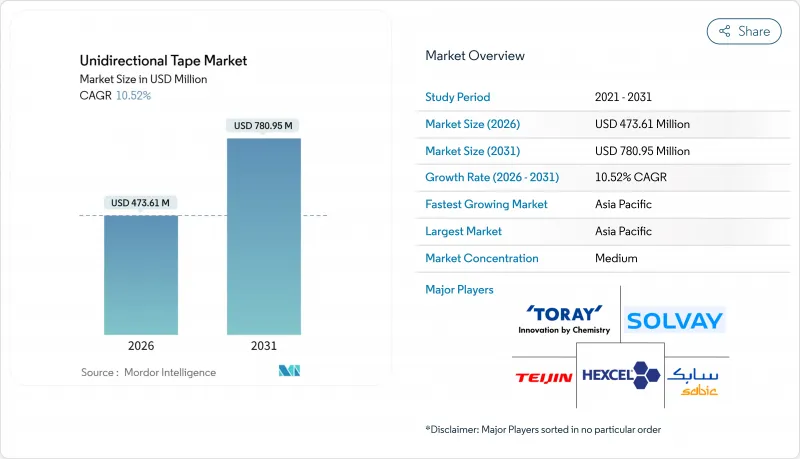
本報告按增強材料類型(玻璃纖維、碳纖維及其他)、基材(PEEK、聚醯胺、聚丙烯、聚碳酸酯、PPS及其他)、黏合劑類型(環氧樹脂、聚氨酯及其他)、終端用戶產業(航太與國防及其他)以及地區(亞太、北美、歐洲、南美、中東和非洲)進行細分。市場預測以美元計價。
全球單向膠帶市場趨勢與洞察
下一代窄體飛機對複合材料的需求激增
在空中巴士A321XLR和波音737 MAX等項目中,為了減輕飛機重量,碳纖維帶在機身面板、翼樑和地板樑的應用日益廣泛。美國國家航空暨太空總署(NASA)的HiCAM測試表明,自動化膠帶層壓技術能夠顯著縮短機身段的生產週期,凸顯了其在大規模生產中的潛力。擁有成熟資料庫的供應商已通過FAA AC 20-107B和EASA AMC 20-29認證,從而獲得競爭優勢,為現有企業提供了保障。鑑於窄體飛機將在未來計劃交付的飛機中佔據相當大的比例,即使複合材料使用量的略微成長,也將對單向膠帶市場產生巨大的需求。計劃於2026-2027年完成的認證里程碑進一步推高了市場需求。
原始設備製造商為 800V 電動車平台設定了激進的減重目標。
豪華汽車製造商致力於打造續航里程達 500 公里、採用 800V 架構的車型,並力求更輕的電池外殼。 Lucid Air 近期進行的撞擊測試取得了突破性成果。測試表明,使用熱塑性膠帶可以製造出形狀複雜的托盤,在保持與沖壓鋼板相同剛性的同時,顯著減輕重量。然而,高昂的資本投入成本對二級供應商而言是一項挑戰。 AFP 電池的單價較高,程式設計也需要耗費大量精力。相較之下,中國汽車製造商透過垂直整合膠帶生產,成功降低了零件成本,從而在快速成長的單向膠帶市場中佔據了主導。此舉鞏固了亞洲在該市場的主導地位。
由於PAN前驅體的供應問題,碳纖維價格持續波動。
2024年中國實施出口限制後,受中國市場主導地位的支撐,PAN現貨價格飆漲。 2025年,由於航太領域的固定價格契約,Hexcel和SGL Carbon無法對沖損失,導致毛利率下降。雖然一條計劃於2027年運作的新前體生產線將帶來一定緩解,但30個月的投產前置作業時間以及地緣政治的不確定性表明,單向膠帶市場的成本基礎波動仍將持續。
細分市場分析
預計到2025年,碳纖維將佔銷售額的58.42%,凸顯其重要性。在關鍵的航太結構中,碳纖維的抗疲勞性能使其高昂的價格物有所值。波音787和空中巴士A350都在其機翼翼樑和機身框架中大量使用碳纖維帶。玻璃纖維雖然剛度較低,但其市場正以9.25%的複合年成長率快速成長。這一成長主要得益於長度超過115公尺的離岸風力發電機葉片,這些葉片需要經濟高效的翼梁帽材料。因此,預計到2031年,玻璃纖維單向帶的市場規模將穩定擴大。碳-玻璃混合帶,例如Hexel公司的“HiTape”,在成本和模量之間實現了極佳的平衡,預計將在汽車電池機殼這一細分市場中受到青睞。
在新興市場,中國渦輪機原始設備製造商(OEM)在其8-12兆瓦級平台上採用玻璃纖維帶,印度製造商也出現了類似的趨勢。醯胺纖維和玄武岩纖維主要服務於防彈裝甲和高溫工業應用等細分市場,但即使兩者合計,其市場佔有率仍然有限。鑑於這些市場動態,預計碳纖維將繼續保持其主導地位,而玻璃纖維產量的絕對成長將在未來五年內對單向纖維帶市場格局的塑造起到至關重要的作用。
由於聚醯胺基材具有均衡的加工範圍、衝擊韌性和耐濕性,這些特性非常適合用於汽車碰撞結構,預計到2025年,聚醯胺基材的需求量將佔31.36%。隨著引擎室支架和引氣管逐漸採用能承受200 度C持續高溫的熱塑性材料,PEEK的市佔率正以9.68%的複合年成長率成長。因此,PEEK單向膠帶在PEEK應用中的市佔率預計將逐步擴大,尤其是在2027年航太認證最終完成後。
聚丙烯在成本比性能更重要的應用中仍然被廣泛使用,例如風力渦輪機葉片的剪切網。聚苯乙烯(PPS)和聚氯乙烯(PC)則在化學和電子等特殊應用領域完善了產品線。索爾維的KetaSpire PEEK在油氣井井下工具領域也越來越受歡迎,進一步證明了熱塑性膠帶溫度範圍的不斷擴大。
區域分析
預計到2025年,亞太地區將佔全球銷售額的44.53%,並在2031年之前以10.88%的複合年成長率成長,這主要得益於中國龐大的風力渦輪機葉片生產、日本碳纖維技術的進步以及韓國對電動汽車電池托盤的廣泛應用。在江蘇省,自動化膠帶層壓單元正在提高纖維取向一致性,最大限度地減少廢棄物,並鞏固中國的成本優勢。東麗公司位於愛媛郡的工廠正在加強該地區的供應鏈,而位於海得拉巴的一條新的膠帶生產線正在滿足印度國內航太的需求。規模較小的東協市場目前依賴進口,但其具備快速適應的能力,尤其是在電池驅動摩托車需求不斷成長的情況下,這將進一步推動單向膠帶市場的發展。
預計北美將在2025年佔據相當大的市場佔有率。隨著737 MAX的生產趨於穩定,波音公司位於埃弗雷特的工廠全年都在大量使用碳纖維膠帶。此外,洛克希德·馬丁公司的F-35和MQ-25計畫也提振了國防領域的需求。然而,汽車業則持謹慎態度,通用汽車和福特都表示擔憂高昂的回收成本和材料價格波動。同時,墨西哥克雷塔羅不斷擴張的碳纖維產業中心顯示供應鏈正在走向多元化,這可能有利於美國推廣電動卡車的努力。
預計到2025年,歐洲將佔據相當大的需求佔有率。儘管報廢車輛指令(ELV指令)帶來了回收壓力,但空中巴士位於圖盧茲和布勞頓的工廠對複合材料的需求仍然強勁。德國汽車製造商正在試驗用於高階車型的碳纖維電池托盤,但其廣泛應用取決於能否實現成本平衡。英國脫歐後的關稅擠壓了英國加工商的利潤空間,對中小企業的影響尤其顯著。值得注意的是,西班牙和丹麥的工廠正在將業務轉向膠帶層壓,目前已為15兆瓦海上風力發電機供應產品,此舉可望推動歐洲大陸單向膠帶市場的發展。
儘管到2025年,南美和中東/非洲地區的市場佔有率總體上仍較小,但它們展現了新的潛力。巴西航空工業公司的E2噴射機採用了本地生產的預浸料,而沙烏地阿拉伯的NEOM計畫正在考慮引入氫氣瓶,這可能需要用到熱塑性膠帶。這些區域性舉措雖然小規模,但正在豐富單向膠帶產業的格局,並有望隨著基礎設施的完善而發展壯大。
其他好處:
- Excel格式的市場預測(ME)表
- 3個月的分析師支持
目錄
第1章:引言
- 研究假設和市場定義
- 調查範圍
第2章:調查方法
第3章執行摘要
第4章 市場狀況
- 市場概覽
- 市場促進因素
- 下一代窄體飛機對複合材料的需求激增
- 原始設備製造商為 800V 電動車平台設定了激進的減重目標。
- 中國風力渦輪機葉片工廠自動化鋪帶生產線的興起
- 用於氫氣壓力容器的熱塑性單軸膠帶的認證
- 國防領域對雷達穿透結構和隱身套件的需求
- 市場限制因素
- 由於PAN前驅體的供應情況,碳纖維價格持續波動。
- 二級汽車零件供應商對AFP設備的採用率較低。
- 加強歐盟關於回收和報廢產品處置的法規(基礎設施不足)
- 價值鏈分析
- 波特五力分析
第5章 市場規模與成長預測
- 加固類型
- 玻璃纖維
- 碳纖維
- 其他加固類型
- 按基礎材料
- 聚醚醚酮(PEEK)
- 聚醯胺(PA)
- 聚丙烯(PP)
- 聚碳酸酯(PC)
- 聚亞苯硫醚(PPS)
- 其他基質
- 黏合劑類型
- 環氧樹脂
- 聚氨酯
- 其他類型的黏合劑
- 按最終用戶行業分類
- 航太/國防
- 車
- 運動休閒
- 產業
- 風力
- 其他終端用戶產業
- 按地區
- 亞太地區
- 中國
- 日本
- 韓國
- 印度
- 其他亞太國家
- 北美洲
- 美國
- 加拿大
- 墨西哥
- 歐洲
- 德國
- 法國
- 英國
- 義大利
- 西班牙
- 俄羅斯
- 其他歐洲國家
- 南美洲
- 巴西
- 阿根廷
- 其他南美國家
- 中東和非洲
- 沙烏地阿拉伯
- 南非
- 其他中東和非洲國家
- 亞太地區
第6章 競爭情勢
- 市場集中度
- 策略趨勢
- 市佔率和排名分析
- 公司簡介
- Barrday Inc.
- BASF
- BUFA Thermoplastic Composites GmbH & Co. KG
- Celanese Corporation
- DSM
- Evonik Industries AG
- Gurit Services AG, Zurich(CH)
- Hexcel Corporation
- Mitsui Chemicals Inc.
- Oxeon AB(TeXtreme)
- Plastic Reinforcement Fabrics Ltd
- SABIC
- SGL Carbon
- Solvay
- TCR Composites Inc.
- TEIJIN LIMITED
- TOPOLO New Materials
- TORAY INDUSTRIES INC.
- Victrex plc
第7章 市場機會與未來展望
According to Mordor Intelligence, the unidirectional tape market size is estimated at USD 473.61 million in 2026, and is expected to reach USD 780.95 million by 2031, at a CAGR of 10.52% during the forecast period (2026-2031).
This report is Segmented by Reinforcement Type (Glass Fiber, Carbon Fiber, and Other), Backing Material (PEEK, Polyamide, Polypropylene, Polycarbonate, PPS, and Other), Adhesive Type (Epoxy, Polyurethane, and Other), End-User Industry (Aerospace and Defense, and More), and Geography (Asia-Pacific, North America, Europe, South America, and Middle-East and Africa). Market Forecasts are in Value (USD).
Global Unidirectional Tape Market Trends and Insights
Surging Composite Demand in Next-Gen Narrow-Body Aircraft
Programs like the Airbus A321XLR and Boeing 737 MAX are increasingly using carbon-fiber tape in their fuselage panels, spars, and floor beams to reduce airframe weight. NASA's HiCAM trials demonstrated that automated tape-laying can significantly reduce the cycle time for fuselage sections, highlighting its potential for high-rate production. Suppliers with established databases gain an advantage due to qualifications under FAA AC 20-107B and EASA AMC 20-29, creating a protective barrier for existing players. Given that narrow-body jets represent a significant portion of anticipated future deliveries, even slight increases in composite content lead to substantial demand in the unidirectional tapes market. Anticipated certification milestones in 2026-2027 further bolster demand projections.
Aggressive OEM Lightweighting Targets for 800 V EV Platforms
Premium carmakers, targeting a 500 km range with 800 V architectures, are pushing for a reduction in battery-enclosure mass. Recent crash tests on the Lucid Air have showcased a breakthrough: thermoplastic tapes can craft intricate tray shapes that achieve the stiffness of stamped steel, but at a significantly lower weight. However, the high capital costs pose a challenge for Tier-2 adoption. Each AFP cell commands a high price, and the programming demands significant labor. In response, Chinese OEMs are taking the reins by vertically integrating tape production, managing to cut part costs. This move solidifies Asia's lead in the burgeoning unidirectional tapes market.
Persistent Carbon-Fiber Price Volatility Tied to PAN Precursor Supply
After China imposed export curbs in 2024, spot prices for PAN surged, driven by China's dominant share in the market. In 2025, Hexcel and SGL Carbon experienced a drop in gross margins, unable to hedge against losses due to their fixed-price aerospace contracts. While new precursor lines set to debut in 2027 offer some respite, the 30-month lead times combined with geopolitical uncertainties ensure continued volatility in the cost base of the unidirectional tapes market.
Other drivers and restraints analyzed in the detailed report include:
- Rise of Automated Tape-Laying Lines in Chinese Wind-Blade Factories
- Certification of Thermoplastic Unidirectional Tapes for Hydrogen Pressure Vessels
- Low Pull-Through Rates of AFP Equipment Among Tier-2 Auto Suppliers
For complete list of drivers and restraints, kindly check the Table Of Contents.
Segment Analysis
Carbon fiber captured 58.42% of 2025 revenue, highlighting its significance in aerospace primary structures, where its fatigue resistance justifies a premium. Both Boeing's 787 and Airbus's A350 heavily utilize carbon-fiber tape for their wing spars and fuselage frames. Glass fiber, though less stiff, is surging at 9.25% CAGR. This rise is driven by the offshore wind blades exceeding 115 m in length, which necessitates cost-effective spar-cap materials. Consequently, the market size for unidirectional tapes in the glass-fiber segment is set to expand steadily through 2031. Hybrid carbon-glass tapes, like Hexcel's HiTape, strike a balance between cost and modulus, finding their niche in automotive battery enclosures.
In emerging markets, Chinese turbine OEMs are opting for glass-fiber tapes in their 8-12 MW platforms, a trend echoed by Indian manufacturers. While aramid and basalt fibers cater to niche markets-primarily ballistic armor and high-temperature industrial applications-together they hold a modest share. Given these market dynamics, while carbon fiber is poised to maintain its dominance, the absolute tonnage gains of glass fiber will play a crucial role in shaping the unidirectional tapes market in the coming five years.
Polyamide backing held 31.36% of 2025 demand due to its balanced processing window, impact toughness, and moisture resistance, traits suited for automotive crash structures. PEEK is expanding at 9.68% CAGR as engine-bay brackets and bleed-air ducts migrate to thermoplastics capable of withstanding 200 °C continuous temperatures. The unidirectional tapes market share for PEEK applications should therefore expand gradually, especially after aerospace certifications are finalized in 2027.
Polypropylene remains popular where cost trumps performance, for example, in wind-blade shear webs. PPS and PC round out the portfolio with specialty applications in chemical processing and electronics. Solvay's KetaSpire PEEK is also penetrating downhole oil-and-gas tools, underscoring the widening high-temperature envelope for thermoplastic tapes.
Complete Report Scope:
- By Reinforcement Type
- Glass Fiber
- Carbon Fiber
- Other Reinforcement Types
- By Backing Material
- Polyether Ether Ketone (PEEK)
- Polyamide (PA)
- Polypropylene (PP)
- Polycarbonate (PC)
- Polyphenylene Sulfide (PPS)
- Other Backing Materials
- By Adhesive Type
- Epoxy
- Polyurethane
- Other Adhesive Types
- By End-user Industry
- Aerospace and Defense
- Automotive
- Sports and Leisure
- Industrial
- Wind Energy
- Other End-user Industries
- By Geography
- Asia-Pacific
- China
- Japan
- South Korea
- India
- Rest of Asia-Pacific
- North America
- United States
- Canada
- Mexico
- Europe
- Germany
- France
- United Kingdom
- Italy
- Spain
- Russia
- Rest of Europe
- South America
- Brazil
- Argentina
- Rest of South America
- Middle-East and Africa
- Saudi Arabia
- South Africa
- Rest of Middle-East and Africa
- Asia-Pacific
Geography Analysis
Asia-Pacific generated 44.53% of 2025 revenue and is projected to grow at a 10.88% CAGR to 2031, driven by China's extensive wind-blade production, Japan's advancements in carbon-fiber technology, and South Korea's adoption of EV battery trays. In Jiangsu, automated tape-laying cells achieved high fiber alignment consistency, minimizing waste and solidifying China's cost advantage. Toray's facility in Ehime bolsters regional supply, while a new tape line in Hyderabad caters to India's domestic aerospace needs. Although smaller ASEAN markets currently rely on imports, they stand poised to adapt swiftly, especially as the demand for battery-electric two-wheelers rises, further boosting the unidirectional tapes market.
North America accounted for a notable share of the 2025 revenue. Boeing's Everett facility, as the 737 MAX production stabilizes, utilizes a significant amount of carbon-fiber tape annually. Additionally, Lockheed Martin's F-35 and MQ-25 programs bolster defense demand. Yet, the automotive sector hesitates: both General Motors and Ford point to high recycling costs and inconsistent material pricing as concerns. Meanwhile, Mexico's expanding carbon-fiber hub in Queretaro hints at a diversifying supply chain, potentially benefiting the United States' electric truck initiatives.
Europe represented a considerable portion of the 2025 demand. Composite consumption remains anchored at Airbus facilities in Toulouse and Broughton, despite recyclability pressures from the End-of-Life Vehicles Directive. While German OEMs experiment with carbon-fiber battery trays for their premium models, widespread adoption hinges on achieving cost parity. Post-Brexit tariffs have squeezed margins for the United Kingdom converters, particularly affecting SMEs. In a notable shift, Spanish and Danish factories, pivoting to tape-laying, are now catering to 15 MW offshore turbines, a move likely to bolster the continent's unidirectional tapes market.
South America and the Middle East-Africa, together contributing a smaller share in 2025, exhibit emerging potential. While Embraer's E2 jets utilize locally produced prepregs, Saudi Arabia's NEOM is exploring hydrogen cylinders, potentially requiring thermoplastic tapes. Though these regional initiatives are modest, they diversify the unidirectional tapes industry's landscape and hold promise for growth as infrastructure develops.
- Barrday Inc.
- BASF
- BUFA Thermoplastic Composites GmbH & Co. KG
- Celanese Corporation
- DSM
- Evonik Industries AG
- Gurit Services AG, Zurich (CH)
- Hexcel Corporation
- Mitsui Chemicals Inc.
- Oxeon AB (TeXtreme)
- Plastic Reinforcement Fabrics Ltd
- SABIC
- SGL Carbon
- Solvay
- TCR Composites Inc.
- TEIJIN LIMITED
- TOPOLO New Materials
- TORAY INDUSTRIES INC.
- Victrex plc
Additional Benefits:
- The market estimate (ME) sheet in Excel format
- 3 months of analyst support
TABLE OF CONTENTS
1 Introduction
- 1.1 Study Assumptions and Market Definition
- 1.2 Scope of the Study
2 Research Methodology
3 Executive Summary
4 Market Landscape
- 4.1 Market Overview
- 4.2 Market Drivers
- 4.2.1 Surging composite demand in next-gen narrow-body aircraft
- 4.2.2 Aggressive OEM lightweighting targets for 800 V EV platforms
- 4.2.3 Rise of automated tape-laying lines in Chinese wind-blade factories
- 4.2.4 Certification of thermoplastic Unidirectional tapes for hydrogen pressure vessels
- 4.2.5 Defense requirement for radar-transparent structures and stealth kits
- 4.3 Market Restraints
- 4.3.1 Persistent carbon-fiber price volatility tied to PAN precursor supply
- 4.3.2 Low pull-through rates of AFP equipment among Tier-2 auto suppliers
- 4.3.3 Recycling and end-of-life mandates tightening in EU (lack of infra)
- 4.4 Value Chain Analysis
- 4.5 Porter's Five Forces Analysis
- 4.5.1 Threat of New Entrants
- 4.5.2 Bargaining Power of Consumers
- 4.5.3 Bargaining Power of Suppliers
- 4.5.4 Threat of Substitutes
- 4.5.5 Degree of Competition
5 Market Size and Growth Forecasts (Value)
- 5.1 By Reinforcement Type
- 5.1.1 Glass Fiber
- 5.1.2 Carbon Fiber
- 5.1.3 Other Reinforcement Types
- 5.2 By Backing Material
- 5.2.1 Polyether Ether Ketone (PEEK)
- 5.2.2 Polyamide (PA)
- 5.2.3 Polypropylene (PP)
- 5.2.4 Polycarbonate (PC)
- 5.2.5 Polyphenylene Sulfide (PPS)
- 5.2.6 Other Backing Materials
- 5.3 By Adhesive Type
- 5.3.1 Epoxy
- 5.3.2 Polyurethane
- 5.3.3 Other Adhesive Types
- 5.4 By End-user Industry
- 5.4.1 Aerospace and Defense
- 5.4.2 Automotive
- 5.4.3 Sports and Leisure
- 5.4.4 Industrial
- 5.4.5 Wind Energy
- 5.4.6 Other End-user Industries
- 5.5 By Geography
- 5.5.1 Asia-Pacific
- 5.5.1.1 China
- 5.5.1.2 Japan
- 5.5.1.3 South Korea
- 5.5.1.4 India
- 5.5.1.5 Rest of Asia-Pacific
- 5.5.2 North America
- 5.5.2.1 United States
- 5.5.2.2 Canada
- 5.5.2.3 Mexico
- 5.5.3 Europe
- 5.5.3.1 Germany
- 5.5.3.2 France
- 5.5.3.3 United Kingdom
- 5.5.3.4 Italy
- 5.5.3.5 Spain
- 5.5.3.6 Russia
- 5.5.3.7 Rest of Europe
- 5.5.4 South America
- 5.5.4.1 Brazil
- 5.5.4.2 Argentina
- 5.5.4.3 Rest of South America
- 5.5.5 Middle-East and Africa
- 5.5.5.1 Saudi Arabia
- 5.5.5.2 South Africa
- 5.5.5.3 Rest of Middle-East and Africa
- 5.5.1 Asia-Pacific
6 Competitive Landscape
- 6.1 Market Concentration
- 6.2 Strategic Moves
- 6.3 Market Share/Ranking Analysis
- 6.4 Company Profiles (includes Global level Overview, Market level overview, Core Segments, Financials as available, Strategic Information, Market Rank/Share for key companies, Products and Services, and Recent Developments)
- 6.4.1 Barrday Inc.
- 6.4.2 BASF
- 6.4.3 BUFA Thermoplastic Composites GmbH & Co. KG
- 6.4.4 Celanese Corporation
- 6.4.5 DSM
- 6.4.6 Evonik Industries AG
- 6.4.7 Gurit Services AG, Zurich (CH)
- 6.4.8 Hexcel Corporation
- 6.4.9 Mitsui Chemicals Inc.
- 6.4.10 Oxeon AB (TeXtreme)
- 6.4.11 Plastic Reinforcement Fabrics Ltd
- 6.4.12 SABIC
- 6.4.13 SGL Carbon
- 6.4.14 Solvay
- 6.4.15 TCR Composites Inc.
- 6.4.16 TEIJIN LIMITED
- 6.4.17 TOPOLO New Materials
- 6.4.18 TORAY INDUSTRIES INC.
- 6.4.19 Victrex plc
7 Market Opportunities and Future Outlook
- 7.1 White-space and Unmet-Need Assessment

 全球單向帶市場:依纖維類型、樹脂類型、終端應用產業及地區分類-預測至2031年
 單向膠帶市場:依樹脂類型、纖維類型、基材、黏合劑類型、製造流程和最終用途產業分類-2026-2032年全球市場預測
 有機片材和熱塑性半成品單向膠帶層壓板市場:按類型、應用和地區分類(2026-2034 年)有機薄膜市場:依產品類型、材料類型和應用分類-2026-2032年全球市場預測
 全球單向膠帶市場規模、佔有率、趨勢和成長分析報告(2026-2034年)
 有機片材和半模塑熱塑性單向帶複合市場-全球產業規模、佔有率、趨勢、機會、預測:按產品、應用、地區和競爭對手分類,2021-2031年
 單向膠帶(UD膠帶)-全球市佔率及排名、總收入及需求預測(2025-2031年)
 全球有機板市場
 UD膠帶(單向膠帶)市場規模、佔有率、趨勢分析報告:按產品、按纖維、按最終用途、按地區、細分市場預測,2025-2030年