


 |
市場調查報告書
商品編碼
2124100
Polyvinylidene氯乙烯(PVDC)塗層薄膜:市場佔有率分析、行業趨勢和統計數據以及成長預測(2026-2031 年)Polyvinylidene Chloride (PVDC) Coated Films - Market Share Analysis, Industry Trends & Statistics, Growth Forecasts (2026 - 2031) |
||||||

※ 本網頁內容可能與最新版本有所差異。詳細情況請與我們聯繫。
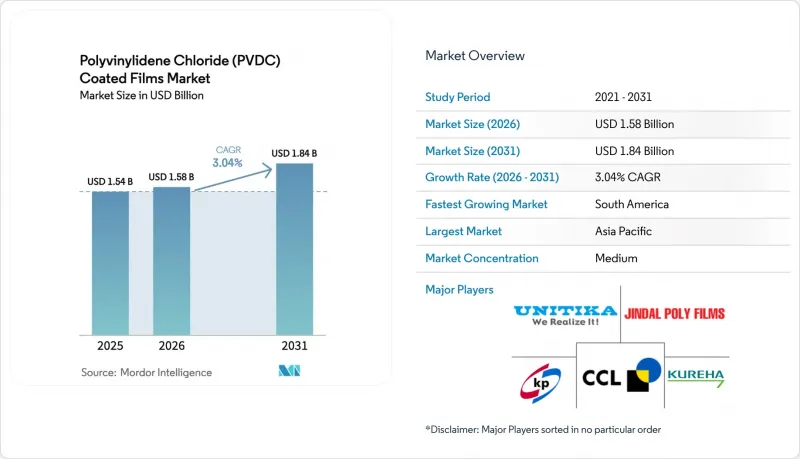
據 Mordor Intelligence 稱,2025 年Polyvinylidene氯乙烯 (PVDC) 塗層薄膜市場價值為 15.4 億美元,預計到 2031 年將從 2026 年的 15.8 億美元成長至 18.4 億美元,預測期(2026-2031 年)複合年成長率為 3.04%。
本報告按薄膜基材類型(BOPP、PET/BOPET、PVC 及其他)、應用領域(食品包裝和藥品泡殼包裝)以及地區(亞太、北美、歐洲、南美、中東和非洲)進行細分。市場預測以美元計價。
全球Polyvinylidene氯乙烯(PVDC)塗佈薄膜市場趨勢及洞察
加工食品和即食食品的蓬勃發展
隨著都市區收入的成長和生活節奏的加快,人們對份量可控、保存期限長的食品的需求日益成長。這些食品需要在冷藏運輸過程中長時間保持新鮮。 PVDC塗層BOPP和PET薄膜可實現調氣包裝,有效抑制脂質氧化和微生物腐敗。為了滿足印度和中東地區調理食品品牌訂單的激增,UFlex正在卡納塔克邦擴大阻隔薄膜的生產。品牌商現在採用比傳統設計更薄的塗層,在降低成本的同時保持了保存期限。雖然符合FDA 21 CFR 177.1980和歐盟10/2011的要求至關重要,但加工商可以透過獲得高溫滅菌耐受性認證來獲得競爭優勢。
藥品泡殼包裝的應用正在迅速增加。
印度和東歐的學名藥生產商正從帶狀包裝轉向熱成型PVC/PVDC泡殼包裝。此舉旨在滿足ICH Q1A關於活性藥物成分(API,例如阿斯匹靈和抗生素)的防潮標準。 PVDC複合PVC即使在IVb區氣候條件下也能確保更長的保存期限。儘管克洛克納·彭塔普拉斯特公司(Klockner Pentaplast)正在根據破產法第11章進行業務重組,但該公司仍在進一步加大對藥用級PVC/PVDC的投資。該公司深知,生物製藥產業所需的高阻隔級產品具有很高的利潤率。歐洲藥品管理局(EMA)關於包裝完整性測試的指南進一步鞏固了PVDC在產業中的重要性。鑑於缺乏可靠的長期現場數據來支持其有效性,這種趨勢在替代陶瓷氧化物塗層領域尤其明顯。
與EVOH和金屬化阻隔材料的競爭
英國Coveris 公司代工生產的 9 層吹塑成型EVOH 薄膜,在乾燥條件下氧氣透過率 (OTR) 低於 1 cm³/m²/天,並且可回收用於聚乙烯廢棄物處理。由於 EVOH 樹脂價格下降和 VDC 成本上升,PVDC 傳統上所具有的成本優勢正在減弱,尤其是在絕對濕度較低的乾食品包裝領域。此外,雖然金屬沉澱PET 和 AlOx 塗層薄膜對需要遮光性能的休閒食品品牌來說很有吸引力,但它們的透明度限制了它們在生肉包裝中的應用。
細分市場分析
到2025年,雙向拉伸聚丙烯(BOPP)將佔據聚偏二氯乙烯(PVDC)塗層薄膜市場44%的佔有率。這主要得益於其樹脂成本低廉以及在凹版塗佈機上較高的運行速度。許多加工商能夠熟練地高速加工20µm厚的BOPP基材,以達到帶骨肉包裝所需的抗張強度。雙向拉伸聚對苯二甲酸乙二醇酯(BOPET)則用於生產經過溫和巴氏殺菌處理的高檔托盤,因此價格較高。聚氯乙烯(PVC)相關的PVDC塗層薄膜市場規模預計將在未來幾年內擴大。此外,聚醯胺香腸腸衣和聚乳酸(PLA)立式袋等專業細分市場也為「其他」類別做出了貢獻。
雙向拉伸聚丙烯(BOPP)的優勢正面臨可回收單層聚丙烯(mono-PP)蓋的挑戰,後者無需聚偏二氯乙烯(PVDC)即可實現低氧氣透過率(OTR)。如果未來的規模化試驗成功,到本十年末,薄型單層聚丙烯可能會威脅BOPP在PVDC塗層薄膜市場的佔有率。然而,這種轉變能否實現,取決於加工商能否驗證其在高濕度條件下的阻隔穩定性,而目前PVDC結構在高濕度條件下仍具有優勢。
區域分析
預計到2025年,亞太地區將佔PVDC塗層薄膜市場銷售額的41.38%,主要得益於印度和中國一體化薄膜生產能力和零售業的快速現代化。金達爾聚合物薄膜公司和科斯莫薄膜公司均採用自主PVDC塗層工藝,從而能夠根據當地的濕度和分銷條件微調阻隔性能。此外,印度向監管市場出口的吸塑包裝數量增加也進一步支撐了市場需求。
預計2031年,以巴西和阿根廷為首的南美洲將達到最高的複合年成長率,達到3.57%。隨著超級市場的普及,加工業者正從蠟紙包裝轉向PVDC高阻隔薄膜,以延長冷藏保存期限。儘管歐洲品牌商正在收緊產品規格,但國內關於可回收性的法規相對寬鬆,這為PVDC提供了發展機會。
在北美,泡殼包裝的強勁成長受到加州和緬因州早期生產者延伸責任制(EPR)運動的限制,該運動對不可回收包裝徵收罰款。如果分類系統能夠接受PE/PVDC多層薄膜,Syensqo在回收技術方面的突破性進展有望降低這些罰款。歐洲的情況最具挑戰性。 《包裝和包裝廢棄物條例》要求在2030年實現大規模的回收利用,並對不可回收產品徵收塑膠稅。雖然一些城市已經開始試行Syensqo的方案,但推廣程度遠未達到統一水準。中東和非洲市場規模仍然小規模,但在沙烏地阿拉伯高階乳製品市場和南非藥品進口的推動下,市場持續成長。
其他好處:
- Excel格式的市場預測(ME)表
- 3個月的分析師支持
目錄
第1章:引言
- 研究假設和市場定義
- 調查範圍
第2章:調查方法
第3章執行摘要
第4章 市場狀況
- 市場概覽
- 市場促進因素
- 加工食品和即食食品的蓬勃發展
- 藥品泡殼包裝的應用正在迅速增加。
- 優異的氣體和水汽阻隔性能
- 過渡到超薄(小於15µm)PVDC塗層
- 推出不含 PFAS 和不含氟的 PVDC 等級產品。
- 市場限制因素
- 與EVOH和金屬化阻隔材料的競爭
- 對廢棄產品/氯基回收的擔憂
- 由於氯鹼工業脫碳,VDC單體的供應出現波動。
- 價值鏈分析
- 波特五力模型
第5章 市場規模與成長預測
- 按薄膜基材類型
- 雙軸延伸聚丙烯(BOPP)
- 聚對苯二甲酸乙二酯(PET/BOPET)
- 聚氯乙烯(PVC)
- 其他材料(聚乙烯、聚醯胺、PLA、纖維素基材料等)
- 透過使用
- 食品包裝
- 藥品泡殼包裝
- 按地區
- 亞太地區
- 中國
- 印度
- 日本
- 韓國
- 其他亞太國家
- 北美洲
- 美國
- 加拿大
- 墨西哥
- 歐洲
- 德國
- 英國
- 法國
- 義大利
- 其他歐洲國家
- 南美洲
- 巴西
- 阿根廷
- 其他南美國家
- 中東和非洲
- 沙烏地阿拉伯
- 南非
- 其他中東和非洲國家
- 亞太地區
第6章 競爭情勢
- 市場集中度
- 策略趨勢
- 市佔率和排名分析
- 公司簡介
- ACG
- Asahi Kasei Corporation
- Bilcare Limited
- Caprihans India Limited
- CCL Industries
- Cosmo Films
- Glenroy Inc.
- Huawei Pharma Foil Packaging
- Jindal Poly Films Limited
- Kaveri Metallising & Coating Ind. Private Limited
- Klockner Pentaplast
- KUREHA CORPORATION
- Liveo Research
- Perlen Packaging
- POLINAS
- Polyplex
- Qingdao Kingchuan Packaging
- RMCL
- Solvay
- Tekni-Plex Inc.
- Tipack Group
- Transparent Paper Ltd.
- UNITIKA LTD
- Valtec Italia SRL
- Vibac Group Spa
第7章 市場機會與未來展望
According to Mordor Intelligence, the polyvinylidene chloride coated films market size was valued at USD 1.54 billion in 2025 and is estimated to grow from USD 1.58 billion in 2026 to reach USD 1.84 billion by 2031, at a CAGR of 3.04% during the forecast period (2026-2031).
This report is Segmented by Film Substrate Type (BOPP, PET/BOPET, PVC, and Others), Application (Food Packaging and Pharmaceutical Blister Packaging), and Geography (Asia-Pacific, North America, Europe, South America, and Middle-East and Africa). Market Forecasts are Provided in Terms of Value (USD).
Global Polyvinylidene Chloride (PVDC) Coated Films Market Trends and Insights
Processed and Ready-to-Eat Food Boom
As urban incomes rise and lifestyles grow busier, there's a heightened demand for portion-controlled, shelf-stable meals. These meals need to remain fresh for an extended period during chilled distribution. PVDC-coated BOPP and PET films facilitate modified-atmosphere packaging, effectively curbing lipid oxidation and microbial spoilage. In response to surging orders from ready-meal brands in India and the Middle East, UFlex is ramping up production of barrier film in Karnataka. Brand owners are now opting for thinner coatings over traditional designs, achieving cost reductions while maintaining shelf life. While compliance with FDA 21 CFR 177.1980 and EU 10/2011 is essential, converters can gain a competitive advantage by certifying pasteurization durability at high temperatures.
Pharmaceutical Blister-Pack Adoption Surge
Producers of generic drugs in India and Eastern Europe are shifting from strip packs to thermoformed PVC/PVDC blisters. This move is to meet the ICH Q1A moisture-barrier criteria for active pharmaceutical ingredients (APIs) like aspirin and antibiotics. PVC laminated with PVDC ensures a longer shelf life even in Zone IVb climates. Despite undergoing a Chapter 11 restructuring, Klockner Pentaplast is doubling down on investments in pharmaceutical-grade PVC/PVDC. The company is keenly aware of the premium margins associated with ultra-high-barrier grades, which are essential for biologics. The European Medicines Agency's guidance on package-integrity testing has solidified PVDC's significance in the industry. This is especially true given that alternative ceramic-oxide coatings don't have robust long-term field data backing their efficacy.
Competition from EVOH and Metallized Barriers
Nine-layer blown EVOH films commissioned by Coveris in the United Kingdom provide sub-1 cm3/m2/day OTR in dry conditions and can be recycled within polyethylene waste streams. Falling EVOH resin prices and rising VDC costs are shrinking PVDC's historical cost edge, particularly in dry-goods packaging where absolute humidity is low. Metallized PET and AlOx-coated films additionally appeal to snack-food brands that demand a light barrier, although opacity restricts their use for fresh meat.
Other drivers and restraints analyzed in the detailed report include:
- Superior Gas and Moisture Barrier Performance
- Shift to Ultra-Thin (less than 15 µm) PVDC Coatings
- End-of-Life / Chlorine-Based Recycling Concerns
For complete list of drivers and restraints, kindly check the Table Of Contents.
Segment Analysis
BOPP claimed a 44% share of the PVDC-coated films market in 2025, reflecting its low resin cost and high run speeds on rotogravure coaters. Many converters adeptly process 20 µm BOPP bases at high speeds, achieving the tensile strength essential for bone-in meat packaging. BOPET, catering to premium trays subjected to mild pasteurization, commands a notable price premium. While PVC holds only a modest volume share, it will log the fastest 3.67% CAGR because of blister demand. The market size for PVDC-coated films linked to polyvinyl chloride is set to rise in the coming years. Additionally, specialty niches like polyamide sausage casings and PLA stand-up pouches contribute to the "others" category.
BOPP's lead faces challenges from recyclable mono-PP lidding, achieving low OTR without the need for PVDC. Should upcoming scale-up trials prove successful, downgauged mono-PP might threaten BOPP's market share in PVDC-coated films by decade's end. However, any transition depends on converters confirming barrier stability at high relative humidity, a benchmark currently favoring PVDC structures.
Complete Report Scope:
- By Film Substrate Type
- Bi-axially Oriented Polypropylene (BOPP)
- Polyethylene Terephthalate (PET/BOPET)
- Polyvinyl Chloride (PVC)
- Others (Polyethylene, polyamide,PLA, Cellulosics etc.)
- By Application
- Food Packaging
- Pharmaceutical Blister Packaging
- By Geography
- Asia-Pacific
- China
- India
- Japan
- South Korea
- Rest of Asia-Pacific
- North America
- United States
- Canada
- Mexico
- Europe
- Germany
- United Kingdom
- France
- Italy
- Rest of Europe
- South America
- Brazil
- Argentina
- Rest of South America
- Middle-East and Africa
- Saudi Arabia
- South Africa
- Rest of Middle-East and Africa
- Asia-Pacific
Geography Analysis
Asia-Pacific held 41.38% of the PVDC-coated films market revenue in 2025 on the back of India's and China's integrated film capacity and strong retail modernization. Jindal Poly Films and Cosmo Films run in-house PVDC coating that lets them tweak barrier properties to local humidity and distribution conditions. Rising blister exports from India to regulated markets further underpin demand.
South America, led by Brazil and Argentina, posts the fastest 3.57% regional CAGR to 2031. As supermarket penetration rises, converters upgrade from waxed wraps to PVDC high-barrier films that extend refrigerated shelf life. Domestic regulations are less stringent on recyclability, giving PVDC a window of opportunity even as European brand owners tighten specifications.
North America balances strong blister-pack growth with early extended-producer-responsibility (EPR) moves in California and Maine that penalize non-recyclable formats. Syensqo's recycling breakthrough could mitigate these fees if sortation systems accept PE/PVDC multilayers. Europe presents the stiffest challenge: the Packaging and Packaging Waste Regulation demands recyclability at scale by 2030 and levies plastic taxes on non-recyclables. Some municipal systems have begun to trial the Syensqo protocol, but acceptance is far from uniform. The Middle East and Africa remain small yet rising, with Saudi Arabia's premium dairy segment and South Africa's pharmaceutical imports driving niche demand.
- ACG
- Asahi Kasei Corporation
- Bilcare Limited
- Caprihans India Limited
- CCL Industries
- Cosmo Films
- Glenroy Inc.
- Huawei Pharma Foil Packaging
- Jindal Poly Films Limited
- Kaveri Metallising & Coating Ind. Private Limited
- Klockner Pentaplast
- KUREHA CORPORATION
- Liveo Research
- Perlen Packaging
- POLINAS
- Polyplex
- Qingdao Kingchuan Packaging
- RMCL
- Solvay
- Tekni-Plex Inc.
- Tipack Group
- Transparent Paper Ltd.
- UNITIKA LTD
- Valtec Italia SRL
- Vibac Group S.p.a.
Additional Benefits:
- The market estimate (ME) sheet in Excel format
- 3 months of analyst support
TABLE OF CONTENTS
1 Introduction
- 1.1 Study Assumptions and Market Definition
- 1.2 Scope of the Study
2 Research Methodology
3 Executive Summary
4 Market Landscape
- 4.1 Market Overview
- 4.2 Market Drivers
- 4.2.1 Processed and Ready-to-Eat Food Boom
- 4.2.2 Pharmaceutical Blister-Pack Adoption Surge
- 4.2.3 Superior Gas- and Moisture-Barrier Performance
- 4.2.4 Shift to Ultra-Thin (less than 15 µm) PVDC Coatings
- 4.2.5 Emergence of PFAS-Free Fluorine-Free PVDC Grades
- 4.3 Market Restraints
- 4.3.1 Competition from EVOH and Metallized Barriers
- 4.3.2 End-of-Life/Chlorine-based Recycling Concerns
- 4.3.3 VDC-Monomer Supply Volatility Amid Chlor-Alkali Decarbonisation
- 4.4 Value Chain Analysis
- 4.5 Porter's Five Forces
- 4.5.1 Threat of New Entrants
- 4.5.2 Bargaining Power of Suppliers
- 4.5.3 Bargaining Power of Buyers
- 4.5.4 Threat of Substitutes
- 4.5.5 Industry Rivalry
5 Market Size and Growth Forecasts (Value)
- 5.1 By Film Substrate Type
- 5.1.1 Bi-axially Oriented Polypropylene (BOPP)
- 5.1.2 Polyethylene Terephthalate (PET/BOPET)
- 5.1.3 Polyvinyl Chloride (PVC)
- 5.1.4 Others (Polyethylene, polyamide,PLA, Cellulosics etc.)
- 5.2 By Application
- 5.2.1 Food Packaging
- 5.2.2 Pharmaceutical Blister Packaging
- 5.3 By Geography
- 5.3.1 Asia-Pacific
- 5.3.1.1 China
- 5.3.1.2 India
- 5.3.1.3 Japan
- 5.3.1.4 South Korea
- 5.3.1.5 Rest of Asia-Pacific
- 5.3.2 North America
- 5.3.2.1 United States
- 5.3.2.2 Canada
- 5.3.2.3 Mexico
- 5.3.3 Europe
- 5.3.3.1 Germany
- 5.3.3.2 United Kingdom
- 5.3.3.3 France
- 5.3.3.4 Italy
- 5.3.3.5 Rest of Europe
- 5.3.4 South America
- 5.3.4.1 Brazil
- 5.3.4.2 Argentina
- 5.3.4.3 Rest of South America
- 5.3.5 Middle-East and Africa
- 5.3.5.1 Saudi Arabia
- 5.3.5.2 South Africa
- 5.3.5.3 Rest of Middle-East and Africa
- 5.3.1 Asia-Pacific
6 Competitive Landscape
- 6.1 Market Concentration
- 6.2 Strategic Moves
- 6.3 Market Share/Ranking Analysis
- 6.4 Company Profiles (includes Global Level Overview, Market Level Overview, Core Segments, Financials, Strategic Info, Market Rank/Share, Products and Services, Recent Developments)
- 6.4.1 ACG
- 6.4.2 Asahi Kasei Corporation
- 6.4.3 Bilcare Limited
- 6.4.4 Caprihans India Limited
- 6.4.5 CCL Industries
- 6.4.6 Cosmo Films
- 6.4.7 Glenroy Inc.
- 6.4.8 Huawei Pharma Foil Packaging
- 6.4.9 Jindal Poly Films Limited
- 6.4.10 Kaveri Metallising & Coating Ind. Private Limited
- 6.4.11 Klockner Pentaplast
- 6.4.12 KUREHA CORPORATION
- 6.4.13 Liveo Research
- 6.4.14 Perlen Packaging
- 6.4.15 POLINAS
- 6.4.16 Polyplex
- 6.4.17 Qingdao Kingchuan Packaging
- 6.4.18 RMCL
- 6.4.19 Solvay
- 6.4.20 Tekni-Plex Inc.
- 6.4.21 Tipack Group
- 6.4.22 Transparent Paper Ltd.
- 6.4.23 UNITIKA LTD
- 6.4.24 Valtec Italia SRL
- 6.4.25 Vibac Group S.p.a.
7 Market Opportunities and Future Outlook
- 7.1 White-Space and Unmet-Need Assessment

 紙箱製造薄膜市場規模、佔有率和成長分析:按薄膜類型、厚度、應用、終端用戶產業、分銷管道和地區分類-產業預測(2026-2033 年)
 蛋白質薄膜市場分析及預測(至2035年):類型、產品、技術、應用、形態、材料類型、過程、最終用戶、功能
 全球剝離袋包裝市場規模、佔有率、成長和行業分析:按材料類型、應用和地區分類,預測至2034年
 包裝薄膜市場:依材料、結構、製造技術、包裝形式及應用分類-2026-2032年全球市場預測
 纖維素薄膜市場:按類型、產品類型、應用、最終用途和地區分類
 聚丙烯包裝薄膜:市佔率分析、產業趨勢與統計、成長預測(2026-2031)高阻隔包裝薄膜:市場佔有率分析、行業趨勢和統計數據以及成長預測(2026-2031 年)
 包裝阻隔膜市場預測至2034年-按材料、包裝類型、最終用戶和地區分類的全球分析高阻隔包裝薄膜市場預測至2034年—按材料、包裝類型、技術、應用和地區分類的全球分析阻隔性軟包裝市場預測至2034年-按材料類型、阻隔類型、包裝形式、技術、最終用戶和地區分類的全球分析