


 |
市場調查報告書
商品編碼
2061631
高阻隔包裝薄膜:市場佔有率分析、行業趨勢和統計數據以及成長預測(2026-2031 年)High-Barrier Packaging Film - Market Share Analysis, Industry Trends & Statistics, Growth Forecasts (2026 - 2031) |
||||||

※ 本網頁內容可能與最新版本有所差異。詳細情況請與我們聯繫。
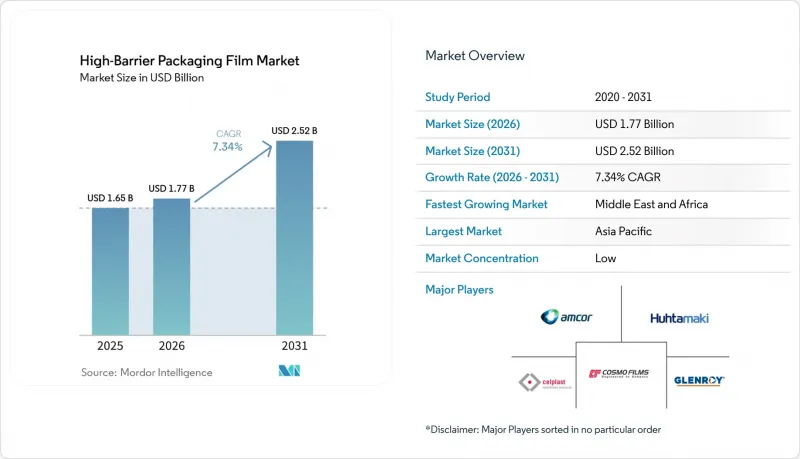
據 Mordor Intelligence 稱,高阻隔包裝薄膜市場預計到 2026 年價值 17.7 億美元,高於 2025 年的 16.5 億美元,預計到 2031 年將達到 25.2 億美元。
預計 2026 年至 2031 年的複合年成長率為 7.34%。
本報告按包裝產品(袋、小袋、立式袋等)、材料(聚乙烯、聚丙烯等)、最終用戶行業(食品、寵物食品、飲料、其他)、阻隔類型(鍍鋁薄膜、其他)、技術(多層共擠出、高層共擠出、其他)和地區(北美、亞太、其他)進行分類。
全球高阻隔包裝薄膜市場趨勢及洞察
藥品泡殼包裝:生物製藥和低溫運輸物流領域的快速成長
全球生物製藥療法要求氧氣透過率低於0.1 cc/m²/天,溫度穩定性範圍為-20 度C至+25 度C,這迫使加工商指定使用符合這些嚴格標準的多層薄膜和含有EVOH的新型塗層。 DS Smith的「TailorTemp」纖維包裝可維持36小時的冷藏狀態,並代表著向監管機構和醫院可接受的可回收形式的過渡。每劑價值超過1萬美元的抗癌藥物能夠承受更高的包裝成本,使供應商能夠維持足以抵消高性能樹脂價格上漲的利潤率。此外,美國和德國對區域性冷藏倉庫的投資正在推動對能夠承受乾冰運輸的耐熱、防穿刺薄膜的需求。
線上食品銷售的激增帶動了對包裝袋和薄膜的需求。
線上零售商在配送前會對生鮮訂單進行 3 到 5 次處理,因此防穿刺性和完美密封性至關重要。為了滿足這項要求,加工商正在添加高密度輪胎樹脂(一種黏合樹脂),以加厚密封層並在更寬的溫度範圍內保持柔軟性。越南的包裝產業預計到 2026 年將成長至 35 億美元,是電子商務經濟直接轉型為更輕、更靈活的包裝形式的典型例子。醬料、調味品和嬰兒食品採用大型立式袋包裝,與玻璃瓶相比,最後一公里破損率降低了 12%,這正在推動跨國食品製造商在 2025 年宣布的品牌轉型計畫。
PE/PP樹脂價格波動劇烈
2025年初,煉油廠停產導致聚合級丙烯供應緊張,北美聚丙烯價格上漲4-5美分/磅,擠壓了加工商的利潤空間。亞洲薄膜生產商也面臨來自中國2024年計劃新增260萬噸聚丙烯出口的競爭,這導致價格波動,並阻礙了長期供應合約的簽訂。中小加工商不願將成本轉嫁給消費者,在避險方案出現之前,也正在縮減阻隔性包裝薄膜的產量。
細分市場分析
2025年,袋裝和軟包裝主導佔總銷售額的35.02%。同時,真空密著包裝預計到2031年將以9.43%的複合年成長率成長,反映出高階生肉和水產品品牌在冷藏供應鏈中對長達13天保存期限的需求。高阻隔包裝薄膜市場的這一細分領域也受益於其良好的產品可見性,從而推高了生鮮電商通路的購物車價格。在醬料和嬰幼兒食品領域,立式袋正繼續取代玻璃罐,這得益於運輸成本的降低,每個托盤運費最多可降低100美元。食材自煮包供應商偏好可剝離的托盤蓋膜,這種包裝便於微波爐加熱,也推動了該細分市場的溫和成長。
真空密著包裝需要更深的成型製程和更高的抗穿刺性,因此薄膜製造商正在添加線性低密度聚乙烯 (LLDPE) 密封網和 EVOH 黏合層。這種包裝即使在第 8 天也能保持調氣包裝中 97% 的氧氣,從而延長保存期限並減少食物廢棄物。熱成型薄膜(主要以 PET 或 PP 為基材)是藥品泡殼包裝的關鍵材料,但隨著單一材料 PE 替代品通過法規核准,其成長速度正在放緩。小袋包裝和枕式包裝在東南亞地區正面臨消費者的抵制,尤其是在印尼,印尼的目標是到 2029 年將小袋包裝廢棄物減少 30%,這迫使加工商轉向可回收的替代品。儘管面臨監管方面的阻力,泡殼包裝薄膜在對水分滲透要求極高的高價值片劑市場仍維持著市場佔有率。加工商正在透過提供生物基 PET 版本來規避風險。
聚乙烯憑藉其廣泛的加工相容性,以32.21%的市佔率保持領先地位,但價格波動意味著密封層配方需要每季進行調整以確保利潤率。 PLA和PHA等生物聚合物的市佔率仍處於個位數,但在零售商大力推廣可堆肥包裝的推動下,其年複合成長率(CAGR)穩定成長,達到10.02%。生物聚合物製成的高阻隔包裝薄膜的市場規模仍然有限,但隨著主要糖果甜點品牌在歐洲擴大其包裝袋產品線,其市場佔有率正在成長,年需求量已增至12,000噸。
聚丙烯作為熱填充解決方案,適用於需要透明度的應用。同時,雙向拉伸聚酯薄膜(BOPET)在尺寸穩定性方面仍然非常重要。其EVOH塗層的氧氣阻隔性低於0.1 cc/m²/天,確保了在相似厚度下沒有可比擬的替代品,即使在原料短缺的情況下,也能保持其高階價格。聚對二氯乙烯(PVDC)雖然受到一些批評,但它仍然是咖啡和調味品包裝袋的主要材料。儘管出於永續性的考慮,鋁箔在軟性複合材料中的使用量正在下降,但它在殺菌袋(用於已調理食品)中仍然佔據主導地位,因為這類包裝袋需要在121°C的高溫滅菌循環中保持金屬性能。微纖化纖維素和幾丁聚醣有機塗層因其能夠減輕總重量、沉積層厚度小於1µm且易於整合到現有的凹版塗佈生產線中而備受關注。
區域分析
預計到2025年,亞太地區將佔全球銷售額的42.31%,這主要得益於中產階級消費的成長以及為降低物流成本而從硬質瓶轉向軟包裝袋的趨勢。中國政府力爭在2024年實現260萬噸聚丙烯出口目標,這降低了樹脂價格,使區域加工商能夠在出口競標中提供更具競爭力的價格,但也使他們面臨價格劇烈波動的風險。日本將於2025年6月生效的《食品接觸材料正面表列》要求薄膜供應商驗證21種聚合物和827種添加劑的相容性,這將延長新型結構產品的上市時間。東南亞地區小袋麵臨的挑戰正在推動可重複填充包裝袋的創新,這與印尼在2029年減少30%廢棄物的目標不謀而合。
中東和非洲地區正以9.35%的複合年成長率快速成長,這主要得益於對藥品泡殼包裝產能的投資以及連接海灣國家與北非和東非的冷鏈運輸路線的開發。各國政府正投入醫療預算推出國內疫苗生產廠,這些工廠需要多層低溫運輸袋,從而推高了對大量使用EVOH(乙烯-醋酸乙烯酯共聚物)的包裝結構的需求。沙烏地阿拉伯的能源補貼降低了乙烯成本,為該地區的一體化生產商創造了空間,使其能夠投資下游阻隔薄膜。
北美市場已趨於成熟,但生物製藥灌裝和包裝設施的擴張以及採用多層包裝袋的高階寵物食品的興起,正為其帶來新的機會。加州和奧勒岡州的生產者責任延伸制度(EPR)根據可回收性指數收取費用,正推動零售商轉向單一材料解決方案。加拿大禁止使用一次性塑膠製品,加速了從熱成型翻蓋式容器轉向可重複密封聚乙烯(PE)包裝袋的轉變。墨西哥正利用美墨加協定(USMCA)吸引對共擠出成型技術的投資,並努力將自身打造成為近岸外包中心。
歐洲仍然是循環經濟法規的標竿。高達每公斤0.80歐元的生產者延伸責任制(EPR)費用正在推動單一材料雙向拉伸聚乙烯(BOPE)和阻隔塗層紙的普及。安姆科(Amcor)的AmFiber紙因其阻隔性和可回收性而獲得歐盟專利,證明了其取代鋁箔的合理性(amcor.com)。東歐較低的營運成本促使西歐品牌商轉移生產,但嚴酷的冬季考驗著薄膜的耐久性,從而推高了對更耐衝擊樹脂的需求。
南美洲經濟呈現穩定成長態勢,主要成長動力來自加工食品和農產品出口。阿根廷和巴西受匯率波動影響,進口樹脂價格難以統一,導致隔離層暫時被價格較低的混合材料取代。當地回收商缺乏處理金屬化廢棄物的能力,但巴西新建的一座化學回收廠預計將於2027年建成,屆時將建立一套循環利用系統。
其他好處:
- Excel格式的市場預測(ME)表
- 3個月的分析師支持
目錄
第1章:引言
- 研究假設和市場定義
- 調查範圍
第2章:調查方法
第3章執行摘要
第4章 市場狀況
- 市場概覽
- 市場促進因素
- 生物製藥和低溫運輸物流領域對藥品泡殼包裝的需求激增。
- 線上食品銷售的激增帶動了對包裝袋和薄膜的需求。
- 亞太地區從硬質立式袋轉向輕質立式袋的過渡
- 採用阻隔包裝的高蛋白寵物食品
- 採用單一材料 MDO-PE/BOPE 來提高可回收性(新)。
- 一種新型近紅外線可檢測奈米塗層,可降低EPR成本
- 市場限制因素
- PE/PP樹脂價格波動劇烈
- 塑膠廢棄物法規和多層薄膜
- SiOx/AlOx BOPE(新)的有限回收利用
- 自2027年起,PVDC和EVOH供應將出現短缺(新增)
- 供應鏈分析
- 監理情勢
- 技術展望
- 波特五力分析
第5章 市場規模與成長預測
- 透過包裝產品
- 袋子和小袋
- 立式袋
- 托盤蓋膜
- 熱成型薄膜
- 拉伸收縮包裝
- 泡殼底膜
- 包裝膜和小袋
- 真空密著包裝
- 材料
- 聚乙烯(LDPE、HDPE、MDO-PE)
- 聚丙烯(雙向拉伸聚丙烯 (BOPP)、共聚聚丙烯 (CPP))
- 雙向拉伸聚對苯二甲酸乙二醇酯(BOPET)
- 乙烯-乙烯醇共聚物(EVOH)
- 聚醯胺
- 鋁箔
- Polyvinylidene氯乙烯(PVDC)
- 生物聚合物(PLA、PHA)
- 其他材料
- 按最終用戶行業分類
- 食品和寵物食品
- 肉類和水產品
- 乳製品和乳酪
- 零食和糖果甜點
- 飲料
- 藥品和醫療保健
- 個人護理化妝品
- 電子設備
- 農業與化學
- 食品和寵物食品
- 屏障類型
- 金屬化薄膜
- 透明高阻隔膜
- 有機塗層膜
- 無機氧化物薄膜
- 透過技術
- 多層共擠出(7層)
- 多層(7層或以上)共擠出
- 單材料阻隔膜
- 其他技術
- 按地區
- 北美洲
- 美國
- 加拿大
- 墨西哥
- 歐洲
- 德國
- 英國
- 法國
- 義大利
- 西班牙
- 俄羅斯
- 其他歐洲國家
- 亞太地區
- 中國
- 日本
- 印度
- ASEAN
- 澳洲和紐西蘭
- 其他亞太國家
- 中東和非洲
- 中東
- 沙烏地阿拉伯
- 阿拉伯聯合大公國
- 土耳其
- 其他中東國家
- 非洲
- 南非
- 肯亞
- 其他非洲國家
- 中東
- 南美洲
- 巴西
- 阿根廷
- 其他南美國家
- 北美洲
第6章 競爭情勢
- 市場集中度
- 策略趨勢
- 市佔率分析
- 公司簡介
- Amcor plc
- Mondi Group plc
- Sealed Air Corp.
- Huhtamaki Oyj
- Taghleef Industries
- Toppan Printing Co. Ltd.
- Cosmo Films Ltd.
- Polyplex Corp. Ltd.
- Uflex Ltd.
- Glenroy Inc.
- Winpak Ltd.
- Jindal Films
- Bemis(now Amcor)
- Toray Advanced Film
- Mitsubishi Chemical Group
- Dow Inc.
- SABIC
- BASF SE
- Kuraray Co. Ltd.
- ExxonMobil Chemical
第7章 市場機會與未來展望
According to Mordor Intelligence, the high barrier packaging films market size in 2026 is estimated at USD 1.77 billion, growing from 2025 value of USD 1.65 billion with 2031 projections showing USD 2.52 billion, growing at 7.34% CAGR over 2026-2031.
This report is Segmented by Packaging Product (Bags and Pouches, Stand-Up Pouches, and More), Material (Polyethylene, Polypropylene, and More), End-User Industry (Food and Pet Food, Beverages, and More), Barrier Type (Metallized Films, and More), Technology (Multilayer Co-Extrusion Layers), (High-Layer Co-Extrusion, and More) and Geography (North America, Asia-Pacific, and More).
Global High-Barrier Packaging Film Market Trends and Insights
Pharma blister Boom in Biologics and Cold-chain Logistics
Global biologics therapies require oxygen transmission rates below 0.1 cc/m2/day and temperature stability from -20 °C to +25 °C, pushing converters to specify multilayer films containing EVOH and novel coatings that meet these strict thresholds. DS Smith's TailorTemp fiber pack keeps chilled conditions for 36 hours, illustrating a switch to recyclable formats acceptable to regulators and hospitals. Oncology drugs valued at more than USD 10,000 per dose tolerate packaging cost premiums, allowing suppliers to command margins that offset higher-performance resin prices. Investment in regional cold warehouses in the United States and Germany is also lifting demand for heat-stable, puncture-resistant films compatible with dry-ice shipping.
E-grocery Surge Driving Pouch and Film Demand
Online retailers handle each grocery order three to five times before delivery, making puncture resistance and flawless seals mandatory. Converters respond by thickening sealing layers and adding higher-density tie resins that retain flexibility over a wider temperature range. Vietnam's packaging sector, racing toward USD 3.5 billion by 2026, exemplifies how e-commerce economies jump directly to lightweight flexible formats. Sauces, condiments, and baby food moving into large stand-up pouches show 12% fewer breakages than glass jars during last-mile transit, underpinning brand conversions announced by multinational food manufacturers in 2025.
Volatile PE/PP Resin Prices
North American polypropylene rose 4-5 cents per pound in early 2025 after refinery shutdowns tightened polymer-grade propylene supply, squeezing converters' margins. Asian film makers also face competition from China's planned 2.6 million-tonne PP export push in 2024, creating a price whipsaw and deterring long-term supply contracts. Smaller converters pass through costs more slowly, prompting some to scale back high barrier packaging films production until hedging tools become affordable.
Other drivers and restraints analyzed in the detailed report include:
- Shift from Rigid to Lightweight Stand-up Pouches in Asia-Pacific
- Mono-material MDO-PE/BOPE Adoption for Recyclability
- PVDC and EVOH Supply Crunch Post-2027
For complete list of drivers and restraints, kindly check the Table Of Contents.
Segment Analysis
The segment led by bags and pouches banked 35.02% of 2025 revenue, while vacuum skin packs are projected to record a 9.43% CAGR through 2031, reflecting premium fresh meat and seafood brands' need for up to 13-day shelf life in chilled supply chains. This portion of the high barrier packaging films market also benefits from attractive product visibility that drives higher cart values in e-grocery channels. Stand-up pouches continue to replace glass jars in sauces and infant food, aided by shipping-cost savings that run to USD 100 per pallet. Meal kit suppliers favor tray lidding films with peelable options compatible with microwave reheating, supporting moderate growth.
Vacuum skin packs require deeper forming and stronger puncture resistance, prompting film formulators to add linear low-density polyethylene seal webs and EVOH tie layers. Such packs often preserve 97% of modified-atmosphere oxygen at day eight, extending the sell-by date and shrinking food waste. Thermoforming films, mostly PET or PP-based, remain essential for blister packs in pharma, but growth lags as mono-material PE replacements pass regulatory audits. Sachets and flow wraps face consumer backlash in Southeast Asia, notably Indonesia's 30% reduction target for sachet waste by 2029, pushing converters toward recyclable alternatives. Blister base films, despite regulatory headwinds, preserve share for high-value tablets that demand near-zero moisture ingress; converters hedge risk by offering bio-based PET versions.
Polyethylene retains the lion's share at 32.21%, anchored by broad processing compatibility, although price volatility triggers quarterly reforms in sealing-layer blends to protect margin. Biopolymers such as PLA and PHA, while accounting for a single-digit slice, are clocking a brisk 10.02% CAGR, buoyed by retailer commitments to compost-ready packaging. The high barrier packaging films market size for biopolymers is still limited, but becomes meaningful when a large confectionery brand rolls out pouch lines across Europe, scaling annual demand to 12,000 tons.
Polypropylene follows as the solution for hot-fill applications and transparency, whereas BOPET retains importance for dimensional stability. EVOH's sub-0.1 cc/m2/day oxygen barrier secures its premium price point even during raw-material shortfalls because no drop-in substitute matches performance at similar thickness. PVDC, though under scrutiny, remains the workhorse in coffee and seasoning sachets. Aluminum foil use recedes in flexible laminates due to sustainability claims, yet still prevails in retort pouches for ready-to-eat meals where 121 °C sterilization cycles demand metal performance. Organic coatings based on micro-fibrillated cellulose or chitosan draw interest because they add less than 1 µm of deposit yet cut overall weight, integrating well within existing gravure-coated production lines.
Geography Analysis
Asia-Pacific retained 42.31% of 2025 revenue, sustained by rising middle-class consumption and a shift from rigid jars to flexible pouches that pare logistics costs. The Chinese government's push to export 2.6 million tons of polypropylene in 2024 dampened resin prices, allowing regional converters to quote aggressive bids in export tenders yet exposing them to price whiplash. Japan's positive list for food contact materials, effective June 2025, obliges film suppliers to qualify 21 polymer classes and 827 additives, lengthening time-to-market for new structures. Southeast Asia's sachet dilemma sparks innovation in refillable pouches, aligning with Indonesia's 30% waste-cut target by 2029.
Middle East and Africa expands at 9.35% CAGR, fueled by investment in pharmaceutical blister capacity and improved refrigerated transport corridors linking the Gulf to North and East Africa. Governments funnel health budgets into local vaccine plant start-ups that specify multilayer cold-chain pouches, propelling demand for EVOH-rich structures. Energy subsidies in Saudi Arabia reduce ethylene costs, giving regional integrated producers margin to support downstream barrier film investments.
North America, though mature, gains from biologics fill-finish expansions and premium pet food formats that rely on multi-layer pouches. EPR laws in California and Oregon levy fees by recyclability index, steering retailers toward mono-material solutions. Canada's single-use plastics ban accelerates moves from thermoform clamshells to resealable PE pouches. Mexico leverages USMCA to attract co-extrusion investments, positioning itself as a near-shoring hub.
Europe remains a bellwether for circular economy mandates. EPR charges of up to EUR 0.80 per kilogram drive adoption of mono-material BOPE and barrier-coated papers. Amcor's AmFiber paper received an EU patent for high barrier recyclable performance, validating movement away from foil amcor.com. Eastern Europe's lower operating costs entice western brand owners to shift volume, yet cold winters test film toughness, spurring higher-impact resins.
South America records stable growth, hinged on processed foods and agricultural exports. Argentina and Brazil see currency swings that challenge import resin parity pricing, causing periodic substitution of barrier layers with cheaper blends. Regional recyclers lack capacity for metallized scrap, but new chemical recycling plants in Brazil promise to close loops by 2027.
- Amcor plc
- Mondi Group plc
- Sealed Air Corp.
- Huhtamaki Oyj
- Taghleef Industries
- Toppan Printing Co. Ltd.
- Cosmo Films Ltd.
- Polyplex Corp. Ltd.
- Uflex Ltd.
- Glenroy Inc.
- Winpak Ltd.
- Jindal Films
- Bemis (now Amcor)
- Toray Advanced Film
- Mitsubishi Chemical Group
- Dow Inc.
- SABIC
- BASF SE
- Kuraray Co. Ltd.
- ExxonMobil Chemical
Additional Benefits:
- The market estimate (ME) sheet in Excel format
- 3 months of analyst support
TABLE OF CONTENTS
1 INTRODUCTION
- 1.1 Study Assumptions and Market Definition
- 1.2 Scope of the Study
2 Research Methodology
3 Executive Summary
4 Market Landscape
- 4.1 Market Overview
- 4.2 Market Drivers
- 4.2.1 Pharma blister boom in biologics and cold-chain logistics
- 4.2.2 E-grocery surge driving pouch and film demand
- 4.2.3 Shift from rigid to lightweight stand-up pouches in APAC
- 4.2.4 High-protein pet-food formats relying on barrier pouches
- 4.2.5 Mono-material MDO-PE/BOPE adoption for recyclability (new)
- 4.2.6 NIR-detectable nano-coatings reducing EPR fees (new)
- 4.3 Market Restraints
- 4.3.1 Volatile PE/PP resin prices
- 4.3.2 Plastic-waste regulations vs multilayer films
- 4.3.3 Limited recycling for SiOx/AlOx BOPE (new)
- 4.3.4 PVDC and EVOH supply crunch post-2027 (new)
- 4.4 Supply-Chain Analysis
- 4.5 Regulatory Landscape
- 4.6 Technological Outlook
- 4.7 Porter's Five Forces Analysis
- 4.7.1 Threat of New Entrants
- 4.7.2 Bargaining Power of Buyers
- 4.7.3 Bargaining Power of Suppliers
- 4.7.4 Threat of Substitutes
- 4.7.5 Competitive Rivalry
5 MARKET SIZE AND GROWTH FORECASTS (VALUE)
- 5.1 By Packaging Product
- 5.1.1 Bags and Pouches
- 5.1.2 Stand-up Pouches
- 5.1.3 Tray-Lidding Films
- 5.1.4 Thermoforming Films
- 5.1.5 Stretch and Shrink Wrap
- 5.1.6 Blister Base Film
- 5.1.7 Flow-wrap and Sachets
- 5.1.8 Vacuum Skin Packs
- 5.2 By Material
- 5.2.1 Polyethylene (LDPE, HDPE, MDO-PE)
- 5.2.2 Polypropylene (BOPP, CPP)
- 5.2.3 Biaxially Oriented Polyethylene Terephthalate (BOPET)
- 5.2.4 Ethylene Vinyl Alcohol Copolymer (EVOH)
- 5.2.5 Polyamide
- 5.2.6 Aluminium Foil
- 5.2.7 Polyvinylidene Chloride (PVDC)
- 5.2.8 Biopolymers (PLA, PHA)
- 5.2.9 Other Material
- 5.3 By End-user Industry
- 5.3.1 Food and Pet Food
- 5.3.1.1 Meat and Seafood
- 5.3.1.2 Dairy and Cheese
- 5.3.1.3 Snacks and Confectionery
- 5.3.2 Beverages
- 5.3.3 Pharmaceutical and Medical
- 5.3.4 Personal Care and Cosmetics
- 5.3.5 Electronics
- 5.3.6 Agriculture and Chemicals
- 5.3.1 Food and Pet Food
- 5.4 By Barrier Type
- 5.4.1 Metallized Films
- 5.4.2 Clear High-Barrier Films
- 5.4.3 Organic-coated Films
- 5.4.4 Inorganic Oxide Films
- 5.5 By Technology
- 5.5.1 Multilayer Co-extrusion (?7 layers)
- 5.5.2 High-layer (>7) Co-extrusion
- 5.5.3 Mono-material Barrier Films
- 5.5.4 Other Technology
- 5.6 By Geography
- 5.6.1 North America
- 5.6.1.1 United States
- 5.6.1.2 Canada
- 5.6.1.3 Mexico
- 5.6.2 Europe
- 5.6.2.1 Germany
- 5.6.2.2 United Kingdom
- 5.6.2.3 France
- 5.6.2.4 Italy
- 5.6.2.5 Spain
- 5.6.2.6 Russia
- 5.6.2.7 Rest of Europe
- 5.6.3 Asia-Pacific
- 5.6.3.1 China
- 5.6.3.2 Japan
- 5.6.3.3 India
- 5.6.3.4 ASEAN
- 5.6.3.5 Australia and New Zealand
- 5.6.3.6 Rest of Asia-Pacific
- 5.6.4 Middle East and Africa
- 5.6.4.1 Middle East
- 5.6.4.1.1 Saudi Arabia
- 5.6.4.1.2 United Arab Emirates
- 5.6.4.1.3 Turkey
- 5.6.4.1.4 Rest of Middle East
- 5.6.4.2 Africa
- 5.6.4.2.1 South Africa
- 5.6.4.2.2 Kenya
- 5.6.4.2.3 Rest of Africa
- 5.6.4.1 Middle East
- 5.6.5 South America
- 5.6.5.1 Brazil
- 5.6.5.2 Argentina
- 5.6.5.3 Rest of South America
- 5.6.1 North America
6 COMPETITIVE LANDSCAPE
- 6.1 Market Concentration
- 6.2 Strategic Moves
- 6.3 Market Share Analysis
- 6.4 Company Profiles (includes Global level Overview, Market level overview, Core Segments, Financials as available, Strategic Information, Market Rank/Share for key companies, Products and Services, and Recent Developments)
- 6.4.1 Amcor plc
- 6.4.2 Mondi Group plc
- 6.4.3 Sealed Air Corp.
- 6.4.4 Huhtamaki Oyj
- 6.4.5 Taghleef Industries
- 6.4.6 Toppan Printing Co. Ltd.
- 6.4.7 Cosmo Films Ltd.
- 6.4.8 Polyplex Corp. Ltd.
- 6.4.9 Uflex Ltd.
- 6.4.10 Glenroy Inc.
- 6.4.11 Winpak Ltd.
- 6.4.12 Jindal Films
- 6.4.13 Bemis (now Amcor)
- 6.4.14 Toray Advanced Film
- 6.4.15 Mitsubishi Chemical Group
- 6.4.16 Dow Inc.
- 6.4.17 SABIC
- 6.4.18 BASF SE
- 6.4.19 Kuraray Co. Ltd.
- 6.4.20 ExxonMobil Chemical
7 MARKET OPPORTUNITIES AND FUTURE OUTLOOK
- 7.1 White-space and Unmet-need Assessment

 紙箱製造薄膜市場規模、佔有率和成長分析:按薄膜類型、厚度、應用、終端用戶產業、分銷管道和地區分類-產業預測(2026-2033 年)
 Polyvinylidene氯乙烯(PVDC)塗層薄膜:市場佔有率分析、行業趨勢和統計數據以及成長預測(2026-2031 年)
 蛋白質薄膜市場分析及預測(至2035年):類型、產品、技術、應用、形態、材料類型、過程、最終用戶、功能
 全球剝離袋包裝市場規模、佔有率、成長和行業分析:按材料類型、應用和地區分類,預測至2034年
 包裝薄膜市場:依材料、結構、製造技術、包裝形式及應用分類-2026-2032年全球市場預測
 纖維素薄膜市場:按類型、產品類型、應用、最終用途和地區分類聚丙烯包裝薄膜:市佔率分析、產業趨勢與統計、成長預測(2026-2031)
 包裝阻隔膜市場預測至2034年-按材料、包裝類型、最終用戶和地區分類的全球分析高阻隔包裝薄膜市場預測至2034年—按材料、包裝類型、技術、應用和地區分類的全球分析阻隔性軟包裝市場預測至2034年-按材料類型、阻隔類型、包裝形式、技術、最終用戶和地區分類的全球分析