


 |
市場調查報告書
商品編碼
2124084
歐洲消費品包裝:市場佔有率分析、產業趨勢與統計及成長預測(2026-2031 年)Europe Consumer Packaging - Market Share Analysis, Industry Trends & Statistics, Growth Forecasts (2026 - 2031) |
||||||

※ 本網頁內容可能與最新版本有所差異。詳細情況請與我們聯繫。
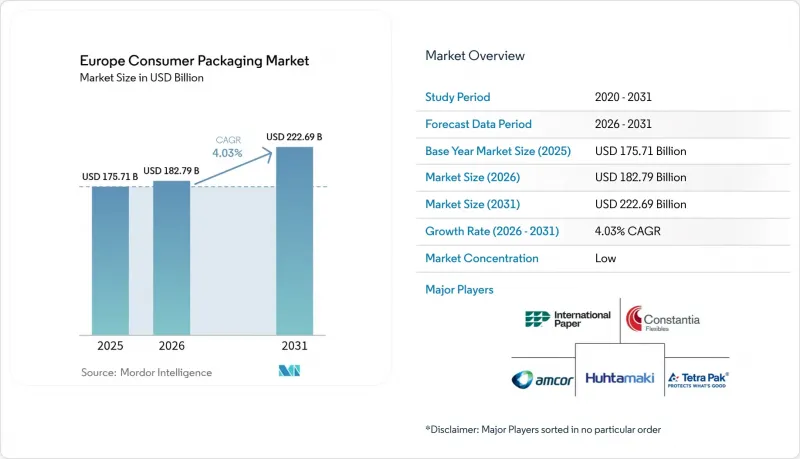
據 Mordor Intelligence 稱,2025 年歐洲消費品包裝市場價值 1757.1 億美元,預計到 2031 年將達到 2226.9 億美元,而 2026 年為 1827.9 億美元,預測期(2026-2031 年)複合年成長率為 4.03%。
本報告按材料(塑膠(PE、PP、PET等)、紙和紙板(瓦楞紙板、模塑纖維等)、玻璃、金屬(罐、蓋/封口、管材等))、包裝類型(硬質、軟質、半硬質)、終端用戶行業(食品、飲料、醫藥/保健等)和國家/地區進行細分。市場預測以美元(USD)為單位。
歐洲消費品包裝市場的趨勢與洞察
對兼顧便捷性的軟塑膠包裝的需求日益成長。
隨著都市區外帶消費的復甦,軟包裝持續蠶食玻璃和金屬包裝的市場佔有率。預先已調整的、易於開啟和重複密封的包裝袋完美契合25-45歲人群的移動生活方式,他們重視便攜性和新鮮度。價格波動相對較小。儘管7微米鋁箔在2024年下半年價格上漲了4%,但加工商透過採用輕質薄膜和阻隔塗層來抵消成本上漲,這些薄膜在不增加體積的情況下延長了保存期限。如今,功能性比包裝形式更為重要,醬料和嬰兒食品等液體產品正從厚重的硬質包裝轉向帶有吸嘴的包裝袋。因此,軟質包裝在食品和個人護理領域持續成長。
電子商務的快速發展催生了對最後一公里包裝的需求。
直接配送給消費者意味著包裝要經過多個環節,必須承受輸送機上的跌落、溫度變化以及送貨上門時的嚴格檢查。 《塑膠廢棄物減量條例》(PPWR) 規定,到 2030 年,40% 的運輸和零售包裝必須可重複使用,這給零售商帶來了壓力,迫使他們將自動化與永續性結合。市場對兼具緩衝性和尺寸效率的模塑纖維內襯以及精密設計的瓦楞紙箱的需求激增。波蘭和西班牙的電子商務滲透率成長最快,加劇了歐洲消費品包裝市場的區域成長差距。品牌擁有者也在利用數位印刷技術將每個小包裹變成行銷畫布,使拆箱體驗從單純的成本中心轉變為收入來源。
高波動性聚合物和紙漿價格
原料價格波動擠壓了加工商的利潤空間,並擾亂了基於季度指數的價格合約。 2024年初,由於下游需求疲軟,聚乙烯價格回落;而亞洲供應鏈中斷導致PET價格上漲,凸顯了預測原物料價格走勢的難度。在紡織業,由於造紙廠停產檢修和物流瓶頸,塗佈紙價格在2024年第二季飆升近10%,之後趨於穩定。儘管回收業務和紙漿資產的垂直整合獲得了支持,但這佔用了原本可用於創新和地理擴張的資金。
細分市場分析
預計到2025年,紙和紙板市場將佔總銷售額的35.22%,這主要得益於電子商務和餐飲服務業對一次性產品的需求。在歐洲消費品包裝市場,紙本解決方案的市場規模預計將溫和成長,這得益於有利的監管政策和消費者環保意識的不斷提高。然而,PET的複合年成長率高達5.74%,凸顯了市場發展勢頭的顯著轉變,這主要得益於押金返還機制的經濟可行性以及品牌對使用食品級再生材料的承諾。歐洲消費品包裝市場佔有率的擴張主要由單一材料PET飲料瓶推動,這些飲料瓶在2024年平均使用了24%的再生樹脂,凸顯了閉合迴路系統的可行性。相較之下,PE和PP則面臨挑戰,因為新的禁令將導致一次性瓶蓋、刀叉餐具和薄型食品袋退出市場。
PET的優勢也體現在其機械回收率上,在最佳化後的工廠中,其回收率可達75%,從而縮小了與纖維紙盒的碳排放差距。同時,玻璃產業協會正積極推動價值200億歐元的熔爐電氣化,但飆升的電費正使其競爭力蒙上陰影。鋁在循環經濟中仍佔據重要地位,但廢舊鋁罐片的流動性取決於各地區的回收率。特種聚合物在藥品泡殼包裝和個人保健產品幫浦組件等領域仍有成長空間,在這些領域,性能比統一的可回收性更為重要。
其他好處:
- Excel格式的市場預測(ME)表
- 3個月的分析師支持
目錄
第1章:引言
- 研究假設和市場定義
- 調查範圍
第2章:調查方法
第3章執行摘要
第4章 市場狀況
- 市場概覽
- 市場促進因素
- 對兼顧便捷性的軟性塑膠包裝的需求日益成長。
- 電子商務的快速發展催生了對最後一公里包裝的需求。
- 重量更輕,更容易打開
- 歐盟的一次性塑膠指令正在促進單一材料產品的研究和開發;
- 押金返還制度正在擴大對再生PET的需求。
- 數位印刷技術能夠增加產品種類,並實現小批量生產。
- 市場限制因素
- 聚合物和紙漿價格飆升
- 歐盟擴大對難以回收形式的監管範圍。
- 多層軟性包裝回收面臨的挑戰
- 能源價格的急劇上漲推高了玻璃和金屬的成本。
- 產業供應鏈分析
- 監理情勢
- 技術展望
- 波特五力分析
第5章 市場規模與成長預測
- 材料
- 塑膠
- PE(聚乙烯)
- PP(聚丙烯)
- PET(聚對苯二甲酸乙二醇酯)
- PVC(聚氯乙烯)
- 其他塑膠
- 紙張和紙板
- 紙板
- 瓦楞紙板底紙和麵紙
- 模塑纖維
- 玻璃
- 金屬
- 能
- 瓶蓋和封口
- 管子
- 其他金屬
- 塑膠
- 按包裝類型
- 死板的
- 靈活的
- 半剛性
- 按最終用戶行業分類
- 食物
- 飲料
- 藥品和醫療保健
- 化妝品、個人護理、居家護理
- 其他終端用戶產業
- 國家
- 德國
- 英國
- 法國
- 義大利
- 西班牙
- 波蘭
- 其他歐洲國家
第6章 競爭情勢
- 市場集中度
- 策略趨勢
- 市佔率分析
- 公司簡介
- Amcor PLC
- Huhtamaki Oyj
- Mondi PLC
- International Paper Company
- Tetra Pak International SA
- Ardagh Group SA
- Crown Holdings, Inc.
- Constantia Flexibles Holding GmbH
- Sealed Air Corporation
- Sonoco Products Company
- Stora Enso Oyj
- Smurfit Kappa Group Limited
- Ball Corporation
- Berry Global, Inc.
- Greiner Packaging International GmbH
- Albea Group SAS
- Gerresheimer AG
- Vetropack Holding AG
- Massilly Holding
第7章 市場機會與未來展望
According to Mordor Intelligence, the Europe consumer packaging market size was valued at USD 175.71 billion in 2025 and estimated to grow from USD 182.79 billion in 2026 to reach USD 222.69 billion by 2031, at a CAGR of 4.03% during the forecast period (2026-2031).
This report is Segmented by Material (Plastic (PE, PP, PET, and More), Paper and Board (Cartonboard, Molded Fiber, and More), Glass, and Metal (Cans, Caps and Closures, Tubes, and More)), Packaging Format (Rigid, Flexible, and Semi-Rigid), End-User Industry (Food, Beverage, Pharmaceutical and Healthcare, and More), and Country. The Market Forecasts are Provided in Terms of Value (USD).
Europe Consumer Packaging Market Trends and Insights
Convenience-driven demand for flexible plastic packs
Flexible formats continue to migrate volume from glass and metal as on-the-go consumption rebounds across urban corridors. Portion-controlled pouches with easy-open reclosable features meet the mobile lifestyle of 25- to 45-year-olds who prize portability and freshness. Price movements remain modest. 7-micron aluminum foil rose 4% in late 2024, but converters offset cost upticks through barrier-coated lightweight films that extend shelf life without adding bulk. Functionality now outweighs format loyalty, drawing liquid applications such as sauces and baby food toward spouted pouches and away from heavier rigid alternatives. The result is sustained share capture for flexibles in both food and personal-care aisles.
E-commerce boom creating last-mile packaging needs
Direct-to-consumer fulfillment adds multiple touchpoints where packs must survive conveyor drops, temperature shifts, and doorstep scrutiny. The PPWR mandates 40% reusable transport and sales packaging by 2030, pressuring retailers to harmonize automation with sustainability. Demand is surging for molded-fiber inserts and precision-engineered corrugated boxes that balance cushioning with dimensional efficiency. Poland and Spain show the steepest e-commerce penetration curves, widening the regional growth gap within the European consumer packaging market. Brand owners also leverage digital print to transform each parcel into a marketing canvas, elevating unboxing to a revenue lever rather than a cost center.
Volatile polymer and paper pulp prices
Feedstock swings erode converter margins and disrupt pricing contracts fixed on quarterly indices. Polyethylene values softened in early 2024 amid weak downstream demand, yet PET tightened when Asian supply lines faltered, demonstrating the difficulty of forecasting input trajectories. On the fiber side, coated paper spiked nearly 10% in Q2 2024 before easing, driven by mill maintenance outages and logistics bottlenecks. Vertical integration into recycling or pulp assets is gaining favor, but it locks capital that could fund innovation or geographic expansion.
Other drivers and restraints analyzed in the detailed report include:
- Shift toward lightweighting and easy-open formats
- EU Single-Use Plastics Directive spurring mono-material R&D
- Expanding EU bans on difficult-to-recycle formats
For complete list of drivers and restraints, kindly check the Table Of Contents.
Segment Analysis
Paper and board defended 35.22% of 2025 revenue on the strength of e-commerce shippers and foodservice disposables. The Europe consumer packaging market size for paper-based solutions is projected to expand modestly as regulatory goodwill and consumer perception remain supportive. However, PET's 5.74% CAGR underscores a decisive momentum swing driven by deposit-return economics and brand pledges for food-grade recycled content. Europe consumer packaging market share gains accrue to mono-PET beverage bottles that averaged 24% recycled resin in 2024, validating closed-loop viability. In contrast, PE and PP navigate headwinds from single-use caps, cutlery, and thin grocery bags disappearing under new bans.
The PET narrative is reinforced by mechanical recycling yields that reach 75% in optimized plants, narrowing the carbon delta versus fiber-based cartons. Meanwhile, glass lobbies are campaigning for EUR 20 billion in furnace electrification, but elevated electricity tariffs cloud competitiveness. Aluminum retains a strong circularity story, yet the liquidity of post-consumer can sheet fluctuates with regional redemption rates. Specialty polymers hold pockets of growth in pharma blister packs and personal-care pump components, where performance trumps uniform recyclability mandates.
Complete Report Scope:
- By Material
- Plastic
- PE (Polyethylene)
- PP (Polypropylene)
- PET (Polyethylene Terephthalate)
- PVC (Polyvinyl Chloride)
- Other Plastics
- Paper and Board
- Cartonboard
- Containerboard and Linerboard
- Molded Fiber
- Glass
- Metal
- Cans
- Caps and Closures
- Tubes
- Other Metals
- Plastic
- By Packaging Format
- Rigid
- Flexible
- Semi-rigid
- By End-user Industry
- Food
- Beverage
- Pharmaceutical and Healthcare
- Cosmetics, Personal and Home Care
- Other End-user Industry
- By Country
- Germany
- United Kingdom
- France
- Italy
- Spain
- Poland
- Rest of Europe
List of Companies Covered in this Report:
- Amcor PLC
- Huhtamaki Oyj
- Mondi PLC
- International Paper Company
- Tetra Pak International SA
- Ardagh Group S.A.
- Crown Holdings, Inc.
- Constantia Flexibles Holding GmbH
- Sealed Air Corporation
- Sonoco Products Company
- Stora Enso Oyj
- Smurfit Kappa Group Limited
- Ball Corporation
- Berry Global, Inc.
- Greiner Packaging International GmbH
- Albea Group S.A.S.
- Gerresheimer AG
- Vetropack Holding AG
- Massilly Holding
Additional Benefits:
- The market estimate (ME) sheet in Excel format
- 3 months of analyst support
TABLE OF CONTENTS
1 INTRODUCTION
- 1.1 Study Assumptions and Market Definition
- 1.2 Scope of the Study
2 RESEARCH METHODOLOGY
3 EXECUTIVE SUMMARY
4 MARKET LANDSCAPE
- 4.1 Market Overview
- 4.2 Market Drivers
- 4.2.1 Convenience-driven demand for flexible plastic packs
- 4.2.2 E-commerce boom creating last-mile packaging needs
- 4.2.3 Shift toward lightweighting and easy-open formats
- 4.2.4 EU Single-Use Plastics Directive spurring mono-material R&D
- 4.2.5 Deposit-return schemes scaling rPET demand
- 4.2.6 Digital printing enabling SKU proliferation and short-runs
- 4.3 Market Restraints
- 4.3.1 Volatile polymer and paper pulp prices
- 4.3.2 Expanding EU bans on difficult-to-recycle formats
- 4.3.3 Recycling gaps for multilayer flexibles
- 4.3.4 Energy-price shocks inflating glass and metal costs
- 4.4 Industry Supply Chain Analysis
- 4.5 Regulatory Landscape
- 4.6 Technological Outlook
- 4.7 Porter's Five Forces Analysis
- 4.7.1 Bargaining Power of Suppliers
- 4.7.2 Bargaining Power of Consumers
- 4.7.3 Threat of New Entrants
- 4.7.4 Threat of Substitutes
- 4.7.5 Intensity of Competitive Rivalry
5 MARKET SIZE AND GROWTH FORECASTS (VALUE)
- 5.1 By Material
- 5.1.1 Plastic
- 5.1.1.1 PE (Polyethylene)
- 5.1.1.2 PP (Polypropylene)
- 5.1.1.3 PET (Polyethylene Terephthalate)
- 5.1.1.4 PVC (Polyvinyl Chloride)
- 5.1.1.5 Other Plastics
- 5.1.2 Paper and Board
- 5.1.2.1 Cartonboard
- 5.1.2.2 Containerboard and Linerboard
- 5.1.2.3 Molded Fiber
- 5.1.3 Glass
- 5.1.4 Metal
- 5.1.4.1 Cans
- 5.1.4.2 Caps and Closures
- 5.1.4.3 Tubes
- 5.1.4.4 Other Metals
- 5.1.1 Plastic
- 5.2 By Packaging Format
- 5.2.1 Rigid
- 5.2.2 Flexible
- 5.2.3 Semi-rigid
- 5.3 By End-user Industry
- 5.3.1 Food
- 5.3.2 Beverage
- 5.3.3 Pharmaceutical and Healthcare
- 5.3.4 Cosmetics, Personal and Home Care
- 5.3.5 Other End-user Industry
- 5.4 By Country
- 5.4.1 Germany
- 5.4.2 United Kingdom
- 5.4.3 France
- 5.4.4 Italy
- 5.4.5 Spain
- 5.4.6 Poland
- 5.4.7 Rest of Europe
6 COMPETITIVE LANDSCAPE
- 6.1 Market Concentration
- 6.2 Strategic Moves
- 6.3 Market Share Analysis
- 6.4 Company Profiles (includes Global level Overview, Market level overview, Core Segments, Financials as available, Strategic Information, Market Rank/Share for key companies, Products and Services, and Recent Developments)
- 6.4.1 Amcor PLC
- 6.4.2 Huhtamaki Oyj
- 6.4.3 Mondi PLC
- 6.4.4 International Paper Company
- 6.4.5 Tetra Pak International SA
- 6.4.6 Ardagh Group S.A.
- 6.4.7 Crown Holdings, Inc.
- 6.4.8 Constantia Flexibles Holding GmbH
- 6.4.9 Sealed Air Corporation
- 6.4.10 Sonoco Products Company
- 6.4.11 Stora Enso Oyj
- 6.4.12 Smurfit Kappa Group Limited
- 6.4.13 Ball Corporation
- 6.4.14 Berry Global, Inc.
- 6.4.15 Greiner Packaging International GmbH
- 6.4.16 Albea Group S.A.S.
- 6.4.17 Gerresheimer AG
- 6.4.18 Vetropack Holding AG
- 6.4.19 Massilly Holding
7 MARKET OPPORTUNITIES AND FUTURE OUTLOOK
- 7.1 White-space and Unmet-need Assessment

 消費品包裝市場規模、佔有率、成長、全球產業分析、區域趨勢及2026-2034年預測。
 居家護理包裝:市場佔有率分析、產業趨勢與統計、成長預測(2026-2031)快速消費品包裝:市場佔有率分析、產業趨勢與統計、成長預測(2026-2031)
 居家照護套餐市場-2026-2032年全球市場預測
 消費性包裝市場預測至2034年-按材料、包裝類型、產品類型、永續性類型、功能、應用和地區分類的全球分析居家護理產品包裝市場規模、佔有率、成長率及全球市場分析:按類型、應用和地區分類,並提供2026-2034年的洞察與預測
 居家照護包裝市場規模、佔有率、趨勢和預測:按產品類型、材料、包裝形式和地區分類,2026-2034年快速消費品包裝市場規模、佔有率、成長及全球產業分析:按類型、應用和地區分類,並預測至2026-2034年日常消費品包裝市場規模、佔有率、趨勢及預測(按包裝類型、材料、最終用途行業和地區分類,2026-2034年)
 2026年全球居家護理產品包裝市場報告