


 |
市場調查報告書
商品編碼
2121510
快速消費品包裝:市場佔有率分析、產業趨勢與統計、成長預測(2026-2031)FMCG Packaging - Market Share Analysis, Industry Trends & Statistics, Growth Forecasts (2026 - 2031) |
||||||

※ 本網頁內容可能與最新版本有所差異。詳細情況請與我們聯繫。
2025年日常消費品(FMCG)包裝市值為4.2712億噸,預計到2031年將達到5.1538億噸,而2026年為4.4071億噸,預測期(2026-2031年)複合年成長率為3.18%。
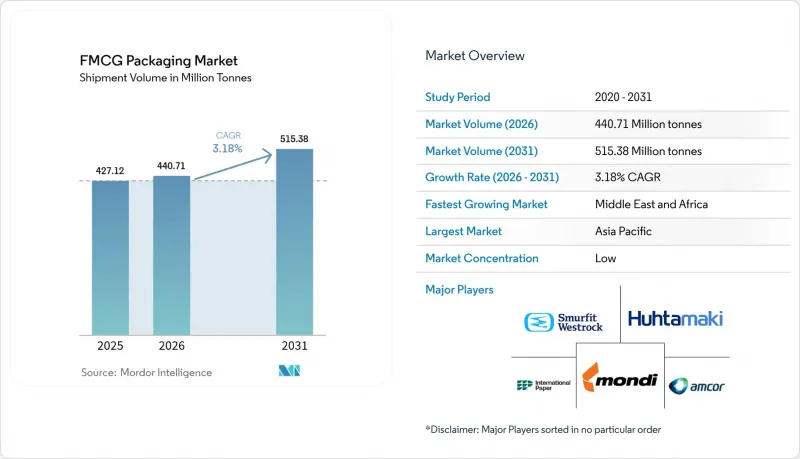
本報告按材料類型(紙和紙板、塑膠、金屬、玻璃、生物基和可堆肥材料)、包裝類型(軟包裝、硬包裝)、終端用戶行業(食品、飲料、個人護理和化妝品等)、分銷管道(直銷、間接銷售)和地區進行細分。市場預測以數量(噸)為單位。
全球快速消費品包裝市場趨勢與洞察
電子商務的快速發展對包裝提出了更高的要求,既要確保包裝的保護性,也要確保包裝的輕盈性。
目前,線上零售業的包裝設計主要圍繞著小包裹的耐用性、體積重量限制和便捷的退貨流程。品牌商指定使用氣泡信封、氣柱袋和客製尺寸的瓦楞紙箱,以顯著減少空間佔用和運輸成本。包裝廠正在採用數位印刷生產線,為每個包裹添加可掃描的條碼,用於驗證真偽和觸發補貨服務。能夠檢測衝擊損壞和溫度控制的智慧指示器正逐漸成為高階產品類別的標配,而小包裹保險公司為可追溯包裝提供保費折扣進一步推動了這一趨勢。這些需求使得對軟性薄膜和瓦楞紙板的需求居高不下,塑膠供應商正在加速開發可直接取代原有材料的再生塑膠,以保持其機械性能。
亞洲都市區「單份裝」消費的蓬勃發展,推動了對便利包裝形式的需求。
受中國、印度和東南亞地區單人家庭數量增加以及通勤堵塞加劇的推動,單份包裝的袋裝、杯裝和小袋裝食品越來越受歡迎。製造商正在實現高速填充和封口生產線的自動化,以減少大包裝食品因部分使用而造成的廢棄物,同時保持與大包裝食品的價格競爭力。零售商將優質貨架空間分配給可重複密封的零食包裝和單份即食食品,迫使加工商加強阻隔隔離層,以確保食品新鮮直至最後一份。這種成長趨勢也蔓延至居家護理和個人保養用品領域,可重複填充的膠囊和便於攜帶的迷你裝產品迎合了忙碌的都市居民的需求。對具有易開孔和抗摔性能的複合材料的需求正在推動亞洲產能的顯著成長。
樹脂價格波動導致計劃存在不確定性。
基準原油和石腦油價格的波動擾亂了季度合約談判,迫使加工商要么對沖原料風險,要么加快向再生或生物基等級產品的轉型。規模較小的公司難以承受價格飆升,導致利潤率下降,資本投資速度放緩。特種添加劑的突然短缺(通常與地緣政治事件有關)迫使企業臨時調整配方,增加了停產和客戶違約的風險。為因應這種情況,跨國公司正在實現採購多元化並簽訂多年供應契約,同時其財務部門也在實施與行業指數掛鉤的成本轉嫁條款。此類波動有利於那些整合了樹脂資產並擁有雄厚營運成本基礎的生產商。
細分市場分析
到2025年,塑膠仍將佔據日常消費品(FMCG)包裝市場61.98%的佔有率。這反映了其無與倫比的強度重量比和廣泛的加工性能。生物基和可堆肥塑膠雖然仍處於小眾市場,但隨著加工商將具有增強氧氣和水分阻隔性的PLA和PHA共混物商業化,其市場佔有率正以6.73%的複合年成長率成長。硬質金屬因其可無限循環利用的特性,在高階飲料包裝領域越來越受歡迎;而紙板在可接受纖維基壁材的領域,例如乾貨和個人保健產品領域,其市場佔有率也在不斷擴大。在快速消費品包裝市場,聚乙烯和聚丙烯因其成本效益,在軟性複合材料領域仍佔據主導地位。但北美和歐洲不斷擴大的化學回收利用可望提供高品質的廢棄樹脂,從而緩解對原生樹脂的需求。反應塗層技術的創新正在為塑膠替代品開闢新的途徑,例如無需塑膠內襯即可盛裝酸性果汁的紙杯。
塑膠供應商正透過推出經認證的、可回收的、源自熱解油的聚乙烯(PE)和聚丙烯(PP)產品來應對永續性壓力,使品牌商能夠採用「即插即用」的方式減少排放,同時維持現有的生產線。隨著政府綠色採購法規的逐步實施,預計到2031年,快速消費品包裝市場中生物基樹脂的市場規模將超過823萬噸。同時,鋁製氣霧罐和寵物食品托盤的輕盈優勢,恰好滿足了需要堅固耐用以承受多次使用的填充站的需求。玻璃在對口味中性要求極高的領域仍然發揮著重要作用,但其重量和易碎性限制了其市場佔有率的成長。總而言之,如今的材料選擇需要考慮功能性能、法規遵循和整體碳排放影響之間的平衡,而不僅僅是單位成本。
預計到2025年,軟包裝將佔據日常消費品(FMCG)包裝市場54.12%的佔有率,並持續以6.22%的複合年成長率成長至2031年。品牌擁有者重視低材料與產品比、高圖形表現力以及能夠提高托盤裝載量的包裝效率。隨著電子商務的興起,市場對適用於郵寄的枕形包裝和無需過度緩衝即可承受自動化分類的多層包裝袋的需求日益成長。連續水平成型、填充和封口(HFFS)生產線能夠以每分鐘超過1500包的速度為零食和糖果甜點品類供貨,這凸顯了迭代式包裝最佳化帶來的營運效率提升。
在結構和可重複密封性至關重要的行業,硬質包裝仍然主導著細分市場。 PET寶特瓶在碳酸飲料領域保持主導地位,而玻璃瓶則在高階醬料領域傳遞優質感。採用模壓蓋的「剛柔複合」混合型包裝袋設計融合了兩者的優勢,與同等尺寸的玻璃容器相比,重量最多可減輕70%。日常消費品(FMCG)市場的硬質包裝市場預計將以個位數低段的速度成長,這反映出成熟品類的市場飽和,但可重複灌裝的個人護理用品分配器領域的新機會將推動市場成長。設備製造商現在提供模組化填充模組,可以在一條生產線上處理各種形狀的容器,例如包裝袋、罐子和瓶子,使加工商能夠應對各種包裝規格需求的波動。
區域分析
預計到2025年,亞太地區將佔全球出貨量的45.21%,成為快速消費品包裝市場的核心樞紐。中國和印度正利用其樹脂裂解、薄膜擠出和加工廠的一體化產業叢集,在滿足國內龐大需求的同時,也為出口提供支撐。都市區微型廚房的興起和便利飲食習慣的普及推動了單份包裝袋的普及,而各國強制性的塑膠減量政策則加速了紙基軟包裝的試用。可支配收入的成長促使消費者更換高階個人保健產品,從而增加了人均包裝使用。印度和東南亞政府主導的冷鏈走廊建設進一步提升了對保溫貨櫃和防篡改封條的需求。
北美憑藉著廣泛的電子商務和先進的瓦楞紙板生產能力,保持著穩定的市場佔有率。價值200億美元的Smurfit Westrock合併案,象徵企業致力於擴大規模,分散固定成本,並為循環經濟領域的研發提供資金。諸如Green Bay Packaging在阿肯色州投資10億美元興建的牛皮箱紙板等項目,正在增強國內供應的穩定性,並拓展輕質襯紙產品的種類。美國各州對飲料容器中再生材料含量的監管,正在推動PET回收計畫的發展,並迫使當地加工商確保rPET原料的供應。加拿大和墨西哥則受益於「近岸外包」模式,即將消費品填充生產線轉移到更靠近主要需求中心的地方。
在成熟的歐洲市場,企業正利用創新來滿足基於《包裝和包裝廢棄物法規》的嚴格可回收性目標。德國和法國正在擴大物料回收設施(MRF)和化學回收試點項目,以達到最低再生材料含量標準;品牌商則在重新設計獨立包裝,以通過可分離性測試。高階糖果甜點製造商正在採用具有生物阻隔性能的纖維包裝材料,英國超級市場也在試行可重複填充服務,以檢驗消費者對可回收包裝袋的接受度。雖然整體銷售量保持穩定,但價值正向更高規格的材料和相關數位化服務轉移。
儘管基數較低,但中東和非洲地區仍錄得最高的複合年成長率(CAGR),達到6.48%,這主要得益於有組織零售業的擴張和人口成長,從而推動了對預包裝必需品的需求。海灣國家正在投資建造最先進的軟包裝工廠,為國內快餐連鎖店和出口訂單提供產品。在南非和肯亞,行動灌裝設備正在引入,以延長牛奶和果汁紙盒在冷藏設施匱乏地區的保存期限。來自歐洲和亞洲企業集團的直接投資正在引進多層擠出技術,從而提升當地的生產能力。
在南美洲,巴西和哥倫比亞的經濟改革正在刺激消費支出,預計將保持穩定成長。該地區豐富的紡織資源支撐著具有成本競爭力的瓦楞紙板生產,而巴西以甘蔗為原料的生物基聚乙烯(bio-PE)產能則為全球品牌提供了展示可再生原料的機會。關稅結構持續影響工廠位置決策,加工企業正被鼓勵採用跨越南方共同市場和太平洋聯盟的跨國企業發展。
其他好處:
- Excel格式的市場預測(ME)表
- 3個月的分析師支持
目錄
第1章:引言
- 研究假設和市場定義
- 調查範圍
第2章:調查方法
第3章執行摘要
第4章 市場狀況
- 市場概覽
- 市場促進因素
- 電子商務的快速發展對包裝提出了更高的要求,既要確保包裝的保護性,也要確保包裝的輕盈性。
- 亞洲都市區單人消費的激增正在推動便利商店業態的發展。
- 即飲飲料的激增推動了高阻隔包裝袋的採用。
- 個人護理行業對優質化的日益重視正在推動智慧和裝飾性包裝的採用。
- 新興市場冷鏈的擴張增加了多層薄膜的使用。
- 市場限制因素
- 樹脂價格波動為該計劃帶來了不確定性。
- 開發中國家缺乏回收基礎設施
- 一次性塑膠製品禁令為傳統的軟包裝市場蒙上了一層陰影。
- 供應鏈分析
- 監理展望
- 技術展望
- 波特五力分析
第5章 市場規模與成長預測
- 材料類型
- 紙張和紙板
- 塑膠
- 聚乙烯(LDPE/HDPE)
- 聚丙烯(PP)
- 聚對苯二甲酸乙二醇酯(PET)
- 其他塑膠(PVC、PS 等)
- 金屬
- 玻璃
- 生物基和可堆肥材料
- 按包裝類型
- 軟包裝
- 小袋和袋子
- 薄膜和包裝
- 其他軟包裝
- 硬包裝
- 瓶子和罐子
- 坎
- 托盤和容器
- 其他硬質包裝
- 軟包裝
- 按最終用途行業分類
- 食物
- 飲料
- 個人護理化妝品
- 居家護理產品
- 藥品和醫療保健
- 其他終端用戶產業
- 透過分銷管道
- 直銷
- 間接銷售
- 按地區
- 北美洲
- 美國
- 加拿大
- 墨西哥
- 歐洲
- 德國
- 英國
- 法國
- 義大利
- 西班牙
- 俄羅斯
- 其他歐洲國家
- 亞太地區
- 中國
- 印度
- 日本
- 韓國
- 澳洲和紐西蘭
- 其他亞太國家
- 中東和非洲
- 中東
- 阿拉伯聯合大公國
- 沙烏地阿拉伯
- 土耳其
- 其他中東國家
- 非洲
- 南非
- 奈及利亞
- 埃及
- 其他非洲國家
- 中東
- 南美洲
- 巴西
- 阿根廷
- 其他南美國家
- 北美洲
第6章 競爭情勢
- 市場集中度
- 策略趨勢
- 市佔率分析
- 公司簡介
- Amcor plc
- Ball Corporation
- Mondi Group
- International Paper Co.
- Sealed Air Corporation
- Constantia Flexibles
- Smurfit Westrock Plc
- Crown Holdings Inc.
- Coveris Holdings SA
- Graphic Packaging International LLC
- Tetra Pak International
- Stora Enso Oyj
- Sonoco Products Co.
- Huhtamaki Oyj
- Toyo Seikan Group HD
- Nampak Ltd
- Mpact Pty Ltd
- Albea SA
- Owens-Illinois(OI)
- Verallia SA
- Napco National
- 3P Gulf Group
第7章 市場機會與未來展望
According to Mordor Intelligence, the FMCG packaging market size was valued at 427.12 million tonnes in 2025 and estimated to grow from 440.71 million tonnes in 2026 to reach 515.38 million tonnes by 2031, at a CAGR of 3.18% during the forecast period (2026-2031).
This report is Segmented by Material Type (Paper and Paperboard, Plastics, Metal, Glass, Bio-Based and Compostable Materials), Packaging Type (Flexible Packaging, Rigid Packaging), End-Use Industry (Food, Beverages, Personal Care and Cosmetics, and More), Distribution Channel (Direct Sales, Indirect Sales), and Geography. The Market Forecasts are Provided in Terms of Volume (Tonnes).
Global FMCG Packaging Market Trends and Insights
Rapid Growth of E-commerce Requiring Protective, Lightweight Packs
Online retail now frames design briefs around parcel durability, dimensional weight limits, and friction-free returns. Brand owners specify cushioned mailers, air-column pouches, and fit-to-size cartons that slash void space and freight spend. Packaging plants add digital print lines so each shipper can carry scannable codes that confirm authenticity or trigger replenishment services. Smart indicators that reveal impact or temperature misuse are becoming standard on premium categories, a trend reinforced by parcel insurers who offer lower premiums for traceable packs. These needs keep flexible films and corrugated board in high demand and encourage resin suppliers to accelerate drop-in recycled grades that retain mechanical properties.
Urban Single-Serve Consumption Boom in Asia Boosting Convenience Formats
Rising numbers of single-person households and congested commutes in China, India, and Southeast Asia spur uptake of portion-controlled pouches, cups, and sachets. Manufacturers are automating high-speed fill-seal lines to reach price points competitive with bulk packs while trimming food waste from partially used larger units. Retailers dedicate premium shelf space to resealable snack packs and ready-to-eat meals sized for one, pushing converters to enhance barrier layers that keep contents fresh until the last serving. Growth spills into home-care and personal-care items, where refill pods and travel-friendly minis fit hectic urban lifestyles. Demand for laminates that couple easy-tear openings with drop-resistance underpins a notable slice of incremental Asian capacity additions.
Resin Price Volatility Creating Planning Uncertainty
Fluctuating crude-oil and naphtha benchmarks upset quarterly contract negotiations, prompting converters to hedge feedstock or accelerate substitution toward recycled and bio-based grades. Smaller firms lacking scale struggle to absorb spikes, which compress margins and slow capital investment. Sudden shortages of specialty additives, often linked to geopolitical events, force ad-hoc reformulations that risk downtime and customer penalties. In response, multinationals diversify sourcing and lock in multi-year supply pacts, while financial teams roll out cost-pass-through clauses keyed to industry indices. Such turbulence favors producers with integrated resin assets and strong working-capital positions.
Other drivers and restraints analyzed in the detailed report include:
- RTD Beverage Surge Driving High-Barrier Pouch Adoption
- Premiumisation in Personal-Care Triggering Smart and Decorative Packs
- Single-Use-Plastic Bans Dampening Conventional Flexibles
For complete list of drivers and restraints, kindly check the Table Of Contents.
Segment Analysis
Plastics maintained a 61.98% share of the FMCG packaging market in 2025, reflecting unmatched strength-to-weight ratios and broad processability. Bio-based and compostable grades, though still niche, are expanding at 6.73% CAGR as converters commercialize PLA and PHA blends with enhanced oxygen and moisture barriers. Rigid metals find favor in premium beverage lines for infinite recyclability, and paperboard gains share where dry food or personal-care formats permit fiber-based walls. The FMCG packaging market continues to favor polyethylene and polypropylene in flexible laminates thanks to cost efficiency, but chemical recycling, now scaling in North America and Europe, promises high-quality post-consumer resins that moderate virgin demand. Innovations in reactive coating lines let paper cups hold acidic juices without plastic liners, opening another pathway for plastics displacement.
Plastics suppliers counter sustainability pressures by launching certified-circular PE and PP grades derived from pyrolysis oil, giving brand owners a drop-in route to lower emissions while retaining incumbent converting lines. The FMCG packaging market size for bio-based resins is projected to surpass 8.23 million tonnes by 2031 as governmental green-procurement rules take hold. Meanwhile, aluminum's light-weight advantage in aerosol cans and pet-food trays aligns with refill stations that prefer robust formats surviving multiple cycles. Glass stays relevant where taste neutrality is prized, yet weight and breakage limit its volume share. Overall, material choice now hinges on balancing functional performance, regulatory compliance, and total carbon impact rather than unit price alone.
With a 54.12% share in 2025, flexible formats dominate the FMCG packaging market and are tracking a 6.22% CAGR to 2031. Brand owners value lower material-to-product ratios, high graphics potential, and pack-out efficiency that allows more units per pallet. The shift to e-commerce adds demand for mail-friendly pillow packs and multi-layer sachets that endure automated sortation without extra void fill. Continuous-motion horizontal form-fill-seal (HFFS) lines supply snack and confectionery categories at speeds exceeding 1,500 packs per minute, highlighting the operational gains that recursive format optimisation delivers.
Rigid options still command niches where structure and reclosability are critical. PET bottles retain leadership in carbonated soft drinks, while glass jars project premium cues in gourmet sauces. Hybrid "rigid-in-flexible" pouch designs with molded caps combine both worlds, slicing weight by up to 70% versus equivalently sized glass containers. The FMCG packaging market size for rigid formats is forecast to post low-single-digit growth, reflecting saturation in mature categories but fresh opportunities in refillable personal-care dispensers. Equipment builders now offer modular filler blocs that handle fitment pouches, jars, and bottles on one line, letting converters hedge against demand swings across formats.
Complete Report Scope:
- By Material Type
- Paper and Paperboard
- Plastics
- Polyethylene (LDPE/HDPE)
- Polypropylene (PP)
- Polyethylene Terephthalate (PET)
- Other Plastics (PVC, PS,etc)
- Metal
- Glass
- Bio-based and Compostable Materials
- By Packaging Type
- Flexible Packaging
- Pouches and Bags
- Films and Wraps
- Other Flexible Packaging
- Rigid Packaging
- Bottles and Jars
- Cans
- Trays and Containers
- Other Rigid Packaging
- Flexible Packaging
- By End-use Industry
- Food
- Beverages
- Personal Care and Cosmetics
- Household Care Products
- Pharmaceuticals and Healthcare
- Other End-use Industry
- By Distribution Channel
- Direct Sales
- Indirect Sales
- By Geography
- North America
- United States
- Canada
- Mexico
- Europe
- Germany
- United Kingdom
- France
- Italy
- Spain
- Russia
- Rest of Europe
- Asia-Pacific
- China
- India
- Japan
- South Korea
- Australia and New Zealand
- Rest of Asia-Pacific
- Middle East and Africa
- Middle East
- United Arab Emirates
- Saudi Arabia
- Turkey
- Rest of Middle East
- Africa
- South Africa
- Nigeria
- Egypt
- Rest of Africa
- Middle East
- South America
- Brazil
- Argentina
- Rest of South America
- North America
Geography Analysis
Asia-Pacific generated 45.21% of 2025 shipments, positioning the region as the anchor of the FMCG packaging market. China and India supply mammoth domestic demand and serve export flows, leveraging clusters of integrated resin crackers, film extruders, and converting plants. Urban micro-kitchens and on-the-go eating habits fuel single-serve pouch uptake, while national plastic-reduction mandates accelerate trials of paper-based flexibles. Rising disposable incomes enable trading-up to premium personal-care formats, deepening per-capita packaging intensity. Government-backed cold-chain corridors in India and Southeast Asia unleash further need for insulated shippers and tamper-evident seals.
North America follows with a stable share rooted in broad e-commerce penetration and advanced corrugated capacity. The Smurfit-WestRock merger, valued at USD 20 billion, exemplifies the push for scale to dilute fixed costs and fund circular-economy R&D. Investments such as Green Bay Packaging's USD 1 billion kraft linerboard mill in Arkansas strengthen domestic supply security and expand lightweight liner offerings. United States state regulations on recycled content in beverage containers catalyze PET reclaim projects, pushing local converters to lock in rPET feedstock. Canada and Mexico gain from near-shoring that relocates consumer-goods filling lines closer to core demand.
Europe's mature market taps innovation to meet its stringent recyclability targets under the Packaging and Packaging Waste Regulation. Germany and France upgrade MRFs and chemical-recycling pilots to satisfy minimum recycled-content thresholds, while brand owners redesign individual packs to pass "sort-ability" tests. Premium confectionery chooses fiber-based wrapping with bio-barriers, and UK supermarkets roll out refill trials that test shopper uptake of returnable pouches. These initiatives stabilize overall tonnage but shift value toward higher-spec materials and linked digital services.
Middle East and Africa register the fastest 6.48% CAGR, albeit from a lower base, as organized retail expands and population growth drives packaged staples. Gulf states invest in state-of-the-art flexible plants that supply both domestic fast-food chains and export orders. South Africa and Kenya attract mobile filling units for milk and juice cartons that extend shelf life in areas lacking refrigeration. Foreign direct investment from European and Asian groups introduces multilayer extrusion technology, lifting local capabilities.
South America offers steady upside as economic reforms in Brazil and Colombia revive consumer spending. Regional fiber availability supports cost-competitive corrugated, and sugar-cane-based bio-PE capacity in Brazil gives global brands a renewable-content narrative. Tariff structures still influence plant-location decisions, nudging converters to adopt multinational footprints that straddle Mercosur and Pacific Alliance blocs.
- Amcor plc
- Ball Corporation
- Mondi Group
- International Paper Co.
- Sealed Air Corporation
- Constantia Flexibles
- Smurfit Westrock Plc
- Crown Holdings Inc.
- Coveris Holdings S.A.
- Graphic Packaging International LLC
- Tetra Pak International
- Stora Enso Oyj
- Sonoco Products Co.
- Huhtamaki Oyj
- Toyo Seikan Group HD
- Nampak Ltd
- Mpact Pty Ltd
- Albea S.A.
- Owens-Illinois (O-I)
- Verallia SA
- Napco National
- 3P Gulf Group
Additional Benefits:
- The market estimate (ME) sheet in Excel format
- 3 months of analyst support
TABLE OF CONTENTS
1 INTRODUCTION
- 1.1 Study Assumptions and Market Definition
- 1.2 Scope of the Study
2 RESEARCH METHODOLOGY
3 EXECUTIVE SUMMARY
4 MARKET LANDSCAPE
- 4.1 Market Overview
- 4.2 Market Drivers
- 4.2.1 Rapid Growth of E-commerce Requiring Protective, Lightweight Packs
- 4.2.2 Urban Single-Serve Consumption Boom in Asia Boosting Convenience Formats
- 4.2.3 RTD Beverage Surge Driving High-Barrier Pouch Adoption
- 4.2.4 Premiumisation in Personal-Care Triggering Smart and Decorative Packs
- 4.2.5 Cold-Chain Expansion in Emerging Markets Raising Multilayer Film Usage
- 4.3 Market Restraints
- 4.3.1 Resin Price Volatility Creating Planning Uncertainty
- 4.3.2 Recycling-Infrastructure Deficit in Developing Nations
- 4.3.3 Single-Use-Plastic Bans Dampening Conventional Flexibles
- 4.4 Supply-Chain Analysis
- 4.5 Regulatory Outlook
- 4.6 Technological Outlook
- 4.7 Porter's Five Forces Analysis
- 4.7.1 Bargaining Power of Suppliers
- 4.7.2 Bargaining Power of Buyers
- 4.7.3 Threat of New Entrants
- 4.7.4 Threat of Substitutes
- 4.7.5 Intensity of Competitive Rivalry
5 MARKET SIZE AND GROWTH FORECASTS (VOLUME)
- 5.1 By Material Type
- 5.1.1 Paper and Paperboard
- 5.1.2 Plastics
- 5.1.2.1 Polyethylene (LDPE/HDPE)
- 5.1.2.2 Polypropylene (PP)
- 5.1.2.3 Polyethylene Terephthalate (PET)
- 5.1.2.4 Other Plastics (PVC, PS,etc)
- 5.1.3 Metal
- 5.1.4 Glass
- 5.1.5 Bio-based and Compostable Materials
- 5.2 By Packaging Type
- 5.2.1 Flexible Packaging
- 5.2.1.1 Pouches and Bags
- 5.2.1.2 Films and Wraps
- 5.2.1.3 Other Flexible Packaging
- 5.2.2 Rigid Packaging
- 5.2.2.1 Bottles and Jars
- 5.2.2.2 Cans
- 5.2.2.3 Trays and Containers
- 5.2.2.4 Other Rigid Packaging
- 5.2.1 Flexible Packaging
- 5.3 By End-use Industry
- 5.3.1 Food
- 5.3.2 Beverages
- 5.3.3 Personal Care and Cosmetics
- 5.3.4 Household Care Products
- 5.3.5 Pharmaceuticals and Healthcare
- 5.3.6 Other End-use Industry
- 5.4 By Distribution Channel
- 5.4.1 Direct Sales
- 5.4.2 Indirect Sales
- 5.5 By Geography
- 5.5.1 North America
- 5.5.1.1 United States
- 5.5.1.2 Canada
- 5.5.1.3 Mexico
- 5.5.2 Europe
- 5.5.2.1 Germany
- 5.5.2.2 United Kingdom
- 5.5.2.3 France
- 5.5.2.4 Italy
- 5.5.2.5 Spain
- 5.5.2.6 Russia
- 5.5.2.7 Rest of Europe
- 5.5.3 Asia-Pacific
- 5.5.3.1 China
- 5.5.3.2 India
- 5.5.3.3 Japan
- 5.5.3.4 South Korea
- 5.5.3.5 Australia and New Zealand
- 5.5.3.6 Rest of Asia-Pacific
- 5.5.4 Middle East and Africa
- 5.5.4.1 Middle East
- 5.5.4.1.1 United Arab Emirates
- 5.5.4.1.2 Saudi Arabia
- 5.5.4.1.3 Turkey
- 5.5.4.1.4 Rest of Middle East
- 5.5.4.2 Africa
- 5.5.4.2.1 South Africa
- 5.5.4.2.2 Nigeria
- 5.5.4.2.3 Egypt
- 5.5.4.2.4 Rest of Africa
- 5.5.4.1 Middle East
- 5.5.5 South America
- 5.5.5.1 Brazil
- 5.5.5.2 Argentina
- 5.5.5.3 Rest of South America
- 5.5.1 North America
6 COMPETITIVE LANDSCAPE
- 6.1 Market Concentration
- 6.2 Strategic Moves
- 6.3 Market Share Analysis
- 6.4 Company Profiles (includes Global level Overview, Market level overview, Core Segments, Financials as available, Strategic Information, Market Rank/Share for key companies, Products and Services, and Recent Developments)
- 6.4.1 Amcor plc
- 6.4.2 Ball Corporation
- 6.4.3 Mondi Group
- 6.4.4 International Paper Co.
- 6.4.5 Sealed Air Corporation
- 6.4.6 Constantia Flexibles
- 6.4.7 Smurfit Westrock Plc
- 6.4.8 Crown Holdings Inc.
- 6.4.9 Coveris Holdings S.A.
- 6.4.10 Graphic Packaging International LLC
- 6.4.11 Tetra Pak International
- 6.4.12 Stora Enso Oyj
- 6.4.13 Sonoco Products Co.
- 6.4.14 Huhtamaki Oyj
- 6.4.15 Toyo Seikan Group HD
- 6.4.16 Nampak Ltd
- 6.4.17 Mpact Pty Ltd
- 6.4.18 Albea S.A.
- 6.4.19 Owens-Illinois (O-I)
- 6.4.20 Verallia SA
- 6.4.21 Napco National
- 6.4.22 3P Gulf Group
7 Market Opportunities and Future Outlook
- 7.1 White-space and Unmet-Need Assessment

 歐洲消費品包裝:市場佔有率分析、產業趨勢與統計及成長預測(2026-2031 年)
 消費品包裝市場規模、佔有率、成長、全球產業分析、區域趨勢及2026-2034年預測。居家護理包裝:市場佔有率分析、產業趨勢與統計、成長預測(2026-2031)
 居家照護套餐市場-2026-2032年全球市場預測
 消費性包裝市場預測至2034年-按材料、包裝類型、產品類型、永續性類型、功能、應用和地區分類的全球分析居家護理產品包裝市場規模、佔有率、成長率及全球市場分析:按類型、應用和地區分類,並提供2026-2034年的洞察與預測
 居家照護包裝市場規模、佔有率、趨勢和預測:按產品類型、材料、包裝形式和地區分類,2026-2034年快速消費品包裝市場規模、佔有率、成長及全球產業分析:按類型、應用和地區分類,並預測至2026-2034年日常消費品包裝市場規模、佔有率、趨勢及預測(按包裝類型、材料、最終用途行業和地區分類,2026-2034年)
 2026年全球居家護理產品包裝市場報告