

 |
市場調查報告書
商品編碼
2124003
中國酒店餐飲市場:市場佔有率分析、產業趨勢與統計及成長預測(2026-2031年)China Hospitality - Market Share Analysis, Industry Trends & Statistics, Growth Forecasts (2026 - 2031) |
||||||

※ 本網頁內容可能與最新版本有所差異。詳細情況請與我們聯繫。
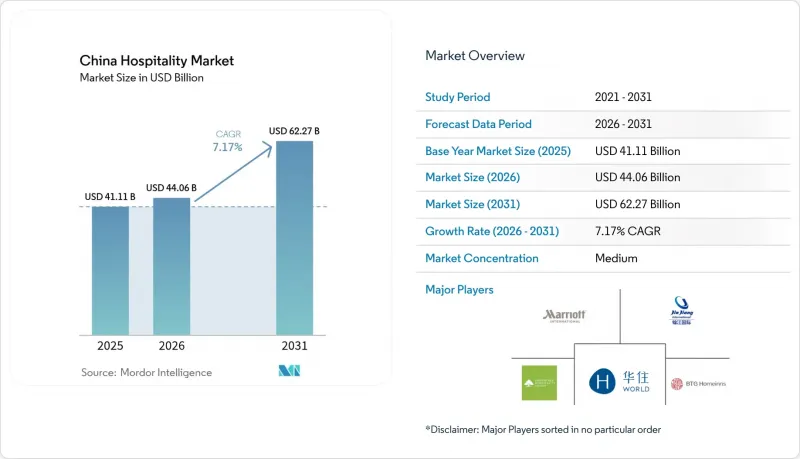
根據 Mordor Intelligence 預測,中國酒店市場規模預計將從 2025 年的 411.1 億美元成長到 2026 年的 440.6 億美元,然後從 2026 年到 2031 年以 7.17% 的複合年成長率成長,到 2031 年達到 62.7 億美元。
本報告按類型(連鎖飯店、獨立飯店)、住宿檔次(豪華、中檔及中高檔、經濟型及經濟飯店、服務式公寓)、預訂管道(直接線上預訂、線上旅行社、企業/會展預訂、批發及傳統代理商)及地區(華北、東北、華東、華南及華中地區及其他地區)進行細分。市場預測以美元計價。
中國酒店業市場趨勢與洞察
疫情後國內休閒熱潮
隨著邊境限制的解除,被壓抑的需求得到釋放,週末和短途旅行大幅復甦,帶動了所有住宿設施類型的運轉率成長。預計2024年國內旅遊收入將達4.91兆元(約6,730億美元),較2023年成長140.3%。遊客數量也已恢復至疫情前水準的81.44%。服務消費成長率是商品消費成長的兩倍,凸顯了體驗式旅遊的持續成長趨勢,遊客更傾向於選擇能夠提供差異化休閒體驗的場所。中檔酒店和精品酒店尤其蓬勃發展,因為遊客更專注於沉浸於獨特的環境和當地文化。政府對文化旅遊的津貼進一步降低了淡季旅遊的門檻,從而推動了這一成長。這些需求特徵表明,中國酒店業市場對宏觀經濟逆風展現了卓越的韌性。
高鐵擴大了週末行程範圍
中國覆蓋全國的5萬公里高速鐵路網縮短了主要城市與小城鎮之間的旅行時間,使得每個通達城市的遊客數量增加了340多萬人次。Delta地區就是一個典型的例子。城際旅行時間縮短了約50%,使得以往需要額外假期才能實現的兩晚短途旅行成為可能。區域中心地帶的精品飯店和中檔飯店如今吸引了以往僅限於大城市中心的客流。火車站附近文化地標的運轉率提升尤為顯著,許多飯店正在調整行銷計劃,以配合列車運行高峰期。交通便利性的提升促進了「樞紐輻射式」旅遊模式的發展,使中國酒店業的繁榮惠及沿海城市以外的地區。
土地租金上漲
都市區高昂的土地拍賣價格給新建酒店帶來了巨大的成本壓力,尤其是在商業房地產價值遠超其潛在收益的二線城市。儘管商業不動產市場面臨吸收壓力,辦公大樓租金也出現下調,但黃金地段的飯店物業依然價格高昂。不斷上漲的地價迫使投資者在成本結構受限的情況下最佳化收益,投資模式也從新建案轉向現有物業的維修和重新定位。這一趨勢對缺乏大型集團規模經濟優勢的獨立飯店業者和小規模飯店的影響尤為顯著,它們難以獲得有利的租金條件。整體而言,地租上漲正在削弱開發方案的多樣性,並減緩中國飯店市場最集中區域的供應成長。
細分市場分析
到2025年,連鎖飯店將佔中國飯店市佔率的55.74%,反映出連鎖飯店滲透率的不斷上升,去年底已達40.95%。由於特許經營協議佔據了新增供應的大部分,預計到2031年,該細分市場的複合年成長率將達到7.95%。因此,在鼓勵直接獲取客戶並減少對線上旅行社(OTA)依賴的忠誠度生態系統的支持下,連鎖飯店營運驅動的中國飯店市場規模預計將比獨立飯店成長更快。
H World集團和錦江飯店的快速擴張展現了輕資產模式的擴充性,超過80%的運轉率也反映了強大的品牌價值。獨立業者在採購和數位化分銷方面的議價能力持續下降,預計收購和向連鎖模式的轉型將會加速。透過將技術規模與會員資料結合,連鎖飯店可以顯著提高收益管理的精準度,這進一步拉大了市場佔有率差距。
其他好處:
- Excel格式的市場預測(ME)表
- 3個月的分析師支持
目錄
第1章:引言
- 研究假設和市場定義
- 調查範圍
第2章:調查方法
第3章執行摘要
第4章 市場狀況
- 市場概覽
- 市場促進因素
- 疫情後國內休閒熱潮
- 高鐵正在擴大週末出遊需求。
- 政府促進夜間經濟
- Z世代對體驗式住宿的需求日益成長。
- 透過智慧酒店技術降低成本
- 預訂時,將低碳認證作為選擇標準之一。
- 市場限制因素
- 土地租金上漲
- OTA行銷費用上漲
- 一線城市勞動力短缺問題日益嚴重
- 該地區新冠疫情再次爆發的風險仍然存在。
- 價值供應鏈分析
- 監理情勢
- 技術展望
- 波特五力模型
第5章 市場規模與成長預測
- 按類型
- 連鎖飯店
- 獨立飯店
- 住宿設施等級
- 奢華
- 中型及中上型
- 預算與經濟
- 服務式公寓
- 透過預訂管道
- 直接數字
- OTA
- 企業/會展
- 批發商和傳統分銷商
- 按地區
- 中國北方
- 中國東北
- 中國東部
- 中國中南部
- 中國西南地區
- 中國西北地區
- 香港和澳門
- 台灣
第6章 競爭情勢
- 市場集中度
- 策略趨勢
- 市佔率分析
- 公司簡介
- Jin Jiang International
- Huazhu Group
- BTG Homeinns
- Dossen International
- GreenTree Hospitality
- Plateno Group
- Atour Lifestyle
- New Century Hotels
- Shanghai Yitel
- IHG Hotels & Resorts(China)
- Marriott International(China)
- Hilton Hotels(China)
- Accor(China)
- Wyndham Hotels(China)
- Shangri-La Hotels
- Mandarin Oriental(China)
- BTG Jianguo
- OCT Hotels
- HNA Hospitality
- Artyzen Hospitality
第7章 市場機會與未來展望
According to Mordor Intelligence, the China hospitality market size is expected to grow from USD 41.11 billion in 2025 to USD 44.06 billion in 2026 and is forecast to reach USD 62.27 billion by 2031 at 7.17% CAGR over 2026-2031.
This report is Segmented by Type (Chain Hotels, Independent Hotels), Accommodation Class (Luxury, Mid & Upper-Mid-Scale, Budget & Economy, Service Apartments), Booking Channel (Direct Digital, Otas, Corporate/MICE, Wholesale & Traditional Agents), and Geography (North China, Northeast China, East China, South-Central China, and More). The Market Forecasts are Provided in Terms of Value (USD).
China Hospitality Market Trends and Insights
Post-pandemic Domestic Leisure Boom
Pent-up demand after border restrictions lifted ignited a sharp rebound in weekend and short-haul trips that has lifted occupancy across all lodging tiers. Domestic tourism revenue rose to CNY 4.91 trillion (USD 673 billio) in 2024, a 140.3% jump from 2023, and trip volume recovered to 81.44% of pre-pandemic levels. Service spending has been expanding twice as fast as goods purchases, confirming a durable experiential shift that favors properties with differentiated leisure offerings. Mid-scale and boutique hotels are capturing outsized gains because travelers prioritize unique settings and local immersion. Government cultural-tourism subsidies have magnified the surge by lowering barriers to off-peak travel. These demand characteristics make the China hospitality market unusually resilient against macro headwinds.
High-speed Rail Expanding Weekend Trips
China's 50,000-kilometer HSR grid compresses travel times between mega-cities and secondary markets, adding more than 3.4 million incremental tourists per connected city. The Yangtze River Delta exemplifies the effect: inter-city travel times have fallen by about 50%, enabling two-night excursions that once required extra vacation days. Boutique and mid-scale hotels in regional clusters now draw demand once limited to primary urban cores. Occupancy uplift is strongest where rail stations sit near cultural landmarks, and many properties are realigning marketing calendars around rail-timetable peaks. The connectivity advantage supports a hub-and-spoke tourism pattern that spreads the benefits of the China hospitality market beyond coastal cities.
Land-lease Cost Inflation
Urban land auction prices have created significant cost pressures for new hotel development, particularly in tier-1 cities where commercial real estate values have outpaced revenue growth potential. The commercial real estate market has experienced absorption pressure and downward rent adjustments in office segments, though hospitality assets in prime locations continue to command premium valuations. Rising land costs have shifted investment patterns toward renovation and repositioning of existing assets rather than ground-up development, as investors seek to optimize returns within constrained cost structures. This dynamic has particularly impacted independent hotel operators and smaller chains that lack the scale advantages of major groups in securing favorable lease terms. Overall, land-lease inflation weighs on pipeline diversity and slows supply growth in the densest nodes of the China hospitality market.
Other drivers and restraints analyzed in the detailed report include:
- Government Push for Night-time Economy
- Gen-Z Demand for Experiential Stays
- OTA Marketing Fee Escalation
For complete list of drivers and restraints, kindly check the Table Of Contents.
Segment Analysis
Chain hotels accounted for 55.74% of the China hospitality market share in 2025, underscoring a rising chainization rate that hit 40.95% by year-end. The cohort is expected to post an 7.95% CAGR to 2031 as franchise signings dominate new supply pipelines. The China hospitality market size attached to chain operations is therefore set to expand faster than that of independents, supported by loyalty ecosystems that funnel direct traffic and reduce OTA reliance.
Rapid roll-outs by H World Group and Jin Jiang are demonstrating the scalability of asset-light models, while occupancy levels above 80% signal strong brand equity. Independent operators continue to lose negotiating leverage on procurement and digital distribution, accelerating buy-out or conversion prospects. Technology scale, combined with membership data, gifts chains superior revenue-management precision, which further enlarges market-share gaps.
Complete Report Scope:
- By Type
- Chain Hotels
- Independent Hotels
- By Accommodation Class
- Luxury
- Mid & Upper-Mid-scale
- Budget & Economy
- Service Apartments
- By Booking Channel
- Direct Digital
- OTAs
- Corporate / MICE
- Wholesale & Traditional Agents
- By Geographic Region
- North China
- Northeast China
- East China
- South-Central China
- Southwest China
- Northwest China
- Hong Kong & Macau
- Taiwan
List of Companies Covered in this Report:
- Jin Jiang International
- Huazhu Group
- BTG Homeinns
- Dossen International
- GreenTree Hospitality
- Plateno Group
- Atour Lifestyle
- New Century Hotels
- Shanghai Yitel
- IHG Hotels & Resorts (China)
- Marriott International (China)
- Hilton Hotels (China)
- Accor (China)
- Wyndham Hotels (China)
- Shangri-La Hotels
- Mandarin Oriental (China)
- BTG Jianguo
- OCT Hotels
- HNA Hospitality
- Artyzen Hospitality
Additional Benefits:
- The market estimate (ME) sheet in Excel format
- 3 months of analyst support
TABLE OF CONTENTS
1 Introduction
- 1.1 Study Assumptions & Market Definition
- 1.2 Scope of the Study
2 Research Methodology
3 Executive Summary
4 Market Landscape
- 4.1 Market Overview
- 4.2 Market Drivers
- 4.2.1 Post-pandemic domestic leisure boom
- 4.2.2 High-speed rail expanding weekend trips
- 4.2.3 Government push for night-time economy
- 4.2.4 Gen-Z demand for experiential stays
- 4.2.5 Smart-hotel tech cost savings (under-the-radar)
- 4.2.6 Low-carbon certification as booking filter (under-the-radar)
- 4.3 Market Restraints
- 4.3.1 Land-lease cost inflation
- 4.3.2 OTA marketing fee escalation
- 4.3.3 Rising labour shortages in tier-1 cities (under-the-radar)
- 4.3.4 Persistent local COVID-19 flare-up risk (under-the-radar)
- 4.4 Value / Supply-Chain Analysis
- 4.5 Regulatory Landscape
- 4.6 Technological Outlook
- 4.7 Porter's Five Forces
- 4.7.1 Threat of New Entrants
- 4.7.2 Bargaining Power of Suppliers
- 4.7.3 Bargaining Power of Buyers
- 4.7.4 Threat of Substitutes
- 4.7.5 Intensity of Competitive Rivalry
5 Market Size & Growth Forecasts
- 5.1 By Type
- 5.1.1 Chain Hotels
- 5.1.2 Independent Hotels
- 5.2 By Accommodation Class
- 5.2.1 Luxury
- 5.2.2 Mid & Upper-Mid-scale
- 5.2.3 Budget & Economy
- 5.2.4 Service Apartments
- 5.3 By Booking Channel
- 5.3.1 Direct Digital
- 5.3.2 OTAs
- 5.3.3 Corporate / MICE
- 5.3.4 Wholesale & Traditional Agents
- 5.4 By Geographic Region
- 5.4.1 North China
- 5.4.2 Northeast China
- 5.4.3 East China
- 5.4.4 South-Central China
- 5.4.5 Southwest China
- 5.4.6 Northwest China
- 5.4.7 Hong Kong & Macau
- 5.4.8 Taiwan
6 Competitive Landscape
- 6.1 Market Concentration
- 6.2 Strategic Moves
- 6.3 Market Share Analysis
- 6.4 Company Profiles {(includes Global level Overview, Market level overview, Core Segments, Financials as available, Strategic Information, Market Rank/Share for key companies, Products & Services, and Recent Developments)}
- 6.4.1 Jin Jiang International
- 6.4.2 Huazhu Group
- 6.4.3 BTG Homeinns
- 6.4.4 Dossen International
- 6.4.5 GreenTree Hospitality
- 6.4.6 Plateno Group
- 6.4.7 Atour Lifestyle
- 6.4.8 New Century Hotels
- 6.4.9 Shanghai Yitel
- 6.4.10 IHG Hotels & Resorts (China)
- 6.4.11 Marriott International (China)
- 6.4.12 Hilton Hotels (China)
- 6.4.13 Accor (China)
- 6.4.14 Wyndham Hotels (China)
- 6.4.15 Shangri-La Hotels
- 6.4.16 Mandarin Oriental (China)
- 6.4.17 BTG Jianguo
- 6.4.18 OCT Hotels
- 6.4.19 HNA Hospitality
- 6.4.20 Artyzen Hospitality
7 Market Opportunities & Future Outlook
- 7.1 Wellness-focused resorts tied to Hainan duty-free tourism
- 7.2 Upscaling mid-tier chains in lower-tier cities


