

 |
市場調查報告書
商品編碼
2123992
越南旅館業:市場佔有率分析、產業趨勢與統計、成長預測(2026-2031)Vietnam Hospitality - Market Share Analysis, Industry Trends & Statistics, Growth Forecasts (2026 - 2031) |
||||||

※ 本網頁內容可能與最新版本有所差異。詳細情況請與我們聯繫。
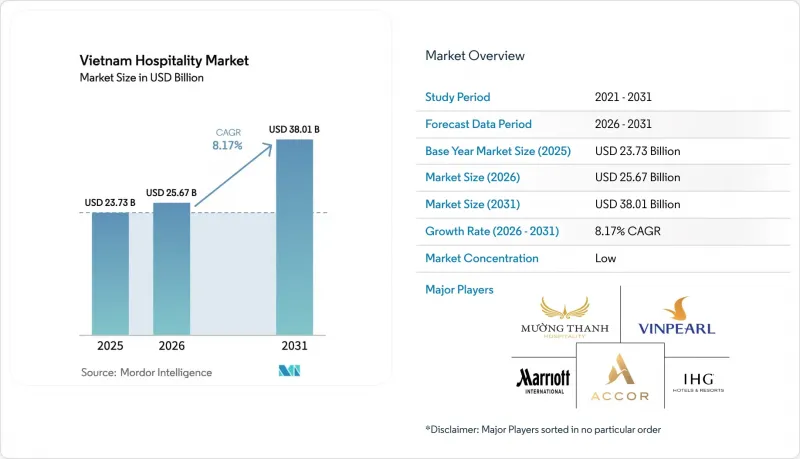
據 Mordor Intelligence 稱,越南酒店業市場在 2025 年的價值為 237.3 億美元,預計到 2031 年將達到 380.1 億美元,而 2026 年為 256.7 億美元,預測期內(2026-2031 年)的複合年成長率為 8.17%。
本報告按類型(連鎖飯店、獨立飯店)、住宿設施檔次(豪華、中檔及中高檔、經濟型、服務式公寓)、預訂管道(直接線上預訂、線上旅行社、企業/會展預訂、批發及傳統代理商)和地區(越南北部、中部沿海及高地、越南南部)進行細分。市場預測以美元計價。
越南酒店業市場趨勢與洞察
落地簽政策的擴大提振了長途旅行的需求。
2025年8月通過的決議修正案將免簽入境範圍擴大至24個國家,最長停留時間可達45天,從而為此前入境手續更為繁瑣的歐洲旅客提供了更多便利。 2025年12月,電子簽證的有效期限和適用範圍進一步擴大,將停留時間延長至90天,並增加了外國旅客的入境口岸,進一步簡化了入境流程。這鼓勵了旅客延長住宿時間。這些變化與2025年全年來自主要長途市場和新興市場的旅客人數的強勁成長相吻合,進一步強化了簡化入境程序與實際旅行趨勢之間的關聯性。印度在2025年也成為累積的客源市場,這反映出行政障礙的降低和航空網路的改善如何釋放了先前被抑制的需求。總體而言,平均停留時間比之前的標準增加了4.5天,在無需相應增加入境人數的情況下,提振了飯店需求。官方的免簽國家名單和指南確認了符合條件的國家範圍,以及該政策旨在刺激旅遊和投資旅行領域的意圖。
國內休閒旅遊蓬勃發展,以及「工作度假」文化盛行。
2024年,越南旅遊業維持了強勁的成長勢頭,國內旅遊人次達到1.1億,旅遊收入達329.6億美元。這使得飯店業得以擺脫對入境旅遊需求的依賴,即使在淡季也能維持較高的入住運轉率。 2025年8月,河內舉辦的一項國內活動引發了旅遊需求的顯著成長,吸引了數百萬遊客,為當月首都的旅遊收入做出了巨大貢獻。 2025年,「工作度假」和「自駕遊」在年輕人中廣受歡迎,帶動了國家公園和沿海地區附近服務式公寓、民宿和共享住宿設施的預訂量。這種需求也起到了緩衝作用,幫助企業抵禦外匯波動和地緣政治因素的影響,這些因素可能會對入境旅遊,特別是來自東北亞主要市場的入境旅遊造成衝擊。這些趨勢進一步凸顯了動態定價和彈性庫存管理的重要性,無論平日、週末或節日,都能有效掌握國內自發性旅遊的需求。官方旅遊統計數據支持國內旅遊活動的整體規模,以及地方活動在推動主要城市月度遊客數量創歷史新高方面所發揮的作用。
建築材料價格上漲給專案的投資報酬率帶來了壓力。
2025年全年建築材料價格居高不下。沙子價格徘徊在每立方公尺17.65美元左右,鋼材價格在每公斤0.47美元至0.52美元之間,這兩種材料佔飯店專案材料成本的大部分。上市建築公司報告稱,2025年第一季獲利大幅下滑,專案延期情況也有所增加。這影響了投機性開發,迫使業主在等待投入成本恢復正常化徵兆的同時,調整專案進度。 2025年下半年,住宅和建築材料的通膨率逐月放緩,但仍高於整體消費者物價指數,顯示業主在固定或半固定管理合約下無法轉嫁持續的成本壓力。瀝青價格上漲,接近每公斤0.70美元,也給沿海旅遊目的地的道路及相關基礎設施的資本投資帶來壓力,這些基礎設施雖然必不可少,但未必能直接產生現金流。由於飯店收益率通常處於個位數中段水平,因此成本超支的容忍度有限,投入成本的持續上漲可能會損害專案的獲利能力,即使在需求強勁的地區也是如此。官方價格和通膨指標能夠反映投入成本與整體通膨的關聯程度,以及預期何時會出現緩解,這些都是決定是否重啟在建工程的重要因素。
細分市場分析
到2025年,獨立酒店將佔客房數量和需求的69.88%,這得益於其所有權結構,即大多數酒店由家族和當地集團擁有,並由他們做出長期投資和運營決策。連鎖品牌成長更為觀點,預計複合年成長率將達到11.65%。這反映出業主正在轉向管理契約,以獲得忠實客戶、建立統一的標準並創建更強大的收益管理系統。國際營運商在2024年至2025年間擴大了合約簽署和新酒店開業數量,擴大了其在中端到豪華酒店領域的業務規模,並將全球銷售網路帶到重要的沿海和都市區。業主發現,管理合約使他們能夠在保留資產所有權的同時,將營運委託給專業人士。這使他們能夠在保持物業柔軟性的同時,提升賓客體驗以適應不斷上漲的平均每日房價(ADR)。國內業主與國際業者之間的品牌合作日益普遍,這表明品牌實力在度假村和城市酒店的運轉率和價格表現方面都具有重要價值。雅高集團宣布了新計畫,並繼續在北方城市拓展其投資組合。同時,洲際酒店集團和萬豪酒店集團在河內、下龍灣、峴港和湄公河三角洲等目的地增加了品牌和酒店,鞏固了其在越南酒店市場的高階地位,並納入了全部區域開發平臺。
連鎖飯店在主要城市的影響力日益增強,商務旅行和展覽旅遊的需求推動了品牌知名度的提升。此外,連鎖飯店還與新建的沿海度假村簽訂契約,這些度假村需要更複雜的開業前支援和大規模的銷售管道。獨立旅館經營者在區域性位置保持優勢,這些地區的民宿和家庭旅館利用線上旅行社(OTA)的覆蓋範圍,但在都市區,它們正面臨著來自擁有完善會員體系的跨國品牌的日益激烈的競爭。市場湧現出新的參與者,包括精品酒店和生活風格品牌,它們的目標是吸引國內千禧世代和尋求價格適中、設計感十足的體驗的全球旅客。銷售技巧和數據驅動的定價如今已成為獨立旅館經營者在主要城市保持競爭力的必要條件,這也提高了它們的競爭門檻。在這種市場格局重塑中,國際連鎖飯店將加強其在豪華飯店領域的佈局,而獨立飯店將繼續保持其在中低階市場的數量優勢。萬豪酒店集團將於 2025 年底在芹苴開設湄公河遺產酒店(傲途格精選酒店),洲際酒店集團也將在下龍灣開設其首家洲際酒店,這表明品牌擴張與集中需求區域相契合,這將支撐越南酒店市場到 2031 年的發展前景。
其他好處:
- Excel格式的市場預測(ME)表
- 3個月的分析師支持
目錄
第1章:引言
- 研究假設和市場定義
- 調查範圍
第2章:調查方法
第3章執行摘要
第4章 市場狀況
- 市場概覽
- 市場促進因素
- 落地簽政策的擴大將提振長程航線的需求。
- 國內休閒旅遊蓬勃發展,以及「工作度假」文化盛行。
- 建設計畫,由外國直接投資(FDI)驅動。
- 數位遊民簽證和共享居住混合模式
- 線上旅行社之間的忠誠度競爭正在降低客戶獲取成本。
- 利用綠色智慧城市津貼進行智慧飯店維修
- 市場限制因素
- 建築材料價格上漲給專案的投資報酬率帶來了壓力。
- 雙語管理人員嚴重短缺。
- 混合用途公寓度假村設施的許可程序延誤。
- 中國和韓國對航空運輸能力的高度依賴
- 價值供應鏈分析
- 監理情勢
- 技術展望
- 波特五力模型
- 投資與外國直接投資(FDI)分析
- 多通道通路分析
第5章 市場規模與成長預測
- 按類型
- 連鎖飯店
- 獨立飯店
- 住宿設施等級
- 奢華
- 中型及中上型
- 預算與經濟
- 服務式公寓
- 透過預訂管道
- 直接數字
- OTA
- 企業/會展
- 批發商和傳統分銷商
- 按地區
- 越南北部(河內及周邊地區)
- 中央海岸和高地
- 越南南部(胡志明市和湄公河地區)
第6章 競爭情勢
- 市場集中度
- 策略趨勢
- 市佔率分析
- 公司簡介
- Vinpearl
- Muong Thanh Hospitality
- Accor
- InterContinental Hotels Group(IHG)
- Marriott International
- Saigontourist
- Fusion Hotel Group
- Lodgis Hospitality
- Wyndham Hotels & Resorts
- Hilton
- Hyatt Hotels
- Best Western
- Radisson Hotel Group
- Sun Hospitality Group
- Diamond Bay Resort & Spa
- A25 Hotel Group
- H&K Hospitality
- Ascott
- Six Senses
- Novotel(Accor)
第7章 市場機會與未來展望
According to Mordor Intelligence, the Vietnam hospitality market size was valued at USD 23.73 billion in 2025 and is estimated to grow from USD 25.67 billion in 2026 to reach USD 38.01 billion by 2031, at a CAGR of 8.17% during the forecast period (2026-2031).
This report is Segmented by Type (Chain Hotels, and Independent Hotels), Accommodation Class (Luxury, Mid & Upper-Mid-Scale, Budget & Economy, Service Apartments), Booking Channel (Direct Digital, Otas, Corporate/MICE, Wholesale & Traditional Agents), and Geography (Northern Vietnam, Central Coast & Highlands, Southern Vietnam). The Market Forecasts are Provided in Terms of Value (USD).
Vietnam Hospitality Market Trends and Insights
Visa-On-Arrival Expansion Boosts Long-Haul Demand
Resolution updates in August 2025 extended visa-free entry to 24 countries with stays of up to 45 days, which broadened access for European travelers who previously faced more complex entry rules. The December 2025 expansion of e-visa validity and access further cut procedural friction by lengthening stays to 90 days and opening more ports of entry to international visitors, which has supported longer trips and higher room-nights. These changes coincided with strong entry growth from major long-haul and emerging markets through 2025, reinforcing the link between facilitation and realized travel. India also stepped up as a larger source market during 2025, reflecting how reduced administrative barriers and improved air connectivity help unlock pent-up demand. The cumulative effect in 2025 showed a longer average stay of 4.5 days compared to prior norms, which raised hotel demand without requiring the same percentage increase in arrival counts. Official visa-exemption lists and guidance confirm the scope of eligible countries and the policy intent to stimulate tourism and investment-grade travel segments.
Resilient Domestic Leisure Travel and Work-Cation Culture
Vietnamese travelers maintained momentum in 2024, delivering 110 million domestic trips and generating USD 32.96 billion in revenue, which allowed hotels to diversify beyond dependence on inbound demand flows to sustain occupancy during shoulder weeks and seasons. The city of Hanoi posted a strong domestic event-led spike during August 2025 that included millions of visitors and meaningful same-month tourism revenue for the capital. Work-cations and self-drive itineraries gained traction among younger cohorts in 2025, which supported bookings for serviced apartments, homestays, and co-living formats near national parks and coastal corridors. This demand also buffered operators against currency swings and geopolitics that can influence inbound volumes, particularly from concentrated source markets in Northeast Asia. The pattern strengthened the case for dynamic pricing and flexible inventory across weekdays, weekends, and holiday periods to capture spontaneous domestic trips. Official tourism statistics corroborate the overall scale of domestic activity and the role of local events in driving monthly highs in key cities.
Construction-Material Inflation Squeezing Project ROIs
Construction input remained elevated in 2025, with sand prices at USD 17.65 per cubic meter, and steel in the USD 0.47-0.52 per kilogram range, together representing the bulk of materials cost for hotel projects. Listed contractors reported sharp profit declines in Q1 2025, and project delays increased, which affected speculative developments and caused owners to reassess schedules while waiting for clearer signals on input-cost normalization. Housing and construction materials inflation moderated month by month into late 2025 but remained above headline consumer inflation, which indicates persistent cost pressure that owners cannot pass through under fixed or semi-fixed management agreements. Rising bitumen costs, nearing USD 0.70 per kilogram, have also weighed on capex for access roads and related infrastructure that are vital for coastal destinations but do not always carry direct cash yields. With hotel yields often in the mid-single digits, the room for cost overruns is limited, so prolonged input inflation can erode project economics even in strong demand corridors. Official price and inflation indicators provide context for how input costs track against broader inflation and the likely timeline for relief to feed into pipeline restart decisions.
Other drivers and restraints analyzed in the detailed report include:
- FDI-Fuelled Upscale Hotel Pipeline in Tier-2 Coastal Cities
- Digital-Nomad Visas and Co-Living Hybrids
- Acute Shortage of Bilingual Managerial Talent
For complete list of drivers and restraints, kindly check the Table Of Contents.
Segment Analysis
Independent hotels accounted for 69.88% of inventory and demand in 2025, supported by ownership structures where families and local groups control most properties and make decisions on capex and operations with long horizons. Chain brands are growing faster, with an 11.65% projected CAGR that reflects owners' shift toward management contracts to capture loyalty traffic, consistent standards, and stronger revenue management engines. International operators expanded signings and openings through 2024 and 2025, which increased their footprint across mid to high-end classes and brought global distribution capabilities to coastal and urban nodes. Owners have found that management contracts let them retain asset ownership while outsourcing operations to specialists, which keeps real-estate optionality intact and elevates guest experience to match rising ADRs. Branded partnerships between domestic owners and international managers have become more common and demonstrate the value of brand flags in resort and city formats for both occupancy and rate performance. Accor announced new projects and continued to expand its portfolio in northern cities, while IHG and Marriott added brands and properties in destinations spanning Hanoi, Ha Long, Da Nang, and the Mekong Delta, reinforcing the premium positioning of the Vietnam hospitality market in regional pipelines.
Chains are gaining influence in gateway cities where corporate travel and MICE volumes reward brand recognition, and they also sign new-built coastal resorts that require more complex pre-opening support and larger distribution engines. Independent operators hold resilience in rural locations where guesthouses and homestays leverage OTA reach, but their urban position is increasingly contested by multinational brands with loyalty ecosystems. The market has seen new brand entries, including boutique and lifestyle flags that aim to capture domestic millennials and global travelers seeking design-led experiences at attainable rates. Distribution technology and data-driven pricing are now baseline requirements for competitive performance in major cities, which raises the bar for independents. As this rebalancing continues, international chains will likely consolidate their presence in upscale categories, while independent hotels continue to dominate numerically in budget and mid-scale segments. Marriott's late-2025 opening of Legacy Mekong, Can Tho, Autograph Collection, and IHG's first InterContinental in Ha Long illustrate how brand expansion aligns with demand corridors that underpin the Vietnam hospitality market outlook into 2031.
Complete Report Scope:
- By Type
- Chain Hotels
- Independent Hotels
- By Accommodation Class
- Luxury
- Mid & Upper-Mid-scale
- Budget & Economy
- Service Apartments
- By Booking Channel
- Direct Digital
- OTAs
- Corporate / MICE
- Wholesale & Traditional Agents
- By Geographic Region
- Northern Vietnam (Hanoi & surrounds)
- Central Coast & Highlands
- Southern Vietnam (HCMC & Mekong)
List of Companies Covered in this Report:
- Vinpearl
- Muong Thanh Hospitality
- Accor
- InterContinental Hotels Group (IHG)
- Marriott International
- Saigontourist
- Fusion Hotel Group
- Lodgis Hospitality
- Wyndham Hotels & Resorts
- Hilton
- Hyatt Hotels
- Best Western
- Radisson Hotel Group
- Sun Hospitality Group
- Diamond Bay Resort & Spa
- A25 Hotel Group
- H&K Hospitality
- Ascott
- Six Senses
- Novotel (Accor)
Additional Benefits:
- The market estimate (ME) sheet in Excel format
- 3 months of analyst support
TABLE OF CONTENTS
1 Introduction
- 1.1 Study Assumptions & Market Definition
- 1.2 Scope of the Study
2 Research Methodology
3 Executive Summary
4 Market Landscape
- 4.1 Market Overview
- 4.2 Market Drivers
- 4.2.1 Visa-on-arrival expansion boosts long-haul demand
- 4.2.2 Resilient domestic leisure travel and "work-cation" culture
- 4.2.3 FDI-fuelled upscale hotel pipeline in Tier-2 coastal cities
- 4.2.4 Digital-nomad visas & co-living hybrids
- 4.2.5 OTA loyalty wars lowering customer-acquisition cost
- 4.2.6 Smart-hotel retrofits via Green & Smart City grants
- 4.3 Market Restraints
- 4.3.1 Construction-material inflation squeezing project ROIs
- 4.3.2 Acute shortage of bilingual managerial talent
- 4.3.3 Slow licensing for mixed-use strata-title resorts
- 4.3.4 High dependency on Chinese/Korean air-lift capacity
- 4.4 Value / Supply-Chain Analysis
- 4.5 Regulatory Landscape
- 4.6 Technological Outlook
- 4.7 Porter's Five Forces
- 4.7.1 Threat of New Entrants
- 4.7.2 Bargaining Power of Buyers
- 4.7.3 Bargaining Power of Suppliers
- 4.7.4 Threat of Substitutes
- 4.7.5 Intensity of Competitive Rivalry
- 4.8 Investments & FDI Analysis
- 4.9 Multichannel Distribution Analysis
5 Market Size & Growth Forecasts (Value, USD)
- 5.1 By Type
- 5.1.1 Chain Hotels
- 5.1.2 Independent Hotels
- 5.2 By Accommodation Class
- 5.2.1 Luxury
- 5.2.2 Mid & Upper-Mid-scale
- 5.2.3 Budget & Economy
- 5.2.4 Service Apartments
- 5.3 By Booking Channel
- 5.3.1 Direct Digital
- 5.3.2 OTAs
- 5.3.3 Corporate / MICE
- 5.3.4 Wholesale & Traditional Agents
- 5.4 By Geographic Region
- 5.4.1 Northern Vietnam (Hanoi & surrounds)
- 5.4.2 Central Coast & Highlands
- 5.4.3 Southern Vietnam (HCMC & Mekong)
6 Competitive Landscape
- 6.1 Market Concentration
- 6.2 Strategic Moves
- 6.3 Market Share Analysis
- 6.4 Company Profiles (includes Global level Overview, Market level overview, Core Segments, Financials as available, Strategic Information, Market Rank/Share for key companies, Products & Services, and Recent Developments)
- 6.4.1 Vinpearl
- 6.4.2 Muong Thanh Hospitality
- 6.4.3 Accor
- 6.4.4 InterContinental Hotels Group (IHG)
- 6.4.5 Marriott International
- 6.4.6 Saigontourist
- 6.4.7 Fusion Hotel Group
- 6.4.8 Lodgis Hospitality
- 6.4.9 Wyndham Hotels & Resorts
- 6.4.10 Hilton
- 6.4.11 Hyatt Hotels
- 6.4.12 Best Western
- 6.4.13 Radisson Hotel Group
- 6.4.14 Sun Hospitality Group
- 6.4.15 Diamond Bay Resort & Spa
- 6.4.16 A25 Hotel Group
- 6.4.17 H&K Hospitality
- 6.4.18 Ascott
- 6.4.19 Six Senses
- 6.4.20 Novotel (Accor)
7 Market Opportunities & Future Outlook
- 7.1 Branded Serviced Apartments in Key Urban Hubs
- 7.2 Eco-Luxury & Sustainable Resorts in Emerging Coastal Provinces


