


 |
市場調查報告書
商品編碼
2123751
紙杯:市場佔有率分析、產業趨勢與統計、成長預測(2026-2031)Paper Cups Industry - Market Share Analysis, Industry Trends & Statistics, Growth Forecasts (2026 - 2031) |
||||||

※ 本網頁內容可能與最新版本有所差異。詳細情況請與我們聯繫。
據 Mordor Intelligence 稱,紙杯行業市場規模預計到 2026 年將達到 541 萬噸,高於 2025 年的 523 萬噸,預計到 2031 年將達到 641 萬噸。
預計從 2026 年到 2031 年,其複合年成長率將達到 3.45%。
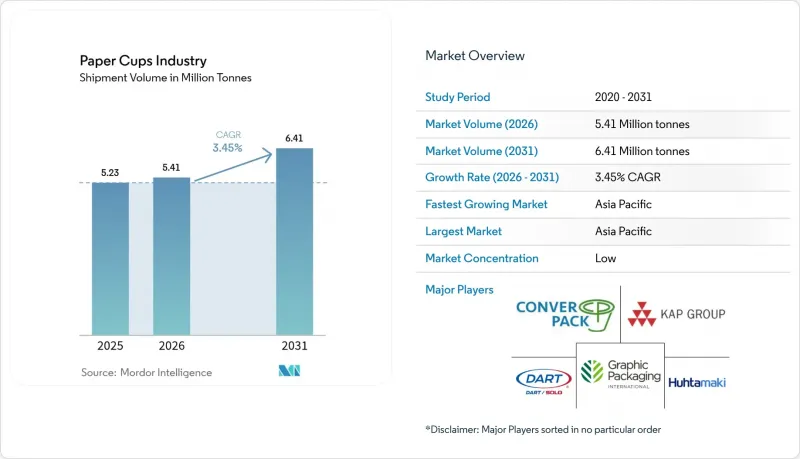
本報告按杯子類型(熱飲紙杯、冷飲紙杯等)、壁體結構(單層、雙層、三層)、容量(4-8盎司、9-12盎司等)、終端用戶(快餐店、咖啡連鎖店、自動售貨機運營商等)、配銷通路(B2B直接合約等)和地區進行細分。市場預測以銷售量(百萬噸)為單位。
紙杯產業的全球趨勢與洞察
攜帶式飲料需求增加
隨著行動生活方式的普及,外帶飲品銷量激增,紙杯已成為方便攜帶飲品的標準容器。都市區通勤者需要符合大眾運輸禮儀的防漏容器,而彈性辦公模式的興起也帶動了午餐時間咖啡消費的成長。預計到2024年,美國外送市場規模將達到1.22兆美元,年均成長率達8.29%,凸顯了數位平台如何將應用程式訂單與紙杯消費量的增加連結起來。在東南亞和中東地區擴張的專門食品咖啡館正在採用優質紙杯,這種紙杯能夠更好地保留咖啡油脂,並清晰地印製品牌標誌。會員應用程式鼓勵小額消費,在無需顧客再次光顧的情況下增加了包裝消耗。在各個地區,這都帶來了對紙杯持續、高頻的需求,與零售商「無縫服務」的目標不謀而合。
政府對一次性塑膠製品的監管
立法者正逐步將一次性塑膠製品轉變為價格更高、用途更有限的選擇,從而迫使人們系統性地轉向紡織材料。歐盟的《包裝和包裝廢棄物條例》於2024年3月最終確定,該條例強制要求包裝完全可回收,並設定了2030年減少5%廢棄物的目標。南澳從2024年9月起禁止使用塑膠飲料容器,市場需求隨即轉向紡織杯等替代品。蘇格蘭計劃在2025年底對每個一次性飲料杯徵收25便士的附加費,鼓勵零售商轉向可重複使用的循環系統,同時將紙杯定位為成本最低的一次性替代品。這些法律措施創造了可預測的更換週期,並使加工商能夠簡化對新成型生產線的資本投資。
廢棄物和回收基礎設施面臨的挑戰
在許多城市,分離紙杯纖維層和塗層層的設備仍然匱乏,儘管紙杯理論上可以回收利用,但許多回收的紙杯最終還是被掩埋。在開發中國家,資源回收預算有限,阻礙了紙杯分類的實施。歐盟關於循環經濟的法規加強了對廢棄產品處理流程的審查,企業買家現在被要求在簽訂合約前提供當地紙杯回收記錄的證明。在基礎設施完善之前,紙杯產業面臨聲譽危機,這可能導致市場需求轉向小眾咖啡館和場所的可重複使用紙杯試點計畫。
細分市場分析
2025年,熱飲杯佔總銷售量的44.92%,預計到2031年,該細分市場將以5.24%的複合年成長率成長。紙杯產業受益於全球專門食品咖啡店的蓬勃發展,這些咖啡店需要高保溫性和醒目的杯身圖案來傳遞品牌故事。高品質的阻隔塗層和雙層壁結構滿足了這兩項要求,使連鎖店能夠合理地提高定價。冷飲杯在冰茶、汽水和冰沙等管道保持著一定的市場佔有率,但由於在氣候溫暖的地區,輕質PET杯的競爭日益激烈,其成長速度正在放緩。錐形杯和特殊設計的杯子在活動餐飲領域佔據利基市場,在這個領域,差異化比大規模銷售更為重要。星巴克轉向礦物塗層清楚地表明,熱飲杯是研發投資和獲利的關鍵。冷飲杯的創新主要集中在無吸管杯蓋和纖維油墨上,但由於對保溫性能的要求較低,其單價仍然很低。
熱飲杯市場的主導也反映在區域氣候模式和飲品習慣上。在北歐和北美,較長的涼爽季節確保了對熱飲的持續日常需求。在亞太地區的特大城市,儘管冰飲的需求不斷成長,但熱茶的基準消費量仍然足以支撐均衡的產品組合。紙杯產業正透過提供可切換冷熱規格的模組化複合生產線來應對這一需求,從而確保設備的全年運轉率。專業的咖啡烘焙商要求供應商降低最低訂購量並頻繁更改包裝設計——只有先進的加工商才能滿足這種服務水準。這些客戶趨勢正在緩解市場碎片化,使那些整合了設計、成型和物流的大規模企業佔據優勢。
到2025年,雙層杯將佔據47.10%的市場佔有率,其優越的觸感和保溫性能備受青睞。在連鎖咖啡館中,雙層杯也成為高階定位的觸覺象徵。然而,單層杯預計成長最快,到2031年年複合成長率(CAGR)將達到5.78%。這種加速成長的驅動力來自於價格敏感型市場中的成本削減目標,以及能夠在不影響性能的前提下實現更薄杯壁的塗層技術。含有微小氣孔的水性內襯確保了單層杯具有足夠的耐熱性,使快餐店經營者能夠在滿足顧客期望的同時減少杯壁層數。三層杯目前仍屬於小眾產品,主要用於盛裝沸湯等常見飲品的企業食堂。
電子商務包裝政策的轉變——即優先選擇更輕的小包裹以減少運輸過程中的排放——也推動了層級構造紙杯的發展。直接面對消費者的咖啡烘焙商在銷售盒裝飲品套裝時,為了滿足嚴格的碳排放計算標準,也傾向於使用更薄的紙杯。在工廠層面,加工商正在重新設計成型工藝,以適應單層層級構造並提高生產線速度。儘管如此,雙層紙杯在高利潤市場仍佔有一定的地位。高階連鎖店重視雙層紙杯的厚實手感,將其視為感官體驗的一部分。因此,紙杯市場呈現兩極化的格局:單層紙杯為廣大消費者提供價格實惠的選擇,而雙層紙杯則服務於高盈利的旗艦產品。
區域分析
預計到2025年,亞太地區將佔全球紙杯總產量的39.10%,到2031年將以6.55%的複合年成長率成長,成長速度在所有地區中最高。中國造紙業在2024年將國內產能提高了10%,確保了2025年紙杯加工所需的充足原料供應。預計到2025年,印度包裝市場規模將達到2,048.1億美元,複合年成長率高達26.7%,如此規模的成長將進一步推動食品配送市場對紙杯的需求。越南包裝市場年增率為9.73%,其製造業競爭力正在促進紙杯在整個東協地區的出口。可支配收入的成長和品牌咖啡文化的興起支撐了亞太地區的銷量,使該地區成為紙杯行業成長的關鍵驅動力。
北美市場依然成熟,但技術發展迅速。美國FDA於2025年2月最終確定逐步淘汰PFAS,將推動水性及礦物基阻隔塗料的普及。喬治亞太平洋公司於2024年投資20億美元,用於其在美國的七家工廠,以保持生產柔軟性並履行永續性目標。現代化的回收系統和企業ESG(環境、社會和治理)報告正在推動高級產品的交付,加工商之間的競爭不僅體現在價格上,也體現在使用後認證方面。儘管銷量成長緩慢,但由於纖維帽等增值規格的出現,利潤率正在不斷提高。
歐洲正走在「法規優先」的道路上。到2030年強制實現可回收的法規正在推動塑膠包裝向紙杯的穩定轉變。為了滿足當地對無塑膠組件的需求,Hootamäki於2024年10月擴大了在北愛爾蘭的纖維杯蓋產能。儘管該地區已實施杯收費和稅收優惠政策以鼓勵消費者改用可重複使用的產品,但纖維杯仍然是受監管的一次性用品。受快餐店(QSR)擴張的推動,東歐市場正在不斷成長,這有助於彌補西歐市場銷售量的飽和。
中東、非洲和南美洲是新興的機會地區。儘管基礎設施不平衡和經濟波動限制了短期成長,但外送應用和國際咖啡連鎖店正在迅速站穩腳跟。加工商透過與當地造紙廠成立合資企業來實現本地化供應,從而降低外匯風險和進口關稅。雖然它們在紙杯市場規模中所佔佔有率仍然較小,但長期人口趨勢表明其產量將逐步成長。
其他好處:
- Excel格式的市場預測(ME)表
- 3個月的分析師支持
目錄
第1章:引言
- 研究假設和市場定義
- 調查範圍
第2章:調查方法
第3章執行摘要
第4章 市場狀況
- 市場概覽
- 市場促進因素
- 外出時對飲料的需求日益成長
- 政府禁止使用一次性塑膠製品
- 拓展快餐和食品配送生態系統
- 一款採用水性塗層的全可回收熱飲杯已經上市。
- 零廢棄體育場館和賽事的採購義務
- 利用人工智慧技術,透過高速成型生產線降低成本
- 市場限制因素
- 缺乏廢棄物處理和回收的基礎設施
- 紙漿價格波動給利潤率帶來了壓力。
- 在咖啡連鎖店試行可重複使用杯子循環系統
- PFAS逐步淘汰計畫的重新設計和認證工作出現延誤。
- 供應鏈分析
- 監理情勢
- 技術展望
- 波特五力分析
第5章 市場規模與成長預測
- 按杯子類型
- 熱紙杯
- 紙杯裝冷飲
- 玉米杯和特製杯子
- 依牆體類型
- 單層壁
- 雙層壁
- 三層壁
- 按產能(盎司)
- 4-8
- 9-12
- 13-20
- >20
- 最終用戶
- 速食店(QSR)
- 咖啡連鎖店和自動販賣機營運商
- 商用餐飲
- 航空公司和鐵路公司
- 其他
- 透過分銷管道
- 直銷(B2B合約)
- 銷售代理商和批發商
- 線上B2B市場
- 按地區
- 北美洲
- 美國
- 加拿大
- 墨西哥
- 歐洲
- 德國
- 英國
- 法國
- 義大利
- 西班牙
- 俄羅斯
- 其他歐洲國家
- 亞太地區
- 中國
- 印度
- 日本
- 韓國
- 澳洲和紐西蘭
- 其他亞太國家
- 中東和非洲
- 中東
- 阿拉伯聯合大公國
- 沙烏地阿拉伯
- 土耳其
- 其他中東國家
- 非洲
- 南非
- 奈及利亞
- 埃及
- 其他非洲國家
- 中東
- 南美洲
- 巴西
- 阿根廷
- 其他南美國家
- 北美洲
第6章 競爭情勢
- 市場集中度
- 策略趨勢
- 市佔率分析
- 公司簡介
- Huhtamaki Oyj
- Dart Container Corp.
- Graphic Packaging International
- Georgia-Pacific LLC
- Seda International Packaging
- Kap Cones Pvt Ltd
- ConverPack Inc.
- Go-Pak UK Ltd(SCGP)
- Benders Paper Cups
- Hotpack Global
- Tekni-Plex Inc.
- CEE Schisler Packaging
- International Paper Foodservice
- Stora Enso Food-Service Boards
- Lollicup USA(Karat)
- Detmold Group
- F-Bender & Co.
- Nissin Paper Products
- Reynolds Consumer Products
- Pactiv Evergreen
第7章 市場機會與未來展望
According to Mordor Intelligence, paper cups industry market size in 2026 is estimated at 5.41 Million tonnes, growing from 2025 value of 5.23 Million tonnes with 2031 projections showing 6.41 Million tonnes, growing at 3.45% CAGR over 2026-2031.
This report is Segmented by Cup Type (Hot Paper Cups, Cold Paper Cups, and More), Wall Type (Single Wall, Double Wall, Triple Wall), Capacity (4-8 Oz, 9-12 Oz, and More), End User (Quick-Service Restaurants, Coffee Chains and Vending Operators, and More), Distribution Channel (Direct B2B Contracts, and More), and Geography. The Market Forecasts are Provided in Terms of Volume (Million Tonnes).
Global Paper Cups Industry Trends and Insights
Rising Demand for On-the-Go Beverages
Mobile lifestyles are lifting daily takeaway beverage volumes, positioning paper cups as the default pack for transit-friendly drinks. Urban commuters seek spill-proof formats that fit public-transport etiquette, and flexible work patterns elevate mid-day coffee runs. The U.S. food-delivery market is on track to generate USD 1.22 trillion in 2024, growing at 8.29% annually, underscoring how digital platforms translate app orders into incremental cup lifts. Specialty cafes expanding in Southeast Asia and the Middle East are introducing premium cup specifications that keep crema intact and print branding crisp. Loyalty apps encourage micro-purchases, which compound packaging volumes without requiring new footfall. Across regions, the result is a consistent, high-frequency pull on the paper cups market that aligns with retailer ambitions for frictionless service.
Government Bans on Single-Use Plastics
Legislators are turning single-use plastics into a costlier, restricted option, forcing a systemic shift toward fiber formats. The EU Packaging and Packaging Waste Regulation finalized in March 2024 mandates full recyclability and sets a 5% waste-cut target by 2030. South Australia banned plastic beverage containers from September 2024, instantly channeling demand to fiber cup alternatives. Scotland intends to levy a 25-pence surcharge on each single-use beverage cup by end-2025, nudging retailers toward reusable loops while positioning paper cups as the least-cost single-use substitute. These legal levers create predictable replacement cycles that let converters rationalize capex in new forming lines.
Disposal and Recycling Infrastructure Gaps
Many municipal systems still lack the equipment to delaminate cup fiber from coatings, so collected cups often end in landfill despite technical recyclability. Developing economies face limited material-recovery budgets, hindering paper cup sorting adoption. EU circular-economy rules tighten scrutiny on end-of-life pathways, and corporate buyers now demand evidence of regional cup recovery before awarding contracts. Until infrastructure catches up, the paper cups industry contends with reputational questions that can shift volumes to reusable pilots in niche cafes and venues.
Other drivers and restraints analyzed in the detailed report include:
- Expansion of QSR and Food-Delivery Ecosystems
- Aqueous-Coated Fully-Recyclable Hot-Cup Launches
- Pulp-Price Volatility Squeezing Margins
For complete list of drivers and restraints, kindly check the Table Of Contents.
Segment Analysis
Hot cups represented 44.92% of 2025 volume, and the segment is projected to expand at a 5.24% CAGR through 2031. The paper cups industry benefits from a global surge in specialty coffee houses that require high heat retention and vivid on-cup graphics for brand storytelling. Premium barrier coatings and double-wall builds deliver both, letting chains justify higher ticket prices. Cold cups protect share in iced tea, soda, and smoothie channels, yet growth lags because competition from lightweight PET cups persists in warm climates. Cone and specialty designs occupy event catering niches where differentiation, not mass volume, rules. Starbucks' switch to mineral coatings underscores how hot cups anchor R&D investment and margin capture. Cold-cup innovation focuses on strawless lids and fiber inks, but without the thermal barrier imperative, unit values stay lower.
Hot-cup leadership also reflects regional weather patterns and beverage rituals. Northern Europe and North America experience extended cool seasons that sustain daily hot-drink demand. In APAC mega-cities, iced beverage upticks occur, but hot tea traditions keep baseline consumption high enough to support a balanced portfolio. The paper cups industry adapts by offering modular lamination lines that toggle between hot and cold specs, ensuring asset utilization year-round. Specialty roasters ask suppliers for smaller minimum order quantities with frequent artwork changeovers, a service level only advanced converters can accommodate. This client dynamic moderates fragmentation by favoring scale players that bundle design, forming, and logistics.
Double-wall cups held 47.10% share in 2025, preferred for superior hand comfort and heat insulation. They also serve as a tactile signal of premium positioning in chain cafes. Yet single-wall designs are forecast to grow fastest at 5.78% CAGR through 2031. This acceleration stems from cost-saving goals in price-sensitive markets and from coating technologies that allow thin walls without hurting performance. Aqueous liners with micro-air pockets give single-wall cups sufficient heat resistance, enabling QSR operators to downgrade wall count while meeting customer expectations. Triple-wall cups remain niche, used in industrial canteens where boiling-hot broths are common.
Shifts in e-commerce packaging policies-favoring lower-weight parcels to cut freight emissions-also help single-wall formats. Direct-to-consumer coffee roasters that ship boxed drink kits favor slim cups to fit tight carbon calculators. On factory floors, converters re-engineer forming cycles to align with single-wall geometry, increasing line speed. Still, double-wall cups keep a foothold in high-margin markets. Chains with strong brand equity treat the thicker feel as part of the sensory experience. The paper cups market thus offers a bifurcated product mix: single-wall for broad affordability and double-wall for revenue-rich flagships.
Complete Report Scope:
- By Cup Type
- Hot Paper Cups
- Cold Paper Cups
- Cone and Specialty Cups
- By Wall Type
- Single Wall
- Double Wall
- Triple Wall
- By Capacity (oz)
- 4-8
- 9-12
- 13-20
- >20
- By End User
- Quick-Service Restaurants (QSR)
- Coffee Chains and Vending Operators
- Institutional Catering
- Airlines and Railways
- Others
- By Distribution Channel
- Direct (B2B Contracts)
- Distributors and Wholesalers
- Online B2B Marketplaces
- By Geography
- North America
- United States
- Canada
- Mexico
- Europe
- Germany
- United Kingdom
- France
- Italy
- Spain
- Russia
- Rest of Europe
- Asia-Pacific
- China
- India
- Japan
- South Korea
- Australia and New Zealand
- Rest of Asia-Pacific
- Middle East and Africa
- Middle East
- United Arab Emirates
- Saudi Arabia
- Turkey
- Rest of Middle East
- Africa
- South Africa
- Nigeria
- Egypt
- Rest of Africa
- Middle East
- South America
- Brazil
- Argentina
- Rest of South America
- North America
Geography Analysis
Asia-Pacific accounted for 39.10% of global tonnage in 2025 and is projected to grow at 6.55% CAGR to 2031, the highest among all regions. China's paper sector added 10% domestic capacity in 2024, ensuring ample substrate for cup converting in 2025. India's packaging market is expected to reach USD 204.81 billion by 2025, expanding at 26.7% CAGR, a scale that deepens end-market pull for cups in food delivery. Vietnam's packaging growth of 9.73% annually demonstrates manufacturing competitiveness that also feeds cup exports across ASEAN. Rising disposable incomes and a shift toward branded cafe culture underpin regional volume, making APAC the growth anchor of the paper cups industry.
North America remains a mature yet technologically progressive market. The PFAS phase-out finalized by the U.S. FDA in February 2025 is propelling adoption of aqueous and mineral barrier coatings. Georgia-Pacific invested USD 2 billion in seven U.S. facilities in 2024 to sustain production agility and comply with sustainability targets. Modern recycling systems and corporate ESG reporting encourage premium offerings, with converters competing on end-of-life certification rather than pure price. Unit growth is slower, but margins are stronger through value-added specs such as fiber lids.
Europe follows a regulation-first trajectory. Mandatory recyclability by 2030 ensures steady substitution away from plastic packaging to paper-based cups. Huhtamaki expanded fiber-lid capacity in Northern Ireland in October 2024 to meet regional demand for plastic-free components. The region adopts pay-per-cup or tax incentives to nudge consumers toward reusables but still positions fiber cups as the compliant single-use option. Eastern European growth pockets, driven by rising QSR penetration, help offset Western Europe's mature volumes.
The Middle East and Africa and South America constitute emerging opportunity zones. Infrastructure gaps and economic swings temper immediate scale, yet food-delivery apps and international coffee chains are planting early seeds. Converters form joint ventures with local paper mills to localize supply, mitigating currency risk and import tariffs. While their contribution to the paper cups market size is still modest, longer-term demographic trends suggest incremental tonnage upside.
- Huhtamaki Oyj
- Dart Container Corp.
- Graphic Packaging International
- Georgia-Pacific LLC
- Seda International Packaging
- Kap Cones Pvt Ltd
- ConverPack Inc.
- Go-Pak UK Ltd (SCGP)
- Benders Paper Cups
- Hotpack Global
- Tekni-Plex Inc.
- CEE Schisler Packaging
- International Paper Foodservice
- Stora Enso Food-Service Boards
- Lollicup USA (Karat)
- Detmold Group
- F-Bender & Co.
- Nissin Paper Products
- Reynolds Consumer Products
- Pactiv Evergreen
Additional Benefits:
- The market estimate (ME) sheet in Excel format
- 3 months of analyst support
TABLE OF CONTENTS
1 INTRODUCTION
- 1.1 Study Assumptions and Market Definition
- 1.2 Scope of the Study
2 RESEARCH METHODOLOGY
3 EXECUTIVE SUMMARY
4 MARKET LANDSCAPE
- 4.1 Market Overview
- 4.2 Market Drivers
- 4.2.1 Rising demand for on-the-go beverages
- 4.2.2 Government bans on single-use plastics
- 4.2.3 Expansion of QSR and food-delivery ecosystems
- 4.2.4 Aqueous-coated fully-recyclable hot-cup launches
- 4.2.5 Zero-waste stadium and event procurement mandates
- 4.2.6 AI-driven high-speed forming lines lowering cost
- 4.3 Market Restraints
- 4.3.1 Disposal and recycling infrastructure gaps
- 4.3.2 Pulp-price volatility squeezing margins
- 4.3.3 Reusable cup loop pilots in coffee chains
- 4.3.4 PFAS-phase-out redesign and certification delays
- 4.4 Supply-Chain Analysis
- 4.5 Regulatory Landscape
- 4.6 Technological Outlook
- 4.7 Porter's Five Forces Analysis
- 4.7.1 Bargaining Power of Suppliers
- 4.7.2 Bargaining Power of Buyers
- 4.7.3 Threat of New Entrants
- 4.7.4 Threat of Substitutes
- 4.7.5 Competitive Rivalry
5 MARKET SIZE AND GROWTH FORECASTS (VALUE)
- 5.1 By Cup Type
- 5.1.1 Hot Paper Cups
- 5.1.2 Cold Paper Cups
- 5.1.3 Cone and Specialty Cups
- 5.2 By Wall Type
- 5.2.1 Single Wall
- 5.2.2 Double Wall
- 5.2.3 Triple Wall
- 5.3 By Capacity (oz)
- 5.3.1 4-8
- 5.3.2 9-12
- 5.3.3 13-20
- 5.3.4 >20
- 5.4 By End User
- 5.4.1 Quick-Service Restaurants (QSR)
- 5.4.2 Coffee Chains and Vending Operators
- 5.4.3 Institutional Catering
- 5.4.4 Airlines and Railways
- 5.4.5 Others
- 5.5 By Distribution Channel
- 5.5.1 Direct (B2B Contracts)
- 5.5.2 Distributors and Wholesalers
- 5.5.3 Online B2B Marketplaces
- 5.6 By Geography
- 5.6.1 North America
- 5.6.1.1 United States
- 5.6.1.2 Canada
- 5.6.1.3 Mexico
- 5.6.2 Europe
- 5.6.2.1 Germany
- 5.6.2.2 United Kingdom
- 5.6.2.3 France
- 5.6.2.4 Italy
- 5.6.2.5 Spain
- 5.6.2.6 Russia
- 5.6.2.7 Rest of Europe
- 5.6.3 Asia-Pacific
- 5.6.3.1 China
- 5.6.3.2 India
- 5.6.3.3 Japan
- 5.6.3.4 South Korea
- 5.6.3.5 Australia and New Zealand
- 5.6.3.6 Rest of Asia-Pacific
- 5.6.4 Middle East and Africa
- 5.6.4.1 Middle East
- 5.6.4.1.1 United Arab Emirates
- 5.6.4.1.2 Saudi Arabia
- 5.6.4.1.3 Turkey
- 5.6.4.1.4 Rest of Middle East
- 5.6.4.2 Africa
- 5.6.4.2.1 South Africa
- 5.6.4.2.2 Nigeria
- 5.6.4.2.3 Egypt
- 5.6.4.2.4 Rest of Africa
- 5.6.4.1 Middle East
- 5.6.5 South America
- 5.6.5.1 Brazil
- 5.6.5.2 Argentina
- 5.6.5.3 Rest of South America
- 5.6.1 North America
6 COMPETITIVE LANDSCAPE
- 6.1 Market Concentration
- 6.2 Strategic Moves
- 6.3 Market Share Analysis
- 6.4 Company Profiles (includes Global level Overview, Market level overview, Core Segments, Financials as available, Strategic Information, Market Rank/Share for key companies, Products and Services, and Recent Developments)
- 6.4.1 Huhtamaki Oyj
- 6.4.2 Dart Container Corp.
- 6.4.3 Graphic Packaging International
- 6.4.4 Georgia-Pacific LLC
- 6.4.5 Seda International Packaging
- 6.4.6 Kap Cones Pvt Ltd
- 6.4.7 ConverPack Inc.
- 6.4.8 Go-Pak UK Ltd (SCGP)
- 6.4.9 Benders Paper Cups
- 6.4.10 Hotpack Global
- 6.4.11 Tekni-Plex Inc.
- 6.4.12 CEE Schisler Packaging
- 6.4.13 International Paper Foodservice
- 6.4.14 Stora Enso Food-Service Boards
- 6.4.15 Lollicup USA (Karat)
- 6.4.16 Detmold Group
- 6.4.17 F-Bender & Co.
- 6.4.18 Nissin Paper Products
- 6.4.19 Reynolds Consumer Products
- 6.4.20 Pactiv Evergreen
7 MARKET OPPORTUNITIES AND FUTURE OUTLOOK
- 7.1 White-space and Unmet-Need Assessment

 全球鋁製一次性餐盤市場規模、佔有率、趨勢和成長分析報告(2026-2034年)全球紙杯市場規模、佔有率、趨勢和成長分析報告(2026-2034年)
 紙杯市場-2026-2032年全球市場預測
 鋁製一次性餐盤市場機會、成長要素、產業趨勢分析及2026-2035年預測。一次性餐盤市場機會、成長要素、產業趨勢分析及2026-2035年預測紙杯市場機會、成長要素、產業趨勢分析及2026-2035年預測。
 一次性紙杯:市場規模及預測(2021-2034 年)、全球及區域佔有率、趨勢和成長機會 - 分析範圍(按類型、材料、塗層技術、最終用途行業和地區分類)
 紙錐杯市場規模、佔有率和成長分析:按杯子尺寸、最終用戶、塗層類型、材料類型、分銷管道和地區分類-2026-2033年產業預測
 美國紙捲和紙錐市場規模、佔有率和趨勢分析報告:按產品、分銷管道和細分市場預測(2026-2033 年)
 紙杯市場規模、佔有率、趨勢和預測:按杯型、壁型、應用、最終用戶、配銷通路和地區分類,2026-2034年