


 |
市場調查報告書
商品編碼
2109298
鋁製一次性餐盤市場機會、成長要素、產業趨勢分析及2026-2035年預測。Aluminium Disposable Plates Market Opportunity, Growth Drivers, Industry Trend Analysis, and Forecast 2026 - 2035 |
||||||

全球鋁製一次性餐盤市場預計到 2025 年將達到 5.953 億美元,年複合成長率為 5.5%,到 2035 年將達到 10 億美元。
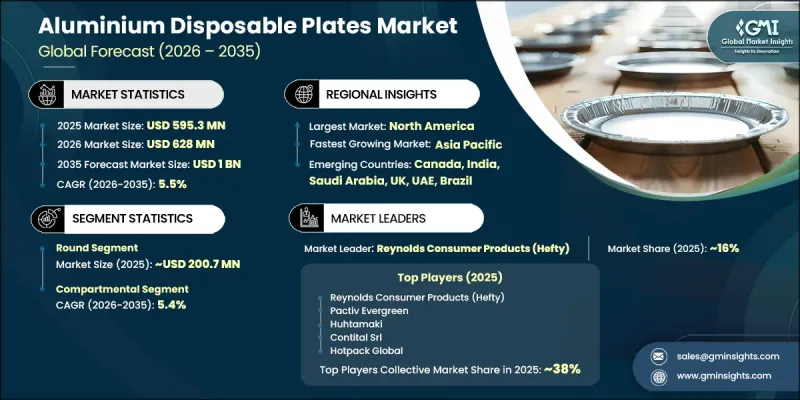
市場成長主要得益於餐飲服務業的持續擴張和外送服務的日益普及。便利性、衛生性和營運效率仍然是這些產業的關鍵考量。快餐店、雲端廚房和數位化食品訂購平台的興起顯著提升了對能夠盛裝各種菜餚的耐用型一次性餐具的需求。鋁製一次性餐盤因其優異的保溫性能、即使盛放熱菜或重菜也能保持結構強度以及運輸過程中的穩定性而廣受歡迎。外帶和宅配服務需求的不斷成長進一步推動了該產品在商用和住宅的應用。此外,會展(MICE,即會議、獎勵旅遊、大會和展覽)產業、大規模餐飲企業以及各類活動的需求成長也為大量採購創造了巨大的機會。鋁製一次性餐盤能夠幫助餐飲企業有效率地服務大量顧客,同時保持高標準的衛生,這在食品安全和清潔度日益重要的今天尤其關鍵。
| 市場範圍 | |
|---|---|
| 開始年份 | 2025 |
| 預測期 | 2026-2035 |
| 上市時的市場規模 | 5.953億美元 |
| 預測金額 | 10億美元 |
| 複合年成長率 | 5.5% |
預計到2025年,圓形餐盤的銷售額將達到2.07億美元,並在2026年至2035年間以5.3%的複合年成長率成長。圓形鋁製一次性餐盤仍然是家庭、餐飲企業、食品攤販和快餐店中最常用的形狀,因為它們符合許多地區傳統的上菜方式。其標準化的形狀使其易於堆疊,從而實現高效的儲存和經濟的運輸,使其成為高客流量食品服務企業、外帶、現場餐飲和活動餐飲的理想選擇。
到2025年,有分隔板的餐盤將佔據68%的市場佔有率,預計到2035年將以5.4%的複合年成長率成長。這類餐盤廣泛應用於食品服務場所,用於在單一容器內分隔和盛裝多種食物。其設計有助於提升菜餚的美觀度、控制份量和保持衛生,同時防止不同菜餚的食材混合。對規範化餐飲服務和標準化食品包裝日益成長的需求,持續推動著帶有分隔板的鋁製餐盤在商業餐飲行業的應用。
美國一次性鋁製餐盤市場預計到2025年將達到1.279億美元,並在2026年至2035年間以6.3%的複合年成長率成長。這項強勁的需求主要得益於遍布各地的快餐店、外帶和送餐服務商,他們需要兼具耐用性和耐熱性的一次性餐具。除了消費者對便利用餐方式日益成長的偏好外,戶外聚會、餐飲服務和社交活動的需求不斷增加也持續推動市場擴張。此外,住宅和商業場所對衛生、食品安全和一次性餐具解決方案的日益重視,也進一步增強了美國各地對該產品的需求。
鋁製拋棄式餐盤市場的競爭格局包括 Pactiv Evergreen Inc.、Continital Srl、Huhtamaki Oyj、Hotpack Global、Georgia-Pacific LLC(Dixie 品牌)、Dopla SpA、Reynolds Consumer Products(Hefty)、Duni AB、Genpak LLC、CKF Inc.、HOS Pack Gi Products(Hefty)、Duni AB、Genpak LLC、CKF Inc.、HOS Packuling、Halak、Pelak、Mr. Euro Ltd. 等公司。這些公司正採取以擴大產能、提升產品品質和加強區域分銷網路為核心的策略,以滿足不斷成長的市場需求。製造商正投資於先進的製造技術,以提高效率、降低生產成本並維持產品標準的一致性。產品創新仍然是重點,各公司致力於開發耐用、輕巧且可回收的鋁製餐具,以滿足不斷變化的客戶偏好。與餐飲服務商、零售商和分銷合作夥伴建立策略夥伴關係,有助於公司拓展基本客群並確保長期供應合約的簽訂。他們還增加對永續製造實踐、客製化產品設計和地理擴張的投資,同時加強品牌建立、客戶服務和營運能力,以增強其在全球鋁製一次性餐盤市場的競爭力。
目錄
第1章:調查方法和範圍
第2章執行摘要
第3章 行業洞察
- 產業生態系分析
- 供應商情況
- 利潤率
- 每個階段增加的價值
- 影響價值鏈的因素
- 影響產業的因素
- 促進因素
- 餐飲和外送行業的擴張推動了對便捷一次性餐具的需求。
- 針對一次性塑膠的監管壓力不斷加大,正加速向可回收鋁製品的轉變。
- 其耐熱性、輕巧設計、易於堆疊等特點,使其在飛機餐飲業中得到越來越廣泛的應用。
- 會展、活動和餐飲業的成長正在推動一次性餐具的大量採購。
- 產業潛在風險與挑戰
- 新興市場缺乏回收基礎設施,限制了產品生命週期結束時永續性方面的說法。
- 克服消費者認為鋁「不環保」的看法,並將其與紙張和可堆肥替代品進行比較。
- 機會
- 永續發展法規正在加速從一次性塑膠餐盤轉向鋁製餐盤的轉變。
- 餐飲服務和活動產業對優質化的日益重視,催生了對更厚、更有光澤的餐盤的需求。
- 電子商務的快速發展正在擴大 B2C 分銷在新興市場的覆蓋範圍。
- 促進因素
- 成長潛力分析
- 未來市場趨勢
- 技術與創新展望
- 最新科技趨勢
- 新興技術
- 監理情勢
- 標準和合規要求
- 區域監理框架
- 認證標準
- 貿易數據分析
- 進出口量及進口額趨勢
- 主要貿易路線及關稅的影響
- 價格分析
- 對過去價格趨勢的分析
- 按業務類型(高階/低階/大眾市場)分類的定價策略
- 人工智慧和生成式人工智慧對市場的影響
- 利用人工智慧改造現有經營模式
- 按細分市場分類的生成式人工智慧用例和部署藍圖
- 風險、限制和監管考量
- 波特的分析
- PESTLE分析
- 消費者購買行為分析
- 人口趨勢
- 影響購買決策的因素
- 消費者產品採納
- 首選分銷管道
第4章 競爭情勢
- 介紹
- 企業市佔率分析
- 按地區
- 企業矩陣分析
- 主要市場公司的競爭分析
- 競爭定位矩陣
- 主要進展
- 併購
- 夥伴關係和聯盟
- 新產品發布
- 業務拓展計劃
第5章 市場估價與預測:依設計分類,2022-2035年
- 飛機
- 隔間
第6章 市場估計與預測:依形狀分類,2022-2035年
- 圓形的
- 方塊
- 長方形
- 其他形狀(橢圓形、六邊形、心形)
第7章 市場規模估算與預測(2022-2035年)
- 30 mm~150 mm
- 230 mm
- 250 mm~300 mm
- 其他
第8章 市場估計與預測:依價格分類,2022-2035年
- 低的
- 中等的
- 高的
第9章 市場估計與預測:依應用領域分類,2022-2035年
- 食品服務
- 餐飲活動
- 飛機餐飲
- 對機構而言
- 家庭和零售用途
第10章 市場估價與預測:依通路分類,2022-2035年
- B2B
- B2C
第11章 市場估價與預測:按地區分類,2022-2035年
- 北美洲
- 美國
- 加拿大
- 歐洲
- 德國
- 英國
- 法國
- 義大利
- 西班牙
- 亞太地區
- 中國
- 印度
- 日本
- 韓國
- 澳洲
- 印尼
- 馬來西亞
- 拉丁美洲
- 巴西
- 墨西哥
- 阿根廷
- 中東和非洲
- 沙烏地阿拉伯
- UAE
- 南非
第12章:公司簡介
- 世界頂尖公司
- Huhtamaki Oyj
- Georgia-Pacific LLC(Dixie Brand)
- Pactiv Evergreen Inc.
- Reynolds Consumer Products(Hefty)
- Genpak LLC
- 該地區的領先企業
- Contital Srl
- Duni AB
- Dopla SpA
- CKF Inc.
- Hotpack Global
- 新興企業
- Be Green Packaging
- HOSTI GmbH
- Fast Plast A/S
- Poppies Europe Ltd.
- Go-Pak Group
The Global Aluminium Disposable Plates Market was valued at USD 595.3 million in 2025 and is estimated to grow at a CAGR of 5.5% to reach USD 1 billion by 2035.
Market growth is fueled by the continued expansion of the foodservice industry and the increasing popularity of food delivery services, where convenience, hygiene, and operational efficiency remain key priorities. The growing presence of quick-service restaurants, cloud kitchens, and digital food ordering platforms has significantly increased the demand for durable disposable tableware capable of handling a wide range of meal types. Aluminium disposable plates are widely preferred because they offer excellent heat retention, maintain their structural strength when carrying hot or heavy foods, and provide reliable performance during transportation. Rising demand for takeaway meals and home delivery services continues to strengthen product adoption across both commercial and residential applications. In addition, increasing demand from the meetings, incentives, conferences, and exhibitions (MICE) industry, large-scale catering operations, and organized events is creating substantial opportunities for bulk purchases. Disposable aluminium plates allow foodservice providers to serve large numbers of guests efficiently while maintaining high hygiene standards, an important consideration as food safety and cleanliness continue to receive greater attention.
| Market Scope | |
|---|---|
| Start Year | 2025 |
| Forecast Year | 2026-2035 |
| Start Value | $595.3 Million |
| Forecast Value | $1 Billion |
| CAGR | 5.5% |
The round-shaped segment generated USD 200.7 million in 2025 and is anticipated to grow at a CAGR of 5.3% from 2026 to 2035. Round aluminium disposable plates remain the most widely used format across households, catering businesses, food vendors, and quick-service restaurants because they complement conventional food presentation practices in many regions. Their standardized shape allows convenient stacking, efficient storage, and cost-effective transportation, making them well suited for high-volume foodservice operations, takeaway applications, institutional dining, and event catering.
The compartmental design segment held 68% share in 2025 and is projected to grow at a CAGR of 5.4% through 2035. These plates are widely selected for organized foodservice environments that require multiple food items to remain separated within a single serving container. Their design supports improved food presentation, portion control, and hygiene while preventing different meal components from mixing. Growing demand for structured meal services and standardized food packaging continues to support the adoption of compartmental aluminium plates across commercial food operations.
U.S. Aluminium Disposable Plates Market captured USD 127.9 million in 2025, and is expected to register a CAGR of 6.3% from 2026 to 2035. Strong demand is supported by an extensive network of quick-service restaurants, takeaway businesses, and food delivery providers that require durable and heat-resistant disposable serving products. Rising consumer preference for convenient dining options, along with increasing demand from outdoor gatherings, catering services, and organized social events, continues to drive market expansion. Greater emphasis on hygiene, food safety, and single-use serving solutions across both residential and commercial settings has further strengthened product demand throughout the country.
The competitive landscape of the aluminium disposable plates market includes companies such as Pactiv Evergreen Inc., Contital Srl, Huhtamaki Oyj, Hotpack Global, Georgia-Pacific LLC (Dixie Brand), Dopla S.p.A., Reynolds Consumer Products (Hefty), Duni AB, Genpak LLC, CKF Inc., HOSTI GmbH, Be Green Packaging, Go-Pak Group, Fast Plast A/S, and Poppies Europe Ltd. Companies operating in the aluminium disposable plates market are adopting strategies centered on expanding production capacity, enhancing product quality, and strengthening regional distribution networks to capture growing demand. Manufacturers are investing in advanced manufacturing technologies to improve efficiency, reduce production costs, and maintain consistent product standards. Product innovation remains a major focus, with companies developing durable, lightweight, and recyclable aluminium tableware that meets evolving customer preferences. Strategic collaborations with foodservice providers, retailers, and distribution partners are helping businesses expand their customer base and secure long-term supply agreements. Companies are also increasing investments in sustainable manufacturing practices, customized product designs, and geographic expansion while strengthening branding, customer service, and operational capabilities to reinforce their competitive position in the global aluminium disposable plates market.
Table of Contents
Chapter 1 Methodology & Scope
- 1.1 Market scope & definitions
- 1.2 Research design
- 1.2.1 Research approach
- 1.2.2 Data collection methods
- 1.3 Base estimates and calculations
- 1.3.1 Base year calculation
- 1.3.2 Market estimates & forecasts parameters
- 1.4 Forecast Model
- 1.4.1 Key trends for market estimates
- 1.4.2 Quantified market impact analysis
- 1.4.2.1 Mathematical impact of growth parameters on forecast
- 1.4.3 Scenario analysis framework
- 1.5 Primary research and validation
- 1.5.1 Some of the primary sources (but not limited to)
- 1.6 Data mining sources
- 1.6.1 Paid Sources
- 1.7 Primary research and validation
- 1.7.1 Primary sources
- 1.8 Research Trail & confidence scoring
- 1.8.1 Research trail components
- 1.8.2 Scoring components
- 1.9 Research transparency addendum
- 1.9.1 Source attribution framework
- 1.9.2 Quality assurance metrics
- 1.10 Our commitment to trust
Chapter 2 Executive Summary
- 2.1 Industry 360° synopsis
- 2.2 Key market trends
- 2.2.1 Regional
- 2.2.2 Design
- 2.2.3 Shape
- 2.2.4 Size
- 2.2.5 Price
- 2.2.6 Application
- 2.2.7 Distribution channel
Chapter 3 Industry Insights
- 3.1 Industry ecosystem analysis
- 3.1.1 Supplier landscape
- 3.1.2 Profit margin
- 3.1.3 Value addition at each stage
- 3.1.4 Factor affecting the value chain
- 3.2 Industry impact forces
- 3.2.1 Growth drivers
- 3.2.1.1 Expanding foodservice & food delivery industry driving demand for convenient disposable tableware
- 3.2.1.2 Growing regulatory pressure on single-use plastics accelerating shift to recyclable aluminium alternatives
- 3.2.1.3 Rising adoption in airline catering due to heat resistance, lightweight properties & stackability
- 3.2.1.4 Growth of MICE, events & catering industry fueling bulk procurement of disposable tableware
- 3.2.2 Industry pitfalls & challenges
- 3.2.2.1 Limited recycling infrastructure in emerging markets constraining end-of-life sustainability claims
- 3.2.2.2 Overcoming consumer perception of aluminium as non-eco-friendly vs. Paper & compostable alternatives
- 3.2.3 Opportunities
- 3.2.3.1 Sustainability regulations driving accelerated substitution of plastic disposable plates with aluminium
- 3.2.3.2 Premiumization in foodservice & events creating demand for heavy-gauge, high-polish plate formats
- 3.2.3.3 Rapid E-commerce growth expanding B2C distribution reach across emerging markets
- 3.2.1 Growth drivers
- 3.3 Growth potential analysis
- 3.4 Future market trends
- 3.5 Technology and innovation landscape
- 3.5.1 Current technological trends
- 3.5.2 Emerging technologies
- 3.6 Regulatory landscape
- 3.6.1 Standards and compliance requirements
- 3.6.2 Regional regulatory frameworks
- 3.6.3 Certification standards
- 3.7 Trade data analysis (HS Code 7615.10)
- 3.7.1 Import/export volume & value trends
- 3.7.2 Key trade corridors & tariff impact
- 3.8 Pricing analysis
- 3.8.1 Historical price trend analysis (driven by primary research)
- 3.8.2 Pricing strategy by player type (premium / value / mass market)
- 3.9 Impact of AI & generative AI on the market
- 3.9.1 AI-driven disruption of existing business models
- 3.9.2 GenAI use cases & adoption roadmap by segment
- 3.9.3 Risks, limitations & regulatory considerations
- 3.10 Porter's analysis
- 3.11 PESTEL analysis
- 3.12 Consumer buying behavior analysis
- 3.12.1 Demographic trends
- 3.12.2 Factors affecting buying decisions
- 3.12.3 Consumer product adoption
- 3.12.4 Preferred distribution channel
Chapter 4 Competitive Landscape, 2025
- 4.1 Introduction
- 4.2 Company market share analysis
- 4.2.1 By Region
- 4.2.1.1 North America
- 4.2.1.2 Europe
- 4.2.1.3 Asia Pacific
- 4.2.1.4 Latin America
- 4.2.1.5 Middle East & Africa
- 4.2.1 By Region
- 4.3 Company matrix analysis
- 4.4 Competitive analysis of major market players
- 4.5 Competitive positioning matrix
- 4.6 Key developments
- 4.6.1 Mergers & acquisitions
- 4.6.2 Partnerships & collaborations
- 4.6.3 New product launches
- 4.6.4 Expansion plans
Chapter 5 Market Estimates & Forecast, By Design, 2022 - 2035, (USD Million) (Thousand Units)
- 5.1 Key trends
- 5.2 Plain
- 5.3 Compartmental
Chapter 6 Market Estimates & Forecast, By Shape, 2022 - 2035, (USD Million) (Thousand Units)
- 6.1 Key trends
- 6.2 Round
- 6.3 Square
- 6.4 Rectangular
- 6.5 Others (Oval, Hexagonal, Heart-Shaped)
Chapter 7 Market Estimates & Forecast, By Size, 2022 - 2035, (USD Million) (Thousand Units)
- 7.1 Key trends
- 7.2 30 mm - 150 mm
- 7.3 230 mm
- 7.4 250 mm - 300 mm
- 7.5 Others
Chapter 8 Market Estimates & Forecast, By Price, 2022 - 2035, (USD Million) (Thousand Units)
- 8.1 Key trends
- 8.2 Low
- 8.3 Medium
- 8.4 High
Chapter 9 Market Estimates & Forecast, By Application, 2022 - 2035, (USD Million) (Thousand Units)
- 9.1 Key trends
- 9.2 Foodservice
- 9.3 Catering & events
- 9.4 Airline catering
- 9.5 Institutional
- 9.6 Household & retail
Chapter 10 Market Estimates & Forecast, By Distribution Channel, 2022 - 2035, (USD Million) (Thousand Units)
- 10.1 Key trends
- 10.2 B2B
- 10.3 B2C
Chapter 11 Market Estimates & Forecast, By Region, 2022 - 2035, (USD Million) (Thousand Units)
- 11.1 Key trends
- 11.2 North America
- 11.2.1 U.S.
- 11.2.2 Canada
- 11.3 Europe
- 11.3.1 Germany
- 11.3.2 UK
- 11.3.3 France
- 11.3.4 Italy
- 11.3.5 Spain
- 11.4 Asia Pacific
- 11.4.1 China
- 11.4.2 India
- 11.4.3 Japan
- 11.4.4 South Korea
- 11.4.5 Australia
- 11.4.6 Indonesia
- 11.4.7 Malaysia
- 11.5 Latin America
- 11.5.1 Brazil
- 11.5.2 Mexico
- 11.5.3 Argentina
- 11.6 MEA
- 11.6.1 Saudi Arabia
- 11.6.2 UAE
- 11.6.3 South Africa
Chapter 12 Company Profiles
- 12.1 Top Global Players
- 12.1.1 Huhtamaki Oyj
- 12.1.2 Georgia-Pacific LLC (Dixie Brand)
- 12.1.3 Pactiv Evergreen Inc.
- 12.1.4 Reynolds Consumer Products (Hefty)
- 12.1.5 Genpak LLC
- 12.2 Regional Champions
- 12.2.1 Contital Srl
- 12.2.2 Duni AB
- 12.2.3 Dopla S.p.A.
- 12.2.4 CKF Inc.
- 12.2.5 Hotpack Global
- 12.3 Emerging Players
- 12.3.1 Be Green Packaging
- 12.3.2 HOSTI GmbH
- 12.3.3 Fast Plast A/S
- 12.3.4 Poppies Europe Ltd.
- 12.3.5 Go-Pak Group

 2026-2030年全球一次性餐盤市場
 一次性餐盤市場規模、佔有率和成長分析:按材質、餐盤/餐具類型、尺寸、應用、分銷管道和地區分類 - 產業預測 2026–2033
 全球鋁製一次性餐盤市場規模、佔有率、趨勢和成長分析報告(2026-2034年)全球紙杯市場規模、佔有率、趨勢和成長分析報告(2026-2034年)
 紙杯:市場佔有率分析、產業趨勢與統計、成長預測(2026-2031)
 紙杯市場-2026-2032年全球市場預測
 一次性餐盤市場機會、成長要素、產業趨勢分析及2026-2035年預測紙杯市場機會、成長要素、產業趨勢分析及2026-2035年預測。
 美國紙捲和紙錐市場規模、佔有率和趨勢分析報告:按產品、分銷管道和細分市場預測(2026-2033 年)
 紙杯紙盤市場:全球產業趨勢、佔有率、規模、成長、機會、預測(2026-2034年)