


 |
市場調查報告書
商品編碼
2101890
一次性餐盤市場機會、成長要素、產業趨勢分析及2026-2035年預測Disposable Plates Market Opportunity, Growth Drivers, Industry Trend Analysis, and Forecast 2026 - 2035 |
||||||

全球一次性餐盤市場預計到 2025 年將達到 63 億美元,年複合成長率為 5.1%,到 2035 年將達到 103 億美元。
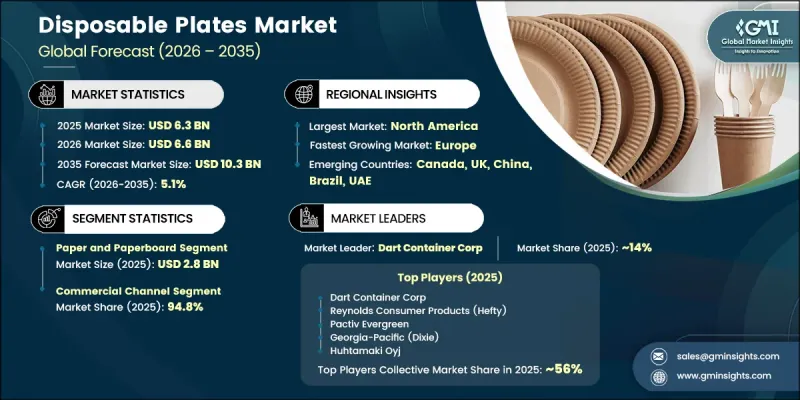
一次性餐盤市場的成長主要受消費者環保意識的增強以及對傳統餐具永續替代品需求的不斷成長的推動。隨著減少廢棄物和負責任消費意識的持續提高,消費者對由可生物分解、可堆肥和可回收材料製成的一次性餐盤表現出越來越濃厚的興趣。這種轉變促使製造商投資於創新材料解決方案,以提高產品功能性並減少對環境的影響。餐飲服務、旅館和零售業對永續實踐的日益重視,進一步加速了環保一次性餐盤的普及。企業擴大將永續餐具納入其運營,以滿足不斷變化的客戶期望並與不斷發展的環境目標保持一致。此外,旨在減少一次性塑膠消耗的監管措施也為替代性一次性餐盤解決方案的推廣創造了有利環境。預計在預測期內,永續性意識的增強、餐飲服務業需求的成長以及環保製造技術的不斷進步,將進一步推動市場成長。
| 市場範圍 | |
|---|---|
| 開始年份 | 2025 |
| 預測期 | 2026-2035 |
| 上市時的市場規模 | 63億美元 |
| 預計金額 | 103億美元 |
| 複合年成長率 | 5.1% |
預計到2025年,紙/紙板市場銷售額將達到28億美元,並在2035年之前維持5.4%的複合年成長率。這一強勁成長主要得益於永續發展法規的日益嚴格、機構對環保產品需求的成長,以及過去十年纖維基製造技術進步帶來的成本優勢。此外,FSC和PEFC認證紙漿原料供應量的不斷擴大也進一步推動了該品類的成長,提升了紙/紙板板材解決方案在零售和機構採購管道的價格競爭力和永續性。
根據最終用途,市場分為住宅和商用領域。到2025年,商用領域將佔據94.8%的市場佔有率,其中餐飲服務場所將廣泛採用一次性餐盤。這些企業擴大選擇棕櫚葉餐盤,以契合其永續性目標。棕櫚葉餐盤經久耐用、美觀大方,且能盛裝各種食物而不變形或破損。這一趨勢也有助於提升企業品牌形象,吸引具有環保意識的消費者。
預計到2025年,美國一次性餐盤市佔率將達到75.74%。美國市場成長的主要驅動力是日益增強的環保意識和消費者對環保產品的偏好。此外,快節奏生活方式的日益普及也是推動一次性餐盤需求成長的重要因素,尤其是在外外帶餐飲方面。一次性餐盤和杯子等產品的便利性滿足了忙碌消費者對實用且永續餐飲解決方案的需求。
Dart Container Corporation、Huhtamaki Oyj、Pactiv Evergreen Inc.、Berry Global Group Inc.、Sabert Corporation、Reynolds Consumer Products、Duni Group、Detpak (Detmold Group)、Eco-Products Inc.、World Centric、Leafware、GreenGood USA、Biopac GmbH & Co.P.D.品牌)等公司正透過推出永續性發展的產品、品牌建立、區域擴張以及投資先進製造流程來提升市場佔有率。一次性餐盤市場的公司正專注於策略性產品開發、永續性措施和市場拓展,以增強自身競爭力。領先企業正投資開發基於可生物分解、可堆肥和可回收材料的一次性餐盤解決方案,以滿足消費者對環保產品日益成長的需求。此外,製造商正致力於擴大產能、最佳化供應鏈網路並加強分銷管道,以拓展其在食品服務、零售和機構領域的市場覆蓋範圍。
目錄
第1章:調查方法和範圍
第2章執行摘要
第3章 行業洞察
- 產業生態系分析
- 供應商情況
- 利潤率
- 每個階段增加的價值
- 影響價值鏈的因素
- 影響產業的因素
- 促進因素
- 來自快餐店和有組織的餐飲服務業的需求不斷成長
- 活動、餐飲和酒店業的成長
- 都市化進程和以便利性為先的消費者生活方式。
- 由於衛生意識提高,對一次性產品的需求增加。
- 產業潛在風險與挑戰
- 可生物分解和可堆肥替代材料的快速普及
- 活動、飯店和餐飲業的優質化
- 電子商務與D2C通路的擴張
- 新興市場尚未開發的成長潛力
- 機會
- 永續替代材料與傳統塑膠的成本差異
- 逐步淘汰 PFAS 以及與材料重組相關的複雜性。
- 監管環境分散且瞬息萬變。
- 促進因素
- 成長潛力分析
- 未來市場趨勢
- 技術與創新展望
- 最新科技趨勢
- 新興技術
- 監理情勢
- 標準和合規要求
- 區域監理框架
- 認證標準
- 貿易數據分析
- 進出口量及進口額趨勢
- 主要貿易路線及關稅的影響
- 價格分析
- 對過去價格趨勢的分析
- 按業務類型(高階/低階/大眾市場)分類的定價策略
- 人工智慧和生成式人工智慧對市場的影響
- 利用人工智慧改造現有經營模式
- 按細分市場分類的生成式人工智慧用例和部署藍圖
- 風險、限制和監管考量
- 波特的分析
- PESTLE分析
第4章 競爭情勢
- 介紹
- 企業市佔率分析
- 按地區
- 企業矩陣分析
- 主要市場公司的競爭分析
- 競爭定位矩陣
- 主要進展
- 併購
- 夥伴關係和聯盟
- 新產品發布
- 業務拓展計劃
第5章 市場估算與預測:依材料類型分類,2022-2035年
- 塑膠
- 紙/紙板
- 可生物分解/環保
- 鋁箔
- 其他
第6章 市場估價與預測:依設計分類,2022-2035年
- 普通/標準
- 帶分隔線
- 裝飾/印刷
第7章 市場規模估算與預測(2022-2035年)
- 小號(6吋或更小)
- 中號(7-9吋)
- 大號(10-12吋)
第8章 市場估計與預測:依功能與特性分類,2022-2035年
- 標準用途
- 可微波爐加熱
- 耐高溫/耐熱
- 潤滑脂/洩漏預防
- 重型/加固型
第9章 市場估計與預測:依價格分類,2022-2035年
- 低的
- 中等的
- 高的
第10章 市場估價與預測:依應用領域分類,2022-2035年
- 住宅
- 商用
- 食品/飲料
- 飯店咖啡廳
- 招待活動
- 其他(快餐店等)
第11章 市場估價與預測:依通路分類,2022-2035年
- 線上
- 企業網站
- 電子商務
- 離線
- B2B
- 超級市場和大賣場
- 便利商店和專賣店
第12章 市場估計與預測:依地區分類,2022-2035年
- 北美洲
- 美國
- 加拿大
- 歐洲
- 德國
- 英國
- 法國
- 義大利
- 西班牙
- 亞太地區
- 中國
- 印度
- 日本
- 韓國
- 澳洲
- 印尼
- 馬來西亞
- 拉丁美洲
- 巴西
- 墨西哥
- 阿根廷
- 中東和非洲
- 沙烏地阿拉伯
- UAE
- 南非
第13章:公司簡介
- 世界公司
- Dart Container Corporation
- Huhtamaki Oyj
- Pactiv Evergreen Inc.
- Georgia-Pacific LLC(Dixie brand)
- Berry Global Group, Inc.
- 該地區的領先企業
- Sabert Corporation
- Reynolds Consumer Products
- Biopac India Corporation Ltd.
- Duni Group
- Detpak(Detmold Group)
- 新興企業
- Eco-Products, Inc.
- World Centric
- Leafware
- GreenGood USA
- Bionatic GmbH & Co. KG
The Global Disposable Plates Market was valued at USD 6.3 billion in 2025 and is estimated to grow at a CAGR of 5.1% to reach USD 10.3 billion by 2035.
The growth of the disposable plates market is supported by increasing environmental consciousness among consumers and the rising preference for sustainable alternatives to conventional tableware products. As awareness regarding waste reduction and responsible consumption continues to increase, consumers are showing greater interest in disposable plates manufactured from biodegradable, compostable, and recycled materials. This shift is encouraging manufacturers to invest in innovative material solutions that offer improved functionality while reducing environmental impact. The growing emphasis on sustainable practices across foodservice, hospitality, and retail sectors is further accelerating the adoption of environmentally friendly disposable plates. Businesses are increasingly incorporating sustainable tableware options into their operations to meet changing customer expectations and align with evolving environmental goals. In addition, regulatory initiatives aimed at reducing single-use plastic consumption are creating favorable conditions for the expansion of alternative disposable plate solutions. The combination of rising sustainability awareness, increased demand from foodservice applications, and continuous advancements in eco-friendly manufacturing technologies is expected to strengthen market growth over the forecast period.
| Market Scope | |
|---|---|
| Start Year | 2025 |
| Forecast Year | 2026-2035 |
| Start Value | $6.3 Billion |
| Forecast Value | $10.3 Billion |
| CAGR | 5.1% |
Paper and paperboard segment generated USD 2.8 billion in 2025 growing at a CAGR of 5.4% through 2035. The segment's strong performance is driven by increasing compliance with sustainability regulations, rising institutional demand for environmentally responsible products, and the cost advantages achieved through advancements in fiber-based manufacturing over the last decade. Growth in this category is further supported by the wider availability of FSC- and PEFC-certified pulp sources, which strengthens the affordability and sustainability profile of paper and paperboard plate solutions across retail and institutional purchasing channels.
Based on end-use, the market is divided into residential and commercial sectors. Commercial applications held a 94.8% share in 2025, with food service providers and beverage centers adopting disposable plates extensively. These establishments are increasingly choosing palm leaf plates to align with sustainability goals. Palm leaf plates are durable, visually appealing, and capable of holding a wide range of foods without bending or cracking. This trend also helps businesses enhance their brand image by appealing to environmentally conscious customers.
U.S. Disposable Plates Market held a 75.74% share in 2025. The U.S. market is fueled by heightened environmental awareness and consumer preferences for eco-friendly products. The rise in on-the-go lifestyles is also a significant factor contributing to the increasing demand for disposable plates, particularly for takeout meals and beverages. The convenience of single-use products, including disposable plates and cups, helps cater to busy consumers seeking practical and sustainable dining solutions.
Companies such as Dart Container Corporation, Huhtamaki Oyj, Pactiv Evergreen Inc., Berry Global Group Inc., Sabert Corporation, Reynolds Consumer Products, Duni Group, Detpak (Detmold Group), Eco-Products Inc., World Centric, Leafware, GreenGood USA, Bionatic GmbH & Co. KG, Biopac India Corporation Ltd., and Georgia-Pacific LLC (Dixie brand) are strengthening their market presence through sustainability-focused product launches, brand development, regional expansion, and investments in advanced manufacturing processes. Companies operating in the disposable plates market are focusing on strategic product development, sustainability initiatives, and market expansion efforts to strengthen their competitive position. Key players are investing in the development of biodegradable, compostable, and recycled-material-based disposable plate solutions to meet growing demand for environmentally responsible products. Manufacturers are also expanding their production capabilities, improving supply chain networks, and strengthening distribution channels to increase market reach across foodservice, retail, and institutional segments.
Table of Contents
Chapter 1 Methodology & Scope
- 1.1 Market scope and definition
- 1.2 Research design
- 1.2.1 Research approach
- 1.2.2 Data collection methods
- 1.3 Data mining sources
- 1.3.1 Global
- 1.3.2 Regional/Country
- 1.4 Base estimates and calculations
- 1.4.1 Base year calculation
- 1.4.2 Key trends for market estimation
- 1.5 Primary research and validation
- 1.5.1 Primary sources
- 1.6 Forecast model
- 1.7 Research assumptions and limitations
Chapter 2 Executive Summary
- 2.1 Industry 360° synopsis
- 2.2 Key market trends
- 2.2.1 Regional
- 2.2.2 Material type
- 2.2.3 Design
- 2.2.4 Size
- 2.2.5 Functionality/feature
- 2.2.6 Price
- 2.2.7 Application
- 2.2.8 Distribution channel
Chapter 3 Industry Insights
- 3.1 Industry ecosystem analysis
- 3.1.1 Supplier landscape
- 3.1.2 Profit margin
- 3.1.3 Value addition at each stage
- 3.1.4 Factor affecting the value chain
- 3.2 Industry impact forces
- 3.2.1 Growth drivers
- 3.2.1.1 Rising demand from QSR & organized foodservice sector
- 3.2.1.2 Growth in events, catering & hospitality industry
- 3.2.1.3 Increasing urbanization & convenience-oriented consumer lifestyles
- 3.2.1.4 Hygiene consciousness sustaining single-use product demand
- 3.2.2 Industry pitfalls & challenges
- 3.2.2.1 Rapid adoption of biodegradable & compostable material alternatives
- 3.2.2.2 Premiumization in events, hospitality & catering segments
- 3.2.2.3 E-commerce & direct-to-consumer channel expansion
- 3.2.2.4 Untapped growth in emerging markets
- 3.2.3 Opportunities
- 3.2.3.1 Cost premium of sustainable alternatives vs. conventional plastics
- 3.2.3.2 PFAS phase-out & material reformulation complexity
- 3.2.3.3 Fragmented & evolving regulatory landscape across geographies
- 3.2.1 Growth drivers
- 3.3 Growth potential analysis
- 3.4 Future market trends
- 3.5 Technology and innovation landscape
- 3.5.1 Current technological trends
- 3.5.2 Emerging technologies
- 3.6 Regulatory landscape
- 3.6.1 Standards and compliance requirements
- 3.6.2 Regional regulatory frameworks
- 3.6.3 Certification standards
- 3.7 Trade data analysis (HS Code 3924.10)
- 3.7.1 Import/export volume & value trends
- 3.7.2 Key trade corridors & tariff impact
- 3.8 Pricing analysis
- 3.8.1 Historical price trend analysis (driven by primary research)
- 3.8.2 Pricing strategy by player type (premium / value / mass market)
- 3.9 Impact of AI & generative AI on the market
- 3.9.1 AI-driven disruption of existing business models
- 3.9.2 GenAI use cases & adoption roadmap by segment
- 3.9.3 Risks, limitations & regulatory considerations
- 3.10 Porter's analysis
- 3.11 PESTEL analysis
Chapter 4 Competitive Landscape, 2025
- 4.1 Introduction
- 4.2 Company market share analysis
- 4.2.1 By Region
- 4.2.1.1 North America
- 4.2.1.2 Europe
- 4.2.1.3 Asia Pacific
- 4.2.1.4 Latin America
- 4.2.1.5 Middle East & Africa
- 4.2.1 By Region
- 4.3 Company matrix analysis
- 4.4 Competitive analysis of major market players
- 4.5 Competitive positioning matrix
- 4.6 Key developments
- 4.6.1 Mergers & acquisitions
- 4.6.2 Partnerships & collaborations
- 4.6.3 New product launches
- 4.6.4 Expansion plans
Chapter 5 Market Estimates & Forecast, By Material Type, 2022 - 2035, (USD Billion) (Million Units)
- 5.1 Key trends
- 5.2 Plastic
- 5.3 Paper/Paperboard
- 5.4 Biodegradable/Eco-Friendly
- 5.5 Aluminum/Foil
- 5.6 Others
Chapter 6 Market Estimates & Forecast, By Design, 2022 - 2035, (USD Billion) (Million Units)
- 6.1 Key trends
- 6.2 Plain/standard
- 6.3 Compartmental
- 6.4 Decorative/printed
Chapter 7 Market Estimates & Forecast, By Size, 2022 - 2035, (USD Billion) (Million Units)
- 7.1 Key trends
- 7.2 Small (Up to 6 Inches)
- 7.3 Medium (7-9 Inches)
- 7.4 Large (10-12 Inches)
Chapter 8 Market Estimates & Forecast, By Functionality/Feature, 2022 - 2035, (USD Billion) (Million Units)
- 8.1 Key trends
- 8.2 Standard use
- 8.3 Microwave-safe
- 8.4 Oven/heat-resistant
- 8.5 Grease/leak-resistant
- 8.6 Heavy-duty/reinforced
Chapter 9 Market Estimates & Forecast, By Price, 2022 - 2035, (USD Billion) (Million Units)
- 9.1 Key trends
- 9.2 Low
- 9.3 Medium
- 9.4 High
Chapter 10 Market Estimates & Forecast, By Application, 2022 - 2035, (USD Billion) (Million Units)
- 10.1 Key trends
- 10.2 Residential
- 10.3 Commercial
- 10.3.1 Food & beverage
- 10.3.2 Hotels and cafes
- 10.3.3 Hospitality and events
- 10.3.4 Others (quick-service restaurants etc.)
Chapter 11 Market Estimates & Forecast, By Distribution Channel, 2022 - 2035, (USD Billion) (Million Units)
- 11.1 Key trends
- 11.2 Online
- 11.2.1 Company websites
- 11.2.2 E-commerce
- 11.3 Offline
- 11.3.1 B2B
- 11.3.2 Supermarkets & hypermarkets
- 11.3.3 Convenience & specialty stores
Chapter 12 Market Estimates & Forecast, By Region, 2022 - 2035, (USD Billion) (Million Units)
- 12.1 Key trends
- 12.2 North America
- 12.2.1 U.S.
- 12.2.2 Canada
- 12.3 Europe
- 12.3.1 Germany
- 12.3.2 UK
- 12.3.3 France
- 12.3.4 Italy
- 12.3.5 Spain
- 12.4 Asia Pacific
- 12.4.1 China
- 12.4.2 India
- 12.4.3 Japan
- 12.4.4 South Korea
- 12.4.5 Australia
- 12.4.6 Indonesia
- 12.4.7 Malaysia
- 12.5 Latin America
- 12.5.1 Brazil
- 12.5.2 Mexico
- 12.5.3 Argentina
- 12.6 MEA
- 12.6.1 Saudi Arabia
- 12.6.2 UAE
- 12.6.3 South Africa
Chapter 13 Company Profiles
- 13.1 Global Players
- 13.1.1 Dart Container Corporation
- 13.1.2 Huhtamaki Oyj
- 13.1.3 Pactiv Evergreen Inc.
- 13.1.4 Georgia-Pacific LLC (Dixie brand)
- 13.1.5 Berry Global Group, Inc.
- 13.2 Regional Champions
- 13.2.1 Sabert Corporation
- 13.2.2 Reynolds Consumer Products
- 13.2.3 Biopac India Corporation Ltd.
- 13.2.4 Duni Group
- 13.2.5 Detpak (Detmold Group)
- 13.3 Emerging Players
- 13.3.1 Eco-Products, Inc.
- 13.3.2 World Centric
- 13.3.3 Leafware
- 13.3.4 GreenGood USA
- 13.3.5 Bionatic GmbH & Co. KG

 全球鋁製一次性餐盤市場規模、佔有率、趨勢和成長分析報告(2026-2034年)全球紙杯市場規模、佔有率、趨勢和成長分析報告(2026-2034年)
 紙杯:市場佔有率分析、產業趨勢與統計、成長預測(2026-2031)
 紙杯市場-2026-2032年全球市場預測
 鋁製一次性餐盤市場機會、成長要素、產業趨勢分析及2026-2035年預測。紙杯市場機會、成長要素、產業趨勢分析及2026-2035年預測。
 一次性紙杯:市場規模及預測(2021-2034 年)、全球及區域佔有率、趨勢和成長機會 - 分析範圍(按類型、材料、塗層技術、最終用途行業和地區分類)
 紙錐杯市場規模、佔有率和成長分析:按杯子尺寸、最終用戶、塗層類型、材料類型、分銷管道和地區分類-2026-2033年產業預測
 美國紙捲和紙錐市場規模、佔有率和趨勢分析報告:按產品、分銷管道和細分市場預測(2026-2033 年)
 紙杯市場規模、佔有率、趨勢和預測:按杯型、壁型、應用、最終用戶、配銷通路和地區分類,2026-2034年