


 |
市場調查報告書
商品編碼
2123551
浮動利率技術(VRT):市場佔有率分析、產業趨勢與統計、成長預測(2026-2031)Variable Rate Technology - Market Share Analysis, Industry Trends & Statistics, Growth Forecasts (2026 - 2031) |
||||||

※ 本網頁內容可能與最新版本有所差異。詳細情況請與我們聯繫。
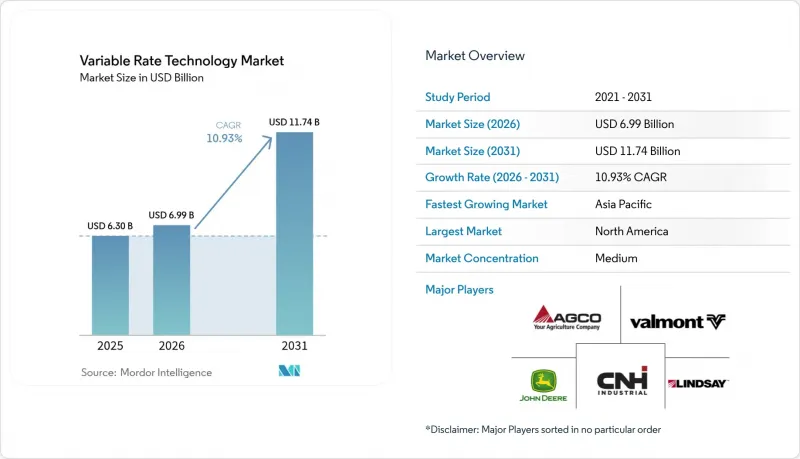
據 Mordor Intelligence 稱,2026 年可變利率技術 (VRT) 的市場規模估計為 69.9 億美元,高於 2025 年的 63 億美元,預計到 2031 年將達到 117.4 億美元。
預計從 2026 年到 2031 年,其複合年成長率將達到 10.93%。
本報告按作物類型(穀物等)、應用(化肥、農藥等)、施用方式(硬體等)、實施方法(基於地圖的變數施肥技術等)、農場規模(大型農場等)和地區(北美、歐洲等)進行分類。市場預測以美元計價。
全球浮動利率技術(VRT)市場趨勢與洞察
農場快速數位化
美國已有61%的農場在使用精密農業硬體,將即時農業數據傳輸到雲端平台。設備製造商正投入數十億美元用於自動化解決方案,以減少勞動力需求並提高施肥精度,例如約翰迪爾公司斥資200億美元,計劃在未來十年內在美國國內實施。歐洲的政策也同樣優先考慮農業數位化策略,確保為連網型設備提供持續資金。由人工智慧驅動演算法建構的封閉回路型回饋機制不斷調整施肥方案,可變施肥技術市場正從靜態地圖轉向自學習系統。然而,大型農場和小規模農場之間日益擴大的數位化鴻溝威脅著這項技術的公平普及。
政府補貼和激勵措施
政策制定者正利用津貼、退稅和生態計畫來支持實施成本。美國農業部(USDA)的「氣候智慧型商品」舉措正在投資31億美元,用於需要詳細生產數據以及相應精準投入管理工具的專案。澳洲的「農場互聯互通計畫」承擔了智慧灌溉設備一半的費用,而印度的「數位農業使命」已撥款6,000立方公尺(約7.2289億美元)用於互聯基礎建設。歐洲通用農業政策(CAP)將至少25%的直接支付用於鼓勵變數施肥的生態計畫。這些補貼降低了進入門檻,尤其對那些曾經因高科技投資而現金流受限的中型農場而言更是如此。
可變施肥機械需要大量資金投入。
通常,年銷售額超過10萬歐元(約114,923.51美元)的農場才能達到損益兩平點。因此,購置設備的成本對小規模農場來說是一筆沉重的負擔,使得它們難以進入這個行業。雖然像AgDirect這樣的金融機構提供產業專用的貸款,但對於財務基礎薄弱的家庭農場來說,抵押品相關的障礙仍然存在。作為一種解決方案,「設備即服務」(Equipment-as-a-Service)合約正在被採用,這種合約允許成本不再按擁有的機器數量分攤,而是按管理的農田面積。
細分市場分析
預計到2025年,穀物將佔總收入的37.18%,鞏固其作為變數施肥技術(VRT)市場基石的地位。這些廣袤農田上的作物受益於數十年的處方測繪,從而能夠對大片地塊的氮、磷肥施用量和播種密度進行精細調整。棉花、菸草和特殊纖維等經濟作物預計將實現最快成長,複合年成長率(CAGR)將達到14.27%。這是因為高利潤率促使生產商採用高性能感測器和儀器驅動的人工智慧技術。隨著強調微米級數值和葉片等級等精準度的品質掛鉤定價機制的普及,商業作物變數施肥技術(VRT)市場規模預計將進一步擴大。利用頻譜相機持續監測作物壓力水平,可為即時模型提供數據,從而在幾分鐘內實施鉀肥施用或葉面噴布等乾預措施。這種快速響應使生產商能夠獲得合約獎金並減少等級下降。雖然穀物將繼續支撐部署數量的基礎,但特種作物領域將推動先進功能的採用。
第二代土壤光譜分析技術能夠測量養分釋放曲線,從而支持油籽和豆類作物輪作中的肥料微量施用。這項技術在巴西和印度特別普及,因為在這些國家,蛋白質和油脂含量直接影響農產品價格。隨著水果出口商對糖度值和色澤容差的要求越來越嚴格,可變施肥技術市場正進一步滲透到果園和葡萄園。供應商正在將樹液分析和灌溉控制整合到訂閱服務中,使小規模果農無需直接購買設備即可獲得先進的分析功能。
到2025年,化肥市佔率將達到31.25%,這主要得益於氮肥利用效率的提高,預計將使大多數氣候帶的投資回報迅速顯現。到2031年,變數灌溉的複合年成長率預計將達到16.55%,這反映了日益嚴重的水資源短缺以及對季節性用水量的監管限制。加州的試驗表明,在杏仁和開心果園中採用精準中心支軸式噴灌系統具有經濟可行性,可在不降低產量的情況下減少25%的用水量。在補貼低壓噴嘴維修成本的津貼計畫的推動下,預計到2031年,灌溉設備中變數灌溉技術的市場規模將新增10.7億美元的銷售額。作物保護噴灑也緊隨其後,電腦視覺雜草辨識技術可將除草劑用量減少高達80%。除了這些成就之外,產量監測應用完善了數據回饋循環,最佳化了未來的施藥計劃,並為分析軟體的續訂奠定了基礎。
無線土壤探針與雲端控制面板的整合,使得灌溉決策能夠充分考慮蒸散量預測和未來降雨機率。這種預測能力透過延長水泵壽命和降低能源需求,提升了資源利用效率的提案。在施肥方面,目前已將即時葉肉分析應用於攜帶式檢測套組,並與施肥速率控制設備同步運行,從而將靜態施肥圖轉化為貫穿整個生長季的動態施肥計劃。生物作物保護材料的創新進一步增加了對精準微施肥的需求,而精準微施肥依賴於感測器驅動的可變施肥演算法。
區域分析
預計到2025年,北美將佔可變施肥技術市場收入的38.62%。農業機械的高普及率、有利的資金籌措環境以及美國農業部的「氣候智慧型採購法規」正在推動市場需求。補貼計畫鼓勵採用智慧農機設備,這些設備可在噴嘴處記錄施肥量,並對已證實的養分減量進行獎勵。雖然中西部和草原部分地區的農村寬頻基礎設施仍然落後,但預計到2026年,衛星網路的部署將擴大覆蓋範圍。俄亥俄州立大學的一項試驗表明,將可變施氮量與基於無人機的種植密度測量相結合,可將產量提高6%,這為持續投資提供了證據。經銷商生態系統正在為車輛維護和數據分析提供認證技術人員,從而支撐了服務業的成長趨勢。
亞太地區正經歷最快的成長,預計到2031年將實現13.65%的複合年成長率,這得益於世界各國政府將數位農業納入其現代化投資計畫。中國最新的五年規劃正大力推動低碳高效農業,並與精準的投入品供應緊密結合。印度的農民登記系統與Aadhaar(國民身分識別號碼)掛鉤,簡化了感測器套件的補貼發放;日本農林水產省則在共同資助水稻變數播種試驗。該地區的小規模農戶結構催生了創造性解決方案,例如由鄉村創業家營運的共用無人機服務。澳洲和中國北方的水資源短缺正在加速變數灌溉技術的應用,促進跨境知識轉移和硬體進口。
在歐洲,可變性技術的應用已融入更廣泛的氣候政策中。 2023-2027 年通用農業政策 (CAP) 撥款 2,695 億歐元(3,124 億美元),其中近一半用於實現氣候目標,包括減少化肥淋溶和農藥漂移。每個成員國必須將其直接支付的至少 25% 用於環境措施,其中許多措施都將精準施藥列為合格實踐。荷蘭等國設立了數位化津貼,補貼高達 40% 的感測器安裝成本,加速了科技的普及。隨著平台適應《一般資料保護規則》(GDPR) 的義務,有關資料主權的法規增加了合規成本。儘管如此,像德國的「5G 農業測試平台」這樣的聯盟計畫正在迅速建立人們對安全連接的信心,而泛歐碳排放舉措也依賴於噴灑速率控制設備產生的可追溯的投入數據。
其他好處:
- Excel格式的市場預測(ME)表
- 3個月的分析師支持
目錄
第1章:引言
- 研究假設和市場定義
- 調查範圍
第2章:調查方法
第3章執行摘要
第4章 市場狀況
- 市場概覽
- 市場促進因素
- 農業的快速數字化
- 政府補貼和激勵措施
- 農業勞動力短缺問題日益嚴峻。
- 針對面積小於一英畝、採用衛星通訊的NB-IoT應用場景的處方箋。
- 排碳權貨幣化需要對投入物進行可追溯性。
- 用於離線VRT分析的設備端AI晶片
- 市場限制因素
- 對VRT相容機械的高額資本投入
- 農村地區的通訊基礎設施發展水準存在差異。
- 關於資料所有權和共用的模糊性
- VRT地區熟練農業服務提供者短缺
- 監理情勢
- 技術展望
- 波特五力分析
第5章 市場規模與成長預測
- 按作物類型
- 穀類和穀類食品
- 水果和蔬菜
- 油籽/豆類
- 經濟作物
- 透過使用
- 肥料
- 作物保護化學品
- 土壤感
- 產量監測
- 灌溉
- 其他(變數播種/種植、變數施用石灰/土壤改良劑)
- 報價
- 硬體
- 軟體
- 服務
- 透過實施方法
- 基於地圖的VRT
- 基於感測器的VRT
- 按農場規模
- 大型農場(超過1000公頃)
- 中型農場(200-1000公頃)
- 小規模農場(小於200公頃)
- 按地區
- 北美洲
- 美國
- 加拿大
- 墨西哥
- 其他北美國家
- 歐洲
- 德國
- 法國
- 英國
- 義大利
- 西班牙
- 俄羅斯
- 其他歐洲國家
- 亞太地區
- 中國
- 日本
- 印度
- 韓國
- 澳洲
- 其他亞太國家
- 中東
- 土耳其
- 沙烏地阿拉伯
- 阿拉伯聯合大公國
- 其他中東國家
- 非洲
- 南非
- 埃及
- 奈及利亞
- 其他非洲國家
- 北美洲
第6章 競爭情勢
- 市場集中度
- 策略趨勢
- 市佔率分析
- 公司簡介
- Deere & Company
- AGCO Corporation
- CNH Industrial NV
- Valmont Industries, Inc.
- Lindsay Corporation
- EarthOptics
- Hexagon AB
- CropX Technologies
- TeeJet Technologies(Spraying Systems)
- DJI
- DroneDeploy
- The Climate Corporation(Bayer AG)
- EOS Data Analytics, Inc
- SoilOptix
- Frontier Agriculture Ltd
第7章 市場機會與未來展望
According to Mordor Intelligence, variable rate technology market size in 2026 is estimated at USD 6.99 billion, growing from 2025 value of USD 6.30 billion with 2031 projections showing USD 11.74 billion, growing at 10.93% CAGR over 2026-2031.
This report is Segmented by Crop Type (Cereals and Grains and More), by Application (Fertilizers, Crop-Protection Chemicals, and More), by Offering (Hardware and More), by Implementation Method (Map-Based VRT and More), by Farm Size (Large Farms and More) and by Geography (North America, Europe, and More). The Market Forecasts are Provided in Terms of Value (USD).
Global Variable Rate Technology Market Trends and Insights
Rapid Digitalization of Farms
Sixty-one percent of United States farms already rely on precision hardware that feeds real-time agronomic data into cloud platforms. Equipment makers allocate multibillion-dollar budgets to autonomous solutions that lower labor needs and refine application accuracy, illustrated by John Deere's decade-long USD 20 billion domestic manufacturing plan. European policy likewise prioritizes an upcoming digital strategy for agriculture, ensuring sustained funding for connected devices. Closed feedback loops created by AI-driven algorithms continuously adjust prescriptions, moving the variable rate technology market beyond static maps toward self-learning systems. Yet a widening digital divide between large and small farms threatens equitable technology uptake.
Government Subsidies and Incentive Schemes
Policymakers use grants, rebates, and eco-schemes to underwrite adoption costs. The USDA Climate-Smart Commodities initiative channels USD 3.1 billion into projects that necessitate granular production data and, by extension, precision input tools. Australia's On-Farm Connectivity Program covers half the cost of smart irrigation devices, while India's Digital Agriculture Mission earmarks INR 6,000 crore (USD 722.89 million) for connected infrastructure. Europe's Common Agricultural Policy directs at least 25% of direct payments toward eco-schemes that reward variable-rate fertilization. These subsidies lower entry barriers, especially for mid-size farms whose cash flows were once restricted by high-tech spending.
High Capital Expenditure of VRT-Ready Machinery
Profitability breakeven often starts at economic farm sizes above EUR 100,000 (USD 114,923.51), leaving smaller operations priced out of equipment purchases. Lenders such as AgDirect offer sector-specific loans, yet collateral hurdles persist for family farms with thin balance sheets. As a workaround, equipment-as-a-service contracts spread costs across acres serviced rather than units owned.
Other drivers and restraints analyzed in the detailed report include:
- Rising Agricultural Labor Shortage
- Satellite NB-IoT-Enabled Sub-Acre Prescriptions
- Patchy Rural Connectivity Infrastructure
For complete list of drivers and restraints, kindly check the Table Of Contents.
Segment Analysis
In 2025, cereals and grains represented 37.18% of revenues, cementing their role as the foundation of the variable rate technology market. These broad-acre crops benefit from decades of prescription mapping that fine-tunes nitrogen, phosphorus, and seeding density across large tracts. Commercial crops such as cotton, tobacco, and specialty fibers deliver the fastest gains with a 14.27% CAGR outlook, as higher margins justify premium sensors and on-equipment AI. Variable rate technology market size for commercial crops is anticipated to climb in tandem with quality-linked pricing schemes that reward precise micronaire or leaf grade. Continuous monitoring of plant stress via multispectral cameras feeds real-time models that initiate potassium or foliar-feed interventions within minutes. This responsiveness helps producers capture contract bonuses and reduce grade-related downgrades. Cereals will keep anchoring installed base volumes, yet specialty segments set the pace for advanced feature uptake.
Second-generation soil spectroscopy now measures nutrient release curves that underpin fertilizer micro-dosing in oilseed and pulse rotations. Adoption is especially strong in Brazil and India, where protein and oil content directly influence farm-gate prices. The variable rate technology market further penetrates orchard and vineyard operations as fruit exporters demand tighter Brix and color tolerances. Providers bundle sap analysis and irrigation rate control into subscription services so smaller acreage fruit farms can access high-end analytics without outright equipment purchases.
Fertilizers held a 31.25% market share in 2025 because nitrogen efficiency improvements deliver quick paybacks in most climatic zones. Variable-rate irrigation is poised for a 16.55% CAGR by 2031, reflecting escalating water scarcity and regulatory caps on seasonal withdrawals. In California trials, precision pivots cut water use by 25% with no yield penalty, validating the economics for almond and pistachio groves. The variable rate technology market size for irrigation equipment is forecast to add USD 1.07 billion in incremental sales by 2031, buoyed by subsidy programs that reimburse low-pressure nozzle retrofits. Crop-protection spraying follows close behind as computer-vision weed identification slashes herbicide volumes by up to 80%. Added to these gains, yield monitoring applications complete the data feedback loop that refines future prescriptions and anchors subscription renewals for analytics software.
Integration of wireless soil probes with cloud dashboards enables irrigation decisions that account for evapotranspiration forecasts and future rainfall probability. This predictive capability extends pump life and trims energy demand, reinforcing the resource-efficiency value proposition. Fertilizer applications now leverage real-time tissue testing via portable lab kits that sync to rate controllers, converting static maps into season-long dynamic schedules. Product innovation in biological crop-protection inputs further amplifies the need for precise micro-dosing that hinges on sensor-driven variable rate algorithms.
Complete Report Scope:
- By Crop Type
- Cereals and Grains
- Fruits and Vegetables
- Oilseeds and Pulses
- Commercial Crops
- By Application
- Fertilizers
- Crop-protection Chemicals
- Soil Sensing
- Yield Monitoring
- Irrigation
- Others (variable-rate seeding/planting, variable-rate lime and soil-amendment application)
- By Offering
- Hardware
- Software
- Services
- By Implementation Method
- Map-based VRT
- Sensor-based VRT
- By Farm Size
- Large Farms (greater than 1,000 ha)
- Medium Farms (200-1,000 ha)
- Small Farms (less than 200 ha)
- By Geography
- North America
- United States
- Canada
- Mexico
- Rest of North America
- Europe
- Germany
- France
- United Kingdom
- Italy
- Spain
- Russia
- Rest of Europe
- Asia-Pacific
- China
- Japan
- India
- South Korea
- Australia
- Rest of Asia-Pacific
- Middle East
- Turkey
- Saudi Arabia
- United Arab Emirates
- Rest of Middle East
- Africa
- South Africa
- Egypt
- Nigeria
- Rest of Africa
- North America
Geography Analysis
North America generated 38.62% of 2025 revenue for the variable rate technology market. Strong machinery penetration, supportive financing, and USDA climate-smart procurement rules anchor demand. Subsidy frameworks reward documented nutrient reductions, spurring the adoption of smart implements that capture nozzle-level logs. Rural broadband lags in parts of the Midwest and Prairie provinces, yet satellite link rollouts promise coverage boosts by 2026. Ohio State trials show a 6% yield lift when VR nitrogen intersects with drone stand counts, proof points that validate ongoing investment. Dealer ecosystems supply certified technicians who maintain fleets and interpret data, underscoring the service growth narrative.
Asia-Pacific is the fastest climber, tracking a 13.65% CAGR to 2031 as governments attach digital farming clauses to modernization spending. China's latest Five-Year Plan promotes low-carbon, high-efficiency agriculture that dovetails with targeted input delivery. India's Aadhaar-linked Farmer Registry simplifies subsidy disbursement for sensor kits, while Japan's Food and Agriculture Ministry co-funds paddy-specific variable rate seeding trials. The region's small-plot structure sparks creative solutions, including shared-service drones operated by village entrepreneurs. Water scarcity across Australia and Northern China accelerates variable-rate irrigation uptake, driving cross-border knowledge transfer and hardware imports.
Europe embeds variable rate technology adoption within sweeping climate policy. The Common Agricultural Policy for 2023-27 allocates EUR 269.5 billion (USD 312.4 billion), nearly half aimed at climate objectives that include reduced fertilizer leaching and pesticide drift. Each member state must earmark at least 25% of direct payments for eco-schemes, many of which list precision application as a qualifying practice. Countries such as the Netherlands fund digitization grants that reimburse up to 40% of sensor installations, hastening implementation. Data sovereignty rules raise compliance costs as platforms adapt to General Data Protection Regulation obligations. Nonetheless, consortium projects like Germany's 5G Testbed Agriculture expedite confidence in secure connectivity, and Pan-European carbon initiatives depend on traceable input data generated by rate controllers.
- Deere & Company
- AGCO Corporation
- CNH Industrial N.V.
- Valmont Industries, Inc.
- Lindsay Corporation
- EarthOptics
- Hexagon AB
- CropX Technologies
- TeeJet Technologies (Spraying Systems)
- DJI
- DroneDeploy
- The Climate Corporation (Bayer AG)
- EOS Data Analytics,Inc
- SoilOptix
- Frontier Agriculture Ltd
Additional Benefits:
- The market estimate (ME) sheet in Excel format
- 3 months of analyst support
TABLE OF CONTENTS
1 Introduction
- 1.1 Study Assumptions and Market Definition
- 1.2 Scope of the Study
2 Research Methodology
3 Executive Summary
4 Market Landscape
- 4.1 Market Overview
- 4.2 Market Drivers
- 4.2.1 Rapid digitalization of farms
- 4.2.2 Government subsidies and incentive schemes
- 4.2.3 Rising agriculture labour shortage
- 4.2.4 Satellite NB-IoT-enabled sub-acre prescriptions
- 4.2.5 Carbon credit monetization demanding input traceability
- 4.2.6 On-equipment AI chips for offline VRT analytics
- 4.3 Market Restraints
- 4.3.1 High capital expenditure of VRT-ready machinery
- 4.3.2 Patchy rural connectivity infrastructure
- 4.3.3 Data ownership and sharing ambiguities
- 4.3.4 Shortage of VRT skilled agronomic service providers
- 4.4 Regulatory Landscape
- 4.5 Technological Outlook
- 4.6 Porter's Five Forces Analysis
- 4.6.1 Threat of New Entrants
- 4.6.2 Bargaining Power of Buyers
- 4.6.3 Bargaining Power of Suppliers
- 4.6.4 Threat of Substitutes
- 4.6.5 Intensity of Competitive Rivalry
5 Market Size and Growth Forecasts (Value)
- 5.1 By Crop Type
- 5.1.1 Cereals and Grains
- 5.1.2 Fruits and Vegetables
- 5.1.3 Oilseeds and Pulses
- 5.1.4 Commercial Crops
- 5.2 By Application
- 5.2.1 Fertilizers
- 5.2.2 Crop-protection Chemicals
- 5.2.3 Soil Sensing
- 5.2.4 Yield Monitoring
- 5.2.5 Irrigation
- 5.2.6 Others (variable-rate seeding/planting, variable-rate lime and soil-amendment application)
- 5.3 By Offering
- 5.3.1 Hardware
- 5.3.2 Software
- 5.3.3 Services
- 5.4 By Implementation Method
- 5.4.1 Map-based VRT
- 5.4.2 Sensor-based VRT
- 5.5 By Farm Size
- 5.5.1 Large Farms (greater than 1,000 ha)
- 5.5.2 Medium Farms (200-1,000 ha)
- 5.5.3 Small Farms (less than 200 ha)
- 5.6 By Geography
- 5.6.1 North America
- 5.6.1.1 United States
- 5.6.1.2 Canada
- 5.6.1.3 Mexico
- 5.6.1.4 Rest of North America
- 5.6.2 Europe
- 5.6.2.1 Germany
- 5.6.2.2 France
- 5.6.2.3 United Kingdom
- 5.6.2.4 Italy
- 5.6.2.5 Spain
- 5.6.2.6 Russia
- 5.6.2.7 Rest of Europe
- 5.6.3 Asia-Pacific
- 5.6.3.1 China
- 5.6.3.2 Japan
- 5.6.3.3 India
- 5.6.3.4 South Korea
- 5.6.3.5 Australia
- 5.6.3.6 Rest of Asia-Pacific
- 5.6.4 Middle East
- 5.6.4.1 Turkey
- 5.6.4.2 Saudi Arabia
- 5.6.4.3 United Arab Emirates
- 5.6.4.4 Rest of Middle East
- 5.6.5 Africa
- 5.6.5.1 South Africa
- 5.6.5.2 Egypt
- 5.6.5.3 Nigeria
- 5.6.5.4 Rest of Africa
- 5.6.1 North America
6 Competitive Landscape
- 6.1 Market Concentration
- 6.2 Strategic Moves
- 6.3 Market Share Analysis
- 6.4 Company Profiles (includes Global level Overview, Market level overview, Core Segments, Financials as available, Strategic Information, Market Rank/Share, Products and Services, Recent Developments)
- 6.4.1 Deere & Company
- 6.4.2 AGCO Corporation
- 6.4.3 CNH Industrial N.V.
- 6.4.4 Valmont Industries, Inc.
- 6.4.5 Lindsay Corporation
- 6.4.6 EarthOptics
- 6.4.7 Hexagon AB
- 6.4.8 CropX Technologies
- 6.4.9 TeeJet Technologies (Spraying Systems)
- 6.4.10 DJI
- 6.4.11 DroneDeploy
- 6.4.12 The Climate Corporation (Bayer AG)
- 6.4.13 EOS Data Analytics,Inc
- 6.4.14 SoilOptix
- 6.4.15 Frontier Agriculture Ltd
7 Market Opportunities and Future Outlook

 可變應用技術市場:按產品、技術類型、作物類型、農場規模和應用分類-2026-2032年全球預測
 農業變數噴灑技術市場規模、佔有率和成長分析:按產品、安裝方式、應用、農場規模、作物類型和地區分類-2026年至2033年產業預測
 可變利率技術設備市場:成長機會、成長要素、產業趨勢分析及2026-2035年預測
 全球可變輸入技術市場規模、佔有率、趨勢和成長分析報告(2026-2034)
 2032年變數施肥技術(VRT)市場預測:按類型、作物類型、農場規模、技術、最終用戶和地區分類的全球分析2032年變數技術(VRT)噴霧器市場預測:按產品、實施方法、平台、農場規模、作物、應用和地區分類的全球分析