


 |
市場調查報告書
商品編碼
2123512
歐洲行車記錄器:市場佔有率分析、產業趨勢與統計及成長預測(2026-2031)Europe Dashboard Camera - Market Share Analysis, Industry Trends & Statistics, Growth Forecasts (2026 - 2031) |
||||||

※ 本網頁內容可能與最新版本有所差異。詳細情況請與我們聯繫。
根據 Mordor Intelligence 預測,歐洲行車記錄器市場規模將從 2025 年的 12.8 億美元成長到 2026 年的 14.1 億美元,然後在 2031 年達到 23.1 億美元,2026 年至 2031 年的複合年成長率為 10.36%。
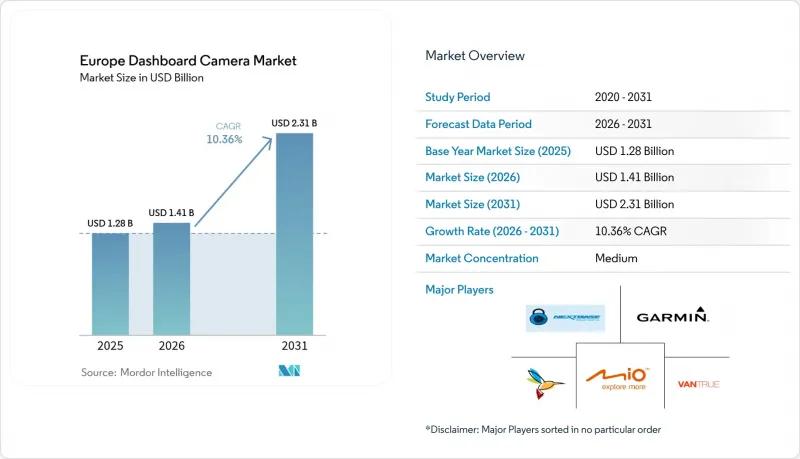
本報告按技術(基礎型、智慧型)、產品類型(單通道、其他)、應用領域(乘用車、商用車)、影像品質/解析度(標清、其他)、銷售管道(線上零售、線下零售)、最終用戶(私家車車主、其他)和國家進行細分。市場預測以美元計價。
歐洲行車記錄器市場趨勢與洞察
交通事故訴訟中對證據的需求激增
目前,歐洲各地的法院都接受行車記錄器影像作為責任糾紛的主要證據,這使得和解時間縮短了高達40%,並降低了保險公司的訴訟成本。 2023年,英國警方透過「簡介行動」(Operation Snap)處理了約12.5萬份報告,其中70%最終採取了執法行動。在法國和義大利,允許錄影,但前提是除非發生事故,否則錄影的保存期限不得超過七天,這提高了消費者的信心。西班牙的叫車司機正在使用影像來反駁欺詐性索賠,這與該國13.44%的複合年成長率相符。物流車輛業者報告稱,安裝攝影機後,事故率降低了15%,保險費降低了高達18%。隨著影像證據價值的日益普及,攝影機正從可有可無的小工具轉變為法律保護的手段。
安裝行車記錄器的車輛可享保險費折扣
保險公司正向共用影像和遠端資訊處理數據的投保人提供獎勵。 Aviva 的智慧型手機行車記錄器應用程式平均每年可節省 170 英鎊(215 美元),安全駕駛評分高的駕駛員最高可節省 250 英鎊(316 美元)。捷豹路虎和安聯保險每月為路虎攬勝探測車補貼 150 英鎊(190 美元),以換取他們提供數據。行車記錄器的普及率正在不斷提高,31% 的駕駛員擁有行車記錄儀,四分之三的駕駛員認為「所有駕駛員都應該使用行車記錄器」。在荷蘭,Fleet 公司在添加影像功能後,安全評分接近 100%,從而獲得了 12% 至 18% 的續保折扣。隨著高里程商用車的承保標準日益嚴格,行車記錄器正逐漸成為必備的設備。
GDPR 帶來的嚴格資料隱私合規成本
德國《聯邦資料保護法》和《電訊與電信媒體法》的修正案強制要求端對端加密並限制連續錄製,導致組件成本增加 50 至 80 歐元(56 至 90 美元)。法國刑法將錄製資料的保留期限限制為七天,並強制實施自動覆蓋功能。供應商必須整合地理圍欄功能以停用敏感區域的錄製,並維護用戶同意日誌,這增加了韌體的複雜性,並降低了入門級產品的利潤率。這種碎片化迫使製造商維護多個軟體版本,從而削弱了規模經濟效益。
細分市場分析
預計智慧行車記錄器將以10.95%的複合年成長率成長,其整合的人工智慧技術可用於駕駛員引導和影片片段即時上傳,從而將安全理念從「被動」轉變為「主動」。雖然到2025年,基礎型行車記錄器仍將佔56.98%的銷量,但隨著車隊選擇數據豐富的設備(可減少15%的事故並節省保險費用),其市場佔有率正在萎縮。在歐洲行車記錄器市場,智慧型行車記錄器市場預計將實現最大成長,這主要得益於物流公司和叫車業者對符合法規要求的行車記錄器的需求。
對價格敏感的個人車主仍傾向於選擇售價150歐元(約169美元)的基本款行車記錄器進行證據錄製,這雖然維持了銷量,但也給利潤率帶來了壓力。隨著4K行車記錄器價格的下降,零售通路的促銷活動正在減少庫存。這種兩極化反映了汽車技術的日益普及:消費者將行車記錄器視為配件,而車隊營運商則將其視為商用的軟體節點。
預計到2025年,單通道設備將佔總銷售量的64.25%,但由於歐盟法規要求新卡車配備車載監視錄影機,雙通道設備的年複合成長率預計將達到12.18%。叫車司機也在安裝車載攝影機來記錄衝突,這種做法在西班牙和法國的普及速度正在加快。
車隊採購商購買雙通道套裝的價格在 250 至 400 歐元(281 至 450 美元)之間,套裝包含帶安全鎖盒的安裝支架,以防止駕駛員篡改。僅用於後輪的攝影機仍然是小眾產品,主要目的是防止停車場刮傷。雖然原始設備製造商 (OEM) 備有多種鏡頭,但售後市場供應商則專注於易於改裝和卓越的分析功能,以維持其市場佔有率。
其他好處:
- Excel格式的市場預測(ME)表
- 3個月的分析師支持
目錄
第1章:引言
- 研究假設和市場定義
- 調查範圍
第2章:調查方法
第3章執行摘要
第4章 市場狀況
- 市場概覽
- 市場促進因素
- 交通事故訴訟中對證據的需求激增
- 安裝行車記錄器的車輛可享保險費折扣
- 歐盟關於高級駕駛員監控系統的強制規定
- 人工智慧驅動的連網行車記錄器的普及
- 將車隊遠端資訊處理技術整合到物流和共享出行領域。
- 降低高解析度成像感測器的成本
- 市場限制因素
- GDPR帶來的嚴格資料隱私合規成本
- 關於公共場所影片的國內法規
- 來自OEM整合攝影機系統的競爭壓力
- 擔心24小時停車模式電池電量消耗過快
- 產業價值/價值鏈分析
- 宏觀經濟因素對市場的影響
- 監理情勢
- 技術展望
- 波特五力分析
第5章 市場規模與成長預測
- 透過技術
- 基本的
- 聰明的
- 依產品類型
- 單通道
- 雙通道
- 後視圖
- 透過使用
- 搭乘用車
- 商用車輛
- 按影像品質/解析度
- 標準清晰度(SD)
- 高畫質 (HD)
- 全高清
- 超高解析度(4K 或更高)
- 透過分銷管道
- 線上零售
- 線下零售
- 最終用戶
- 私家車車主
- 車隊營運商
- 執法機關和緊急服務
- 共乘司機和計程車駕駛人
- 國家
- 英國
- 德國
- 法國
- 西班牙
- 義大利
- 其他歐洲國家
第6章 競爭情勢
- 市場集中度
- 策略趨勢
- 市佔率分析
- 公司簡介
- Pittasoft Co., Ltd.
- MiTAC Europe Ltd.(Mio)
- Vantrue Inc.
- Portable Multimedia Ltd.(Nextbase)
- Garmin Ltd.
- Trakm8 Holdings plc(RoadHawk)
- Halfords Group plc
- JVCKENWOOD Corporation
- Samsara Inc.
- Steelmate Automotive(UK)Ltd.
- Thinkware Corporation
- Fine Digital Inc.
- Transcend Information Inc.
- VIOFO Ltd.
- Cobra Electronics Corporation
- Nextbase Manufacturing(Hong Kong)Ltd.
- Anker Innovations Ltd.(ROAV)
- DOD Tech Co., Ltd.
第7章 市場機會與未來展望
According to Mordor Intelligence, the Europe dashboard camera market size is expected to grow from USD 1.28 billion in 2025 to USD 1.41 billion in 2026 and is forecast to reach USD 2.31 billion by 2031 at 10.36% CAGR over 2026-2031.
This report is Segmented by Technology (Basic, and Smart), Product Type (Single-Channel, and More), Application (Passenger Vehicles, and Commercial Vehicles), Video Quality/Resolution (Standard Definition, and More), Distribution Channel (Online Retail, and Offline Retail), End-User (Private Vehicle Owners, and More), and Country. The Market Forecasts are Provided in Terms of Value (USD)
Europe Dashboard Camera Market Trends and Insights
Surge in Road-Accident Litigation Evidence Needs
Courts across Europe now accept dashcam video as primary proof in liability disputes, shortening settlement cycles by up to 40% and cutting insurer legal fees. United Kingdom police processed about 125,000 Operation Snap submissions in 2023, with 70% yielding enforcement action. France and Italy allow recordings if retention is limited to seven days unless an incident occurs, reinforcing consumer confidence. Spanish rideshare drivers rely on footage to rebut fraudulent claims, mirroring the country's 13.44% CAGR. Logistics fleets report accident reductions of 15% and premium cuts of up to 18% after deploying cameras. As video admissibility spreads, cameras shift from optional gadgets to legal safeguards.
Insurance Premium Discounts for Dashcam-Equipped Vehicles
Insurers reward policyholders who share footage or telematics data. Aviva's smartphone dashcam app yields average annual savings of GBP 170 (USD 215) and peaks at GBP 250 (USD 316) for high-scoring drivers. Jaguar Land Rover and Allianz subsidize Range Rover premiums by GBP 150 (USD 190) monthly in exchange for data feeds. Adoption is advanced, with 31% of motorists owning dashcams and three-quarters believing all drivers should use one. Dutch fleets report safety scores near 100% after adding video, translating into 12%-18% renewal discounts. As commercial carriers with high mileage face tighter underwriting, cameras are increasingly required equipment.
Stringent GDPR-Driven Data-Privacy Compliance Costs
Germany's revised Federal Data Protection Act and Telecommunications-Telemedia amendments impose end-to-end encryption and restrict continuous recording, adding EUR 50-80 (USD 56-90) to bill-of-materials costs. France's Penal Code limits footage retention to seven days, compelling automatic overwrite functions. Vendors must code geofencing to disable recording in sensitive zones and maintain consent logs, complicating firmware and shrinking entry-level margins. Such fragmentation forces makers to maintain multiple software builds, undermining scale economies.
Other drivers and restraints analyzed in the detailed report include:
- EU Mandates for Advanced Driver Monitoring Systems
- Proliferation of AI-Enabled Connected Dashcams
- National Restrictions on Public-Space Video Recording
For complete list of drivers and restraints, kindly check the Table Of Contents.
Segment Analysis
Smart models, forecast to grow at an 10.95% CAGR, embed AI that coaches drivers and uploads clips instantly, reshaping value from passive to predictive safety. Basic devices held 56.98% of 2025 revenue, yet their share erodes as fleets choose data-rich units that cut accidents by 15% and unlock insurance savings. The Europe dashboard camera market size for smart units is projected to widen most among logistics and rideshare operators that demand compliance dashboards.
Price-sensitive private owners still choose EUR 150 (USD 169) basic models for evidence capture, sustaining volume but pressuring margins. Retail channel promotions clear aging inventory as 4K prices drop. The bifurcation mirrors wider automotive tech adoption: consumers judge cameras as accessories, fleets view them as operational software nodes.
Single-channel devices held 64.25% revenue in 2025, yet dual-channel units will rise at a 12.18% CAGR because EU rules now require cabin-facing monitoring on new truck types. Rideshare drivers also install cabin cameras to document disputes, accelerating uptake in Spain and France.
Fleet buyers pay EUR 250-400 (USD 281-450) for dual-channel bundles that include secure lock-box mounts, avoiding driver tampering. Rear-only units remain niche, aimed at parking-lot scuffs. As OEMs add multiple lenses, after-market suppliers focus on ease of retrofit and superior analytics to retain share.
Complete Report Scope:
- By Technology
- Basic
- Smart
- By Product Type
- Single-Channel
- Dual-Channel
- Rear-View
- By Application
- Passenger Vehicles
- Commercial Vehicles
- By Video Quality/Resolution
- Standard Definition (SD)
- High Definition (HD)
- Full High Definition (FULL HD)
- Ultra High Definition (4K and Above)
- By Distribution Channel
- Online Retail
- Offline Retail
- By End-User
- Private Vehicle Owners
- Fleet Operators
- Law Enforcement and Emergency Services
- Rideshare and Taxi Drivers
- By Country
- United Kingdom
- Germany
- France
- Spain
- Italy
- Rest of Europe
List of Companies Covered in this Report:
- Pittasoft Co., Ltd.
- MiTAC Europe Ltd. (Mio)
- Vantrue Inc.
- Portable Multimedia Ltd. (Nextbase)
- Garmin Ltd.
- Trakm8 Holdings plc (RoadHawk)
- Halfords Group plc
- JVCKENWOOD Corporation
- Samsara Inc.
- Steelmate Automotive (UK) Ltd.
- Thinkware Corporation
- Fine Digital Inc.
- Transcend Information Inc.
- VIOFO Ltd.
- Cobra Electronics Corporation
- Nextbase Manufacturing (Hong Kong) Ltd.
- Anker Innovations Ltd. (ROAV)
- DOD Tech Co., Ltd.
Additional Benefits:
- The market estimate (ME) sheet in Excel format
- 3 months of analyst support
TABLE OF CONTENTS
1 INTRODUCTION
- 1.1 Study Assumptions and Market Definition
- 1.2 Scope of the Study
2 RESEARCH METHODOLOGY
3 EXECUTIVE SUMMARY
4 MARKET LANDSCAPE
- 4.1 Market Overview
- 4.2 Market Drivers
- 4.2.1 Surge in Road-Accident Litigation Evidence Needs
- 4.2.2 Insurance Premium Discounts for Dashcam-Equipped Vehicles
- 4.2.3 EU Mandates for Advanced Driver Monitoring Systems
- 4.2.4 Proliferation of AI-Enabled Connected Dashcams
- 4.2.5 Fleet Telematics Integration Across Logistics and Rideshare
- 4.2.6 Declining Cost of High-Resolution Imaging Sensors
- 4.3 Market Restraints
- 4.3.1 Stringent GDPR-Driven Data-Privacy Compliance Costs
- 4.3.2 National Restrictions on Public-Space Video Recording
- 4.3.3 Competitive Pressure from OEM-Integrated Camera Systems
- 4.3.4 Battery-Drain Concerns During 24-Hour Parking Mode
- 4.4 Industry Value / Supply-Chain Analysis
- 4.5 Impact of Macroeconomic Factors on the Market
- 4.6 Regulatory Landscape
- 4.7 Technological Outlook
- 4.8 Porter's Five Forces Analysis
- 4.8.1 Threat of New Entrants
- 4.8.2 Bargaining Power of Buyers
- 4.8.3 Bargaining Power of Suppliers
- 4.8.4 Threat of Substitute Products
- 4.8.5 Intensity of Competitive Rivalry
5 MARKET SIZE AND GROWTH FORECASTS (VALUE)
- 5.1 By Technology
- 5.1.1 Basic
- 5.1.2 Smart
- 5.2 By Product Type
- 5.2.1 Single-Channel
- 5.2.2 Dual-Channel
- 5.2.3 Rear-View
- 5.3 By Application
- 5.3.1 Passenger Vehicles
- 5.3.2 Commercial Vehicles
- 5.4 By Video Quality/Resolution
- 5.4.1 Standard Definition (SD)
- 5.4.2 High Definition (HD)
- 5.4.3 Full High Definition (FULL HD)
- 5.4.4 Ultra High Definition (4K and Above)
- 5.5 By Distribution Channel
- 5.5.1 Online Retail
- 5.5.2 Offline Retail
- 5.6 By End-User
- 5.6.1 Private Vehicle Owners
- 5.6.2 Fleet Operators
- 5.6.3 Law Enforcement and Emergency Services
- 5.6.4 Rideshare and Taxi Drivers
- 5.7 By Country
- 5.7.1 United Kingdom
- 5.7.2 Germany
- 5.7.3 France
- 5.7.4 Spain
- 5.7.5 Italy
- 5.7.6 Rest of Europe
6 COMPETITIVE LANDSCAPE
- 6.1 Market Concentration
- 6.2 Strategic Moves
- 6.3 Market Share Analysis
- 6.4 Company Profiles (includes Global Level Overview, Market Level Overview, Core Segments, Financials as available, Strategic Information, Market Rank/Share for key companies, Products and Services, and Recent Developments)
- 6.4.1 Pittasoft Co., Ltd.
- 6.4.2 MiTAC Europe Ltd. (Mio)
- 6.4.3 Vantrue Inc.
- 6.4.4 Portable Multimedia Ltd. (Nextbase)
- 6.4.5 Garmin Ltd.
- 6.4.6 Trakm8 Holdings plc (RoadHawk)
- 6.4.7 Halfords Group plc
- 6.4.8 JVCKENWOOD Corporation
- 6.4.9 Samsara Inc.
- 6.4.10 Steelmate Automotive (UK) Ltd.
- 6.4.11 Thinkware Corporation
- 6.4.12 Fine Digital Inc.
- 6.4.13 Transcend Information Inc.
- 6.4.14 VIOFO Ltd.
- 6.4.15 Cobra Electronics Corporation
- 6.4.16 Nextbase Manufacturing (Hong Kong) Ltd.
- 6.4.17 Anker Innovations Ltd. (ROAV)
- 6.4.18 DOD Tech Co., Ltd.
7 MARKET OPPORTUNITIES AND FUTURE OUTLOOK
- 7.1 White-Space and Unmet-Need Assessment

 北美行車記錄器:市場佔有率分析、產業趨勢與統計及成長預測(2026-2031)行車記錄器:市場佔有率分析、產業趨勢與統計、成長預測(2026-2031)
 汽車事件資料記錄器市場-2026-2032年全球市場預測汽車行車記錄器市場:2026-2032年全球市場預測(按產品類型、技術、解析度、車輛類型、應用和分銷管道分類)
 汽車行車記錄器市場機會、成長要素、產業趨勢分析及2026-2035年預測。
 汽車數位錄影機市場規模、佔有率和成長分析:按產品類型、技術、解析度、應用、銷售管道和地區分類-2026-2033年產業預測
 全球汽車行車記錄器市場:依產品類型、最終用戶、安裝類型和地區分類
 全球汽車行車記錄器市場(至2033年):按原廠配套/售後市場、產品類型(前行車記錄器、前後置行車記錄器、前後置+車載行車記錄器)、技術(基礎型、高級型、智慧型)、影像品質、電動車類型、配銷通路和地區分類
 行車記錄器市場規模、佔有率、趨勢和預測:按技術、產品、影像品質、應用、分銷管道和地區分類,2026-2034年
 2026年全球汽車事件資料記錄器市場報告