


 |
市場調查報告書
商品編碼
2122292
行車記錄器:市場佔有率分析、產業趨勢與統計、成長預測(2026-2031)Dashboard Camera - Market Share Analysis, Industry Trends & Statistics, Growth Forecasts (2026 - 2031) |
||||||

※ 本網頁內容可能與最新版本有所差異。詳細情況請與我們聯繫。
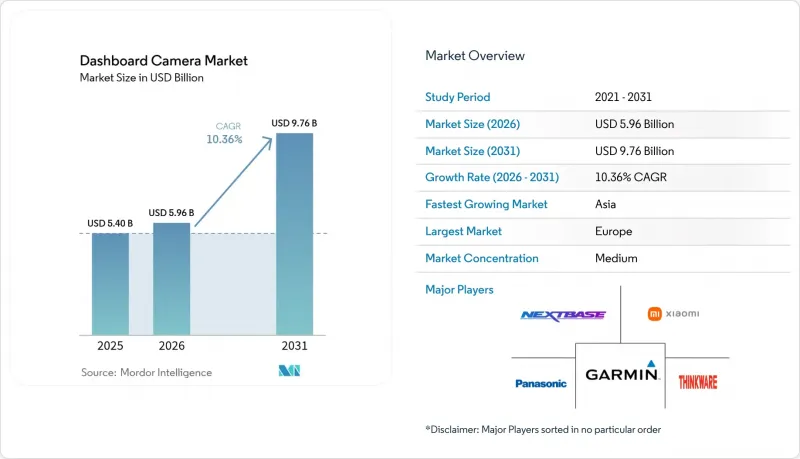
據 Mordor Intelligence 稱,2025 年行車記錄器市值為 54 億美元,預計到 2031 年將達到 97.6 億美元,而 2026 年為 59.6 億美元,預測期(2026-2031 年)的複合年成長率為 10.36%。
本報告按技術(基礎型、高級型、智慧型/AI整合型)、產品類型(單通道、雙通道、後視/環繞型)、影片品質(標準/高清、全高清、4K/超高清)、應用領域(乘用車、商用車隊)、分銷管道(實體店、線上)和地區進行分類。市場預測以美元計價。
全球行車記錄器市場趨勢與洞察
歐洲強制安裝 eCall 事件資料記錄器,導致原廠安裝行車記錄器廣泛使用。
將於2024年7月生效的法規將強制要求歐盟所有新乘用車儲存碰撞相關數據,這使得影像成為汽車製造商生產線整合的自然延伸。製造商需要獲得基於合規性的差異化優勢,供應商需要確保長期的平台供應,而售後市場品牌則需要將業務轉向經銷商配件和車隊改裝。德國一級電子公司正在迅速採用符合GDPR標準的韌體和加密存儲,並透過其全球平台將歐盟檢驗的技術推廣到其他市場,從而建立競爭優勢。
美國和英國物流行業引入人工智慧驅動的車隊影像遠端資訊處理技術。
大型運輸公司正從事故後檢驗轉向主動引導。人工智慧分析能夠自動偵測跟車距離不足、拖曳以及駕駛員疲勞等問題,使安全管理人員能夠及早介入,減少保險索賠,並協商降低保費。高度可擴展的雲端檢驗減少了影像審查,並支援在數千輛牽引車和貨車上進行企業級部署。擁有專有電腦視覺技術的供應商正與尋求「影像優先」差異化的遠端資訊處理整合商主導策略夥伴關係。
德國和奧地利因GDPR而實施錄音限制
強制循環錄製、匿名化以及遵守最低保存期限等要求增加了韌體的複雜性和成本。奧地利交通管理部門對違規行為處以最高 2,000 萬歐元(約 2,180 萬美元)的罰款。雖然德國聯邦法院在訴訟中採納行車記錄器證據提高了法律的清晰度,但硬體供應商仍然要求提供特定地區的 SKU,這阻礙了規模經濟的實現。
細分市場分析
到2025年,基礎型行車記錄器仍將佔據57.40%的市場佔有率,而智慧型/人工智慧整合行車記錄器預計將以11.83%的複合年成長率(CAGR)實現最高成長,直至2031年。智慧型行車記錄器可將影像轉換為駕駛輔助警報,幫助車隊營運商減少保險索賠並降低保費。個人用戶仍然會購買基礎型行車記錄器以經濟高效地收集證據,但注重高階功能的消費者群體正擴大選擇具備雲端上傳功能的應用程式連接設備。擁有電腦視覺相關智慧財產權的供應商正在確保持續的訂閱收入,從而緩解行車記錄器市場硬體的同質化趨勢。
同時,保險公司在保費談判中開始參考人工智慧產生的風險評估報告,這進一步推高了保險公司和採用自保模式的企業的需求。雖然個人車主仍然對價格比較敏感,但高所得消費者更傾向於選擇能夠透過緊急資料上傳和遠端查看等功能提供安心保障的應用程式增強型設備。隨著空中下載(OTA)更新的日益普及,行車記錄器市場的品牌主導地位可能更多地取決於韌體藍圖,而非光學性能。
到2025年,單通道設計將佔71.30%的銷售量,成為市場領導者。然而,雙通道系統正以10.78%的複合年成長率成長,這主要得益於車隊對前置攝影機和車內影像證據的需求。物流公司報告稱,當車內影像可用時,糾紛解決速度可提高30%,證明了巨額資本投資的合理性。叫車司機和家長構成了多視角套件的主要消費群體,而原始設備製造商(OEM)正在整合現有的泊車輔助感應器,以便在需要時啟動車內錄影功能,從而在隱私合規性和擴大覆蓋範圍之間取得平衡。
後視和車內視角組合的普及速度緩慢,主要受安裝複雜性和隱私顧慮的限制。叫車司機和家長是願意為360°全景影像付費的小眾群。汽車製造商正在嘗試利用現有的泊車輔助感測器來觸發選擇性車內錄影,以平衡安全性和隱私合規性。
區域分析
預計到2025年,歐洲將以34.60%的市佔率佔據領先地位,這主要得益於強制實施的eCall事件資料記錄器(EDR),該記錄器將影像證據制度化。北歐國家的採用率高於平均水平,因為保險公司在初步審核保險索賠時會使用影像。自動人臉模糊等隱私保護功能現已成為標準配置,雖然增加了開發複雜性,但也增強了消費者的信心。
預計到2031年,亞洲將以11.25%的複合年成長率實現最高成長。中國受惠於大規模製造業帶來的經濟效益,以及市政當局為推廣連網攝影機所提供的智慧城市津貼。韓國的保險公司正在提供系統性的遠端資訊處理補貼,加速了家庭用戶的使用。印度預計將成為需求的主要驅動力,因為商用高級駕駛輔助系統(ADAS)將於2026年強制實施。當地供應商已開始按照印度公路運輸和公路部的指導方針,對能夠承受季風潮濕氣候的耐用設備進行檢查和運作。
在北美,車隊市場呈現強勁成長動能。運輸公司正將影像資料與現有的電子道路記錄器 (ELD) 和路線最佳化系統整合,而成熟的保險公司和風險管理機構也積極利用攝影機證據來降低訴訟成本。硬體可靠性挑戰仍然是西南地區極端高溫以及中東和非洲氣候條件下的一個限制因素,但隨著現場檢驗數據的積累,投資於耐熱設計的供應商有望開拓潛在市場。
其他好處
- Excel格式的市場預測(ME)表
- 3個月的分析師支持
目錄
第1章:引言
- 研究假設和市場定義
- 調查範圍
第2章:調查方法
第3章執行摘要
第4章 市場狀況
- 市場概覽
- 市場促進因素
- 歐洲強制安裝 eCall 事件資料記錄器,導致原廠安裝行車記錄器廣泛使用。
- 美國和英國物流行業引入人工智慧驅動的車隊影像遠端資訊處理技術。
- 特斯拉、寶馬和現代汽車正在加速亞太地區採用原廠安裝的行車記錄器。
- 加拿大和韓國的保險遠端資訊處理折扣
- 政府關於商用車輛影像證據的法規(例如,印度的2026年法規)
- 保險公司率先主導4K/UHD 視訊質量,以澄清保險索賠。
- 市場限制因素
- 德國和奧地利因GDPR而實施錄音限制
- 連網行車記錄器暴露出的網路安全漏洞
- 因過熱而導致的設備故障(例如,中東地區(超過 15% 的 RMA))
- 安裝雙車載攝影機的複雜性以及隱私問題。
- 價值供應鏈分析
- 監理展望
- 技術展望
- 波特五力模型
- 投資分析
第5章 市場規模與成長預測
- 透過技術
- 基本的
- 高度
- 智慧AI整合
- 依產品類型
- 單通道
- 雙通道
- 後視環繞
- 透過影片品質
- 標清/高畫質
- 全高清
- 4K/UHD
- 透過使用
- 私家車
- 商用車隊
- 透過分銷管道
- 店內
- 線上
- 按地區
- 北美洲
- 美國
- 加拿大
- 墨西哥
- 南美洲
- 巴西
- 阿根廷
- 其他南美國家
- 歐洲
- 德國
- 英國
- 法國
- 義大利
- 西班牙
- 北歐國家(瑞典、挪威、丹麥、芬蘭)
- 其他歐洲國家
- 亞太地區
- 中國
- 日本
- 印度
- 韓國
- 東協(印尼、泰國、馬來西亞、越南、菲律賓)
- 其他亞太國家
- 中東和非洲
- 中東
- 沙烏地阿拉伯
- 阿拉伯聯合大公國
- 土耳其
- 其他中東國家
- 非洲
- 南非
- 奈及利亞
- 其他非洲地區
- 中東
- 北美洲
第6章 競爭情勢
- 市場集中度
- 策略趨勢
- 市佔率分析
- 公司簡介
- Garmin Ltd.
- Nextbase
- Thinkware Corporation
- Cobra Electronics(Cedar Electronics)
- Pittasoft Co. Ltd.(BlackVue)
- Xiaomi Corp.
- DOD Tech
- HP Inc.
- Lukas(Qronetek)
- Kenwood Corp.(JVC Kenwood)
- Philips NV(Dashcam Line)
- Steelmate Automotive
- Papago Inc.
- RoadHawk UK
- AsusTek Computer Inc.
- Vantrue
- Viofo Ltd.
- Panasonic Corporation
第7章 市場機會與未來展望
According to Mordor Intelligence, the dashboard camera market size was valued at USD 5.40 billion in 2025 and estimated to grow from USD 5.96 billion in 2026 to reach USD 9.76 billion by 2031, at a CAGR of 10.36% during the forecast period (2026-2031).
This report is Segmented by Technology (Basic, Advanced, Smart/AI-Integrated), Product Type (Single-Channel, Dual-Channel, Rear-View/Surround), Video Quality (SD and HD, Full-HD, 4K/UHD), Application (Personal Vehicles, Commercial Fleets), Distribution Channel (In-Store, and Online), and Geography. The Market Forecasts are Provided in Terms of Value (USD).
Global Dashboard Camera Market Trends and Insights
European eCall-Event Data Recorder mandate driving factory-fit dashcams
The July 2024 regulation obliges every new passenger vehicle in the EU to store crash-related data, making video capture a logical extension that OEMs are embedding at the production line . Manufacturers gain a compliance differentiator, suppliers secure long-term platform volume, and aftermarket brands must pivot toward dealer accessories and fleet retrofits. German Tier-1 electronics firms have moved quickly with GDPR-ready firmware and encrypted storage, giving them an edge as global platforms export EU-validated technology to other markets.
AI-enabled fleet video telematics adoption in US and UK logistics
Large carriers have transitioned from incident review to predictive coaching. AI analytics automatically flag tail-gating, distraction, or fatigue, enabling safety managers to intervene early, cut claims, and negotiate lower premiums . Scalable cloud review reduces manual footage trawling and makes enterprise deployments feasible across thousands of tractors and vans. Vendors that own proprietary computer-vision stacks now command strategic partnerships with telematics integrators eager for video-first differentiation.
GDPR-driven recording restrictions in Germany and Austria
Loop recording, anonymization, and minimal retention periods are compulsory, raising firmware complexity and cost. The Austrian traffic authority enforces fines up to EUR 20 million (USD 21.8 million) for non-compliance. Legal clarity improved after Germany's Federal Court allowed dashcam evidence in lawsuits, but hardware vendors still need region-specific SKUs, eroding economies of scale.
Other drivers and restraints analyzed in the detailed report include:
- OEM-installed dashcams by global automakers accelerating APAC uptake
- Insurance telematics discounts in Canada and selected APAC markets
- Heat-induced device failures in Middle East markets
For complete list of drivers and restraints, kindly check the Table Of Contents.
Segment Analysis
Basic dashcam technology retained the largest 57.40% market share in 2025, while smart/AI-integrated units register the fastest 11.83% CAGR through 2031. Smart models convert video into coaching alerts, helping fleets cut claims and negotiate lower premiums. Personal users still buy basic units for cost-effective evidence, yet upscale buyers increasingly choose app-linked devices with cloud uploads. Suppliers that control computer-vision IP secure recurring subscription revenue, buffering hardware commoditization within the dashboard camera market.
Concurrently, insurers cite AI-generated risk profiles when negotiating premiums, reinforcing demand from both carriers and self-insured corporates. Personal vehicle owners remain price-focused, yet upscale buyers gravitate to app-enhanced devices offering emergency upload and remote-viewing peace of mind. As over-the-air updates become commonplace, firmware road-maps rather than optics will anchor brand stickiness within the dashboard camera market.
Single-channel designs led with 71.30% revenue share in 2025, but dual-channel systems are growing at an 10.78% CAGR on the strength of fleet demand for forward-plus-cabin evidence. Logistics firms report 30% faster dispute resolution when interior footage is available, validating higher capital spend. Ride-hailing drivers and parents form a niche retail audience for multi-view kits, whereas OEMs integrate existing park-assist sensors to trigger selective cabin recording, merging privacy compliance with expanded coverage.
Consumer adoption of rear-plus-cabin views is slower; installation complexity and privacy hesitancy dampen uptake. Nonetheless, ride-hailing drivers and parents are niche segments willing to pay for 360° coverage. OEMs are experimenting with leveraging existing park-assist sensors to trigger selective interior recording, blending safety with privacy compliance.
Complete Report Scope:
- By Technology
- Basic
- Advanced
- Smart / AI-Integrated
- By Product Type
- Single-Channel
- Dual-Channel
- Rear-View/Surround
- By Video Quality
- SD and HD
- Full-HD
- 4K / UHD
- By Application
- Personal Vehicles
- Commercial Fleets
- By Distribution Channel
- In-store
- Online
- By Geography
- North America
- United States
- Canada
- Mexico
- South America
- Brazil
- Argentina
- Rest of South America
- Europe
- Germany
- United Kingdom
- France
- Italy
- Spain
- Nordics (Sweden, Norway, Denmark, Finland)
- Rest of Europe
- Asia Pacific
- China
- Japan
- India
- South Korea
- ASEAN (Indonesia, Thailand, Malaysia, Vietnam, Philippines)
- Rest of Asia Pacific
- Middle East and Africa
- Middle East
- Saudi Arabia
- United Arab Emirates
- Turkey
- Rest of Middle East
- Africa
- South Africa
- Nigeria
- Rest of Africa
- Middle East
- North America
Geography Analysis
Europe led with 34.60% share in 2025, anchored by the eCall-Event Data Recorder mandate that institutionalized video evidence. Northern markets exhibit above-average attach rates as insurers embrace footage for claims triage. Privacy safeguards such as automatic face blurring are now baseline specifications, adding development complexity yet raising consumer trust.
Asia posts the fastest 11.25% CAGR to 2031. China benefits from scale manufacturing economies and municipal smart-city grants that endorse connected cameras. South Korea's insurers offer structured telematics credits, accelerating household adoption. India's 2026 commercial ADAS requirement positions the country as a major demand catalyst; localized suppliers already pilot rugged units tuned for monsoon humidity under guidelines from the Ministry of Road Transport and Highways.
North America shows robust fleet momentum. Carriers integrate video with existing ELD and route-optimization stacks, while progressive insurers and risk-management pools endorse camera evidence to curb litigation costs. Extreme-heat regions of the Southwest, alongside Middle-Eastern and African climates, remain constrained by hardware reliability issues; vendors investing in thermal-resistant designs stand to unlock latent potential as validated field data emerges.
- Garmin Ltd.
- Nextbase
- Thinkware Corporation
- Cobra Electronics (Cedar Electronics)
- Pittasoft Co. Ltd. (BlackVue)
- Xiaomi Corp.
- DOD Tech
- HP Inc.
- Lukas (Qronetek)
- Kenwood Corp. (JVC Kenwood)
- Philips N.V. (Dashcam Line)
- Steelmate Automotive
- Papago Inc.
- RoadHawk UK
- AsusTek Computer Inc.
- Vantrue
- Viofo Ltd.
- Panasonic Corporation
Additional Benefits:
- The market estimate (ME) sheet in Excel format
- 3 months of analyst support
TABLE OF CONTENTS
1 INTRODUCTION
- 1.1 Study Assumptions and Market Definition
- 1.2 Scope of the Study
2 RESEARCH METHODOLOGY
3 EXECUTIVE SUMMARY
4 MARKET LANDSCAPE
- 4.1 Market Overview
- 4.2 Market Drivers
- 4.2.1 European eCall-Event Data Recorder Mandate Driving Factory-Fit Dashcams
- 4.2.2 AI-Enabled Fleet Video Telematics Adoption in US and UK Logistics
- 4.2.3 OEM-Installed Dashcams by Tesla, BMW and Hyundai Accelerating APAC Uptake
- 4.2.4 Insurance Telematics Discounts in Canada and South Korea
- 4.2.5 Government Commercial Fleet Video Evidence Regulation (e.g. India 2026 Regulation)
- 4.2.6 Insurer-driven 4K/UHD video-quality adoption for claim clarity
- 4.3 Market Restraints
- 4.3.1 GDPR?Driven Recording Restrictions in Germany and Austria
- 4.3.2 Cyber-Vulnerability Disclosures in Connected Dashcams
- 4.3.3 Heat-Induced Device Failures (e.g., Middle-East (>15 % RMA))
- 4.3.4 Installation complexity and privacy hesitancy for dual/in-cabin cameras
- 4.4 Value / Supply-Chain Analysis
- 4.5 Regulatory Outlook
- 4.6 Technological Outlook
- 4.7 Porter's Five Forces
- 4.7.1 Bargaining Power of Suppliers
- 4.7.2 Bargaining Power of Buyers
- 4.7.3 Threat of New Entrants
- 4.7.4 Threat of Substitutes
- 4.7.5 Intensity of Competitive Rivalry
- 4.8 Investment Analysis
5 MARKET SIZE AND GROWTH FORECASTS (VALUE)
- 5.1 By Technology
- 5.1.1 Basic
- 5.1.2 Advanced
- 5.1.3 Smart / AI-Integrated
- 5.2 By Product Type
- 5.2.1 Single-Channel
- 5.2.2 Dual-Channel
- 5.2.3 Rear-View/Surround
- 5.3 By Video Quality
- 5.3.1 SD and HD
- 5.3.2 Full-HD
- 5.3.3 4K / UHD
- 5.4 By Application
- 5.4.1 Personal Vehicles
- 5.4.2 Commercial Fleets
- 5.5 By Distribution Channel
- 5.5.1 In-store
- 5.5.2 Online
- 5.6 By Geography
- 5.6.1 North America
- 5.6.1.1 United States
- 5.6.1.2 Canada
- 5.6.1.3 Mexico
- 5.6.2 South America
- 5.6.2.1 Brazil
- 5.6.2.2 Argentina
- 5.6.2.3 Rest of South America
- 5.6.3 Europe
- 5.6.3.1 Germany
- 5.6.3.2 United Kingdom
- 5.6.3.3 France
- 5.6.3.4 Italy
- 5.6.3.5 Spain
- 5.6.3.6 Nordics (Sweden, Norway, Denmark, Finland)
- 5.6.3.7 Rest of Europe
- 5.6.4 Asia Pacific
- 5.6.4.1 China
- 5.6.4.2 Japan
- 5.6.4.3 India
- 5.6.4.4 South Korea
- 5.6.4.5 ASEAN (Indonesia, Thailand, Malaysia, Vietnam, Philippines)
- 5.6.4.6 Rest of Asia Pacific
- 5.6.5 Middle East and Africa
- 5.6.5.1 Middle East
- 5.6.5.1.1 Saudi Arabia
- 5.6.5.1.2 United Arab Emirates
- 5.6.5.1.3 Turkey
- 5.6.5.1.4 Rest of Middle East
- 5.6.5.2 Africa
- 5.6.5.2.1 South Africa
- 5.6.5.2.2 Nigeria
- 5.6.5.2.3 Rest of Africa
- 5.6.5.1 Middle East
- 5.6.1 North America
6 COMPETITIVE LANDSCAPE
- 6.1 Market Concentration
- 6.2 Strategic Moves
- 6.3 Market Share Analysis
- 6.4 Company Profiles (Includes Global-level Overview, Market-level Overview, Core Segments, Financials, Strategic Info, Market Rank/Share, Products and Services, Recent Developments)
- 6.4.1 Garmin Ltd.
- 6.4.2 Nextbase
- 6.4.3 Thinkware Corporation
- 6.4.4 Cobra Electronics (Cedar Electronics)
- 6.4.5 Pittasoft Co. Ltd. (BlackVue)
- 6.4.6 Xiaomi Corp.
- 6.4.7 DOD Tech
- 6.4.8 HP Inc.
- 6.4.9 Lukas (Qronetek)
- 6.4.10 Kenwood Corp. (JVC Kenwood)
- 6.4.11 Philips N.V. (Dashcam Line)
- 6.4.12 Steelmate Automotive
- 6.4.13 Papago Inc.
- 6.4.14 RoadHawk UK
- 6.4.15 AsusTek Computer Inc.
- 6.4.16 Vantrue
- 6.4.17 Viofo Ltd.
- 6.4.18 Panasonic Corporation
7 MARKET OPPORTUNITIES AND FUTURE OUTLOOK
- 7.1 White-space and Unmet-Need Assessment

 歐洲行車記錄器:市場佔有率分析、產業趨勢與統計及成長預測(2026-2031)北美行車記錄器:市場佔有率分析、產業趨勢與統計及成長預測(2026-2031)
 汽車事件資料記錄器市場-2026-2032年全球市場預測汽車行車記錄器市場:2026-2032年全球市場預測(按產品類型、技術、解析度、車輛類型、應用和分銷管道分類)
 汽車行車記錄器市場機會、成長要素、產業趨勢分析及2026-2035年預測。
 汽車數位錄影機市場規模、佔有率和成長分析:按產品類型、技術、解析度、應用、銷售管道和地區分類-2026-2033年產業預測
 全球汽車行車記錄器市場:依產品類型、最終用戶、安裝類型和地區分類
 全球汽車行車記錄器市場(至2033年):按原廠配套/售後市場、產品類型(前行車記錄器、前後置行車記錄器、前後置+車載行車記錄器)、技術(基礎型、高級型、智慧型)、影像品質、電動車類型、配銷通路和地區分類
 行車記錄器市場規模、佔有率、趨勢和預測:按技術、產品、影像品質、應用、分銷管道和地區分類,2026-2034年
 2026年全球汽車事件資料記錄器市場報告