


 |
市場調查報告書
商品編碼
2123338
雙向拉伸聚丙烯薄膜:市佔率分析、產業趨勢與統計、成長預測(2026-2031)BOPP Films - Market Share Analysis, Industry Trends & Statistics, Growth Forecasts (2026 - 2031) |
||||||

※ 本網頁內容可能與最新版本有所差異。詳細情況請與我們聯繫。
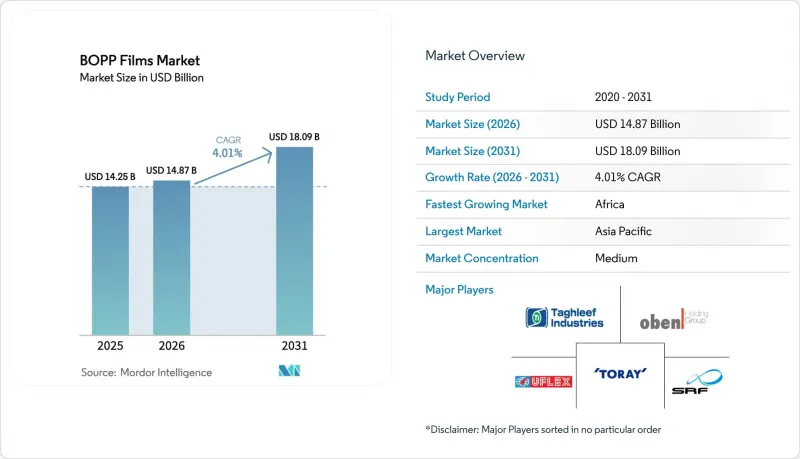
根據 Mordor Intelligence 預測,BOPP 薄膜市場預計將從 2025 年的 142.5 億美元成長到 2026 年的 148.7 億美元,到 2031 年達到 180.9 億美元,預計 2026 年至 2031 年的複合年成長率為 4.01%。
本報告按薄膜類型(透明、金屬化、不透明/白色、珠光)、厚度(小於15毫米、15-30毫米、30-45毫米、大於45毫米)、應用(包裝、標籤和纏繞、其他)、終端用戶行業(食品、飲料、醫藥、個人護理和化妝品、工業)以及地區進行細分。市場預測以美元(USD)為單位。
全球雙向拉伸聚丙烯薄膜市場趨勢及洞察
新興經濟體對高透明度零食包裝的需求激增
隨著東南亞、印度和撒哈拉以南非洲地區可支配收入的成長,消費趨勢正從大眾市場必需品轉向單份品牌零食。這類零食需要光澤度達到85%或更高、霧度低於3%的透明薄膜,才能在零售店中展現產品的鮮度。透明雙向拉伸聚丙烯(BOPP)薄膜相比流延聚丙烯和低密度聚乙烯具有更優異的光學透明度,使加工商能夠省去二次瓦楞紙板包裝,並將包裝重量減輕高達30%。 2025年6月,Cosmo First公司運作了年產能81,200公噸的生產線,以滿足印度糖果甜點和印度鹹味零嘴零食(namkeen)品牌對水蒸氣透過率低於5克/平方米/天的需求。非洲加工商目前正以本地擠出的BOPP薄膜取代進口聚乙烯包裝薄膜,從而節省外匯,並符合奈及利亞、南非和肯亞正在實施的日益嚴格的生產者責任延伸(EPR)法規。對中國出口產品徵收反傾銷稅正在加速區域多元化,並擴大與全球樹脂供應商進行合約製造合作的範圍。
為了實現永續性目標,品牌所有者正在從PVC包裝過渡到BOPP(本體聚丙烯)包裝。
由於氯化塑膠在焚燒過程中會產生鹽酸,且PVC難以進行機械回收,零售商和消費品公司正努力逐步淘汰氯化塑膠。歐盟的《包裝和包裝廢棄物法規》對可回收性和再生材料含量設定了標準,而PVC則未能達到這些標準。因此,超級市場連鎖店開始要求在2027年使用不含PVC的自有品牌包裝。雙向拉伸聚丙烯(BOPP)的回收流程與聚丙烯的回收流程相符,聚丙烯目前已回收歐洲約五分之一的廢舊廢棄物。 2024年,Innovia Films和Taghleef Industries將一種單材料BOPP複合材料商業化,該材料將密封層、隔離層和印刷表面整合到單一聚合物系列中,無需聚對苯二甲酸乙二醇酯(PET)和鋁箔層。早期採用者需支付15-25%的溢價,但隨著擠出模具成本的攤銷和樹脂供應商鼓勵大規模採用,這一價格差異正在縮小。
聚丙烯樹脂價格波動
由於聚丙烯約佔雙向拉伸聚丙烯薄膜(BOPP)現金成本的三分之二,因此當原油價格飆升或丙烯裂解裝置因計劃外運作而停產時,薄膜的利潤率會發生劇烈波動。 2025年初,美國現貨樹脂價格達到每噸1371美元,東南亞達到每噸1010美元,迫使簽訂年度固定價格合約的加工商要么自行承擔損失,要么根據合約中的困難條款重新談判。在北美和歐洲以外的地區,期貨避險產品的流動性仍然較低,原油和丙烯之間的基差風險阻礙了成本的完全覆蓋。雖然一體化生產商能夠承受這些波動,但獨立加工商面臨現金流波動,並且由於資金短缺而無法實施能夠提高生產力的資本投資。
細分市場分析
在2025年的雙向拉伸聚丙烯(BOPP)薄膜市場中,透明薄膜佔據主導地位,市場佔有率高達43.50%,其應用領域包括零嘴零食包裝、膠帶基材和花套等。同時,金屬沉澱薄膜預計到2031年將以7.90%的複合年成長率成長,因為藥品吸塑包裝和高階零食小袋包裝等應用需要氧氣透過率低於5 cc/m²/天。 30-50奈米的金屬化厚度與鋁箔複合材料相比,可降低高達30%的材料成本,同時將包裝整合到聚丙烯回收流程中。不透明和珠光薄膜則滿足了標籤和禮品等細分市場的需求,這些應用需要不透明度、表面光澤或視覺效果,其價格比通用透明薄膜高出40-60%。
金屬化雙向拉伸聚丙烯薄膜(BOPP)的成長正推動包裝產業向單一材料包裝轉型,這種包裝既符合歐洲回收標準,又不犧牲阻隔性能。製藥公司對此表示歡迎,因為這種薄膜符合美國藥典(USP)<661.1>萃取物限量標準和歐洲藥品管理局(EMA)水分標準。供應商也積極回應,加大產能投資。 SRF有限公司宣布,將於2025年初在其位於Indole的工廠擴建1.5萬噸產能,目標市場是出口市場,其利潤率比食品包裝應用高出30%至40%。這些措施共同確保了金屬化薄膜的生產能夠滿足零嘴零食、咖啡和非處方藥等產品對阻隔包裝日益成長的需求。
截至2025年,厚度在15-30微米範圍內的薄膜將佔雙向拉伸聚丙烯(BOPP)薄膜市場總量的51.03%,在通用包裝領域兼具機械強度和成本效益。然而,預計到2031年,厚度小於15微米的薄膜將以8.40%的複合年成長率成長,這反映了品牌所有者為減少每個包裝所用原生塑膠量五分之一所做的努力。要達到小於微米的厚度,需要精確的雙軸拉伸比和先進的生產線控制,以確保在寬度達10公尺的捲材上,厚度偏差控制在±0.3微米以內。金達爾聚合物薄膜公司(Jindal Poly Films)和科斯莫薄膜公司(Cosmo Films)近期安裝的設備均採用了從布魯克納機械製造公司(Bruckner Maschinenbau)獲得許可的共拉伸技術。
在感壓膠帶基材和電容器介質中,對30-45微米薄膜的需求依然強勁,因為這些應用對薄膜的剛性和尺寸穩定性要求極高。厚度超過微米的雙向拉伸聚丙烯薄膜(BOPP)則用於合成紙張和嚴苛環境下的標籤,但這一細分市場的年成長率僅3-4%。法律規範主要關注可回收性,而較少關注薄膜厚度本身。然而,如果歐洲發布一項指令,強制規定薄膜的最小厚度,將有助於遏制薄膜變薄的趨勢,並鼓勵轉向使用更厚薄膜的功能性阻隔塗層。
區域分析
到2025年,亞太地區將佔全球產量的59.40%,這主要得益於中國產量超過300萬噸以及印度加工基地的不斷擴大。儘管產能過剩,但該地區的需求依然強勁,這得益於休閒食品市場、電商包裝的成長以及日益嚴格的單一材料可回收性法規。中國、印度和中東的綜合性生產企業以折扣價供應樹脂,幫助該地區的雙向拉伸聚丙烯薄膜(BOPP)市場保持成本競爭力。同時,剩餘產能的出口也有助於抑制全球價格上漲。
非洲是成長最快的地區,預計到2031年將以7.50%的複合年成長率成長。食品和飲料經銷商正從硬質包裝轉向利用雙向拉伸聚丙烯(BOPP)的氣密性和印刷優勢的軟包裝袋。奈及利亞、南非和埃及引領這項投資,UFlex計劃於2025年下半年在埃及運作新的生產線,這將鞏固埃及作為區域出口中心的地位。本地化生產使品牌所有者不易受到外匯波動和進口關稅的影響。此外,隨著新興市場生產者延伸責任制(EPR)框架的建立,加工商正加速採用單一材料聚丙烯解決方案。
北美和歐洲市場正以2-3%的複合年成長率穩定成長,這主要得益於醫藥和電商應用領域的高階需求,同時也反映出包裝食品產業的消費模式日趨成熟。計劃於2026年全面實施的碳邊境調節機制(CBAM)將對每噸進口聚丙烯徵收碳排放成本,從而鼓勵歐洲買家轉向本地生產或經認證的低碳薄膜。南美洲的成長率為3-4%,但巴西和阿根廷的宏觀經濟波動增加了資本密集型擠出生產線的資金籌措成本,阻礙了其成長。
其他好處:
- Excel格式的市場預測(ME)表
- 3個月的分析師支持
目錄
第1章:引言
- 研究假設和市場定義
- 調查範圍
第2章:調查方法
第3章執行摘要
第4章 市場狀況
- 市場概覽
- 市場促進因素
- 開發中國家對高透明度零食包裝材料的需求激增
- 為實現永續性目標,該品牌所有者正在從PVC包裝膜過渡到BOPP包裝膜。
- 電子商務的快速發展帶動了對熱封郵寄薄膜的需求。
- 一體化聚烯生產商產能快速成長
- 可回收單材料層壓板的商業化
- 人工智慧驅動的製程控制可降低廢品率和能源消耗。
- 市場限制因素
- 聚丙烯樹脂價格波動
- 中國未充分利用、運轉率的航線正在拉低全球利潤率。
- 在高階細分市場中,生物基阻隔薄膜面臨競爭
- 提高傳統塑膠碳邊境調節稅
- 產業價值鏈分析
- 監理情勢
- 技術展望
- 宏觀經濟因素的影響
- 波特五力分析
第5章 市場規模與成長預測
- 按膠片類型
- 透明的
- 金屬化
- 不透明/白色
- 珠光飾面
- 其他膠片類型
- 按厚度
- 小於15微米
- 15–30 μm
- 30–45 μm
- 45微米或更大
- 透過使用
- 包裝
- 標籤和環繞
- 層壓板
- 感壓膠帶
- 其他用途
- 按最終用戶行業分類
- 食物
- 飲料
- 藥品和醫療保健
- 個人護理化妝品
- 產業
- 其他終端用戶產業
- 按地區
- 北美洲
- 美國
- 加拿大
- 墨西哥
- 歐洲
- 德國
- 英國
- 法國
- 義大利
- 西班牙
- 俄羅斯
- 其他歐洲國家
- 亞太地區
- 中國
- 日本
- 印度
- 韓國
- 澳洲
- 其他亞太國家
- 中東
- 沙烏地阿拉伯
- 阿拉伯聯合大公國
- 土耳其
- 其他中東國家
- 非洲
- 南非
- 奈及利亞
- 其他非洲國家
- 南美洲
- 巴西
- 阿根廷
- 其他南美國家
- 北美洲
第6章 競爭情勢
- 市場集中度
- 策略趨勢
- 市佔率分析
- 公司簡介
- Taghleef Industries
- Jindal Poly Films
- Toray Industries
- SRF Limited
- Uflex Ltd
- Cosmo Films
- Polyplex Corp
- Oben Holding Group
- Treofan Group
- Vacmet India
- NAN YA Plastics
- Mitsui Chemicals Tohcello
- Futamura Chemical
- Innovia Films
- Irplast SpA
- Inteplast Group
- Biofilm SA
- Manucor Spa
- Dunmore Corp
- Tatrafan SRO
第7章 市場機會與未來展望
According to Mordor Intelligence, the BOPP films market size is expected to increase from USD 14.25 billion in 2025 to USD 14.87 billion in 2026 and reach USD 18.09 billion by 2031, growing at a CAGR of 4.01% over 2026-2031.
This report is Segmented by Film Type (Transparent, Metallized, Opaque/White, and Pearlescent), Thickness (Below 15 Mm, 15-30 Mm, 30-45 Mm, and Above 45 Mm), Application (Packaging, Labeling and Wrap-Arounds, and More), End-User Vertical (Food, Beverage, Pharmaceutical and Medical, Personal Care and Cosmetics, and Industrial), and Geography. The Market Forecasts are Provided in Terms of Value (USD).
Global BOPP Films Market Trends and Insights
Surging Demand for High-Clarity Snack Packaging in Developing Economies
Rising disposable incomes across Southeast Asia, India, and Sub-Saharan Africa are shifting consumption from bulk staples toward branded single-serve snacks that require transparent films with gloss above 85% and haze below 3% to display product freshness at retail. Transparent BOPP grades provide better optical clarity than cast polypropylene or low-density polyethylene, enabling converters to drop secondary cartons and trim package mass by up to 30%. Cosmo First commissioned an 81,200-metric-tonne line in June 2025 to serve Indian confectionery and namkeen brands seeking moisture-vapor transmission rates below 5 g/m2/day. African converters now replace imported polyethylene wraps with locally extruded BOPP, capturing foreign-exchange savings and meeting emerging extended-producer-responsibility rules in Nigeria, South Africa, and Kenya. Anti-dumping duties imposed on Chinese exports accelerate this regional diversification and open space for tolling partnerships with global resin suppliers.
Brand-Owner Switch from PVC Wrap to BOPP for Sustainability Goals
Retailers and consumer-goods companies commit to phasing out chlorinated plastics because hydrochloric acid forms during incineration and PVC complicates mechanical recycling. The European Union's Packaging and Packaging Waste Regulation sets recyclability and recycled-content thresholds that PVC cannot meet, prompting supermarket chains to demand PVC-free private-label packaging by 2027. BOPP aligns with polypropylene recycling streams that already capture roughly one-fifth of post-consumer plastic waste in Europe. Innovia Films and Taghleef Industries commercialized mono-material BOPP laminates in 2024 that integrate sealant, barrier, and print surfaces in one polymer family and remove polyethylene terephthalate or aluminum foil layers. Early adopters absorbed a 15-25% cost premium, yet this differential narrows as extrusion tooling is amortized and resin suppliers incentivize volume uptake.
Volatility in Polypropylene Resin Prices
Polypropylene accounts for roughly two-thirds of BOPP cash-costs, so film margins swing sharply when crude prices spike or when propylene crackers go offline for unplanned maintenance. Spot resin touched USD 1,371 per t in the United States and USD 1,010 per t in Southeast Asia in early 2025, forcing converters on annual fixed-price contracts to absorb losses or renegotiate under hardship clauses. Futures hedging instruments remain illiquid outside North America and Europe, and basis risk between crude and propylene undermines perfect cost coverage. Integrated producers withstand the turbulence, whereas stand-alone converters face precarious cash flows and delayed capital upgrades that could otherwise improve productivity.
Other drivers and restraints analyzed in the detailed report include:
- E-Commerce Boom Driving Heat-Sealable Mailer Films
- Rapid Capacity Additions by Integrated Polyolefin Producers
- Under-Utilized Legacy Lines in China Depressing Global Margins
For complete list of drivers and restraints, kindly check the Table Of Contents.
Segment Analysis
Transparent films dominated the BOPP films market in 2025 with 43.50% value, reflecting their role in snack wrappers, adhesive-tape backings, and floral sleeves. Metallized films, however, are tracking a 7.90% CAGR through 2031 as pharmaceutical blister lidding and premium snack sachets demand oxygen transmission rates below 5 cc/m2/day. Metallization thickness of 30-50 nm lowers material cost by up to 30% compared with aluminum-foil laminates while keeping packages in polypropylene recycling streams. Opaque and pearlescent variants fill label and gifting niches where opacity, surface gloss, or visual effects command premiums of 40-60% over commodity transparent grades.
Growth in metallized BOPP supports the broader pivot toward mono-material packaging that satisfies European recyclability criteria without sacrificing barrier performance. Drug makers embrace the shift because the film complies with USP <661.1> extractables limits and European Medicines Agency moisture targets. Suppliers respond with capacity investments: SRF Limited disclosed a 15,000-t expansion at Indore in early 2025 aimed at export markets that pay 30-40% margins above food-wrap applications. Combined, these moves ensure metallized output keeps pace with rising demand for barrier packages in snacks, coffee, and over-the-counter medicines.
The 15-30 micrometer range represented 51.03% of BOPP films market volume in 2025, balancing mechanical strength and cost efficiency for general-purpose packaging. Yet sub-15 micrometer films are projected to log an 8.40% CAGR to 2031, mirroring brand owner commitments to curb virgin plastic per package by one-fifth. Achieving gauges below 15 micrometers requires precise biaxial orientation ratios and advanced line controls that hold gauge variation within +-0.3 micrometers across webs up to 10 m wide. Simultaneous-stretch technology, licensed by Bruckner Maschinenbau, underpins recent installations at Jindal Poly Films and Cosmo Films.
Demand for 30-45 micrometer films persists in pressure-sensitive tape backings and capacitor dielectrics that value stiffness and dimensional stability. Above 45 micrometers, BOPP serves synthetic-paper and harsh-environment labels, although this niche grows only 3-4% annually. Regulatory frameworks focus mainly on recyclability rather than gauge, yet any European directive imposing minimum film thickness would temper the lightweighting trajectory and spur a shift toward functional barrier coatings at higher gauges.
Complete Report Scope:
- By Film Type
- Transparent
- Metallized
- Opaque / White
- Pearlescent
- Other Film Type
- By Thickness
- Less than 15 μm
- 15 - 30 μm
- 30 - 45 μm
- More than 45μm
- By Application
- Packaging
- Labeling and Wrap-Arounds
- Laminating
- Pressure-Sensitive Tapes
- Other Application
- By End-User Vertical
- Food
- Beverage
- Pharmaceutical and Medical
- Personal Care and Cosmetics
- Industrial
- Other End-User Vertical
- By Geography
- North America
- United States
- Canada
- Mexico
- Europe
- Germany
- United Kingdom
- France
- Italy
- Spain
- Russia
- Rest of Europe
- Asia-Pacific
- China
- Japan
- India
- South Korea
- Australia
- Rest of Asia-Pacific
- Middle East
- Saudi Arabia
- United Arab Emirates
- Turkey
- Rest of Middle East
- Africa
- South Africa
- Nigeria
- Rest of Africa
- South America
- Brazil
- Argentina
- Rest of South America
- North America
Geography Analysis
Asia-Pacific accounted for 59.40% of global volume in 2025, anchored by China's output above 3 million t and India's expanding converter base. Despite excess capacity, regional demand remains resilient, supported by snack-food growth, e-commerce packaging, and regulatory pushes for mono-material recyclability. Integrated complexes in China, India, and the Middle East supply resin at transfer discounts that ensure the BOPP films market in the region remains cost-competitive, while export of surplus tonnage tempers global price escalation.
Africa is the fastest-growing region at 7.50% CAGR to 2031 as food and beverage distributors migrate from rigid containers to flexible pouches that exploit BOPP's moisture barrier and printability advantages. Nigeria, South Africa, and Egypt spearhead investment, with UFlex commissioning a new Egyptian line in late 2025 that positions the country as a regional export hub. Localized production insulates brand owners from currency swings and import tariffs, while emerging extended-producer-responsibility frameworks encourage converters to adopt mono-material polypropylene solutions.
North America and Europe advance at a steady 2-3% CAGR, reflecting mature consumption patterns in packaged food but buoyed by premium demand in pharmaceutical and e-commerce applications. The Carbon Border Adjustment Mechanism slated for full implementation in 2026 embeds a carbon cost into every imported tonne of polypropylene, nudging European buyers toward regionally produced or certified low-carbon films. South America grows at 3-4%, constrained by macroeconomic volatility in Brazil and Argentina that raises financing costs for capital-intensive extrusion lines.
- Taghleef Industries
- Jindal Poly Films
- Toray Industries
- SRF Limited
- Uflex Ltd
- Cosmo Films
- Polyplex Corp
- Oben Holding Group
- Treofan Group
- Vacmet India
- NAN YA Plastics
- Mitsui Chemicals Tohcello
- Futamura Chemical
- Innovia Films
- Irplast S.p.A
- Inteplast Group
- Biofilm SA
- Manucor Spa
- Dunmore Corp
- Tatrafan SRO
Additional Benefits:
- The market estimate (ME) sheet in Excel format
- 3 months of analyst support
TABLE OF CONTENTS
1 INTRODUCTION
- 1.1 Study Assumptions and Market Definition
- 1.2 Scope of the Study
2 RESEARCH METHODOLOGY
3 EXECUTIVE SUMMARY
4 MARKET LANDSCAPE
- 4.1 Market Overview
- 4.2 Market Drivers
- 4.2.1 Surging Demand for High-Clarity Snack Packaging in Developing Economies
- 4.2.2 Brand-Owner Switch from PVC Wrap to BOPP for Sustainability Goals
- 4.2.3 E-Commerce Boom Driving Heat-Sealable Mailer Films
- 4.2.4 Rapid Capacity Additions by Integrated Polyolefin Producers
- 4.2.5 Commercialization of Recycle-Ready Mono-Material Laminates
- 4.2.6 AI-Enabled Process Control Lowering Scrap Rates and Energy Use
- 4.3 Market Restraints
- 4.3.1 Volatility in Polypropylene Resin Prices
- 4.3.2 Under-Utilized Legacy Lines in China Depressing Global Margins
- 4.3.3 Competition from Bio-Based Barrier Films in Premium Niches
- 4.3.4 Rising Carbon-Border Tariffs on Conventional Plastics
- 4.4 Industry Value Chain Analysis
- 4.5 Regulatory Landscape
- 4.6 Technological Outlook
- 4.7 Impact of Macroeconomic Factors
- 4.8 Porter's Five Forces Analysis
- 4.8.1 Threat of New Entrants
- 4.8.2 Bargaining Power of Suppliers
- 4.8.3 Bargaining Power of Buyers
- 4.8.4 Threat of Substitutes
- 4.8.5 Competitive Rivalry
5 MARKET SIZE AND GROWTH FORECASTS (VALUE)
- 5.1 By Film Type
- 5.1.1 Transparent
- 5.1.2 Metallized
- 5.1.3 Opaque / White
- 5.1.4 Pearlescent
- 5.1.5 Other Film Type
- 5.2 By Thickness
- 5.2.1 Less than 15 μm
- 5.2.2 15 - 30 μm
- 5.2.3 30 - 45 μm
- 5.2.4 More than 45μm
- 5.3 By Application
- 5.3.1 Packaging
- 5.3.2 Labeling and Wrap-Arounds
- 5.3.3 Laminating
- 5.3.4 Pressure-Sensitive Tapes
- 5.3.5 Other Application
- 5.4 By End-User Vertical
- 5.4.1 Food
- 5.4.2 Beverage
- 5.4.3 Pharmaceutical and Medical
- 5.4.4 Personal Care and Cosmetics
- 5.4.5 Industrial
- 5.4.6 Other End-User Vertical
- 5.5 By Geography
- 5.5.1 North America
- 5.5.1.1 United States
- 5.5.1.2 Canada
- 5.5.1.3 Mexico
- 5.5.2 Europe
- 5.5.2.1 Germany
- 5.5.2.2 United Kingdom
- 5.5.2.3 France
- 5.5.2.4 Italy
- 5.5.2.5 Spain
- 5.5.2.6 Russia
- 5.5.2.7 Rest of Europe
- 5.5.3 Asia-Pacific
- 5.5.3.1 China
- 5.5.3.2 Japan
- 5.5.3.3 India
- 5.5.3.4 South Korea
- 5.5.3.5 Australia
- 5.5.3.6 Rest of Asia-Pacific
- 5.5.4 Middle East
- 5.5.4.1 Saudi Arabia
- 5.5.4.2 United Arab Emirates
- 5.5.4.3 Turkey
- 5.5.4.4 Rest of Middle East
- 5.5.5 Africa
- 5.5.5.1 South Africa
- 5.5.5.2 Nigeria
- 5.5.5.3 Rest of Africa
- 5.5.6 South America
- 5.5.6.1 Brazil
- 5.5.6.2 Argentina
- 5.5.6.3 Rest of South America
- 5.5.1 North America
6 COMPETITIVE LANDSCAPE
- 6.1 Market Concentration
- 6.2 Strategic Moves
- 6.3 Market Share Analysis
- 6.4 Company Profiles (includes Global level Overview, Market level overview, Core Segments, Financials as available, Strategic Information, Market Rank/Share for key companies, Products and Services, and Recent Developments)
- 6.4.1 Taghleef Industries
- 6.4.2 Jindal Poly Films
- 6.4.3 Toray Industries
- 6.4.4 SRF Limited
- 6.4.5 Uflex Ltd
- 6.4.6 Cosmo Films
- 6.4.7 Polyplex Corp
- 6.4.8 Oben Holding Group
- 6.4.9 Treofan Group
- 6.4.10 Vacmet India
- 6.4.11 NAN YA Plastics
- 6.4.12 Mitsui Chemicals Tohcello
- 6.4.13 Futamura Chemical
- 6.4.14 Innovia Films
- 6.4.15 Irplast S.p.A
- 6.4.16 Inteplast Group
- 6.4.17 Biofilm SA
- 6.4.18 Manucor Spa
- 6.4.19 Dunmore Corp
- 6.4.20 Tatrafan SRO
7 MARKET OPPORTUNITIES AND FUTURE OUTLOOK
- 7.1 White-Space and Unmet-Need Assessment

 中國雙向拉伸聚丙烯薄膜:市佔率分析、產業趨勢與統計及成長預測(2026-2031年)印度雙向拉伸聚丙烯薄膜:市佔率分析、產業趨勢與統計及成長預測(2026-2031)
 雙向拉伸聚丙烯薄膜市場報告:趨勢、預測及競爭分析(至2035年)南美洲BOPP薄膜:市佔率分析、產業趨勢與統計及成長預測(2026-2031年)
 BOPP薄膜市場規模、佔有率和趨勢分析報告:按類型、厚度、製造流程、應用、地區和細分市場預測(2026-2033年)
 雙向拉伸聚丙烯薄膜市場規模、佔有率、成長及全球產業分析:按類型、應用和地區的洞察,2026-2034年預測
 2026-2034年BOPP薄膜市場規模、佔有率、趨勢及預測(按類型、厚度、製造流程、應用和地區分類)
 雙向拉伸聚丙烯薄膜市場:市場規模-按地區、應用和至2034年的預測日本雙向拉伸聚丙烯薄膜市場規模、佔有率、趨勢及預測(按類型、厚度、製造流程、應用和地區分類),2026-2034年
 BOPP 薄膜市場-全球產業規模、佔有率、趨勢、機會和預測,按類型、厚度、生產流程、應用、地區和競爭細分,2020-2030 年