


 |
市場調查報告書
商品編碼
2116953
中國雙向拉伸聚丙烯薄膜:市佔率分析、產業趨勢與統計及成長預測(2026-2031年)China BOPP Film - Market Share Analysis, Industry Trends & Statistics, Growth Forecasts (2026 - 2031) |
||||||

※ 本網頁內容可能與最新版本有所差異。詳細情況請與我們聯繫。
據 Mordor Intelligence 稱,中國 BOPP 薄膜市場預計到 2026 年價值 21.2 億美元,高於 2025 年的 20.2 億美元,預計到 2031 年將達到 27 億美元。
預計從 2026 年到 2031 年,其複合年成長率將達到 4.96%。
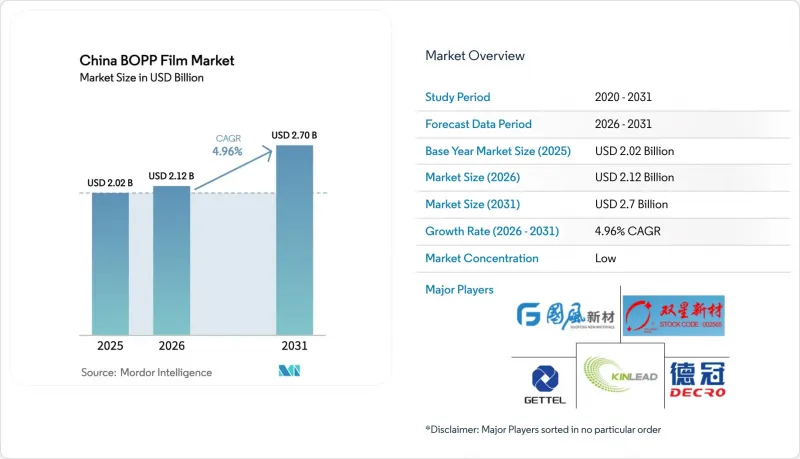
本報告按薄膜類型(透明、金屬化、不透明/白色、珠光等)、厚度(45毫米)、應用(包裝、標籤/環繞等)和終端用戶行業(食品、飲料、醫藥/醫療、個人護理/化妝品等)進行細分。市場預測以價值(美元)表示。
中國雙向拉伸聚丙烯薄膜市場趨勢與洞察
電子商務包裝需求快速成長
隨著線上零售的快速發展,採用輕薄可印刷雙向拉伸聚丙烯(BOPP)基材的宅配袋、郵寄信封和單件產品包裝的出貨量持續成長。為生鮮宅配和藥品履約業者提供服務的加工業者對可在低溫下密封的共擠薄膜的需求日益成長,以保護對溫度敏感的商品。為此,製造商推出了12-15微米的透明薄膜,這種薄膜在保持抗穿刺性的同時,還能減少樹脂用量,從而即使在運費持續高企的情況下也能確保利潤。高油墨親和性表面處理技術和改進的抗靜電處理技術縮短了印刷機的設定時間,這為直播平台上流行的小批量個人化客製化專案提供了決定性的優勢。
政府致力於阻隔性食品衛生標準。
隨著食品接觸用黏合劑標準GB 4806.15-2024的實施,貼合加工企業被要求加強遷移控制,並對每批油墨、底塗和黏合層進行記錄。為此,中國領先的雙向拉伸聚丙烯薄膜(BOPP)生產商正在引進多層在線厚度測量設備,並投資建造ISO 17025認證實驗室,以便在24小時內出具分析證書。這項新規將促進阻隔性金屬沉澱和塗層等級產品的使用,這些產品即使在更嚴格的運輸溫度條件下也能延長保存期限,尤其是在便利商店銷售的即食食品和乳製品零食中。
聚丙烯原料價格波動
2025年初,聚丙烯樹脂現貨價格在每噸740美元至755美元之間波動,但由於宏觀經濟的不確定性,貿易商不願囤積庫存,訂單交貨前置作業時間縮短至一周。中國主要的雙向拉伸聚丙烯薄膜(BOPP)生產商目前正透過與中國設定的基準價格掛鉤的長期契約,對高達50%的未來樹脂需求進行套期保值,而中型企業則依靠聯合採購來緩解每週的價格波動。儘管如此,價格的急劇上漲仍可能在一個季度內擠壓薄膜利潤率300至400個基點。
細分市場分析
到2025年,鍍膜薄膜在中國雙向拉伸聚丙烯薄膜(BOPP)市場中所佔佔有率將很小,但該年度6.23%的複合年成長率表明,在對濕度敏感的零嘴零食、粉狀飲料和非處方藥等領域,鍍膜薄膜的需求正在加速成長。到2025年,透明薄膜仍將佔據中國BOPP薄膜市場39.98%的佔有率,主要得益於其在水平成型、填充和密封(FFS)製程中的多功能性。在氧氣透過率要求低於0.5 g/m²的領域,對鍍膜薄膜的需求不斷成長,迫使供應商在真空鍍膜機中引入等離子預處理設備,以實現更強的黏合力。品牌擁有者也開始採用透明阻隔塗層作為替代方案,以實現透明、可回收的窗口,同時保持與鋁相當的阻隔性。因此,一條優質化路徑正在形成,加工商可以提高每公斤利潤,品牌所有者可以增強其產品的展示吸引力。
第二代鍍膜金屬化材料兼具半鏡面外觀和可去除油墨的表面,符合APR指南的一般可回收性要求。先導計畫表明,僅需300埃的鋁沉澱層即可達到碳酸化維持目標,其在高速填充過程中的實用性也得到了驗證。多家跨國零食製造商已簽署為期兩年的供應協議,以確保產能並減少對塗層PET的依賴,這表明他們對鍍膜BOPP在從剛性材料向軟性材料過渡的過程中將繼續取代傳統基材充滿信心。
2025年,主流的15-30微米厚度範圍在中國雙向拉伸聚丙烯(BOPP)薄膜市場維持36.22%的佔有率。然而,從2026年到2031年,受立式袋拉鍊、蒸餾蓋和工業搭接件等需求的推動,45微米及以上厚度範圍預計將呈現5.94%的最高成長率。製造商正在策略性地調整生產線配置,以滿足兩端的需求:將傳統寬度的生產線用於生產薄型產品,而使用新型10.4米設備生產高附加價值、厚型產品,這些產品的每毫米產量較低,但每噸價格較高。人工智慧驅動的回饋迴路和整合式線上紅外線攝影機實現了±0.3微米的厚度精度,這對於確保轉換器的運作運作至關重要。
儘管市場對厚度小於12微米的透明薄膜(用於小袋和微型包裝袋)的需求日益成長,但生產製程的公差要求已大幅收窄,只有配備高精度冷輥系統和正電子厚度建模技術的操作人員才能達到缺陷目標。同時,用於馬達繞組的60微米拉伸絕緣膠帶因其優異的介電強度和耐磨性而備受電動車製造商的關注。綜上所述,這些趨勢表明,中國雙向拉伸聚丙烯薄膜(BOPP)市場並未趨向於單一的最佳厚度,而是持續拓展厚度範圍以滿足各種性能要求。
其他好處:
- Excel格式的市場預測(ME)表
- 3個月的分析師支持
目錄
第1章:引言
- 研究假設和市場定義
- 調查範圍
第2章:調查方法
第3章執行摘要
第4章 市場狀況
- 市場概覽
- 市場促進因素
- 電子商務對包裝材料的需求迅速成長。
- 政府推廣高門檻食品安全標準
- 飲料業從PVC標籤過渡到BOPP標籤
- 對薄而低成本薄膜的需求日益成長
- 鋰離子電池用BOPP基隔膜的放大
- 投資國內高速拉幅機生產線
- 市場限制因素
- 聚丙烯原料價格波動
- 對一次性塑膠廢棄物實施嚴格監管
- 供應過剩導致價格承壓
- 新興的生物基薄膜替代品
- 產業價值鏈分析
- 監理情勢
- 技術展望
- 波特五力分析
- 宏觀經濟因素對市場的影響
第5章 市場規模與成長預測
- 按膠片類型
- 透明的
- 金屬化
- 不透明/白色
- 珠光
- 其他膠片類型
- 按厚度
- 小於15微米
- 15~30µm
- 30~45µm
- 大於45微米
- 透過使用
- 包裝
- 標籤環繞
- 層壓板
- 感壓膠帶
- 其他用途
- 按最終用戶行業分類
- 食物
- 飲料
- 藥品和醫療保健
- 個人護理化妝品
- 產業
- 其他終端用戶產業
第6章 競爭情勢
- 市場集中度
- 策略趨勢
- 市佔率分析
- 公司簡介
- Qingdao Kingchuan Packaging Co., Ltd.
- RuiYann Industrial Co., Ltd.
- Zhejiang Haibin Film Technology Co., Ltd.
- Zhejiang Kinlead Innovative Materials Co., Ltd.
- Zhejiang Changyu New Materials Co., Ltd.
- Quanzhou Lichang Plastic Co., Ltd.
- Zhejiang Yimei Film Industry Group Co., Ltd.
- Anhui Guofeng Plastic Industry Co., Ltd.
- Foshan Plastics Group Co., Ltd.
- San-East Group Limited
- Guangdong Decro Film New Materials Co., Ltd.
- Jiangsu Shuangxing Color Plastic New Materials Co., Ltd.
- Sichuan Yongfeng Lingyun Industrial Co., Ltd.
- Shaanxi Huatai Color Film Packaging Co., Ltd.
- Shanghai Brilliant Film Co., Ltd.
- Wenzhou Zhongda Packaging Material Co., Ltd.
- Gettel Group Co., Ltd.
- Yunnan Energy New Material Co., Ltd.
- Nan Ya Plastics Corporation
- Jiangxi Kewei Film New Materials Co., Ltd.
第7章 市場機會與未來展望
According to Mordor Intelligence, China BOPP film market size in 2026 is estimated at USD 2.12 billion, growing from 2025 value of USD 2.02 billion with 2031 projections showing USD 2.7 billion, growing at 4.96% CAGR over 2026-2031.
This report is Segmented by Film Type (Transparent, Metallized, Opaque/White, Pearlescent, and More), Thickness (45 Mm), Application (Packaging, Labeling and Wrap-Arounds, and More), End-User Vertical (Food, Beverage, Pharmaceutical and Medical, Personal Care and Cosmetics, and More). The Market Forecasts are Provided in Terms of Value (USD).
China BOPP Film Market Trends and Insights
Surging E-commerce Packaging Demand
Rapid growth of online retail continues to lift shipment volumes for courier bags, mailers and single-serve product packs that favor thin, printable BOPP substrates. Converters serving grocery delivery and pharmaceutical fulfillment increasingly request co-extruded films engineered for low-temperature seal initiation to protect temperature-sensitive goods. Producers reply with 12-15 micron transparent grades that retain puncture resistance while shaving resin use, thereby protecting margins even as freight costs stay elevated. Ink-receptive surface chemistries and improved anti-static packages shorten press setup time, a decisive edge for short-run personalization programs popular on livestream platforms.
Government Push for High-Barrier Food Safety Standards
Implementation of GB 4806.15-2024 for food-contact adhesives compels lamination houses to tighten migration controls and to document every batch of inks, primers and tie-layers. Large-scale China BOPP film market producers have responded by installing multi-layer on-line thickness gauges and investing in ISO 17025-accredited labs so they can issue certificates of analysis within 24 hours. The new rules favor high-barrier metallized and coated grades that extend shelf life under stricter distribution temperatures, especially for ready-to-eat meals and dairy snacks sold via convenience stores.
Volatility in Polypropylene Feedstock Prices
Spot PP resin hovered in a USD 740-755 per-ton band during early 2025, but order lead times shortened to one week as traders hesitated to build stocks amid uncertain macro conditions. Larger China BOPP film market producers now hedge up to 50% of their forward resin requirements under term contracts indexed to China-created benchmarks, while midsize players rely on syndicated purchasing pools to buffer weekly swings. Nonetheless, abrupt spikes can still compress film margins by 300-400 basis points in a single quarter.
Other drivers and restraints analyzed in the detailed report include:
- Shift from PVC to BOPP Labels in Beverages
- Rising Demand for Low-Gauge Cost-Saving Films
- Stringent Single-Use Plastic Waste Regulations
For complete list of drivers and restraints, kindly check the Table Of Contents.
Segment Analysis
Metallized structures accounted for a modest slice of China BOPP film market size in 2025, yet their 6.23% CAGR signals accelerating traction in moisture-sensitive snacks, powdered beverages and over-the-counter medicines. Transparent films still held 39.98% China BOPP film market share in 2025, largely due to their versatility in horizontal form-fill-seal operations. Demand for metallized film rises where <=0.5 g/m2 oxygen transmission rate is non-negotiable, pushing suppliers to retrofit vacuum metallizers with plasma pretreatment for tighter adhesion. Brand owners also embrace clear barrier coatings as an alternative route to see-through, recyclable windows that maintain aluminum-equivalent barrier. The result is a premiumization path where converters secure higher per-kilogram profits while brand owners improve shelf appeal.
Second-generation coated metallized grades now combine half-mirror aesthetics with de-inkable surfaces, unlocking mainstream recyclability under APR guidelines. Pilot projects with beverage closures demonstrate that aluminum deposition as low as 300 angstroms still meets carbonation retention targets, proving viable across high-speed bottling. Multinational snack players structure two-year supply agreements to lock in capacity and reduce exposure to coated PET, signaling confidence that metallized BOPP will continue displacing incumbent substrates in rigid-to-flexible conversions.
The dominant 15-30 micron band retained 36.22% China BOPP film market share in 2025, yet gauges above 45 microns will grow fastest at 5.94% over 2026-2031 on the back of stand-up pouch zippers, retort lids and industrial over-wraps. Producers strategically balance line mixes to capture both ends, dedicating older legacy widths to thin-gauge runs and saving new 10.4-meter assets for high-value thick products where output-per-millimeter is lower but price-per-ton higher. Inline IR cameras integrated with AI-driven feedback loops now deliver +-0.3 micron profiles, an essential requirement for converter uptime.
Demand for sub-12 micron transparent film grows in sachets and micro-pouches, but process windows tighten sharply; thus, only operators with high-precision chill-roll systems and positron thickness modeling can meet defect targets. Conversely, 60-micron oriented insulation tapes for motor windings draw interest from EV manufacturers because of dielectric strength and abrasion resistance. Together these trends illustrate how the China BOPP film market keeps diversifying thickness spectrums to fulfill disparate performance codes rather than converging on a single optimized gauge.
Complete Report Scope:
- By Film Type
- Transparent
- Metallized
- Opaque / White
- Pearlescent
- Other Film Type
- By Thickness
- < 15 µm
- 15 - 30 µm
- 30 - 45 µm
- > 45 µm
- By Application
- Packaging
- Labeling and Wrap-Arounds
- Laminating
- Pressure-Sensitive Tapes
- Other Application
- By End-user Vertical
- Food
- Beverage
- Pharmaceutical and Medical
- Personal Care and Cosmetics
- Industrial
- Other End-user Vertical
List of Companies Covered in this Report:
- Qingdao Kingchuan Packaging Co., Ltd.
- RuiYann Industrial Co., Ltd.
- Zhejiang Haibin Film Technology Co., Ltd.
- Zhejiang Kinlead Innovative Materials Co., Ltd.
- Zhejiang Changyu New Materials Co., Ltd.
- Quanzhou Lichang Plastic Co., Ltd.
- Zhejiang Yimei Film Industry Group Co., Ltd.
- Anhui Guofeng Plastic Industry Co., Ltd.
- Foshan Plastics Group Co., Ltd.
- San-East Group Limited
- Guangdong Decro Film New Materials Co., Ltd.
- Jiangsu Shuangxing Color Plastic New Materials Co., Ltd.
- Sichuan Yongfeng Lingyun Industrial Co., Ltd.
- Shaanxi Huatai Color Film Packaging Co., Ltd.
- Shanghai Brilliant Film Co., Ltd.
- Wenzhou Zhongda Packaging Material Co., Ltd.
- Gettel Group Co., Ltd.
- Yunnan Energy New Material Co., Ltd.
- Nan Ya Plastics Corporation
- Jiangxi Kewei Film New Materials Co., Ltd.
Additional Benefits:
- The market estimate (ME) sheet in Excel format
- 3 months of analyst support
TABLE OF CONTENTS
1 INTRODUCTION
- 1.1 Study Assumptions and Market Definition
- 1.2 Scope of the Study
2 RESEARCH METHODOLOGY
3 EXECUTIVE SUMMARY
4 MARKET LANDSCAPE
- 4.1 Market Overview
- 4.2 Market Drivers
- 4.2.1 Surging e-commerce packaging demand
- 4.2.2 Government push for high-barrier food safety standards
- 4.2.3 Shift from PVC to BOPP labels in beverages
- 4.2.4 Rising demand for low-gauge cost-saving films
- 4.2.5 Expansion of BOPP-based lithium battery separator films
- 4.2.6 Investments in high-speed domestic tenter lines
- 4.3 Market Restraints
- 4.3.1 Volatility in polypropylene feedstock prices
- 4.3.2 Stringent single-use plastic waste regulations
- 4.3.3 Capacity overbuild causing price compression
- 4.3.4 Emerging bio-based film alternatives
- 4.4 Industry Value Chain Analysis
- 4.5 Regulatory Landscape
- 4.6 Technological Outlook
- 4.7 Porter's Five Forces Analysis
- 4.7.1 Threat of New Entrants
- 4.7.2 Bargaining Power of Buyers
- 4.7.3 Bargaining Power of Suppliers
- 4.7.4 Threat of Substitute Products
- 4.7.5 Intensity of Competitive Rivalry
- 4.8 Impact of Macroeconomic Factors on the Market
5 MARKET SIZE AND GROWTH FORECASTS (VALUE)
- 5.1 By Film Type
- 5.1.1 Transparent
- 5.1.2 Metallized
- 5.1.3 Opaque / White
- 5.1.4 Pearlescent
- 5.1.5 Other Film Type
- 5.2 By Thickness
- 5.2.1 < 15 µm
- 5.2.2 15 - 30 µm
- 5.2.3 30 - 45 µm
- 5.2.4 > 45 µm
- 5.3 By Application
- 5.3.1 Packaging
- 5.3.2 Labeling and Wrap-Arounds
- 5.3.3 Laminating
- 5.3.4 Pressure-Sensitive Tapes
- 5.3.5 Other Application
- 5.4 By End-user Vertical
- 5.4.1 Food
- 5.4.2 Beverage
- 5.4.3 Pharmaceutical and Medical
- 5.4.4 Personal Care and Cosmetics
- 5.4.5 Industrial
- 5.4.6 Other End-user Vertical
6 COMPETITIVE LANDSCAPE
- 6.1 Market Concentration
- 6.2 Strategic Moves
- 6.3 Market Share Analysis
- 6.4 Company Profiles (includes Global-level Overview, Market-level Overview, Core Segments, Financials as available, Strategic Information, Market Rank/Share for key companies, Products and Services, and Recent Developments)
- 6.4.1 Qingdao Kingchuan Packaging Co., Ltd.
- 6.4.2 RuiYann Industrial Co., Ltd.
- 6.4.3 Zhejiang Haibin Film Technology Co., Ltd.
- 6.4.4 Zhejiang Kinlead Innovative Materials Co., Ltd.
- 6.4.5 Zhejiang Changyu New Materials Co., Ltd.
- 6.4.6 Quanzhou Lichang Plastic Co., Ltd.
- 6.4.7 Zhejiang Yimei Film Industry Group Co., Ltd.
- 6.4.8 Anhui Guofeng Plastic Industry Co., Ltd.
- 6.4.9 Foshan Plastics Group Co., Ltd.
- 6.4.10 San-East Group Limited
- 6.4.11 Guangdong Decro Film New Materials Co., Ltd.
- 6.4.12 Jiangsu Shuangxing Color Plastic New Materials Co., Ltd.
- 6.4.13 Sichuan Yongfeng Lingyun Industrial Co., Ltd.
- 6.4.14 Shaanxi Huatai Color Film Packaging Co., Ltd.
- 6.4.15 Shanghai Brilliant Film Co., Ltd.
- 6.4.16 Wenzhou Zhongda Packaging Material Co., Ltd.
- 6.4.17 Gettel Group Co., Ltd.
- 6.4.18 Yunnan Energy New Material Co., Ltd.
- 6.4.19 Nan Ya Plastics Corporation
- 6.4.20 Jiangxi Kewei Film New Materials Co., Ltd.
7 MARKET OPPORTUNITIES AND FUTURE OUTLOOK
- 7.1 White-space and Unmet-Need Assessment

 印度雙向拉伸聚丙烯薄膜:市佔率分析、產業趨勢與統計及成長預測(2026-2031)
 雙向拉伸聚丙烯薄膜市場報告:趨勢、預測及競爭分析(至2035年)雙向拉伸聚丙烯薄膜:市佔率分析、產業趨勢與統計、成長預測(2026-2031)南美洲BOPP薄膜:市佔率分析、產業趨勢與統計及成長預測(2026-2031年)
 BOPP薄膜市場規模、佔有率和趨勢分析報告:按類型、厚度、製造流程、應用、地區和細分市場預測(2026-2033年)
 雙向拉伸聚丙烯薄膜市場規模、佔有率、成長及全球產業分析:按類型、應用和地區的洞察,2026-2034年預測
 2026-2034年BOPP薄膜市場規模、佔有率、趨勢及預測(按類型、厚度、製造流程、應用和地區分類)
 雙向拉伸聚丙烯薄膜市場:市場規模-按地區、應用和至2034年的預測日本雙向拉伸聚丙烯薄膜市場規模、佔有率、趨勢及預測(按類型、厚度、製造流程、應用和地區分類),2026-2034年
 BOPP 薄膜市場-全球產業規模、佔有率、趨勢、機會和預測,按類型、厚度、生產流程、應用、地區和競爭細分,2020-2030 年