


 |
市場調查報告書
商品編碼
2123277
聚丙烯:市場佔有率分析、產業趨勢與統計、成長預測(2026-2031)Polypropylene - Market Share Analysis, Industry Trends & Statistics, Growth Forecasts (2026 - 2031) |
||||||

※ 本網頁內容可能與最新版本有所差異。詳細情況請與我們聯繫。
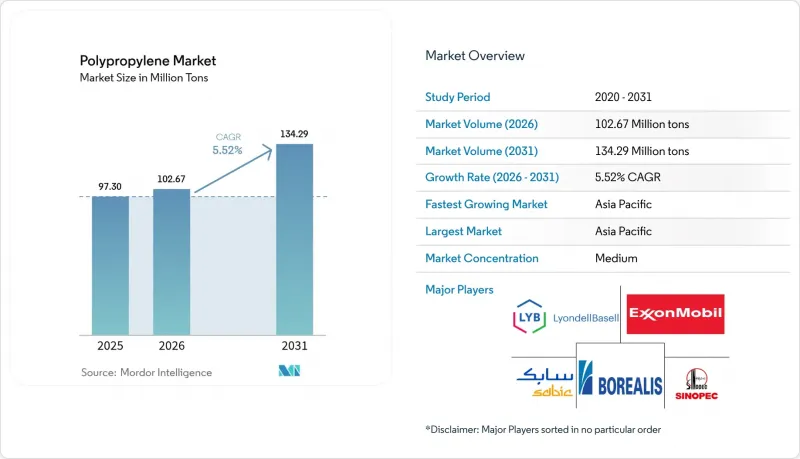
2025年聚丙烯市場價值為9,730萬噸,預計2031年將達到1.3429億噸,而2026年為1.0267億噸,預測期(2026-2031年)複合年成長率為5.52%。
本報告按類型(均聚物、共聚物)、加工技術(射出成型、吹塑成型、擠出成型及其他)、終端用戶行業(包裝、汽車、消費品、電氣電子及其他)和地區(亞太、北美、歐洲、南美、中東和非洲)進行細分。市場預測以噸為單位。
全球聚丙烯市場趨勢與洞察
促進汽車和電動車產業的減重。
為了延長電池續航里程,汽車製造商正以高熔體強度聚丙烯泡沫材料取代金屬組件,尤其是在儀錶面板和引擎艙護板等部件中,這可以在保證碰撞安全性的前提下,將零件重量減輕高達 40%。整合式催化系統也使得丙烯彈性體的生產成為可能,從而取代了橡膠墊圈和密封件,為設計人員提供了零件整合和縮短組裝時間的機會。一級供應商正在將其模具策略轉向薄壁射出成型,以最佳化生產週期,這在歐洲掀起了一股注塑機維修浪潮。北美原始設備製造商 (OEM) 正在調整其樹脂選擇矩陣,使其與報廢回收目標保持一致,進一步推動單一材料內裝的應用。因此,汽車應用領域的複合年成長率 (CAGR) 達到 6.29%,使聚丙烯市場成為電氣化趨勢的主要受益者。
單一材料軟質包裝的需求爆炸性成長
全球品牌正加速推進其到2025年實現100%包裝回收的自願性目標,促使加工商逐步淘汰多層複合工藝,轉而使用阻隔塗層聚丙烯薄膜。歐洲超級市場目前強制要求使用單一聚合物「貨架即用型」包裝袋,以最大限度地減少生產者延伸責任(EPR)費用,從而推動了專有表面處理生產線的普及。亞太地區的包裝製造商正利用規模經濟優勢,採用無溶劑複合技術,在確保符合食品接觸法規的前提下,實現高速運作。因此,包裝正轉向高利潤的阻隔型包裝形式,從而在維持最高產量的同時,實現溢價。這種轉變也提高了機械回收過程中包裝包的純度,間接增加了日常消費品(FMCG)公司對聚丙烯再生顆粒的需求。
高性能替代樹脂的可用性
軟質包裝產業的產品開發人員正擴大測試金屬化聚乙烯薄膜,這種薄膜的氧氣阻隔性與聚丙烯相當,但加工溫度更低,從而逐漸削弱了聚丙烯傳統的成本優勢。在飲料瓶蓋領域,聚酯供應商強調其產品中化學回收材料的含量和卓越的透明度,以滿足永續性的品牌的要求。丙烯腈-丁二烯-苯乙烯共聚物 (ABS) 憑藉其高表面光澤度和抗衝擊性,在家用電器的M型蓋市場持續擴大市場佔有率,對高階需求領域的聚丙烯構成壓力。為了應對這項挑戰,聚丙烯供應商推出了具有更高剛度/衝擊比的創新聚丙烯產品,但其應用取決於加工商是否願意重新認證其模具。隨著材料選擇團隊在機械性能和可回收性目標之間權衡取捨,這種拉鋸戰愈演愈烈,導致預期的複合年成長率下降了0.9個百分點。
細分市場分析
至2025年,均聚物將佔聚丙烯市佔率的69.53%。這反映了瓶蓋、帽簷和紗線等行業對價格的敏感性,在這些行業中,剛度重量比至關重要。得益於聚二聯氨肼(PDH)帶來的成本競爭力,預計該細分市場將以5.63%的複合年成長率成長,到2031年,均聚物聚丙烯市場規模預計將達到9,337萬噸。生產商正在利用循環反應器技術來縮小分子量分佈並提高透明度,同時又不影響剛度,這推動了乳製品容器領域從無規共聚物向均聚物的轉變。儘管共聚物的產量較小,但在汽車保險桿和洗衣機滾筒等對衝擊要求極高的零件中,它們卻能獲得更高的價格。催化劑的不斷改進正在縮小先前存在的性能差距,使得混合產品能夠在保持接近均聚物的經濟效益的同時,達到與共聚物相當的韌性。這種趨同趨勢使得採購負責人更加關注總實施成本,而不是表面的樹脂價格,即使特種樹脂的市場佔有率不斷擴大,均聚物仍然保持其主導地位。
第二代氣相反應器能夠實現快速的牌號切換,減少切換過程中產生的廢料,並滿足消費品製造商所需的準時制物流需求。採用乙丙橡膠域的抗衝共聚物因其可靠的低溫延展性,在寒冷氣候下的汽車前圍板領域正日益受到青睞。無規共聚物在需要耐伽瑪射線滅菌的醫用注射器領域中佔有一定的市場佔有率。然而,均聚物共混物中耐滅菌添加劑的日益普及表明,未來這可能會蠶食共聚物的市場佔有率。隨著添加劑母粒配方日趨成熟,均聚物的銷售量可能會蠶食共聚物的部分成長,鞏固其規模經濟優勢。
區域分析
亞太地區58.78%的市佔率凸顯了該地區製造業的實力,但預計到2025年中國產量將激增68%,這將造成供應過剩,擠壓利潤空間,並可能引發印尼和菲律賓的反傾銷措施。目前,各國政府正嚴格審查新建丙烷脫氫(PDH)計畫的環境核准,限制了未來產能的逐步成長。在印度,隨著消費品的普及,下游需求正加速成長。該國計劃建造一座價值80億美元的乙烷裂解裝置,預計將降低進口依賴度,並重塑亞洲內部的貿易格局。
北美利用其丙烷脫氫(PDH)原料優勢以及接近性復甦的汽車工業的地理優勢,在聚丙烯市場對南美和歐洲的出口中保持競爭力。富含乙烷的頁岩氣支持低成本丙烯生產,墨西哥灣沿岸地區的工廠儘管面臨全球價格波動,仍能維持高運轉率。位於加拿大薩尼亞的裂解裝置透過完善的鐵路物流網路向中西部地區的加工商供應原料,增強了區域供應的穩定性。
歐洲面臨雙重挑戰:能源價格飆升和日益嚴格的廢棄物法規。為了遵守歐盟的包裝和包裝廢棄物法規,生產商正在考慮永久停產或轉型為再生材料生產平台。同時,中東向歐洲的聚合物貿易量正在成長。這得歸功於利用低成本石腦油的煉油和石化整合中心,而土耳其的煉油廠則成為進入歐盟關稅同盟的貿易門戶。在嚴重依賴進口的南美洲,各方正努力吸引投資進入上游領域,但貨幣波動和政策不確定性導致大規模新計畫延期。
其他好處:
- Excel格式的市場預測(ME)表
- 3個月的分析師支持
目錄
第1章:引言
- 研究假設和市場定義
- 調查範圍
第2章:調查方法
第3章執行摘要
第4章 市場狀況
- 市場概覽
- 市場促進因素
- 促進汽車和電動車領域的減重
- 單一材料軟性包裝的需求爆炸性成長
- 丙烷脫氫(PDH)裝置產能的快速成長降低了現金成本。
- 高熔體強度的聚丙烯可用於發泡和低密度應用。
- 與化學回收相關的供應合約迅速擴張
- 市場限制因素
- 高性能替代樹脂(PE、PET、ABS)的可用性
- 原油和丙烯價格的波動給轉換器利潤率帶來了壓力。
- 歐盟塑膠稅迫使加工商改用單層聚乙烯複合材料。
- 價值鏈分析
- 波特五力模型
- 價格趨勢
- 進出口趨勢
- 原料分析
- 技術趨勢概述
第5章 市場規模與成長預測
- 按類型
- 均聚物
- 共聚物
- 透過加工技術
- 射出成型
- 吹塑成型
- 擠出成型
- 其他
- 按最終用戶行業分類
- 包裝
- 車
- 消費品
- 電氣和電子設備
- 其他
- 按地區
- 亞太地區
- 中國
- 印度
- 日本
- 韓國
- 東南亞國協
- 其他亞太國家
- 北美洲
- 美國
- 加拿大
- 墨西哥
- 歐洲
- 德國
- 英國
- 法國
- 義大利
- 俄羅斯
- 北歐國家
- 其他歐洲國家
- 南美洲
- 巴西
- 阿根廷
- 其他南美國家
- 中東和非洲
- 沙烏地阿拉伯
- 南非
- 其他中東和非洲國家
- 亞太地區
第6章 競爭情勢
- 市場集中度
- 策略趨勢
- 市佔率和排名分析
- 公司簡介
- Borealis AG
- Braskem
- China National Petroleum Corporation
- Ducor Petrochemicals
- Exxon Mobil Corporation
- Formosa Plastics Corporation
- Hanwha Total Petrochemical Co., Ltd
- HMC Polymers Company Limited
- INEOS
- LG Chem
- LyondellBasell Industries Holdings BV
- Mitsubishi Chemical Group Corporation
- Mitsui Chemicals Inc.
- OQ SAOC
- PJSC SIBUR Holding
- Reliance Industries Limited
- SABIC
- Sinopec
- Sumitomo Chemical Co. Ltd.
- TotalEnergies
- Trinseo PLC
- Vioneo
第7章 市場機會與未來展望
According to Mordor Intelligence, the polypropylene market size was valued at 97.30 million tons in 2025 and estimated to grow from 102.67 million tons in 2026 to reach 134.29 million tons by 2031, at a CAGR of 5.52% during the forecast period (2026-2031).
This report is Segmented by Type (Homopolymer, Copolymer), Processing Technology (Injection Molding, Blow Molding, Extrusion Molding, and Others), End-User Industry (Packaging, Automotive, Consumer Products, Electrical and Electronics, and Others), and Geography (Asia-Pacific, North America, Europe, South America, and Middle East and Africa). The Market Forecasts are Provided in Terms of Volume (Tons).
Global Polypropylene Market Trends and Insights
Lightweighting Push in Automotive and E-Mobility
Automakers targeting extended battery range are replacing metal assemblies with high-melt-strength polypropylene foams that cut part mass by up to 40% while retaining crashworthiness, particularly in instrument panels and under-hood shields Integrated catalyst systems now produce propylene-based elastomers that displace rubber grommets and seals, offering designers consolidation opportunities that trim assembly time. Tier-one suppliers are shifting tooling strategies toward thin-wall injection molding to optimize cycle times, spurring a fresh wave of press retrofits across Europe. North American OEMs are aligning resin selection matrices with end-of-life recyclability targets, giving an additional boost to mono-material interiors. The resulting 6.29% CAGR for automotive applications positions the polypropylene market as a pivotal beneficiary of electrification trends.
Exploding Demand for Mono-Material Flexible Packaging
Global brands have fast-tracked voluntary targets demanding 100% recyclable packaging by 2025, prompting converters to abandon multi-layer laminates in favor of barrier-coated polypropylene films. European supermarkets now specify shelf-ready pouches made from single-polymer structures to minimize extended-producer-responsibility fees, sparking a surge in proprietary surface-treatment lines. Asia-Pacific packagers, capitalizing on economies of scale, are adopting solvent-free lamination technologies that deliver high-speed runs while meeting food-contact compliance. As a result, packaging retains the largest volume base yet transitions toward higher-margin barrier formats that command premium pricing. The migration also elevates bale purity in mechanical recycling streams, indirectly raising demand for recycled polypropylene pellets among fast-moving consumer-goods companies in the polypropylene market.
Availability of High-Performance Substitute Resins
Product developers in flexible packaging are increasingly testing metallized polyethylene films that match polypropylene's oxygen barrier while delivering lower sealing temperatures, eroding polypropylene's historic cost advantage. In beverage closures, polyester suppliers tout chemical-recycling content and superior clarity to capture sustainability-oriented brand guidelines. Acrylonitrile-butadiene-styrene (ABS) continues to win share in consumer electronics m-covers through higher surface gloss and impact resistance, pressuring polypropylene in premium aesthetics. Resin makers counter by launching inspired polypropylene grades with boosted stiffness-to-impact ratios, but adoption hinges on converter willingness to requalify molds. The tug-of-war intensifies as material selection teams weigh mechanical performance against recyclability targets, creating a net 0.9 percentage-point drag on forecast CAGR.
Other drivers and restraints analyzed in the detailed report include:
- Capacity Surge of PDH Units Lowering Cash Cost
- High-Melt-Strength PP Enabling Foamed, Low-Density Applications
- Crude-Oil and Propylene Price Volatility Squeezing Converter Margins
For complete list of drivers and restraints, kindly check the Table Of Contents.
Segment Analysis
Homopolymer accounted for 69.53% of polypropylene market share in 2025, reflecting price sensitivity in caps, closures, and yarns where stiffness-to-weight ratio is paramount. The segment is forecast to post a 5.63% CAGR supported by PDH-driven cost competitiveness, with the polypropylene market size for homopolymers expected to reach 93.37 million tons by 2031. Producers are narrowing molecular-weight distributions using loop-reactor technology, enhancing clarity without sacrificing rigidity, which aids transition from random copolymer in dairy containers. Copolymers, while smaller in tonnage, secure premium pricing in impact-critical parts such as automotive bumpers and washing-machine tubs. Continuous catalyst upgrades blur the historical performance gap, enabling hybrid products that echo copolymer toughness at near-homopolymer economics. This convergence keeps procurement teams attentive to total-installed-cost rather than headline resin price, sustaining homopolymer's dominant share even as specialty grades expand.
Second-generation gas-phase reactors allow rapid grade switches, reducing transition scrap and favoring just-in-time logistics demanded by consumer-goods converters. Impact copolymers leveraging ethylene-propylene rubber domains gain traction in cold-climate automotive fascia owing to reliable low-temperature ductility. Random copolymers maintain a niche in medical syringes requiring gamma-sterilization stability. Yet rising sterilization-resistant additives in homopolymer blends signal potential future cannibalization. As additive master-batch formulations mature, homopolymer volumes could siphon incremental growth from copolymer, cementing their scale advantage.
Complete Report Scope:
- By Type
- Homopolymer
- Copolymer
- By Processing Technology
- Injection Molding
- Blow Molding
- Extrusion Molding
- Others
- By End-user Industry
- Packaging
- Automotive
- Consumer Products
- Electrical and Electronics
- Others
- By Geography
- Asia-Pacific
- China
- India
- Japan
- South Korea
- ASEAN Countries
- Rest of Asia-Pacific
- North America
- United States
- Canada
- Mexico
- Europe
- Germany
- United Kingdom
- France
- Italy
- Russia
- NORDIC Countries
- Rest of Europe
- South America
- Brazil
- Argentina
- Rest of South America
- Middle East and Africa
- Saudi Arabia
- South Africa
- Rest of Middle East and Africa
- Asia-Pacific
Geography Analysis
Asia-Pacific's 58.78% share underscores the region's manufacturing heft, but China's 68% production surge in 2025 spawned oversupply that pressured margins and spurred anti-dumping actions in Indonesia and the Philippines. Provincial governments are now scrutinizing environmental approvals for new PDH projects, tempering future capacity creep. India's downstream demand is accelerating as consumer-goods penetration deepens; the country's upcoming USD 8 billion ethane cracker promises to narrow import dependency, reshuffling intra-Asian trade.
North America leverages PDH feedstock advantages and proximity to a resurgent automotive sector in the polypropylene market, translating into competitive export offerings to South America and Europe. Ethane-rich shale gas underpins low propylene cash costs, enabling Gulf Coast plants to run at high utilization despite global volatility. Canada's Sarnia-based crackers feed into Midwestern converters through well-established rail logistics, fortifying regional supply security.
Europe faces twin headwinds of elevated energy pricing and stringent waste regulations. Producers are evaluating permanent shutdowns or conversions to recycled-feedstock platforms to stay compliant with the EU Packaging and Packaging Waste Regulation. Concurrently, polymer trade flows from the Middle East into Europe expand as integrated refinery-petrochemical hubs exploit low naphtha costs, while Turkish converters act as trading gateways into the EU customs union. South America, largely import-dependent, is courting upstream investment; however, currency volatility and policy uncertainty delay large-scale grassroots projects.
- Borealis AG
- Braskem
- China National Petroleum Corporation
- Ducor Petrochemicals
- Exxon Mobil Corporation
- Formosa Plastics Corporation
- Hanwha Total Petrochemical Co., Ltd
- HMC Polymers Company Limited
- INEOS
- LG Chem
- LyondellBasell Industries Holdings B.V.
- Mitsubishi Chemical Group Corporation
- Mitsui Chemicals Inc.
- OQ SAOC
- PJSC SIBUR Holding
- Reliance Industries Limited
- SABIC
- Sinopec
- Sumitomo Chemical Co. Ltd.
- TotalEnergies
- Trinseo PLC
- Vioneo
Additional Benefits:
- The market estimate (ME) sheet in Excel format
- 3 months of analyst support
TABLE OF CONTENTS
1 Introduction
- 1.1 Study Assumptions and Market Definition
- 1.2 Scope of the Study
2 Research Methodology
3 Executive Summary
4 Market Landscape
- 4.1 Market Overview
- 4.2 Market Drivers
- 4.2.1 Lightweighting Push in Automotive and E-Mobility
- 4.2.2 Exploding Demand for Mono-Material Flexible Packaging
- 4.2.3 Capacity Surge of Propane-Dehydrogenation (PDH) Units Lowering Cash-Cost
- 4.2.4 High-Melt-Strength PP Enabling Foamed, Low-Density Applications
- 4.2.5 Rapid Scale-Up of Chemical-Recycling Supply Agreements
- 4.3 Market Restraints
- 4.3.1 Availability of High-Performance Substitute Resins (PE, PET, ABS)
- 4.3.2 Crude-Oil and Propylene Price Volatility Squeezing Converter Margins
- 4.3.3 EU Plastics Tax Steering Converters Toward Mono-PE Laminates
- 4.4 Value Chain Analysis
- 4.5 Porter's Five Forces
- 4.5.1 Bargaining Power of Suppliers
- 4.5.2 Bargaining Power of Buyers
- 4.5.3 Threat of New Entrants
- 4.5.4 Threat of Substitutes
- 4.5.5 Competitive Rivalry
- 4.6 Price Trends
- 4.7 Import-Export Trends
- 4.8 Feedstock Analysis
- 4.9 Technological Snapshot
5 Market Size and Growth Forecasts (Volume)
- 5.1 By Type
- 5.1.1 Homopolymer
- 5.1.2 Copolymer
- 5.2 By Processing Technology
- 5.2.1 Injection Molding
- 5.2.2 Blow Molding
- 5.2.3 Extrusion Molding
- 5.2.4 Others
- 5.3 By End-user Industry
- 5.3.1 Packaging
- 5.3.2 Automotive
- 5.3.3 Consumer Products
- 5.3.4 Electrical and Electronics
- 5.3.5 Others
- 5.4 By Geography
- 5.4.1 Asia-Pacific
- 5.4.1.1 China
- 5.4.1.2 India
- 5.4.1.3 Japan
- 5.4.1.4 South Korea
- 5.4.1.5 ASEAN Countries
- 5.4.1.6 Rest of Asia-Pacific
- 5.4.2 North America
- 5.4.2.1 United States
- 5.4.2.2 Canada
- 5.4.2.3 Mexico
- 5.4.3 Europe
- 5.4.3.1 Germany
- 5.4.3.2 United Kingdom
- 5.4.3.3 France
- 5.4.3.4 Italy
- 5.4.3.5 Russia
- 5.4.3.6 NORDIC Countries
- 5.4.3.7 Rest of Europe
- 5.4.4 South America
- 5.4.4.1 Brazil
- 5.4.4.2 Argentina
- 5.4.4.3 Rest of South America
- 5.4.5 Middle East and Africa
- 5.4.5.1 Saudi Arabia
- 5.4.5.2 South Africa
- 5.4.5.3 Rest of Middle East and Africa
- 5.4.1 Asia-Pacific
6 Competitive Landscape
- 6.1 Market Concentration
- 6.2 Strategic Moves
- 6.3 Market Share (%)/Ranking Analysis
- 6.4 Company Profiles (includes Global-level Overview, Market-level Overview, Core Segments, Financials as available, Strategic Information, Market Rank/Share, Products and Services, Recent Developments)
- 6.4.1 Borealis AG
- 6.4.2 Braskem
- 6.4.3 China National Petroleum Corporation
- 6.4.4 Ducor Petrochemicals
- 6.4.5 Exxon Mobil Corporation
- 6.4.6 Formosa Plastics Corporation
- 6.4.7 Hanwha Total Petrochemical Co., Ltd
- 6.4.8 HMC Polymers Company Limited
- 6.4.9 INEOS
- 6.4.10 LG Chem
- 6.4.11 LyondellBasell Industries Holdings B.V.
- 6.4.12 Mitsubishi Chemical Group Corporation
- 6.4.13 Mitsui Chemicals Inc.
- 6.4.14 OQ SAOC
- 6.4.15 PJSC SIBUR Holding
- 6.4.16 Reliance Industries Limited
- 6.4.17 SABIC
- 6.4.18 Sinopec
- 6.4.19 Sumitomo Chemical Co. Ltd.
- 6.4.20 TotalEnergies
- 6.4.21 Trinseo PLC
- 6.4.22 Vioneo
7 Market Opportunities and Future Outlook
- 7.1 White-space and Unmet-Need Assessment

 印尼聚丙烯市場:市場佔有率分析、產業趨勢與統計、成長預測(2026-2031)
 2026-2030年全球聚丙烯市場
 改質聚丙烯蠟市場規模、佔有率和成長分析:按改性類型、形態、應用、最終用途產業、功能和地區分類-2026-2033年產業預測
 改質聚丙烯市場:全球預測,2026-2032年聚丙烯市場:依類型、形狀、加工技術、終端用途產業及通路分類-2026-2032年全球市場預測
 聚丙烯玻璃纖維增強複合材料市場-全球產業規模、佔有率、趨勢、機會、預測:銷售管道、最終用途、地區和競爭格局分類,2021-2031年
 全球聚丙烯樹脂市場規模、佔有率、趨勢和成長分析報告(2026-2034)
 改質聚丙烯市場規模、佔有率和成長分析:按類型、加工方法、最終用途和地區分類-2026-2033年產業預測
 聚丙烯紗線市場:商業機會、成長要素、產業趨勢分析及2026-2035年預測
 2026年全球聚丙烯熱固性聚合物市場報告