


 |
市場調查報告書
商品編碼
2038727
聚丙烯紗線市場:商業機會、成長要素、產業趨勢分析及2026-2035年預測Polypropylene Yarn Market Opportunity, Growth Drivers, Industry Trend Analysis, and Forecast 2026 - 2035 |
||||||

2025年全球聚丙烯紗線市場價值為193億美元,預計2035年將以5.3%的複合年成長率成長至323億美元。
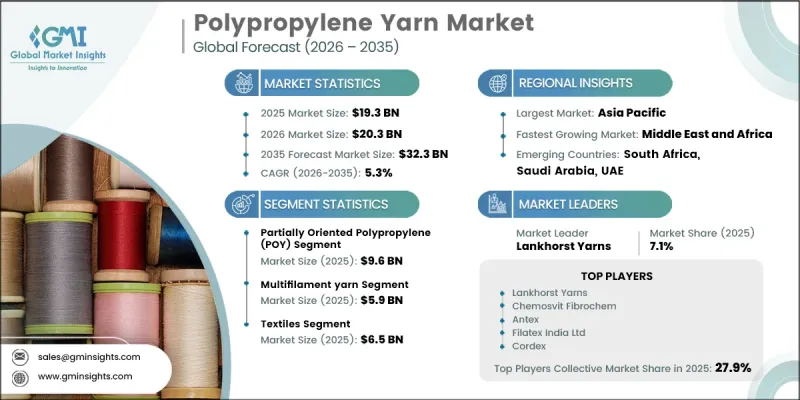
隨著各應用領域對耐用、輕巧且經濟高效的合成材料的需求不斷成長,市場也持續發展。聚丙烯紗線採用擠出和紡絲技術,以多絲纖維、單絲和帶狀紗線,為各種終端應用提供柔軟性。即使經過反覆使用和暴露於外部環境,其強度仍能保持穩定,從而支撐了市場需求。此外,此紗線的耐濕性有助於保持尺寸穩定性並抑制微生物生長。而且,該材料可回收利用,可透過可控的加工方法進行再利用,進一步支撐了市場。隨著各行業不斷優先考慮效率和產品耐用性,聚丙烯紗線仍然是功能性紡織品應用的理想選擇。
| 市場範圍 | |
|---|---|
| 開始年份 | 2025 |
| 預測期 | 2026-2035 |
| 上市時的市場規模 | 193億美元 |
| 預測市場規模 | 323億美元 |
| 複合年成長率 | 5.3% |
預計2025年,部分拉伸聚丙烯紗線市場規模將達96億美元。該細分市場作為一種中間產品,在實現靈活的下游加工方面發揮著至關重要的作用。同時,全拉伸聚丙烯紗線在需要即時尺寸穩定性和性能一致性的應用領域,預計將繼續保持穩定的需求。這兩類產品有助於提高工業和包裝紡織品產業的生產效率、纖維一致性和製程控制。
預計2025年,多絲纖維聚丙烯紗線市場規模將達59億美元。在需要耐用性、結構完整性和長使用壽命的行業中,單絲和多絲纖維的需求仍然強勁。其他類型的紗線,包括短纖紗和變形紗,也被用於需要更高柔軟性、表面變化和易操作性的應用領域,尤其是在功能性紡織品和室內紡織品領域。
預計北美聚丙烯紗線市場規模將從2025年的46億美元成長到2035年的73億美元。這一區域成長主要得益於各行業對可靠材料性能和穩定供應的持續需求。在美國,各工業和技術領域對聚丙烯材料的持續依賴也推動了市場的持續擴張。
目錄
第1章:調查方法和範圍
第2章執行摘要
第3章業界考察
- 生態系分析
- 供應商情況
- 利潤率
- 每個階段增加的價值
- 影響價值鏈的因素
- 中斷
- 影響產業的因素
- 促進因素
- 對輕質工業紡織品的需求不斷成長
- 在包裝應用的擴展應用
- 與天然纖維的成本效益比較
- 陷阱與挑戰
- 對高溫環境的敏感性
- 有限的染料吸收特性
- 機會
- 在農業領域擴大應用
- 可回收紡織品的成長
- 紗線加工技術進步
- 促進因素
- 成長潛力分析
- 監理情勢
- 北美洲
- 歐洲
- 亞太地區
- 拉丁美洲
- 中東和非洲
- 波特五力分析
- PESTEL 分析
- 科技與創新趨勢
- 當前技術趨勢
- 新興技術
- 價格趨勢
- 按地區
- 依產品類型
- 未來市場趨勢
- 科技與創新趨勢
- 當前技術趨勢
- 新興技術
- 專利趨勢
- 貿易統計(HS編碼)
- 主要進口國
- 主要出口國
- 永續性和環境方面
- 永續計劃
- 減少廢棄物策略
- 生產中的能源效率
- 環保意識的舉措
- 考慮碳足跡
第4章 競爭情勢
- 介紹
- 企業市佔率分析
- 按地區
- 北美洲
- 歐洲
- 亞太地區
- 拉丁美洲
- 中東和非洲(MEA)
- 按地區
- 企業矩陣分析
- 主要市場公司的競爭分析
- 競爭定位矩陣
- 主要進展
- 併購
- 夥伴關係和聯盟
- 新產品發布
- 業務拓展計劃
第5章 市場估價與預測:依製造流程分類,2022-2035年
- 部分取向聚丙烯(POY)
- 全拉伸聚丙烯(FDY)
- 拉伸紋理紗線
第6章 市場估算與預測:依產品類型分類,2022-2035年
- 單絲紗線
- 多絲纖維紗線
- 紗
- 撚線
- 染色紗線
- 纖維紗線
- 膠帶紗線
- 空氣變形紗線
第7章 市場估計與預測:依應用領域分類,2022-2035年
- 纖維
- 建材
- 車
- 包裝
- 體育用品
- 醫用紡織品
- 其他
第8章 市場估計與預測:依地區分類,2022-2035年
- 北美洲
- 美國
- 加拿大
- 歐洲
- 德國
- 英國
- 法國
- 西班牙
- 義大利
- 其他歐洲國家
- 亞太地區
- 中國
- 印度
- 日本
- 澳洲
- 韓國
- 其他亞太地區
- 拉丁美洲
- 巴西
- 墨西哥
- 阿根廷
- 其他拉丁美洲
- 中東和非洲
- 沙烏地阿拉伯
- 南非
- 阿拉伯聯合大公國
- 其他中東和非洲地區
第9章:公司簡介
- Antex
- Agropoli
- Barnet
- BR Group as
- Chemosvit Fibrochem
- Cordex
- Dostlar
- Essegomma
- Filatex India Ltd
- Lotte Chemical Corporation
- Lankhorst Yarns
The Global Polypropylene Yarn Market was valued at USD 19.3 billion in 2025 and is estimated to grow at a CAGR of 5.3% to reach USD 32.3 billion by 2035.
The market continues to evolve as industries demand durable, lightweight, and cost-effective synthetic materials for a wide range of applications. Polypropylene yarn is produced through extrusion and spinning techniques using polypropylene polymer, offering properties such as low moisture absorption, chemical resistance, and structural stability. These characteristics make it suitable for environments that require reliable performance under varying conditions. The material can be manufactured in multiple formats, including multifilament, monofilament, and tape yarn, allowing flexibility across different end uses. Its ability to retain strength despite repeated use and exposure to external elements contributes to its consistent demand. In addition, the yarn's resistance to moisture supports dimensional stability and helps limit microbial development. The market is further supported by the material's recyclability, enabling reuse through controlled processing methods. As industries continue to prioritize efficiency and product longevity, polypropylene yarn remains a practical choice for functional textile applications.
| Market Scope | |
|---|---|
| Start Year | 2025 |
| Forecast Year | 2026-2035 |
| Start Value | $19.3 Billion |
| Forecast Value | $32.3 Billion |
| CAGR | 5.3% |
The partially oriented polypropylene yarn segment accounted for USD 9.6 billion in 2025. It serves as an intermediate product that allows flexible downstream processing, while fully drawn polypropylene yarn continues to see steady demand in applications requiring immediate dimensional stability and consistent performance. Together, these categories support improvements in production efficiency, filament consistency, and process control across industrial and packaging textile segments.
The multifilament polypropylene yarn segment captured USD 5.9 billion in 2025. Demand for both monofilament and multifilament variants remains strong across sectors that require durability, structural integrity, and long service life. Other yarn types, including spun and textured formats, are also utilized in applications that require enhanced flexibility, surface variation, and ease of handling, particularly in functional and furnishing-related textile products.
North America Polypropylene Yarn Market is expected to grow from USD 4.6 billion in 2025 to USD 7.3 billion by 2035. Growth in the region is supported by steady demand from sectors requiring reliable material performance and consistent supply. The United States continues to rely on these materials for various industrial and technical applications, contributing to sustained market expansion.
Key companies operating in the Global Polypropylene Yarn Market include Lotte Chemical Corporation, Filatex India Ltd, Barnet, Cordex, Chemosvit Fibrochem, BR Group a.s., Antex, Agropoli, Essegomma, Dostlar, and Lankhorst Yarns. Companies in the Polypropylene Yarn Market are strengthening their market presence through continuous innovation and product development focused on improving durability, efficiency, and performance characteristics. Investments in advanced manufacturing technologies are helping enhance production quality and reduce operational costs. Strategic partnerships and distribution agreements are being formed to expand market reach and improve supply chain efficiency. Firms are also focusing on sustainability by incorporating recyclable materials and optimizing resource utilization. Capacity expansion and geographic diversification are enabling companies to meet rising global demand.
Table of Contents
Chapter 1 Methodology & Scope
- 1.1 Market scope and definition
- 1.2 Research design
- 1.2.1 Research approach
- 1.2.2 Data collection methods
- 1.3 Data mining sources
- 1.3.1 Global
- 1.3.2 Regional/Country
- 1.4 Base estimates and calculations
- 1.4.1 Base year calculation
- 1.4.2 Key trends for market estimation
- 1.5 Primary research and validation
- 1.5.1 Primary sources
- 1.6 Forecast model
- 1.7 Research assumptions and limitations
Chapter 2 Executive Summary
- 2.1 Industry 360° synopsis
- 2.2 Key market trends
- 2.2.1 Process Type
- 2.2.2 Product Type
- 2.2.3 Application
- 2.2.4 Regional
- 2.3 TAM Analysis, 2026-2035
- 2.4 CXO perspectives: Strategic imperatives
- 2.5 Future outlook and strategic recommendations
Chapter 3 Industry Insights
- 3.1 Industry ecosystem analysis
- 3.1.1 Supplier landscape
- 3.1.2 Profit margin
- 3.1.3 Value addition at each stage
- 3.1.4 Factor affecting the value chain
- 3.1.5 Disruptions
- 3.2 Industry impact forces
- 3.2.1 Growth drivers
- 3.2.1.1 Rising demand for lightweight industrial textiles
- 3.2.1.2 Increased use in packaging applications
- 3.2.1.3 Cost efficiency compared to natural fibers
- 3.2.2 Pitfalls/challenge
- 3.2.2.1 Sensitivity to high temperature exposure
- 3.2.2.2 Limited dye absorption characteristics
- 3.2.3 Opportunities
- 3.2.3.1 Expanding use in agricultural applications
- 3.2.3.2 Growth in recyclable textile products
- 3.2.3.3 Technological improvements in yarn processing
- 3.2.1 Growth drivers
- 3.3 Growth potential analysis
- 3.4 Regulatory landscape
- 3.4.1 North America
- 3.4.2 Europe
- 3.4.3 Asia Pacific
- 3.4.4 Latin America
- 3.4.5 Middle East & Africa
- 3.5 Porter's analysis
- 3.6 PESTEL analysis
- 3.7 Technology and innovation landscape
- 3.7.1 Current technological trends
- 3.7.2 Emerging technologies
- 3.8 Price trends
- 3.8.1 By region
- 3.8.2 By product type
- 3.9 Future market trends
- 3.10 Technology and innovation landscape
- 3.10.1 Current technological trends
- 3.10.2 Emerging technologies
- 3.11 Patent landscape
- 3.12 Trade statistics (HS code)
- 3.12.1 Major importing countries
- 3.12.2 Major exporting countries
- 3.13 Sustainability and environmental aspects
- 3.13.1 Sustainable practices
- 3.13.2 Waste reduction strategies
- 3.13.3 Energy efficiency in production
- 3.13.4 Eco-friendly initiatives
- 3.14 Carbon footprint consideration
Chapter 4 Competitive Landscape, 2025
- 4.1 Introduction
- 4.2 Company market share analysis
- 4.2.1 By region
- 4.2.1.1 North America
- 4.2.1.2 Europe
- 4.2.1.3 Asia Pacific
- 4.2.1.4 LATAM
- 4.2.1.5 MEA
- 4.2.1 By region
- 4.3 Company matrix analysis
- 4.4 Competitive analysis of major market players
- 4.5 Competitive positioning matrix
- 4.6 Key developments
- 4.6.1 Mergers & acquisitions
- 4.6.2 Partnerships & collaborations
- 4.6.3 New product launches
- 4.6.4 Expansion plans
Chapter 5 Market Estimates and Forecast, By Process Type, 2022-2035 (USD Billion) (Kilo Tons)
- 5.1 Key trends
- 5.2 Partially oriented polypropylene (POY)
- 5.3 Fully drawn polypropylene (FDY)
- 5.4 Draw textured yarn
Chapter 6 Market Estimates and Forecast, By Product Type, 2022-2035 (USD Billion) (Kilo Tons)
- 6.1 Key trends
- 6.2 Monofilament yarn
- 6.3 Multifilament yarn
- 6.4 Spun yarn
- 6.5 Textured yarn
- 6.6 Dyed yarn
- 6.7 Fibrillated yarn
- 6.8 Tape yarn
- 6.9 Air-textured yarn
Chapter 7 Market Estimates and Forecast, By Application, 2022-2035 (USD Billion) (Kilo Tons)
- 7.1 Key trends
- 7.2 Textiles
- 7.3 Construction materials
- 7.4 Automotive
- 7.5 Packaging
- 7.6 Sports accessories
- 7.7 Medical textiles
- 7.8 Others
Chapter 8 Market Estimates and Forecast, By Region, 2022-2035 (USD Billion) (Kilo Tons)
- 8.1 Key trends
- 8.2 North America
- 8.2.1 U.S.
- 8.2.2 Canada
- 8.3 Europe
- 8.3.1 Germany
- 8.3.2 UK
- 8.3.3 France
- 8.3.4 Spain
- 8.3.5 Italy
- 8.3.6 Rest of Europe
- 8.4 Asia Pacific
- 8.4.1 China
- 8.4.2 India
- 8.4.3 Japan
- 8.4.4 Australia
- 8.4.5 South Korea
- 8.4.6 Rest of Asia Pacific
- 8.5 Latin America
- 8.5.1 Brazil
- 8.5.2 Mexico
- 8.5.3 Argentina
- 8.5.4 Rest of Latin America
- 8.6 Middle East and Africa
- 8.6.1 Saudi Arabia
- 8.6.2 South Africa
- 8.6.3 UAE
- 8.6.4 Rest of Middle East and Africa
Chapter 9 Company Profiles
- 9.1 Antex
- 9.2 Agropoli
- 9.3 Barnet
- 9.4 BR Group a.s.
- 9.5 Chemosvit Fibrochem
- 9.6 Cordex
- 9.7 Dostlar
- 9.8 Essegomma
- 9.9 Filatex India Ltd
- 9.10 Lotte Chemical Corporation
- 9.11 Lankhorst Yarns

 印尼聚丙烯市場:市場佔有率分析、產業趨勢與統計、成長預測(2026-2031)
 2026-2030年全球聚丙烯市場
 改質聚丙烯蠟市場規模、佔有率和成長分析:按改性類型、形態、應用、最終用途產業、功能和地區分類-2026-2033年產業預測聚丙烯:市場佔有率分析、產業趨勢與統計、成長預測(2026-2031)
 改質聚丙烯市場:全球預測,2026-2032年聚丙烯市場:依類型、形狀、加工技術、終端用途產業及通路分類-2026-2032年全球市場預測
 聚丙烯玻璃纖維增強複合材料市場-全球產業規模、佔有率、趨勢、機會、預測:銷售管道、最終用途、地區和競爭格局分類,2021-2031年
 全球聚丙烯樹脂市場規模、佔有率、趨勢和成長分析報告(2026-2034)
 改質聚丙烯市場規模、佔有率和成長分析:按類型、加工方法、最終用途和地區分類-2026-2033年產業預測
 2026年全球聚丙烯熱固性聚合物市場報告