


 |
市場調查報告書
商品編碼
2123109
資料中心加速器:市場佔有率分析、產業趨勢與統計、成長預測(2026-2032 年)Data Center Accelerator - Market Share Analysis, Industry Trends & Statistics, Growth Forecasts (2026 - 2032) |
||||||

※ 本網頁內容可能與最新版本有所差異。詳細情況請與我們聯繫。
據 Mordor Intelligence 稱,資料中心加速器市場預計到 2026 年價值 146.9 億美元,高於 2025 年的 128.9 億美元,預計到 2032 年將達到 321.3 億美元。
預計 2026 年至 2032 年的複合年成長率為 13.96%。
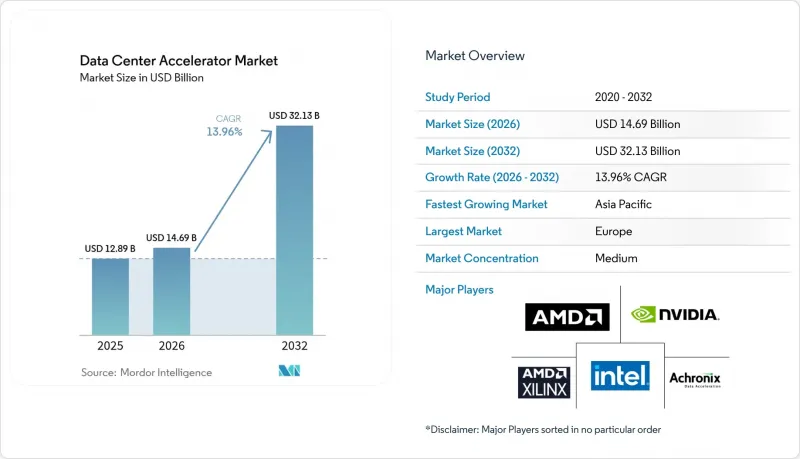
本報告按處理器類型(CPU等)、應用領域(高效能運算(HPC))、部署方式(本地部署、託管等)、最終用戶產業(IT/電信等)和地區(北美等)進行分類。市場預測以美元(USD)計價。
全球資料中心加速器市場趨勢與洞察
超大規模資料中心人工智慧/機器學習訓練工作負載激增
超大規模營運商正在部署專為人工智慧設計的資料中心,其運算密度比傳統企業工作負載高出 10 到 100 倍。 Meta 公司斥資 8 億美元在印第安納州建設的園區,採用標準化水冷機架以容納多千兆次浮點運算的 GPU叢集,正是這種轉變的象徵。微軟計劃在 2025 會計年度向其美國人工智慧設施投入超過 800 億美元,凸顯了訓練基礎設施的地理集中化趨勢。亞馬遜在多個州投資 1000 億美元的擴張計劃進一步表明,雲端超大規模資料中心業者營運商正在追求規模經濟,但每增加一兆瓦的電力必須符合其內部的可可再生能源標準。隨著企業從原型模型轉向推理管線,整合 GPU、CPU 和 ASIC 節點的異質機架設計正逐漸成為主流,而平衡這些資源的需求也日益成長。金融機構正是這種雙管齊下策略的典型代表:它們既配置獨立的 GPU叢集用於即時詐欺偵測,又維護以 CPU 為核心的分析叢集用於監管報告。
GPU供不應求正在推動雲端加速器租賃業務的成長。
在高效能GPU長期短缺的背景下,將硬體所有權與使用權分開的「GPU即服務」平台正在興起。 Oracle雲端基礎設施的叢集支援16,384塊AMD Instinct MI300X GPU,並透過提供計量型的Web門戶,將採購前置作業時間從數月縮短至數分鐘。北美和歐洲的加密貨幣挖礦設施被改造為高功率密度設施,使營運商能夠將閒置的電力容量貨幣化。這種租賃模式為以前無法負擔頂級加速器資本投資的中小型企業提供了更多機會。服務供應商在與供應商的分配談判中也獲得了優勢,並增強了對單一供應商依賴的適應能力。
全球先進封裝基板供應短缺
整合HBM堆疊和晶片組的加速器依賴味之素的增材膜和CoWoS封裝技術,但這些材料的前置作業時間目前長達一年。供應商優先供應高利潤產品,迫使小規模的供應商爭奪有限的配額。有機中介層的試驗正在進行中,但至少在兩個生產週期內不太可能顯著緩解供應緊張的局面。台灣和韓國已宣布大幅擴大基板產能,但這些擴張的時機已經錯過了當前的需求轉折點。
細分市場分析
預計到2025年,GPU處理器將維持73.20%的市場佔有率,這反映了它們在模型訓練和推理任務中的多功能性。然而,隨著企業致力於低耗電量,ASIC晶片的出貨量預計到2032年將以15.42%的複合年成長率成長。谷歌自主研發的TPU v6晶片反映了自主晶片開發的趨勢,優先考慮效能和成本之間的平衡。同時,AMD的Instinct MI350系列將HBM顯存容量擴充至288GB,目標應用是記憶體受限的變壓器模型。 CPU插槽繼續統籌I/O和系統維護任務,而FPGA卡在需要確定性延遲的通訊邊緣節點中仍扮演著重要角色。
ASIC晶片的成長顯示買家的優先事項發生了轉變。託管機房的電力預算很少會隨著機架密度的增加而線性成長,因此營運商更加關注諸如每瓦性能(TOPS/watt)之類的指標。推理密集型SaaS服務,例如客戶支援聊天機器人和即時個人化引擎,需要可預測的延遲,而ASIC設計現在正滿足這項需求。訓練工作負載仍集中在多GPU叢集,而一些運算週期正在轉移到整合到下一代GPU中的專用張量引擎,這模糊了不同類別之間的界限。總體而言,處理器多樣化加劇了供應商之間的競爭,這有利於買家在價格談判和穩定供應方面獲得優勢。
2025年,人工智慧訓練在資料中心加速器市場收入中佔比49.30%,但到2032年,推理工作負載預計將以15.55%的更高複合年成長率成長。曾經滿足於先導計畫的公司現在正將聊天機器人、建議模型和影像分析服務部署到生產環境中,而延遲過高會直接導致客戶流失。高效能運算仍然是一個穩定的細分市場,主要集中在天氣建模、基因組學和計算流體力學領域,依賴配備大規模HBM堆疊的GPU,而非純粹的ASIC。
推理能力的提升也影響硬體的選擇。可變批次大小和嚴格的服務等級協定 (SLA) 要求加速器必須最佳化記憶體頻寬而非原始浮點運算吞吐量。醫療機構正在採用針對推理最佳化的闆卡進行現場影像診斷,從而縮短中風等疾病的診斷時間。同樣,金融機構也在利用加速器進行即時風險評分,並將運算節點整合到私有雲端環境中,以確保符合監管要求。隨著應用日益多樣化,採購標準也將更加多元化,軟體生態系統的成熟度將越來越影響採購決策。
區域分析
北美仍然是最大的採購市場,這主要得益於亞馬遜、微軟和谷歌等公司的大規模資本投資計畫。光是微軟一家預計到2025年就將在美國本土設施投資超過800億美元。加拿大和墨西哥正在崛起為近岸外包目的地,它們在電力成本和延遲方面取得了平衡,同時又符合北美的法規結構。
亞太地區預計將以最高的複合年成長率成長,這主要得益於強制性主權雲以及韓國耗資350億美元的大型園區建設。中國正大力推動國產加速器(例如華為的Ascend系列)的研發,以克服出口管制限制。日本Rapidus聯盟和Softbank Corporation的半導體晶片計畫在公共資金的支持下,旨在重返半導體製造領域。
歐洲的「GAIA-X」和「IPCEI-CIS」計畫正在加速跨境資料主權雲端的建置。黑石集團對英國資料中心130億美元的投資凸顯了投資者對該地區人工智慧需求的信心。中東和非洲的成長依賴主權財富基金的支持,而有利的能源價格則為阿拉伯聯合大公國和沙烏地阿拉伯等電力消耗量設施提供了支撐。
其他好處:
- Excel格式的市場預測(ME)表
- 3個月的分析師支持
目錄
第1章:引言
- 市場分析與定義的前提條件
- 分析範圍
第2章 分析方法
第3章執行摘要
第4章 市場狀況
- 市場概覽
- 市場促進因素
- 超大規模資料中心人工智慧/機器學習訓練工作負載激增
- GPU供不應求正在推動基於雲端的加速器租賃服務的興起。
- 生成式人工智慧在SaaS平台中的快速普及
- 需要異質加速器的量子啟發式演算法
- 從邊緣到核心的工作負載編配(適用於營運商的 5G 和雲端)
- 主權雲端計畫將津貼國內加速器製造工廠
- 市場限制因素
- 全球先進封裝基板供應短缺
- 異質程式設計模型中的陡峭學習曲線
- 範圍 3 排放目標的向上修訂限制了巨型 GPU叢集的擴展。
- 高階GPU/ASIC的出口管理體制
- 價值鍊和供應鏈分析
- 監理情勢
- 技術展望
- 波特五力分析
第5章:預測市場規模與成長率
- 依處理器類型
- CPU
- GPU
- FPGA
- ASIC
- 透過使用
- 高效能運算(HPC)
- 人工智慧(AI)訓練
- 人工智慧(AI)推理
- 其他工作量
- 透過部署方法
- 本地部署/企業級/邊緣運算
- 搭配
- 公共雲端
- 按最終用戶行業分類
- 資訊科技/通訊
- 銀行、金融服務和保險業 (BFSI)
- 醫學與生命科學
- 政府/國防
- 媒體與娛樂
- 其他最終用戶
- 按地區
- 北美洲
- 美國
- 墨西哥
- 加拿大
- 南美洲
- 巴西
- 其他南美國家
- 歐洲
- 德國
- 英國
- 法國
- 俄羅斯
- 其他歐洲國家
- 亞太地區
- 中國
- 日本
- 印度
- 韓國
- 其他亞太國家
- 中東和非洲
- 中東
- 沙烏地阿拉伯
- UAE
- 土耳其
- 非洲
- 南非
- 其他非洲國家
- 中東
- 北美洲
第6章 競爭情勢
- 市佔率分析
- 公司簡介
- NVIDIA Corporation
- Intel Corporation
- Advanced Micro Devices Inc.
- Google LLC(TPU)
- Amazon Web Services Inc.
- Qualcomm Technologies Inc.
- Xilinx Inc.(AMD)
- Achronix Semiconductor Corp.
- NEC Corporation
- Dell Technologies Inc.
- IBM Corporation
- Cisco Systems Inc.
- Huawei Technologies Co. Ltd.
- Alibaba Cloud(Hanguang)
- Baidu Inc.(Kunlun)
- Graphcore Ltd.
- Cerebras Systems Inc.
- Tenstorrent Inc.
- Ampere Computing LLC
- Arm Ltd.
- Broadcom Inc.
- Marvell Technology Inc.
- Samsung Electronics Co. Ltd.
- Fujitsu Ltd.
第7章 市場機會與未來展望
According to Mordor Intelligence, data center accelerator market size in 2026 is estimated at USD 14.69 billion, growing from 2025 value of USD 12.89 billion with 2032 projections showing USD 32.13 billion, growing at 13.96% CAGR over 2026-2032.
This report is Segmented by Processor Type (CPU and More), Application (High-Performance Computing, and More), Deployment Model (On-Premise, Colocation, and More), End-User Industry (IT and Telecom, and More), and Geography (North America and More). The Market Forecasts are Provided in (USD).
Global Data Center Accelerator Market Trends and Insights
Surging AI/ML Training Workloads in Hyperscale Data Centers
Hyperscale operators now deploy data halls purpose-built for AI that demand 10-100 times more compute density than legacy enterprise workloads. Meta's USD 800 million Indiana campus exemplifies the shift as it standardizes liquid-cooled racks to accommodate multi-petaflop GPU clusters. Microsoft earmarked more than USD 80 billion for U.S. AI facilities in fiscal-year 2025, underscoring the geographic clustering of training infrastructure. Amazon's USD 100 billion multistate expansion further signals that cloud hyperscalers are pursuing scale economics, but every new megawatt must meet internal renewable-energy thresholds. A balancing act is emerging as enterprises move from prototype models to inference pipelines, resulting in more heterogeneous rack designs that integrate GPU, CPU, and ASIC nodes. Financial institutions exemplify this dual-track buildout, allocating discrete GPU clusters for real-time fraud detection while maintaining CPU-heavy analytics farms for regulatory reporting.
GPU Scarcity Driving Cloud-Based Accelerator Rentals
Chronic shortages of premium GPUs have spawned GPU-as-a-Service platforms that decouple hardware ownership from usage. Oracle Cloud Infrastructure's supercluster supports 16,384 AMD Instinct MI300X GPUs and offers consumption-based web portals, reducing procurement lead times from months to minutes. Re-purposed cryptocurrency-mining sites in North America and Europe contribute power-dense real estate, allowing operators to monetize stranded electrical capacity. The rental model democratizes access for small and midsize organizations that could not previously justify the capital outlay for top-tier accelerators. Service providers also gain leverage when negotiating vendor allocations, enhancing resilience against single-supplier constraints.
Tight Global Supply of Advanced Packaging Substrates
Accelerators that integrate HBM stacks and chiplets rely on Ajinomoto Build-Up Film and CoWoS packaging, materials now subject to year-long lead times. Suppliers prioritize high-margin SKUs, leaving smaller vendors scrambling for limited allocations. Organic-interposer experimentation is underway but will not meaningfully ease constraints for at least two production cycles. Taiwan and South Korea have announced aggressive substrate-capacity expansions, yet the ramp window extends beyond current demand inflection points.
Other drivers and restraints analyzed in the detailed report include:
- Rapid Adoption of Generative AI in SaaS Platforms
- Quantum-Inspired Algorithms Demanding Heterogeneous Accelerators
- Steep Learning Curve for Heterogeneous Programming Models
For complete list of drivers and restraints, kindly check the Table Of Contents.
Segment Analysis
GPU processors retained a 73.20% stake in 2025, reflecting their versatility across both model-training and inference tasks. ASIC shipments, however, are projected to rise at a 15.42% CAGR to 2032 as enterprises tune for lower power draw during steady-state inference workloads. Google's internally developed TPU v6 exemplifies the in-house silicon trend that balances performance and cost. Meanwhile, AMD's Instinct MI350 family expands HBM capacity to 288 GB, targeting memory-bound transformer models. CPU sockets still orchestrate I/O and housekeeping tasks, while FPGA cards maintain relevance in telecom edge nodes that call for deterministic latency.
ASIC growth illustrates shifting buyer priorities. Power budgets inside co-location cages rarely scale linearly with rack density, driving operators to favor TOPS-per-watt metrics. Inference-dense SaaS offerings, such as customer-support chatbots and real-time personalization engines, require predictable latency that ASIC designs now deliver. Training workloads will still concentrate on multi-GPU clusters, yet a portion of compute cycles migrates to specialized tensor engines integrated into next-gen GPUs, blurring categorical boundaries. Overall, processor diversity strengthens vendor competition, offering buyers leverage on pricing and supply continuity.
AI training accounted for 49.30% of Data Center Accelerator market revenue in 2025, but inference workloads will record a faster 15.55% CAGR through 2032. Businesses once content with pilot projects are now releasing chatbots, recommendation models, and image-analysis services into production, where latency slippage translates directly into customer churn. High-performance computing remains a stable niche centered on weather modeling, genomics, and computational fluid dynamics, relying on GPUs with larger HBM stacks rather than pure ASICs.
Inference growth ripples across hardware selection. Batch-size variability and strict service-level agreements necessitate accelerators that optimize memory bandwidth over raw floating-point throughput. Healthcare providers employ inference-optimized boards to perform diagnostic imaging at the point of care, shortening time to diagnosis for conditions such as stroke. Financial institutions likewise leverage accelerators for real-time risk scoring, embedding compute nodes inside private-cloud environments for regulatory compliance. The expanding application mix will continue to diversify purchase criteria, with software ecosystem maturity increasingly tipping buying decisions.
Complete Report Scope:
- By Processor Type
- CPU
- GPU
- FPGA
- ASIC
- By Application
- High-Performance Computing
- Artificial Intelligence Training
- Artificial Intelligence Inference
- Other Workloads
- By Deployment Model
- On-Premise/ Enteprise/Edge
- Colocation
- Public Cloud
- By End-user Industry
- IT and Telecom
- BFSI
- Healthcare and Life Sciences
- Government and Defense
- Media and Entertainment
- Others End Users
- By Geography
- North America
- United States
- Mexico
- Canada
- South America
- Brazil
- Rest of South America
- Europe
- Germany
- United Kingdom
- France
- Russia
- Rest of Europe
- Asia-Pacific
- China
- Japan
- India
- South Korea
- Rest of Asia-Pacific
- Middle East and Africa
- Middle East
- Saudi Arabia
- UAE
- Turkey
- Africa
- South Africa
- Rest of Africa
- Middle East
- North America
Geography Analysis
North America remains the largest buyer, underpinned by hyperscale capital-expenditure plans from Amazon, Microsoft, and Google. Microsoft's spending alone surpasses USD 80 billion for domestic facilities in 2025. Canada and Mexico emerge as near-shore options that balance power-cost and latency considerations while staying within North American regulatory frameworks.
APAC will post the highest CAGR, buoyed by sovereign-cloud mandates and the construction of enormous campuses such as South Korea's USD 35 billion complex. China advances domestic accelerators like Huawei's Ascend series to navigate export-control limitations. Japan's Rapidus consortium and SoftBank's chip initiatives, aided by public funding, aim to reclaim semiconductor manufacturing relevance.
Europe's GAIA-X and IPCEI-CIS programs foster cross-border data-sovereignty clouds. Blackstone's USD 13 billion UK data-center commitment underscores investor confidence in regional AI demand. Middle East and Africa growth hinges on sovereign wealth-fund backing, with energy-price advantages supporting power-hungry installations in the UAE and Saudi Arabia.
- NVIDIA Corporation
- Intel Corporation
- Advanced Micro Devices Inc.
- Google LLC (TPU)
- Amazon Web Services Inc.
- Qualcomm Technologies Inc.
- Xilinx Inc. (AMD)
- Achronix Semiconductor Corp.
- NEC Corporation
- Dell Technologies Inc.
- IBM Corporation
- Cisco Systems Inc.
- Huawei Technologies Co. Ltd.
- Alibaba Cloud (Hanguang)
- Baidu Inc. (Kunlun)
- Graphcore Ltd.
- Cerebras Systems Inc.
- Tenstorrent Inc.
- Ampere Computing LLC
- Arm Ltd.
- Broadcom Inc.
- Marvell Technology Inc.
- Samsung Electronics Co. Ltd.
- Fujitsu Ltd.
Additional Benefits:
- The market estimate (ME) sheet in Excel format
- 3 months of analyst support
TABLE OF CONTENTS
1 INTRODUCTION
- 1.1 Study Assumptions and Market Definition
- 1.2 Scope of the Study
2 RESEARCH METHODOLOGY
3 EXECUTIVE SUMMARY
4 MARKET LANDSCAPE
- 4.1 Market Overview
- 4.2 Market Drivers
- 4.2.1 Surging AI/ML training workloads in hyperscale data centers
- 4.2.2 GPU scarcity driving cloud-based accelerator rentals
- 4.2.3 Rapid adoption of Generative AI in SaaS platforms
- 4.2.4 Quantum-inspired algorithms demanding heterogeneous accelerators
- 4.2.5 Edge-to-core workload orchestration (5G and telco clouds)
- 4.2.6 Sovereign-cloud programs subsidising domestic accelerator fabs
- 4.3 Market Restraints
- 4.3.1 Tight global supply of advanced packaging substrates
- 4.3.2 Steep learning-curve for heterogenous programming models
- 4.3.3 Rising Scope-3 emission targets constraining mega-GPU clusters
- 4.3.4 Export-control regimes on high-end GPUs/ASICs
- 4.4 Value / Supply-Chain Analysis
- 4.5 Regulatory Landscape
- 4.6 Technological Outlook
- 4.7 Porter's Five Forces
- 4.7.1 Threat of New Entrants
- 4.7.2 Bargaining Power of Suppliers
- 4.7.3 Bargaining Power of Buyers
- 4.7.4 Threat of Substitutes
- 4.7.5 Competitive Rivalry
5 MARKET SIZE AND GROWTH FORECASTS (VALUE)
- 5.1 By Processor Type
- 5.1.1 CPU
- 5.1.2 GPU
- 5.1.3 FPGA
- 5.1.4 ASIC
- 5.2 By Application
- 5.2.1 High-Performance Computing
- 5.2.2 Artificial Intelligence Training
- 5.2.3 Artificial Intelligence Inference
- 5.2.4 Other Workloads
- 5.3 By Deployment Model
- 5.3.1 On-Premise/ Enteprise/Edge
- 5.3.2 Colocation
- 5.3.3 Public Cloud
- 5.4 By End-user Industry
- 5.4.1 IT and Telecom
- 5.4.2 BFSI
- 5.4.3 Healthcare and Life Sciences
- 5.4.4 Government and Defense
- 5.4.5 Media and Entertainment
- 5.4.6 Others End Users
- 5.5 By Geography
- 5.5.1 North America
- 5.5.1.1 United States
- 5.5.1.2 Mexico
- 5.5.1.3 Canada
- 5.5.2 South America
- 5.5.2.1 Brazil
- 5.5.2.2 Rest of South America
- 5.5.3 Europe
- 5.5.3.1 Germany
- 5.5.3.2 United Kingdom
- 5.5.3.3 France
- 5.5.3.4 Russia
- 5.5.3.5 Rest of Europe
- 5.5.4 Asia-Pacific
- 5.5.4.1 China
- 5.5.4.2 Japan
- 5.5.4.3 India
- 5.5.4.4 South Korea
- 5.5.4.5 Rest of Asia-Pacific
- 5.5.5 Middle East and Africa
- 5.5.5.1 Middle East
- 5.5.5.1.1 Saudi Arabia
- 5.5.5.1.2 UAE
- 5.5.5.1.3 Turkey
- 5.5.5.2 Africa
- 5.5.5.2.1 South Africa
- 5.5.5.2.2 Rest of Africa
- 5.5.5.1 Middle East
- 5.5.1 North America
6 COMPETITIVE LANDSCAPE
- 6.1 Market Share Analysis
- 6.2 Company Profiles (includes Global level Overview, Market level overview, Core Segments, Financials as available, Strategic Information, Market Rank/Share for key companies, Products and Services, and Recent Developments)
- 6.2.1 NVIDIA Corporation
- 6.2.2 Intel Corporation
- 6.2.3 Advanced Micro Devices Inc.
- 6.2.4 Google LLC (TPU)
- 6.2.5 Amazon Web Services Inc.
- 6.2.6 Qualcomm Technologies Inc.
- 6.2.7 Xilinx Inc. (AMD)
- 6.2.8 Achronix Semiconductor Corp.
- 6.2.9 NEC Corporation
- 6.2.10 Dell Technologies Inc.
- 6.2.11 IBM Corporation
- 6.2.12 Cisco Systems Inc.
- 6.2.13 Huawei Technologies Co. Ltd.
- 6.2.14 Alibaba Cloud (Hanguang)
- 6.2.15 Baidu Inc. (Kunlun)
- 6.2.16 Graphcore Ltd.
- 6.2.17 Cerebras Systems Inc.
- 6.2.18 Tenstorrent Inc.
- 6.2.19 Ampere Computing LLC
- 6.2.20 Arm Ltd.
- 6.2.21 Broadcom Inc.
- 6.2.22 Marvell Technology Inc.
- 6.2.23 Samsung Electronics Co. Ltd.
- 6.2.24 Fujitsu Ltd.
7 MARKET OPPORTUNITIES AND FUTURE OUTLOOK
- 7.1 White-space and Unmet-Need Assessment

 資料中心獨立GPU市場:全球市場預測,2026-2032年
 AI資料中心CXL記憶體擴展和池化基礎設施的市場規模、佔有率和成長預測(2026-2032年)AI資料中心DPU和智慧網卡的市場規模、佔有率和成長預測(2026-2032年)
 資料中心加速器:全球市場
 資料中心加速器市場:依產品類型、應用、通路、技術、國家及地區分類-全球產業分析、市場規模、市場佔有率及2026年至2033年預測資料中心加速器市場規模、佔有率、成長、全球產業分析、區域趨勢及2026-2034年預測資料中心加速器市場-2026-2032年全球市場預測
 機架級GPU基礎設施:市場佔有率分析、產業趨勢與統計及成長預測(2026-2031年)
 資料中心加速器市場報告:按加速器類型、處理器類型、應用和地區分類(2026-2034 年)
 2026年全球資料中心加速器市場報告