


 |
市場調查報告書
商品編碼
2099267
機架級GPU基礎設施:市場佔有率分析、產業趨勢與統計及成長預測(2026-2031年)Rack-Scale GPU Infrastructure - Market Share Analysis, Industry Trends & Statistics, Growth Forecasts (2026 - 2031) |
||||||

※ 本網頁內容可能與最新版本有所差異。詳細情況請與我們聯繫。
根據 Mordor Intelligence 預測,機架級 GPU 基礎設施市場規模將從 2025 年的 68.2 億美元和 2026 年的 95.8 億美元成長到 2031 年的 412.7 億美元,2026 年至 2031 年的年複合成長率(CAGR)。
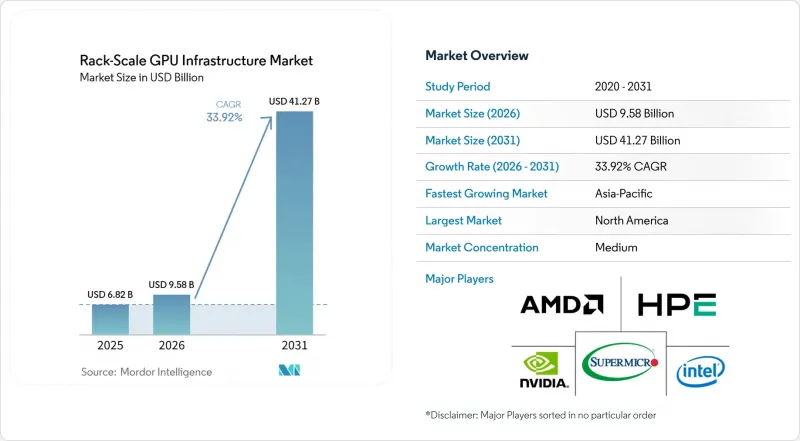
本報告按解決方案類型(機架級計算系統、機架級網路系統、機架級冷卻系統等)、部署規模(單機架部署等)、冷卻架構(浸沒式冷卻機架基礎設施等)、最終用戶(政府和研究機構等)以及地區進行細分。市場預測以價值(美元)表示。
全球機架式GPU基礎設施市場趨勢與洞察
對用於人工智慧工廠機架的超大規模資料中心業者的需求正在激增。
機架級GPU基礎設施市場正受到超大規模資料中心業者資本規劃的推動,預計將從2025年的4,100億美元成長到2026年的約7,250億美元,其中伺服器和機架基礎設施的預算預計將達到1,300億美元。採購模式正從購買單一伺服器轉向購買機架級系統,這些系統將計算托架、互連架構、液冷和電源整合到單一部署包中。隨著每個平台週期中部署的硬體和站點基礎設施越來越多,這種轉變提高了每次部署的收入。此外,由於下一代系統的預購名單很長,一些業者開始提前鎖定當前世代系統的容量,從而支撐了短期訂單流。因此,機架級GPU基礎設施市場不僅會受到需求成長的影響,還會受到平台部署時機和設施準備的影響。
快速過渡到液冷、高密度基礎設施
機架級GPU基礎設施市場正迅速轉型為液冷設計。這主要歸功於Vera Rubin公司計畫於2026年5月全面量產其全液冷無風扇機架架構。 Rubin的機架配置功耗超過300千瓦,這意味著營運商不僅需要購買機架,還需要購買冷卻液分配單元、機房歧管和專用管道。此外,根據Open Rack Wide的研究,在高密度AI環境中,機架尺寸、電源和冷卻逐漸整合為一個整體並標準化。這正在改變採購行為,因為與傳統資料中心建置相比,冷卻供應商現在需要在專案週期的早期階段就獲得認證。此外,隨著冷卻和電源供應不再是運算訂單中的次要部分,機架級GPU基礎設施市場的支出規模也不斷擴大。
先進包裝及HBM供應瓶頸
機架級GPU基礎設施市場持續面臨供應限制,尤其是在封裝和記憶體層,特別是CoWoS產能和高頻寬記憶體的供應。即使終端需求超過供應,這些限制也限制了成品機架中可整合的加速器數量。供應緊張也加劇了系統供應商的成本壓力,因為封裝成本的成長速度遠超過許多採購週期。因此,對於那些希望根據客戶設定的固定計畫擴展大規模AI工廠部署的OEM廠商和整合商而言,利潤率的靈活性受到了影響。在機架級GPU基礎設施市場,這意味著儘管需求強勁,但交貨柔軟性仍取決於上游記憶體和封裝的供應狀況。
細分市場分析
到2025年,機架級運算系統將佔總營收的70.34%,成為機架級GPU基礎設施市場中最大的細分市場。這一領先地位反映了GPU和加速器托架在任何機架部署的總物料成本(BOM)中仍然佔據顯著地位。由於平台從Hopper遷移到光連接模組,以支援大規模的AI叢集。
預計從2026年到2031年,機架級冷卻系統將以35.52%的複合年成長率成長,成為所有解決方案類型中成長最快的。這一成長主要得益於全液冷架構的轉變,在這種架構中,冷卻設計與運算和網路配置同步進行,而非在機架選型之後。隨著供應商將800VDC架構標準化用於高密度AI部署,機架級電源系統的策略價值也不斷提升。在機架級GPU基礎設施市場,這意味著雖然計算仍然是收入的主要來源,但冷卻和電源在決定部署能否按計劃進行方面發揮著越來越重要的作用。
預計從2026年到2031年,叢集規模人工智慧工廠的部署將以35.18%的複合年成長率成長,成為所有部署模式中成長最快的。這反映出大型營運商正在從逐步增加小型單元轉向可跨多個站點重複部署的整合式園區規模建置。 Supermicro為NVIDIA Vera Rubin NVL72設計的DCBBS藍圖,其GPU建置模組的擴展能力從1152個擴展到1GW,這表明供應商正在將大規模人工智慧部署打包成可重複的建置單元,而不是一次性的工程專案。因此,機架級GPU基礎設施市場正朝著大規模的合約結構轉變,將硬體策略與長期站點規劃連結起來。
到 2025 年,多機架 pod 部署將佔按部署規模計算的收入的 50.46%,並將繼續成為許多企業和中型雲端建置的標準採購單位。 pod 模型之所以有效,是因為它允許圍繞共用網路和冷卻迴路整合 4 到 16 個機架,而無需像園區級專案那樣承擔繁重的設計負擔。單機架部署仍然適用於企業推理處理和首次建置 AI 基礎架構的項目,因為在這些專案中,證明架構開銷和設施變更的合理性比較困難。在機架級 GPU 基礎設施市場,從單機架到 pod,再從 pod 到叢集的轉變不僅僅是規模的變化。這是因為每個階段都涉及服務的增加、設施間協調的需求以及整合帶來的收入成長。
區域分析
2025年,北美仍將是機架級GPU基礎設施最大的區域市場,佔全球整體營收的45.29%。該地區受益於維吉尼亞北部、達拉斯、鳳凰城和太平洋西北地區集中的超大規模資料中心業者中心和新雲園區。然而,電力供應問題是限制建設速度的最大瓶頸,國際能源總署(IEA)警告稱,由於電網限制,約20%的規劃資料中心專案面臨延期風險。加拿大推出了人工智慧主權運算基礎設施計劃,投資8.9億加元(約6.48億美元)建設大規模國家人工智慧運算能力,進一步刺激了公共部門的需求。因此,儘管由於施工場地可用性問題導致交付日期難以預測,北美在機架級GPU基礎設施市場仍佔據中心地位。
預計亞太地區在2026年至2031年間將以35.42%的複合年成長率成長,成為機架級GPU基礎設施市場成長最快的地區。韓國也積極參與了這一趨勢,韓國科學技術資訊研究院(KISTI)正根據與惠普企業(HPE)簽訂的價值3825億韓元(約合2.78億美元)的契約,推進第六代超級電腦的部署。中國仍然是該地區需求的重要參與者,但美國對先進計算設備(特別是ECCN 3A090和4A090)的出口限制,仍然限制著總部位於中國的企業獲取最先進的人工智慧伺服器系統。日本也推動了該地區的發展,日本理化學研究所(RIKEN)宣布「ROQUO」超級電腦將於2026年6月建成並投入營運。
歐洲仍是機架級GPU基礎設施的第三大市場,其基礎建設主要依賴公共部門的運算項目。 2026年3月,歐洲高效能運算聯合組織(EuroHPC JU)與惠普企業公司簽署了一份價值5500萬歐元(約合6220萬美元)的契約,用於斯圖加特高效能運算資源站(HLRS Stuttgart)專案。英國也透過其人工智慧硬體計畫投入了11億英鎊(約14億美元),並為愛丁堡國家超級電腦額外投入了7.5億英鎊(約9.525億美元),為該地區帶來了意義重大的國家主導基礎設施建設。與許多私營主導的市場相比,這種公共資金基礎為歐洲提供了更穩定的需求前景,儘管專案進度仍取決於場地準備和系統整合能力。
其他好處:
- Excel格式的市場預測(ME)表
- 3個月的分析師支持
目錄
第1章:引言
- 研究假設和市場定義
- 調查範圍
第2章:調查方法
第3章執行摘要
第4章 市場狀況
- 市場概覽
- 市場促進因素
- 超大規模資料中心業者對人工智慧工廠機架的需求正在激增。
- 快速過渡到水冷式高密度基礎設施
- 擴大國家主導的人工智慧和國家運算計劃
- 機架級互連的標準化和分散化
- 針對推理進行最佳化的 Neocloud 的應用越來越廣泛。
- 一個被忽略的驅動力:重新設計功率密度以提升預製人工智慧機架的效能
- 市場限制因素
- 先進包裝和人血腦屏障供應瓶頸
- 電力傳輸網路容量和施工現場發展狀況的限制。
- 出口限制和跨境營運摩擦
- 報告不足的阻礙因素,以及計算、電力、冷卻和光學結構整合的複雜性。
- 產業價值鏈分析
- 技術展望
- 宏觀經濟因素對市場的影響
- 波特五力分析
第5章 市場規模與成長預測
- 按解決方案類型
- 機架級計算系統
- 機架級網路系統
- 機架式冷卻系統
- 機架式電源系統
- 按部署規模
- 單機架實現
- 多機架艙部署
- 實施叢集規模的人工智慧工廠
- 冷卻架構
- 風冷式機架基礎設施
- 晶片直接液冷機架基礎設施
- 潛水式冷卻架基礎設施
- 混合式冷卻機架基礎設施
- 最終用戶
- 雲端服務供應商
- 公司
- 政府和研究機構
- 電信服務供應商
- 邊緣基礎設施提供商
- 按地區
- 北美洲
- 美國
- 加拿大
- 墨西哥
- 歐洲
- 德國
- 英國
- 法國
- 義大利
- 其他歐洲國家
- 亞太地區
- 中國
- 日本
- 韓國
- 印度
- 東南亞
- 其他亞太國家
- 南美洲
- 中東和非洲
- 北美洲
第6章 競爭情勢
- 市場集中度
- 策略趨勢
- Vendor Positioning Analysis
- 公司簡介
- NVIDIA Corporation
- Advanced Micro Devices, Inc.
- Intel Corporation
- Super Micro Computer, Inc.
- Hewlett Packard Enterprise Company
- Dell Technologies Inc.
- Lenovo Group Limited
- Giga-Byte Technology Co., Ltd.
- Quanta Computer Inc.
- Quanta Cloud Technology Inc.
- Wiwynn Corporation
- Inventec Corporation
- Foxconn Technology Co., Ltd.
- Ingrasys Technology Inc.
- Pegatron Corporation
- ASUS Computer Inc.
- Giga Computing Technology Co., Ltd.
- Tyan Computer Corporation
- MiTAC Computing Technology Corporation
- FII Group
- Lambda, Inc.
- Penguin Solutions, Inc.
- H3C Technologies Co., Limited
第7章 市場機會與未來展望
According to Mordor Intelligence, the rack-Scale GPU infrastructure market size is projected to expand from USD 6.82 billion in 2025 and USD 9.58 billion in 2026 to USD 41.27 billion by 2031, registering a CAGR of 33.92% between 2026 and 2031.
This report is Segmented by Solution Type (Rack-Scale Compute Systems, Rack-Scale Networking Systems, Rack-Scale Cooling Systems, and More), Deployment Scale (Single-Rack Deployments, and More), Cooling Architecture (Immersion-Cooled Rack Infrastructure, and More), End User (Government and Research Institutions, and More), and Geography. The Market Forecasts are Provided in Terms of Value (USD).
Global Rack-Scale GPU Infrastructure Market Trends and Insights
Surging Hyperscaler Demand for AI Factory Racks
The rack-scale GPU infrastructure market is being led by hyperscaler capital plans that reached approximately USD 725 billion for 2026, up from USD 410 billion in 2025, with server and rack infrastructure absorbing an estimated USD 130 billion. Procurement has shifted from buying isolated servers to buying integrated rack-scale systems that combine compute trays, interconnect fabrics, liquid cooling, and power delivery into a single deployment package. That change increases revenue per installation because each platform cycle now carries more hardware and site infrastructure. Allocation queues for next-generation systems are also pushing some operators to secure current-generation capacity earlier, which supports near-term order flow. This keeps the rack-scale GPU infrastructure market tied not only to demand growth, but also to platform timing and facility readiness.
Rapid Shift to Liquid-Cooled High-Density Infrastructure
The rack-scale GPU infrastructure market is moving quickly toward liquid-cooled designs because Vera Rubin entered full production in May 2026 with a fully liquid-cooled, fanless rack architecture. Rubin rack configurations draw 300 kW or more, which means operators now need coolant distribution units, facility manifolds, and dedicated piping, in addition to the rack purchase. Open Rack Wide also shows that rack geometry, power, and cooling are being standardized together across dense AI environments. This changes buying behavior because cooling vendors now need qualification much earlier in the project cycle than in traditional data center builds. It also broadens the addressable spend in the rack-scale GPU infrastructure market because cooling and power are no longer secondary add-ons to the compute order.
Advanced Packaging and HBM Supply Bottlenecks
The rack-scale GPU infrastructure market remains limited by supply at the packaging and memory layer, especially in CoWoS capacity and high-bandwidth memory output. These constraints cap the number of accelerators that can be assembled into finished racks, even when end demand exceeds available supply. Tight availability also increases cost pressure on system vendors, as packaging inflation moves faster than many procurement cycles. That weakens margin flexibility for OEMs and integrators that are trying to scale large AI factory deployments on fixed customer timelines. In the rack-scale GPU infrastructure market, this means demand is strong, but shipment timing still depends on upstream memory and packaging availability.
Other drivers and restraints analyzed in the detailed report include:
- Expanding Sovereign AI And National Compute Programs
- Rack-Level Interconnect Standardization and Disaggregation
- Grid Capacity and Site-Readiness Constraints
For complete list of drivers and restraints, kindly check the Table Of Contents.
Segment Analysis
Rack-Scale Compute Systems accounted for 70.34% of total revenues in 2025, making it the largest segment of the rack-scale GPU infrastructure market. This lead reflects the continuing weight of GPU and accelerator trays in the total bill of materials for every rack deployment. Platform transitions from Hopper to Blackwell and now to Rubin have kept compute spending elevated because operators are replacing full rack systems rather than upgrading parts one server at a time. Rack-Scale Networking Systems remain the second-largest layer as buyers move toward high-radix Ethernet fabrics and optical interconnects that support larger AI clusters.
Rack-Scale Cooling Systems are projected to grow at a 35.52% CAGR from 2026 to 2031, the fastest pace among all solution types. That growth follows the move toward fully liquid-cooled architectures, where cooling design is specified alongside compute and networking rather than after rack selection. Rack-Scale Power Delivery Systems are also gaining strategic value as vendors align around 800 VDC architectures for denser AI deployments. In the rack-scale GPU infrastructure market, this means compute still anchors revenue, but cooling and power now play a larger role in determining who can actually deploy on time.
Cluster-Scale AI Factory Deployments are projected to grow at a 35.18% CAGR from 2026 to 2031, the fastest pace among deployment models. This reflects a shift among the largest operators from staged pod additions toward integrated campus-scale builds that can be repeated across multiple sites. Supermicro's DCBBS blueprints for NVIDIA Vera Rubin NVL72 were designed to scale from a 1,152-GPU building block to 1 GW, demonstrating how vendors are packaging large AI deployments as repeatable construction units rather than one-off engineering projects. The rack-scale GPU infrastructure market is therefore shifting toward larger contract structures that tie hardware strategy to long-term site planning.
Multi-Rack Pod Deployments held 50.46% of deployment-scale revenues in 2025 and remained the default procurement unit for many enterprises and mid-scale cloud builds. The pod model works well because 4 to 16 racks can be integrated around a shared network and cooling loop without the heavier design burden of a full campus program. Single-Rack Deployments still serve enterprise inference and first-time AI infrastructure programs where fabric overhead and facility changes would be harder to justify. In the rack-scale GPU infrastructure market, the move from single rack to pod and from pod to cluster is not just a size change, because each step adds more services, more facility coordination, and more integration revenue.
Complete Report Scope:
- By Solution Type
- Rack-Scale Compute Systems
- Rack-Scale Networking Systems
- Rack-Scale Cooling Systems
- Rack-Scale Power Delivery Systems
- By Deployment Scale
- Single-Rack Deployments
- Multi-Rack Pod Deployments
- Cluster-Scale AI Factory Deployments
- By Cooling Architecture
- Air-Cooled Rack Infrastructure
- Direct-to-Chip Liquid-Cooled Rack Infrastructure
- Immersion-Cooled Rack Infrastructure
- Hybrid Cooling Rack Infrastructure
- By End User
- Cloud Service Providers
- Enterprises
- Government and Research Institutions
- Telecommunications Providers
- Edge Infrastructure Operators
- By Geography
- North America
- United States
- Canada
- Mexico
- Europe
- Germany
- United Kingdom
- France
- Italy
- Rest of Europe
- Asia-Pacific
- China
- Japan
- South Korea
- India
- Southeast Asia
- Rest of Asia-Pacific
- South America
- Middle East and Africa
- North America
Geography Analysis
North America accounted for 45.29% of global revenues in 2025 and remained the largest regional market for rack-scale GPU infrastructure. The region benefits from the concentration of hyperscaler and neocloud campuses across Northern Virginia, Dallas, Phoenix, and the Pacific Northwest. At the same time, power availability has become the clearest brake on build speed, with the International Energy Agency warning that around 20% of planned data center projects are at risk of delay because of grid constraints. Canada added another layer of public demand when it launched its AI Sovereign Compute Infrastructure Program, with CAD 890 million (USD 648 million) for large-scale national AI compute capacity. This keeps North America central to the rack-scale GPU infrastructure market, even as site-readiness issues make delivery timing harder to predict.
Asia-Pacific is projected to expand at a 35.42% CAGR from 2026 to 2031, making it the fastest-growing geography in the rack-scale GPU infrastructure market. South Korea is part of that shift, with KISTI moving ahead on Supercomputer No. 6 under a KRW 382.5 billion (USD 278 million) contract with Hewlett Packard Enterprise. China also remains important to regional demand, but US export controls on advanced computing items under ECCNs 3A090 and 4A090 continue to limit access for China-headquartered entities to the most advanced classes of AI server systems. Japan added to the region's momentum when RIKEN announced the completion and operational launch of ROQUO in June 2026.
Europe remained the third-largest region in the rack-scale GPU infrastructure market and continued to build around public-sector compute programs. EuroHPC JU signed the EUR 55 million (USD 62.2 million) with Hewlett Packard Enterprise for HLRS Stuttgart in March 2026. The United Kingdom also committed GBP 1.1 billion (USD 1.4 billion) through its AI Hardware Plan and another GBP 750 million (USD 952.5 million) for a national supercomputer in Edinburgh, giving the region a meaningful sovereign infrastructure pipeline. This public funding base gives Europe steadier demand visibility than many privately led markets, even though project pacing still depends on site preparation and system integration capacity.
List of Companies Covered in this Report:
- NVIDIA Corporation
- Advanced Micro Devices, Inc.
- Intel Corporation
- Super Micro Computer, Inc.
- Hewlett Packard Enterprise Company
- Dell Technologies Inc.
- Lenovo Group Limited
- Giga-Byte Technology Co., Ltd.
- Quanta Computer Inc.
- Quanta Cloud Technology Inc.
- Wiwynn Corporation
- Inventec Corporation
- Foxconn Technology Co., Ltd.
- Ingrasys Technology Inc.
- Pegatron Corporation
- ASUS Computer Inc.
- Giga Computing Technology Co., Ltd.
- Tyan Computer Corporation
- MiTAC Computing Technology Corporation
- FII Group
- Lambda, Inc.
- Penguin Solutions, Inc.
- H3C Technologies Co., Limited
Additional Benefits:
- The market estimate (ME) sheet in Excel format
- 3 months of analyst support
TABLE OF CONTENTS
1 INTRODUCTION
- 1.1 Study Assumptions and Market Definition
- 1.2 Scope of the Study
2 RESEARCH METHODOLOGY
3 EXECUTIVE SUMMARY
4 MARKET LANDSCAPE
- 4.1 Market Overview
- 4.2 Market Drivers
- 4.2.1 Surging Hyperscaler Demand for AI Factory Racks
- 4.2.2 Rapid Shift to Liquid-Cooled High-Density Infrastructure
- 4.2.3 Expanding Sovereign AI and National Compute Programs
- 4.2.4 Rack-Level Interconnect Standardization and Disaggregation
- 4.2.5 Rising Adoption of Inference-Optimized Neocloud Deployments
- 4.2.6 Under-Reported Driver, Power Density Redesign Favoring Prefabricated AI Racks
- 4.3 Market Restraints
- 4.3.1 Advanced Packaging and HBM Supply Bottlenecks
- 4.3.2 Grid Capacity and Site-Readiness Constraints
- 4.3.3 Export Controls and Cross-Border Deployment Friction
- 4.3.4 Under-Reported Restraint, Integration Complexity Across Compute, Power, Cooling, and Optical Fabrics
- 4.4 Industry Value Chain Analysis
- 4.5 Technological Outlook
- 4.6 Impact of Macroeconomic Factors on the Market
- 4.7 Porter's Five Forces Analysis
- 4.7.1 Bargaining Power of Suppliers
- 4.7.2 Bargaining Power of Buyers
- 4.7.3 Threat of New Entrants
- 4.7.4 Threat of Substitutes
- 4.7.5 Industry Rivalry
5 MARKET SIZE AND GROWTH FORECASTS (VALUE)
- 5.1 By Solution Type
- 5.1.1 Rack-Scale Compute Systems
- 5.1.2 Rack-Scale Networking Systems
- 5.1.3 Rack-Scale Cooling Systems
- 5.1.4 Rack-Scale Power Delivery Systems
- 5.2 By Deployment Scale
- 5.2.1 Single-Rack Deployments
- 5.2.2 Multi-Rack Pod Deployments
- 5.2.3 Cluster-Scale AI Factory Deployments
- 5.3 By Cooling Architecture
- 5.3.1 Air-Cooled Rack Infrastructure
- 5.3.2 Direct-to-Chip Liquid-Cooled Rack Infrastructure
- 5.3.3 Immersion-Cooled Rack Infrastructure
- 5.3.4 Hybrid Cooling Rack Infrastructure
- 5.4 By End User
- 5.4.1 Cloud Service Providers
- 5.4.2 Enterprises
- 5.4.3 Government and Research Institutions
- 5.4.4 Telecommunications Providers
- 5.4.5 Edge Infrastructure Operators
- 5.5 By Geography
- 5.5.1 North America
- 5.5.1.1 United States
- 5.5.1.2 Canada
- 5.5.1.3 Mexico
- 5.5.2 Europe
- 5.5.2.1 Germany
- 5.5.2.2 United Kingdom
- 5.5.2.3 France
- 5.5.2.4 Italy
- 5.5.2.5 Rest of Europe
- 5.5.3 Asia-Pacific
- 5.5.3.1 China
- 5.5.3.2 Japan
- 5.5.3.3 South Korea
- 5.5.3.4 India
- 5.5.3.5 Southeast Asia
- 5.5.3.6 Rest of Asia-Pacific
- 5.5.4 South America
- 5.5.5 Middle East and Africa
- 5.5.1 North America
6 COMPETITIVE LANDSCAPE
- 6.1 Market Concentration
- 6.2 Strategic Moves
- 6.3 Vendor Positioning Analysis
- 6.4 Company Profiles (includes Global Level Overview, Market Level Overview, Core Segments, Financials as available, Strategic Information, Market Rank/Share, Products and Services, Recent Developments)
- 6.4.1 NVIDIA Corporation
- 6.4.2 Advanced Micro Devices, Inc.
- 6.4.3 Intel Corporation
- 6.4.4 Super Micro Computer, Inc.
- 6.4.5 Hewlett Packard Enterprise Company
- 6.4.6 Dell Technologies Inc.
- 6.4.7 Lenovo Group Limited
- 6.4.8 Giga-Byte Technology Co., Ltd.
- 6.4.9 Quanta Computer Inc.
- 6.4.10 Quanta Cloud Technology Inc.
- 6.4.11 Wiwynn Corporation
- 6.4.12 Inventec Corporation
- 6.4.13 Foxconn Technology Co., Ltd.
- 6.4.14 Ingrasys Technology Inc.
- 6.4.15 Pegatron Corporation
- 6.4.16 ASUS Computer Inc.
- 6.4.17 Giga Computing Technology Co., Ltd.
- 6.4.18 Tyan Computer Corporation
- 6.4.19 MiTAC Computing Technology Corporation
- 6.4.20 FII Group
- 6.4.21 Lambda, Inc.
- 6.4.22 Penguin Solutions, Inc.
- 6.4.23 H3C Technologies Co., Limited
7 MARKET OPPORTUNITIES AND FUTURE OUTLOOK
- 7.1 White-Space and Unmet-Need Assessment

 資料中心獨立GPU市場:全球市場預測,2026-2032年
 AI資料中心CXL記憶體擴展和池化基礎設施的市場規模、佔有率和成長預測(2026-2032年)AI資料中心DPU和智慧網卡的市場規模、佔有率和成長預測(2026-2032年)
 資料中心加速器:全球市場
 資料中心加速器市場:依產品類型、應用、通路、技術、國家及地區分類-全球產業分析、市場規模、市場佔有率及2026年至2033年預測資料中心加速器市場規模、佔有率、成長、全球產業分析、區域趨勢及2026-2034年預測
 資料中心加速器:市場佔有率分析、產業趨勢與統計、成長預測(2026-2032 年)資料中心加速器市場-2026-2032年全球市場預測
 資料中心加速器市場報告:按加速器類型、處理器類型、應用和地區分類(2026-2034 年)
 2026年全球資料中心加速器市場報告