


 |
市場調查報告書
商品編碼
2123023
託管列印服務:市場佔有率分析、行業趨勢和統計數據、成長預測(2026-2031 年)Managed Print Services - Market Share Analysis, Industry Trends & Statistics, Growth Forecasts (2026 - 2031) |
||||||

※ 本網頁內容可能與最新版本有所差異。詳細情況請與我們聯繫。
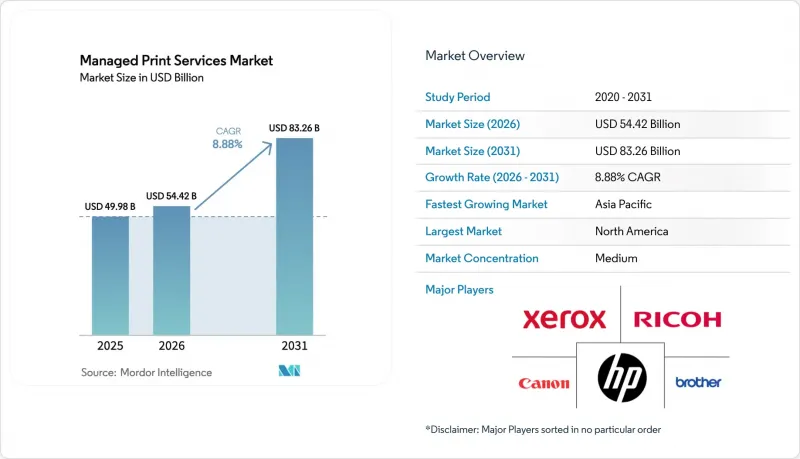
根據 Mordor Intelligence 預測,到 2026 年,託管列印服務 (MPS) 市場規模將達到 544.2 億美元,到 2031 年將達到 832.6 億美元,2026 年至 2031 年的複合年成長率為 8.88%。
本報告按通路類型(印表機/影印機製造商、其他)、服務類型(列印基礎設施評估、其他)、部署模式(本地部署、雲端部署)、組織規模(中小企業、大型企業)、最終用戶行業(銀行、金融服務和保險 (BFSI)、醫療保健、IT 和電信、其他)以及地區進行細分。市場預測以美元 (USD) 為單位。
全球託管列印服務 (MPS) 市場趨勢與洞察
最佳化遠距辦公列印基礎設施,以促進北美地區MPS(管理列印服務)的普及
混合辦公模式實現了設備分散部署,員工可以在家辦公、在共享辦公空間辦公,也可以在部分運作的總部辦公,這迫使IT部門從固定設備配置轉向按需配置。安全列印、身份驗證存取和無需VPN的作業提交已成為基本要求,這使得託管列印服務 (MPS) 市場不再只是成本中心,而是安全解決方案。全錄的虛擬列印管理服務可讓員工從任何位置提交列印作業,並在最近的已驗證裝置上接收,從而無需本機伺服器和專用VPN通道。企業現在優先考慮零信任列印架構和按需容量最佳化,因此,儘管用戶費用較高,但基本契約仍持續跑贏整體市場成長曲線。
關於永續性和碳足跡的法規正在加速歐盟企業採用MPS(管理績效標準)。
歐盟的《永續發展報告指令》要求員工人數超過250人的公司從2025年起揭露範圍3的碳排放,包括列印產生的碳排放。因此,列印設備的管理已成為合規性問題。理光公司的報告顯示,2025年,36%的辦公室服務客戶將加入碳會計模組,比前一年增加10個百分點。此外,預計到2027年,歐洲超過50%的新訂單將是與永續發展掛鉤的合約。德國、法國和北歐國家的採購指南優先考慮能夠提供頁面級碳排放數據的供應商,這實際上排除了缺乏詳細遙測數據的供應商。
由於數位轉型的推進,辦公室列印量有所下降。
隨著電子簽章、電子帳單和雲端協作取代紙本工作流程,成熟經濟體的企業在2020年至2025年間辦公室列印量預計將下降高達20%。列印量的減少正在削弱傳統合約中「按點擊付費」的收入模式,迫使供應商轉向更高價值的模組,例如工作流程自動化和合規性儀表板。在託管列印服務 (MPS) 市場,儘管對安全管理列印設備的需求日益成長,但那些仍然堅持按使用量收費的供應商將面臨利潤率下降的風險。
細分市場分析
獨立軟體供應商 (ISV) 透過銷售「雲端優先」且獨立於供應商的平台,正在蠶食傳統供應商的市場佔有率。這些平台能夠管理涵蓋惠普、佳能、全錄、理光等眾多品牌的印表機群。儘管到 2025 年,印表機和影印機製造商仍將佔據通路貢獻的最大佔有率,但 ISV 群體的年成長率比託管列印服務 (MPS) 市場的整體成長率高出 1 個百分點以上。全錄收購利盟凸顯了原始設備製造商 (OEM) 迫切需要取得軟體能力。同時,佳能正試圖透過其訂閱捆綁的「imageFORCE」套件,將中型買家納入其垂直整合的產品體系。然而,擁有異質印表機群的大型企業仍傾向於選擇能夠降低轉換成本並加速功能部署的 ISV。因此,OEM 服務附加率正在下降,經銷商與 ISV 之間的通路合作關係正在激增,以保持其市場地位。
獨立軟體供應商 (ISV) 透過快速的雲端版本發布、開放的 API 和分析功能來脫穎而出,這些功能可以對異質叢集的使用情況進行基準測試,從而促進持續改進。原始設備製造商 (OEM) 則透過內建遙測和軟硬體編配包來應對,但價格與價值之間的差距仍然存在。企業逐漸意識到,合約續約的柔軟性比供應商的同質性更為重要,這導致託管列印服務 (MPS) 市場呈現兩極分化的格局。尋求集中管治的全球性公司更傾向於獨立於供應商的編排方案,而尋求清晰明確的「一站式」管理結構和明確責任的單一品牌中型企業仍然青睞整合式 OEM 套件。隨著全球 IT負責人可以透過超大規模資料中心業者中心市場發現獨立的列印管理應用程式,預計競爭將進一步加劇。
雲端列印服務的發展速度超過了整體託管列印服務 (MPS) 市場,這主要得益於微軟通用列印 (Universal Print) 已成為事實上的企業標準。儘管託管列印服務憑藉其設備監控和故障修復支援等功能仍佔據相當大的市場佔有率,但雲端交付模式降低了本地伺服器的成本,並將引進週期從數週縮短至數小時。與通用列印的整合減輕了 IT 部門的驅動程式管理負擔,並支援遠端員工在無需 VPN 配置的情況下進行安全列印。
儘管文件工作流程最佳化目前是最小的收入來源,但它透過自動化採集、路由和歸檔,實現了結構性的成本節約。柯尼卡美能達的AI驅動型Workplace Hub減少了重複列印,並縮短了人力資源和財務文件的處理時間,這清晰地展現了從設備管理向流程轉型的轉變。整合設備分析和工作流程重新設計的供應商可以擺脫因列印頁數減少而導致的收入下降,從而保障利潤率。這在託管列印服務 (MPS) 市場中至關重要,因為該市場的複雜性日益增加,而列印頁數卻在減少。
區域分析
預計北美地區在2025年將擁有最高的營收,這得益於該地區較早採用混合辦公模式以及嚴格的網路安全法規。各公司正專注於零信任列印和進階分析,從而推動每位用戶平均營收高於全球平均。加拿大也呈現與美國類似的趨勢,而墨西哥公司則透過近岸外包的方式,對其列印設備進行現代化改造,以擴大生產規模。
同時,亞太地區是成長最快的地區,複合年成長率高達10.48%。中國、印度、日本和韓國的製造商正在整合物聯網遙測技術,以最大限度地減少停機時間,並將印表機運轉率和生產吞吐量直接關聯起來。儘管本地資料主權法律減緩了純雲端部署的普及,但由本地端分析支援的混合部署正在加速發展。印度政府的數位化措施和中國的智慧工廠激勵政策進一步刺激了需求,鞏固了該地區對託管列印服務 (MPS) 市場成長的重要貢獻。
歐洲的發展趨勢主要受碳排放計算法規的驅動。德國、法國和北歐國家的企業正將生命週期排放追蹤納入供應商評估標準,並迅速擴大包含永續發展儀錶板的合約範圍。隨著數位政府專案和企業現代化專案的推進,中東和南美市場正保持著穩定的中等個位數成長。非洲市場仍在發展中,但對於那些尋求提供低成本訂閱方案以應對基礎設施差異的供應商而言,蘊藏著豐富的機會。總體而言,這些趨勢正在使全球託管列印服務 (MPS) 供應商的收入來源多元化,並有助於外匯匯率風險。
其他好處
- Excel格式的市場預測(ME)表
- 3個月的分析師支持
目錄
第1章:引言
- 研究假設和市場定義
- 調查範圍
第2章:調查方法
第3章執行摘要
第4章 市場狀況
- 市場概覽
- 市場促進因素
- 最佳化遠距辦公列印基礎設施,以促進北美地區MPS(管理列印服務)的普及
- 關於永續性和碳足跡的法規正在加速歐盟企業採用MPS(管理績效標準)。
- 中小企業採用訂閱式「XaaS(一切皆服務)」的現狀
- 受監管領域列印設備的安全性和合規性要求
- 利用物聯網進行車隊分析,減少亞洲大型企業的停機時間
- 利用人工智慧進行預測性維護和自動補貨
- 市場限制因素
- 由於數位轉型的推進,辦公室列印量有所下降。
- 對資料主權的擔憂阻礙了基於雲端的 MPS 的普及。
- 中小企業因擔心供應商鎖定和合約複雜性而猶豫不決。
- 邊緣零信任列印架構的複雜性
- 產業價值鏈分析
- 監理展望
- 技術展望
- 波特五力分析
- 宏觀經濟因素對市場的影響
第5章 市場規模與成長預測
- 按頻道類型
- 印表機和影印機製造商
- 系統整合商和經銷商
- 獨立軟體供應商 (ISV)
- 按服務類型
- 印刷基礎設施評估
- 管理列印操作
- 設備群管理
- 最佳化文件工作流程
- 雲端列印服務
- 部署模式
- 現場
- 基於雲端的
- 按組織規模
- 中小企業
- 大公司
- 按最終用戶行業分類
- BFSI
- 衛生保健
- 資訊科技/通訊
- 政府
- 教育
- 其他終端用戶產業
- 按地區
- 北美洲
- 美國
- 加拿大
- 墨西哥
- 南美洲
- 巴西
- 阿根廷
- 其他南美國家
- 歐洲
- 德國
- 英國
- 法國
- 北歐的
- 其他歐洲國家
- 亞太地區
- 中國
- 日本
- 印度
- 韓國
- 其他亞太國家
- 中東
- 海灣合作理事會(沙烏地阿拉伯、阿拉伯聯合大公國、卡達)
- 土耳其
- 其他中東國家
- 非洲
- 南非
- 奈及利亞
- 其他非洲地區
- 北美洲
第6章 競爭情勢
- 市場集中度
- 策略趨勢
- 市佔率分析
- 公司簡介
- Xerox Corporation
- Ricoh Company, Ltd.
- HP Inc.
- Canon Inc.
- Brother Industries, Ltd.
- Lexmark International, Inc.
- Konica Minolta, Inc.
- Kyocera Document Solutions Inc.
- Sharp Corporation
- Epson(Seiko Epson Corporation)
- Toshiba Tec Corporation
- Fujifilm Business Innovation Corp.
- Dell Technologies Inc.
- EFI(Electronics For Imaging, Inc.)
- PrintFleet(ECI Software Solutions)
- PaperCut Software International
- Quadient SA
- Arc Document Solutions, Inc.
- FlexPrint Managed Print Solutions
- OKI Electric Industry Co., Ltd.
- Pitney Bowes Inc.
- Wipro Ltd.
第7章 市場機會與未來展望
According to Mordor Intelligence, the managed print services market size reached USD 54.42 billion in 2026 and is forecast to advance to USD 83.26 billion by 2031, registering an 8.88% CAGR over 2026-2031.
This report is Segmented by Channel Type (Printer/Copier Manufacturers, and More), Service Type (Print Infrastructure Assessment, and More), Deployment Mode (On-Premise, and Cloud-Based), Organization Size (Small and Medium Enterprises (SMEs), and Large Enterprises), End-User Vertical (BFSI, Healthcare, IT and Telecom, and More), and Geography. The Market Forecasts are Provided in Terms of Value (USD).
Global Managed Print Services Market Trends and Insights
Remote Work Print Infrastructure Optimisation Driving MPS Adoption In North America
Hybrid work models fragmented device footprints across homes, co-working sites, and partially occupied headquarters, forcing IT departments to swap static fleets for usage-based provisioning. Secure print release, identity-aware access, and VPN-free job submission became baseline requirements, repositioning the Managed Print Services market as a security solution rather than a cost-center. Xerox's Virtual Print Management service allows workers to send a job from any location and collect it at the nearest authenticated device, eliminating on-premise servers and bespoke VPN tunnels. Enterprises now value zero-trust print architecture and on-demand capacity rightsizing, which explains why cloud-based contracts command premium seat fees while still outpacing the overall growth curve.
Sustainability And Carbon Footprint Mandates Accelerating EU Corporate MPS
The European Union's Corporate Sustainability Reporting Directive compels companies with over 250 employees to disclose Scope 3 emissions, including those from printing, starting in 2025. Print fleet management therefore shifted into the compliance domain. Ricoh reported that 36% of its Office Services clients subscribed to carbon-accounting modules in 2025, a 10-point leap year-over-year, and expects sustainability-linked contracts to exceed 50% of new European bookings by 2027. Procurement guidelines in Germany, France, and the Nordic region now prefer providers that supply page-level emissions data, effectively sidelining vendors lacking granular telemetry.
Declining Office Print Volumes Amid Digital Transformation
Companies in mature economies cut office print usage by up to 20% between 2020 and 2025 as e-signatures, electronic invoicing, and cloud collaboration displaced paper workflows. Lower page counts erode per-click revenue models embedded in legacy contracts, forcing providers to pivot toward value-added modules such as workflow automation and compliance dashboards. Vendors that cling to volume-based billing risk margin compression even as the need for secure fleet oversight increases across the Managed Print Services market.
Other drivers and restraints analyzed in the detailed report include:
- Subscription-Based Everything-As-A-Service Adoption Among SMEs
- Print-Device Security And Compliance Requirements In Regulated Sectors
- Data Sovereignty Concerns Hindering Cloud-Based MPS
For complete list of drivers and restraints, kindly check the Table Of Contents.
Segment Analysis
Independent software vendors erode incumbent share by selling cloud-first, vendor-agnostic platforms that manage fleets spanning HP, Canon, Xerox, Ricoh, and more. Printer and copier makers still generated the largest 2025 channel contribution, but the ISV cohort is outgrowing the total Managed Print Services market by more than one percentage point annually. The Xerox-Lexmark acquisition underscored OEM urgency to acquire software muscle, while Canon's subscription-bundled imageFORCE suite tries to lock mid-market buyers into vertically integrated stacks. Still, large enterprises with heterogeneous fleets gravitate toward ISVs that reduce switching costs and accelerate feature rollouts. As a result, OEM service attach rates are slipping, and channel alliances between resellers and ISVs are proliferating to defend relevance.
ISVs differentiate through rapid cloud releases, open APIs, and analytics that benchmark utilization across mixed fleets, feeding continuous improvement loops. OEMs counter with device-embedded telemetry and hardware-software bundles, but price-to-value gaps remain. Enterprises recognize that renewal flexibility outweighs vendor homogeneity, pushing the Managed Print Services market toward a bifurcated structure. Vendor-agnostic orchestration appeals to global corporations that centralize governance, while integrated OEM suites still resonate with single-brand midsize operations seeking one-throat-to-choke accountability. Competitive intensity will deepen as hyperscaler marketplaces make independent print-management apps discoverable to IT buyers worldwide.
Cloud Print Services are expanding faster than the overall Managed Print Services market, bolstered by Microsoft Universal Print becoming the de facto enterprise standard. Managed Print Operations retain sizeable share because they encompass device monitoring and break-fix support, but cloud delivery models remove on-premise server costs and shrink deployment cycles from weeks to hours. Universal Print integration cuts driver management overhead for IT departments and unlocks secure printing for remote employees without VPN configurations.
Document workflow optimization, though the smallest current revenue pool, unlocks structural savings by automating capture, routing, and archiving. Konica Minolta's AI-enabled Workplace Hub trims redundant prints and reduces processing time for HR and finance documents, illustrating the pivot from device management to process transformation. Providers that marry fleet analytics with workflow re-engineering can decouple earnings from declining page volumes and defend margins, a critical maneuver as print counts fall yet complexity rises across the Managed Print Services market size.
Complete Report Scope:
- By Channel Type
- Printer/Copier Manufacturers
- System Integrators/Resellers
- Independent Software Vendors (ISVs)
- By Service Type
- Print Infrastructure Assessment
- Managed Print Operations
- Device and Fleet Management
- Document Workflow Optimisation
- Cloud Print Services
- By Deployment Mode
- On-Premise
- Cloud-Based
- By Organisation Size
- Small and Medium Enterprises (SMEs)
- Large Enterprises
- By End-User Vertical
- BFSI
- Healthcare
- IT and Telecom
- Government
- Education
- Other End-User Verticals
- By Geography
- North America
- United States
- Canada
- Mexico
- South America
- Brazil
- Argentina
- Rest of South America
- Europe
- Germany
- United Kingdom
- France
- Nordics
- Rest of Europe
- Asia Pacific
- China
- Japan
- India
- South Korea
- Rest of Asia Pacific
- Middle East
- GCC (Saudi Arabia, United Arab Emirates, Qatar)
- Turkey
- Rest of Middle East
- Africa
- South Africa
- Nigeria
- Rest of Africa
- North America
Geography Analysis
North America generated the largest 2025 revenue thanks to early hybrid-work adoption and stringent cybersecurity mandates. Enterprises value zero-trust prints and advanced analytics, lifting average revenue per user above the global mean. Canada mirrors U.S. patterns, while Mexican corporations modernize fleets as part of near-shoring manufacturing expansions.
Asia Pacific, however, is the fastest-growing region with a 10.48% CAGR. Chinese, Indian, Japanese, and South Korean manufacturers integrate IoT telemetry to minimize downtime, directly linking printer availability to production throughput. Local data-sovereignty laws slow pure cloud adoption but boost hybrid deployments supported by regionally hosted analytics. Government digitization agendas in India and smart-factory incentives in China further elevate demand, solidifying the region's outsized contribution to Managed Print Services market growth.
Europe's trajectory hinges on carbon-accounting regulations. German, French, and Nordic enterprises embed lifecycle emissions tracking into vendor scorecards, rapidly expanding contracts that include sustainability dashboards. The Middle East and South America log steady, mid-single-digit expansion as digital government programs and corporate modernization projects unfold. Africa remains nascent yet opportunity-rich for vendors willing to offer low-capex subscription bundles that accommodate infrastructure variability. Collectively, these dynamics diversify revenue sources and hedge currency exposure for global providers in the Managed Print Services market.
- Xerox Corporation
- Ricoh Company, Ltd.
- HP Inc.
- Canon Inc.
- Brother Industries, Ltd.
- Lexmark International, Inc.
- Konica Minolta, Inc.
- Kyocera Document Solutions Inc.
- Sharp Corporation
- Epson (Seiko Epson Corporation)
- Toshiba Tec Corporation
- Fujifilm Business Innovation Corp.
- Dell Technologies Inc.
- EFI (Electronics For Imaging, Inc.)
- PrintFleet (ECI Software Solutions)
- PaperCut Software International
- Quadient SA
- Arc Document Solutions, Inc.
- FlexPrint Managed Print Solutions
- OKI Electric Industry Co., Ltd.
- Pitney Bowes Inc.
- Wipro Ltd.
Additional Benefits:
- The market estimate (ME) sheet in Excel format
- 3 months of analyst support
TABLE OF CONTENTS
1 INTRODUCTION
- 1.1 Study Assumptions and Market Definition
- 1.2 Scope of the Study
2 RESEARCH METHODOLOGY
3 EXECUTIVE SUMMARY
4 MARKET LANDSCAPE
- 4.1 Market Overview
- 4.2 Market Drivers
- 4.2.1 Remote Work Print Infrastructure Optimization Driving MPS Adoption in North America
- 4.2.2 Sustainability and Carbon Footprint Mandates Accelerating EU Corporate MPS
- 4.2.3 Subscription-Based Everything-as-a-Service Adoption Among SMEs
- 4.2.4 Print-Device Security and Compliance Requirements in Regulated Sectors
- 4.2.5 IoT-Enabled Fleet Analytics Reducing Downtime in Large Asian Enterprises
- 4.2.6 Generative-AI-Driven Predictive Maintenance and Auto-Replenishment
- 4.3 Market Restraints
- 4.3.1 Declining Office Print Volumes Amid Digital Transformation
- 4.3.2 Data Sovereignty Concerns Hindering Cloud-Based MPS
- 4.3.3 Vendor Lock-In Perception and Contract Complexity Discouraging SMEs
- 4.3.4 Complexity of Edge Zero-Trust Print Architectures
- 4.4 Industry Value Chain Analysis
- 4.5 Regulatory Outlook
- 4.6 Technological Outlook
- 4.7 Porter's Five Forces Analysis
- 4.7.1 Bargaining Power of Buyers
- 4.7.2 Bargaining Power of Suppliers
- 4.7.3 Threat of New Entrants
- 4.7.4 Threat of Substitutes
- 4.7.5 Intensity of Competitive Rivalry
- 4.8 Impact of Macroeconomic Factors on the Market
5 MARKET SIZE AND GROWTH FORECASTS (VALUE)
- 5.1 By Channel Type
- 5.1.1 Printer/Copier Manufacturers
- 5.1.2 System Integrators/Resellers
- 5.1.3 Independent Software Vendors (ISVs)
- 5.2 By Service Type
- 5.2.1 Print Infrastructure Assessment
- 5.2.2 Managed Print Operations
- 5.2.3 Device and Fleet Management
- 5.2.4 Document Workflow Optimisation
- 5.2.5 Cloud Print Services
- 5.3 By Deployment Mode
- 5.3.1 On-Premise
- 5.3.2 Cloud-Based
- 5.4 By Organisation Size
- 5.4.1 Small and Medium Enterprises (SMEs)
- 5.4.2 Large Enterprises
- 5.5 By End-User Vertical
- 5.5.1 BFSI
- 5.5.2 Healthcare
- 5.5.3 IT and Telecom
- 5.5.4 Government
- 5.5.5 Education
- 5.5.6 Other End-User Verticals
- 5.6 By Geography
- 5.6.1 North America
- 5.6.1.1 United States
- 5.6.1.2 Canada
- 5.6.1.3 Mexico
- 5.6.2 South America
- 5.6.2.1 Brazil
- 5.6.2.2 Argentina
- 5.6.2.3 Rest of South America
- 5.6.3 Europe
- 5.6.3.1 Germany
- 5.6.3.2 United Kingdom
- 5.6.3.3 France
- 5.6.3.4 Nordics
- 5.6.3.5 Rest of Europe
- 5.6.4 Asia Pacific
- 5.6.4.1 China
- 5.6.4.2 Japan
- 5.6.4.3 India
- 5.6.4.4 South Korea
- 5.6.4.5 Rest of Asia Pacific
- 5.6.5 Middle East
- 5.6.5.1 GCC (Saudi Arabia, United Arab Emirates, Qatar)
- 5.6.5.2 Turkey
- 5.6.5.3 Rest of Middle East
- 5.6.6 Africa
- 5.6.6.1 South Africa
- 5.6.6.2 Nigeria
- 5.6.6.3 Rest of Africa
- 5.6.1 North America
6 COMPETITIVE LANDSCAPE
- 6.1 Market Concentration
- 6.2 Strategic Moves
- 6.3 Market Share Analysis
- 6.4 Company Profiles (includes Global Level Overview, Market Level Overview, Core Segments, Financials as Available, Strategic Information, Market Rank/Share for Key Companies, Products and Services, and Recent Developments)
- 6.4.1 Xerox Corporation
- 6.4.2 Ricoh Company, Ltd.
- 6.4.3 HP Inc.
- 6.4.4 Canon Inc.
- 6.4.5 Brother Industries, Ltd.
- 6.4.6 Lexmark International, Inc.
- 6.4.7 Konica Minolta, Inc.
- 6.4.8 Kyocera Document Solutions Inc.
- 6.4.9 Sharp Corporation
- 6.4.10 Epson (Seiko Epson Corporation)
- 6.4.11 Toshiba Tec Corporation
- 6.4.12 Fujifilm Business Innovation Corp.
- 6.4.13 Dell Technologies Inc.
- 6.4.14 EFI (Electronics For Imaging, Inc.)
- 6.4.15 PrintFleet (ECI Software Solutions)
- 6.4.16 PaperCut Software International
- 6.4.17 Quadient SA
- 6.4.18 Arc Document Solutions, Inc.
- 6.4.19 FlexPrint Managed Print Solutions
- 6.4.20 OKI Electric Industry Co., Ltd.
- 6.4.21 Pitney Bowes Inc.
- 6.4.22 Wipro Ltd.
7 MARKET OPPORTUNITIES AND FUTURE OUTLOOK
- 7.1 White-Space and Unmet-Need Assessment

 託管列印服務市場:2026-2032年全球市場預測(按服務類型、合約期限、定價模式、通路類型和最終用戶行業分類)
 託管列印服務市場:按服務類型、組織規模、應用程式和地區分類
 2026年全球列印管理軟體市場報告
 託管列印服務市場報告:按類型、部署模式、組織規模、行業和地區分類(2026-2034 年)2026年全球託管列印服務市場報告
 全球託管列印服務市場:市場規模、佔有率和趨勢分析(按部署方式、企業規模、通路、最終用途和地區分類),細分市場預測(2026-2033 年)
 託管列印服務市場 - 全球產業規模、佔有率、趨勢、機會和預測:按部署模式、類型、組織規模、通路類型、最終用戶產業、地區和競爭格局預測,2021-2031 年印表機監控軟體市場按產品類型、設備類型、定價模式、部署類型、應用和分銷管道分類,全球預測(2026-2032年)日本託管列印服務市場報告:按類型、部署類型、組織規模、產業和地區分類(2026-2034 年)
 列印管理軟體市場規模、佔有率、成長及全球產業分析:依類型、應用和地區劃分的洞察與預測(2024-2032 年)