


 |
市場調查報告書
商品編碼
2122986
資料中心浸沒式冷卻:市場佔有率分析、產業趨勢與統計、成長預測(2026-2031)Data Center Immersion Cooling - Market Share Analysis, Industry Trends & Statistics, Growth Forecasts (2026 - 2031) |
||||||

※ 本網頁內容可能與最新版本有所差異。詳細情況請與我們聯繫。
據 Mordor Intelligence 稱,資料中心浸沒式冷卻市場預計在 2026 年達到 57.2 億美元,預計在預測期(2026-2031 年)內將以 18.44% 的複合年成長率成長,到 2031 年達到 133.3 億美元。
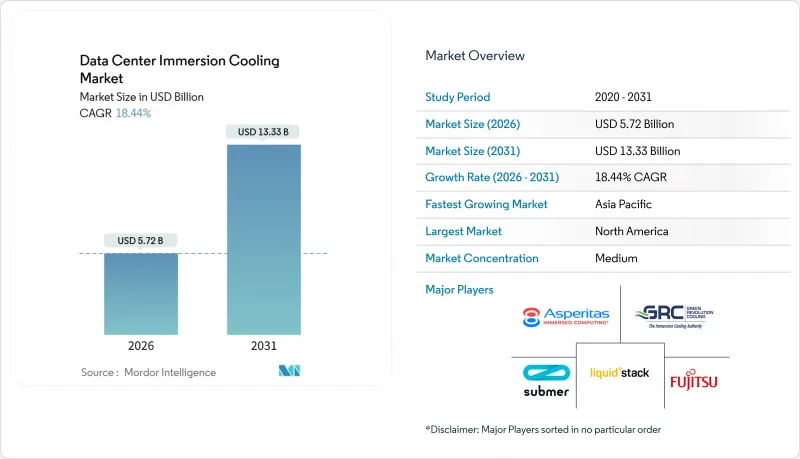
本報告按類型(單相浸沒式冷卻系統、兩相浸沒式冷卻系統)、冷卻劑類型(礦物油、其他)、應用領域(高效能運算、其他)、等級(Tier 1 和 Tier 2、其他)、資料中心規模(小規模資料中心、其他)、資料中心類型(可利用資料中心、其他)和區域進行細分。市場預測以美元計價。
全球資料中心浸沒式冷卻市場趨勢與洞察
超大規模資料中心的激增
各公司正將運算資源整合到千兆瓦級園區,這些園區不僅能提供大規模可再生能源接入,還能攤提巨額資本項目。 Meta公司計畫在2025年營運21個這樣的園區,每個園區的平均裝置容量超過100兆瓦。該公司提交的文件顯示,每層樓伺服器密度的提高得益於浸沒式冷卻技術。微軟的目標是到2025年將其基礎設施中15%的採用液冷技術,到2028年達到40%,並稱這是在溫帶地區將電源使用效率(PUE)保持在1.15以下的有效途徑。谷歌已開始維修八個現有機房,以容納單晶片功耗超過350瓦的張量處理單元(TPU)叢集。雖然每個專案的建造成本將超過5億美元,但採用浸沒式冷卻技術將降低每個運算單元的土地、機械和風扇能耗。
由於人工智慧和機器學習工作負載,每個機架的功率密度增加
目前,訓練大規模語言模型需要使用功耗為 80-120 千瓦的機架。 NVIDIA 的 H100 單機功耗高達 700 瓦,因此,一個 42U 機櫃中八台雙 GPU 伺服器的功耗將超過 100 千瓦。 Intel 的 Gaudi 3 加速器功耗為 600 瓦,對於超過 1000 個晶片的客戶叢集,為了避免擴展冷卻迴路,通常採用浸沒式冷卻。 AMD 的 MI300X 功耗高達 750 瓦,但總體擁有成本 (TCO) 估算表明,機架密度超過 60 千瓦後,五年內可降低 20-30% 的成本。雖然空氣的熱容量低,無法經濟高效地轉移如此大的負載,但液體的導熱係數是空氣的 25 倍,這使得在保持性能裕度的同時,可以推遲設施擴容。
較大的初始資本支出(CAPEX)和設施改造成本
浸沒式水箱、歧管管路和結構加固意味著承包成本在250萬美元到350萬美元之間,大約是空冷系統的兩倍。現有設施的維修項目由於需要加固地板、升級到K級消防系統以及員工再培訓,成本會增加15%到25%。投資回收期為4到6年,前提是當地電價不超過每千瓦時0.10美元,且未簽訂任何購熱協議。由於利潤率低的託管業者不願採用,而小規模企業又缺乏資金,因此該技術的普及速度較為緩慢。
細分市場分析
預計2026年至2031年間,兩相架構將以19.42%的複合年成長率成長,超過資料中心浸沒式冷卻市場的整體成長速度。截至2025年,單相系統仍佔據資料中心浸沒式冷卻市場62.43%的佔有率,這主要得益於其與通用伺服器的兼容性以及對冷卻液性能的極低要求。 LiquidStack通報了一家歐洲人工智慧實驗室利用潛熱完全取消了水泵,從而降低了40%的輔助負載。雖然單相系統仍然是加密貨幣和通用高效能運算工作負載的首選,但對於目標功率為100千瓦的機架營運商而言,兩相系統作為實現大規模被動散熱的唯一途徑,正日益受到關注。
無泵運轉降低了整體能耗,重力驅動的冷凝水循環簡化了維護。然而,對氫氟醚流體的依賴導致成本居高不下,並使買家面臨 PFAS 法規的風險。製造商正在加快合成烴和低全球暖化潛勢 (GWP) 化學品的認證,預計在預測期內,兩相系統的價格溢價將會下降。互通性的努力也可能使在同一廠房內引入混合相成為可能,這將使營運商能夠使用各種溫度控管工具。
預計到2025年,礦物油將佔總使用量的48.65%,這主要得益於其每公升3-5美元的價格以及成熟的供應鏈。然而,隨著歐洲和北美營運商向脫碳轉型,生物基冷卻劑預計將以19.56%的複合年成長率成長。嘉吉的酯類冷卻液導熱係數為0.17 W·m·K(相當於礦物油的85%),同時滿足ISO 14001和範圍3的計算要求。氟基冷卻劑仍然適用於兩相循環,並保持22%的市場佔有率,但3M的退出和科慕的配方變更凸顯了其供應和合規方面的風險。
殼牌的合成烴產品兼具0.16 W·m·K的熱導率和265 度C的閃點,無需大規模滅火系統。雖然去離子水並非完全浸沒介質,但它已在超大規模資料中心業者的直接進水循環應用中佔據了8%的市場佔有率。展望未來,流體選擇將受到當地法規、廢熱利用目標和保險公司偏好的影響,業者可能會透過多元化其化學品組合來規避風險。
區域分析
北美地區在2025年仍維持40.32%的市場佔有率,這主要得益於超大規模資料中心公司在維吉尼亞、奧勒岡州和德克薩斯州的投資。微軟宣布,2028年將在美國投資100億美元建造液冷系統,理由是美國溫暖的氣候允許在乾燥側直接使用空氣冷卻。 Meta公司位於普賴恩維爾的園區運作15,000台浸沒式伺服器,實現了世界一流的電源使用效率(PUE)1.06。加拿大佔該地區總電力容量的8%,這主要得益于魁北克省和不列顛哥倫比亞省的水力發電;而墨西哥則佔4%,這主要來自近岸製造地的需求。
受中國政府主導的人工智慧計畫和印度20億美元激勵計畫的推動,亞太地區預計到2031年將以19.94%的複合年成長率成長。阿里巴巴和騰訊已分別在杭州和深圳經營沉浸式資料中心,並聲稱冷卻能耗降低了30%以上。在日本「綠色轉型」計畫的補貼支持下,預計到2025年,日本將佔該地區收入的18%。其餘佔有率將由韓國、澳洲和紐西蘭瓜分,這三個國家都將致力於為國內需求提供低延遲服務。
到2025年,歐洲將佔全球整體的28%,主要得益於能源效率要求和熱回收獎勵。德國津貼5億歐元用於區域供熱,為法蘭克福和慕尼黑的營運商提供支援;荷蘭則充分利用了阿姆斯特丹附近的可再生能源網路。英國在倫敦碼頭區和曼徹斯特增建了液冷設施,以滿足1.3的電力使用效率(PUE)標準。中東地區的建設僅佔全球總裝置容量的6%,但凸顯了浸沒式冷卻技術在溫度高達45攝氏度的沙漠地區的熱能優勢,例如阿布達比計劃於2026年底竣工的150兆瓦項目。南美洲佔3%,其中巴西金融業扮演主導角色。而非洲的佔比僅2%,電網穩定性是其面臨的一大挑戰。
其他好處
- Excel格式的市場預測(ME)表
- 3個月的分析師支持
目錄
第1章:引言
- 研究假設和市場定義
- 調查範圍
第2章:調查方法
第3章執行摘要
第4章 市場狀況
- 市場概覽
- 市場促進因素
- 超大規模資料中心的激增
- 由於人工智慧和機器學習工作負載,每個機架的功率密度增加
- 與空氣冷卻系統相比,具有更高的能源效率和更高的PUE值。
- 推動制定不含 PFAS 的生物基冷卻劑法規
- 區域供熱網路中廢熱的有效利用
- 利用人工智慧探索下一代介電流體
- 市場限制因素
- 較大的初始資本支出(CAPEX)和設施改造成本
- 標準碎片化和供應商之間的互通性差距
- 含氟介電材料的供應鏈風險
- 關於流體和硬體的長期相容性,現場數據有限。
- 工業供應鏈分析
- 監理情勢
- 技術展望
- 資料中心冷卻技術的演變
- 功耗和計算密度指標
- 流體動力學、處理器、GPU、機架和基礎設施故障分析
- 波特五力分析
- 對影響市場的宏觀經濟因素進行評估
第5章 市場規模與成長預測
- 按類型
- 單相浸沒式冷卻系統
- 兩相浸沒式冷卻系統
- 透過冷卻劑
- 礦物油
- 去離子水
- 含氟冷卻劑
- 合成烴冷卻劑
- 生物衍生冷卻劑
- 透過使用
- 高效能運算(HPC)
- 邊緣運算
- 人工智慧和機器學習
- 雲端和超大規模應用
- 加密貨幣挖礦
- 其他
- 層級類型
- 一級和二級
- 三級
- 第四級
- 按資料中心規模
- 小規模資料中心
- 中型資料中心
- 大型資料中心
- 超大規模資料中心
- 依資料中心類型
- 託管資料中心
- 超大規模資料中心業者/CSP資料中心
- 企業邊緣資料中心
- 按地區
- 北美洲
- 美國
- 加拿大
- 墨西哥
- 南美洲
- 巴西
- 阿根廷
- 其他南美國家
- 歐洲
- 德國
- 英國
- 法國
- 荷蘭
- 其他歐洲國家
- 亞太地區
- 中國
- 日本
- 印度
- 韓國
- 澳洲和紐西蘭
- 其他亞太國家
- 中東和非洲
- 中東
- 阿拉伯聯合大公國
- 沙烏地阿拉伯
- 土耳其
- 其他中東國家
- 非洲
- 南非
- 埃及
- 奈及利亞
- 其他非洲地區
- 中東
- 北美洲
第6章 競爭情勢
- 市場集中度
- 策略趨勢
- 市佔率分析
- 公司簡介
- Fujitsu Limited
- Green Revolution Cooling(GRC)Inc.
- Submer Technologies SL
- LiquidStack Inc.
- Asperitas
- LiquidCool Solutions
- Midas Green Technologies
- Iceotope Technologies Ltd.
- Wiwynn Corporation
- DCX Ltd.
- Dell Technologies
- Intel Corporation
- Schneider Electric SE
- Vertiv Holdings Co.
- NVIDIA Corporation
- Asetek A/S
- Shell plc(Immersion Cooling Fluids)
- Cargill Inc.(NatureCool)
- 3M Company
- Chemours Company
- Molex LLC
- Hypertec Group
- Alibaba Cloud
- Tencent Cloud
第7章 市場機會與未來展望
According to Mordor Intelligence, the data center immersion cooling market size is estimated at USD 5.72 billion in 2026, and is expected to reach USD 13.33 billion by 2031, at a CAGR of 18.44% during the forecast period (2026-2031).
This report is Segmented by Type (Single-Phase Immersion Cooling System, and Two-Phase Immersion Cooling System), Cooling Fluid (Mineral Oil, and More), Application (HPC and More), Tier Type (Tier 1 and 2, and More), Data Center Size (Small Data Center, and More), Data Center Type (Colocation Data Center, and More), and Geography. Market Forecasts are Provided in Terms of Value (USD).
Global Data Center Immersion Cooling Market Trends and Insights
Proliferation of Hyperscale Data Centers
Operators are consolidating compute into gigawatt-class campuses that can negotiate renewable power at scale and amortize large capital projects. Meta ran 21 such sites in 2025 averaging more than 100 megawatts each, and its filings credit immersion cooling for raising server density per floor tile. Microsoft lifted liquid penetration to 15% of its fleet during 2025 and targets 40% by 2028, citing a route to sub-1.15 power usage effectiveness in temperate zones. Google began retrofitting eight legacy halls to house Tensor Processing Unit clusters that top 350 watts per chip. With each build exceeding USD 500 million, shifting to immersion lowers land, mechanical, and fan energy per compute unit.
Rising Rack Power Densities From AI and ML Workloads
Large language model training now fills racks that draw 80-120 kilowatts. NVIDIA's H100 hits 700 watts per device, so eight dual-GPU servers inside a 42U cabinet breach 100 kilowatts. Intel's Gaudi 3 accelerator checks in at 600 watts, and customer clusters above 1,000 chips specify immersion to avoid expanding chilled-water loops. AMD's MI300X peaks at 750 watts, with total cost of ownership modeling showing 20%-30% savings over five years once rack densities cross 60 kilowatts. Air's low heat capacity cannot cost-effectively move that load, whereas liquid's 25-times-higher thermal conductivity preserves performance margins and delays building expansions.
High Upfront CAPEX and Facility-Redesign Costs
Immersion tanks, manifold plumbing, and structural reinforcements push turnkey expense for a 1 megawatt block to USD 2.5-3.5 million, roughly double air cooling levels. Retrofit projects add 15%-25% due to floor strengthening, Class K suppression upgrades, and staff retraining. Payback stretches four to six years unless local power prices exceed USD 0.10 per kilowatt-hour or heat-offtake deals materialize. Colocation operators running thin margins hesitate, while smaller enterprises lack balance-sheet capacity, slowing broad uptake.
Other drivers and restraints analyzed in the detailed report include:
- Superior Energy-Efficiency and PUE Gains Over Air Cooling
- Regulatory Push Toward PFAS-Free Bio-Based Coolants
- Fragmented Standards and Vendor Interoperability Gaps
For complete list of drivers and restraints, kindly check the Table Of Contents.
Segment Analysis
Two-phase architectures will outgrow the wider data center immersion cooling market at 19.42% CAGR between 2026 and 2031. In 2025 single-phase systems still commanded a 62.43% data center immersion cooling market share thanks to compatibility with commodity servers and minimal fluid volatility. LiquidStack documented a European AI lab that removed pumps altogether by exploiting latent heat, cutting auxiliary loads 40%. Single-phase remains preferred for cryptocurrency and general HPC workloads, yet operators chasing 100 kilowatt racks view two-phase as the only route to passive rejection at scale.
Pumpless operation lowers total energy draw, and gravity-fed condensate return simplifies maintenance. However, reliance on hydrofluoroether fluids keeps costs high and exposes buyers to PFAS restrictions. Manufacturers are racing to qualify synthetic hydrocarbon and low-GWP chemistries, suggesting the two-phase premium will narrow over the forecast horizon. Interoperability efforts may also make mixed-phase deployments practical inside a single hall, giving operators a menu of thermal tools.
Mineral oil supplied 48.65% of liters in 2025 because of USD 3-5 per liter pricing and mature supply chains. Yet bio-based options are set for a 19.56% CAGR as operators in Europe and North America look to decarbonize. Cargill's ester delivers 0.17 W-m-K conductivity, 85% of oil levels, but satisfies ISO 14001 and Scope 3 accounting. Fluorocarbon fluids still enable two-phase cycles and held 22% share, though 3M's exit and Chemours' reformulation underscore supply and compliance risk.
Shell's synthetic hydrocarbon variant blended 0.16 W-m-K performance with a 265 °C flash point, removing the need for extensive fire suppression. De-ionized water, while not a full-immersion medium, earned 8% share inside direct-to-chip loops at hyperscalers. Going forward, fluid choice will hinge on local regulation, waste-heat goals, and insurer preferences, with operators likely to diversify chemistry portfolios to hedge risk.
Complete Report Scope:
- By Type
- Single-Phase Immersion Cooling System
- Two-Phase Immersion Cooling System
- By Cooling Fluid
- Mineral Oil
- De-Ionized Water
- Fluorocarbon-Based Fluids
- Synthetic Hydrocarbon Fluids
- Bio-Based Fluids
- By Application
- High-Performance Computing (HPC)
- Edge Computing
- Artificial Intelligence and Machine Learning
- Cloud and Hyperscale Applications
- Cryptocurrency Mining
- Other Applications
- By Tier Type
- Tier 1 and 2
- Tier 3
- Tier 4
- By Data Center Size
- Small Data Center
- Medium Data Center
- Large Data Center
- Hyperscale Data Center
- By Data Center Type
- Colocation Data Center
- Hyperscalers Data Center/CSPs
- Enterprise and Edge Data Center
- By Geography
- North America
- United States
- Canada
- Mexico
- South America
- Brazil
- Argentina
- Rest of South America
- Europe
- Germany
- United Kingdom
- France
- Netherlands
- Rest of Europe
- Asia-Pacific
- China
- Japan
- India
- South Korea
- Australia and New Zealand
- Rest of Asia-Pacific
- Middle East and Africa
- Middle East
- United Arab Emirates
- Saudi Arabia
- Turkey
- Rest of Middle East
- Africa
- South Africa
- Egypt
- Nigeria
- Rest of Africa
- Middle East
- North America
Geography Analysis
North America retained a 40.32% share in 2025 on the strength of hyperscale spend in Virginia, Oregon, and Texas. Microsoft earmarked USD 10 billion for U.S. liquid builds through 2028, citing temperate climates that allow direct air economization on the dry side. Meta's Prineville campus operated 15 000 submerged servers and posted a 1.06 annual power usage effectiveness, among the best globally. Canada gathered 8% of regional megawatts thanks to hydroelectric power in Quebec and British Columbia, while Mexico captured 4% serving nearshore manufacturing nodes.
Asia-Pacific is projected to grow at a 19.94% CAGR to 2031, led by China's sovereign AI push and India's incentive scheme worth USD 2 billion. Alibaba and Tencent already run immersion halls in Hangzhou and Shenzhen, each claiming cooling energy cuts above 30%. Japan contributed 18% of regional revenue in 2025, supported by subsidies under the Green Transformation program. South Korea, Australia, and New Zealand share the remainder, each targeting low-latency service for local consumption.
Europe controlled 28% of the global tally in 2025, propelled by efficiency mandates and heat-recovery incentives. Germany's EUR 500 million grant package for district heating tapped operators in Frankfurt and Munich, while the Netherlands leveraged renewable grids near Amsterdam. The United Kingdom added liquid rooms in London Docklands and Manchester to meet a 1.3 power usage effectiveness threshold. Middle East builds, though only 6% of world capacity, highlight immersion's thermal edge in 45 °C deserts, exemplified by a 150 megawatt Abu Dhabi project set to complete in late 2026. South America sits at 3%, dominated by Brazil's finance sector, and Africa at 2%, held back by grid stability.
- Fujitsu Limited
- Green Revolution Cooling (GRC) Inc.
- Submer Technologies SL
- LiquidStack Inc.
- Asperitas
- LiquidCool Solutions
- Midas Green Technologies
- Iceotope Technologies Ltd.
- Wiwynn Corporation
- DCX Ltd.
- Dell Technologies
- Intel Corporation
- Schneider Electric SE
- Vertiv Holdings Co.
- NVIDIA Corporation
- Asetek A/S
- Shell plc (Immersion Cooling Fluids)
- Cargill Inc. (NatureCool)
- 3M Company
- Chemours Company
- Molex LLC
- Hypertec Group
- Alibaba Cloud
- Tencent Cloud
Additional Benefits:
- The market estimate (ME) sheet in Excel format
- 3 months of analyst support
TABLE OF CONTENTS
1 INTRODUCTION
- 1.1 Study Assumptions and Market Definition
- 1.2 Scope of the Study
2 RESEARCH METHODOLOGY
3 EXECUTIVE SUMMARY
4 MARKET LANDSCAPE
- 4.1 Market Overview
- 4.2 Market Drivers
- 4.2.1 Proliferation of Hyperscale Data Centers
- 4.2.2 Rising Rack-Power Densities from AI and ML Workloads
- 4.2.3 Superior Energy-Efficiency and PUE Gains over Air Cooling
- 4.2.4 Regulatory Push toward PFAS-Free, Bio-Based Coolants
- 4.2.5 Monetization of Waste-Heat for District Heating Networks
- 4.2.6 AI-Assisted Discovery of Next-Generation Dielectric Fluids
- 4.3 Market Restraints
- 4.3.1 High Upfront CAPEX and Facility-Redesign Costs
- 4.3.2 Fragmented Standards and Vendor Interoperability Gaps
- 4.3.3 Supply-Chain Risk for Fluorinated Dielectrics
- 4.3.4 Limited Field Data on Long-Term Fluid-Hardware Compatibility
- 4.4 Industry Supply-Chain Analysis
- 4.5 Regulatory Landscape
- 4.6 Technological Outlook
- 4.6.1 Evolution of Data-Center Cooling
- 4.6.2 Energy-Consumption and Compute-Density Metrics
- 4.6.3 Teardown of Fluids, Processors, GPUs, Racks and Infrastructure
- 4.7 Porter's Five Forces Analysis
- 4.7.1 Bargaining Power of Suppliers
- 4.7.2 Bargaining Power of Buyers
- 4.7.3 Threat of New Entrants
- 4.7.4 Degree of Competition
- 4.7.5 Threat of Substitutes
- 4.8 Assesment of Macroeconomic Factors on the Market
5 MARKET SIZE AND GROWTH FORECASTS (VALUE)
- 5.1 By Type
- 5.1.1 Single-Phase Immersion Cooling System
- 5.1.2 Two-Phase Immersion Cooling System
- 5.2 By Cooling Fluid
- 5.2.1 Mineral Oil
- 5.2.2 De-Ionized Water
- 5.2.3 Fluorocarbon-Based Fluids
- 5.2.4 Synthetic Hydrocarbon Fluids
- 5.2.5 Bio-Based Fluids
- 5.3 By Application
- 5.3.1 High-Performance Computing (HPC)
- 5.3.2 Edge Computing
- 5.3.3 Artificial Intelligence and Machine Learning
- 5.3.4 Cloud and Hyperscale Applications
- 5.3.5 Cryptocurrency Mining
- 5.3.6 Other Applications
- 5.4 By Tier Type
- 5.4.1 Tier 1 and 2
- 5.4.2 Tier 3
- 5.4.3 Tier 4
- 5.5 By Data Center Size
- 5.5.1 Small Data Center
- 5.5.2 Medium Data Center
- 5.5.3 Large Data Center
- 5.5.4 Hyperscale Data Center
- 5.6 By Data Center Type
- 5.6.1 Colocation Data Center
- 5.6.2 Hyperscalers Data Center/CSPs
- 5.6.3 Enterprise and Edge Data Center
- 5.7 By Geography
- 5.7.1 North America
- 5.7.1.1 United States
- 5.7.1.2 Canada
- 5.7.1.3 Mexico
- 5.7.2 South America
- 5.7.2.1 Brazil
- 5.7.2.2 Argentina
- 5.7.2.3 Rest of South America
- 5.7.3 Europe
- 5.7.3.1 Germany
- 5.7.3.2 United Kingdom
- 5.7.3.3 France
- 5.7.3.4 Netherlands
- 5.7.3.5 Rest of Europe
- 5.7.4 Asia-Pacific
- 5.7.4.1 China
- 5.7.4.2 Japan
- 5.7.4.3 India
- 5.7.4.4 South Korea
- 5.7.4.5 Australia and New Zealand
- 5.7.4.6 Rest of Asia-Pacific
- 5.7.5 Middle East and Africa
- 5.7.5.1 Middle East
- 5.7.5.1.1 United Arab Emirates
- 5.7.5.1.2 Saudi Arabia
- 5.7.5.1.3 Turkey
- 5.7.5.1.4 Rest of Middle East
- 5.7.5.2 Africa
- 5.7.5.2.1 South Africa
- 5.7.5.2.2 Egypt
- 5.7.5.2.3 Nigeria
- 5.7.5.2.4 Rest of Africa
- 5.7.5.1 Middle East
- 5.7.1 North America
6 COMPETITIVE LANDSCAPE
- 6.1 Market Concentration
- 6.2 Strategic Moves
- 6.3 Market Share Analysis
- 6.4 Company Profiles (includes Global Level Overview, Market Level Overview, Core Segments, Financials as available, Strategic Information, Market Rank/Share, Products and Services, Recent Developments)
- 6.4.1 Fujitsu Limited
- 6.4.2 Green Revolution Cooling (GRC) Inc.
- 6.4.3 Submer Technologies SL
- 6.4.4 LiquidStack Inc.
- 6.4.5 Asperitas
- 6.4.6 LiquidCool Solutions
- 6.4.7 Midas Green Technologies
- 6.4.8 Iceotope Technologies Ltd.
- 6.4.9 Wiwynn Corporation
- 6.4.10 DCX Ltd.
- 6.4.11 Dell Technologies
- 6.4.12 Intel Corporation
- 6.4.13 Schneider Electric SE
- 6.4.14 Vertiv Holdings Co.
- 6.4.15 NVIDIA Corporation
- 6.4.16 Asetek A/S
- 6.4.17 Shell plc (Immersion Cooling Fluids)
- 6.4.18 Cargill Inc. (NatureCool)
- 6.4.19 3M Company
- 6.4.20 Chemours Company
- 6.4.21 Molex LLC
- 6.4.22 Hypertec Group
- 6.4.23 Alibaba Cloud
- 6.4.24 Tencent Cloud
7 MARKET OPPORTUNITIES AND FUTURE OUTLOOK
- 7.1 White-Space and Unmet-Need Assessment

 資料中心浸沒式冷卻市場預測至2034年-全球分析(按冷卻方式、系統組件、冷卻劑類型、資料中心類型、機架密度、應用、最終用戶和地區分類)
 非洲資料中心浸沒式冷卻液:市場佔有率分析、產業趨勢與統計及成長預測(2026-2031 年)
 全球兩相浸沒式冷卻液市場(按流體類型、系統類型、流動技術、應用和最終用戶產業分類)預測(2026-2032年)泵送式兩相冷凍系統市場(按最終用戶、應用、泵類型、蒸發器設計、分銷管道和冷媒類型分類),全球預測,2026-2032年
 資料中心浸沒式冷卻市場:成長機會、成長要素、產業趨勢分析及2026-2035年預測資料中心氟化冷卻劑市場:依流體組成、相態、冷卻方式、部署配置和應用分類-全球預測,2026-2032年資料中心綠色冷卻劑市場:按冷卻劑類型、資料中心規模、部署模式、最終用戶產業和銷售管道,全球預測,2026-2032年
 全球兩相資料中心浸沒式冷卻市場:市場規模、佔有率、成長率、產業分析、依類型、應用和地區劃分的分析以及未來預測(2026-2034)