


 |
市場調查報告書
商品編碼
2122972
膠帶:市場佔有率分析、產業趨勢與統計、成長預測(2026-2031)Adhesive Tapes - Market Share Analysis, Industry Trends & Statistics, Growth Forecasts (2026 - 2031) |
||||||

※ 本網頁內容可能與最新版本有所差異。詳細情況請與我們聯繫。
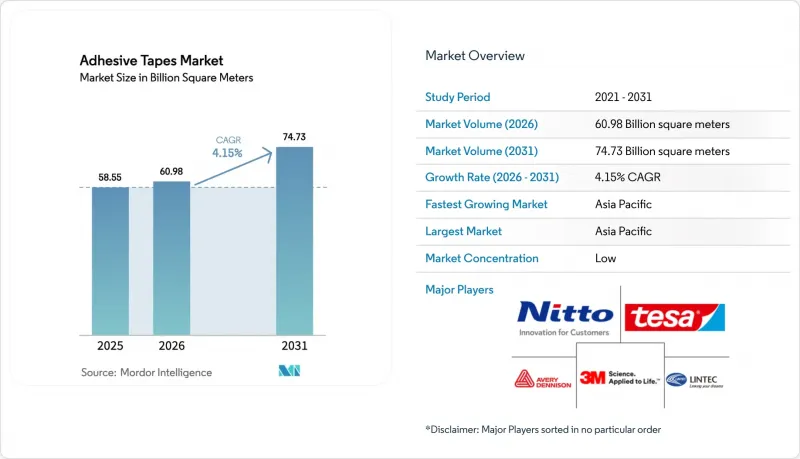
根據 Mordor Intelligence 預測,膠帶市場規模預計將從 2025 年的 585.5 億平方公尺擴大到 2026 年的 609.8 億平方公尺,並將從 2026 年到 2031 年以 4.15% 的複合年成長率成長,到 2031 年達到 747.3 億平方公尺。
本報告依樹脂類型(壓克力、橡膠基樹脂、矽樹脂、環氧樹脂、聚氨酯樹脂)、製程(水性、溶劑型、熱熔膠、反應型)、產品類型(感壓膠帶、水活化膠帶、導熱膠帶、特種膠帶)、終端應用(包裝、汽車、其他地區)和地區(亞太地區)進行細分(亞太地區、其他地區(亞太)區進行細分(亞太地區)。市場預測以平方公尺為單位。
全球膠帶市場趨勢及洞察
電子商務包裝材料需求的激增帶動了對膠帶的需求成長。
到2025年,像亞馬遜這樣的履約巨頭消耗的壓敏包裝膠帶數量將遠遠超過傳統零售分銷商。隨著加工商降低最低訂購量,品牌預印卷膠帶的銷售量實現了強勁的同比成長,這使得即使是小規模經銷商也能在單封裝中同時使用防篡改和行銷功能。法規也在影響材料的選擇。例如,歐盟的包裝廢棄物法規建議使用水活化牛皮紙膠帶,這種膠帶不太可能污染紡織品回收流程。同時,在印度和東南亞等潮濕的物流中心,人們正轉向使用合成橡膠製成的熱熔膠帶。這些膠帶即使在相對濕度超過80%的環境中也能保持黏性,確保瓦楞紙板的密封牢固,且不會發生黏合劑滲漏。這些趨勢共同作用,不僅提高了瓦楞紙板封條膠帶在每個運輸小包裹中的滲透率,也推動了膠帶市場的長期成長。
OEM廠商過渡到使用輕量化線束膠帶
汽車製造商正擴大採用丙烯酸布基膠帶,這種膠帶比傳統的PVC電氣纏繞膠帶更輕,同時介電強度卻與之相當。這種轉變降低了每輛車的重量,從而顯著節省了成本。這些成本節省對於遵守歐盟車隊法規以及避免因二氧化碳排放超標而受到處罰至關重要。特斯拉Model Y就清晰地展現了這一趨勢,其線束中就採用了這種新型膠帶。 2025年,日本供應商推出了無鹵阻燃聚酯膠帶,這種膠帶不僅符合嚴格的ISO 6722 D級耐磨標準,也確保符合回收法規。同樣在2025年,中國推出了新能源汽車,要求每輛車都必須配備線束膠帶。這種需求的激增源自於電池平台需要容納比內燃機汽車更多的電纜。汽車產業對輕量化和安全性的關注正在推動汽車線束膠帶市場的成長。
石油衍生原料價格波動
2024年至2025年間,丙烯酸現貨價格波動劇烈,導致加工商利潤率承壓。丁二烯價格受裂解裝置維護造成的供應限制影響。漢高2025年報告指出,原物料價格上漲推高了成本。然而,減少丙烯酸聚合物的使用量在一定程度上緩解了這種影響。由於原物料價格波動和未能實施避險措施,小規模加工商退出通用膠帶市場,凸顯了膠帶市場短期業務擴張所面臨的挑戰。
細分市場分析
儘管丙烯酸類膠帶在2025年仍佔據41.12%的市場佔有率,但橡膠基化學品預計將在2026年至2031年間以4.29%的複合年成長率成長,成為樹脂類產品中成長最快的。天然橡膠和苯乙烯-丁二烯橡膠是高速物流的關鍵材料,即使在多塵表面也能提供即時黏合力。矽樹脂雖然產量低於丙烯酸類和橡膠類產品,但在醫療和高溫應用領域,其透明度和生物相容性比成本更為重要,因此備受青睞。環氧樹脂結構膠帶也日益受到關注,這個小眾市場以其高剪切強度而聞名,使其成為航太航太和風力渦輪機葉片的理想選擇。生物基妥爾油和大豆基化學品目前面臨成本溢價的阻礙,但先導計畫結果表明,它們有望在未來幾年逐步進入市場。
丙烯酸類化合物憑藉其紫外線穩定性和低揮發性,在豪華汽車和電子產品領域保持領先地位,鞏固了其在膠帶市場的重要佔有率。在價格敏感型領域,橡膠基化合物因其能夠承受不規則形狀的瓦楞紙箱和多塵的工作環境而備受青睞。雖然矽膠已獲得ISO 10993-10標準認證,可與皮膚接觸30天,從而拓展了其在醫療領域的應用,但反應型聚氨酯熱熔膠在軟性包裝領域兼具易加工性和結構強度。總而言之,即使在商品價格持續波動的情況下,樹脂的多樣化仍然支撐著價值的穩定創造。
預計到2025年,水性技術將佔市場佔有率的45.19%,並以4.51%的最高複合年成長率成長,這反映了日益嚴格的VOC法規以及品牌對永續性的承諾。現代丙烯酸乳液在用量較小的情況下即可達到與溶劑型產品相當的剝離強度和剪切強度,這使得加工商能夠關閉溶劑型乾燥箱並降低能耗。由於其瞬時黏合特性,熱熔系統在超高速包裝生產線中更受歡迎。考慮到能源成本,這些體系已被證明比水性體系更經濟。同時,溶劑型技術在汽車和航太領域仍然佔據主導地位。在這些領域,乾燥速度和對低表面能材料的黏合性是關鍵考慮因素,其重要性甚至超過了法規方面的挑戰。
反應型平台(紫外光固化丙烯酸酯和濕固化聚氨酯)市場佔有率雖小,但在電子和醫療設備領域佔據較高的價格區間。結合水性載體和紫外光交聯劑的混合產品正在興起,有望透過單組分工藝實現所需的結構性能。隨著這些細分市場的融合,預計在預測期內,與水性和熱熔產品相關的膠帶市場規模將以最快的速度成長。
區域分析
預計到2025年,亞太地區將佔全球市場佔有率的58.91%,年複合成長率達5.15%,成長率超過其他任何地區。在中國這個關鍵市場,強勁的需求推動了市場成長,這主要得益於廣東、江蘇和浙江三省,這三省擁有重要的電子產業叢集和汽車產業中心。同時,印度市場也實現了強勁成長,這得益於汽車產量的大幅成長和電子商務產業的快速發展,其中瓦楞紙板封口膠帶的使用量激增。
日本持續引領光學和半導體膠帶市場,向整個東亞地區出口高品質膠帶。在韓國,與三星和LG顯示器製造工廠密切相關的需求仍然佔據特種膠帶市場相當大的佔有率。東協,特別是越南、泰國和馬來西亞,由於外商直接投資將組裝從中國轉移至這些地區,全年成長強勁,鞏固了該地區在膠帶市場的主導地位。
北美傳統包裝市場趨於成熟,但得益於電動車產量增加和小包裹物流的激增,預計到2025年將佔據全球消費的相當大佔有率。歐洲在遵守回收法規方面取得了進展,單層複合材料的背襯膠帶也從聚丙烯(PP)轉向牛皮紙替代品。在南美方面,巴西強勁的汽車產業推動了需求,但阿根廷貨幣問題導致的進口限制制約了其發展。中東和非洲在中期內保持了穩定的成長率,受益於沙烏地阿拉伯和阿拉伯聯合大公國的大型企劃以及南非的汽車生產。
其他好處
- Excel格式的市場預測(ME)表
- 3個月的分析師支持
目錄
第1章:引言
- 研究假設和市場定義
- 調查範圍
第2章:調查方法
第3章執行摘要
第4章 市場狀況
- 市場概覽
- 市場促進因素
- 電子商務包裝材料需求的激增帶動了對膠帶的需求成長。
- OEM廠商過渡到使用輕量化線束膠帶
- 由於穿戴式和軟性電子產品。
- 東協和中東地區的建築熱潮促進了膠帶的使用。
- 電動汽車電池組的溫度控管和電磁干擾膠帶整合
- 市場限制因素
- 石油衍生原料價格波動
- 關於揮發性有機化合物和有害溶劑的法規
- 由於配方變更為不含 PFAS,含氟聚合物膠帶市場出現波動。
- 價值鏈分析
- 波特五力模型
第5章 市場規模與成長預測
- 依樹脂類型
- 丙烯酸纖維
- 橡膠基
- 矽
- 環氧樹脂
- 聚氨酯
- 透過技術
- 水溶液
- 溶劑型
- 熱熔膠
- 反應性
- 依產品類型
- 感壓膠帶
- 水活化膠帶
- 導熱膠帶
- 特殊膠帶
- 按最終用途行業分類
- 包裝
- 車
- 電氣和電子設備
- 衛生保健
- 一般消費者/DIY
- 其他(建築/施工等)
- 按地區
- 亞太地區
- 中國
- 印度
- 日本
- 韓國
- ASEAN
- 其他亞太國家
- 北美洲
- 美國
- 加拿大
- 墨西哥
- 歐洲
- 德國
- 英國
- 法國
- 義大利
- 俄羅斯
- 其他歐洲國家
- 南美洲
- 巴西
- 阿根廷
- 其他南美國家
- 中東和非洲
- 沙烏地阿拉伯
- 南非
- 其他中東和非洲國家
- 亞太地區
第6章 競爭情勢
- 市場集中度
- 策略趨勢
- 市佔率和排名分析
- 公司簡介
- 3M
- Adchem Corporation
- Amcor
- Avery Dennison Corporation
- CCT(Coating and Converting Technologies, LLC)
- DuPont
- HB Fuller Company
- Henkel AG and Co. KGaA
- IPG
- LINTEC Corporation
- Lohmann
- Mativ
- Nitto Denko Corporation
- Oji Holdings Corporation
- Rogers Corporation
- Saint-Gobain
- Scapa Group Ltd
- Sekisui Chemical Co., Ltd.
- Shurtape Technologies, LLC
- Sika AG
- tesa SE-A Beiersdorf Company
第7章 市場機會與未來展望
According to Mordor Intelligence, the adhesive tapes market size is expected to grow from 58.55 Billion square meters in 2025 to 60.98 Billion square meters in 2026 and is forecast to reach 74.73 Billion square meters by 2031 at 4.15% CAGR over 2026-2031.
This report is Segmented by Resin (Acrylic, Rubber-Based, Silicone, Epoxy, and Polyurethane), Technology (Water-Based, Solvent-Based, Hot-Melt, and Reactive), Product Type (Pressure-Sensitive, Water-Activated, Heat-Sensitive, and Specialty), End-Use Industry (Packaging, Automotive, and More), and Geography (Asia-Pacific, and More). The Market Forecasts are Provided in Terms of Volume (Square Meters).
Global Adhesive Tapes Market Trends and Insights
E-commerce Packaging Boom Boosting Adhesive Tapes Demand
Fulfillment giants like Amazon consumed significant volumes of pressure-sensitive packaging tape in 2025, a volume much higher than that of traditional retail distribution. Branded pre-printed rolls saw strong year-on-year growth, as converters reduced minimum order quantities to levels that empowered smaller sellers to utilize both tamper-evident and marketing features in a single closure. Legislative bodies are influencing material choices; for instance, the European Union's waste-packaging regulations favor water-activated kraft tapes, which are less likely to contaminate fiber recycling streams. Meanwhile, in humid logistics hubs across India and Southeast Asia, there is a shift towards synthetic-rubber hot-melt tapes. These tapes maintain tack at relative humidity above 80%, ensuring cartons are sealed without adhesive bleed. Collectively, these dynamics are not only increasing the penetration of carton-sealing tape in each shipped parcel but also bolstering the long-term growth of the adhesive tapes market.
OEM Shift to Lightweight Wire-Harness Tapes
Automakers are turning to acrylic cloth tapes, which are lighter than traditional PVC electrical wraps but offer the same dielectric strength. This switch results in a weight reduction per vehicle, translating to significant savings. These savings are crucial as they help automakers sidestep penalties for excess CO2, in compliance with EU fleet regulations. Tesla's Model Y, a testament to this trend, incorporates the new tape in its harness. In 2025, Japanese suppliers introduced flame-retardant polyester tapes that not only meet the stringent ISO 6722 Class D abrasion resistance standards but also do so without halogens, ensuring alignment with recyclability mandates. In 2025, China rolled out new-energy vehicles, each requiring harness tapes. This demand surge is attributed to battery platforms accommodating more cables than their combustion counterparts. The automotive industry's focus on lightweighting and safety propels the adhesive tapes market forward in automotive wiring.
Petro-Derived Raw-Material Price Volatility
Between 2024 and 2025, acrylic acid spot prices fluctuated significantly, which in turn squeezed converter margins. Butadiene prices were influenced by supply constraints due to cracker maintenance. A 2025 report from Henkel highlighted that raw-material inflation contributed to increased costs. However, this was somewhat mitigated by a reduction in acrylic polymer loadings. The exit of smaller converters from commodity segments, due to feedstock volatility and without hedging, underscores the challenges in short-term expansion within the adhesive tapes market.
Other drivers and restraints analyzed in the detailed report include:
- Wearable and Flexible Electronics Adoption Increasing Tapes Usage
- Construction Boom in ASEAN and Middle East Region Boosting Adhesive Tape Usage
- VOC and Hazardous-Solvent Regulations
For complete list of drivers and restraints, kindly check the Table Of Contents.
Segment Analysis
Rubber-based chemistries are projected to compound at 4.29% between 2026 and 2031, the highest rate in the resin spectrum, even though acrylic maintained 41.12% adhesive tapes market share in 2025. For high-speed logistics, natural and styrene-butadiene rubbers are crucial, achieving instant tack even on dusty surfaces. On the other hand, silicone resins, though smaller in volume than acrylic and rubber-based systems, are favored in the medical field and for high-temperature applications, prioritizing clarity and biocompatibility over cost. There's also a rising interest in epoxy-based structural tapes, a niche known for providing high shear strength, making them ideal for aerospace applications and wind blades. While bio-based tall-oil and soy chemistries face a hurdle with cost premiums, pilot projects suggest a potential gradual market entry in the coming years.
Acrylic continues to own premium automotive and electronics slots thanks to UV stability and low outgassing, anchoring its large slice of the adhesive tapes market. Still, price-sensitive sectors lean toward rubber formulations that tolerate irregular cartons and dusty worksites. Silicone approvals for 30-day skin contact under ISO 10993-10 protocols widen medical use cases, while reactive polyurethane hot-melts bridge processing ease and structural strength in flexible packaging. Collectively, resin diversification supports steady value creation even as commodity pricing stays volatile.
Water-based technology held 45.19% of the 2025 volume and is forecast to clock the fastest 4.51% CAGR, reflecting tightening VOC norms and brand sustainability pledges. Modern acrylic emulsions now match solvent grades on peel and shear at lower coat weights, enabling converters to shut down solvent ovens and cut energy use. Ultra-fast packaging lines favor hot-melt systems due to their instant bonding capabilities. When factoring in energy costs, these systems prove to be more economical than their water-based counterparts. Meanwhile, solvent-based technology continues to dominate the automotive and aerospace sectors. Here, the emphasis on drying speed and low-surface-energy adhesion outweighs any regulatory challenges.
Reactive platforms-UV-curable acrylics and moisture-cure polyurethanes-collect a small share yet command premium prices in electronics and medical devices. Hybrids that co-package water-based carriers with UV crosslinkers are emerging, promising one-part processing with structural final properties. As these camps converge, the total adhesive tapes market size attached to water-based and hot-melt lines will expand most rapidly across the forecast window.
Complete Report Scope:
- By Resin
- Acrylic
- Rubber-based
- Silicone
- Epoxy
- Polyurethane
- By Technology
- Water-based
- Solvent-based
- Hot-melt
- Reactive
- By Product Type
- Pressure-Sensitive Tapes
- Water-Activated Tapes
- Heat-Sensitive Tapes
- Specialty Tapes
- By End-use Industry
- Packaging
- Automotive
- Electrical and Electronics
- Healthcare
- Consumer/DIY
- Others (Building and Construction, etc.)
- By Geography
- Asia-Pacifc
- China
- India
- Japan
- South Korea
- ASEAN Countries
- Rest of Asia-Pacific
- North America
- United States
- Canada
- Mexico
- Europe
- Germany
- United Kingdom
- France
- Italy
- Russia
- Rest of Europe
- South America
- Brazil
- Argentina
- Rest of South America
- Middle-East and Africa
- Saudi Arabia
- South Africa
- Rest of Middle-East and Africa
- Asia-Pacifc
Geography Analysis
Asia-Pacific held 58.91% of global volume in 2025 and is projected to expand at a 5.15% CAGR, the fastest of any region. China, a significant player, saw major demand driven by the provinces of Guangdong, Jiangsu, and Zhejiang-home to major electronics clusters and auto hubs. Meanwhile, India's market witnessed robust growth, fueled by a strong vehicle output and a booming e-commerce sector, leading to a surge in carton-sealing tape usage.
Japan continues to spearhead the market for optical and semiconductor tapes, exporting premium rolls throughout East Asia. South Korea's demand, closely tied to the display fabs of Samsung and LG, remained significant for specialty tapes. ASEAN countries, notably Vietnam, Thailand, and Malaysia, experienced strong annual growth as foreign direct investment shifted assembly lines from China, solidifying the region's dominance in the adhesive tapes market.
North America accounted for a notable share of global consumption in 2025, buoyed by the rise of electric vehicle production and a surge in parcel logistics, even as traditional packaging faced maturity. Europe adapted to recycling mandates, transitioning from PP-backed tapes to kraft paper alternatives in mono-material laminates. South America saw Brazil's robust automotive sector driving demand, albeit constrained by Argentina's currency challenges, limiting imports. The Middle East and Africa reaped benefits from mega projects in Saudi Arabia and the UAE, alongside South Africa's automotive output, maintaining a steady medium-term growth rate.
- 3M
- Adchem Corporation
- Amcor
- Avery Dennison Corporation
- CCT (Coating and Converting Technologies, LLC)
- DuPont
- H.B. Fuller Company
- Henkel AG and Co. KGaA
- IPG
- LINTEC Corporation
- Lohmann
- Mativ
- Nitto Denko Corporation
- Oji Holdings Corporation
- Rogers Corporation
- Saint-Gobain
- Scapa Group Ltd
- Sekisui Chemical Co., Ltd.
- Shurtape Technologies, LLC
- Sika AG
- tesa SE - A Beiersdorf Company
Additional Benefits:
- The market estimate (ME) sheet in Excel format
- 3 months of analyst support
TABLE OF CONTENTS
1 Introduction
- 1.1 Study Assumptions and Market Definition
- 1.2 Scope of the Study
2 Research Methodology
3 Executive Summary
4 Market Landscape
- 4.1 Market Overview
- 4.2 Market Drivers
- 4.2.1 E-commerce packaging boom boosting adhesive tapes demand
- 4.2.2 OEM shift to lightweight wire-harness tapes
- 4.2.3 Wearable and flexible electronics adoption increasing tapes usage
- 4.2.4 Construction boom in ASEAN and Middle-East region boosting adhesive tape usage
- 4.2.5 EV battery-pack thermal/EMI tape integration
- 4.3 Market Restraints
- 4.3.1 Petro-derived raw-material price volatility
- 4.3.2 VOC and hazardous-solvent regulations
- 4.3.3 PFAS-free reformulation disrupting fluoropolymer tapes
- 4.4 Value Chain Analysis
- 4.5 Porter's Five Forces
- 4.5.1 Bargaining Power of Suppliers
- 4.5.2 Bargaining Power of Consumers
- 4.5.3 Threat of New Entrants
- 4.5.4 Threat of Substitutes
- 4.5.5 Degree of Competition
5 Market Size and Growth Forecasts (Volume)
- 5.1 By Resin
- 5.1.1 Acrylic
- 5.1.2 Rubber-based
- 5.1.3 Silicone
- 5.1.4 Epoxy
- 5.1.5 Polyurethane
- 5.2 By Technology
- 5.2.1 Water-based
- 5.2.2 Solvent-based
- 5.2.3 Hot-melt
- 5.2.4 Reactive
- 5.3 By Product Type
- 5.3.1 Pressure-Sensitive Tapes
- 5.3.2 Water-Activated Tapes
- 5.3.3 Heat-Sensitive Tapes
- 5.3.4 Specialty Tapes
- 5.4 By End-use Industry
- 5.4.1 Packaging
- 5.4.2 Automotive
- 5.4.3 Electrical and Electronics
- 5.4.4 Healthcare
- 5.4.5 Consumer/DIY
- 5.4.6 Others (Building and Construction, etc.)
- 5.5 By Geography
- 5.5.1 Asia-Pacifc
- 5.5.1.1 China
- 5.5.1.2 India
- 5.5.1.3 Japan
- 5.5.1.4 South Korea
- 5.5.1.5 ASEAN Countries
- 5.5.1.6 Rest of Asia-Pacific
- 5.5.2 North America
- 5.5.2.1 United States
- 5.5.2.2 Canada
- 5.5.2.3 Mexico
- 5.5.3 Europe
- 5.5.3.1 Germany
- 5.5.3.2 United Kingdom
- 5.5.3.3 France
- 5.5.3.4 Italy
- 5.5.3.5 Russia
- 5.5.3.6 Rest of Europe
- 5.5.4 South America
- 5.5.4.1 Brazil
- 5.5.4.2 Argentina
- 5.5.4.3 Rest of South America
- 5.5.5 Middle-East and Africa
- 5.5.5.1 Saudi Arabia
- 5.5.5.2 South Africa
- 5.5.5.3 Rest of Middle-East and Africa
- 5.5.1 Asia-Pacifc
6 Competitive Landscape
- 6.1 Market Concentration
- 6.2 Strategic Moves
- 6.3 Market Share(%)/Ranking Analysis
- 6.4 Company Profiles {(includes Global level Overview, Market level overview, Core Segments, Financials as available, Strategic Information, Market Rank/Share for key companies, Products and Services, and Recent Developments)}
- 6.4.1 3M
- 6.4.2 Adchem Corporation
- 6.4.3 Amcor
- 6.4.4 Avery Dennison Corporation
- 6.4.5 CCT (Coating and Converting Technologies, LLC)
- 6.4.6 DuPont
- 6.4.7 H.B. Fuller Company
- 6.4.8 Henkel AG and Co. KGaA
- 6.4.9 IPG
- 6.4.10 LINTEC Corporation
- 6.4.11 Lohmann
- 6.4.12 Mativ
- 6.4.13 Nitto Denko Corporation
- 6.4.14 Oji Holdings Corporation
- 6.4.15 Rogers Corporation
- 6.4.16 Saint-Gobain
- 6.4.17 Scapa Group Ltd
- 6.4.18 Sekisui Chemical Co., Ltd.
- 6.4.19 Shurtape Technologies, LLC
- 6.4.20 Sika AG
- 6.4.21 tesa SE - A Beiersdorf Company
7 Market Opportunities and Future Outlook
- 7.1 White-Space and Unmet-Need Assessment
- 7.2 Increasing innovation in efficient manufacturing technology

 全球膠帶市場:按基材、類別、技術、樹脂類型、終端應用產業和地區分類-預測至2031年
 2026年電子設備拆卸用隨選釋放膠帶全球市場報告
 全球人體膠帶市場規模、佔有率、趨勢和成長分析報告(2026-2034年)
 膠帶市場:2026-2032年全球市場預測(依樹脂類型、性能、基材、厚度、黏合方式、形狀、最終用途和通路分類)全球膠帶市場規模、佔有率、趨勢和成長分析報告(2026-2034年)
 人體膠帶市場商機、成長要素、產業趨勢分析及2026-2035年預測
 膠帶市場規模、佔有率、趨勢和預測:按材料、樹脂、技術、應用和地區分類,2026-2034年
 膠帶市場分析及預測(至2035年):類型、產品類型、應用、材料類型、技術、最終用戶、形態、組件、功能、工藝日本膠帶市場規模、佔有率、趨勢及預測(依材料、樹脂、技術、應用及地區分類),2026-2034年2026年全球膠帶市場報告