


 |
市場調查報告書
商品編碼
2122956
低密度聚乙烯:市場佔有率分析、行業趨勢和統計數據以及成長預測(2026-2031 年)Low Density Polyethylene - Market Share Analysis, Industry Trends & Statistics, Growth Forecasts (2026 - 2031) |
||||||

※ 本網頁內容可能與最新版本有所差異。詳細情況請與我們聯繫。
根據 Mordor Intelligence 預測,低密度聚乙烯 (LDPE) 市場規模將從 2025 年的 2,723 萬噸和 2026 年的 2,821 萬噸成長到 2031 年的 3,365 萬噸,2026 年至 2031 年的年複合成長率(CAGR)為 3.59%。
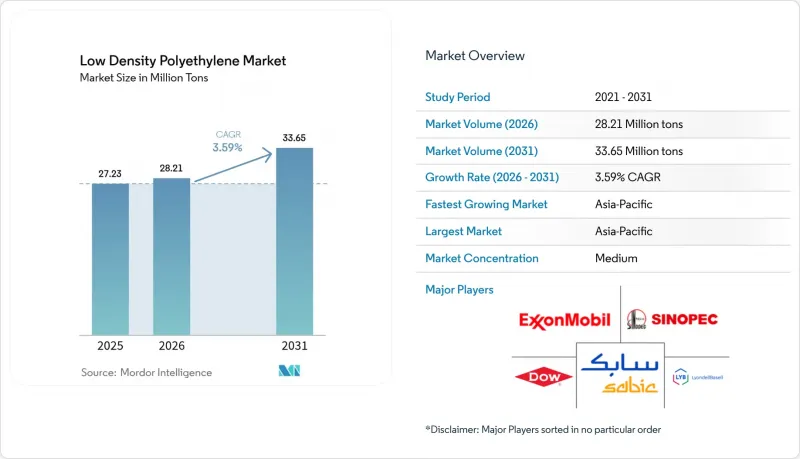
本報告按產品類型(吹塑成型、薄膜、射出成型、片材、泡棉、電線電纜絕緣)、終端用戶產業(農業、電氣和電子設備、包裝、建築、汽車及其他)和地區(亞太地區、北美、歐洲、南美、中東和非洲)進行細分。市場預測以噸為單位。
全球低密度聚乙烯市場趨勢與洞察
電子商務軟包裝的成長
到2025年,亞馬遜、阿里巴巴和區域平台的小包裹處理量將成長18%,因為它們採用了符合加州、法國和德國生產者延伸責任制(EPR)法規的單一材料低密度聚乙烯(LDPE)郵件信封。 LDPE可在105-115 度C下密封,使包裝袋生產線的速度超過200公尺/分鐘,比需要電暈處理的聚丙烯複合材料快25%。印度和越南的加工商將15%的消費後樹脂摻入30-40微米的吹塑薄膜中,以滿足2024年7月的塑膠廢棄物法規,比認證原料每噸溢價150美元。陶氏化學的「INNATE」樹脂於2025年第二季推出,可使品牌商在維持400克重物衝擊強度的同時,將薄膜厚度減少20%,從而減少範圍3排放。因此,結構允許其作為生活垃圾回收的產品正在擴大 LDPE 市場,從沒有適當處置管道的多層複合材料手中奪取市場佔有率。
對農用薄膜的需求增加
2024年至2025年間,印度保護性栽培面積增加了12%,越南成長了9%。這主要得益於補貼計劃,該計劃強制使用使用壽命為3至5年的紫外線穩定型低密度聚乙烯(LDPE)地膜。由於LDPE透光波長範圍為400-600奈米,因此即使在熱帶地區溫度快速變化(超過40 度C)的情況下,它也能保持柔軟性,同時最佳化番茄和甜椒的光合有效輻射。在中國,2025年地膜消耗量約140萬噸,其中LDPE佔60%。這是因為線性LDPE地膜的撕裂強度為25牛/平方毫米。 Braschem公司於2025年10月推出的生物基LDPE地膜主要針對歐洲有機農場,在堆肥條件下18個月內可分解98%。在紐西蘭、愛爾蘭和阿根廷,由於乳品加工業從捆紮式乾草轉向厭氧儲存乾草,並利用低密度聚乙烯的氧氣阻隔性來防止乾草變質,乾草儲存包裝的需求增加了 7%。
與LLDPE和HDPE的競爭
2020年至2025年間,線性低密度聚乙烯(LLDPE)在拉伸膜市佔率成長了12個百分點,使加工業者能夠在不影響抗穿刺性能的前提下,將膜厚從23微米減薄至17微米。儘管低密度聚乙烯(LDPE)在冷凍食品應用中仍能提供400-500克的泥土衝擊強度,但2025年第四季每噸150美元的溢價促使注重成本的買家轉向LLDPE。在吹塑成型瓶領域,高密度聚乙烯(HDPE)的普及速度正在加快,因為HDPE在該領域的抗應力開裂性能比LDPE高出50%。雪佛龍菲利普斯化學公司於2024年推出的雙峰HDPE「MARLEX」具有與LDPE相當的加工性能,使托盤製造商能夠逐步淘汰LDPE瓶蓋和包裝箱。因此,到 2025 年,高壓 LDPE 反應器的運轉率下降到 70% 以下,而 LLDPE 生產線的運轉率超過 80%。
細分市場分析
2025年,薄膜佔市場佔有率的56.71%,但隨著線性低密度聚乙烯(LLDPE)和高密度聚乙烯(HDPE)進入拉伸膜和硬質容器等細分市場,預計其成長速度將相對放緩。用於電線電纜的低密度聚乙烯(LDPE)市場規模預計在2026年至2031年間以4.14%的複合年成長率成長,儘管薄膜領域仍將佔據主導地位,但市場正步入成熟階段。 2025年3月,北歐化工(Borealis)推出了用於400kV電纜的LDPE 2426H,其水樹抑制性能永續超過10,000小時。
射出成型(瓶蓋和封口)產業正在成長,這主要得益於對符合美國藥典(USP)VI級標準的藥用管瓶的需求。吹塑成型容器市場也在擴張,因為高密度聚乙烯(HDPE)的剛性能夠滿足電子商務物流的需求。低密度聚乙烯(LDPE)市場仍然強勁,新興的海底電纜、資料中心和高壓應用抵消了成熟薄膜的需求。
區域分析
預計到2025年,亞太地區將佔全球LDPE產量的47.36%,並以每年4.47%的速度成長至2031年。這主要得益於中國在2025年至2026年間新增820萬噸LDPE產能,以滿足溫室薄膜和擠壓塗布的需求。到2025年底,東南亞地區的工廠運轉率達到91%。這是因為全球產能運作主要集中在線性等級,導致中國以外地區常規LDPE供不應求。印度LDPE市場面臨來自中國的低於成本價的進口,導致印度於2024年11月啟動了反傾銷調查。日本和韓國已在化學回收領域投入巨資,目標是到2028年實現20萬噸的處理能力。在越南,由於政府補貼擴大了電子產品組裝和溫室種植面積,預計2025年進口量將增加14%。
北美市場的需求主要受頁岩乙烷成本優勢的驅動。雪佛龍菲利普斯化學公司投資85億美元的金三角聚合物綜合體沒有新建低密度聚乙烯(LDPE)生產設施的計劃,這導致區域供應趨緊,並推高了LDPE的溢價。在加拿大,溫室薄膜需求的成長預計將使國內LDPE使用量在2025年成長4.2%。墨西哥市場的需求則主要來自線束和醫療設備製造的近岸外包。加州計劃在2030年前實施的30%消費後回收(PCR)強制令,已使機械回收LDPE的溢價上漲至每噸180美元。
2025年,歐洲在產量方面佔據了較大的市場佔有率,但由於Versalis關閉了一條40萬噸的產能,以及從2028年起實施的嚴格的PPWR法規(該法規將禁止使用不可回收的單層薄膜),其複合年成長率受到限制。在德國,由於汽車產量下降了6%,加工商為了達到VerpackG法規的要求而轉向使用PET基複合材料,2025年的需求下降。 Repsol在Cines的30萬噸LLDPE生產線凸顯了該產業不願投資高成本、高壓LDPE設備的現況。北歐地區的成長得益於資料中心光纖和溫室薄膜的需求,這些需求由歐盟農村發展基金資助。儘管里拉疲軟,土耳其仍然扮演中東和北非市場轉口樞紐的角色。
在南美、中東和非洲,由於快速的工業化進程,對低密度聚乙烯(LDPE)的需求不斷成長。巴西對農用薄膜的需求以及沙烏地阿拉伯乙烷基LDPE產量的擴大,也使LDPE市場維持了強勁的成長動能。
其他好處
- Excel格式的市場預測(ME)表
- 3個月的分析師支持
目錄
第1章:引言
- 研究假設和市場定義
- 調查範圍
第2章:調查方法
第3章執行摘要
第4章 市場狀況
- 市場概覽
- 市場促進因素
- 電子商務彈性包裝的成長
- 對農用薄膜的需求增加
- 擠壓塗布應用的偏好
- 太陽能板封裝膜的應用現狀
- 採用先進的回收技術,獲得高品質的低密度聚乙烯(LDPE)。
- 市場限制因素
- 與LLDPE和HDPE的競爭
- 乙烯原料價格波動
- 歐盟禁止使用單層聚烯薄膜
- 價值鏈分析
- 監理情勢
- 技術展望
- 波特五力分析
第5章 市場規模與成長預測
- 依產品類型
- 吹塑成型
- 電影
- 射出成型
- 座位
- 發泡體
- 電線電纜的絕緣
- 按最終用戶行業分類
- 農業
- 電氣和電子設備
- 包裝
- 建造
- 車
- 消費品
- 醫療保健和製藥
- 按地區
- 亞太地區
- 中國
- 印度
- 日本
- 韓國
- 馬來西亞
- 泰國
- 印尼
- 越南
- 其他亞太國家
- 北美洲
- 美國
- 加拿大
- 墨西哥
- 歐洲
- 德國
- 英國
- 法國
- 義大利
- 西班牙
- 北歐國家
- 土耳其
- 俄羅斯
- 其他歐洲國家
- 南美洲
- 巴西
- 阿根廷
- 哥倫比亞
- 其他南美國家
- 中東和非洲
- 沙烏地阿拉伯
- 卡達
- 阿拉伯聯合大公國
- 奈及利亞
- 埃及
- 南非
- 其他中東和非洲國家
- 亞太地區
第6章 競爭情勢
- 市場集中度
- 策略趨勢
- 市佔率和排名分析
- 公司簡介
- Borealis AG
- Braskem SA
- Chevron Phillips Chemical Company LLC
- China Petrochemical Corporation
- Dow
- ExxonMobil Corporation
- Formosa Plastics Corporation
- Hanwha Solutions Chemical Division Corporation
- INEOS Group
- LG Chem
- LyondellBasell Industries Holdings BV
- Mitsui Chemicals, Inc.
- NOVA Chemicals Corporation
- PetroChina
- PTT Global Chemical PLC
- Qatar Chemical Company Ltd
- Reliance Industries Limited
- Repsol SA
- SABIC
- Sumitomo Chemical Co., Ltd.
- TotalEnergies SE
- Versalis SpA(Eni)
- Westlake Corporation
第7章 市場機會與未來展望
According to Mordor Intelligence, the low density polyethylene market size is projected to expand from 27.23 million tons in 2025 and 28.21 million tons in 2026 to 33.65 million tons by 2031, registering a CAGR of 3.59% between 2026 to 2031.
This report is Segmented by Product Type (Blow Molded, Films, Injection Molded, Sheets, Foams, Wire and Cable Insulation), End-User Industry (Agriculture, Electrical and Electronics, Packaging, Construction, Automotive, and More), and Geography (Asia-Pacific, North America, Europe, South America, Middle East and Africa). Market Forecasts are Provided in Terms of Volume (Tons).
Global Low Density Polyethylene Market Trends and Insights
Growth in E-Commerce Flexible Packaging
Parcel volumes rose 18% in 2025 as Amazon, Alibaba, and regional platforms adopted mono-material LDPE mailers that satisfy extended-producer-responsibility rules in California, France, and Germany. LDPE seals at 105-115 °C, enabling pouch lines above 200 m/min-25% faster than polypropylene laminates that require corona treatment. Converters in India and Vietnam merged 15% post-consumer resin into 30-40 µm blown films to meet July 2024 plastic-waste mandates, generating a USD 150/ton premium for certified feedstock. Dow's INNATE resin, launched Q2 2025, lets brands down-gauge films by 20% yet keep 400 g dart-drop impact, cutting scope-3 emissions. Curbside-recyclable structures are therefore expanding the low density polyethylene market at the expense of multi-layer laminates lacking viable end-of-life pathways.
Rising Demand for Agricultural Films
Protected-agriculture acreage climbed 12% in India and 9% in Vietnam during 2024-2025, incentivized by subsidies that require UV-stabilized LDPE with a 3-5 year service life. LDPE transmits 400-600 nm light, optimizing photosynthetically active radiation for tomatoes and capsicums while flexing under 40 °C tropical swings. China consumed nearly 1.4 million tons of mulch film in 2025, 60% of it LDPE, because linear grades tear at 25 N/mm2. Braskem's October 2025 bio-based grade targets European organic farms and biodegrades 98% within 18 months under composting conditions. Silage-wrap demand grew 7% in New Zealand, Ireland, and Argentina as dairies shifted from baled hay to anaerobic ensiling, relying on LDPE's oxygen-barrier to curb spoilage.
Competition from LLDPE and HDPE
Between 2020 and 2025, LLDPE captured 12 percentage points of stretch-film volume by enabling converters to down-gauge from 23 µm to 17 µm without puncture-resistance loss. LDPE still offers 400-500 g dart-drop impact for frozen-food applications, yet its USD 150/ton Q4 2025 premium pushed cost-sensitive buyers toward LLDPE. HDPE substitution accelerated in blow-molded bottles, where stress-crack resistance outperforms LDPE by 50%. Chevron Phillips Chemical's 2024 MARLEX bimodal HDPE mimics LDPE processability, allowing pallet makers to phase out LDPE caps and crates. Consequently, high-pressure LDPE reactors operated below 70% utilization in 2025 versus greater than 80% for LLDPE lines.
Other drivers and restraints analyzed in the detailed report include:
- Preference for Extrusion-Coated Applications
- Solar-Panel Encapsulant Film Uptake
- Ethylene Feedstock Price Volatility
For complete list of drivers and restraints, kindly check the Table Of Contents.
Segment Analysis
Films kept 56.71% of the 2025 volume but anticipated grow with a relatively low growth rate as LLDPE and HDPE encroached on stretch-film and rigid-container niches. The low density polyethylene market size for wire and cable is projected to expand at 4.14% CAGR between 2026-2031, while films hold a dominant yet maturing footprint. Borealis debuted LDPE 2426H in March 2025 for 400 kV cables, offering water-tree retardance greater than 10,000 h.
Injection molding (caps and closures) is witnessing growth propelled by pharmaceutical vial demand needing USP Class VI compliance. Blow-molded containers are growing as HDPE's rigidity supports e-commerce logistics. Nevertheless, the low density polyethylene market remains resilient because emerging subsea-cable, data-center, and high-voltage applications offset mature film demand.
Complete Report Scope:
- By Product Type
- Blow Molded
- Films
- Injection Molded
- Sheets
- Foams
- Wire and Cable Insulation
- By End-user Industry
- Agriculture
- Electrical and Electronics
- Packaging
- Construction
- Automotive
- Consumer Goods
- Healthcare and Pharma
- By Geography
- Asia-Pacific
- China
- India
- Japan
- South Korea
- Malaysia
- Thailand
- Indonesia
- Vietnam
- Rest of Asia-Pacific
- North America
- United States
- Canada
- Mexico
- Europe
- Germany
- United Kingdom
- France
- Italy
- Spain
- Nordic Countries
- Turkey
- Russia
- Rest of Europe
- South America
- Brazil
- Argentina
- Colombia
- Rest of South America
- Middle-East and Africa
- Saudi Arabia
- Qatar
- United Arab Emirates
- Nigeria
- Egypt
- South Africa
- Rest of Middle-East and Africa
- Asia-Pacific
Geography Analysis
Asia-Pacific captured 47.36% of 2025 volume and will grow at 4.47% through 2031, propelled by China's 8.2 million tons of new LDPE capacity commissioned 2025-2026 for greenhouse film and extrusion-coating demand. Southeast Asian plants ran at 91% utilization in late 2025 because global additions skewed to linear grades, leaving conventional LDPE in deficit outside China. India's low density polyethylene market confronted below-cost Chinese imports, triggering an anti-dumping probe in November 2024. Japan and South Korea invested heavily in chemical recycling, targeting 200 kt capacity by 2028. Vietnam boosted imports 14% in 2025 as electronics assembly and greenhouse acreage expanded under state subsidies.
North America market demand is supported by shale-ethane cost advantages. No new LDPE units are slated in Chevron Phillips Chemical's USD 8.5 billion Golden Triangle Polymers complex, tightening regional supply and underpinning premiums. Canada's greenhouse-film demand lifted national LDPE use 4.2% in 2025. Mexico 's market is driven by near-shoring of wire-harness and medical-device manufacturing. California's 30% PCR rule for 2030 has already raised mechanically recycled LDPE premiums to USD 180/ton.
Europe accounted for a significant market share in 2025 volume, but growing with modest CAGR because Versalis shuttered 400 kt of capacity and stringent PPWR rules ban non-recyclable mono-layer films from 2028. German demand slipped in 2025 as automotive output dropped 6% and converters pivoted to PET-based laminates to meet VerpackG targets. Repsol's 300 kt LLDPE line at Sines underscores industry reluctance to invest in costly high-pressure LDPE units. Nordic growth is tied to data-center fiber and greenhouse films financed under EU rural-development funds. Turkey is acting as re-export hub for MENA markets despite lira depreciation.
South America and the Middle East-Africa together are witnessing a rising demand for low-density polyethylene due to rapidly growing industrialization in the regions. Brazil's agricultural-film demand and Saudi ethane-based expansions keep the low density polyethylene market momentum intact.
- Borealis AG
- Braskem S.A.
- Chevron Phillips Chemical Company LLC
- China Petrochemical Corporation
- Dow
- ExxonMobil Corporation
- Formosa Plastics Corporation
- Hanwha Solutions Chemical Division Corporation
- INEOS Group
- LG Chem
- LyondellBasell Industries Holdings BV
- Mitsui Chemicals, Inc.
- NOVA Chemicals Corporation
- PetroChina
- PTT Global Chemical PLC
- Qatar Chemical Company Ltd
- Reliance Industries Limited
- Repsol S.A.
- SABIC
- Sumitomo Chemical Co., Ltd.
- TotalEnergies SE
- Versalis S.p.A. (Eni)
- Westlake Corporation
Additional Benefits:
- The market estimate (ME) sheet in Excel format
- 3 months of analyst support
TABLE OF CONTENTS
1 Introduction
- 1.1 Study Assumptions and Market Definition
- 1.2 Scope of the Study
2 Research Methodology
3 Executive Summary
4 Market Landscape
- 4.1 Market Overview
- 4.2 Market Drivers
- 4.2.1 Growth in e-commerce flexible packaging
- 4.2.2 Rising demand for agricultural films
- 4.2.3 Preference for extrusion-coated applications
- 4.2.4 Solar-panel encapsulant film uptake
- 4.2.5 Advanced recycling enabling premium LDPE grades
- 4.3 Market Restraints
- 4.3.1 Competition from LLDPE and HDPE
- 4.3.2 Ethylene feedstock price volatility
- 4.3.3 European Union bans on mono-layer polyolefin films
- 4.4 Value Chain Analysis
- 4.5 Regulatory Landscape
- 4.6 Technological Outlook
- 4.7 Porter's Five Forces Analysis
- 4.7.1 Bargaining Power of Suppliers
- 4.7.2 Bargaining Power of Buyers
- 4.7.3 Threat of New Entrants
- 4.7.4 Threat of Substitutes
- 4.7.5 Degree of Competition
5 Market Size and Growth Forecasts (Volume)
- 5.1 By Product Type
- 5.1.1 Blow Molded
- 5.1.2 Films
- 5.1.3 Injection Molded
- 5.1.4 Sheets
- 5.1.5 Foams
- 5.1.6 Wire and Cable Insulation
- 5.2 By End-user Industry
- 5.2.1 Agriculture
- 5.2.2 Electrical and Electronics
- 5.2.3 Packaging
- 5.2.4 Construction
- 5.2.5 Automotive
- 5.2.6 Consumer Goods
- 5.2.7 Healthcare and Pharma
- 5.3 By Geography
- 5.3.1 Asia-Pacific
- 5.3.1.1 China
- 5.3.1.2 India
- 5.3.1.3 Japan
- 5.3.1.4 South Korea
- 5.3.1.5 Malaysia
- 5.3.1.6 Thailand
- 5.3.1.7 Indonesia
- 5.3.1.8 Vietnam
- 5.3.1.9 Rest of Asia-Pacific
- 5.3.2 North America
- 5.3.2.1 United States
- 5.3.2.2 Canada
- 5.3.2.3 Mexico
- 5.3.3 Europe
- 5.3.3.1 Germany
- 5.3.3.2 United Kingdom
- 5.3.3.3 France
- 5.3.3.4 Italy
- 5.3.3.5 Spain
- 5.3.3.6 Nordic Countries
- 5.3.3.7 Turkey
- 5.3.3.8 Russia
- 5.3.3.9 Rest of Europe
- 5.3.4 South America
- 5.3.4.1 Brazil
- 5.3.4.2 Argentina
- 5.3.4.3 Colombia
- 5.3.4.4 Rest of South America
- 5.3.5 Middle-East and Africa
- 5.3.5.1 Saudi Arabia
- 5.3.5.2 Qatar
- 5.3.5.3 United Arab Emirates
- 5.3.5.4 Nigeria
- 5.3.5.5 Egypt
- 5.3.5.6 South Africa
- 5.3.5.7 Rest of Middle-East and Africa
- 5.3.1 Asia-Pacific
6 Competitive Landscape
- 6.1 Market Concentration
- 6.2 Strategic Moves
- 6.3 Market Share(%)/Ranking Analysis
- 6.4 Company Profiles (includes Global Overview, Market Overview, Core Segments, Financials, Strategic Information, Products and Services, Recent Developments)
- 6.4.1 Borealis AG
- 6.4.2 Braskem S.A.
- 6.4.3 Chevron Phillips Chemical Company LLC
- 6.4.4 China Petrochemical Corporation
- 6.4.5 Dow
- 6.4.6 ExxonMobil Corporation
- 6.4.7 Formosa Plastics Corporation
- 6.4.8 Hanwha Solutions Chemical Division Corporation
- 6.4.9 INEOS Group
- 6.4.10 LG Chem
- 6.4.11 LyondellBasell Industries Holdings BV
- 6.4.12 Mitsui Chemicals, Inc.
- 6.4.13 NOVA Chemicals Corporation
- 6.4.14 PetroChina
- 6.4.15 PTT Global Chemical PLC
- 6.4.16 Qatar Chemical Company Ltd
- 6.4.17 Reliance Industries Limited
- 6.4.18 Repsol S.A.
- 6.4.19 SABIC
- 6.4.20 Sumitomo Chemical Co., Ltd.
- 6.4.21 TotalEnergies SE
- 6.4.22 Versalis S.p.A. (Eni)
- 6.4.23 Westlake Corporation
7 Market Opportunities and Future Outlook
- 7.1 White-space and Unmet-need Assessment

 線型低密度聚乙烯(LLDPE):市場佔有率分析、產業趨勢與統計數據、成長預測(2026-2031)南美低密度聚乙烯(LDPE):市場佔有率分析、行業趨勢和統計數據以及成長預測(2026-2031 年)
 低密度聚乙烯市場分析:按製造流程、原料、應用和地區分類(2026-2034 年)
 低密度聚乙烯市場:按技術、應用和地區分類
 低密度聚乙烯市場分析及預測(至2035年):類型、產品、應用、技術、形式、最終用戶、材料類型、製程、功能與組件
 2026年全球低密度聚乙烯市場報告
 低密度聚乙烯(LDPE)市場,全球市場,2025-2029年
 生質能聚乙烯低密度聚乙烯市場按等級、原料、產品形式、應用和分銷管道分類,全球預測,2026-2032年
 全球低密度聚乙烯市場:市場規模、佔有率、成長率、產業分析、依類型、應用和地區劃分的考察、未來預測(2026-2034)擠壓低密度聚乙烯(LDPE)市場:未來預測(2025-2030)