


 |
市場調查報告書
商品編碼
2116870
線型低密度聚乙烯(LLDPE):市場佔有率分析、產業趨勢與統計數據、成長預測(2026-2031)Linear Low-Density Polyethylene (LLDPE) - Market Share Analysis, Industry Trends & Statistics, Growth Forecasts (2026 - 2031) |
||||||

※ 本網頁內容可能與最新版本有所差異。詳細情況請與我們聯繫。
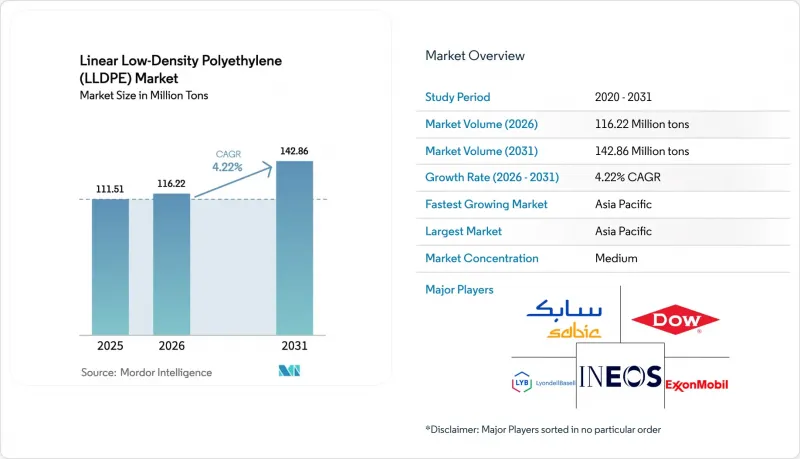
預計到 2025 年,線型低密度聚乙烯(LLDPE) 的市場規模將達到 1.1151 億噸,到 2031 年將達到 1.4286 億噸,而 2026 年的市場規模為 1.1622 億噸,2026 年至 2031 年的複合年成長率為 4.22%。
本報告按應用領域(薄膜、模塑、射出成型及其他應用)、終端用戶行業(農業、電氣電子、包裝、建築及其他終端用戶行業)和地區(亞太地區、北美地區、歐洲地區、南美地區以及中東和非洲地區)進行細分。市場預測以噸為單位。
全球線型低密度聚乙烯(LLDPE)市場趨勢與洞察
食品包裝薄膜需求不斷成長
零食和調理食品的軟包裝正從硬容器轉向輕質包裝袋,利用茂金屬樹脂在保持密封強度的同時,將樹脂用量減少近90%。埃克森美孚將於2024年推出的「Exceed XP 7」級產品,在密度接近0.912 g/cc的情況下,抗污衝擊值達到900 g,抗穿刺能量達到2.3 J/mil,使加工商能夠在不影響阻隔性能的前提下,將薄膜厚度減少15%至20%。這項性能的飛躍在印度至關重要,因為預計2024年印度對聚乙烯的需求將年增20%,而掩埋空間有限。對於立式袋,LLDPE優於LDPE,因為其短鏈支化結構在高速成型、填充和封口(FFS)生產線上具有更優異的熱黏強度。隨著亞洲中產階級食品支出的增加,品牌所有者將 LLDPE 的減薄性能視為實現節約成本和永續性目標的關鍵手段。
電子商務用拉伸/收縮膜需求激增
全球線上零售市場成長持續超過GDP增速,推動了對更高品質托盤包裝和小包裹保護產品的需求。採用茂金屬基線性低密度聚乙烯(LLDPE)的拉伸膜具有極佳的黏合性和抗穿刺性,滿足了消費者對包裝穩定性的更高要求,而這種穩定性往往高於材料成本。萊昂內爾巴塞爾公司計劃透過其與AFA Nord於2023年成立的合資企業,在2026年前根據生產者延伸責任制(EPR)法規,每年生產5萬噸再生LLDPE和LDPE軟包裝材料。儘管東北亞地區的裂解利潤率在2024年下半年轉為負值,但由於拉伸膜的消費量與小包裹體積幾乎完全相關,因此其消費量依然保持強勁。此外,零售商也在飲料和電子產品的收縮包裝中,從PVC轉向LLDPE混合物,以減少氯基聚合物的使用並提高回收率。
過渡到m-LLDPE/HDPE以提高強度
由於茂金屬基線性低密度聚乙烯(LLDPE)和高密度聚乙烯(HDPE)具有優異的抗穿刺性和剛性,其價格溢價高達10-15%,並已取代舊款材料用於重型包裝袋和工業內襯。埃克森美孚的數據顯示,C6茂金屬LLDPE的分子量分佈較窄,因此在高速生產線上,其密封起始溫度較低,廢棄物也較少。 HDPE優異的環境應力開裂性能使其適用於化學品容器和中型散裝容器(IBC),並且在北美和歐洲,由於加工商可以重新配置設備,HDPE正在蠶食LLDPE的市場佔有率。然而,在新興市場,由於仍使用老舊擠出機,成本意識依然強勁,減緩了替代效應的推進速度。
細分市場分析
到2025年,薄膜將佔全球產量的62.89%。這是因為加工商更青睞茂金屬基材料,這種材料能夠在不影響密封強度的前提下產生更薄的薄膜。茂金屬催化劑系統能夠提高熱黏強度,加快多層立式袋的生產線速度,並降低每個包裝的總材料消耗量。拉伸膜生產商正在採用預拉伸捲材,這種捲材可將每個托盤的樹脂用量減少高達50%,從而進一步將線性低密度聚乙烯(LLDPE)融入供應鏈永續發展計畫。由於氯相關廢棄物處理責任,聚氯乙烯(PVC)的使用受到限制,因此電子產品包裝領域對特種收縮膜的需求正在不斷成長。
預計到2031年,其他應用領域的複合年成長率將達到5.68%,超過市場平均。雖然線型低密度聚乙烯(LLDPE)在這些特殊應用領域仍佔市場佔有率小規模,但其價值提案正在不斷提升。利用LLDPE一體成型、無洩漏的特性,旋轉成型水箱在非洲的偏遠地區越來越受歡迎。用於消費性電子產品包裝的超輕量保護泡棉也正在成為一個新的成長領域,這得益於一種即使在微米級厚度下也能保持柔軟性的超薄聚乙烯薄膜製造方法,相關研究成果已發表在《自然》雜誌上。在半導體物流領域,對防靜電薄膜的需求正在成長,在這個細分市場中,LLDPE與導電添加劑複合後固有的低表面電阻率優勢顯著。
區域分析
到2025年,亞太地區將佔全球聚乙烯產量的46.10%,預計到2031年將以5.07%的複合年成長率成長。在中國,聚乙烯產能將於2025年運作,年產能為500萬噸,2026年將達到650萬噸,將使進口需求平均降至每年30萬噸,來自中東和美國的貨物將轉向印尼、越南和菲律賓。在印度,預計未來三年內將運作年產能為240萬噸的聚乙烯,這主要得益於石化產品需求7%的年成長率以及為確保賈姆訥格爾的原料供應而擴建的「虛擬乙烷管道」。日本和韓國正在升級其觸媒技術,以應對成熟市場、農業薄膜等利基市場,並透過整合進口乙烷來對沖石腦油價格波動風險。
由於北美在乙烷作為原料方面具有成本優勢,因此在供需平衡中繼續發揮關鍵作用。北歐化工(Borealis)已將其年產64萬噸的Baystar工廠投入運作,確保了其能夠快速進入墨西哥灣沿岸的出口碼頭。埃克森美孚(ExxonMobil)繼續探索在Point Comfort建設一座價值86億美元的綜合設施,同時關閉了其位於法國Gravochon的年產40萬噸的生產線,凸顯了各大洲之間原料經濟的差異。根據美墨加協定(USMCA),墨西哥作為轉口國的角色正在擴大,但加拿大的成長卻受到亞伯達和安大略省新建石化工廠授權壁壘的限制。在歐洲,由於能源成本高和環境法規日益嚴格,產能正在萎縮。沙烏地基礎工業公司(SABIC)已關閉其年產40萬噸的Helen裂解裝置,而利安德巴塞爾(Lyondbasell)正在考慮出售價值70億至90億美元的資產,以專注於其回收和生物基樹脂業務。儘管如此,該地區正在推動循環經濟領域的創新。里昂巴塞爾的軟性包裝回收業務計畫在2026年實現年處理量5萬噸,從而將歐洲打造為化學回收技術中心。南美洲、中東和非洲是未來的成長點。布拉舍姆正在洽談天然氣供應,以擴建其位於裡約熱內盧的工廠,使其年產能超過54萬噸;而北歐化工位於阿布扎比的年產140萬噸聚乙烯項目已完成過半,這將確保為亞洲和非洲的加工商提供低成本的供應。
其他好處:
- Excel格式的市場預測(ME)表
- 3個月的分析師支持
目錄
第1章:引言
- 研究的先決條件
- 調查範圍
第2章:調查方法
第3章執行摘要
第4章 市場狀況
- 市場概覽
- 市場促進因素
- 包裝薄膜需求不斷成長
- 電子商務對拉伸/收縮膜的需求正在激增。
- 太陽能板封裝膜的採用現狀
- 減少材料用量並強制實施循環經濟
- 農業覆蓋物和溫室薄膜
- 市場限制因素
- 過渡到m-LLDPE/HDPE以提高強度
- 揮發性石腦油/乙烷原料成本
- 全球一次性塑膠製品法規
- 價值鏈分析
- 波特五力模型
第5章 市場規模與成長預測
- 透過使用
- 電影
- 模具
- 射出成型
- 其他用途
- 按最終用戶行業分類
- 農業
- 電氣和電子設備
- 包裝
- 建造
- 其他終端用戶產業
- 按地區
- 亞太地區
- 中國
- 印度
- 日本
- 韓國
- 東南亞國協
- 其他亞太國家
- 北美洲
- 美國
- 加拿大
- 墨西哥
- 歐洲
- 德國
- 英國
- 義大利
- 法國
- 俄羅斯
- 其他歐洲國家
- 南美洲
- 巴西
- 阿根廷
- 其他南美國家
- 中東和非洲
- 沙烏地阿拉伯
- 南非
- 其他中東和非洲國家
- 亞太地區
第6章 競爭情勢
- 市場集中度
- 策略趨勢
- 市佔率和排名分析
- 公司簡介
- Borealis GmbH
- Braskem
- Chevron Phillips Chemical Company
- Dow
- Exxon Mobil Chemical
- Formosa Plastic Corporation
- INEOS
- LG Chem
- Lyonde Bassells Industries Holdings BV
- Mitsui Chemicals Inc.
- Nova Chemicals Corporate
- PTT Global Chemical Public Company Limited.
- Reliance Industries Limited
- Repsol
- SABIC
- SINOPEC(China Petroleum & Chemical Corporation)
- Tasnee
- TotalEnergies
- Westlake Corporation
第7章 市場機會與未來展望
According to Mordor Intelligence, the linear low-Density polyethylene market size was valued at 111.51 million tons in 2025 and estimated to grow from 116.22 million tons in 2026 to reach 142.86 million tons by 2031, at a CAGR of 4.22% during the forecast period (2026-2031).
This report is Segmented by Application (Films, Molding, Injection Molding, and Other Application Types), End-User Industry (Agriculture, Electrical and Electronics, Packaging, Construction, and Other End-User Industries), and Geography (Asia-Pacific, North America, Europe, South America, and Middle East and Africa). The Market Forecasts are Provided in Terms of Volume (tons).
Global Linear Low-Density Polyethylene (LLDPE) Market Trends and Insights
Escalating Packaged-Food Film Demand
Flexible snack and ready-meal packaging is shifting from rigid to lightweight pouches, trimming resin use by nearly 90% while preserving seal integrity through metallocene-enabled downgauging. ExxonMobil's Exceed XP 7 grade introduced in 2024 delivers dart-impact values of 900 g and puncture energy reaching 2.3 J per mil at densities near 0.912 g/cc, allowing converters to thin film gauges by 15%-20% without sacrificing barrier performance. The performance leap is crucial in India, where polyethylene demand increased by 20% year-over-year in 2024 and landfill space is limited. Stand-up pouch adoption favors LLDPE over LDPE because short-chain branching supplies superior hot-tack strength for high-speed form-fill-seal lines. As middle-class food spending rises throughout Asia, brand owners view LLDPE's downgauging capability as the primary lever for both cost and sustainability goals.
E-commerce Stretch-/Shrink-Film Surge
Global online retail continues to outpace GDP, driving the need for enhanced pallet-wrap and parcel-protection specifications. Stretch film incorporating metallocene LLDPE maximizes cling and puncture resistance, addressing load-stability demands that outweigh direct material costs. LyondellBasell's 2023 venture with AFA Nord aims to produce 50,000 t/y of recycled LLDPE and LDPE flexible packaging by 2026, in line with extended producer responsibility rules. Although Northeast Asian cracker margins turned negative in late 2024, stretch-film consumption showed resilience due to its near-perfect correlation with parcel volumes. Retailers are also migrating from PVC to LLDPE blends for beverage and electronics shrink-bundling to eliminate chlorinated polymers and improve recycling yields.
Shift Toward m-LLDPE/HDPE for Strength
Metallocene LLDPE and HDPE command 10%-15% price premiums by delivering higher puncture resistance and stiffness, displacing conventional grades in heavy-duty sacks and industrial liners. ExxonMobil's data show that C6-metallocene LLDPE provides narrower molecular-weight distributions, which lower seal-initiation temperatures and reduce trim waste on high-speed lines. HDPE's superior environmental stress-crack resistance favors chemical containers and IBCs, drawing share away from LLDPE in North America and Europe where converters can reconfigure equipment. Emerging markets with legacy extruders remain cost-sensitive, slowing the substitution effect.
Other drivers and restraints analyzed in the detailed report include:
- Solar-Panel Encapsulation Film Uptake
- Downgauging and Circular-Economy Mandates
- Volatile Naphtha/Ethane Feedstock Cost
For complete list of drivers and restraints, kindly check the Table Of Contents.
Segment Analysis
Films represented 62.89% of the global volume in 2025, as converters favored metallocene grades that enabled thinner gauges without compromising seal integrity. Metallocene catalyst systems provide enhanced hot-tack strength, enabling multilayer stand-up pouches to operate at higher line speeds and reduce total material consumption per package. Stretch-film producers are adopting pre-stretched rolls that reduce resin usage per pallet by up to 50%, further integrating LLDPE into supply-chain sustainability programs. Specialty shrink-film adoption in electronics bundling is advancing as PVC falls out of favor due to chlorine-related disposal liabilities.
Other application types are forecast to grow at a market-leading 5.68% CAGR through 2031. The Linear Low-Density Polyethylene market share of these specialty applications remains modest, yet the value proposition is rising. Rotomolded water tanks are gaining traction in off-grid African communities, leveraging LLDPE's one-piece construction that eliminates leak points. Ultralight protective foams for consumer electronics packaging are another emerging outlet, supported by a method reported in Nature for producing ultrathin polyethylene sheets that preserve flexibility at micro-scale thicknesses. Semiconductor logistics are stimulating demand for antistatic films, a niche that benefits from LLDPE's inherently low surface resistivity when compounded with conductive additives.
Complete Report Scope:
- By Application
- Films
- Molding
- Injection Molding
- Other Application Types
- By End-user Industry
- Agricultute
- Electrical and Electronics
- Packaging
- Constrution
- Other End-user Industries
- By Geography
- Asia-Pacific
- China
- India
- Japan
- South Korea
- ASEAN Countries
- Rest of Asia-Pacific
- North America
- United States
- Canada
- Mexico
- Europe
- Germany
- United Kingdom
- Italy
- France
- Russia
- Rest of Europe
- South America
- Brazil
- Argentina
- Rest of South America
- Middle-East and Africa
- Saudi Arabia
- South Africa
- Rest of Middle-East and Africa
- Asia-Pacific
Geography Analysis
The Asia-Pacific region accounted for 46.10% of the global 2025 volume and is expected to deliver a 5.07% CAGR through 2031. China's commissioning of 5 million tonnes per year (t/y) of polyethylene capacity in 2025 and 6.5 million t/y in 2026 will narrow its import requirement to an average of 300,000 t/y, redirecting Middle Eastern and US cargoes toward Indonesia, Vietnam, and the Philippines. India is expected to bring 2.4 million tonnes per year online over the next three years, driven by 7% annual growth in petrochemical demand and an expanded virtual ethane pipeline that secures feedstock for Jamnagar. Japan and South Korea, while mature, are upgrading catalyst technology to serve agricultural-film niches and to hedge against naphtha volatility by integrating imported ethane.
North America remains a swing supplier thanks to ethane-based cost advantages. Borealis started up its 640,000 t/y Baystar unit and gained rapid access to Gulf export terminals. ExxonMobil continues to evaluate a USD 8.6 billion complex in Point Comfort, yet the company shuttered its 400,000 tonnes per year Gravenchon line in France, highlighting the continental divergence in feedstock economics. Mexico's re-export role is expanding under USMCA, while Canada's growth is capped by permitting hurdles for greenfield petrochemical sites in Alberta and Ontario. Europe is contracting capacity amid high energy costs and stringent environmental rules. SABIC closed its 400,000 t/y Geleen cracker, and LyondellBasell is exploring USD 7-9 billion in asset divestitures to focus on recycling and bio-based resins. Nonetheless, the region leads circular-economy innovation; LyondellBasell's flexible-packaging recycling venture targets 50,000 t/y by 2026, positioning Europe as a technology hub for chemical recycling. South America and the Middle East-Africa represent growth frontiers. Braskem is negotiating gas supply to expand its Rio complex beyond 540,000 t/y, while Borealis's 1.4 million t/y polyethylene project in Abu Dhabi is more than halfway to mechanical completion, assuring low-cost supply to Asian and African converters.
- Borealis GmbH
- Braskem
- Chevron Phillips Chemical Company
- Dow
- Exxon Mobil Chemical
- Formosa Plastic Corporation
- INEOS
- LG Chem
- Lyonde Bassells Industries Holdings BV
- Mitsui Chemicals Inc.
- Nova Chemicals Corporate
- PTT Global Chemical Public Company Limited.
- Reliance Industries Limited
- Repsol
- SABIC
- SINOPEC (China Petroleum & Chemical Corporation)
- Tasnee
- TotalEnergies
- Westlake Corporation
Additional Benefits:
- The market estimate (ME) sheet in Excel format
- 3 months of analyst support
TABLE OF CONTENTS
1 Introduction
- 1.1 Study Assumptions
- 1.2 Scope of the Study
2 Research Methodology
3 Executive Summary
4 Market Landscape
- 4.1 Market Overview
- 4.2 Market Drivers
- 4.2.1 Escalating packaged-food film demand
- 4.2.2 E-commerce stretch-/shrink-film surge
- 4.2.3 Solar-panel encapsulation film uptake
- 4.2.4 Downgauging and circular-economy mandates
- 4.2.5 Agricultural mulch and greenhouse films
- 4.3 Market Restraints
- 4.3.1 Shift toward m-LLDPE/HDPE for strength
- 4.3.2 Volatile naphtha/ethane feedstock cost
- 4.3.3 Global single-use-plastic restrictions
- 4.4 Value Chain Analysis
- 4.5 Porter's Five Forces
- 4.5.1 Bargaining Power of Suppliers
- 4.5.2 Bargaining Power of Buyers
- 4.5.3 Threat of New Entrants
- 4.5.4 Threat of Substitutes
- 4.5.5 Degree of Competition
5 Market Size & Growth Forecasts (Volume)
- 5.1 By Application
- 5.1.1 Films
- 5.1.2 Molding
- 5.1.3 Injection Molding
- 5.1.4 Other Application Types
- 5.2 By End-user Industry
- 5.2.1 Agricultute
- 5.2.2 Electrical and Electronics
- 5.2.3 Packaging
- 5.2.4 Constrution
- 5.2.5 Other End-user Industries
- 5.3 By Geography
- 5.3.1 Asia-Pacific
- 5.3.1.1 China
- 5.3.1.2 India
- 5.3.1.3 Japan
- 5.3.1.4 South Korea
- 5.3.1.5 ASEAN Countries
- 5.3.1.6 Rest of Asia-Pacific
- 5.3.2 North America
- 5.3.2.1 United States
- 5.3.2.2 Canada
- 5.3.2.3 Mexico
- 5.3.3 Europe
- 5.3.3.1 Germany
- 5.3.3.2 United Kingdom
- 5.3.3.3 Italy
- 5.3.3.4 France
- 5.3.3.5 Russia
- 5.3.3.6 Rest of Europe
- 5.3.4 South America
- 5.3.4.1 Brazil
- 5.3.4.2 Argentina
- 5.3.4.3 Rest of South America
- 5.3.5 Middle-East and Africa
- 5.3.5.1 Saudi Arabia
- 5.3.5.2 South Africa
- 5.3.5.3 Rest of Middle-East and Africa
- 5.3.1 Asia-Pacific
6 Competitive Landscape
- 6.1 Market Concentration
- 6.2 Strategic Moves
- 6.3 Market Share(%)/Ranking Analysis
- 6.4 Company Profiles {(includes Global level Overview, Market level overview, Core Segments, Financials as available, Strategic Information, Market Rank/Share, Products & Services, Recent Developments)}
- 6.4.1 Borealis GmbH
- 6.4.2 Braskem
- 6.4.3 Chevron Phillips Chemical Company
- 6.4.4 Dow
- 6.4.5 Exxon Mobil Chemical
- 6.4.6 Formosa Plastic Corporation
- 6.4.7 INEOS
- 6.4.8 LG Chem
- 6.4.9 Lyonde Bassells Industries Holdings BV
- 6.4.10 Mitsui Chemicals Inc.
- 6.4.11 Nova Chemicals Corporate
- 6.4.12 PTT Global Chemical Public Company Limited.
- 6.4.13 Reliance Industries Limited
- 6.4.14 Repsol
- 6.4.15 SABIC
- 6.4.16 SINOPEC (China Petroleum & Chemical Corporation)
- 6.4.17 Tasnee
- 6.4.18 TotalEnergies
- 6.4.19 Westlake Corporation
7 Market Opportunities and Future Outlook
- 7.1 White-space and Unmet-Need Assessment

 低密度聚乙烯:市場佔有率分析、行業趨勢和統計數據以及成長預測(2026-2031 年)南美低密度聚乙烯(LDPE):市場佔有率分析、行業趨勢和統計數據以及成長預測(2026-2031 年)
 低密度聚乙烯市場分析:按製造流程、原料、應用和地區分類(2026-2034 年)
 低密度聚乙烯市場:按技術、應用和地區分類
 低密度聚乙烯市場分析及預測(至2035年):類型、產品、應用、技術、形式、最終用戶、材料類型、製程、功能與組件
 2026年全球低密度聚乙烯市場報告
 低密度聚乙烯(LDPE)市場,全球市場,2025-2029年
 生質能聚乙烯低密度聚乙烯市場按等級、原料、產品形式、應用和分銷管道分類,全球預測,2026-2032年
 全球低密度聚乙烯市場:市場規模、佔有率、成長率、產業分析、依類型、應用和地區劃分的考察、未來預測(2026-2034)擠壓低密度聚乙烯(LDPE)市場:未來預測(2025-2030)