


 |
市場調查報告書
商品編碼
2122909
軟性電子產品:市場佔有率分析、產業趨勢與統計、成長預測(2026-2031)Flexible Electronics - Market Share Analysis, Industry Trends & Statistics, Growth Forecasts (2026 - 2031) |
||||||

※ 本網頁內容可能與最新版本有所差異。詳細情況請與我們聯繫。
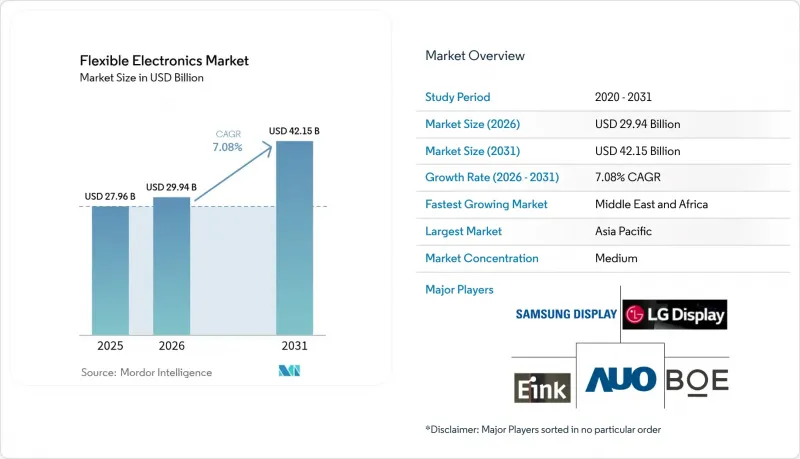
根據 Mordor Intelligence 估計,軟性電子產品市場規模從 2025 年的 279.6 億美元成長到 2026 年的 299.4 億美元,預計到 2031 年將達到 421.5 億美元。
預計 2026 年至 2031 年的複合年成長率為 7.08%。
本報告按組件(軟性顯示器、軟性感測器等)、材料(塑膠基板、玻璃等)、技術(印刷電子、有機電子等)、應用(感測、照明、顯示等)、終端用戶行業(家用電子電器、汽車和交通運輸設備等)以及地區進行細分。市場預測以美元計價。
全球軟性電子產品市場趨勢與洞察
超薄 OLED 堆疊結構的耐用性提升,使折疊式智慧型手機成為現實。
三星顯示器的「Flex Magic Pixel」示範樣機已通過軍用級耐久性測試,消除了可見摺痕,滿足了用戶對堅固耐用、折疊式螢幕的期望。蘋果訂購了900萬至1500萬塊7.8英寸面板,預計2026年上市,這證實了該技術已做好商業化準備,並預示著其將得到大規模應用。到2026年,筆記型電腦面板的重量和功耗將分別降低30%,這將使目標設備範圍從智慧型手機擴展到其他領域。隨著OEM廠商轉向可彎曲平板電腦和筆記型電腦,這些進步將波及整個軟性電子產品市場,並推動供應鏈對阻隔性封裝和超薄玻璃的需求。
北美地區對用於穿戴式醫療貼片的貼合式感測器的需求
X-trodes公司的「智慧皮膚」和加州大學聖地牙哥分校的1024通道腦部感測器陣列已獲得FDA批准,這使得軟性生物感測器在連續監測中的應用合法化。隨著醫療報銷模式轉向基於結果的照護模式,能夠長期收集患者資料的設備變得日益重要。軟式電路板可以減少運動偽影,並在日常活動中保持訊號完整性。設備製造商正在採用有機電化學電晶體進行感測器內計算,以最大限度地減少延遲並保護患者隱私。隨著遠端監測被納入保險報銷代碼,軟性電子產品市場正受益於感測器和貼片的定期更換。
可拉伸互連可靠性測試缺乏標準化
現有的剛性電子裝置標準未能充分評估穿戴式裝置使用過程中同時發生的彎曲、扭轉和溫度循環等問題。 IEEE 的「膀胱擴張法」草案雖然測量了多軸拉伸,但仍屬於臨時標準,阻礙了需要經認證的壽命數據的汽車和醫療設備製造商(OEM)的准入。研究人員提案了聚合物中階設計方案來抑制基板在應力作用下的開裂,但由於缺乏公認的評估指標,投資人對大規模生產模具的研發持謹慎態度。因此,在統一標準建立之前,軟性電子產品市場從設計到應用的周期預計將會延長。
細分市場分析
到2025年,軟性顯示器將佔據軟性電子產品市場54.12%的佔有率。這主要得益於折疊式智慧型手機的持續發布和曲面汽車儀錶板的普及。三星的18.1吋折疊式原型機展示了其在筆記型電腦應用方面的潛力,而LG的可拉伸微型LED面板則為時尚和汽車照明領域的3D表面提供了可能。與顯示器相輔相成的感測器領域預計在2026年至2031年間將以8.78%的複合年成長率成長,這主要得益於醫院採用表皮心電圖(ECG)和腦電圖(EEG)貼片來管理慢性疾病。能夠承受1.5倍拉伸的量子點顯示-感測器混合裝置預示著能夠同時顯示和感知資料的多功能表面時代的到來,這使得感測器成為下一個成長驅動力。儘管取得了進展,但由於安全性和良率方面的挑戰,軟性電池和記憶體的發展仍然滯後,這限制了目前完全整合軟性系統的應用。
在軟性電子產品市場,面板製造商正利用透明OLED堆疊技術,將指紋辨識和血氧飽和度(SpO2)測量功能直接整合到螢幕下方,從而減少元件數量,使裝置更薄。整合生物感測功能的顯示器為尋求差異化的智慧型手機廠商開闢了新的獲利途徑。能夠將振動轉化為微瓦級電能的能源採集薄膜可以降低穿戴式裝置和工業標籤的電池負載,但其商業化取決於高性能壓電聚合物的穩定供應。隨著各元件間協同效應的日益成熟,設備設計人員將能夠設計出融合視覺、觸覺和感測功能的無縫外形規格。
至2025年,在成熟的聚醯亞胺供應鏈與顯示器製造工廠的整合推動下,塑膠基板將佔軟性電子產品市場61.10%的佔有率。其高達度C的耐熱性使其非常適合用於銅線,即使在汽車儀錶板等對溫度高度敏感的環境中也能最大限度地減少分層。主要由銅和不銹鋼組成的金屬箔,因其固有的導電性和電磁干擾屏蔽效果,在國防無線電和高速數據電纜領域備受青睞,其年複合成長率達8.11%。石墨烯塗層銅奈米線作為捲對卷觸摸感測器正日益受到關注,其薄片電阻低於氧化銦錫(ITO),同時保持了柔軟性。
超薄玻璃在高階折疊式設備領域備受關注,這些設備對光學性能和耐刮擦性都有極高的要求。康寧公司最新研發的玻璃厚度僅30微米,雖然比聚合物玻璃昂貴,但即使彎曲至5毫米的曲率半徑也不會破裂。杜邦公司於2024年收購C3Nano公司,加速了奈米銀線油墨技術的進步,提升了智慧窗戶的透明度和機械耐久性。碳基導電油墨不使用稀有銦或有毒溶劑,符合ESG(環境、社會和治理)要求,因此對將軟性太陽能電池整合到帷幕牆中的製造商極具吸引力。隨著監管機構對電子廢棄物的嚴格監管,在材料選擇中,成本、性能和可回收性之間的平衡變得愈發重要。
區域分析
到2025年,亞太地區將佔據軟性電子產品市場45.30%的佔有率,這主要得益於中國龐大的製造業規模和韓國OLED技術創新的持續發展。京東方在成都投資90億美元興建的第八代.6 AMOLED工廠(該市最大的單一產業投資項目)正在擴大平板電腦和汽車駕駛座面板的產能。韓國研究機構已將壓電能源採集的產量提高了280倍,凸顯了該地區在顯示器、感測器和能源裝置領域的領先地位。日本則提供精密沉積設備和超薄玻璃,為折疊式智慧型手機的可靠性奠定了基礎。
北美正聚焦高附加價值的醫療和國防領域,利用美國食品藥物管理局(FDA)對軟性生物感測器的批准以及五角大廈對戰場天線陣列的資助。三星向橫濱封裝研發中心投資2.4億美元,凸顯了跨國合作,例如亞洲供應商在美國系統整合商附近設立分公司。矽谷的新創公司在軟性積體電路設計自動化方面處於領先地位,縮短了用於一次性診斷設備的印刷邏輯晶片的流片週期。
在歐洲,汽車的數位化和永續性正成為優先事項。德國汽車製造商強制要求在2028年前安裝全像顯示器(HUD),這推動了對符合嚴格防眩光和抗衝擊標準的軟性顯示器的需求。歐盟關於建築光伏整合的指令正在加速軟性光伏面板嵌入建築立面的示範應用。同時,嚴格的電子廢棄物法規要求產品必須可回收利用,加速了可生物分解基板的研究。
中東和非洲地區以11.05%的複合年成長率領跑,這主要得益於在國防現代化和智慧城市項目中,對重量敏感型無人機和在惡劣氣候條件下運行的感測器對共形電子裝置的廣泛應用。各國政府正在加速部署5G和邊緣網路,催生了對耐沙耐熱軟性天線的需求。該地區的大學正與歐洲研究機構合作開發有機光伏技術,為離網物聯網節點供電,進一步拓展了其應用範圍。
其他好處:
- Excel格式的市場預測(ME)表
- 3個月的分析師支持
目錄
第1章:引言
- 研究假設和市場定義
- 調查範圍
第2章:調查方法
第3章執行摘要
第4章 市場狀況
- 市場概覽
- 市場促進因素
- 超薄 OLED 螢幕堆疊結構的耐用性提升,使折疊式智慧型手機成為現實。
- 北美對穿戴式醫療貼片用貼合式感測器的需求
- 汽車駕駛座的數位化正在推動歐洲曲面抬頭顯示器(HUD)的普及。
- 降低亞洲印刷積體電路卷對卷製造成本
- 促進中東地區推廣用於無人機的輕型共形天線。
- 以ESG原則為指導,促進商業建築中軟性光伏面板的應用。
- 市場限制因素
- 金屬油墨大面積印刷的良率下降。
- 可拉伸互連可靠性測試標準化的局限性
- 封裝膜供應鏈的集中度較高,進入障礙也較高。
- 聚醯亞胺基板處置與回收的挑戰
- 產業價值鏈分析
- 技術展望
- 波特五力分析
- 投資分析
第5章 市場規模與成長預測
- 按組件
- 軟性顯示器
- OLED
- 電子紙
- 其他
- 軟性感測器
- 生物感測器
- 壓力感測器
- 溫度感測器
- 其他
- 彈性電池
- 軟性記憶體
- 軟性太陽能電池
- 其他
- 軟性顯示器
- 材料
- 塑膠基板
- 玻璃(超薄)
- 金屬箔
- 導電油墨
- 絕緣/封裝
- 透過技術
- 印刷電子
- 有機電子學
- 無機薄膜電子學
- 混合系統
- 透過使用
- 感測
- 照明
- 展示
- 能源採集
- RFID和智慧標籤
- 其他
- 按最終用戶行業分類
- 家用電子產品
- 汽車和運輸業
- 醫療保健和醫療設備
- 軍事/國防
- 工業和物聯網
- 其他
- 按地區
- 北美洲
- 美國
- 加拿大
- 墨西哥
- 歐洲
- 德國
- 英國
- 法國
- 北歐的
- 其他歐洲國家
- 南美洲
- 巴西
- 其他南美國家
- 亞太地區
- 中國
- 日本
- 印度
- 東南亞
- 其他亞太國家
- 中東和非洲
- 中東
- 波灣合作理事會(GCC)成員國
- 土耳其
- 其他中東國家
- 非洲
- 南非
- 其他非洲國家
- 中東
- 北美洲
第6章 競爭情勢
- 市場集中度
- 策略趨勢
- 市佔率分析
- 公司簡介
- Samsung Display Co. Ltd
- LG Display Co. Ltd
- BOE Technology Group Co. Ltd
- AU Optronics Corp.
- Royole Corporation
- E Ink Holdings Inc.
- OLEDWorks LLC
- FlexEnable Ltd
- PragmatIC Semiconductor Ltd
- Imprint Energy Inc.
- Blue Spark Technologies Inc.
- Flexpoint Sensor Systems Inc.
- Universal Display Corporation
- Kyocera Corporation
- Panasonic Holdings Corp.
- Sony Group Corp.
- Polyera Corporation
- Cambrios Advanced Materials Corp.
- Heliatek GmbH
- First Solar Inc.(Flex PV Division)
第7章 市場機會與未來展望
According to Mordor Intelligence, the flexible electronics market size in 2026 is estimated at USD 29.94 billion, growing from 2025 value of USD 27.96 billion with 2031 projections showing USD 42.15 billion, growing at 7.08% CAGR over 2026-2031.
This report is Segmented by Component (Flexible Displays, Flexible Sensors, and More), Material (Plastic Substrate, Glass, and More), Technology (Printed Electronics, Organic Electronics, and More), Application (Sensing, Lighting, Display, and More), End-User Industry (Consumer Electronics, Automotive and Transportation, and More), and Geography. The Market Forecasts are Provided in Terms of Value (USD).
Global Flexible Electronics Market Trends and Insights
Improved durability of ultra-thin OLED stacks enabling foldable smartphones
Samsung Display's Flex Magic Pixel demonstrator passed military-grade durability tests, eliminating visible creases and meeting user expectations for robust folding screens. Apple's 2026 foldable iPhone order for 9-15 million 7.8-inch panels validates commercial readiness and signals mass adoption. Weight reductions of 30% and power savings of 30% in 2026 laptop panels widen the addressable device pool beyond phones. These advances resonate across the flexible electronics market as OEMs migrate tablets and laptops toward bendable formats, reinforcing supply-chain demand for high-barrier encapsulation and ultra-thin glass.
Demand for conformal sensors in wearable medical patches across North America
FDA clearance for X-trodes' Smart Skin and UC San Diego's 1,024-channel brain sensor array legitimizes flexible biosensors for continuous monitoring. Health-system reimbursement models pivot toward outcome-based care, favoring devices that capture longitudinal patient data. Flexible substrates reduce motion artifacts, maintaining signal integrity during everyday activities. Device makers tap organic electrochemical transistors for in-sensor computing, minimizing latency and protecting patient privacy. As reimbursement codes codify remote monitoring, the flexible electronics market benefits from recurrent sensor and patch replacements.
Limited standardization of stretchable interconnect reliability tests
Rigid-electronics standards fail to capture simultaneous bending, twisting, and temperature cycling seen in wearable use. IEEE's draft bladder-inflation method measures multi-axis stretch but remains voluntary, deterring automotive and medical OEMs that require certified lifetime data. Researchers propose polymer interlayer designs to curb substrate cracking under strain, yet without consensus metrics investors hesitate to fund high-volume tooling. The flexible electronics market thus faces slower design-win cycles until unified protocols emerge.
Other drivers and restraints analyzed in the detailed report include:
- Automotive cockpit digitization driving curved HUD adoption in Europe
- Roll-to-roll manufacturing cost reduction in Asia for printed ICs
- Yield Losses in Large-area Printing of Metallic Inks
For complete list of drivers and restraints, kindly check the Table Of Contents.
Segment Analysis
Flexible displays accounted for 54.12% of flexible electronics market share in 2025, powered by relentless foldable smartphone launches and curved automotive dashboards. Samsung's 18.1-inch foldable prototype proves scalability into laptops, while LG's stretchable micro-LED panel unlocks 3D surfaces in fashion and in-vehicle lighting. Complementing displays, the sensor category yields a 8.78% CAGR over 2026-2031 as hospitals adopt epidermal ECG and EEG patches for chronic care. Quantum-dot display-sensor hybrids that tolerate 1.5X stretching herald multifunctional surfaces that both show and sense data, positioning sensors as the next growth catalyst. Despite progress, flexible batteries and memory lag due to safety and yield hurdles, limiting fully integrated flexible systems today.
The flexible electronics market benefits from panel makers leveraging transparent OLED stacks to embed fingerprint and SpO2 reading directly under the screen, condensing component count and thinning device profiles. Integrated biosensing displays open new monetization avenues for smartphone vendors seeking differentiation. Energy-harvesting films that convert vibration into micro-watts reduce battery load in wearables and industrial tags, though commercialization awaits stable supply of high-performance piezoelectric polymers. As cross-component synergies mature, device architects can design seamless form factors that merge visual, haptic, and sensing capabilities.
Plastic substrates represented 61.10% of flexible electronics market size in 2025, driven by mature polyimide supply chains aligned with display fabs. Their thermal stability up to 400 °C pairs well with copper traces, minimizing delamination in automotive dashboards exposed to wide temperature swings. Metal foils, chiefly copper and stainless steel, post an 8.11% CAGR thanks to innate conductivity and EMI shielding valued in defense radios and high-speed data cables. Graphene-coated copper nanowires offer lower sheet resistance than indium-tin-oxide while retaining flexibility, attracting interest for roll-to-roll touch sensors.
Ultra-thin glass gains traction in premium foldable devices requiring pristine optics and scratch resistance. At just 30 µm, Corning's latest glass can bend to 5 mm radius without fracture, albeit at a higher price point than polymer. Silver-nanowire ink advances, accelerated by DuPont's 2024 C3Nano asset purchase, improve transparency and mechanical resilience for smart windows. Carbon-based conductive inks address ESG mandates by eliminating scarce indium and toxic solvents, appealing to builders of flexible photovoltaics integrated into facades. Material selection now balances cost, performance, and recyclability as regulators scrutinize electronic waste.
Complete Report Scope:
- By Component
- Flexible Displays
- OLED
- E-Paper
- Others
- Flexible Sensors
- Biosensors
- Pressure Sensors
- Temperature Sensors
- Others
- Flexible Batteries
- Flexible Memory
- Flexible Photovoltaics
- Others
- Flexible Displays
- By Material
- Plastic Substrate
- Glass (Ultra-thin)
- Metal Foils
- Conductive Inks
- Dielectrics/Encapsulation
- By Technology
- Printed Electronics
- Organic Electronics
- Thin-Film Inorganic Electronics
- Hybrid Systems
- By Application
- Sensing
- Lighting
- Display
- Energy Harvesting
- RFID and Smart Labels
- Others
- By End-User Industry
- Consumer Electronics
- Automotive and Transportation
- Healthcare and Medical Devices
- Military and Defense
- Industrial and IoT
- Others
- By Geography
- North America
- United States
- Canada
- Mexico
- Europe
- Germany
- United Kingdom
- France
- Nordics
- Rest of Europe
- South America
- Brazil
- Rest of South America
- Asia-Pacific
- China
- Japan
- India
- South-East Asia
- Rest of Asia-Pacific
- Middle East and Africa
- Middle East
- Gulf Cooperation Council Countries
- Turkey
- Rest of Middle East
- Africa
- South Africa
- Rest of Africa
- Middle East
- North America
Geography Analysis
Asia-Pacific commanded 45.30% of flexible electronics market share in 2025, anchored by China's manufacturing scale and Korea's OLED innovation pipeline. BOE's USD 9 billion Gen-8.6 AMOLED fab in Chengdu-the city's largest single industrial investment-expands panel capacity for tablets and automotive cockpits. Korean institutes pushed piezoelectric harvester output 280X, underscoring regional leadership across displays, sensors, and energy devices. Japan contributes precision deposition tools and ultra-thin glass that support foldable handset reliability.
North America focuses on high-value healthcare and defense niches, leveraging FDA clearances for flexible biosensors and Pentagon funding for battlefield antenna arrays. Samsung's USD 240 million Yokohama packaging R&D hub highlights cross-border collaboration, as Asian suppliers co-locate near U.S. system integrators. Silicon Valley startups pioneer flexible IC design automation, shortening tape-out cycles for printed logic that feeds disposable diagnostics.
Europe prioritizes automotive digitization and sustainability. German OEMs mandate holographic HUD integration by 2028, driving demand for bendable displays meeting stringent glare and impact standards. EU directives on building-integrated photovoltaics spur trials of facade-embedded flexible PV skins. Simultaneously, strict e-waste rules push recyclability, accelerating research into biodegradable substrates.
Middle East and Africa posts the highest 11.05% CAGR as defense modernization and smart-city programs embrace conformal electronics for weight-sensitive drones and harsh-climate sensors. Governments fast-track 5G and edge networks, creating pull for flexible antennas resistant to sand and heat. Regional universities partner with European labs on organic PV to power off-grid IoT nodes, broadening application diversity.
- Samsung Display Co. Ltd
- LG Display Co. Ltd
- BOE Technology Group Co. Ltd
- AU Optronics Corp.
- Royole Corporation
- E Ink Holdings Inc.
- OLEDWorks LLC
- FlexEnable Ltd
- PragmatIC Semiconductor Ltd
- Imprint Energy Inc.
- Blue Spark Technologies Inc.
- Flexpoint Sensor Systems Inc.
- Universal Display Corporation
- Kyocera Corporation
- Panasonic Holdings Corp.
- Sony Group Corp.
- Polyera Corporation
- Cambrios Advanced Materials Corp.
- Heliatek GmbH
- First Solar Inc. (Flex PV Division)
Additional Benefits:
- The market estimate (ME) sheet in Excel format
- 3 months of analyst support
TABLE OF CONTENTS
1 INTRODUCTION
- 1.1 Study Assumptions and Market Definition
- 1.2 Scope of the Study
2 RESEARCH METHODOLOGY
3 EXECUTIVE SUMMARY
4 MARKET LANDSCAPE
- 4.1 Market Overview
- 4.2 Market Drivers
- 4.2.1 Improved Durability of Ultra-thin OLED Stacks Enabling Foldable Smartphones
- 4.2.2 Demand for Conformal Sensors in Wearable Medical Patches across North America
- 4.2.3 Automotive Cockpit Digitization Driving Curved HUD Adoption in Europe
- 4.2.4 Roll-to-Roll Manufacturing Cost Reduction in Asia for Printed ICs
- 4.2.5 Defense Push for Lightweight, Conformal Antennas in Middle East UAVs
- 4.2.6 ESG-Led Push toward Flexible PV Skins on Commercial Buildings
- 4.3 Market Restraints
- 4.3.1 Yield Losses in Large-area Printing of Metallic Inks
- 4.3.2 Limited Standardization of Stretchable Interconnect Reliability Tests
- 4.3.3 Supply-chain Concentration of High-barrier Encapsulation Films
- 4.3.4 Disposal and Recycling Complexities of Poly-imide Substrates
- 4.4 Industry Value Chain Analysis
- 4.5 Technological Outlook
- 4.6 Porter's Five Forces Analysis
- 4.6.1 Bargaining Power of Suppliers
- 4.6.2 Bargaining Power of Buyers
- 4.6.3 Threat of New Entrants
- 4.6.4 Threat of Substitutes
- 4.6.5 Intensity of Competitive Rivalry
- 4.7 Investment Analysis
5 MARKET SIZE AND GROWTH FORECASTS (VALUES)
- 5.1 By Component
- 5.1.1 Flexible Displays
- 5.1.1.1 OLED
- 5.1.1.2 E-Paper
- 5.1.1.3 Others
- 5.1.2 Flexible Sensors
- 5.1.2.1 Biosensors
- 5.1.2.2 Pressure Sensors
- 5.1.2.3 Temperature Sensors
- 5.1.2.4 Others
- 5.1.3 Flexible Batteries
- 5.1.4 Flexible Memory
- 5.1.5 Flexible Photovoltaics
- 5.1.6 Others
- 5.1.1 Flexible Displays
- 5.2 By Material
- 5.2.1 Plastic Substrate
- 5.2.2 Glass (Ultra-thin)
- 5.2.3 Metal Foils
- 5.2.4 Conductive Inks
- 5.2.5 Dielectrics/Encapsulation
- 5.3 By Technology
- 5.3.1 Printed Electronics
- 5.3.2 Organic Electronics
- 5.3.3 Thin-Film Inorganic Electronics
- 5.3.4 Hybrid Systems
- 5.4 By Application
- 5.4.1 Sensing
- 5.4.2 Lighting
- 5.4.3 Display
- 5.4.4 Energy Harvesting
- 5.4.5 RFID and Smart Labels
- 5.4.6 Others
- 5.5 By End-User Industry
- 5.5.1 Consumer Electronics
- 5.5.2 Automotive and Transportation
- 5.5.3 Healthcare and Medical Devices
- 5.5.4 Military and Defense
- 5.5.5 Industrial and IoT
- 5.5.6 Others
- 5.6 By Geography
- 5.6.1 North America
- 5.6.1.1 United States
- 5.6.1.2 Canada
- 5.6.1.3 Mexico
- 5.6.2 Europe
- 5.6.2.1 Germany
- 5.6.2.2 United Kingdom
- 5.6.2.3 France
- 5.6.2.4 Nordics
- 5.6.2.5 Rest of Europe
- 5.6.3 South America
- 5.6.3.1 Brazil
- 5.6.3.2 Rest of South America
- 5.6.4 Asia-Pacific
- 5.6.4.1 China
- 5.6.4.2 Japan
- 5.6.4.3 India
- 5.6.4.4 South-East Asia
- 5.6.4.5 Rest of Asia-Pacific
- 5.6.5 Middle East and Africa
- 5.6.5.1 Middle East
- 5.6.5.1.1 Gulf Cooperation Council Countries
- 5.6.5.1.2 Turkey
- 5.6.5.1.3 Rest of Middle East
- 5.6.5.2 Africa
- 5.6.5.2.1 South Africa
- 5.6.5.2.2 Rest of Africa
- 5.6.5.1 Middle East
- 5.6.1 North America
6 COMPETITIVE LANDSCAPE
- 6.1 Market Concentration
- 6.2 Strategic Moves
- 6.3 Market Share Analysis
- 6.4 Company Profiles (includes Global Level Overview, Market Level Overview, Core Segments, Financials as available, Strategic Information, Market Rank/Share for key companies, Products and Services, and Recent Developments)
- 6.4.1 Samsung Display Co. Ltd
- 6.4.2 LG Display Co. Ltd
- 6.4.3 BOE Technology Group Co. Ltd
- 6.4.4 AU Optronics Corp.
- 6.4.5 Royole Corporation
- 6.4.6 E Ink Holdings Inc.
- 6.4.7 OLEDWorks LLC
- 6.4.8 FlexEnable Ltd
- 6.4.9 PragmatIC Semiconductor Ltd
- 6.4.10 Imprint Energy Inc.
- 6.4.11 Blue Spark Technologies Inc.
- 6.4.12 Flexpoint Sensor Systems Inc.
- 6.4.13 Universal Display Corporation
- 6.4.14 Kyocera Corporation
- 6.4.15 Panasonic Holdings Corp.
- 6.4.16 Sony Group Corp.
- 6.4.17 Polyera Corporation
- 6.4.18 Cambrios Advanced Materials Corp.
- 6.4.19 Heliatek GmbH
- 6.4.20 First Solar Inc. (Flex PV Division)
7 MARKET OPPORTUNITIES AND FUTURE OUTLOOK
- 7.1 White-space and Unmet-Need Assessment

 金屬化隔離層市場:全球市場預測(2026-2032年)
 軟性PCB市場:預測至2034年-按類型、材料、厚度、製造流程、元件類型、應用、最終用戶、銷售管道和地區分類的全球分析
 軟性混合電子元件(FHE):市場佔有率分析、產業趨勢與統計及成長預測(2026-2031 年)軟性電子產品與電路市場-2026-2032年全球市場預測
 軟性PCB市場規模、佔有率和成長分析:按類型、材料類型、應用、元件類型、最終用戶、製造流程和地區分類-2026-2033年產業預測
 軟性電子產品市場分析與預測(至2035年):按類型、產品、技術、組件、應用、材料類型、裝置、製程、最終用戶和功能分類
 軟性電子產品市場報告:按應用、電路結構類型、產業和地區分類(2026-2034 年)
 軟性電子產品市場:按組件、應用和地區分類軟性導體市場預測至2034年:按材料類型、形狀、性能特徵、應用、最終用戶和地區分類的全球分析
 全球軟性印刷電路板(PCB)市場